REVIEW 4 major objections 6 minor 113 references
Simulating Binary Neutron Stars with Hybrid Equation of States: Gravitational Waves, Electromagnetic Signatures, and Challenges for Numerical Relativity
T0 review · 4 major / 6 minor · reviewed 2026-08-14 · deepseek-v4-flash
Pith's one-line read This paper reports the first full numerical-relativity simulations of binary neutron star mergers whose stars contain strange quark matter cores, and argues that a strong phase transition degrades the simulations' convergence to first…
desk verdict First NR look at hybrid stars with strange quark matter cores; the convergence-order finding is real, but the headline waveform validation leans on an unverified Richardson extrapolation and should be treated as provisional. read the letter →
The pith
A machine-rendered reading of the paper's core claim, the machinery that carries it, and where it could break.
The reading
What carries the argument
The load-bearing construction is a hybrid equation of state built by the Gibbs condition: the SLy hadronic equation of state is joined at a fixed transition pressure to the tdBag strange quark matter model, with the quark matter parameterized by $a_4$, $a_2$, and the bag constant $B$, and the joined curve is represented as a piecewise polytrope for the evolution codes. The numerical machinery is the BAM code with the Z4c formulation and WENOZ hydrodynamics, whose known second-order phase convergence for hadronic stars provides the baseline against which the first-order degradation is measured. The argument for the paper's main physics comparison is carried by a Richardson extrapolation of the highest two resolutions, $Re_{3,4}$, treating it as the best estimate of the true hybrid-star phase, and comparing it with the hadronic waveform approximant IMRPhenomPv2_NRTidal. The convergence-order analysis itself is what identifies the phase transition as the cause of the enlarged uncertainty.
What would settle it
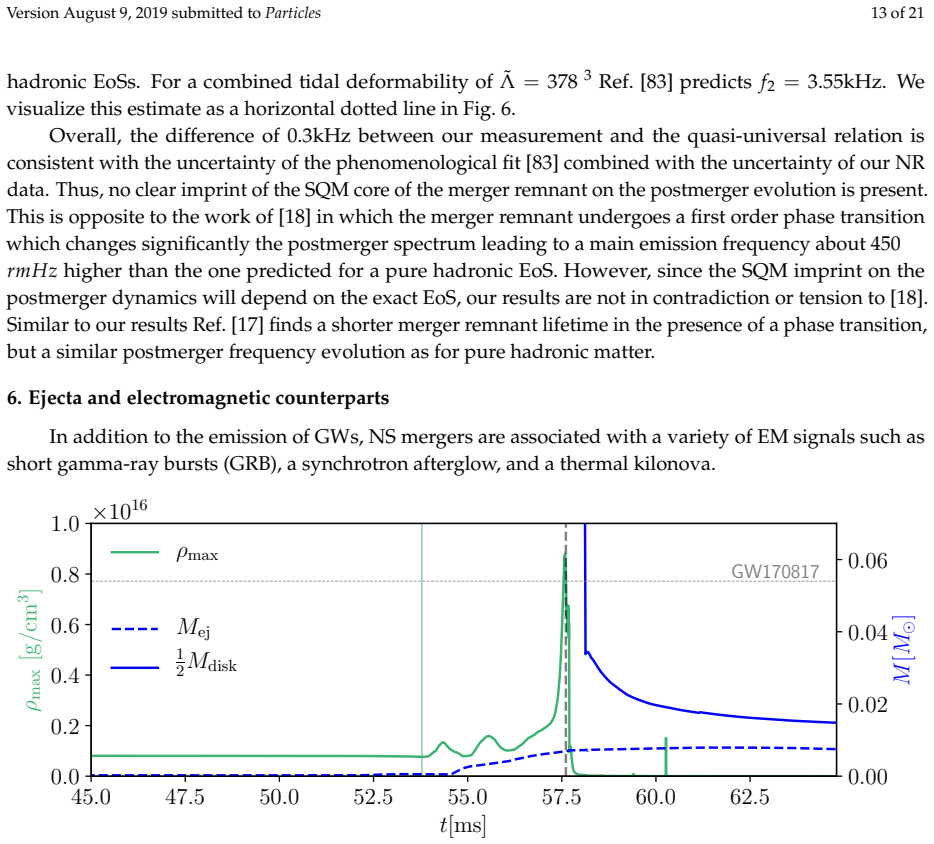
Run an additional higher-resolution simulation of the same hybrid-star configuration, for example with a finer grid spacing than $h_6 = 0.096$, and check whether the phase difference between it and the Richardson-extrapolated waveform $Re_{3,4}$ follows the assumed second-order scaling; if the phase error between the new resolution and $Re_{3,4}$ is not consistent with that scaling, or if the phase difference to IMRPhenomPv2_NRTidal exceeds the re-estimated error, the paper's central agreement claim would be overturned.
Extended reading notes
Core claim
On the paper's own terms, the central discovery is that a first-order phase transition inside the neutron stars, converting hadronic matter into strange quark matter, changes the numerical behavior of binary neutron star simulations before it changes the physics of the signal. At the three lowest resolutions the gravitational-wave phase converges only to first order in grid spacing, whereas the same code and schemes converge to second order for purely hadronic equations of state; only at the finest resolution is second-order convergence recovered. Using the two highest resolutions to build a Richardson-extrapolated waveform, the paper finds that the phase difference with respect to the hadronic waveform model IMRPhenomPv2_NRTidal stays below the estimated numerical error up to merger, which it presents as the first validation of a waveform model against a numerical-relativity dataset that includes a strong phase transition inside the star. The same simulation produces a postmerger frequency consistent with hadronic quasi-universal relations, about half the dynamical ejecta mass of comparable SLy runs, and a disk mass only 15 to 40 percent of the SLy comparison, leading to a predicted kilonova too faint to match AT2017gfo while a rough GRB energy remains compatible with GRB170817A.
Load-bearing premise
The load-bearing premise is that the Richardson-extrapolated waveform built from the two finest resolutions represents the true hybrid-star signal, which assumes the phase error between those two resolutions already follows the same second-order scaling used in the extrapolation.
Editorial extensions
If this is right
- If the central claim is right, existing hadronic waveform approximants can be used as a first approximation for mergers of stars with strange quark matter cores, but only with error bars several times larger than for hadronic equations of state.
- Template production for equations of state with a strong phase transition will require higher resolutions than current standard runs, because the same code that converges to second order for hadronic stars drops to first order when the phase transition is present.
- The postmerger gravitational-wave frequency of a hybrid star binary can be consistent with quasi-universal relations derived purely from hadronic stars, so a quark core need not leave a detectable imprint in the postmerger spectrum for every equation of state.
- Mergers of hybrid stars with the studied equation of state retain more mass in the remnant and eject less matter, predicting dimmer kilonovae than GW170817's counterpart while still producing a short-GRB energy compatible with GRB170817A.
- The simulation provides a first numerical-relativity dataset for inspiral with strange quark matter cores, giving future waveform and ejecta models a target to reproduce.
Reading between the lines
- If the convergence-order drop is generic across hybrid equations of state, then published binary neutron star waveforms for equations of state with strong phase transitions may carry larger phase errors than their resolution labels suggest, and convergence order rather than grid spacing should become the quoted accuracy metric.
- The claimed validation against IMRPhenomPv2_NRTidal would be stronger with a same-setup purely hadronic SLy control run; without it, the large error estimate could mask a real phase difference that happens to lie inside the extrapolation uncertainty.
- A testable extension is to vary the strange quark matter parameters $a_4$, $a_2$, and $B$ for the same numerical setup, which would show whether the convergence-order drop and the ejecta suppression are universal properties of strong phase transitions or artifacts of this particular hybrid equation of state.
- Because the postmerger frequency stayed within hadronic quasi-universal relations while the ejecta mass dropped sharply, multi-messenger observations may be the more sensitive route to detecting quark cores: a GW170817-like event with a normal gravitational-wave phase but an unusually faint kilonova would be the signature this scenario predicts.
Editorial analysis
A structured set of objections, weighed in public.
Referee Report
Summary. This paper constructs a hybrid neutron-star equation of state by joining the SLy hadronic EoS to a strange-quark-matter phase described by the tdBag model, and presents full numerical-relativity simulations of an equal-mass, non-spinning binary with masses and tidal deformabilities chosen to match GW170817. The authors study the inspiral gravitational-wave phase, the postmerger spectrum, dynamical and disk ejecta, and the expected electromagnetic counterparts. The central claims are: (i) the strong phase transition can reduce the numerical convergence order of the BAM code to first order at low resolution, with second-order convergence recovered at the highest resolutions; (ii) the Richardson-extrapolated waveform Re3,4 agrees with the hadronic-only approximant IMRPhenomPv2_NRTidal within the estimated numerical error, providing 'the first validation of a waveform model against a NR dataset including a strong phase transition'; (iii) the postmerger main frequency is consistent with hadronic-derived quasi-universal relations; and (iv) the predicted kilonova is too dim to explain AT2017gfo. The paper includes a complete piecewise-polytrope representation of the hybrid EoS and detailed grid specifications for reproducibility.
Significance. If substantiated, this is a useful first step toward assessing whether existing waveform models are safe for analyses of binaries containing hybrid stars with strong phase transitions. The paper's strengths are its explicit EoS construction, use of four resolutions, comparison against an independent waveform model and quasi-universal relations, and the clear identification of a possible first-order convergence degradation caused by the phase transition. The work does not appear circular: the hybrid EoS parameters are fixed from theoretical constraints rather than fit to the simulations, and the comparative waveform model and postmerger relation are independent hadronic-EoS results. The main significance lies in opening a new numerical-relativity challenge and in providing a first, albeit preliminary, quantitative benchmark for waveform-model validation in the presence of a strong phase transition; the stated limitations about needing higher resolutions are appropriate but leave the headline validation claim only conditionally supported.
major comments (4)
- [§5.1, Fig. 5] The central validation claim that φ(Re3,4) − φ(IMRPhenomPv2_NRTidal) is below the estimated error Δφ(Re3,4, R4) rests on the assumption that the R3 and R4 phases follow second-order convergence. The Richardson-extrapolated waveform Re3,4 is constructed by rescaling the phase difference under exactly that assumption, and the error estimate is the difference between Re3,4 and R4. If the true local convergence order at R3/R4 is between first and second order, the extrapolation is biased, the error band is mis-centered, and the stated agreement could be spurious. The manuscript does not provide an independent high-resolution run or a same-setup hadronic control to confirm the convergence order; the authors themselves state that 'further evolutions with higher resolutions are required for a more quantitative and stronger test.' This is load-bearing because the validation of a waveform model against a strong-phase-transition dataset is the paper's main physics result.
- [§5.1, Fig. 5] The claim that the strong phase transition degrades convergence to first order is inferred from visual comparison of the rescaled phase differences: the dashed yellow line (first-order rescaling of Δφ(R2,R3)) is said to agree well, and the dash-dotted green line (second-order rescaling of Δφ(R3,R4)) indicates recovery of second order. No quantitative convergence factor or Richardson-error diagnostic is provided, and the claim is not tested with a control simulation using only the hadronic SLy EoS at the same resolutions and grid settings. Given that Ref. [53] attributes the second-order convergence to the stellar surface, one cannot exclude that the effect is partly due to the atmosphere or surface treatment rather than the phase transition itself. A quantitative convergence-order analysis, such as a time-dependent fit to the phase differences, would strengthen this claim.
- [§5.2, Fig. 6] The statement that the measured postmerger frequency f2 = (3.27 ± 0.1) kHz is 'consistent with the uncertainty of the phenomenological fit [83] combined with the uncertainty of our NR data' is not quantitatively supported in the text. The quoted NR uncertainty is roughly 0.1 kHz, while the prediction from Ref. [83] is 3.55 kHz, a difference of about 0.28 kHz (about 2.8 times the quoted NR uncertainty). The uncertainty of the quasi-universal fit is not stated. To support the claim that quasi-universal relations hold for hybrid EoS, the authors should quote the fit uncertainty and state how the combined uncertainty was evaluated.
- [§6, Fig. 8] The conclusion that the kilonova associated with the studied configuration 'would not be bright enough to explain the kilonova associated to GW170817' depends on the assumed disk-wind ejecta mass Mej,wind = 0.017 M⊙, which is exactly half of the final disk mass estimated at the end of the simulation. This value is an input to the light-curve model, not a result of a disk-wind simulation, and the text offers no argument that half of the disk mass is an upper bound or a typical fraction. If the disk wind were more efficient or the lanthanide fraction lower, the predicted brightness could increase. The claim should be phrased as conditional on this assumption, or the sensitivity of the light curves to Mej,wind should be explored.
minor comments (6)
- [§5.1] The notation Re3,4 is used before it is defined in the text; a brief definition of the Richardson-extrapolated phase in the main text would aid readability.
- [§5.1] The alignment of Re3,4 with IMRPhenomPv2_NRTidal is described only as 'minimizing the phase difference within' u ∈ [5,10] ms; it would be useful to specify whether this is a two-parameter time and phase alignment, and to state the sensitivity of the phase difference to the chosen alignment window.
- [§5.2] In Eq. (19), the uncertainty is said to include 'the finite width of the peak in the frequency domain spectrum,' but the width is not quantified; stating a full-width-at-half-maximum value would make the error estimate more transparent.
- [§6] The sentence 'This estimate agrees to about 30% with resolution R3' is unclear; the authors presumably mean that the result agrees with the R3 resolution within about 30%.
- [§5.2] There is a typo in the phrase 'about 450 rmHz higher' — the unit should likely be Hz (or kHz), not 'rmHz'.
- [Footnote 4] The word 'hydonic' should be 'hadronic' in the footnote.
Circularity Check
No significant circularity found: hybrid-EoS inputs are constrained independently, and both waveform and postmerger benchmarks derive from hadronic-only simulations.
full rationale
This paper is self-contained against external benchmarks. The hybrid EoS is built from the tdBag model with parameters a4=0.70, a2=5000 MeV^2, B^1/4=150 MeV selected from absolute-stability and positive-transition-pressure conditions; these parameters are not fitted to any simulation output. The central numerical result (first-order convergence at low resolution) emerges from the phase-error scaling of the four resolution runs and is not an input assumption. The waveform comparison uses IMRPhenomPv2_NRTidal, which the paper states was constructed from hadronic-EoS NR simulations only ('During its construction only NR simulations with hadronic EOSs were used'), so agreement with hybrid-star NR is an independent test; the same holds for the postmerger frequency comparison against the hadronic-derived quasi-universal relation of Ref. [83]. Self-citations to Dietrich et al. appear for code settings, numerical methods, and earlier hadronic benchmarks, but none supply the target hybrid-star result. The paper's own caveat, 'further evolutions with higher resolutions are required for a more quantitative and stronger test', flags an accuracy limitation in the Richardson-extrapolated error estimate, not a logical dependence of the result on its inputs.
Assumptions & free parameters
free parameters (4)
- a4 (quartic coefficient) =
0.70 (primary), 0.85 (secondary)
- a2 (quadratic coefficient) =
5000 MeV^2
- B (bag constant) =
B^(1/4) = 150 MeV (primary), 157 MeV (secondary)
- Disk wind ejecta mass for kilonova model =
0.017 M_sun
assumptions (7)
- domain assumption The tdBag (MIT-bag-inspired) model correctly describes strange quark matter in the CFL phase.
- domain assumption The absolutely stable strange quark matter hypothesis is valid.
- domain assumption Hadron-quark deconfinement is a first-order phase transition with a sharp interface and local charge neutrality.
- domain assumption The SLy hadronic EoS is a valid description of the hadronic phase.
- domain assumption The numerical codes BAM and SGRID produce a converged solution at the highest resolutions with the stated grid settings.
- domain assumption The quasi-universal postmerger relation of Bernuzzi et al. (2015) applies to hybrid EoS remnants.
- domain assumption The kilonova model of Kasen et al. (2017) and Coughlin et al. (2018) with the assumed ejecta parameters is a valid predictor of EM counterparts.
Cite this review
Pith. "Pith review of Simulating Binary Neutron Stars with Hybrid Equation of States: Gravitational Waves, Electromagnetic Signatures, and Challenges for Numerical Relativity." pith.science (2026). https://pith.science/paper/YMO2AYDE
@misc{pith2026190803135,
  author       = {Pith},
  title        = {Pith review of: Simulating Binary Neutron Stars with Hybrid Equation of States: Gravitational Waves, Electromagnetic Signatures, and Challenges for Numerical Relativity},
  year         = {2026},
  howpublished = {\url{https://pith.science/paper/YMO2AYDE}},
  note         = {Machine review of arXiv:1908.03135}
}
read the original abstract
The gravitational wave and electromagnetic signatures connected to the merger of two neutron stars allow us to test the nature of matter at supranuclear densities. Since the Equation of State governing the interior of neutron stars is only loosely constrained, there is even the possibility that strange quark matter exists inside the core of neutron stars. We investigate how strange quark matter cores affect the binary neutron star coalescence by performing numerical relativity simulations. Interestingly, the strong phase transition can cause a reduction of the convergence order of the numerical schemes to first order if the numerical resolution is not high enough. Therefore, an additional challenge is added in producing high-quality gravitational wave templates for Equation of States with a strong phase transition. Focusing on one particular configuration of an equal mass configuration consistent with GW170817, we compute and discuss the associated gravitational wave signal and some of the electromagnetic counterparts connected to the merger of the two stars. We find that existing waveform approximants employed for the analysis of GW170817 allow describing this kind of systems within the numerical uncertainties, which, however, are several times larger than for pure hadronic Equation of States, which means that even higher resolutions have been employed for an accurate gravitational wave model comparison. We also show that for the chosen Equation of State, quasi-universal relations describing the gravitational wave emission after the moment of merger seem to hold and that the electromagnetic signatures connected to our chosen setup would not be bright enough to explain the kilonova associated to GW170817.
Figures


Figures from the paper (5 more)



Reference graph
Works this paper leans on
-
[53]
Small, dense quark stars from perturbative QCD
Fraga, E.S.; Pisarski, R.D.; Schaffner-Bielich, J. Small, dense quark stars from perturbative QCD. Phys. Rev. 2001, D63, 121702, [arXiv:hep-ph/hep-ph/0101143]. doi:10.1103/PhysRevD.63.121702
arXiv 2001
-
[83]
Gravitational waves and mass ejecta from binary neutron star mergers: Effect of the stars’ rotation
Dietrich, T.; Bernuzzi, S.; Ujevic, M.; Tichy, W. Gravitational waves and mass ejecta from binary neutron star mergers: Effect of the stars’ rotation. Phys. Rev. 2017, D95, 044045, [arXiv:gr-qc/1611.07367]. doi:10.1103/PhysRevD.95.044045
arXiv 2017
-
[1]
Introduction The observation of gravitational waves (GWs), GW170817, and electromagnetic (EM) signatures, AT2017gfo and GRB170817A, originating from the same astrophysical source have initiated a new era of multi-messenger astronomy [1–3]. Because of their large compactness, neutron stars (NSs) contain matter at supranuclear densities, which makes them a ...
arXiv 1908
-
[2]
tdBag model for strange quark matter tdBag [35] is a bag-like model inspired by the standard MIT bag model [ 36,37]1
A new hybrid Star Equation of State 2.1. tdBag model for strange quark matter tdBag [35] is a bag-like model inspired by the standard MIT bag model [ 36,37]1. It incorporates features expected for cold strange quark matter composed of up, down, and strange quarks in free Fermi seas resulting from the deconfinement, i.e., the breaking of hadronic matter int...
2019
-
[3]
Fraga et al
The quartic coefficient a4 can be interpreted as a correction to the pressure of the free Fermi sea arising from quantum chromodynamics (QCD). Fraga et al. [41] show that, to second order in the strong coupling constant, a reasonable value for this parameter is a4∼ 0.7. The values of a4 = 0 and a4 = 1 correspond to maximum or none QCD interaction, respectively
-
[4]
The quadratic coefficient a2 accounts for the contribution of the strange quark mass and color superconductivity. The value of this parameter is given by a2 = m2 s− 4∆2, where ms∼ 100 MeV is the strange quark mass and ∆ ∼ 0− 100 MeV is the energy gap between free and Cooper pairs of quarks [38,40,42]
-
[5]
vacuumless
The bag constant B, introduced phenomenologically into the theory to describe the deconfinement, is the energy density required to produce a “vacuumless” volume in which quarks exist
-
[6]
The contribution of the electron potential ( Ωe) for our purposes is negligible; cf. Ref. [ 43] and references therein. Nevertheless, if the SQM is not in the CFL phase [40] there must be electrons within the quark phase to ensure (i) local charge neutrality and (ii) chemical equilibrium. These two conditions may be expressed respectively as 2 3 nu− 1 3 n...
2019
Show all 113 references
-
[7]
Our procedure can be applied to study a variety of parameters and HM EoS choice and enables future studies of NSs binary containing SQM cores
Conclusion In this work, we presented and discussed the general procedure to construct HyS EoSs combining the tdBag model for SQM and a HM EoS for low-density material. Our procedure can be applied to study a variety of parameters and HM EoS choice and enables future studies o...
2019
-
[8]
Configurations details and numerical methods 3.1. Hybrid star configuration For our primary study of the binary HyS coalescence, we chose a setup which is close to the estimated binary properties of GW170817 (details are given in Tab. 1). Our configuration consists of two non-spi...
-
[9]
Quantitative Merger Dynamics We start discussing our binary HyS mergers with a qualitative description of the coalescence of the two stars as depicted in Fig. 4. The first panel shows the initial setup for our evolution as computed from SGRID. The two stars have an initial coor...
-
[10]
The Inspiral We present the full gravitational waveform obtained from our simulations in Fig
Gravitational Wave Signal 5.1. The Inspiral We present the full gravitational waveform obtained from our simulations in Fig. 5 (top panel). Quantities related to the GW signal are plotted against the retarded coordinate time u, defined as u = t− rext− 2M ln(rext/2M− 1), (18) wh...
2019
-
[11]
45.0 47.5 50.0 52.5 55.0 57.5 60.0 62.5 t[ms] 0.0 0.2 0.4 0.6 0.8 1.0 ρmax [g/cm3] ×1016 ρmax 0.00 0.02 0.04 0.06 M [M⊙] GW170817 Mej 1 2Mdisk Figure 7
Ejecta and electromagnetic counterparts In addition to the emission of GWs, NS mergers are associated with a variety of EM signals such as short gamma-ray bursts (GRB), a synchrotron afterglow, and a thermal kilonova. 45.0 47.5 50.0 52.5 55.0 57.5 60.0 62.5 t[ms] 0.0 0.2 0.4 0...
2019
-
[12]
Multimessenger Parameter Estimation of GW170817 2018
Radice, D.; Dai, L. Multimessenger Parameter Estimation of GW170817 2018. [arXiv:astro-ph.HE/1810.12917]
2018 arXiv
-
[13]
GW170817: Observation of Gravitational Waves from a Binary Neutron Star Inspiral
Abbott, B.P .; others. GW170817: Observation of Gravitational Waves from a Binary Neutron Star Inspiral. Phys. Rev. Lett. 2017, 119, 161101, [arXiv:gr-qc/1710.05832]. doi:10.1103/PhysRevLett.119.161101
2017 arXiv
-
[14]
Multi-messenger Observations of a Binary Neutron Star Merger
Abbott, B.P .; others. Multi-messenger Observations of a Binary Neutron Star Merger. Astrophys. J. 2017, 848, L12, [arXiv:astro-ph.HE/1710.05833]. doi:10.3847/2041-8213/aa91c9
2017 arXiv
-
[15]
Gravitational Waves and Gamma-rays from a Binary Neutron Star Merger: GW170817 and GRB 170817A
Abbott, B.P .; others. Gravitational Waves and Gamma-rays from a Binary Neutron Star Merger: GW170817 and GRB 170817A. Astrophys. J. 2017, 848, L13, [arXiv:astro-ph.HE/1710.05834]. doi:10.3847/2041-8213/aa920c
2017 arXiv
-
[16]
Parameter Estimation for GW170817 using Relative Binning 2018
Dai, L.; Venumadhav, T.; Zackay, B. Parameter Estimation for GW170817 using Relative Binning 2018. [arXiv:gr-qc/1806.08793]
2018 arXiv
-
[17]
Tidal Deformabilities and Radii of Neutron Stars from the Observation of GW170817
De, S.; Finstad, D.; Lattimer, J.M.; Brown, D.A.; Berger, E.; Biwer, C.M. Tidal Deformabilities and Radii of Neutron Stars from the Observation of GW170817. Phys. Rev. Lett. 2018, 121, 091102, [arXiv:astro-ph.HE/1804.08583]. [Erratum: Phys. Rev. Lett.121,no.25,259902(2018)], d...
2018 arXiv
-
[18]
Properties of the binary neutron star merger GW170817
Abbott, B.P .; others. Properties of the binary neutron star merger GW170817. Phys. Rev. 2019, X9, 011001, [arXiv:gr-qc/1805.11579]. doi:10.1103/PhysRevX.9.011001
2019 arXiv
-
[19]
GW170817: Measurements of neutron star radii and equation of state
Abbott, B.P .; others. GW170817: Measurements of neutron star radii and equation of state. Phys. Rev. Lett. 2018, 121, 161101, [arXiv:gr-qc/1805.11581]. doi:10.1103/PhysRevLett.121.161101. Version August 9, 2019 submitted to Particles 16 of 21
2018 arXiv
-
[20]
GWTC-1: A Gravitational-Wave Transient Catalog of Compact Binary Mergers Observed by LIGO and Virgo during the First and Second Observing Runs 2018
Abbott, B.P .; others. GWTC-1: A Gravitational-Wave Transient Catalog of Compact Binary Mergers Observed by LIGO and Virgo during the First and Second Observing Runs 2018. [arXiv:astro-ph.HE/1811.12907]
2018 arXiv
-
[21]
GW170817: Joint Constraint on the Neutron Star Equation of State from Multimessenger Observations
Radice, D.; Perego, A.; Zappa, F.; Bernuzzi, S. GW170817: Joint Constraint on the Neutron Star Equation of State from Multimessenger Observations. Astrophys. J. 2018, 852, L29, [arXiv:astro-ph.HE/1711.03647]. doi:10.3847/2041-8213/aaa402
2018 arXiv
-
[22]
Neutron-star radius constraints from GW170817 and future detections
Bauswein, A.; Just, O.; Janka, H.T.; Stergioulas, N. Neutron-star radius constraints from GW170817 and future detections. Astrophys. J. 2017, 850, L34, [arXiv:astro-ph.HE/1710.06843]. doi:10.3847/2041-8213/aa9994
2017 arXiv
-
[23]
Constraints on the neutron star equation of state from AT2017gfo using radiative transfer simulations 2018
Coughlin, M.W.; others. Constraints on the neutron star equation of state from AT2017gfo using radiative transfer simulations 2018. [arXiv:astro-ph.HE/1805.09371]. doi:10.1093/mnras/sty2174
2018 arXiv
-
[24]
The missing link: Merging neutron stars naturally produce jet-like structures and can power short Gamma-Ray Bursts
Rezzolla, L.; Giacomazzo, B.; Baiotti, L.; Granot, J.; Kouveliotou, C.; Aloy, M.A. The missing link: Merging neutron stars naturally produce jet-like structures and can power short Gamma-Ray Bursts. Astrophys. J. 2011, 732, L6, [arXiv:astro-ph.HE/1101.4298]. doi:10.1088/2041-8...
2011 arXiv
-
[25]
Multi-messenger Bayesian parameter inference of a binary neutron-star merger 2018
Coughlin, M.W.; Dietrich, T.; Margalit, B.; Metzger, B.D. Multi-messenger Bayesian parameter inference of a binary neutron-star merger 2018. [arXiv:astro-ph.HE/1812.04803]
2018 arXiv
-
[26]
Gravitational-wave constraints on the neutron-star-matter Equation of State
Annala, E.; Gorda, T.; Kurkela, A.; Vuorinen, A. Gravitational-wave constraints on the neutron-star-matter Equation of State. Phys. Rev. Lett. 2018, 120, 172703, [arXiv:astro-ph.HE/1711.02644]. doi:10.1103/PhysRevLett.120.172703
2018 arXiv
-
[27]
New constraints on radii and tidal deformabilities of neutron stars from GW170817
Most, E.R.; Weih, L.R.; Rezzolla, L.; Schaffner-Bielich, J. New constraints on radii and tidal deformabilities of neutron stars from GW170817. Phys. Rev. Lett. 2018, 120, 261103, [arXiv:gr-qc/1803.00549]. doi:10.1103/PhysRevLett.120.261103
2018 arXiv
-
[28]
Quark-matter cores in neutron stars 2019
Annala, E.; Gorda, T.; Kurkela, A.; Nättilä, J.; Vuorinen, A. Quark-matter cores in neutron stars 2019. [arXiv:astro-ph.HE/1903.09121]
2019 arXiv
-
[29]
Signatures of quark-hadron phase transitions in general-relativistic neutron-star mergers
Most, E.R.; Papenfort, L.J.; Dexheimer, V .; Hanauske, M.; Schramm, S.; Stöcker, H.; Rezzolla, L. Signatures of quark-hadron phase transitions in general-relativistic neutron-star mergers. Phys. Rev. Lett. 2019, 122, 061101, [arXiv:astro-ph.HE/1807.03684]. doi:10.1103/PhysRevL...
2019 arXiv
-
[30]
Identifying a first-order phase transition in neutron star mergers through gravitational waves
Bauswein, A.; Bastian, N.U.F.; Blaschke, D.B.; Chatziioannou, K.; Clark, J.A.; Fischer, T.; Oertel, M. Identifying a first-order phase transition in neutron star mergers through gravitational waves. Phys. Rev. Lett. 2019, 122, 061102, [arXiv:astro-ph.HE/1809.01116]. doi:10.1103...
2019 arXiv
-
[31]
Beyond second-order convergence in simulations of binary neutron stars in full general-relativity
Radice, D.; Rezzolla, L.; Galeazzi, F. Beyond second-order convergence in simulations of binary neutron stars in full general-relativity. Mon. Not. Roy. Astron. Soc. 2014, 437, L46–L50, [arXiv:gr-qc/1306.6052]. doi:10.1093/mnrasl/slt137
2014 arXiv
-
[32]
Exploring tidal effects of coalescing binary neutron stars in numerical relativity
Hotokezaka, K.; Kyutoku, K.; Okawa, H.; Shibata, M. Exploring tidal effects of coalescing binary neutron stars in numerical relativity. II. Long-term simulations. Phys. Rev. 2015, D91, 064060, [arXiv:gr-qc/1502.03457]. doi:10.1103/PhysRevD.91.064060
2015 arXiv
-
[33]
Closed-form tidal approximants for binary neutron star gravitational waveforms constructed from high-resolution numerical relativity simulations
Dietrich, T.; Bernuzzi, S.; Tichy, W. Closed-form tidal approximants for binary neutron star gravitational waveforms constructed from high-resolution numerical relativity simulations. Phys. Rev. 2017, D96, 121501, [arXiv:gr-qc/1706.02969]. doi:10.1103/PhysRevD.96.121501
2017 arXiv
-
[34]
Sub-radian-accuracy gravitational waveforms of coalescing binary neutron stars in numerical relativity
Kiuchi, K.; Kawaguchi, K.; Kyutoku, K.; Sekiguchi, Y.; Shibata, M.; Taniguchi, K. Sub-radian-accuracy gravitational waveforms of coalescing binary neutron stars in numerical relativity. Phys. Rev. 2017, D96, 084060, [arXiv:astro-ph.HE/1708.08926]. doi:10.1103/PhysRevD.96.084060
2017 arXiv
-
[35]
CoRe database of binary neutron star merger waveforms
Dietrich, T.; Radice, D.; Bernuzzi, S.; Zappa, F.; Perego, A.; Brügmann, B.; Chaurasia, S.V .; Dudi, R.; Tichy, W.; Ujevic, M. CoRe database of binary neutron star merger waveforms. Class. Quant. Grav. 2018, 35, 24LT01, [arXiv:gr-qc/1806.01625]. doi:10.1088/1361-6382/aaebc0
2018 arXiv
-
[36]
A New Extended Model of Hadrons.Phys
Chodos, A.; Jaffe, R.L.; Johnson, K.; Thorn, C.B.; Weisskopf, V .F. A New Extended Model of Hadrons.Phys. Rev. 1974, D9, 3471–3495. doi:10.1103/PhysRevD.9.3471
1974 doi
-
[37]
Magnetized Neutron Stars With Realistic Equations of State and Neutrino Cooling
Neilsen, D.; Liebling, S.L.; Anderson, M.; Lehner, L.; O’Connor, E.; Palenzuela, C. Magnetized Neutron Stars With Realistic Equations of State and Neutrino Cooling. Phys. Rev. 2014, D89, 104029, [arXiv:gr-qc/1403.3680]. doi:10.1103/PhysRevD.89.104029. Version August 9, 2019 su...
2014 arXiv
-
[38]
Dynamical mass ejection from binary neutron star mergers: Radiation-hydrodynamics study in general relativity
Sekiguchi, Y.; Kiuchi, K.; Kyutoku, K.; Shibata, M. Dynamical mass ejection from binary neutron star mergers: Radiation-hydrodynamics study in general relativity. Phys. Rev. 2015, D91, 064059, [arXiv:astro-ph.HE/1502.06660]. doi:10.1103/PhysRevD.91.064059
2015 arXiv
-
[39]
Effects of the microphysical Equation of State in the mergers of magnetized Neutron Stars With Neutrino Cooling
Palenzuela, C.; Liebling, S.L.; Neilsen, D.; Lehner, L.; Caballero, O.L.; O’Connor, E.; Anderson, M. Effects of the microphysical Equation of State in the mergers of magnetized Neutron Stars With Neutrino Cooling. Phys. Rev. 2015, D92, 044045, [arXiv:gr-qc/1505.01607]. doi:10....
2015 arXiv
-
[40]
Monte Carlo closure for moment-based transport schemes in general relativistic radiation hydrodynamic simulations
Foucart, F. Monte Carlo closure for moment-based transport schemes in general relativistic radiation hydrodynamic simulations. Mon. Not. Roy. Astron. Soc. 2018, 475, 4186–4207, [arXiv:astro-ph.HE/1708.08452]. doi:10.1093/mnras/sty108
2018 arXiv
-
[41]
GW170817, General Relativistic Magnetohydrodynamic Simulations, and the Neutron Star Maximum Mass
Ruiz, M.; Shapiro, S.L.; Tsokaros, A. GW170817, General Relativistic Magnetohydrodynamic Simulations, and the Neutron Star Maximum Mass. Phys. Rev. 2018, D97, 021501, [arXiv:astro-ph.HE/1711.00473]. doi:10.1103/PhysRevD.97.021501
2018 arXiv
-
[42]
General relativistic magnetohydrodynamic simulations of binary neutron star mergers forming a long-lived neutron star
Ciolfi, R.; Kastaun, W.; Giacomazzo, B.; Endrizzi, A.; Siegel, D.M.; Perna, R. General relativistic magnetohydrodynamic simulations of binary neutron star mergers forming a long-lived neutron star. Phys. Rev. 2017, D95, 063016, [arXiv:astro-ph.HE/1701.08738]. doi:10.1103/PhysRe...
2017 arXiv
-
[43]
Global simulations of strongly magnetized remnant massive neutron stars formed in binary neutron star mergers
Kiuchi, K.; Kyutoku, K.; Sekiguchi, Y.; Shibata, M. Global simulations of strongly magnetized remnant massive neutron stars formed in binary neutron star mergers. Phys. Rev. 2018, D97, 124039, [arXiv:astro-ph.HE/1710.01311]. doi:10.1103/PhysRevD.97.124039
2018 arXiv
-
[44]
They consider the ground state of matter to be three Fermi seas of deconfined quarks in equal proportions of up, down and strange flavors
and Witten [45]. They consider the ground state of matter to be three Fermi seas of deconfined quarks in equal proportions of up, down and strange flavors. The reason for this is that the energy per baryon (E/A) in the ground state is smaller than that of the most stable pressur...
2019
-
[45]
General-Relativistic Large-Eddy Simulations of Binary Neutron Star Mergers
Radice, D. General-Relativistic Large-Eddy Simulations of Binary Neutron Star Mergers. Astrophys. J. 2017, 838, L2, [arXiv:astro-ph.HE/1703.02046]. doi:10.3847/2041-8213/aa6483
2017 arXiv
-
[46]
General relativistic viscous hydrodynamics of differentially rotating neutron stars
Shibata, M.; Kiuchi, K.; Sekiguchi, Y.i. General relativistic viscous hydrodynamics of differentially rotating neutron stars. Phys. Rev. 2017, D95, 083005, [arXiv:astro-ph.HE/1703.10303]. doi:10.1103/PhysRevD.95.083005
2017 arXiv
-
[47]
Merger of Compact Stars in the Two-Families Scenario 2019
Pietri, R.d.; Drago, A.; Feo, A.; Pagliara, G.; Pasquali, M.; Traversi, S.; Wiktorowicz, G. Merger of Compact Stars in the Two-Families Scenario 2019. [arXiv:astro-ph.HE/1904.01545]
2019 arXiv
-
[48]
Strange Matter
Farhi, E.; Jaffe, R.L. Strange Matter. Phys. Rev. 1984, D30, 2379. doi:10.1103/PhysRevD.30.2379
1984 doi
-
[49]
THE MIT BAG MODEL
Detar, C.E. THE MIT BAG MODEL. NATO Advanced Study Institute in Elementary Particles: Quantum Flavordynamics, Quantum Chromodynamics and Unified Theories Boulder, Colo., July 9-27, 1979, 1979, p. 393
1979
-
[50]
Hybrid stars that masquerade as neutron stars
Alford, M.; Braby, M.; Paris, M.W.; Reddy, S. Hybrid stars that masquerade as neutron stars. Astrophys. J. 2005, 629, 969–978, [arXiv:nucl-th/nucl-th/0411016]. doi:10.1086/430902
2005 arXiv
-
[51]
Color superconductivity in dense quark matter
Alford, M.G.; Schmitt, A.; Rajagopal, K.; Schäfer, T. Color superconductivity in dense quark matter. Rev. Mod. Phys. 2008, 80, 1455–1515, [arXiv:hep-ph/0709.4635]. doi:10.1103/RevModPhys.80.1455
2008 arXiv
-
[52]
Color flavor locked strange matter
Lugones, G.; Horvath, J.E. Color flavor locked strange matter. Phys. Rev. 2002, D66, 074017, [arXiv:hep-ph/hep-ph/0211070]. doi:10.1103/PhysRevD.66.074017
2002 arXiv
-
[54]
Vector interaction enhanced bag model for astrophysical applications
Klahn, T.; Fischer, T. Vector interaction enhanced bag model for astrophysical applications. Astrophys. J. 2015, 810, 134, [arXiv:nucl-th/1503.07442]. doi:10.1088/0004-637X/810/2/134
2015 arXiv
-
[55]
Phase transition effects on the dynamical stability of hybrid neutron stars
Pereira, J.P .; Flores, C.V .; Lugones, G. Phase transition effects on the dynamical stability of hybrid neutron stars. Astrophys. J. 2018, 860, 12, [arXiv:gr-qc/1706.09371]. doi:10.3847/1538-4357/aabfbf
2018 arXiv
-
[56]
Collapsed nuclei
Bodmer, A.R. Collapsed nuclei. Phys. Rev. 1971, D4, 1601–1606. doi:10.1103/PhysRevD.4.1601
1971 doi
-
[57]
Cosmic Separation of Phases
Witten, E. Cosmic Separation of Phases. Phys. Rev. 1984, D30, 272–285. doi:10.1103/PhysRevD.30.272
1984 doi
-
[58]
Compact Stars: Nuclear Physics, Particle Physics, and General Relativity, 2 ed.; Springer: The address, 2000
Glendenning, N.K. Compact Stars: Nuclear Physics, Particle Physics, and General Relativity, 2 ed.; Springer: The address, 2000
2000
-
[59]
Surface tension and curvature energy of quark matter in the Nambu-Jona-Lasinio model
Lugones, G.; Grunfeld, A.G.; Al Ajmi, M. Surface tension and curvature energy of quark matter in the Nambu-Jona-Lasinio model. Phys. Rev. 2013, C88, 045803, [arXiv:hep-ph/1308.1452]. doi:10.1103/PhysRevC.88.045803. Version August 9, 2019 submitted to Particles 18 of 21
2013 arXiv
-
[60]
Dynamical Model of Elementary Particles Based on an Analogy with Superconductivity
Nambu, Y.; Jona-Lasinio, G. Dynamical Model of Elementary Particles Based on an Analogy with Superconductivity. 1. Phys. Rev. 1961, 122, 345–358. [,127(1961)], doi:10.1103/PhysRev.122.345
1961 doi
-
[61]
A unified equation of state of dense matter and neutron star structure
Douchin, F.; Haensel, P . A unified equation of state of dense matter and neutron star structure. Astron. Astrophys. 2001, 380, 151, [arXiv:astro-ph/astro-ph/0111092]. doi:10.1051/0004-6361:20011402
2001 arXiv
-
[62]
Calibration of Moving Puncture Simulations
Bruegmann, B.; Gonzalez, J.A.; Hannam, M.; Husa, S.; Sperhake, U.; Tichy, W. Calibration of Moving Puncture Simulations. Phys. Rev. 2008, D77, 024027, [arXiv:gr-qc/gr-qc/0610128]. doi:10.1103/PhysRevD.77.024027
2008 arXiv
-
[63]
Numerical relativity simulations of binary neutron stars
Thierfelder, M.; Bernuzzi, S.; Bruegmann, B. Numerical relativity simulations of binary neutron stars. Phys. Rev. 2011, D84, 044012, [arXiv:gr-qc/1104.4751]. doi:10.1103/PhysRevD.84.044012
2011 arXiv
-
[64]
Numerical relativity simulations of neutron star merger remnants using conservative mesh refinement
Dietrich, T.; Bernuzzi, S.; Ujevic, M.; Brügmann, B. Numerical relativity simulations of neutron star merger remnants using conservative mesh refinement. Phys. Rev. 2015, D91, 124041, [arXiv:gr-qc/1504.01266]. doi:10.1103/PhysRevD.91.124041
2015 arXiv
-
[65]
Gravitational waveforms from binary neutron star mergers with high-order weighted-essentially-nonoscillatory schemes in numerical relativity
Bernuzzi, S.; Dietrich, T. Gravitational waveforms from binary neutron star mergers with high-order weighted-essentially-nonoscillatory schemes in numerical relativity. Phys. Rev. 2016, D94, 064062, [arXiv:gr-qc/1604.07999]. doi:10.1103/PhysRevD.94.064062
2016 arXiv
-
[66]
A New numerical method to construct binary neutron star initial data
Tichy, W. A New numerical method to construct binary neutron star initial data. Class. Quant. Grav. 2009, 26, 175018, [arXiv:gr-qc/0908.0620]. doi:10.1088/0264-9381/26/17/175018
2009 arXiv
-
[67]
Constraints on a phenomenologically parameterized neutron-star equation of state
Read, J.S.; Lackey, B.D.; Owen, B.J.; Friedman, J.L. Constraints on a phenomenologically parameterized neutron-star equation of state. Phys. Rev. 2009, D79, 124032, [arXiv:astro-ph/0812.2163]. doi:10.1103/PhysRevD.79.124032
2009 arXiv
-
[68]
Instabilities in Close Neutron Star Binaries
Wilson, J.R.; Mathews, G.J. Instabilities in Close Neutron Star Binaries. Phys. Rev. Lett. 1995, 75, 4161–4164. doi:10.1103/PhysRevLett.75.4161
1995 doi
-
[69]
Relativistic numerical model for close neutron star binaries.Phys
Wilson, J.R.; Mathews, G.J.; Marronetti, P . Relativistic numerical model for close neutron star binaries.Phys. Rev. 1996, D54, 1317–1331, [arXiv:gr-qc/gr-qc/9601017]. doi:10.1103/PhysRevD.54.1317
1996 arXiv
-
[70]
Conformal ’thin sandwich’ data for the initial-value problem.Phys
York, Jr., J.W. Conformal ’thin sandwich’ data for the initial-value problem.Phys. Rev. Lett. 1999, 82, 1350–1353, [arXiv:gr-qc/gr-qc/9810051]. doi:10.1103/PhysRevLett.82.1350
1999 arXiv
-
[71]
Constructing quasi-equilibrium initial data for binary neutron stars with arbitrary spins
Tichy, W. Constructing quasi-equilibrium initial data for binary neutron stars with arbitrary spins. Phys. Rev. D 2012, 86, 064024, [arXiv:gr-qc/1209.5336]. doi:10.1103/PhysRevD.86.064024
2012 arXiv
-
[72]
Binary Neutron Stars with Generic Spin, Eccentricity, Mass ratio, and Compactness - Quasi-equilibrium Sequences and First Evolutions
Dietrich, T.; Moldenhauer, N.; Johnson-McDaniel, N.K.; Bernuzzi, S.; Markakis, C.M.; Brügmann, B.; Tichy, W. Binary Neutron Stars with Generic Spin, Eccentricity, Mass ratio, and Compactness - Quasi-equilibrium Sequences and First Evolutions. Phys. Rev. 2015, D92, 124007, [arX...
2015 arXiv
-
[73]
Initial data for binary neutron stars with adjustable eccentricity
Moldenhauer, N.; Markakis, C.M.; Johnson-McDaniel, N.K.; Tichy, W.; Brügmann, B. Initial data for binary neutron stars with adjustable eccentricity. Phys. Rev. 2014, D90, 084043, [arXiv:gr-qc/1408.4136]. doi:10.1103/PhysRevD.90.084043
2014 arXiv
-
[74]
Reducing orbital eccentricity in initial data of binary neutron stars
Kyutoku, K.; Shibata, M.; Taniguchi, K. Reducing orbital eccentricity in initial data of binary neutron stars. Phys. Rev. 2014, D90, 064006, [arXiv:gr-qc/1405.6207]. doi:10.1103/PhysRevD.90.064006
2014 arXiv
-
[75]
Constraint violation in free evolution schemes: Comparing BSSNOK with a conformal decomposition of Z4
Bernuzzi, S.; Hilditch, D. Constraint violation in free evolution schemes: Comparing BSSNOK with a conformal decomposition of Z4. Phys. Rev. 2010, D81, 084003, [arXiv:gr-qc/0912.2920]. doi:10.1103/PhysRevD.81.084003
2010 arXiv
-
[76]
Constraint damping for the Z4c formulation of general relativity
Weyhausen, A.; Bernuzzi, S.; Hilditch, D. Constraint damping for the Z4c formulation of general relativity. Phys. Rev. 2012, D85, 024038, [arXiv:gr-qc/1107.5539]. doi:10.1103/PhysRevD.85.024038
2012 arXiv
-
[77]
Compact binary evolutions with the Z4c formulation
Hilditch, D.; Bernuzzi, S.; Thierfelder, M.; Cao, Z.; Tichy, W.; Bruegmann, B. Compact binary evolutions with the Z4c formulation. Phys. Rev. 2013, D88, 084057, [arXiv:gr-qc/1212.2901]. doi:10.1103/PhysRevD.88.084057
2013 arXiv
-
[78]
An improved weighted essentially non-oscillatory scheme for hyperbolic conservation laws
Borges, R.; Carmona, M.; Costa, B.; Don, W.S. An improved weighted essentially non-oscillatory scheme for hyperbolic conservation laws. Journal of Computational Physics 2008, 227, 3191–3211. doi:10.1016/j.jcp.2007.11.038
2008 doi
-
[79]
High-resolution numerical relativity simulations of spinning binary neutron star mergers
Dietrich, T.; Bernuzzi, S.; Bruegmann, B.; Tichy, W. High-resolution numerical relativity simulations of spinning binary neutron star mergers. Proceedings, 26th Euromicro International Conference on Parallel, Distributed and Network-based Processing (PDP 2018): Cambridge, UK, ...
2018 arXiv
-
[80]
Binary Neutron Star Mergers
Faber, J.A.; Rasio, F.A. Binary Neutron Star Mergers. Living Rev.Rel. 2012, 15, 8, [arXiv:gr-qc/1204.3858]
2012 arXiv
-
[81]
Matter imprints in waveform models for neutron star binaries: Tidal and self-spin effects
Dietrich, T.; others. Matter imprints in waveform models for neutron star binaries: Tidal and self-spin effects. Phys. Rev. 2019, D99, 024029, [arXiv:gr-qc/1804.02235]. doi:10.1103/PhysRevD.99.024029
2019 arXiv
-
[82]
Gravitational waves and mass ejecta from binary neutron star mergers: Effect of the mass-ratio
Dietrich, T.; Ujevic, M.; Tichy, W.; Bernuzzi, S.; Bruegmann, B. Gravitational waves and mass ejecta from binary neutron star mergers: Effect of the mass-ratio. Phys. Rev. 2017, D95, 024029, [arXiv:gr-qc/1607.06636]. doi:10.1103/PhysRevD.95.024029
2017 arXiv
-
[84]
Simple Model of Complete Precessing Black-Hole-Binary Gravitational Waveforms
Hannam, M.; Schmidt, P .; Bohé, A.; Haegel, L.; Husa, S.; Ohme, F.; Pratten, G.; Pürrer, M. Simple Model of Complete Precessing Black-Hole-Binary Gravitational Waveforms. Phys. Rev. Lett. 2014, 113, 151101, [arXiv:gr-qc/1308.3271]. doi:10.1103/PhysRevLett.113.151101
2014 arXiv
-
[85]
Tests of General Relativity with GW170817 2018
Abbott, B.P .; others. Tests of General Relativity with GW170817 2018. [arXiv:gr-qc/1811.00364]
2018 arXiv
-
[86]
Constraining the Equation of State of Neutron Stars from Binary Mergers
Takami, K.; Rezzolla, L.; Baiotti, L. Constraining the Equation of State of Neutron Stars from Binary Mergers. Phys. Rev. Lett. 2014, 113, 091104, [arXiv:gr-qc/1403.5672]. doi:10.1103/PhysRevLett.113.091104
2014 arXiv
-
[87]
Spectral properties of the post-merger gravitational-wave signal from binary neutron stars
Takami, K.; Rezzolla, L.; Baiotti, L. Spectral properties of the post-merger gravitational-wave signal from binary neutron stars. Phys. Rev. 2015, D91, 064001, [arXiv:gr-qc/1412.3240]. doi:10.1103/PhysRevD.91.064001
2015 arXiv
-
[88]
Gravitational-wave signal from binary neutron stars: a systematic analysis of the spectral properties
Rezzolla, L.; Takami, K. Gravitational-wave signal from binary neutron stars: a systematic analysis of the spectral properties. Phys. Rev. 2016, D93, 124051, [arXiv:gr-qc/1604.00246]. doi:10.1103/PhysRevD.93.124051
2016 arXiv
-
[89]
Measuring neutron-star properties via gravitational waves from binary mergers
Bauswein, A.; Janka, H.T. Measuring neutron-star properties via gravitational waves from binary mergers. Phys. Rev. Lett. 2012, 108, 011101, [arXiv:astro-ph.SR/1106.1616]. doi:10.1103/PhysRevLett.108.011101
2012 arXiv
-
[90]
Gravitational waves and nonaxisymmetric oscillation modes in mergers of compact object binaries.Mon
Stergioulas, N.; Bauswein, A.; Zagkouris, K.; Janka, H.T. Gravitational waves and nonaxisymmetric oscillation modes in mergers of compact object binaries.Mon. Not. Roy. Astron. Soc. 2011, 418, 427, [arXiv:gr-qc/1105.0368]. doi:10.1111/j.1365-2966.2011.19493.x
2011 arXiv
-
[91]
Equation-of-state dependence of the gravitational-wave signal from the ring-down phase of neutron-star mergers
Bauswein, A.; Janka, H.T.; Hebeler, K.; Schwenk, A. Equation-of-state dependence of the gravitational-wave signal from the ring-down phase of neutron-star mergers. Phys. Rev. 2012, D86, 063001, [arXiv:astro-ph.SR/1204.1888]. doi:10.1103/PhysRevD.86.063001
2012 arXiv
-
[92]
Revealing the high-density equation of state through binary neutron star mergers
Bauswein, A.; Stergioulas, N.; Janka, H.T. Revealing the high-density equation of state through binary neutron star mergers. Phys. Rev. 2014, D90, 023002, [arXiv:astro-ph.SR/1403.5301]. doi:10.1103/PhysRevD.90.023002
2014 arXiv
-
[93]
Observing Gravitational Waves From The Post-Merger Phase Of Binary Neutron Star Coalescence
Clark, J.A.; Bauswein, A.; Stergioulas, N.; Shoemaker, D. Observing Gravitational Waves From The Post-Merger Phase Of Binary Neutron Star Coalescence. Class. Quant. Grav. 2016, 33, 085003, [arXiv:astro-ph.HE/1509.08522]. doi:10.1088/0264-9381/33/8/085003
2016 arXiv
-
[94]
Unified picture of the post-merger dynamics and gravitational wave emission in neutron star mergers
Bauswein, A.; Stergioulas, N. Unified picture of the post-merger dynamics and gravitational wave emission in neutron star mergers. Phys. Rev. 2015, D91, 124056, [arXiv:astro-ph.SR/1502.03176]. doi:10.1103/PhysRevD.91.124056
2015 arXiv
-
[95]
Modeling the complete gravitational wave spectrum of neutron star mergers
Bernuzzi, S.; Dietrich, T.; Nagar, A. Modeling the complete gravitational wave spectrum of neutron star mergers. Phys. Rev. Lett. 2015, 115, 091101, [arXiv:gr-qc/1504.01764]. doi:10.1103/PhysRevLett.115.091101
2015 arXiv
-
[96]
Gravitational waves and mass ejecta from binary neutron star mergers: Effect of large eccentricities
Chaurasia, S.V .; Dietrich, T.; Johnson-McDaniel, N.K.; Ujevic, M.; Tichy, W.; Brügmann, B. Gravitational waves and mass ejecta from binary neutron star mergers: Effect of large eccentricities. Phys. Rev. 2018, D98, 104005, [arXiv:gr-qc/1807.06857]. doi:10.1103/PhysRevD.98.104005
2018 arXiv
-
[97]
Kilonovae
Metzger, B.D. Kilonovae. Living Rev. Rel. 2017, 20, 3, [arXiv:astro-ph.HE/1610.09381]. doi:10.1007/s41114-017-0006-z
2017 arXiv
-
[98]
Modeling dynamical ejecta from binary neutron star mergers and implications for electromagnetic counterparts
Dietrich, T.; Ujevic, M. Modeling dynamical ejecta from binary neutron star mergers and implications for electromagnetic counterparts. Class. Quant. Grav. 2017, 34, 105014, [arXiv:gr-qc/1612.03665]. doi:10.1088/1361-6382/aa6bb0
2017 arXiv
-
[99]
Neutrino-dominated accretion and supernovae.Astrophys
Kohri, K.; Narayan, R.; Piran, T. Neutrino-dominated accretion and supernovae.Astrophys. J. 2005, 629, 341–361, [arXiv:astro-ph/astro-ph/0502470]. doi:10.1086/431354
2005 arXiv
-
[100]
Nucleosynthesis in the outflow from gamma-ray burst accretion disks
Surman, R.; McLaughlin, G.C.; Hix, W.R. Nucleosynthesis in the outflow from gamma-ray burst accretion disks. Astrophys. J. 2006, 643, 1057–1064, [arXiv:astro-ph/astro-ph/0509365]. doi:10.1086/501116. Version August 9, 2019 submitted to Particles 20 of 21
2006 arXiv
-
[101]
Time-Dependent Models of Accretion Disks Formed from Compact Object Mergers
Metzger, B.D.; Piro, A.L.; Quataert, E. Time-Dependent Models of Accretion Disks Formed from Compact Object Mergers. Mon. Not. Roy. Astron. Soc. 2008, 390, 781, [arXiv:astro-ph/0805.4415]. doi:10.1111/j.1365-2966.2008.13789.x
2008 arXiv
-
[102]
Neutrino signatures and the neutrino-driven wind in Binary Neutron Star Mergers
Dessart, L.; Ott, C.D.; Burrows, A.; Rosswog, S.; Livne, E. Neutrino signatures and the neutrino-driven wind in Binary Neutron Star Mergers. Astrophys. J. 2009, 690, 1681, [arXiv:astro-ph/0806.4380]. doi:10.1088/0004-637X/690/2/1681
2009 arXiv
-
[103]
Delayed outflows from black hole accretion tori following neutron star binary coalescence
Fernández, R.; Metzger, B.D. Delayed outflows from black hole accretion tori following neutron star binary coalescence. Mon. Not. Roy. Astron. Soc. 2013, 435, 502, [arXiv:astro-ph.HE/1304.6720]. doi:10.1093/mnras/stt1312
2013 arXiv
-
[104]
Neutrino-driven winds from neutron star merger remnants
Perego, A.; Rosswog, S.; Cabezón, R.M.; Korobkin, O.; Käppeli, R.; Arcones, A.; Liebendörfer, M. Neutrino-driven winds from neutron star merger remnants. Mon. Not. Roy. Astron. Soc. 2014, 443, 3134–3156, [arXiv:astro-ph.HE/1405.6730]. doi:10.1093/mnras/stu1352
2014 arXiv
-
[105]
Magnetically driven winds from differentially rotating neutron stars and X-ray afterglows of short gamma-ray bursts
Siegel, D.M.; Ciolfi, R.; Rezzolla, L. Magnetically driven winds from differentially rotating neutron stars and X-ray afterglows of short gamma-ray bursts. Astrophys. J. 2014, 785, L6, [arXiv:astro-ph.HE/1401.4544]. doi:10.1088/2041-8205/785/1/L6
2014 arXiv
-
[106]
Comprehensive nucleosynthesis analysis for ejecta of compact binary mergers
Just, O.; Bauswein, A.; Pulpillo, R.A.; Goriely, S.; Janka, H.T. Comprehensive nucleosynthesis analysis for ejecta of compact binary mergers. Mon. Not. Roy. Astron. Soc. 2015, 448, 541–567, [arXiv:astro-ph.SR/1406.2687]. doi:10.1093/mnras/stv009
2015 arXiv
-
[107]
A novel paradigm for short gamma-ray bursts with extended X-ray emission.Astrophys
Rezzolla, L.; Kumar, P . A novel paradigm for short gamma-ray bursts with extended X-ray emission.Astrophys. J. 2015, 802, 95, [arXiv:astro-ph.HE/1410.8560]. doi:10.1088/0004-637X/802/2/95
2015 arXiv
-
[108]
time-reversal
Ciolfi, R.; Siegel, D.M. Short gamma-ray bursts in the "time-reversal" scenario. Astrophys. J. 2015, 798, L36, [arXiv:astro-ph.HE/1411.2015]. doi:10.1088/2041-8205/798/2/L36
2015 arXiv
-
[109]
Three-Dimensional General-Relativistic Magnetohydrodynamic Simulations of Remnant Accretion Disks from Neutron Star Mergers: Outflows and r-Process Nucleosynthesis
Siegel, D.M.; Metzger, B.D. Three-Dimensional General-Relativistic Magnetohydrodynamic Simulations of Remnant Accretion Disks from Neutron Star Mergers: Outflows and r-Process Nucleosynthesis. Phys. Rev. Lett. 2017, 119, 231102, [arXiv:astro-ph.HE/1705.05473]. doi:10.1103/PhysR...
2017 arXiv
-
[110]
Origin of the heavy elements in binary neutron-star mergers from a gravitational wave event
Kasen, D.; Metzger, B.; Barnes, J.; Quataert, E.; Ramirez-Ruiz, E. Origin of the heavy elements in binary neutron-star mergers from a gravitational wave event. Nature 2017, [arXiv:astro-ph.HE/1710.05463]. [Nature551,80(2017)], doi:10.1038/nature24453
2017 arXiv
-
[111]
Gamma-ray bursters at cosmological distances
Paczynski, B. Gamma-ray bursters at cosmological distances. Astrophys. J. 1986, 308, L43–L46. doi:10.1086/184740
1986 doi
-
[112]
Nucleosynthesis, Neutrino Bursts and Gamma-Rays from Coalescing Neutron Stars
Eichler, D.; Livio, M.; Piran, T.; Schramm, D.N. Nucleosynthesis, Neutrino Bursts and Gamma-Rays from Coalescing Neutron Stars. Nature 1989, 340, 126–128. [,682(1989)], doi:10.1038/340126a0
1989 doi
-
[113]
A year in the life of GW170817: the rise and fall of a structured jet from a binary neutron star merger 2018
van Eerten, E.T.H.; Ryan, G.; Ricci, R.; Burgess, J.M.; Wieringa, M.; Piro, L.; Cenko, S.B.; Sakamoto, T. A year in the life of GW170817: the rise and fall of a structured jet from a binary neutron star merger 2018. [arXiv:astro-ph.HE/1808.06617]. Author Contributions: Concept...
2018 arXiv
Reviewed August 14, 2026 · model on record in the stance chip above.
Discussion (0). Continue with ORCID to comment.