REVIEW 3 major objections 6 minor
Prompt-Driven Exploration
T0 review · 3 major / 6 minor · reviewed 2026-07-13 · grok-4.5
Pith's one-line read Rewriting the language prompt lets RL escape zero-success robot and coding policies that action noise cannot fix.
desk verdict Solid practical method for bootstrapping weak VLAs via prompt-space exploration; transfer to the canonical prompt is the real hinge, and the paper mostly shows it works. read the letter →
The pith
A machine-rendered reading of the paper's core claim, the machinery that carries it, and where it could break.
The reading
What carries the argument
Prompt-Driven Exploration (PDE): a VLM maintains an implicit distribution over prompts, updates it from compressed rollout summaries and success rates, samples exploratory prompts, and transfers the resulting successes back to the canonical prompt via mixture sampling and mixed backpropagation inside PPO (or analogous LLM RL algorithms).
What would settle it
On a held-out suite of hard LIBERO-PRO or real Franka tasks where the initial policy has zero success, run PDE versus action-noise PPO under identical rollout budgets: if the VLM-rewritten prompts never produce nonzero reward, or if success under the original prompt never rises while exploratory prompts succeed, the central claim fails.
Extended reading notes
Core claim
Prompt-Driven Exploration turns a vision-language model into an implicit posterior sampler over natural-language prompts. By diagnosing rollout videos and rewriting the prompt, PDE discovers globally different behaviors that action-space noise cannot reach, supplies the first successful trajectories from a zero-reward start, and lets RL fine-tuning improve the policy under the original evaluation prompt.
Load-bearing premise
The method assumes a frozen vision-language model can reliably diagnose short rollout videos and propose prompts that unlock nonzero reward from a fixed weak policy, and that those successes will transfer back to the original evaluation wording.
Editorial analysis
A structured set of objections, weighed in public.
Referee Report
Summary. The paper proposes Prompt-Driven Exploration (PDE): for language-conditioned VLAs/LLMs, a VLM refines a distribution over natural-language prompts from rollout videos and success feedback, inducing global behavior changes that action-space noise rarely produces. The authors cast this as posterior sampling over an induced prompt-conditioned policy class (Alg. 1, §4.1), then transfer exploratory successes to the canonical evaluation prompt via mixture sampling and mixed backpropagation (Eq. 3, §4.2). Empirically, PDE is evaluated on a microwave case study, difficulty-stratified LIBERO-PRO (Pi0.5/GR00T/Pi0), ManiSkill OOD axes, three real Franka tasks, LiveCodeBench, and AIME, with ablations on random paraphrases, single-best prompts, and mixed backprop.
Significance. Exploration under near-zero success is a genuine bottleneck for VLA post-training; using the existing language interface as a structured exploration axis is a clean and timely idea. Strengths include breadth of evidence (simulation, real robot, LLM coding/math), interpretable prompt categories in the microwave study, difficulty-stratified aggregation, and ablations showing that unoptimized paraphrases and single-best-prompt training are insufficient (Fig. 9, Tables 8–9). If the transfer and budget claims hold under fair accounting, PDE is a practical contribution that other VLA RL pipelines can adopt without new density models or reward densifiers.
major comments (3)
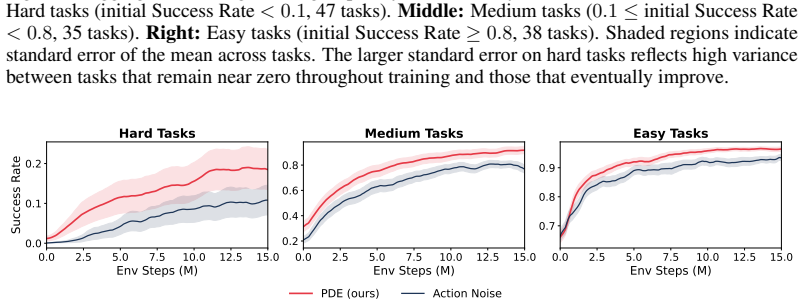
- [§4.2 / App. A.2 / Figs. 4–6] Sample-budget accounting for the two-stage schedule (App. A.2) is load-bearing for the sample-efficiency claim. Prompt discovery freezes θ and spends T0×K×N rollouts per task before PPO; the microwave study alone uses ~85 discovery rollouts. Figures 4–6 and the abstract claim higher success with far fewer environment interactions, but it is unclear whether discovery rollouts are included on the Env Steps axis or only the RL stage. Please report total environment interactions (discovery + RL) for PDE and baselines on the same axes, or mark discovery cost separately, so the efficiency comparison is not understated for action-noise PPO.
- [§4.2 Eq. (3) / Table 2 / Tables 8–9] Transfer to the canonical prompt pg is the hinge of the central claim (successful policies under evaluation prompts from zero-reward starts), not discovery alone. Table 2 Regime 3 and Tables 8–9 already show discovery can be 0% while later RL under mixture+mixed backprop succeeds, and that training only on the best exploratory prompt collapses under pg (39.6% vs 63.8%). On hard zero-init tasks, please isolate transfer more cleanly: e.g., discovery-only (no θ update), discovery+PPO without mixed backprop (Eq. 3), and full PDE, all evaluated only under pg, with discovery cost counted. Without this, gains on hard tiers could be partly attributed to extra successful data under non-eval prompts rather than improved πθ(·|o,pg).
- [§4.1 / Abstract] The PSRL framing (§4.1) is an analogy: ρ is an implicit VLM sampler with no explicit density, likelihood, or Bayesian update, and history is compressed to one-sentence summaries plus success rates (App. A.1). That is fine as motivation, but phrases such as “realizes posterior sampling” and “amortized posterior update” overstate formality relative to classical PSRL. Please reframe as “PSRL-inspired prompt-space exploration” unless a concrete correspondence (e.g., what constitutes the likelihood and prior) is stated, so the contribution is not judged as a theoretical PSRL result.
minor comments (6)
- [Appendix tables] Table numbering in the appendix is inconsistent with in-text references (e.g., GR00T/Pi0 aggregate appears as Table 11 after Table 14 in the source order). Renumber tables in reading order.
- [§5.1 / App. A.5] Hyperparameters for the VLM supervisor (which model, temperature, frames_per_video) should be stated once in the main experimental setup, not only implied by templates in App. A.5.
- [Fig. 1 / §5.2] Figure 1 caption refers to improving from 10% to 50%, while the microwave narrative in §5.2 discusses ~0% to ~98%; align figure choice and caption with the section that cites it.
- [§5.3] Clarify whether language-perturbation tasks were excluded solely for confounding (§5.3) and whether that exclusion biases the hard-tier set toward tasks where prompt rephrasing is especially effective.
- [Eq. (3)] In Eq. (3), the denominator uses π_old under p while the numerator averages log-probs under pg and p; a one-sentence justification that this remains a valid importance ratio (or is a heuristic) would help readers.
- [§5.6 / Table 5] Real-world results (Fig. 8, Table 5) use only three tasks and 20 eval rollouts; report confidence intervals or binomial CIs so the “more than twice” claim is statistically readable.
Circularity Check
No circularity: PDE is an empirical exploration method evaluated on external environment rewards under held-out canonical prompts; the PSRL framing is an analogy, not a derivation that reduces to its inputs.
full rationale
The paper's load-bearing claims are empirical: that VLM-refined prompts unlock nonzero reward from weak VLAs/LLMs, and that mixture sampling plus mixed backpropagation (Eq. 3) transfers those successes so πθ(·|o, pg) improves under the canonical evaluation prompt. Success is defined by external task reward R(τp, g) that depends only on task completion, not on the prompt wording (Section 3), and is measured on LIBERO-PRO, ManiSkill, real Franka tasks, LiveCodeBench, and AIME against action-noise and other baselines under the same PPO/RLOO/GRPO budgets. The 'posterior sampling' language in §4.1 is explicitly an analogy: the authors state that ρ has 'no explicit density' and is 'queried as an implicit sampler,' not a derived Bayesian update. No parameter is fitted to data and then re-reported as a prediction; no uniqueness theorem or self-citation chain forces the method; ablations (random paraphrases, single-best prompt, mixed vs. original-only backprop) further test rather than define the result. The derivation chain therefore does not reduce by construction to its inputs.
Assumptions & free parameters
free parameters (3)
- mixture schedule α_t / consolidation target c =
c=0.5, α_min=0.05, β=0.3
- pool admission threshold η and search budget (T0, K, N) =
η>0, T0=10, K=5, N=10
- mixed-backpropagation log-prob weights =
1/2 + 1/2
assumptions (4)
- domain assumption For fixed VLA parameters, each natural-language prompt induces a coherent policy whose entire rollout can be globally shifted by rephrasing the prompt.
- domain assumption A VLM can produce useful one-sentence diagnoses and rewrites from short rollout video summaries without gradient training on the target policy.
- domain assumption Reward depends only on task completion, not on prompt wording, so any prompt that elicits success is valid training data for the canonical-prompt policy.
- ad hoc to paper Classical PSRL exploration benefits transfer when the policy class is reparameterized as a prompt-conditioned family.
invented entities (1)
-
Prompt-Driven Exploration (PDE) / VLM-as-implicit-prompt-posterior
independent evidence
Cite this review
Pith. "Pith review of Prompt-Driven Exploration." pith.science (2026). https://pith.science/paper/YMVSPOFE
@misc{pith2026260708837,
  author       = {Pith},
  title        = {Pith review of: Prompt-Driven Exploration},
  year         = {2026},
  howpublished = {\url{https://pith.science/paper/YMVSPOFE}},
  note         = {Machine review of arXiv:2607.08837}
}
read the original abstract
Exploration is essential to RL since a policy cannot improve by repeatedly sampling the behaviors it already prefers. Standard methods inject stochasticity in the action space, but such jitter only yields rollouts close to the original. Escaping a weak policy often requires global perturbations that action noise cannot produce. Large language models (LLMs) and vision-language-action (VLA) models offer a pathway: they condition the policy on a natural language prompt, and since the rollout follows from it, modifying the prompt induces global changes. The challenge is finding prompts that induce useful global changes. With a weak policy that rarely succeeds, reward is too sparse to select on. Our idea is to refine prompts from the rollouts themselves: a vision-language model (VLM) reasons over the rollout video, diagnoses how the policy responded, and rewrites the prompt to elicit better behavior next time. This procedure resembles posterior sampling, a classical RL exploration framework, at the level of prompts: the VLM maintains an implicit distribution over useful prompts and updates it from observed rollouts. We call this strategy Prompt-Driven Exploration (PDE). Across manipulation and reasoning tasks, PDE enables RL to learn successful policies even from zero-reward starts, and improves sample efficiency more broadly. Our website is available at https://xinyunsunshine.github.io/prompt-rl.
Figures


Figures from the paper (9 more)



Reviewed July 13, 2026 · model on record in the stance chip above.
Discussion (0). Continue with ORCID to comment.