Under What Conditions Can a Machine Be Called Genuinely Creative?
Pith reviewed 2026-06-27 07:07 UTC · model grok-4.3
The pith
A machine is genuinely creative only when it structurally transforms incomplete situations through recursive intervention dynamics meeting ten Designics requirements.
A machine-rendered reading of the paper's core claim, the machinery that carries it, and where it could break.
Core claim
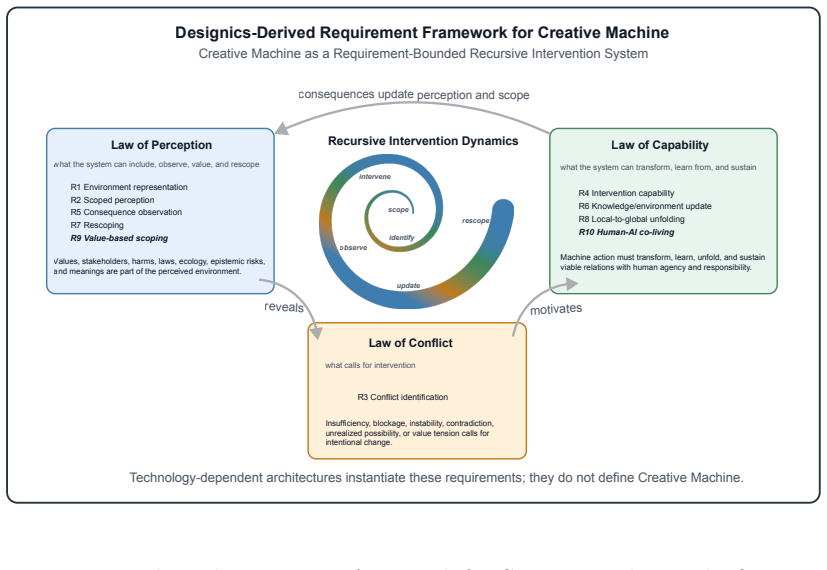
Genuine machine creativity is the structural transformation of incomplete situations through recursive intervention dynamics. It depends on ten requirements—environment representation, scoped perception, conflict identification, intervention capability, consequence observation, knowledge and environment update, rescoping, local-to-global unfolding, value-based scoping, and human-AI co-living—organized through the three laws of Designics: perception, conflict, and capability. Selected cyber-physical and cyber-biological studies illustrate computational tractability. Pressure cases such as foundation models, self-modifying agents, and automated discovery frameworks show strong generative means
What carries the argument
The ten-requirement framework organized by the three laws of Designics, which defines creativity as structural transformation of incomplete situations via recursive intervention dynamics.
If this is right
- Machines must update both knowledge and environment representations after observing intervention consequences.
- Value-based scoping must shape perception, conflict identification, intervention selection, and rescoping at every step.
- Human-AI co-living must integrate human agency into the creative loop rather than treating it as external.
- Open-ended systems, agentic workflows, and foundation models demonstrate generative capacity but fall short of genuine creativity without the full requirement set.
- Ethics shapes the core dynamics of perception, conflict, and capability instead of serving as a post-hoc filter.
Where Pith is reading between the lines
- The framework could be applied to existing generative models to identify which of the ten requirements they currently miss.
- This view of creativity as intervention in incomplete situations may link to questions in cognitive science about how humans handle open-ended tasks.
- Implementation in additional cyber-physical systems could test whether meeting the requirements produces measurable differences in outcome quality or adaptability.
- The requirement of local-to-global unfolding suggests creativity scales from local fixes to broader structural changes only when rescoping occurs repeatedly.
Load-bearing premise
That Designics supplies the correct foundational science whose three laws and ten requirements are both necessary and sufficient for genuine machine creativity.
What would settle it
A machine that produces outputs widely judged creative yet fails to satisfy all ten requirements, or one that satisfies the requirements yet fails to transform situations in ways humans recognize as creative.
Figures
read the original abstract
Recent AI systems can generate texts, software architectures, hypotheses, designs, and scientific workflows that appear creative. This paper asks under what conditions a machine can be called genuinely creative, and how human agency can be preserved within shared cognitive and creative environments. It develops a requirement framework derived from Designics, the science of meaning-bearing intentional change. The paper argues that genuine machine creativity should not be defined by output novelty, current performance, or transient architecture alone. Instead, creativity is understood as the structural transformation of incomplete situations through recursive intervention dynamics. On this view, it depends on ten requirements: environment representation, scoped perception, conflict identification, intervention capability, consequence observation, knowledge and environment update, rescoping, local-to-global unfolding, value-based scoping, and human-AI co-living. These are organized through the three laws of Designics: perception, conflict, and capability. The paper illustrates the computational tractability of these requirements through selected cyber-physical and cyber-biological studies, including recursive element extraction, autonomous mesh generation, and neurophysiological and workload analysis. It then treats open-ended systems, automated discovery frameworks, self-modifying agents, foundation models, and agentic workflows as pressure cases: they demonstrate powerful generative means but do not by themselves establish genuine machine creativity. Finally, the paper argues that proactive AI ethics is internal to genuine machine creativity rather than an after-the-fact filter. Value-based scoping and human-AI co-living must shape how creative machines perceive environments, identify conflicts, select interventions, observe consequences, update knowledge, and rescope future action.
Editorial analysis
A structured set of objections, weighed in public.
Referee Report
Summary. The paper claims that genuine machine creativity is the structural transformation of incomplete situations through recursive intervention dynamics rather than output novelty or performance. It derives a requirement framework from Designics consisting of ten capabilities (environment representation, scoped perception, conflict identification, intervention capability, consequence observation, knowledge and environment update, rescoping, local-to-global unfolding, value-based scoping, and human-AI co-living) organized by the three laws of Designics (perception, conflict, capability). The paper illustrates computational tractability with cyber-physical and cyber-biological examples and uses pressure cases (open-ended systems, foundation models, agentic workflows) to show that current AI lacks the full set, while arguing that proactive ethics is internal to the framework.
Significance. If the central claim holds, the paper would supply a structured, capability-based alternative to output-centric definitions of creativity, with explicit integration of human-AI co-living and value-based scoping as load-bearing elements. The selected cyber-physical illustrations (recursive element extraction, autonomous mesh generation) demonstrate that at least some requirements are computationally addressable. These strengths are offset by the absence of independent derivation or external benchmarks.
major comments (3)
- [Abstract / requirement framework] Abstract and requirement framework section: the ten requirements are asserted as necessary and sufficient for genuine creativity without derivation steps, falsifiable tests, or argument showing why the absence of any single requirement precludes creativity or why the set is exhaustive.
- [Pressure cases analysis] Pressure cases section: the analysis demonstrates that current systems (foundation models, agentic workflows) lack the full list of requirements but supplies no test or argument establishing that satisfying the complete list would in fact constitute genuine creativity as defined.
- [Requirement framework] Requirement framework: no contrast is provided to alternative accounts (e.g., Boden-style transformational creativity or purely performance-based criteria) to justify why the Designics-derived ontology is the correct one rather than an ad-hoc choice.
minor comments (2)
- The three laws of Designics are referenced repeatedly but lack explicit formal definitions or pseudocode early in the manuscript, which would aid readability.
- The transition from the requirement list to the claim that ethics is 'internal' rather than an after-the-fact filter would benefit from a dedicated subsection with a concrete example.
Simulated Author's Rebuttal
We thank the referee for the detailed and constructive report. We agree that the manuscript requires additional explicit derivation of the requirements from the Designics laws, arguments establishing sufficiency, and contrasts with alternative accounts of creativity. We will revise the paper accordingly to address these points while preserving the core framework.
read point-by-point responses
-
Referee: Abstract / requirement framework] Abstract and requirement framework section: the ten requirements are asserted as necessary and sufficient for genuine creativity without derivation steps, falsifiable tests, or argument showing why the absence of any single requirement precludes creativity or why the set is exhaustive.
Authors: The requirements are derived from the three laws of Designics (perception, conflict, capability) that organize meaning-bearing intentional change. We will add a dedicated subsection mapping each requirement to these laws and explaining why its absence blocks recursive structural transformation of incomplete situations. The pressure cases already function as negative tests; we will expand them with a brief positive scenario illustrating sufficiency. The set is exhaustive within the Designics ontology rather than ad hoc. revision: yes
-
Referee: [Pressure cases analysis] Pressure cases section: the analysis demonstrates that current systems (foundation models, agentic workflows) lack the full list of requirements but supplies no test or argument establishing that satisfying the complete list would in fact constitute genuine creativity as defined.
Authors: Genuine creativity is defined in the paper as structural transformation via recursive intervention dynamics. The requirements are those needed to realize this definition. We will add a short argument and hypothetical illustration (building on the cyber-physical examples) showing how a system meeting all ten would produce such transformation, thereby addressing sufficiency. revision: yes
-
Referee: [Requirement framework] Requirement framework: no contrast is provided to alternative accounts (e.g., Boden-style transformational creativity or purely performance-based criteria) to justify why the Designics-derived ontology is the correct one rather than an ad-hoc choice.
Authors: We will insert a new subsection contrasting the framework with Boden's transformational creativity, noting that our account requires human-AI co-living and value-based scoping as load-bearing elements absent from purely transformational or output-novelty criteria. We will also distinguish the process-oriented Designics ontology from performance-based definitions that evaluate only final artifacts. revision: yes
Circularity Check
Creativity definition and requirements reduce to acceptance of author's prior Designics framework
specific steps
-
self citation load bearing
[Abstract]
"It develops a requirement framework derived from Designics, the science of meaning-bearing intentional change. ... These are organized through the three laws of Designics: perception, conflict, and capability."
The ten requirements and three laws are taken as given from Designics (the author's prior framework) and then used to define what counts as genuine creativity; no derivation shows why these are necessary/sufficient or why Designics supplies the correct ontology rather than alternatives.
-
self definitional
[Abstract]
"creativity is understood as the structural transformation of incomplete situations through recursive intervention dynamics. On this view, it depends on ten requirements: environment representation, scoped perception, conflict identification, intervention capability, consequence observation, knowledge and environment update, rescoping, local-to-global unfolding, value-based scoping, and human-AI co-living."
The definition of creativity is stipulated to require precisely the Designics-derived list, so the claim that these requirements are needed for genuine creativity is true by the paper's own definitional choice rather than by independent argument.
full rationale
The paper's central claim—that genuine machine creativity equals structural transformation via recursive intervention dynamics and requires exactly the ten listed requirements organized by the three Designics laws—is presented as derived from Designics without an independent derivation, contrast to alternatives (e.g., Boden-style or performance-based), or external benchmark shown in the provided text. This matches self-citation load-bearing where the ontology and necessity claims rest on the author's originating science rather than being derived or tested within the paper.
Axiom & Free-Parameter Ledger
axioms (1)
- domain assumption The three laws of Designics (perception, conflict, and capability) organize the requirements for genuine creativity.
Reference graph
Works this paper leans on
-
[1]
Ackerman, M. (2025). Creative Machines: AI, Art & Us. Wiley. https://doi.org/10.1002/ 9781394321506 Amodei, D., Olah, C., Steinhardt, J., Christiano, P., Schulman, J., & Mané, D. (2016). Concrete problems in AI safety. arXiv:1606.06565. 25 Blacker, T. D., & Stephenson, M. B. (1991). Paving: A new approach to automated quadrilateral mesh generation. Intern...
work page internal anchor Pith review Pith/arXiv arXiv doi:10.1002/nme.1620320410 2025
-
[2]
(pp. 90–95). Cross, N. (1982). Designerly ways of knowing. Design Studies, 3(4), 221–227.https://doi. org/10.1016/0142-694X(82)90040-0 Cross, N. (2006). Designerly ways of knowing. Springer. Elgammal, A., Liu, B., Elhoseiny, M., & Mazzone, M. (2017). CAN: Creative Adversarial Networks, generating “art” by learning about styles and deviating from style nor...
work page internal anchor Pith review Pith/arXiv arXiv doi:10.1016/0142-694x(82)90040-0 1982
-
[3]
Toolformer: Language Models Can Teach Themselves to Use Tools
arXiv:2302.04761. Schmidhuber, J. (2006). Gödel machines: Fully self-referential optimal universal self-improvers. In B. Goertzel & C. Pennachin (Eds.), Artificial general intelligence (pp. 199–226). Springer. Schön, D. A. (1983). The reflective practitioner: How professionals think in action. Basic Books. Shinn, N., Cassano, F., Berman, E., Gopinath, A.,...
work page internal anchor Pith review Pith/arXiv arXiv 2006
-
[4]
Reflexion: Language Agents with Verbal Reinforcement Learning
arXiv:2303.11366. Shneiderman, B. (2020). Human-centered artificial intelligence: Reliable, safe & trustworthy. International Journal of Human–Computer Interaction, 36(6), 495–504.https://doi.org/10. 1080/10447318.2020.1741118 Shneiderman, B. (2022). Human-centered AI. Oxford University Press.https://doi.org/10. 1093/oso/9780192845290.001.0001 Simon, H. A...
work page internal anchor Pith review Pith/arXiv arXiv doi:10.1038/s41586-023-06747-5 2020
discussion (0)
Sign in with ORCID, Apple, or X to comment. Anyone can read and Pith papers without signing in.