Deep Learning-Assisted Improved Differential Fault Attacks on Lightweight Stream Ciphers
Pith reviewed 2026-05-21 10:40 UTC · model grok-4.3
The pith
MLP models identify single-bit fault locations in ACORNv3, MORUSv2 and ATOM with accuracies up to 0.99988, enabling state recovery with fewer injections than prior methods.
A machine-rendered reading of the paper's core claim, the machinery that carries it, and where it could break.
Core claim
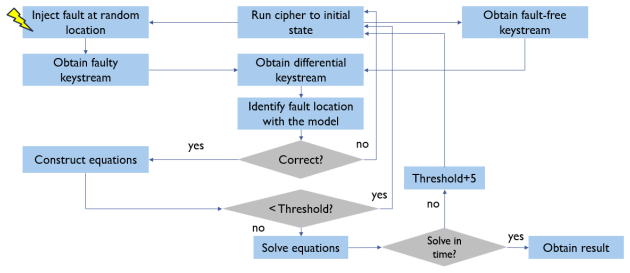
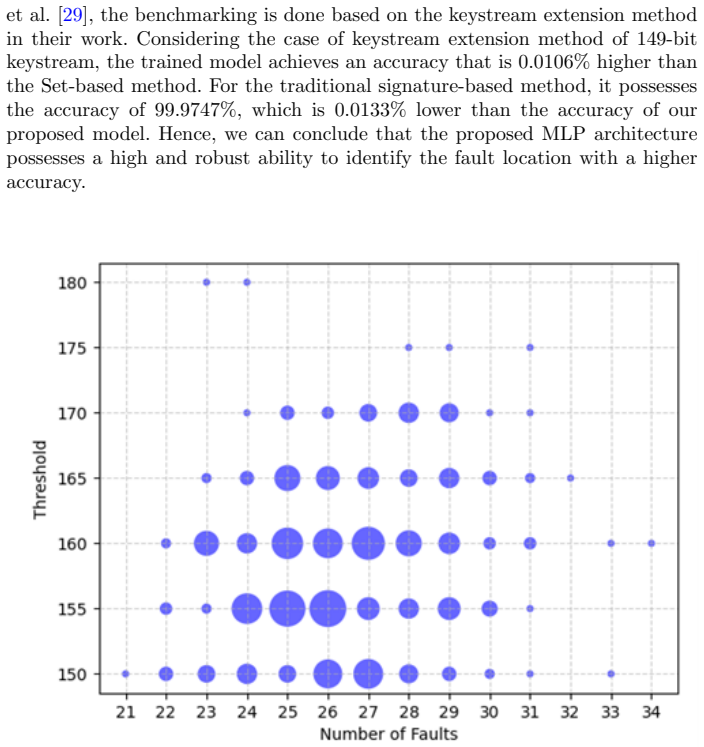
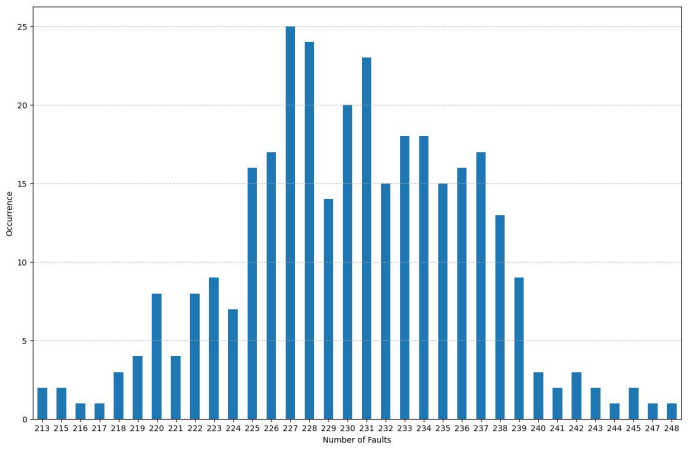
Trained MLP models achieve identification accuracies of 0.999880 for ACORNv3, 0.999231 for MORUSv2 and 0.823568 for ATOM; a threshold-based procedure then recovers the initial state of ACORN with 21 to 34 faults and of MORUS with 213 to 248 faults while guessing at most six bits, lowering overall attack complexity relative to earlier differential fault analyses. ATOM exhibits greater resistance because most NFSR state bits require a precise-control fault model.
What carries the argument
Multilayer perceptron models trained to map observed ciphertext differences to the unknown location of a single-bit flip, followed by a threshold-based filtering step that selects consistent fault hypotheses for state recovery.
If this is right
- ACORN initial state is recoverable with 21-34 faults and at most a few bits of guessing.
- MORUS initial state is recoverable with 213-248 faults under the same relaxed model.
- Both recoveries require fewer faults and lower complexity than previously published differential fault attacks on these ciphers.
- ATOM resists recovery for most NFSR bits unless the attacker can control the exact fault location.
Where Pith is reading between the lines
- The same training-plus-threshold pipeline could be applied to other feedback-shift-register ciphers once suitable simulation data are generated.
- If the simulation-to-hardware gap proves small, device vendors may need new countermeasures that either hide fault effects or detect deep-learning-assisted analysis.
- The reported accuracy gap between ATOM and the other two ciphers suggests that register size and nonlinear feedback structure directly affect how much information a single-bit fault leaks.
Load-bearing premise
Models trained only on simulated fault-injection data will generalize to the fault behavior that actually occurs when the same ciphers run on real hardware.
What would settle it
Measure whether the trained MLP still reaches at least 0.99 accuracy when the same ciphers are implemented on an FPGA or microcontroller and subjected to actual laser or voltage-glitch faults whose locations are later verified by side-channel or exhaustive search.
Figures
read the original abstract
Lightweight cryptographic primitives are widely deployed in resource-constrained environments, particularly in Internet of Things (IoT) devices. Due to their public accessibility, these devices are vulnerable to physical attacks, especially fault attacks. Recently, deep learning-based cryptanalytic techniques have demonstrated promising results; however, their application to fault attacks remains limited, particularly for stream ciphers. In this work, we investigate the feasibility of deep learning assisted differential fault attacks on three lightweight stream ciphers, namely ACORNv3, MORUSv2, and ATOM, under a relaxed fault model in which a single-bit bit-flipping fault is injected at an unknown location. We develop and train multilayer perceptron (MLP) models to identify the fault locations. Experimental results show that the trained models achieve high identification accuracies of 0.999880, 0.999231, and 0.823568 for ACORNv3, MORUSv2 and ATOM, respectively, and outperform traditional signature-based methods. For the secret recovery process, we introduce a threshold-based method to optimize the number of fault injections required to recover the secret information. The results show that the initial state of ACORN can be recovered with 21 to 34 faults, while MORUS requires 213 to 248 faults, with at most 6 bits of guessing. Both attacks reduce the attack complexity compared to existing works. For ATOM, the results show that it possesses a higher security margin, as the majority of state bits in the Nonlinear Feedback Shift Register (NFSR) can only be recovered under a precise control model. To the best of our knowledge, this work provides the first experimental results of differential fault attacks on ATOM.
Editorial analysis
A structured set of objections, weighed in public.
Referee Report
Summary. The manuscript presents a deep learning-assisted approach to differential fault attacks on the lightweight stream ciphers ACORNv3, MORUSv2, and ATOM. Using multilayer perceptron (MLP) models trained to identify single-bit fault locations under a relaxed unknown-location model, the authors report identification accuracies of 0.999880, 0.999231, and 0.823568 for the three ciphers. They further introduce a threshold-based stopping rule for fault injections that allows recovery of the initial state with 21-34 faults for ACORN and 213-248 for MORUS, claiming reduced complexity over prior attacks. The work also provides the first DFA results on ATOM, noting its higher security margin.
Significance. Should the empirical results prove robust upon detailed validation, this paper would contribute to the intersection of machine learning and fault cryptanalysis by demonstrating practical improvements in attack efficiency for IoT-relevant primitives. The explicit comparison to signature-based methods and the extension to ATOM are positive aspects. The main limitation in assessing significance is the absence of sufficient experimental methodology details to confirm the reliability of the reported accuracies and fault counts.
major comments (2)
- Experimental Setup section: No information is given on the size of the training set for the MLP models, the validation procedure used to obtain the accuracies (e.g., train-test split or cross-validation), or how the baseline signature-based method was implemented for comparison. These omissions directly affect the ability to assess the statistical significance and reproducibility of the central claims regarding model performance (0.999880 for ACORNv3 etc.).
- Results and Discussion section: The attack is evaluated exclusively under simulated fault injection with a relaxed single-bit unknown-location model. There is no description of hardware experiments, characterization of actual fault behavior on target devices, or analysis of potential discrepancies between simulated and physical fault distributions. This is a load-bearing issue for the claim that the threshold-based method reduces attack complexity in practice.
Simulated Author's Rebuttal
We thank the referee for their constructive and detailed feedback on our manuscript. We have carefully reviewed the major comments and provide point-by-point responses below, indicating where revisions will be made to enhance reproducibility, clarity, and the discussion of limitations.
read point-by-point responses
-
Referee: Experimental Setup section: No information is given on the size of the training set for the MLP models, the validation procedure used to obtain the accuracies (e.g., train-test split or cross-validation), or how the baseline signature-based method was implemented for comparison. These omissions directly affect the ability to assess the statistical significance and reproducibility of the central claims regarding model performance (0.999880 for ACORNv3 etc.).
Authors: We agree that these methodological details are critical for reproducibility and for allowing readers to evaluate the statistical robustness of the reported accuracies. In the revised manuscript, we will expand the Experimental Setup section to specify the training set sizes (number of simulated fault samples per cipher), the validation procedure (including the train-test split ratio and any cross-validation folds used), and a full description of the signature-based baseline implementation, including the extracted features, matching rules, and comparison metrics. These additions will directly support assessment of the model performance claims. revision: yes
-
Referee: Results and Discussion section: The attack is evaluated exclusively under simulated fault injection with a relaxed single-bit unknown-location model. There is no description of hardware experiments, characterization of actual fault behavior on target devices, or analysis of potential discrepancies between simulated and physical fault distributions. This is a load-bearing issue for the claim that the threshold-based method reduces attack complexity in practice.
Authors: We acknowledge that the evaluation is performed exclusively via simulation under the stated relaxed single-bit unknown-location fault model, which is a standard approach in differential fault analysis literature to isolate algorithmic contributions. In the revision, we will add an explicit discussion in the Results and Discussion section addressing the simulation assumptions, citing relevant hardware fault characterization studies, and analyzing potential discrepancies (e.g., multi-bit faults or timing effects in real devices). We will also qualify the complexity reduction claims to apply specifically under the simulated model. However, new physical hardware experiments lie outside the scope of the current work, as they would require dedicated equipment and target platforms not available for this study; we will therefore frame the results as demonstrating feasibility and improvements within the defined model rather than claiming direct practical deployment. revision: partial
Circularity Check
No significant circularity; results are empirical measurements from ML training and simulation
full rationale
The paper's core claims consist of reported identification accuracies (0.999880 for ACORNv3 etc.) and fault counts (21-34 for ACORN) obtained by training MLP classifiers on simulated single-bit fault data and applying a threshold-based recovery procedure. These quantities are direct experimental outputs measured on held-out test sets or simulation runs rather than algebraic derivations, fitted parameters renamed as predictions, or self-citation chains that reduce the result to its own inputs by construction. No uniqueness theorems, ansatzes smuggled via prior work, or self-definitional loops appear in the abstract or described methodology. The derivation chain is therefore self-contained against external benchmarks such as prior differential fault attack literature.
Axiom & Free-Parameter Ledger
free parameters (2)
- MLP architecture and training hyperparameters
- Threshold values for fault-injection stopping rule
Lean theorems connected to this paper
-
IndisputableMonolith/Cost/FunctionalEquation.leanwashburn_uniqueness_aczel unclear?
unclearRelation between the paper passage and the cited Recognition theorem.
We develop and train multilayer perceptron (MLP) models to identify the fault locations... accuracies of 0.999880, 0.999231 and 0.823568
-
IndisputableMonolith/Foundation/RealityFromDistinction.leanreality_from_one_distinction unclear?
unclearRelation between the paper passage and the cited Recognition theorem.
threshold-based method to optimize the number of fault injections... 21 to 34 faults
What do these tags mean?
- matches
- The paper's claim is directly supported by a theorem in the formal canon.
- supports
- The theorem supports part of the paper's argument, but the paper may add assumptions or extra steps.
- extends
- The paper goes beyond the formal theorem; the theorem is a base layer rather than the whole result.
- uses
- The paper appears to rely on the theorem as machinery.
- contradicts
- The paper's claim conflicts with a theorem or certificate in the canon.
- unclear
- Pith found a possible connection, but the passage is too broad, indirect, or ambiguous to say the theorem truly supports the claim.
Reference graph
Works this paper leans on
-
[1]
CAAI Transactions on Intelli- gence Technology6(1), 17–24 (2021).https://doi.org/10.1049/cit2.12027
Baksi, A., Sarkar, S., Siddhanti, A., Anand, R., Chattopadhyay, A.: Differential fault location identification by machine learning. CAAI Transactions on Intelli- gence Technology6(1), 17–24 (2021).https://doi.org/10.1049/cit2.12027
-
[2]
Banik, S., Caforio, A., Isobe, T., Liu, F., Meier, W., Sakamoto, K., Sarkar, S.: Atom: A stream cipher with double key filter. IACR Transactions on Symmetric Cryptology2021(1), 5–36 (Mar 2021).https://doi.org/10.46586/tosc.v2021. i1.5-36
-
[3]
Differential fault analysis of secret key cryptosystems
Biham, E., Shamir, A.: Differential fault analysis of secret key cryptosystems. In: Kaliski, B.S. (ed.) Advances in Cryptology — CRYPTO ’97. pp. 513–525. Springer, Berlin, Heidelberg (1997).https://doi.org/10.1007/BFb0052259
-
[4]
Boneh, D., DeMillo, R.A., Lipton, R.J.: On the importance of checking crypto- graphic protocols for faults. In: Fumy, W. (ed.) Advances in Cryptology — EU- ROCRYPT ’97. pp. 37–51. Springer, Berlin, Heidelberg (1997).https://doi.org/ 10.1007/3-540-69053-0_4
-
[5]
Cryptology ePrint Archive, Paper 2023/021 (2023),https://eprint.iacr.org/2023/021
Cheng, Y., Ou, C., Zhang, F., Zheng, S., Xu, S., Long, J.: DLFA: Deep learn- ing based fault analysis against block ciphers. Cryptology ePrint Archive, Paper 2023/021 (2023),https://eprint.iacr.org/2023/021
work page 2023
-
[6]
In: Yan, Z., Molva, R., Mazurczyk, W., Kantola, R
Dalai, D.K., Roy, D.: A state recovery attack on ACORN-v1 and ACORN-v2. In: Yan, Z., Molva, R., Mazurczyk, W., Kantola, R. (eds.) Network and Sys- tem Security. pp. 332–345. Springer, Cham (2017).https://doi.org/10.1007/ 978-3-319-64701-2_24
work page 2017
-
[7]
Gohr, A.: Improving attacks on round-reduced Speck32/64 using deep learn- ing. In: Advances in Cryptology – CRYPTO 2019: 39th Annual International Cryptology Conference, Santa Barbara, CA, USA, August 18–22, 2019, Proceed- ings, Part II. p. 150–179. Springer, Cham (2019).https://doi.org/10.1007/ 978-3-030-26951-7_6
work page 2019
-
[8]
Hoch, J.J., Shamir, A.: Fault analysis of stream ciphers. In: Joye, M., Quisquater, J.J. (eds.) Cryptographic Hardware and Embedded Systems - CHES 2004. pp. 240–253. Springer, Berlin, Heidelberg (2004).https://doi.org/10.1007/ 978-3-540-28632-5_18
work page 2004
-
[9]
Security and Communication Networks2021(1), 9288229 (2021).https://doi
Hou, Z., Ren, J., Chen, S.: Improve neural distinguishers of SIMON and SPECK. Security and Communication Networks2021(1), 9288229 (2021).https://doi. org/10.1155/2021/9288229
-
[10]
Kim, H., Lim, S., Kang, Y., Kim, W., Kim, D., Yoon, S., Seo, H.: Deep-learning- based cryptanalysis of lightweight block ciphers revisited. Entropy25(7) (2023). https://doi.org/10.3390/e25070986
-
[11]
Chinese Journal of Electronics30(3), 534–541 (2021).https://doi.org/10.1049/ cje.2021.04.007
Ma, Z., Tian, T., Qi, W.: Differential fault attack on the stream cipher LIZARD. Chinese Journal of Electronics30(3), 534–541 (2021).https://doi.org/10.1049/ cje.2021.04.007
work page 2021
-
[12]
Cryptology ePrint Archive, Paper 2015/236 (2015),https://eprint.iacr.org/2015/236
Maitra, S., Sarkar, S., Baksi, A., Dey, P.: Key recovery from state information of Sprout: application to cryptanalysis and fault attack. Cryptology ePrint Archive, Paper 2015/236 (2015),https://eprint.iacr.org/2015/236
work page 2015
-
[13]
IEEE Transactions on Computers66(10), 1804–1808 (2017).https://doi.org/ 10.1109/TC.2017.2700469
Maitra, S., Siddhanti, A., Sarkar, S.: A differential fault attack on Plantlet. IEEE Transactions on Computers66(10), 1804–1808 (2017).https://doi.org/ 10.1109/TC.2017.2700469
-
[14]
IEEE Transactions on Computers73(6), 1631–1639 (2024)
Mondal, S.K., Dey, P., Roy, H.S., Adhikari, A., Maitra, S.: Improved fault analysis on Subterranean 2.0. IEEE Transactions on Computers73(6), 1631–1639 (2024). https://doi.org/10.1109/TC.2024.3371784
-
[15]
Orumiehchiha, M.A., Rostami, S., Shakour, E., Pieprzyk, J.: A differential fault attack on the WG family of stream ciphers. Journal of Cryptographic Engineering 10(2), 189–195 (Jun 2020).https://doi.org/10.1007/s13389-020-00222-x
-
[16]
In: Boyd, C., Safavi-Naini, R., Simpson, L
Prajasantosa, S.R., Salam, I.: Differential fault analysis of TinyJAMBU. In: Boyd, C., Safavi-Naini, R., Simpson, L. (eds.) Information Security in a Connected World: Celebrating the Life and Work of Ed Dawson. pp. 68–88. Springer, Cham (2025). https://doi.org/10.1007/978-3-031-83490-5_4
-
[17]
In: 2025 6th International Conference on Recent Advances in Information Technology (RAIT)
Radheshwar, R., Roy, D.: Differential fault attack on ChaosForge. In: 2025 6th International Conference on Recent Advances in Information Technology (RAIT). pp. 1–6 (2025).https://doi.org/10.1109/RAIT65068.2025.11089261
-
[18]
Journal of Cryptographic Engineering15, 3 (Jan 2025)
Rostami, S., Orumiehchiha, M.A., Shakour, E., Alizadeh, S.: Fault attack on eno- coro stream cipher family. Journal of Cryptographic Engineering15, 3 (Jan 2025). https://doi.org/10.1007/s13389-024-00367-z
-
[19]
Journal of Cryp- tology36(3), 19 (May 2023).https://doi.org/10.1007/s00145-023-09462-6
Saha, S., Alam, M., Bag, A., Mukhopadhyay, D., Dasgupta, P.: Learn from your faults: Leakage assessment in fault attacks using deep learning. Journal of Cryp- tology36(3), 19 (May 2023).https://doi.org/10.1007/s00145-023-09462-6
-
[20]
IEEE Access9, 72568–72586 (2021).https://doi.org/ 10.1109/ACCESS.2021.3078845
Salam, I., Ooi, T.H., Xue, L., Yau, W.C., Pieprzyk, J., Phan, R.C.W.: Random differential fault attacks on the lightweight authenticated encryption stream ci- pher Grain-128AEAD. IEEE Access9, 72568–72586 (2021).https://doi.org/ 10.1109/ACCESS.2021.3078845
-
[21]
Salam, I., Yau, W.C., Phan, R.C.W., Pieprzyk, J.: Differential fault attacks on the lightweight authenticated encryption algorithm CLX-128. Journal of Cryptographic Engineering13, 265–281 (Sep 2023).https://doi.org/10.1007/ s13389-023-00326-0
work page 2023
-
[22]
In: Ali, S.S., Danger, J.L., Eisenbarth, T
Siddhanti, A., Sarkar, S., Maitra, S., Chattopadhyay, A.: Differential fault attack on Grainv1, ACORNv3 and Lizard. In: Ali, S.S., Danger, J.L., Eisenbarth, T. (eds.) Security, Privacy, and Applied Cryptography Engineering – SPACE 2017. pp. 247–
work page 2017
-
[23]
Springer, Cham (2017).https://doi.org/10.1007/978-3-319-71501-8_14
-
[24]
Computers14(12) (2025).https://doi.org/10.3390/computers14120505
Silva, C., Ten´ orio, N., Bernardino, J.: Lightweight encryption algorithms for IoT. Computers14(12) (2025).https://doi.org/10.3390/computers14120505
-
[25]
Cryptology ePrint Archive, Paper 2020/022 (2020),https://eprint.iacr.org/2020/022
Wong, K.K.H., Bartlett, H., Simpson, L., Dawson, E.: Differential random fault attacks on certain CAESAR stream ciphers (supplementary material). Cryptology ePrint Archive, Paper 2020/022 (2020),https://eprint.iacr.org/2020/022
work page 2020
-
[26]
Wu, H.: Acorn: A lightweight authenticated cipher (v3) (2016),https:// competitions.cr.yp.to/round3/acornv3.pdf
work page 2016
-
[27]
Wu, H., Huang, T.: The authenticated cipher MORUS (v2) (2016),https:// competitions.cr.yp.to/round3/morusv2.pdf
work page 2016
-
[28]
Zahednejad, B., Lyu, L.: An improved integral distinguisher scheme based on neural networks. International Journal of Intelligent Systems37(10), 7584–7613 (2022).https://doi.org/10.1002/int.22895
-
[29]
Security and Communication Networks2017(1), 3834685 (2017).https://doi
Zhang, X., Feng, X., Lin, D.: Fault attack on the authenticated cipher ACORNv2. Security and Communication Networks2017(1), 3834685 (2017).https://doi. org/10.1155/2017/3834685
-
[30]
The Computer Journal 61(8), 1166–1179 (05 2018).https://doi.org/10.1093/comjnl/bxy044
Zhang, X., Feng, X., Lin, D.: Fault attack on ACORN v3. The Computer Journal 61(8), 1166–1179 (05 2018).https://doi.org/10.1093/comjnl/bxy044
discussion (0)
Sign in with ORCID, Apple, or X to comment. Anyone can read and Pith papers without signing in.