REVIEW 4 minor 75 references
Diffusion-influenced reaction rates in the presence of pair interactions
T0 review · 0 major / 4 minor · reviewed 2026-08-14 · deepseek-v4-flash
Pith's one-line read A single formula now gives the reaction rate constant for diffusing molecules that attract or repel each other, valid from well-mixed to diffusion-limited kinetics.
desk verdict Solid central result with a flawed validation detail: the logarithmic potential check in §IVD does not hold up, but Eq. (32) is still a worthwhile contribution. read the letter →
The pith
A machine-rendered reading of the paper's core claim, the machinery that carries it, and where it could break.
The reading
What carries the argument
The load-bearing object is $\psi(r)$, the dimensionless radial flux profile inside the reaction volume: it removes the unknown reaction frequency $K$ from the inner problem and turns the reaction–diffusion equation into a linear, one-dimensional boundary-value problem, $$\psi'' + (\$\beta$ U' - 2/r)\psi' - (\$\lambda$/D)\psi = 0, \quad \psi(0)=0,\ \psi(R)=1.$$ Its boundary derivative $\psi'(R)$ fixes the concentration at the reaction surface, $p(R) = \psi'(R)K/(4\pi R^2\lambda)$, and thereby the formation rate. Outside the sphere, flux conservation plus the Boltzmann-weighted gradient law give the Debye profile in terms of the single integral of $g(s)=e^{\beta U(s)} s^{-2}$. Matching the two solutions at $r=R$ produces Eq. (32), so the whole argument is powered by this two-domain split and the linearity of the inner equation.
What would settle it
Measure the radial concentration profile $p(r)$ near the origin in a stochastic Brownian-dynamics simulation of a hard-core or strongly repulsive potential, e.g. $U(r) \sim a r^{-12}$, with finite propensity $\lambda$. If $p(r)$ exceeds $c_A e^{-\beta U(r)}$ anywhere, the equilibrium upper bound used to extend $j(0)=0$ to divergent potentials is wrong and Eq. (32) would have to be revised. Alternatively, compare the theory's prediction for the diffusion-limited plateau, $k \to 4\pi D[\int_R^\infty e^{\beta U(s)}s^{-2} ds]^{-1}$, against brute-force simulation at $\kappa R = 10^3$ for a potential with a deep well inside the reaction sphere.
Extended reading notes
Core claim
The central result is that the steady-state reaction rate constant for an isotropic pair potential $U(r)$ is $$k = 4\pi D\left[\int_R^\infty $e^{{\beta U(s)}}$ $s^{{-2}}$\,ds + \frac{$e^{{\beta U(R)}}$ \psi'(R)}{\$\lambda$/D}\right]^{-1},$$ where $\psi(r)$, defined by $\psi = -4\pi r^2 j(r)/K$ inside the reactive sphere, solves $\psi'' + (\beta U' - 2/r)\psi' - (\lambda/D)\psi = 0$ with $\psi(0)=0$ and $\psi(R)=1$; here $j(r)$ is the radial flux and $K$ is the reaction frequency. The first term in the bracket is the Debye encounter rate, the second is the formation rate, so the formula is an exact harmonic-mean decomposition $k^{-1}=k_e^{-1}+k_f^{-1}$. As the propensity $\lambda$ grows, $k$ saturates at the Debye rate, and without any potential it reduces to Doi's and Smoluchowski's results. The same construction yields the full concentration profile $p(r)$, and a slow-reaction expansion gives $k \approx \lambda\int_{|r|\le R} e^{-\beta U(r)} d^3r$, so the rate is the propensity times the Boltzmann-weighted accessible reaction volume. These predictions were compared with particle-based simulations for a repulsive harmonic potential, a Lennard-Jones potential, and no potential, with agreement across three decades of reactivity.
Load-bearing premise
The derivation requires the no-flux condition at the origin, $j(0)=0$, and for potentials that diverge at $r=0$ this condition is justified by an assumed physical bound on the concentration rather than a proof; if the near-origin behavior were different, Eq. (32) would change.
Editorial extensions
If this is right
- For any isotropic potential, computing $k$ reduces to one quadrature and one one-dimensional boundary-value problem, so the rate can be evaluated essentially instantly for any choice of $\lambda$ and $R$.
- The exact decomposition $k^{-1}=k_e^{-1}+k_f^{-1}$ holds over the full reactivity range, with $k_e$ always Debye's rate and $k_f$ fixed by the boundary concentration; the diffusion-limited limit is the Debye/Smoluchowski rate.
- A purely repulsive potential inside the reaction volume lowers both partial rates and is most damaging in the slow-reaction regime, while attraction outside the sphere raises the encounter rate and can raise the total rate by tens of percent.
- In the well-mixed limit the rate reduces to $k = \lambda V_{\mathrm{eff}}$, with $V_{\mathrm{eff}}$ the Boltzmann-weighted reaction volume, giving a direct way to measure accessible volume from reaction kinetics.
- The matching of theory and particle-based simulation across three decades of $\lambda$ means the model can be used to calibrate microscopic parameters to experimental rate constants without free fit parameters.
Reading between the lines
- Because the inner equation is linear, the same matching logic should extend to time-dependent rates: a Laplace transform in time would turn Eq. (29) into a resolvent problem, giving the full autocorrelation of the rate, not just its steady-state value.
- The non-monotonic formation rate seen when the reaction boundary moves through the potential well suggests that the reaction radius could be treated as a tunable design parameter: choosing $R$ near the potential minimum should maximize the total rate at fixed $\lambda$.
- In a crowded environment the relevant potential is a potential of mean force; if that quantity were measured or computed, Eq. (32) would predict how crowding shifts the apparent rate, an extension the paper explicitly leaves to future work.
- Inverting Eq. (32) numerically yields $(\lambda, R)$ pairs that reproduce a target experimental $k$; one could tabulate $\lambda$ for a grid of $R$ and $U$, producing ready-to-use parameter tables for particle-based reaction–diffusion simulations.
Signed reviews
Editorial analysis
A structured set of objections, weighed in public.
Referee Report
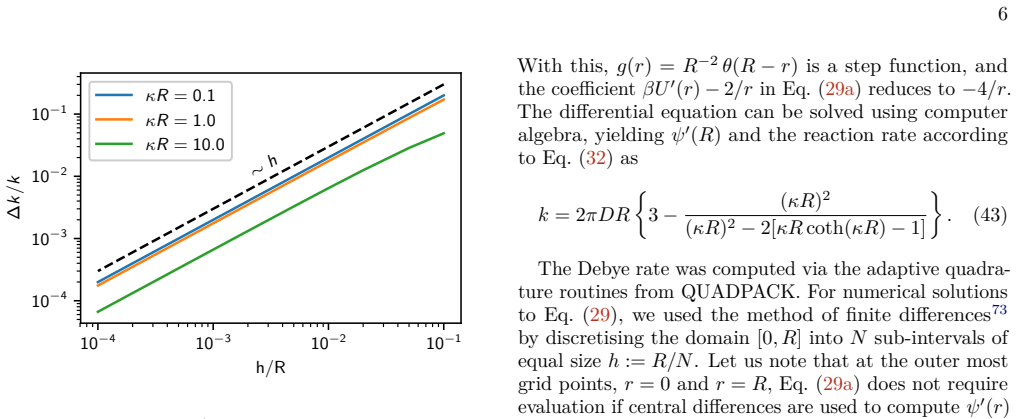
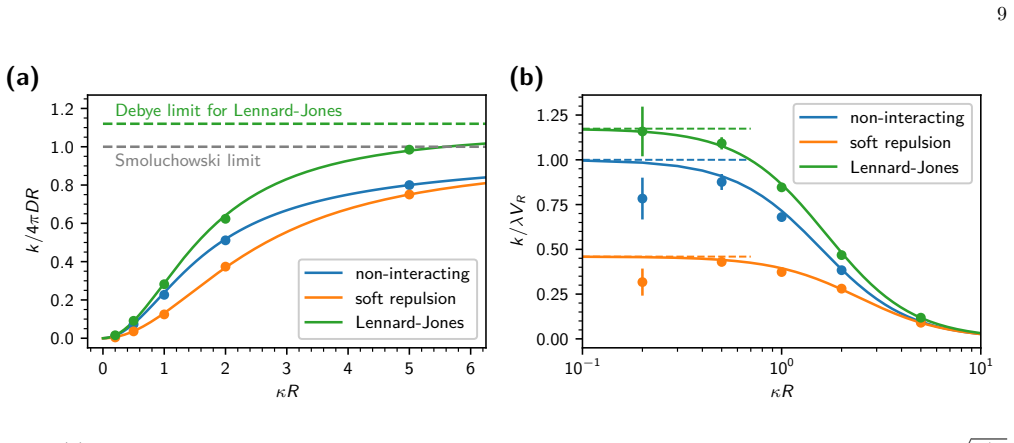
Summary. The manuscript extends Doi's volume-reaction model to bimolecular reactions in which the two reactants interact through an arbitrary isotropic pair potential U(r). In the steady state, the authors derive a semi-analytical expression, Eq. (32), for the macroscopic association rate constant k in terms of the reactivity κ = √(λ/D), the reaction radius R, and the potential: k = 4πD [∫_R^∞ e^{βU(s)} s^{-2} ds + e^{βU(R)} R^{-2} ψ'(R)/κ^2]^{-1}, where ψ solves the one-dimensional boundary-value problem (29) with ψ(0)=0 and ψ(R)=1. The expression reproduces Debye's rate in the diffusion-limited limit and λV_eff in the well-mixed limit, and it decomposes uniquely into encounter and formation rates. The theory is checked against an analytically solvable logarithmic potential, against perturbation theory for slow reactions, and against 195 stochastic iPRD simulations for non-interacting, softly repulsive, and Lennard-Jones systems.
Significance. If the final result holds, this is a valuable and practical contribution. It bridges the well-mixed and diffusion-limited regimes for interacting particles and provides a direct route to calibrate the microscopic parameters λ and R in iPRD simulations. The derivation of Eq. (32) is clean and self-contained; the limiting cases correctly recover Smoluchowski, Debye, and Doi results; and the decomposition k^{-1} = k_e^{-1} + k_f^{-1} emerges naturally from the matching calculation. The perturbative result, Eq. (40), and the cheap finite-difference scheme with documented linear convergence are useful tools. The simulation campaign is extensive, and the agreement between theory and simulations in Figs. 4 and 8 is excellent. The paper also makes falsifiable predictions, such as the non-monotonic dependence of the formation rate on the reaction-boundary position in Fig. 5.
minor comments (4)
- [IV.D, Eq. (42)] The sentence "With this, g(r) = R^{-2} θ(R−r) is a step function" is incorrect. For the stated potential U(r) = −2k_BT ln(r/R) inside r<R, one has e^{βU} = R^2/r^2 and hence g(r) = R^2/r^4 inside, while g(r) = 1/r^2 outside. The analytic solution Eq. (43) is nevertheless the correct solution for this potential (for example, its slow-reaction limit matches the perturbative result Eq. (40) with V_eff = 4πR^3/5), so the numerical validation is not invalidated; however, the misleading statement about g should be corrected.
- [III, after Eq. (15); IV.D] The extension of the boundary condition j(0)=0 to potentials that diverge at r=0 rests on the bound p(r) ≤ c_A e^{−βU(r)}, which is physically motivated but not proven. Since this bound is load-bearing for the Lennard-Jones example via Eq. (29b) and for the boundedness argument in Section IV.D, the authors should either supply a short proof (e.g., by a maximum principle or a probabilistic killing argument) or explicitly state the bound as a regularity assumption on the potential.
- [IV.D, boundedness argument] In the sentence "The expression is proportional to [βU'(r) − 2/r] r^2 p(r)", the proportionality constant is 4πκ^2D/K; making this explicit would help the reader verify the limiting argument that follows.
- [References] Reference 64 contains a typo in the journal name: "Chem. Phys.ll" should read "Chem. Phys.".
Circularity Check
No circularity: Eq. (32) is derived self-containedly from the reaction-diffusion equations; simulation validation uses only an extrapolated boundary concentration, not a fitted theory parameter.
full rationale
The central rate expression, Eq. (32), is obtained by solving the stationary reaction-diffusion problem, Eqs. (10)-(11), with boundary conditions (13), (16)-(17); the inner boundary-value problem (29) is derived, not assumed, and the matching condition (31) algebraically yields (32). No quantity appearing in (32) is fitted to the simulation output: c_A enters only via the far-field Dirichlet condition (9), and in the simulations c_A is recovered from the measured profile by fitting Eq. (21), which calibrates the finite simulation domain and is not a parameter of the theoretical formula. The harmonic-mean decomposition (1) is used to identify k_e and k_f, but the total rate (32) does not presuppose the decomposition. The paper flags the extension of the no-flux condition j(0)=0 to diverging potentials as physically motivated rather than proven (Section III, after Eq. (15)); this is a limitation or correctness risk, not circularity, since the bound p <= c_A e^{-beta U} is not an input equivalent to Eq. (32). The logarithmic-potential numerical check in Section IVD has an apparent inconsistency (g(r) for U = -2 k_BT ln(r/R) is R^2/r^4, not R^{-2} theta(R-r)), which affects the validation of the numerical scheme but does not make the derivation circular. Self-citations to ReaDDy and prior iPRD work are software and method background, not load-bearing premises of the analytic result.
Assumptions & free parameters
assumptions (5)
- domain assumption The solution is restricted to the dilute limit with c_B << c_A and no interactions between A molecules, reducing the problem to a single B molecule in a large volume with a prescribed far-field concentration c_A.
- domain assumption The pair potential is isotropic, U(r)=U(|r|), and the relative diffusion coefficient D is constant.
- domain assumption A quasi-steady state holds with Dirichlet boundary condition p(r)=c_A at the outer boundary and a negligible fraction of A consumed.
- domain assumption The no-flux condition at r=0 and the resulting boundary behavior extend to potentials that diverge at the origin, justified by a physical upper bound on the concentration profile.
- domain assumption Reaction events are governed by a Poisson clock with propensity lambda whenever the interparticle distance is below R (Doi model).
Cite this review
Pith. "Pith review of Diffusion-influenced reaction rates in the presence of pair interactions." pith.science (2026). https://pith.science/paper/YOXRW6NF
@misc{pith2026190807764,
  author       = {Pith},
  title        = {Pith review of: Diffusion-influenced reaction rates in the presence of pair interactions},
  year         = {2026},
  howpublished = {\url{https://pith.science/paper/YOXRW6NF}},
  note         = {Machine review of arXiv:1908.07764}
}
read the original abstract
The kinetics of bimolecular reactions in solution depends, among other factors, on intermolecular forces such as steric repulsion or electrostatic interaction. Microscopically, a pair of molecules first has to meet by diffusion before the reaction can take place. In this work, we establish an extension of Doi's volume reaction model to molecules interacting via pair potentials, which is a key ingredient for interacting-particle-based reaction-diffusion (iPRD) simulations. As a central result, we relate model parameters and macroscopic reaction rate constants in this situation. We solve the corresponding reaction-diffusion equation in the steady state and derive semi-analytical expressions for the reaction rate constant and the local concentration profiles. Our results apply to the full spectrum from well-mixed to diffusion--limited kinetics. For limiting cases, we give explicit formulas, and we provide a computationally inexpensive numerical scheme for the general case, including the intermediate, diffusion-influenced regime. The obtained rate constants decompose uniquely into encounter and formation rates, and we discuss the effect of the potential on both subprocesses, exemplified for a soft harmonic repulsion and a Lennard-Jones potential. The analysis is complemented by extensive stochastic iPRD simulations, and we find excellent agreement with the theoretical predictions.
Figures


Figures from the paper (4 more)


Reference graph
Works this paper leans on
-
[1]
author author D. E. \ Scott , author A. R. \ Bayly , author C. Abell , \ and\ author J. Skidmore ,\ title title Small molecules, big targets: Drug discovery faces the protein-protein interaction challenge , \ 10.1038/nrd.2016.29 journal journal Nat. Rev. Drug Discovery \ volume 15 ,\ pages 533--550 ( year 2016 ) NoStop
-
[2]
author author N. Plattner , author S. Doerr , author G. De Fabritiis , \ and\ author F. No \' e ,\ title title Complete protein–protein association kinetics in atomic detail revealed by molecular dynamics simulations and Markov modelling , \ 10.1038/nchem.2785 journal journal Nat. Chem. \ volume 9 ,\ pages 1005--1011 ( year 2017 ) NoStop
-
[3]
author author M. D. \ Houslay ,\ title title Underpinning compartmentalised cAMP signalling through targeted cAMP breakdown , \ 10.1016/j.tibs.2009.09.007 journal journal Trends Biochem. Sci. \ volume 35 ,\ pages 91--100 ( year 2010 ) NoStop
-
[4]
author author F. Paul , author C. Wehmeyer , author E. T. \ Abualrous , author H. Wu , author M. D. \ Crabtree , author J. Schöneberg , author J. Clarke , author C. Freund , author T. R. \ Weikl , \ and\ author F. Noé ,\ title title Protein-peptide association kinetics beyond the seconds timescale from atomistic simulations , \ 10.1038/s41467-017-01163-6 ...
-
[5]
author author J. Burr \' e , author M. Sharma , \ and\ author T. C. \ S \" u dhof ,\ title title -Synuclein assembles into higher-order multimers upon membrane binding to promote SNARE complex formation , \ 10.1073/pnas.1416598111 journal journal Proc. Natl. Acad. Sci. U.S.A. \ volume 111 ,\ pages E4274--E4283 ( year 2014 ) NoStop
-
[6]
author author J. Sch \"o neberg , author M. Lehmann , author A. Ullrich , author Y. Posor , author W.-t. T. \ Lo , author G. Lichtner , author J. Schmoranzer , author V. Haucke , \ and\ author F. No \'e ,\ title title Lipid-mediated PX-BAR domain recruitment couples local membrane constriction to endocytic vesicle fission , \ 10.1038/ncomms15873 journal j...
-
[7]
author author P. Hervés , author M. Pérez-Lorenzo , author L. M. \ Liz-Marzán , author J. Dzubiella , author Y. Lu , \ and\ author M. Ballauff ,\ title title Catalysis by metallic nanoparticles in aqueous solution: model reactions , \ 10.1039/C2CS35029G journal journal Chem. Soc. Rev. \ volume 41 ,\ pages 5577--5587 ( year 2012 ) NoStop
-
[8]
author author M. Galanti , author D. Fanelli , author S. Angioletti-Uberti , author M. Ballauff , author J. Dzubiella , \ and\ author F. Piazza ,\ title title Reaction rate of a composite core–shell nanoreactor with multiple nanocatalysts , \ 10.1039/C6CP01179A journal journal Phys. Chem. Chem. Phys. \ volume 18 ,\ pages 20758--20767 ( year 2016 ) NoStop
Show all 75 references
-
[9]
Zhou , author K
author author L. Zhou , author K. Zhang , author Z. Hu , author Z. Tao , author L. Mai , author Y.-M. \ Kang , author S.-L. \ Chou , \ and\ author J. Chen ,\ title title Recent developments on and prospects for electrode materials with hierarchical structures for lithium-ion b...
-
[10]
Armand \ and\ author J
author author M. Armand \ and\ author J. M. \ Tarascon ,\ title title Building better batteries , \ 10.1038/451652a journal journal Nature \ volume 451 ,\ pages 652--657 ( year 2008 ) NoStop
2008 doi
-
[11]
Melo \ and\ author J
author author E. Melo \ and\ author J. Martins ,\ title title Kinetics of bimolecular reactions in model bilayers and biological membranes. A critical review , \ 10.1016/j.bpc.2006.05.003 journal journal Biophys. Chem. \ volume 123 ,\ pages 77--94 ( year 2006 ) NoStop
2006 doi
-
[12]
\ Zhou , author G
author author H.-X. \ Zhou , author G. Rivas , \ and\ author A. P. \ Minton ,\ title title Macromolecular Crowding and Confinement: Biochemical, Biophysical, and Potential Physiological Consequences , \ 10.1146/annurev.biophys.37.032807.125817 journal journal Ann. Rev. Biophys...
-
[13]
Höf ling \ and\ author T
author author F. Höf ling \ and\ author T. Franosch ,\ title title Anomalous transport in the crowded world of biological cells , \ 10.1088/0034-4885/76/4/046602 journal journal Rep. Prog. Phys. \ volume 76 ,\ pages 046602 ( year 2013 ) NoStop
-
[14]
author author M. Weiss ,\ title title Crowding, Diffusion, and Biochemical Reactions , \ in\ 10.1016/B978-0-12-800046-5.00011-4 booktitle New Models of the Cell Nucleus: Crowding, Entropic Forces, Phase Separation, and Fractals ,\ series Int. Rev. Cell Mol. Biol. , Vol.\ volum...
-
[15]
Etoc , author E
author author F. Etoc , author E. Balloul , author C. Vicario , author D. Normanno , author D. Li e , author A. Sittner , author J. Piehler , author M. Dahan , \ and\ author M. Coppey ,\ title title Non-specific interactions govern cytosolic diffusion of nanosized objects in m...
-
[16]
Witzel , author M
author author P. Witzel , author M. Götz , author Y. Lanoisel \' e e , author T. Franosch , author D. S. \ Grebenkov , \ and\ author D. Heinrich ,\ title title Heterogeneities shape passive intracellular transport , \ 10.1016/j.bpj.2019.06.009 journal journal Biophys. J. \ vol...
-
[17]
author author D. S. \ Banks , author C. Tressler , author R. S. \ Peters , author F. Höf ling , \ and\ author C. Fradin ,\ title title Characterizing anomalous diffusion in crowded polymer solutions and gels over five decades in time with variable-lengthscale fluorescence corr...
-
[18]
Stiehl \ and\ author M
author author O. Stiehl \ and\ author M. Weiss ,\ title title Heterogeneity of crowded cellular fluids on the meso- and nanoscale , \ 10.1039/c6sm01436d journal journal Soft Matter \ volume 12 ,\ pages 9413--9416 ( year 2016 ) NoStop
2016 doi
-
[19]
Kusumi , author C
author author A. Kusumi , author C. Nakada , author K. Ritchie , author K. Murase , author K. Suzuki , author H. Murakoshi , author R. S. \ Kasai , author J. Kondo , \ and\ author T. Fujiwara ,\ title title Paradigm shift of the plasma membrane concept from the two-dimensional...
-
[20]
Metzler , author J.-H
author author R. Metzler , author J.-H. \ Jeon , \ and\ author A. Cherstvy ,\ title title Non- B rownian diffusion in lipid membranes: Experiments and simulations , \ 10.1016/j.bbamem.2016.01.022 journal journal Biochimica et Biophysica Acta (BBA) - Biomembranes \ volume 1858 ...
2016 doi
-
[21]
Albrecht , author C
author author D. Albrecht , author C. M. \ Winterflood , author M. Sadeghi , author T. Tschager , author F. No \'e , \ and\ author H. Ewers ,\ title title Nanoscopic compartmentalization of membrane protein motion at the axon initial segment , \ 10.1083/jcb.201603108 journal j...
-
[22]
of ling , author J. O. \ R\
author author M. R. \ Horton , author F. H\"of ling , author J. O. \ R\"adler , \ and\ author T. Franosch ,\ title title Development of anomalous diffusion among crowding proteins , \ 10.1039/B924149C journal journal Soft Matter \ volume 6 ,\ pages 2648--2656 ( year 2010 ) NoStop
-
[23]
Smith \ and\ author R
author author S. Smith \ and\ author R. Grima ,\ title title Spatial stochastic intracellular kinetics: A review of modelling approaches , \ 10.1007/s11538-018-0443-1 journal journal Bull. Math. Biol. \ volume 81 ,\ pages 2960--3009 ( year 2018 ) NoStop
-
[24]
Winkelmann \ and\ author C
author author S. Winkelmann \ and\ author C. Schütte ,\ title title The spatiotemporal master equation: Approximation of reaction-diffusion dynamics via M arkov state modeling , \ 10.1063/1.4971163 journal journal J. Chem. Phys. \ volume 145 ,\ pages 214107 ( year 2016 ) NoStop
-
[25]
Engblom , author P
author author S. Engblom , author P. L\"otstedt , \ and\ author L. Meinecke ,\ title title Mesoscopic modeling of random walk and reactions in crowded media , \ 10.1103/PhysRevE.98.033304 journal journal Phys. Rev. E \ volume 98 ,\ pages 033304 ( year 2018 ) NoStop
-
[26]
Ridgway , author G
author author D. Ridgway , author G. Broderick , author A. Lopez-Campistrous , author M. Ru'aini , author P. Winter , author M. Hamilton , author P. Boulanger , author A. Kovalenko , \ and\ author M. J. \ Ellison ,\ title title Coarse-Grained Molecular Simulation of Diffusion ...
-
[27]
author author J. S. \ Kim \ and\ author A. Yethiraj ,\ title title Crowding Effects on Association Reactions at Membranes , \ 10.1016/j.bpj.2009.11.022 journal journal Biophys. J. \ volume 98 ,\ pages 951--958 ( year 2010 ) NoStop
2009 doi
-
[28]
Dorsaz , author C
author author N. Dorsaz , author C. De Michele , author F. Piazza , author P. De Los Rios , \ and\ author G. Foffi ,\ title title Diffusion-Limited Reactions in Crowded Environments , \ 10.1103/PhysRevLett.105.120601 journal journal Phys. Rev. Lett. \ volume 105 ,\ pages 12060...
-
[29]
Grima , author S
author author R. Grima , author S. N. \ Yaliraki , \ and\ author M. Barahona ,\ title title Crowding-Induced Anisotropic Transport Modulates Reaction Kinetics in Nanoscale Porous Media , \ 10.1021/jp9025865 journal journal J. Phys. Chem. B \ volume 114 ,\ pages 5380--5385 ( ye...
-
[30]
Trovato \ and\ author V
author author F. Trovato \ and\ author V. Tozzini ,\ title title Diffusion within the Cytoplasm: A Mesoscale Model of Interacting Macromolecules , \ 10.1016/j.bpj.2014.09.043 journal journal Biophys. J. \ volume 107 ,\ pages 2579 -- 2591 ( year 2014 ) NoStop
2014 doi
-
[31]
Echeverria \ and\ author R
author author C. Echeverria \ and\ author R. Kapral ,\ title title Enzyme kinetics and transport in a system crowded by mobile macromolecules , \ 10.1039/C5CP05056A journal journal Phys. Chem. Chem. Phys. \ volume 17 ,\ pages 29243--29250 ( year 2015 ) NoStop
-
[32]
H \"o f ling , author T
author author F. H \"o f ling , author T. Munk , author E. Frey , \ and\ author T. Franosch ,\ title title Critical dynamics of ballistic and B rownian particles in a heterogeneous environment , \ 10.1063/1.2901170 journal journal J. Chem. Phys. \ volume 128 ,\ eid 164517 ( ye...
-
[33]
Spanner , author F
author author M. Spanner , author F. Höf ling , author S. C. \ Kapfer , author K. R. \ Mecke , author G. E. \ Schröder-Turk , \ and\ author T. Franosch ,\ title title Splitting of the Universality Class of Anomalous Transport in Crowded Media , \ 10.1103/PhysRevLett.116.060601...
-
[34]
author author S. K. \ Schnyder , author M. Spanner , author F. Höfling , author T. Franosch , \ and\ author J. Horbach ,\ title title Rounding of the localization transition in model porous media , \ 10.1039/C4SM02334J journal journal Soft Matter \ volume 11 ,\ pages 701--711 ...
-
[35]
author author C. F. \ Petersen \ and\ author T. Franosch ,\ title title Anomalous transport in the soft-sphere L orentz model , \ 10.1039/C9SM00442D journal journal Soft Matter \ volume 15 ,\ pages 3906--3913 ( year 2019 ) NoStop
2019 doi
-
[36]
author author M. J. \ Morelli \ and\ author P. R. \ ten Wolde ,\ title title Reaction Brownian dynamics and the effect of spatial fluctuations on the gain of a push-pull network , \ 10.1063/1.2958287 journal journal J. Chem. Phys. \ volume 129 ,\ pages 054112 ( year 2008 ) NoStop
-
[37]
Erban \ and\ author S
author author R. Erban \ and\ author S. J. \ Chapman ,\ title title Stochastic modelling of reaction-diffusion processes: algorithms for bimolecular reactions. \ 10.1088/1478-3975/6/4/046001 journal journal Phys. Biol. \ volume 6 ,\ pages 046001 ( year 2009 ) NoStop
-
[38]
author author M. E. \ Johnson \ and\ author G. Hummer ,\ title title Free-Propagator Reweighting Integrator for Single-Particle Dynamics in Reaction-Diffusion Models of Heterogeneous Protein-Protein Interaction Systems , \ 10.1103/PhysRevX.4.031037 journal journal Phys. Rev. X...
-
[39]
Schöneberg , author M
author author J. Schöneberg , author M. Heck , author K. P. \ Hofmann , \ and\ author F. Noé ,\ title title Explicit Spatiotemporal Simulation of Receptor-G Protein Coupling in Rod Cell Disk Membranes , \ 10.1016/J.BPJ.2014.05.050 journal journal Biophys. J. \ volume 107 ,\ pa...
2014 doi
-
[40]
Sch \"o neberg , author A
author author J. Sch \"o neberg , author A. Ullrich , \ and\ author F. No \'e ,\ title title Simulation tools for particle-based reaction-diffusion dynamics in continuous space , \ 10.1186/s13628-014-0011-5 journal journal BMC Biophys. \ volume 7 ,\ pages 11 ( year 2014 ) NoStop
-
[41]
Vijaykumar , author P
author author A. Vijaykumar , author P. G. \ Bolhuis , \ and\ author P. R. \ ten Wolde ,\ title title Combining molecular dynamics with mesoscopic Green’s function reaction dynamics simulations , \ 10.1063/1.4936254 journal journal J. Chem. Phys. \ volume 143 ,\ pages 214102 (...
-
[42]
author author S. S. \ Andrews ,\ title title Smoldyn: particle-based simulation with rule-based modeling, improved molecular interaction and a library interface , \ 10.1093/bioinformatics/btw700 journal journal Bioinformatics \ volume 33 ,\ pages 710--717 ( year 2016 ) NoStop
-
[43]
author author P. J. \ Michalski \ and\ author L. M. \ Loew ,\ title title SpringSaLaD: a spatial, particle-based biochemical simulation platform with excluded volume , \ 10.1016/j.bpj.2015.12.026 journal journal Biophys. J. \ volume 110 ,\ pages 523--529 ( year 2016 ) NoStop
2015 doi
-
[44]
author author S. N. \ Arjunan \ and\ author K. Takahashi ,\ title title Multi-algorithm particle simulations with Spatiocyte , \ in\ 10.1007/978-1-4939-7015-5_16 booktitle Protein Function Prediction \ ( publisher Springer ,\ year 2017 )\ pp.\ pages 219--236 NoStop
-
[45]
Sadeghi , author T
author author M. Sadeghi , author T. R. \ Weikl , \ and\ author F. No \'e ,\ title title Particle-based membrane model for mesoscopic simulation of cellular dynamics , \ 10.1063/1.5009107 journal journal J. Chem. Phys. \ volume 148 ,\ pages 044901 ( year 2018 ) NoStop
-
[46]
author author S. S. \ Andrews ,\ title Particle-based stochastic simulators , \ in\ 10.1007/978-1-4614-7320-6_191-2 booktitle Encyclopedia of Computational Neuroscience ,\ editor edited by\ editor D. Jaeger \ and\ editor R. Jung \ ( publisher Springer ,\ address New York, NY ,...
-
[47]
Donev , author C.-y
author author A. Donev , author C.-y. \ Yang , \ and\ author C. Kim ,\ title title Efficient reactive Brownian dynamics , \ 10.1063/1.5009464 journal journal J. Chem. Phys. \ volume 148 ,\ pages 034103 ( year 2018 ) NoStop
2018 doi
-
[48]
Fr \"o hner \ and\ author F
author author C. Fr \"o hner \ and\ author F. No \'e ,\ title title Reversible Interacting-Particle Reaction Dynamics , \ 10.1021/acs.jpcb.8b06981 journal journal J. Phys. Chem. B \ ( year 2018 ),\ 10.1021/acs.jpcb.8b06981 NoStop
2018 doi
-
[49]
Dibak , author M
author author M. Dibak , author M. J. \ del Razo , author D. De Sancho , author C. Sch \"u tte , \ and\ author F. No \'e ,\ title title MSM/RD: Coupling Markov state models of molecular kinetics with reaction-diffusion simulations , \ 10.1063/1.5020294 journal journal J. Chem....
-
[50]
Sbail \`o \ and\ author F
author author L. Sbail \`o \ and\ author F. No \'e ,\ title title An efficient multi-scale Green’s function reaction dynamics scheme , \ 10.1063/1.5010190 journal journal J. Chem. Phys. \ volume 147 ,\ pages 184106 ( year 2017 ) NoStop
-
[51]
Sbail \` o \ and\ author L
author author L. Sbail \` o \ and\ author L. D. \ Site ,\ title title On the formalization of asynchronous first passage algorithms , \ 10.1063/1.5083147 journal journal J. Chem. Phys. \ volume 150 ,\ pages 134106 ( year 2019 ) NoStop
-
[52]
Schöneberg \ and\ author F
author author J. Schöneberg \ and\ author F. Noé ,\ title title ReaDDy--a software for particle-based reaction-diffusion dynamics in crowded cellular environments. \ 10.1371/journal .pone.0074261 journal journal PLoS One \ volume 8 ,\ pages e74261 ( year 2013 ) NoStop
-
[53]
Biedermann , author A
author author J. Biedermann , author A. Ullrich , author J. Sch \"o neberg , \ and\ author F. No \'e ,\ title title Readdymm: Fast interacting particle reaction-diffusion simulations using graphical processing units , \ 10.1016/j.bpj.2014.12.025 journal journal Biophys. J. \ v...
-
[54]
Hoffmann , author C
author author M. Hoffmann , author C. Fr \"o hner , \ and\ author F. No \'e ,\ title title ReaDDy 2: Fast and flexible software framework for interacting-particle reaction dynamics , \ 10.1371/journal.pcbi.1006830 journal journal PLoS Comput. Biol. \ volume 15 ,\ pages e100683...
-
[55]
Buch , author S
author author I. Buch , author S. K. \ Sadiq , \ and\ author G. De Fabritiis ,\ title title Optimized potential of mean force calculations for standard binding free energies , \ 10.1021/ct2000638 journal journal J. Chem. Theory Comput. \ volume 7 ,\ pages 1765--1772 ( year 201...
-
[56]
Xu , author S
author author X. Xu , author S. Angioletti-Uberti , author Y. Lu , author J. Dzubiella , \ and\ author M. Ballauff ,\ title title Interaction of proteins with polyelectrolytes: Comparison of theory to experiment , \ 10.1021/acs.langmuir.8b01802 journal journal Langmuir \ volum...
-
[57]
Wu , author F
author author H. Wu , author F. Paul , author C. Wehmeyer , \ and\ author F. No \'e ,\ title title Multiensemble M arkov models of molecular thermodynamics and kinetics , \ 10.1073/pnas.1525092113 journal journal Proc. Natl. Acad. Sci. U.S.A. \ volume 113 ,\ pages E3221--E3230...
-
[58]
Shoup \ and\ author A
author author D. Shoup \ and\ author A. Szabo ,\ title title Role of diffusion in ligand binding to macromolecules and cell-bound receptors , \ 10.1016/S0006-3495(82)84455-X journal journal Biophys. J. \ volume 40 ,\ pages 33--39 ( year 1982 ) NoStop
-
[59]
Szabo , author K
author author A. Szabo , author K. Schulten , \ and\ author Z. Schulten ,\ title title First passage time approach to diffusion controlled reactions , \ 10.1063/1.439715 journal journal J. Chem. Phys. \ volume 72 ,\ pages 4350--4357 ( year 1980 ) NoStop
-
[60]
Debye ,\ title title Reaction Rates in Ionic Solutions , \ 10.1149/1.3071413 journal journal J
author author P. Debye ,\ title title Reaction Rates in Ionic Solutions , \ 10.1149/1.3071413 journal journal J. Electrochem. Soc. \ volume 82 ,\ pages 265 ( year 1942 ) NoStop
1942 doi
-
[61]
author author D. S. \ Grebenkov , author R. Metzler , \ and\ author G. Oshanin ,\ title title Strong defocusing of molecular reaction times results from an interplay of geometry and reaction control , \ 10.1038/s42004-018-0096-x journal journal Commun. Chem. \ volume 1 ,\ page...
-
[62]
author author U. S. \ Bhalla ,\ title title Signaling in Small Subcellular Volumes. I. Stochastic and Diffusion Effects on Individual Pathways , \ 10.1529/biophysj.104.040469 journal journal Biophys. J. \ volume 87 ,\ pages 733--744 ( year 2004 ) NoStop
-
[63]
Teramoto \ and\ author N
author author E. Teramoto \ and\ author N. Shigesada ,\ title title Theory of Bimolecular Reaction Processes in Liquids , \ 10.1143/PTP.37.29 journal journal Prog. Theor. Exp. Phys. \ volume 37 ,\ pages 29--51 ( year 1967 ) NoStop
1967 doi
-
[64]
Doi ,\ title title Theory of diffusion-controlled reactions between non-simple molecules
author author M. Doi ,\ title title Theory of diffusion-controlled reactions between non-simple molecules. I , \ 10.1016/0301-0104(75)80043-7 journal journal Chem. Phys. \ volume ll ,\ pages 107--113 ( year 1975 a ) NoStop
1975 doi
-
[65]
Doi ,\ title title Theory of diffusion-controlled reactions between non-simple molecules
author author M. Doi ,\ title title Theory of diffusion-controlled reactions between non-simple molecules. II , \ 10.1016/0301-0104(75)80044-9 journal journal Chem. Phys. \ ,\ pages 115--121 ( year 1975 b ) NoStop
1975 doi
-
[66]
Doi ,\ title title Stochastic theory of diffusion-controlled reaction , \ 10.1088/0305-4470/9/9/009 journal journal J
author author M. Doi ,\ title title Stochastic theory of diffusion-controlled reaction , \ 10.1088/0305-4470/9/9/009 journal journal J. Phys. A \ volume 9 ( year 1976 ),\ 10.1088/0305-4470/9/9/009 NoStop
1976 doi
-
[67]
von Smoluchowski ,\ title title Versuch einer mathematischen Theorie der Koagulationskinetik kolloider Lösungen , \ 10.1007/BF01427232 journal journal Z
author author M. von Smoluchowski ,\ title title Versuch einer mathematischen Theorie der Koagulationskinetik kolloider Lösungen , \ 10.1007/BF01427232 journal journal Z. Phys. Chem. \ volume 92 ,\ pages 129--168 ( year 1917 ) NoStop
1917 doi
-
[68]
author author F. C. \ Collins \ and\ author G. E. \ Kimball ,\ title title Diffusion-Controlled Reactions in Liquid Solutions , \ 10.1021/ie50479a040 journal journal Ind. Eng. Chem. Res. \ volume 41 ,\ pages 2551--2553 ( year 1949 a ) NoStop
-
[69]
author author F. C. \ Collins \ and\ author G. E. \ Kimball ,\ title title Diffusion-controlled reaction rates , \ 10.1016/0095-8522(49)90023-9 journal journal J. Colloid Sci. \ volume 4 ,\ pages 425--437 ( year 1949 b ) NoStop
1949 doi
-
[70]
Agmon \ and\ author A
author author N. Agmon \ and\ author A. Szabo ,\ title title Theory of reversible diffusion-influenced reactions , \ 10.1063/1.2137716 journal journal J. Chem. Phys. \ volume 921 ,\ pages 5270--234910 ( year 1990 ) NoStop
1990 doi
-
[71]
author author M. J. \ del Razo , author H. Qian , \ and\ author F. No \' e ,\ title title Grand canonical diffusion-influenced reactions: A stochastic theory with applications to multiscale reaction-diffusion simulations , \ 10.1063/1.5037060 journal journal J. Chem. Phys. \ v...
-
[72]
author author D. T. \ Gillespie ,\ title title Stochastic Simulation of Chemical Kinetics , \ 10.1146/annurev.physchem.58.032806.104637 journal journal Annu. Rev. Phys. Chem. \ volume 58 ,\ pages 35--55 ( year 2007 ) NoStop
2007
-
[73]
author author G. D. \ Smith ,\ @noop title Numerical solution of partial differential equations: finite difference methods \ ( publisher Oxford university press ,\ year 1985 ) NoStop
1985
-
[74]
note The chosen time step is sufficiently small to be suitable for the Lennard-Jones potential, which generally calls for much smaller integration steps than the harmonic repulsion due to an increased stiffness. Stop
-
[75]
Poier , author C
author author P. Poier , author C. N. \ Likos , author A. J. \ Moreno , \ and\ author R. Blaak ,\ title title An anisotropic effective model for the simulation of semiflexible ring polymers , \ 10.1021/acs.macromol.5b00603 journal journal Macromolecules \ volume 48 ,\ pages 49...
Reviewed August 14, 2026 · model on record in the stance chip above.
Discussion (0). Continue with ORCID to comment.