REVIEW 2 major objections 2 minor 1 cited by
Bhabha scattering between an electron and positron generates genuine tripartite entanglement when the positron starts entangled with a spectator electron.
Reviewed by Pith at T0; open to challenge. T0 means a machine referee read the full paper against a public rubric. the ladder, T0–T4 →
T0 review · grok-4.3
2026-07-01 08:57 UTC pith:YPNBZSWM
load-bearing objection Bhabha scattering with a spectator produces GTE via standard measures, but the result follows directly from applying known tools to tree-level amplitudes. the 2 major comments →
Genuine tripartite entanglement in Bhabha scattering with an entangled spectator particle
The pith
A machine-rendered reading of the paper's core claim, the machinery that carries it, and where it could break.
Core claim
In tree-level Bhabha scattering of incident electron A with positron B, where B is initially entangled with spectator electron C that takes no part in the interaction, the QED scattering drives the composite ABC system into a genuine tripartite entangled state. The generated GTE is characterized and quantified with four standard tripartite entanglement metrics, and its magnitude is governed by the scattering momentum of the A-B pair together with the initial B-C entanglement. Monogamy relations for squared entanglement of formation and squared quantum discord are found to be relaxed in the non-relativistic limit, allowing enhanced shareability of quantum correlations across the three particl
What carries the argument
The tree-level Bhabha scattering amplitude in QED acting on an A-B pair whose positron B is pre-entangled with spectator C, producing a final ABC state whose genuine tripartite entanglement is evaluated by four canonical metrics.
Load-bearing premise
The spectator electron C remains completely non-interacting throughout the process and only tree-level QED contributions are considered.
What would settle it
Numerical computation of the four tripartite entanglement measures on the final density matrix of ABC yields zero genuine tripartite entanglement for all values of scattering momentum and initial B-C entanglement.
If this is right
- Higher A-B scattering momentum increases the amount of generated genuine tripartite entanglement.
- Stronger initial B-C entanglement produces higher final GTE in the ABC system.
- Monogamy constraints on squared entanglement of formation and squared quantum discord become less restrictive in the non-relativistic regime.
- Scattering momentum and initial entanglement serve as tunable resources for controlling multipartite entanglement in QED processes.
Where Pith is reading between the lines
- Scattering could serve as an indirect method to distribute entanglement to a third party without requiring direct interaction with that party.
- Low-energy electron-positron experiments might observe the predicted GTE and relaxed monogamy.
- Analogous generation of GTE may occur in other tree-level QED processes involving an entangled spectator.
Editorial analysis
A structured set of objections, weighed in public.
Referee Report
Summary. The manuscript investigates tree-level Bhabha scattering in QED between incident electron A and positron B, where B is initially entangled with a non-interacting spectator electron C. It claims that the scattering drives the ABC system into a genuine tripartite entangled state, which is quantified using four canonical tripartite entanglement metrics. Scattering momentum and initial B-C entanglement are identified as controlling resources. The work further examines monogamy relations for squared entanglement of formation and squared quantum discord, reporting that these constraints are relaxed in the non-relativistic regime.
Significance. If the calculations hold, the result demonstrates a concrete mechanism for generating GTE via a standard QED process with an entangled spectator, extending quantum information concepts to relativistic scattering. The use of multiple standard metrics and the monogamy analysis provide a systematic characterization that could inform protocols for distributing quantum correlations in particle-based systems.
major comments (2)
- [§3] §3 (post-scattering state and GTE metrics): the claim that the QED interaction generates GTE rests on the post-scattering density matrix; the manuscript must explicitly verify that the state is not biseparable across all three partitions (A|BC, B|AC, C|AB) rather than relying on generic arguments, as the tree-level amplitude may yield separable cases for certain momentum choices.
- [§4] §4 (monogamy relations): the statement that monogamy constraints are 'markedly relaxed' in the non-relativistic regime is load-bearing for the shareability claim; without a direct quantitative comparison (e.g., ratio of monogamy scores or explicit bounds) between relativistic and non-relativistic limits using the same initial state, the relaxation cannot be assessed as significant.
minor comments (2)
- [Abstract] Abstract: the four canonical metrics are not named; explicitly listing them (e.g., GTE concurrence, residual entanglement, etc.) would aid readability.
- [Model section] Notation throughout: the initial B-C state is described as entangled but its explicit two-qubit form (e.g., specific Bell state coefficients) should be stated in the model section for reproducibility.
Simulated Author's Rebuttal
We thank the referee for the careful reading and constructive comments. We address the major points below and will revise the manuscript accordingly to strengthen the claims on genuine tripartite entanglement and monogamy relations.
read point-by-point responses
-
Referee: [§3] §3 (post-scattering state and GTE metrics): the claim that the QED interaction generates GTE rests on the post-scattering density matrix; the manuscript must explicitly verify that the state is not biseparable across all three partitions (A|BC, B|AC, C|AB) rather than relying on generic arguments, as the tree-level amplitude may yield separable cases for certain momentum choices.
Authors: We agree that explicit verification of non-biseparability for all three partitions is required. The four GTE metrics already vanish on biseparable states, but to address potential separable cases at specific momenta we will add in the revised §3 explicit checks (via partial transpose and other witnesses) over the full momentum and initial-entanglement ranges considered, confirming the post-scattering state is entangled across A|BC, B|AC and C|AB wherever the metrics indicate GTE. revision: yes
-
Referee: [§4] §4 (monogamy relations): the statement that monogamy constraints are 'markedly relaxed' in the non-relativistic regime is load-bearing for the shareability claim; without a direct quantitative comparison (e.g., ratio of monogamy scores or explicit bounds) between relativistic and non-relativistic limits using the same initial state, the relaxation cannot be assessed as significant.
Authors: We accept that a direct quantitative comparison is needed. In the revised §4 we will include a new table (or figure) that evaluates the monogamy scores for squared entanglement of formation and squared quantum discord on identical initial B-C states, explicitly comparing the relativistic and non-relativistic limits and reporting ratios or differences to quantify the relaxation. revision: yes
Circularity Check
No significant circularity; derivation uses standard QED amplitudes and canonical entanglement measures
full rationale
The central construction starts from an initial bipartite entangled state of B-C, applies the tree-level Bhabha scattering unitary (standard QED Feynman rules, no fitted parameters) acting only on A-B while C evolves freely, then evaluates the resulting ABC state with four off-the-shelf tripartite entanglement metrics (e.g., residual entanglement, genuine tripartite negativity). All steps are direct computations from the interaction Hamiltonian and the chosen initial state; no quantity is defined in terms of another, no prediction is a renamed fit, and no load-bearing premise rests on a self-citation chain. Monogamy relations are likewise evaluated on the explicitly computed correlation functions using known inequalities. The model is therefore self-contained against external benchmarks.
Axiom & Free-Parameter Ledger
read the original abstract
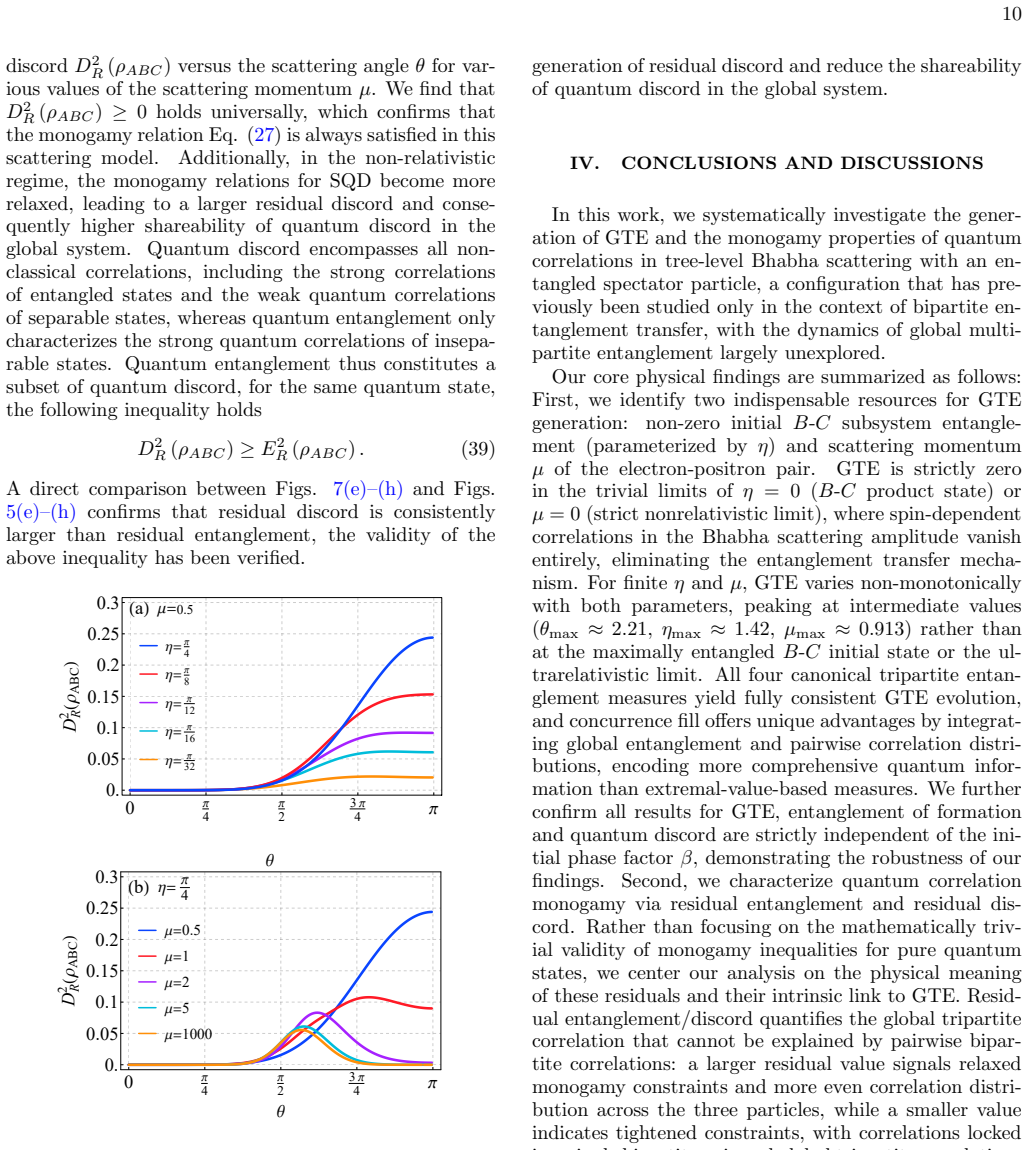
From the perspective of quantum information science, we investigate tree-level Bhabha scattering between an incident electron $A$ and a positron $B$, where $B$ is initially entangled with a spectator electron $C$, which does not participate in the scattering interaction. We find that the quantum electrodynamics (QED) scattering between $A$ and $B$ can drive the global $ABC$ system into a genuine tripartite entangled (GTE) state. Using four canonical tripartite entanglement metrics, we systematically characterize and quantify the GTE of the composite system, and demonstrate that the scattering momentum of the $A$-$B$ pair and the initial $B$-$C$ entanglement are the key resources governing GTE generation. We further analyze the monogamy of quantum correlations, which imposes fundamental constraints on the shareability of quantum resources in multipartite systems. Specifically, we systematically study the monogamy relations for the squared entanglement of formation and squared quantum discord in our scattering model, and find that monogamy constraints are markedly relaxed in the non-relativistic regime, enabling enhanced shareability of quantum correlations across the three particles. This work uncovers novel quantum correlation properties of fundamental QED scattering processes, and provides direct theoretical guidance for the development of QED-based quantum information processing protocols.
Figures


Forward citations
Cited by 1 Pith paper
-
Binary Gauss Stabilizers for Abelian Lattice Gauge Theories
Binary Gauss stabilizers provide a non-Pauli stabilizer description of the physical subspace of Z_{2^η} lattice gauge theories, enabling bit-flip error correction and gauge fixing from gauge constraints alone.
Reference graph
Works this paper leans on
-
[1]
Generalized geometric measure The GGM [44–46] quantifies the degree of genuine mul- tipartite entanglement for an arbitraryn-partite pure state|ψ N ⟩. It is defined as the optimal distance between the given state and the set of non-genuine multipartite entangled states. Its explicit form is given below G(|ψN ⟩) = 1−Λ 2 max(|ψN ⟩),(10) where Λmax (|ψN ⟩) =...
-
[2]
Following the approach outlined in Ref
Three-πentanglement For a tripartite pure state|ψ⟩ ABC, the Coff- man–Kundu–Wootters (CKW)-like monogamy inequal- ity quantified via negativity [54] is given by N2 AB +N 2 AC ≤N 2 A(BC) ,(13) whereN AB andN AC denote the sum of the negative eigenvalues of the partial transpose matrices of the re- duced statesρ AB = TrC(ρABC) andρ AC = TrB(ρABC), respectiv...
-
[3]
Genuinely multipartite concurrence The GMC is a computable measure for quantifying multipartite entanglement, based on the well-known con- currence [48]. For ann-partite pure state|Ψ⟩ ∈ H 1⊗H2⊗ · · · ⊗ Hn, the GMC is defined as CGMC(|Ψ⟩) = min γi∈γ q 2[1−Tr(ρ 2 Aγi )] (18) whereγ={γ i}represents the entire set of all possible bipartitions{A i|Bi}of the se...
-
[4]
Concurrence fill For tripartite entangled states, concurrence fill was in- troduced as a robust entanglement measure based on the entanglement triangle area method [49]. In this formu- lation, the side lengths of the triangle are equal to the squares of the three bipartite concurrences. With Heron’s triangle area formula, the concurrence fill is defined a...
-
[5]
Monogamy relation for SEF For an arbitrary two-qubit stateρ AB, Wootters [58] derived an explicit analytical expression for the entan- glement of formation. Ef (ρAB) =H 1 + q 1− |C(ρ AB)|2 2 ,(22) whereH(x) =−xlog 2 x−(1−x) log 2(1−x) is the binary entropy,C(ρ AB) = max √λ1 − √λ2 − √λ3 − √λ4,0 denotes the concurrence of the density matrixρAB. Here,...
-
[6]
Monogamy relation for SQD Apart from entanglement, quantum discord (QD) is another pivotal measure of bipartite quantum correla- tion, with its formal definition provided in Refs. [59, 60] D(ρAB) = eS(ρA|ρB)−S(ρ A|ρB),(24) where eS(ρA|ρB) = min {M B j } P j pjS ρA|j denotes the measurement-induced quantum conditional entropy. Here,{M B j }is a positive op...
- [7]
- [8]
-
[9]
R. Horodecki, P. Horodecki, M. Horodecki, and K. Horodecki, Rev. Mod. Phys.81, 865 (2009)
work page 2009
- [10]
- [11]
-
[12]
D. R. Terno,Quantum Information Processing: From Theory to Experiment, edited by D. G. Angelakis et al.(IOP Press, Amsterdam, 2006)
work page 2006
-
[13]
S. R. Beane, D. B. Kaplan, N. Klco, and M. J. Savage, Phys. Rev. Lett.112, 102001 (2019). 13
work page 2019
- [14]
- [15]
- [16]
-
[17]
G. A. Miller, Phys. Rev. C108, L041601 (2023)
work page 2023
-
[18]
J. Fan, G. M. Deng, and X. J. Ren, Phys. Rev. D104, 116021 (2021)
work page 2021
- [19]
- [20]
- [21]
-
[22]
D. E. Kharzeev and E. M. Levin, Phys. Rev. D95, 114008 (2017)
work page 2017
-
[23]
M. Blasone, S. De Siena, G. Lambiase, C. Matrella, and B. Micciola, Phys. Rev. D111, 016007 (2025)
work page 2025
-
[24]
B. L. Ye, L. Y. Xue, Z. Q. Zhu, D. D. Shi, and S. M. Fei, Phys. Rev. D110, 055025 (2024)
work page 2024
-
[25]
M. Fabbrichesi, R. Floreanini, and G. Panizzo, Phys. Rev. Lett.127, 161801 (2021)
work page 2021
-
[26]
J. Bernabeu, A. Di Domenico, and P. Villanueva-Perez, J. High Energy Phys. 10 (2015) 139
work page 2015
- [27]
- [28]
- [29]
-
[30]
Y. Afik, Y. Kats, J. R. Mu˜ noz de Nova, A. Soffer, and D. Uzan, Phys. Rev. D111, L111902 (2025)
work page 2025
-
[31]
M. Blasone, F. Dell’Anno, S. De Siena, and F. Illuminati, Europhys. Lett.106, 30002 (2014)
work page 2014
-
[32]
M. Blasone, F. Dell’Anno, S. De Siena, and F. Illuminati, Adv. High Energy Phys.2014, 359168 (2014)
work page 2014
-
[33]
V. Bittencourt, M. Blasone, and G. Zanfardino, J. Phys. Conf. Ser.2533, 012024 (2023)
work page 2023
-
[34]
J. A. Formaggio, D. I. Kaiser, M. M. Murskyj, and T. E. Weiss, Phys. Rev. Lett.117, 050402 (2016)
work page 2016
- [35]
-
[36]
M. Blasone, F. Illuminati, L. Petruzziello, and L. Smal- done, Phys. Rev. A108, 032210 (2023)
work page 2023
-
[37]
D. Gangopadhyay, D. Home, and A. S. Roy, Phys. Rev. A88, 022115 (2013)
work page 2013
-
[38]
X. K. Song, Y. Huang, J. Ling, and M. H. Yung, Phys. Rev. A98, 050302 (2018)
work page 2018
-
[39]
F. Ming, X. K. Song, J. Ling, L. Ye, and D. Wang, Eur. Phys. J. C80, 275 (2020)
work page 2020
-
[40]
D. Wang, F. Ming, X. K. Song, L. Ye, and J. L. Chen, Eur. Phys. J. C800, 800 (2020)
work page 2020
-
[41]
Y. W. Li, L. J. Li, X. K. Song, D. Wang, and L. Ye, Eur. Phys. J. C82, 799 (2022)
work page 2022
-
[42]
G. J. Wang, L. J. Li, X. K. Song, and D. Wang, Eur. Phys. J. C83, 801 (2023)
work page 2023
-
[43]
A. Cervera-Lierta, J. I. Latorre, J. Rojo, and L. Rottoli, SciPost Phys.3, 036 (2017)
work page 2017
-
[44]
Maximal Entanglement: Applications in Quantum Information and Particle Physics
A. Cervera-Lierta, arXiv:1906.12099
work page internal anchor Pith review Pith/arXiv arXiv 1906
-
[45]
B. Massimo, G. L. Silvio De Siena, M. Cristina, and M. Bruno, arXiv:2505.06878
-
[46]
J. B. Araujo, B. Hiller, I. G. da Paz, Manoel M. Ferreira, Marcos Sampaio, and H. A. S. Costa, Phys. Rev. D100, 105018 (2019). spectator particle
work page 2019
-
[47]
J. D. Fonseca, B. Hiller, J. B. Araujo, I. G. da Paz, and M. Sampaio, Phys. Rev. D106, 056015 (2022)
work page 2022
- [48]
- [49]
- [50]
-
[51]
T. Das, S. Singha Roy, S. Bagchi, A. Misra, A. Sen(De), and U. Sen, Phys. Rev. A94, 022336 (2016)
work page 2016
-
[52]
D. Sadhukhan, S. S. Roy, A. K. Pal, D. Rakshit, A. Sen(De), and U. Sen, Phys. Rev. A95, 022301 (2017)
work page 2017
-
[53]
Y. C. Ou and H. Fan, Phys. Rev. A75, 062308 (2007)
work page 2007
-
[54]
Z. H. Ma, Z. H. Chen, and J. L. Chen, Phys. Rev. A83, 062325 (2011)
work page 2011
-
[55]
S. B. Xie and J. H. Eberly, Phys. Rev. Lett.127, 040403 (2021)
work page 2021
-
[56]
Y. K. Bai, Y. F. Xu, and Z. D. Wang, Phys. Rev. Lett. 113, 100503 (2014)
work page 2014
-
[57]
Y. K. Bai, N. Zhang, M. Y. Ye, and Z. D. Wang, Phys. Rev. A88, 012123 (2013)
work page 2013
-
[58]
S. M. Zangi, C. Shukla, A. u. Rahman, and B. Zheng, Entropy25, 415 (2023)
work page 2023
-
[59]
T. L. Wang, P. Wang, Z. A. Zhao, S. Zhang, R. Z. Zhao, X. Y. Yang, H. F. Zhang, Z. F. Li, and Y. Wu, PRX Quantum7, 010348 (2026)
work page 2026
-
[60]
T. J. Osborne and F. Verstraete, Phys. Rev. Lett.96, 20503 (2006)
work page 2006
-
[61]
D. A. Meyer and N. R. Wallach, J. Math. Phys.43, 4273 (2002)
work page 2002
-
[62]
G. K. Brennen, Quantum Inf. Comput.3, 619 (2003)
work page 2003
- [63]
-
[64]
W. K. Wootters, Phys. Rev. Lett.88, 2245 (1998)
work page 1998
- [65]
- [66]
- [67]
- [68]
-
[69]
A. Hayrapetyan et al. (CMS Collaboration), Rep. Prog. Phys.87, 117801 (2024)
work page 2024
-
[70]
A. Hayrapetyan et al. (CMS Collaboration) Phys. Rev.D 110, 112016 (2024)
work page 2024
- [71]
-
[72]
A. Abada et al. (FCC Collaboration), Eur. Phys. J. Spe- cial Topics228, 261 (2019)
work page 2019
-
[73]
H. J. Kimble, Nature (London)453, 1023 (2008)
work page 2008
-
[74]
Y. P. Zhong, H. S. Chang, A. Bienfait, ´E. Dumur, M. H. Chou, C. R. Conner, J. Grebel, R. G. Povey, H. X. Yan, D. I. Schuster, and A. N. Cleland Nature (London)590, 571 (2021)
work page 2021
discussion (0)
Sign in with ORCID, Apple, or X to comment. Anyone can read and Pith papers without signing in.