Nonperturbative Nonlinear Hall Effect in Nonequilibrium Steady States
Pith reviewed 2026-07-03 18:03 UTC · model grok-4.3
The pith
Nonequilibrium Green's functions enable nonperturbative calculation of nonlinear Hall response in strong dc fields.
A machine-rendered reading of the paper's core claim, the machinery that carries it, and where it could break.
Core claim
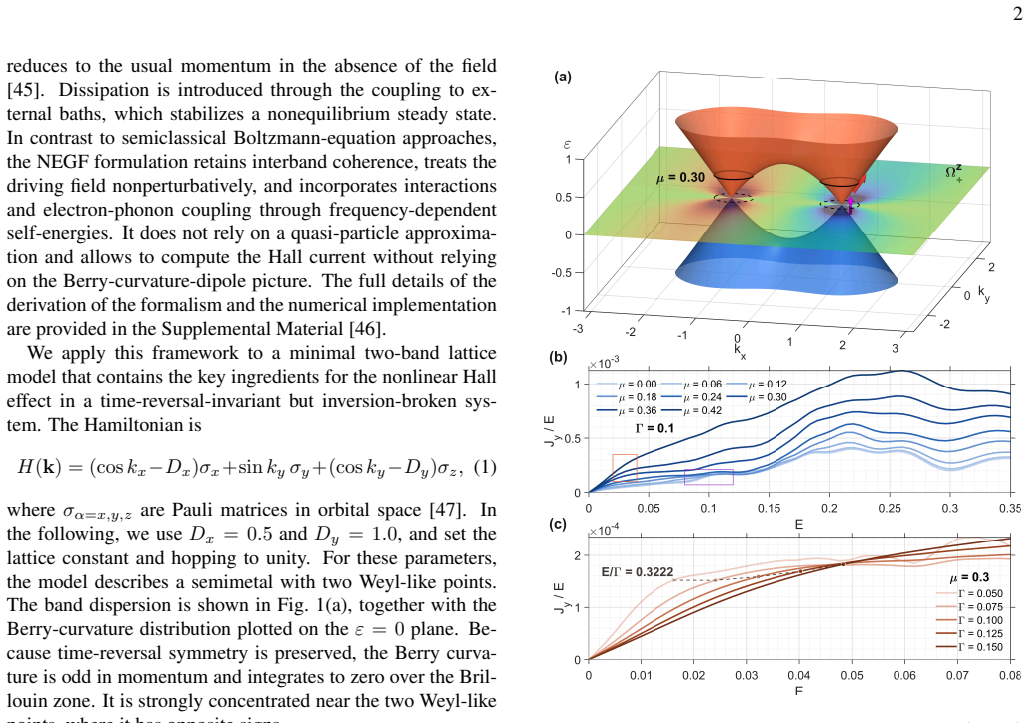
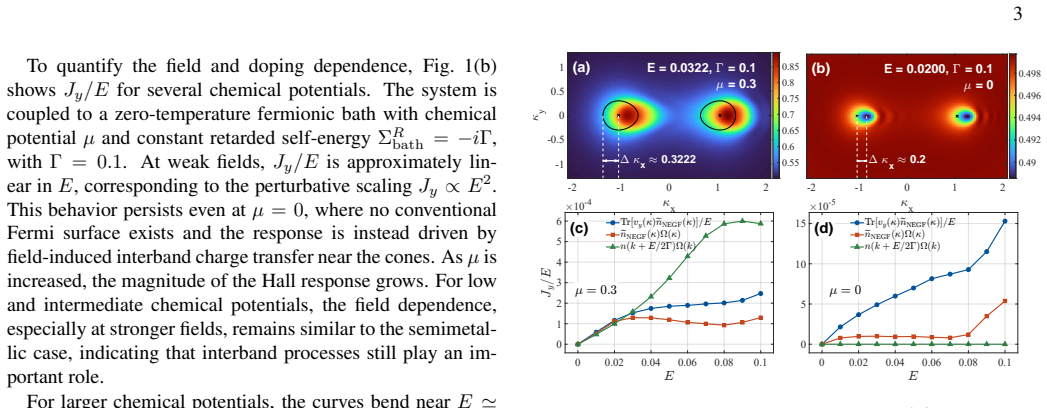
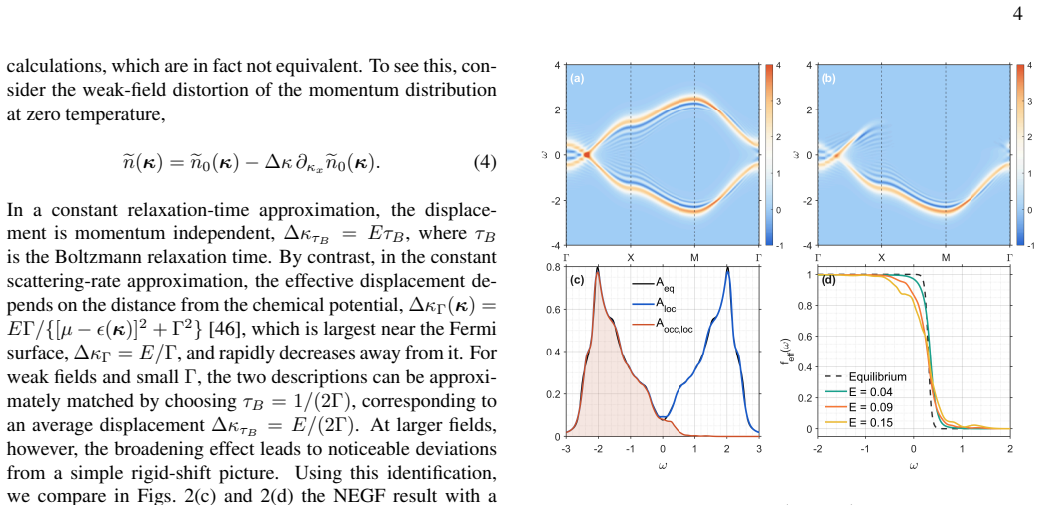
We develop a nonperturbative approach based on nonequilibrium steady-state Green's functions for dc-field-driven lattice systems, with dissipation and interactions incorporated through self-energies beyond the constant relaxation-time approximation and interband transitions treated alongside their intraband counterparts. Applied to a two-band semimetal model, our approach provides direct access to the strong-field Hall response beyond the nonperturbative crossover where the edge of the nonequilibrium distribution reaches Berry-curvature hot spots, a regime in which constant relaxation-time estimates and Berry curvature dipole calculations become unreliable. We further demonstrate that intera
What carries the argument
Nonequilibrium steady-state Green's functions with self-energies that incorporate dissipation and interactions
If this is right
- The Hall response remains computable after the nonequilibrium distribution reaches Berry-curvature hot spots.
- Constant-relaxation-time and Berry-curvature-dipole approximations lose reliability in the strong-field regime.
- Dynamical mean-field theory interactions produce substantial quantitative changes to the Hall signal.
- The framework supports quantitative simulations of nonequilibrium nonlinear Hall phenomena in lattice systems.
Where Pith is reading between the lines
- The same Green's-function construction could be used to compute other nonlinear dc transport coefficients once the distribution function is obtained self-consistently.
- Strong-field Hall measurements on semimetals may be able to distinguish between different interaction channels if the DMFT self-energies are replaced by more material-specific ones.
- The crossover field strength identified by the method offers a concrete target for experiments that ramp dc bias until the distribution edge reaches known Berry-curvature concentrations.
Load-bearing premise
Dynamical mean-field theory self-energies sufficiently capture the relevant dissipation and interaction effects for the nonlinear Hall response in the chosen two-band model without requiring more microscopic details.
What would settle it
A measurement of the Hall conductivity in the two-band semimetal model that continues to follow constant-relaxation-time predictions even after the nonequilibrium distribution edge reaches the Berry-curvature hot spots would show the nonperturbative corrections are not required.
Figures
read the original abstract
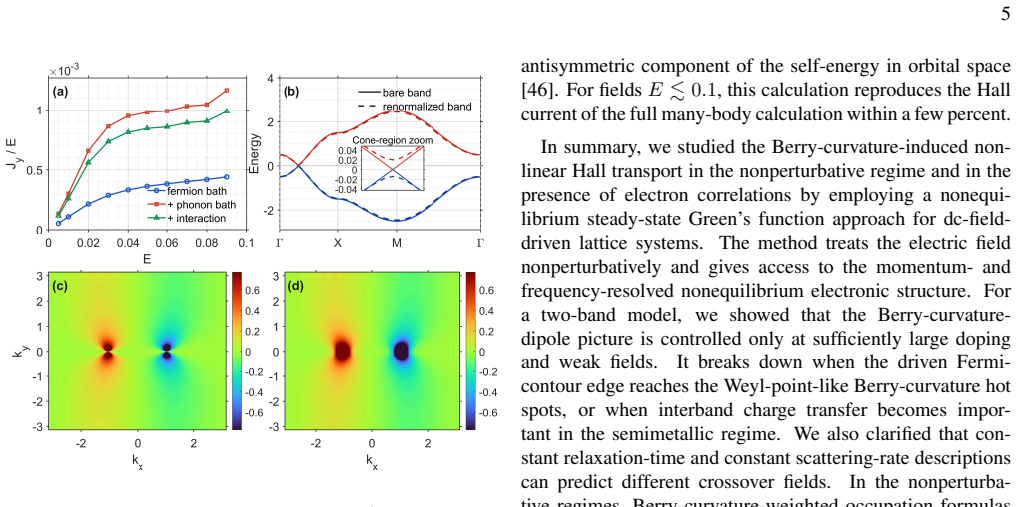
The nonlinear Hall effect in quantum materials has attracted broad interest, yet most existing studies focus on the weak-field, perturbative regime. Here we develop a nonperturbative approach based on nonequilibrium steady-state Green's functions for dc-field-driven lattice systems, with dissipation and interactions incorporated through self-energies beyond the constant relaxation-time approximation and interband transitions treated alongside their intraband counterparts. Applied to a two-band semimetal model, our approach provides direct access to the strong-field Hall response beyond the nonperturbative crossover where the edge of the nonequilibrium distribution reaches Berry-curvature hot spots, a regime in which constant relaxation-time estimates and Berry curvature dipole calculations become unreliable. We further demonstrate that interaction and electron-phonon self-energies within dynamical mean-field theory can substantially change the Hall signal. Our framework enables quantitative simulations of nonequilibrium nonlinear Hall phenomena and provides guidance for strong-field transport experiments.
Editorial analysis
A structured set of objections, weighed in public.
Referee Report
Summary. The manuscript develops a nonperturbative framework based on nonequilibrium steady-state Green's functions for dc-field-driven lattice systems to compute the nonlinear Hall effect, incorporating dissipation and interactions via self-energies beyond the constant relaxation-time approximation while treating interband and intraband transitions on equal footing; it applies this to a two-band semimetal model to access the strong-field regime past the crossover where the nonequilibrium distribution edge reaches Berry-curvature hot spots, claims that constant-relaxation-time and Berry-dipole methods become unreliable there, and shows that DMFT interaction and electron-phonon self-energies can substantially alter the Hall signal.
Significance. If the numerical implementation and results hold, the approach would offer a concrete route to quantitative nonequilibrium transport calculations in strong-field regimes inaccessible to perturbative methods, with explicit demonstration that self-energy effects beyond constant relaxation time modify the nonlinear Hall response in a two-band model.
major comments (2)
- [Abstract] Abstract and main text: the central claim that the method provides 'direct access' to the strong-field Hall response beyond the nonperturbative crossover, and that constant-relaxation-time estimates and Berry curvature dipole calculations become unreliable, is asserted without any derivations, explicit formulas for the current or Hall conductivity, numerical data, or error analysis in the available manuscript text, so the support for the claim cannot be assessed.
- [Abstract] Abstract: the statement that 'interaction and electron-phonon self-energies within dynamical mean-field theory can substantially change the Hall signal' is presented as a demonstration, yet no specific model parameters, self-energy forms, or comparative plots/results are supplied, leaving the magnitude and robustness of this change unverified.
Simulated Author's Rebuttal
We thank the referee for their detailed reading of our manuscript. The full text contains the derivations, explicit formulas, numerical data, and comparisons referenced in the abstract; we address the points below and will revise to improve clarity and cross-referencing.
read point-by-point responses
-
Referee: [Abstract] Abstract and main text: the central claim that the method provides 'direct access' to the strong-field Hall response beyond the nonperturbative crossover, and that constant-relaxation-time estimates and Berry curvature dipole calculations become unreliable, is asserted without any derivations, explicit formulas for the current or Hall conductivity, numerical data, or error analysis in the available manuscript text, so the support for the claim cannot be assessed.
Authors: The nonperturbative framework, including the nonequilibrium Green's function formalism and current expression, is derived in Section II with explicit formulas for the Hall conductivity in Eqs. (7)–(9). Numerical results demonstrating direct access beyond the crossover, together with comparisons showing unreliability of constant-relaxation-time and Berry-dipole approaches, appear in Figs. 2–4; error analysis from the iterative solver is provided in the methods and supplementary material. We will revise the abstract and introduction to add explicit citations to these equations and figures. revision: yes
-
Referee: [Abstract] Abstract: the statement that 'interaction and electron-phonon self-energies within dynamical mean-field theory can substantially change the Hall signal' is presented as a demonstration, yet no specific model parameters, self-energy forms, or comparative plots/results are supplied, leaving the magnitude and robustness of this change unverified.
Authors: Model parameters for the two-band semimetal are specified in Sec. III A. The DMFT interaction and electron-phonon self-energies are defined in Sec. II C; comparative results quantifying the change in the Hall signal are shown in Figs. 4 and 5. We will add a brief sentence in the abstract or main text with direct references to these sections and figures to make the demonstration explicit. revision: yes
Circularity Check
No significant circularity; minor self-citation not load-bearing
full rationale
The paper presents a method based on nonequilibrium steady-state Green's functions with DMFT self-energies applied to a two-band semimetal model. The strongest claim concerns direct numerical access to the strong-field Hall response beyond a defined crossover regime, with explicit statements that constant-relaxation-time and Berry-dipole approximations become unreliable there. No equations or results are shown to reduce by construction to fitted inputs, renamed empirical patterns, or self-citation chains. The derivation chain is self-contained against external benchmarks, with any self-citations on DMFT techniques serving as standard methodological support rather than load-bearing justification for the Hall response itself.
Axiom & Free-Parameter Ledger
free parameters (1)
- Two-band semimetal model parameters
axioms (1)
- domain assumption Dynamical mean-field theory self-energies accurately represent dissipation and interactions for the Hall response.
Reference graph
Works this paper leans on
-
[1]
Sodemann and L
I. Sodemann and L. Fu, Quantum nonlinear hall effect induced 6 by berry curvature dipole in time-reversal invariant materials, Phys. Rev. Lett.115, 216806 (2015)
2015
-
[2]
Du, H.-Z
Z. Du, H.-Z. Lu, and X. Xie, Nonlinear hall effects, Nat. Rev. Phys.3, 744 (2021)
2021
-
[3]
Bandyopadhyay, N
A. Bandyopadhyay, N. B. Joseph, and A. Narayan, Non-linear hall effects: Mechanisms and materials, Mater. Today Electron. 8, 100101 (2024)
2024
-
[4]
E. Deyo, L. Golub, E. Ivchenko, and B. Spivak, Semi- classical theory of the photogalvanic effect in non- centrosymmetric systems, arXiv preprint arXiv:0904.1917 10.48550/arXiv.0904.1917 (2009)
work page internal anchor Pith review Pith/arXiv arXiv doi:10.48550/arxiv.0904.1917 1917
-
[5]
J. E. Moore and J. Orenstein, Confinement-induced berry phase and helicity-dependent photocurrents, Phys. Rev. Lett.105, 026805 (2010)
2010
-
[6]
Ma, S.-Y
Q. Ma, S.-Y . Xu, H. Shen, D. MacNeill, V . Fatemi, A. M. Mier Valdivia, S. Wu, T.-R. Chang, Z. Du, C.-H. Hsu, Q. D. Gibson, S. Fang, E. Kaxiras, K. Watanabe, T. Taniguchi, R. J. Cava, H.-Z. Lu, H. Lin, L. Fu, N. Gedik, and P. Jarillo-Herrero, Observation of the nonlinear hall effect under time-reversal- symmetric conditions, Nature565, 337 (2019)
2019
-
[7]
K. Kang, T. Li, E. Sohn, J. Shan, and K. F. Mak, Nonlinear anomalous hall effect in few-layer WTe 2, Nat. Mater.18, 324 (2019)
2019
-
[8]
Kumar, C.-H
D. Kumar, C.-H. Hsu, R. Sharma, T.-R. Chang, P. Yu, J. Wang, G. Eda, G. Liang, and H. Yang, Room-temperature nonlinear hall effect and wireless radiofrequency rectification in weyl semimetal TaIrTe4, Nat. Nanotechnol.16, 421 (2021)
2021
-
[9]
Dzsaber, X
S. Dzsaber, X. Yan, M. Taupin, G. Eguchi, A. Prokofiev, T. Shiroka, P. Blaha, O. Rubel, S. E. Grefe, H.-H. Lai,et al., Giant spontaneous hall effect in a nonmagnetic weyl–kondo semimetal, Proc. Natl. Acad. Sci.118, e2013386118 (2021)
2021
-
[10]
H.-H. Lai, S. E. Grefe, S. Paschen, and Q. Si, Weyl–kondo semimetal in heavy-fermion systems, Proc. Natl. Acad. Sci. U.S.A.115, 93 (2018)
2018
-
[11]
Dzsaber, L
S. Dzsaber, L. Prochaska, A. Sidorenko, G. Eguchi, R. Svagera, M. Waas, A. Prokofiev, Q. Si, and S. Paschen, Kondo insulator to semimetal transformation tuned by spin-orbit coupling, Phys. Rev. Lett.118, 246601 (2017)
2017
-
[12]
Zhang, X.-J
C.-P. Zhang, X.-J. Gao, Y .-M. Xie, H. C. Po, and K. T. Law, Higher-order nonlinear anomalous hall effects induced by berry curvature multipoles, Phys. Rev. B107, 115142 (2023)
2023
-
[13]
Wang, R.-C
C. Wang, R.-C. Xiao, H. Liu, Z. Zhang, S. Lai, C. Zhu, H. Cai, N. Wang, S. Chen, Y . Deng, Z. Liu, S. A. Yang, and W.- B. Gao, Room-temperature third-order nonlinear hall effect in weyl semimetal TaIrTe4, Natl. Sci. Rev.9, nwac020 (2022)
2022
-
[14]
S. Lai, H. Liu, Z. Zhang, J. Zhao, X. Feng, N. Wang, C. Tang, Y . Liu, K. Xu, W. Duan, and W.-B. Gao, Third-order nonlinear hall effect induced by the berry-connection polarizability ten- sor, Nat. Nanotechnol.16, 869 (2021)
2021
-
[15]
Z. Z. Du, C. M. Wang, S. Li, H.-Z. Lu, and X. C. Xie, Disorder- induced nonlinear hall effect with time-reversal symmetry, Nat. Commun.10, 3047 (2019)
2019
-
[16]
Nandy and I
S. Nandy and I. Sodemann, Symmetry and quantum kinetics of the nonlinear hall effect, Phys. Rev. B100, 195117 (2019)
2019
-
[17]
C. Xiao, Z. Z. Du, and Q. Niu, Theory of nonlinear hall ef- fects: Modified semiclassics from quantum kinetics, Phys. Rev. B100, 165422 (2019)
2019
-
[18]
Z. Z. Du, C. M. Wang, H.-P. Sun, H.-Z. Lu, and X. C. Xie, Quantum theory of the nonlinear hall effect, Nat. Commun.12, 5038 (2021)
2021
-
[19]
Kaplan, T
D. Kaplan, T. Holder, and B. Yan, Unifying semiclassics and quantum perturbation theory at nonlinear order, SciPost Phys. 14, 082 (2023)
2023
-
[20]
Michishita and N
Y . Michishita and N. Nagaosa, Dissipation and geometry in nonlinear quantum transports of multiband electronic systems, Phys. Rev. B106, 125114 (2022)
2022
-
[21]
Tokura and N
Y . Tokura and N. Nagaosa, Nonreciprocal responses from non- centrosymmetric quantum materials, Nat. Commun.9, 3740 (2018)
2018
-
[22]
Y . Fang, S. Sur, Y . Xie, and Q. Si, Nonlinear thermal and ther- moelectric transport from quantum geometry, arXiv preprint arXiv:2505.16999 https://doi.org/10.48550/arXiv.2505.16999 (2025)
work page internal anchor Pith review Pith/arXiv arXiv doi:10.48550/arxiv.2505.16999 2025
-
[23]
Y . Gao, S. A. Yang, and Q. Niu, Field induced positional shift of bloch electrons and its dynamical implications, Phys. Rev. Lett.112, 166601 (2014)
2014
-
[24]
C. Wang, Y . Gao, and D. Xiao, Intrinsic nonlinear hall effect in antiferromagnetic tetragonal CuMnAs, Phys. Rev. Lett.127, 277201 (2021)
2021
-
[25]
H. Liu, J. Zhao, Y .-X. Huang, W. Wu, X.-L. Sheng, C. Xiao, and S. A. Yang, Intrinsic second-order anomalous hall effect and its application in compensated antiferromagnets, Phys. Rev. Lett. 127, 277202 (2021)
2021
-
[26]
Kaplan, T
D. Kaplan, T. Holder, and B. Yan, General nonlinear hall cur- rent in magnetic insulators beyond the quantum anomalous hall effect, Nat. Commun.14, 3053 (2023)
2023
-
[27]
Kaplan, T
D. Kaplan, T. Holder, and B. Yan, Unification of nonlinear anomalous hall effect and nonreciprocal magnetoresistance in metals by the quantum geometry, Phys. Rev. Lett.132, 026301 (2024)
2024
-
[28]
Gao, Y .-F
A. Gao, Y .-F. Liu, J.-X. Qiu, B. Ghosh, T. V . Trevisan, Y . On- ishi, C. Hu, T. Qian, H.-J. Tien, S.-W. Chen, M. Huang, D. B ´erub´e, H. Li, C. Tzschaschel, T. Dinh, Z. Sun, S.-C. Ho, S.-W. Lien, B. Singh, K. Watanabe, T. Taniguchi, D. C. Bell, H. Lin, T.-R. Chang, C. R. Du, A. Bansil, L. Fu, N. Ni, P. P. Orth, Q. Ma, and S.-Y . Xu, Quantum metric nonli...
2023
-
[29]
N. Wang, D. Kaplan, Z. Zhang, T. Holder, N. Cao, A. Wang, X. Zhou, F. Zhou, Z. Jiang, C. Zhang, S. Ru, H. Cai, K. Watan- abe, T. Taniguchi, B. Yan, and W. Gao, Quantum-metric- induced nonlinear transport in a topological antiferromagnet, Nature621, 487 (2023)
2023
- [30]
-
[31]
Ultrafast nonlinear Hall effect in black phosphorus
M. Dendzik, A. Marini, S. Beaulieu, S. Dong, T. Pincelli, J. Maklar, R. P. Xian, E. Perfetto, M. Wolf, G. Stefanucci, et al., Ultrafast nonlinear hall effect in black phosphorus, arXiv preprint arXiv:2604.06083 (2026)
work page internal anchor Pith review Pith/arXiv arXiv 2026
-
[32]
Li and M
J. Li and M. Eckstein, Nonequilibrium steady-state theory of photodoped mott insulators, Phys. Rev. B103, 045133 (2021)
2021
-
[33]
Murakami, D
Y . Murakami, D. Goleˇz, M. Eckstein, and P. Werner, Photoin- duced nonequilibrium states in mott insulators, Rev. Mod. Phys. 97, 035001 (2025)
2025
- [34]
-
[35]
L. Geng, S. Ray, and P. Werner, Photoinduced excitonic mag- netism in a multiorbital hubbard system, Phys. Rev. B113, 035143 (2026)
2026
-
[36]
L. Geng, A. J. Kim, and P. Werner, Third-order strong-coupling impurity solver for real-frequency dynamical mean field the- ory: Accurate spectral functions for antiferromagnetic and photodoped states, Phys. Rev. B112, 245119 (2025)
2025
-
[37]
Murakami and P
Y . Murakami and P. Werner, Nonequilibrium steady states of electric field driven mott insulators, Phys. Rev. B98, 075102 (2018). 7
2018
-
[38]
J. Li, C. Aron, G. Kotliar, and J. E. Han, Electric-field-driven resistive switching in the dissipative hubbard model, Phys. Rev. Lett.114, 226403 (2015)
2015
-
[39]
J. E. Han, J. Li, C. Aron, and G. Kotliar, Nonequilibrium mean- field theory of resistive phase transitions, Phys. Rev. B98, 035145 (2018)
2018
-
[40]
C. Aron, G. Kotliar, and C. Weber, Dimensional crossover driven by an electric field, Phys. Rev. Lett.108, 086401 (2012)
2012
-
[41]
Aron, Dielectric breakdown of a mott insulator, Phys
C. Aron, Dielectric breakdown of a mott insulator, Phys. Rev. B86, 085127 (2012)
2012
-
[42]
C. Aron, C. Weber, and G. Kotliar, Impurity model for non- equilibrium steady states, Phys. Rev. B87, 125113 (2013)
2013
-
[43]
H. J. Groenewold, On the principles of elementary quantum me- chanics, inOn the principles of elementary quantum mechanics (Springer, 1946) pp. 1–56
1946
-
[44]
J. E. Moyal, Quantum mechanics as a statistical theory, inMath- ematical Proceedings of the Cambridge Philosophical Society, V ol. 45 (Cambridge University Press, 1949) pp. 99–124
1949
-
[45]
Thus formulas written in terms of the ordinary momentum argument can be used in the gauge-covariant representation by evaluating them atκ
More precisely, the Green’s function written as a function of κis the gauge-covariant Wigner Green’s function ˜G(X,κ) = G(X,κ+qA(X)), whereA(X)is the vector potential. Thus formulas written in terms of the ordinary momentum argument can be used in the gauge-covariant representation by evaluating them atκ
-
[46]
See supplemental material at [url will be inserted by publisher] for the derivation of the gauge-covariant steady-state green’s- function formalism, details of the numerical implementation, and additional results
-
[47]
In a minimal linearizedk·pmodel of a single cone, a tilt term proportional toσ 0 is needed to reproduce the asymmet- ric nonequilibrium distribution near the cone. In Eq. (1), this effect arises from the full lattice momentum dependence, and no explicitσ 0 term is required
-
[48]
Gradhand, D
M. Gradhand, D. Fedorov, F. Pientka, P. Zahn, I. Mertig, and B. Gy¨orffy, First-principle calculations of the berry curvature of bloch states for charge and spin transport of electrons, Journal of Physics: Condensed Matter24, 213202 (2012)
2012
-
[49]
Culcer, A
D. Culcer, A. Sekine, and A. H. MacDonald, Interband coher- ence response to electric fields in crystals: Berry-phase contri- butions and disorder effects, Phys. Rev. B96, 035106 (2017)
2017
-
[50]
This nearly uniform offset does not affect the Hall cur- rent, which is computed directly from the converged density matrix
The slight downward shift of the average occupation from0.5 originates from finite time- and momentum-grid discretization errors. This nearly uniform offset does not affect the Hall cur- rent, which is computed directly from the converged density matrix
-
[51]
H. Aoki, N. Tsuji, M. Eckstein, M. Kollar, T. Oka, and P. Werner, Nonequilibrium dynamical mean-field theory and its applications, Rev. Mod. Phys.86, 779 (2014)
2014
-
[52]
Onoda, N
S. Onoda, N. Sugimoto, and N. Nagaosa, Theory of non- equilibirum states driven by constant electromagnetic fields: —non-commutative quantum mechanics in the keldysh formal- ism—, Progress of theoretical physics116, 61 (2006)
2006
-
[53]
J. K. Freericks and V . M. Turkowski, Steady-state nonequilib- rium dynamical mean-field theory and the quantum boltzmann equation, J. Phys.: Conf. Ser.35, 39 (2006)
2006
-
[54]
Bertoncini and A
R. Bertoncini and A. P. Jauho, Gauge-invariant formulation of the intracollisional field effect including collisional broadening, Phys. Rev. B44, 3655 (1991)
1991
-
[55]
J. E. Han, Solution of electric-field-driven tight-binding lattice coupled to fermion reservoirs, Phys. Rev. B87, 085119 (2013)
2013
-
[56]
Z. Dai, M. Manjappa, Y . Yang, T. C. W. Tan, B. Qiang, S. Han, L. J. Wong, F. Xiu, W. Liu, and R. Singh, High mobility 3d dirac semimetal (Cd3As2) for ultrafast photoactive terahertz photon- ics, Advanced Functional Materials31, 2011011 (2021)
2021
-
[57]
Neupane, S.-Y
M. Neupane, S.-Y . Xu, R. Sankar, N. Alidoust, G. Bian, C. Liu, I. Belopolski, T.-R. Chang, H.-T. Jeng, H. Lin,et al., Ob- servation of a three-dimensional topological dirac semimetal phase in high-mobility cd3as2, Nature communications5, 3786 (2014)
2014
-
[58]
Mosca Conte, O
A. Mosca Conte, O. Pulci, and F. Bechstedt, Electronic and op- tical properties of topological semimetal cd3as2, Scientific Re- ports7, 45500 (2017)
2017
-
[59]
J. P. Carbotte, E. J. Nicol, and S. G. Sharapov, Effect of electron-phonon interaction on spectroscopies in graphene, Phys. Rev. B81, 045419 (2010)
2010
-
[60]
D ´ora and R
B. D ´ora and R. Moessner, Nonlinear electric transport in graphene: Quantum quench dynamics and the schwinger mech- anism, Phys. Rev. B81, 165431 (2010)
2010
-
[61]
Nonperturbative Nonlinear Hall Effect in Nonequilibrium Steady States
D. Allor, T. D. Cohen, and D. A. McGady, Schwinger mecha- nism and graphene, Phys. Rev. D78, 096009 (2008). Supplemental Material for “Nonperturbative Nonlinear Hall Effect in Nonequilibrium Steady States” STEADY-STA TE FORMALISM BASED ON NONEQUILIBRIUM GREEN’S FUNCTIONS Moyal product The nonlinear Hall effect under a constant electric field, and in the p...
2008
discussion (0)
Sign in with ORCID, Apple, or X to comment. Anyone can read and Pith papers without signing in.