Frustrated superradiant phases in one- and two-dimensional lattices
Pith reviewed 2026-06-28 05:46 UTC · model grok-4.3
The pith
Frustration in coupled Dicke lattices drives photonic density-wave ordering whose broken periodicity follows from the symmetric phase excitation spectrum.
A machine-rendered reading of the paper's core claim, the machinery that carries it, and where it could break.
Core claim
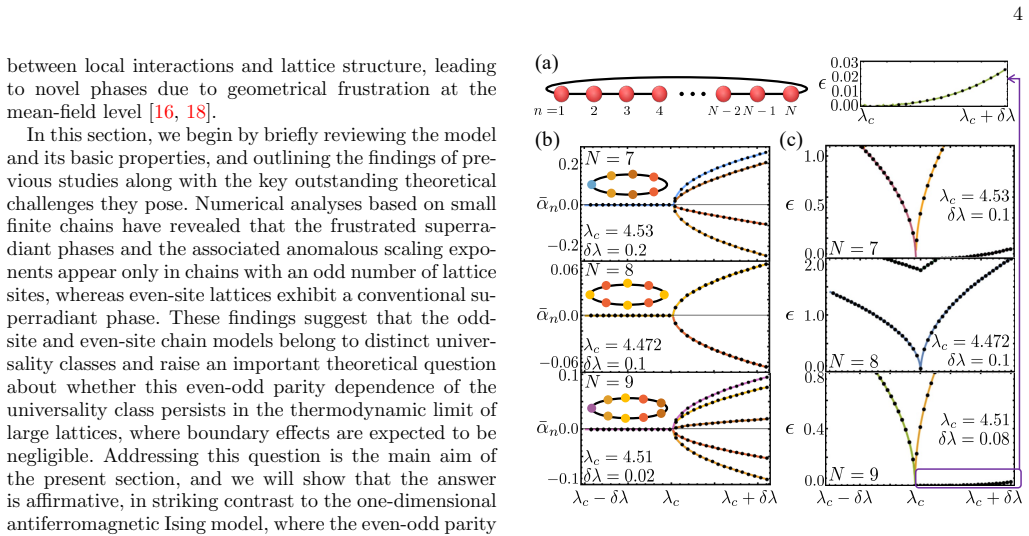
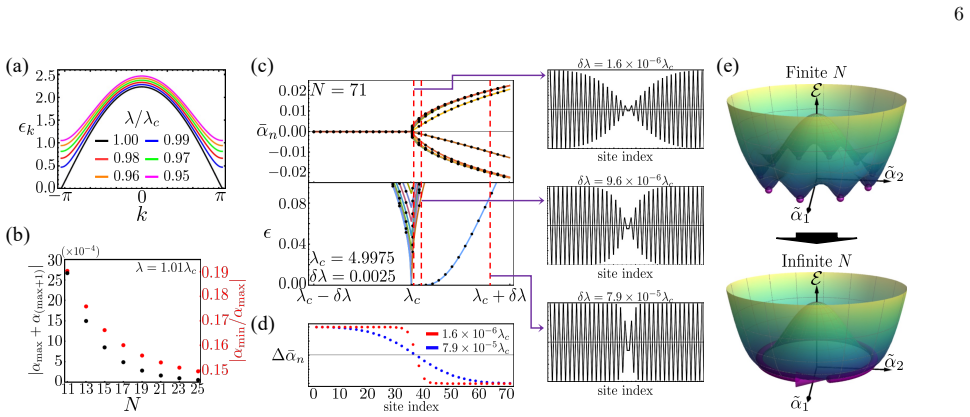
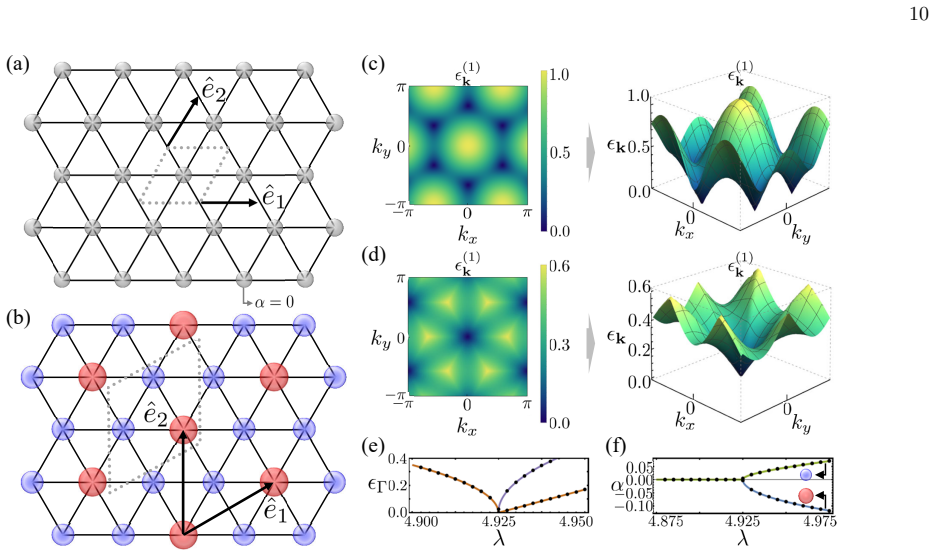
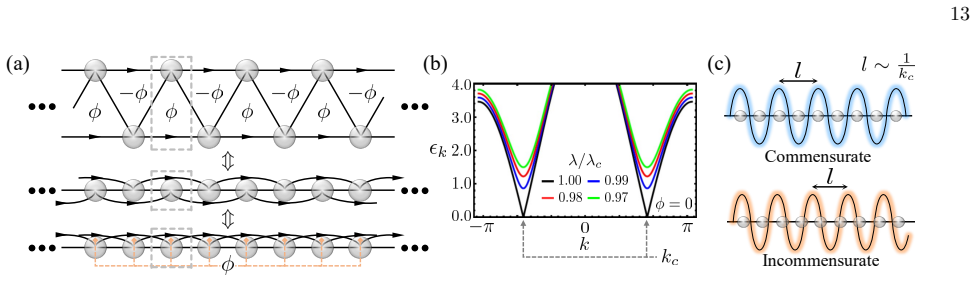
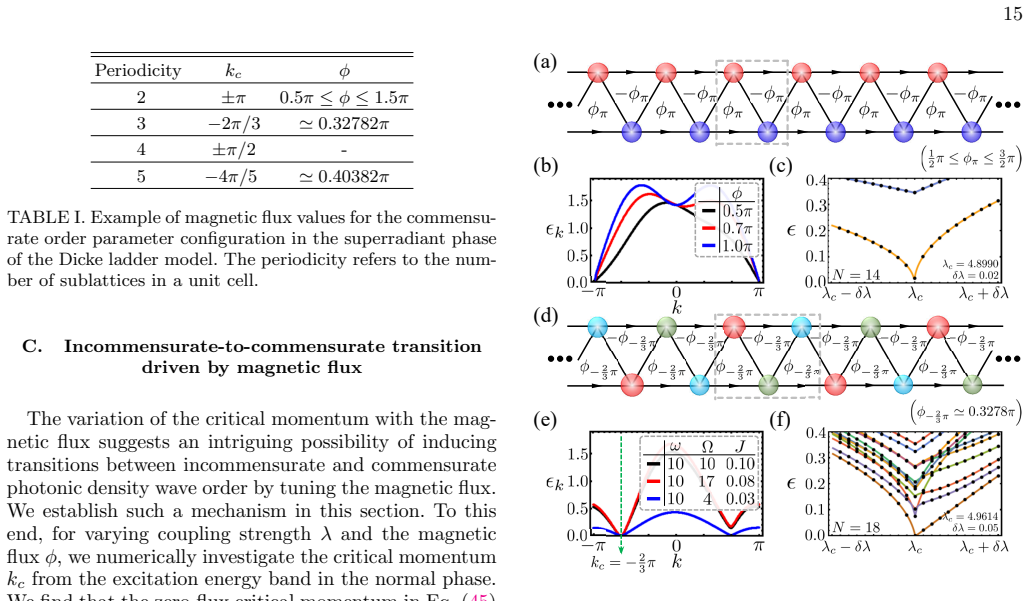
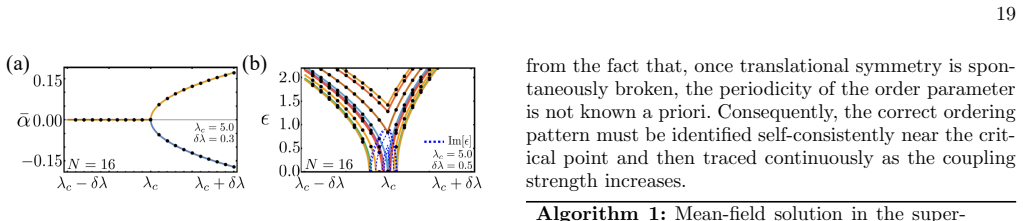
The central claim is that frustration between neighboring superradiant order parameters in large periodic Dicke lattices drives photonic density-wave ordering, with the resulting broken translational periodicity predictable from the excitation spectrum of the symmetric phase without requiring computationally prohibitive thermodynamic energy minimization. An emergent Nambu-Goldstone mode arises near the critical point in a one-dimensional chain, and the mechanism enabling this gapless excitation despite discrete symmetry is identified. Quasi-periodic ordering appears in the superradiant phase, and synthetic magnetic flux provides control over the nature of the translational symmetry breaking.
What carries the argument
The excitation spectrum of the symmetric superradiant phase, whose soft modes encode the wavevectors of the density-wave instabilities induced by frustration.
If this is right
- The periodicity of the density-wave order is set by the soft-mode wavevectors of the symmetric-phase spectrum.
- An emergent Nambu-Goldstone mode appears near the critical point in one-dimensional chains despite the presence of only discrete symmetry.
- Quasi-periodic ordering emerges in the superradiant phase, reminiscent of quasicrystals.
- Synthetic magnetic flux controls the character of the translational symmetry breaking.
Where Pith is reading between the lines
- The spectrum-based prediction method may reduce computational cost when mapping symmetry-broken phases in other systems that combine multiple thermodynamic limits.
- Flux tuning of periodicity could be used to design specific density-wave patterns in photonic or circuit-QED lattices.
- The coexistence of local and global thermodynamic limits may generate similar unconventional modes or orders in related light-matter Hamiltonians beyond the Dicke case.
Load-bearing premise
The ideal coupled Dicke lattice Hamiltonian with periodic boundaries, no dissipation, and infinite on-site emitter collectivity faithfully represents realizable systems in which the lattice-size and collective thermodynamic limits coexist without additional relevant scales or cutoffs.
What would settle it
An experimental realization of a frustrated Dicke lattice in which the measured photonic density-wave periodicity is compared against the wavevector of the soft mode in the symmetric-phase excitation spectrum.
Figures
read the original abstract
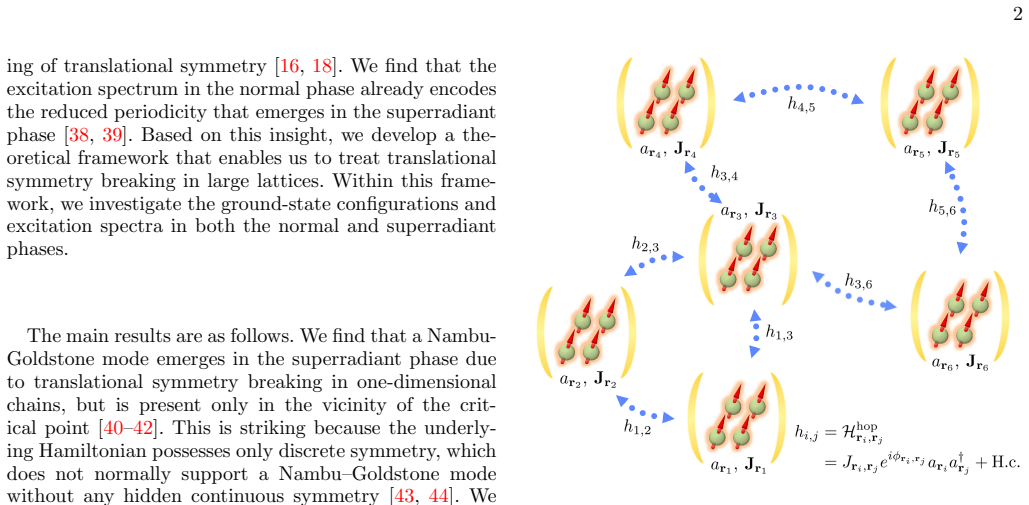
Understanding how frustration and symmetry breaking shape collective behavior is a central problem in quantum many-body systems. In this work, we investigate this problem in large one- and two-dimensional arrays of coupled Dicke models on a periodic lattice, where strong light-matter coupling gives rise to a superradiant phase and competition between neighboring order parameters induces spontaneous translational symmetry breaking. Such Dicke lattice models constitute a fundamentally new class of quantum many-body systems, as they simultaneously realize the thermodynamic limit associated with the lattice size and an intrinsic thermodynamic limit arising from collective on-site interactions with quantum emitters. We show that frustration drives photonic density-wave ordering, and that the resulting broken periodicity can be predicted from the excitation spectrum of the symmetric phase, without requiring computationally prohibitive thermodynamic energy minimization. Furthermore, we demonstrate that an emergent Nambu-Goldstone mode arises near the critical point in a one-dimensional chain despite the presence of only discrete symmetry, and uncover the mechanism that enables this otherwise forbidden gapless excitation. We also find quasi-periodic ordering in the superradiant phase, reminiscent of quasicrystals, and demonstrate that synthetic magnetic flux provides a powerful knob to control the nature of translational symmetry breaking. Our results establish a new direction in quantum many-body physics where the coexistence of local and global thermodynamic limits gives rise to unconventional symmetry breaking and emergent collective behavior.
Editorial analysis
A structured set of objections, weighed in public.
Referee Report
Summary. The manuscript investigates superradiant phases in one- and two-dimensional periodic lattices of coupled Dicke models. It claims that frustration induces spontaneous translational symmetry breaking into photonic density-wave ordered phases whose periodicity is directly predictable from the wavevector of the lowest-lying excitation in the symmetric phase, without needing full thermodynamic energy minimization. Additional results include an emergent Nambu-Goldstone mode in 1D chains (despite only discrete symmetry), quasi-periodic ordering reminiscent of quasicrystals, and control of the ordering via synthetic magnetic flux. The work emphasizes the coexistence of lattice and on-site collective thermodynamic limits.
Significance. If the spectrum-based prediction method is shown to be robust, the results would offer a computationally efficient diagnostic for identifying ordered phases in frustrated light-matter systems and would highlight unconventional symmetry-breaking mechanisms arising from dual thermodynamic limits. The tunability with synthetic flux and the quasi-periodic structures add potentially new directions for both theory and experiment in quantum optics many-body physics.
major comments (1)
- The central claim that the wavevector of the lowest-lying excitation in the symmetric phase determines the realized photonic density-wave periodicity assumes that linear soft-mode instability selects the global energy minimum. The manuscript must explicitly verify or argue that nonlinear terms, anharmonic corrections, or lattice commensurability effects do not shift the selected ordering wavevector away from the linear prediction, especially in 2D lattices or under synthetic flux where competing interactions are present.
minor comments (2)
- Clarify the precise definition of the coupled Dicke lattice Hamiltonian (including boundary conditions and the form of the inter-site coupling) early in the text, as the dual thermodynamic limits are central to the claims.
- The abstract refers to 'large' arrays; the manuscript should state the concrete system sizes and convergence checks used for the numerical spectra and ordering calculations.
Simulated Author's Rebuttal
We thank the referee for their careful reading and for highlighting the need to strengthen the justification of our central claim. We address the major comment below.
read point-by-point responses
-
Referee: The central claim that the wavevector of the lowest-lying excitation in the symmetric phase determines the realized photonic density-wave periodicity assumes that linear soft-mode instability selects the global energy minimum. The manuscript must explicitly verify or argue that nonlinear terms, anharmonic corrections, or lattice commensurability effects do not shift the selected ordering wavevector away from the linear prediction, especially in 2D lattices or under synthetic flux where competing interactions are present.
Authors: We agree that an explicit check against nonlinear effects is required to substantiate the claim. In the revised manuscript we will add a dedicated subsection performing direct numerical minimization of the mean-field energy functional on finite clusters (up to 8×8 in 2D and chains of length 32 in 1D) for representative points in the frustrated regime, both with and without synthetic flux. The ordering wavevectors obtained from energy minimization coincide with the soft-mode wavevectors of the symmetric-phase spectrum to within the Brillouin-zone discretization, with no shifts attributable to anharmonic or commensurability corrections inside the parameter window where the superradiant transition remains second-order. Outside this window the mean-field description itself ceases to be valid, so the linear prediction remains the appropriate diagnostic for the phases studied in the paper. revision: yes
Circularity Check
No significant circularity; spectrum-based prediction of ordering is independent of fitted inputs or self-citation chains
full rationale
The central claim—that broken periodicity is predictable from the symmetric-phase excitation spectrum without thermodynamic energy minimization—is presented as a diagnostic method rather than a tautology. No equations or steps in the abstract or described derivation reduce by construction to their own inputs (e.g., no fitted parameter renamed as prediction, no self-definitional mapping, and no load-bearing self-citation invoked to justify uniqueness). The approach relies on standard linear instability analysis, which is externally falsifiable via direct minimization or other methods and does not import ansatzes or uniqueness theorems from the authors' prior work. The derivation chain remains self-contained against external benchmarks.
Axiom & Free-Parameter Ledger
Forward citations
Cited by 1 Pith paper
-
Disorder-Induced Enhancement of Fermionic Superradiance
Disorder in fermionic cavity couplings yields a superradiant phase where multiple grey modes participate coherently, producing enhanced scaling of the condensate with system size unlike the single bright mode of unifo...
Reference graph
Works this paper leans on
-
[1]
Forn-D´ ıaz, L
P. Forn-D´ ıaz, L. Lamata, E. Rico, J. Kono, and E. Solano, Ultrastrong coupling regimes of light-matter interaction, Rev. Mod. Phys.91, 025005 (2019)
2019
-
[2]
I. M. Georgescu, S. Ashhab, and F. Nori, Quantum sim- ulation, Rev. Mod. Phys.86, 153 (2014)
2014
-
[3]
Blatt and C
R. Blatt and C. F. Roos, Quantum simulations with trapped ions, Nature Physics8, 277 (2012)
2012
-
[4]
A. A. Houck, H. E. T¨ ureci, and J. Koch, On-chip quan- tum simulation with superconducting circuits, Nature Physics8, 292 (2012)
2012
-
[5]
Ritsch, P
H. Ritsch, P. Domokos, F. Brennecke, and T. Esslinger, Cold atoms in cavity-generated dynamical optical po- tentials, Rev. Mod. Phys.85, 553 (2013)
2013
-
[6]
Altman, K
E. Altman, K. R. Brown, G. Carleo, L. D. Carr, E. Dem- ler, C. Chin, B. DeMarco, S. E. Economou, M. A. Eriks- son, K.-M. C. Fu, M. Greiner, K. R. Hazzard, R. G. Hulet, A. J. Koll´ ar, B. L. Lev, M. D. Lukin, R. Ma, X. Mi, S. Misra, C. Monroe, K. Murch, Z. Nazario, K.-K. Ni, A. C. Potter, P. Roushan, M. Saffman, M. Schleier- Smith, I. Siddiqi, R. Simmonds,...
2021
-
[7]
Baumann, C
K. Baumann, C. Guerlin, F. Brennecke, and T. Esslinger, Dicke quantum phase transition with a superfluid gas in an optical cavity, nature464, 1301 (2010)
2010
-
[8]
Klinder, H
J. Klinder, H. Keßler, M. Wolke, L. Mathey, and A. Hemmerich, Dynamical phase transition in the open dicke model, Proceedings of the National Academy of Sciences112, 3290 (2015)
2015
-
[9]
Hwang, R
M.-J. Hwang, R. Puebla, and M. B. Plenio, Quantum phase transition and universal dynamics in the rabi model, Physical review letters115, 180404 (2015)
2015
-
[10]
Yoshihara, T
F. Yoshihara, T. Fuse, S. Ashhab, K. Kakuyanagi, S. Saito, and K. Semba, Superconducting qubit– oscillator circuit beyond the ultrastrong-coupling regime, Nature Physics13, 44 (2017)
2017
-
[11]
J. Jin, D. Rossini, R. Fazio, M. Leib, and M. J. Hart- mann, Photon solid phases in driven arrays of nonlin- early coupled cavities, Phys. Rev. Lett.110, 163605 (2013)
2013
-
[12]
L. J. Zou, D. Marcos, S. Diehl, S. Putz, J. Schmied- mayer, J. Majer, and P. Rabl, Implementation of the dicke lattice model in hybrid quantum system arrays, Phys. Rev. Lett.113, 023603 (2014)
2014
-
[13]
Hwang and M
M.-J. Hwang and M. B. Plenio, Quantum phase transi- tion in the finite jaynes-cummings lattice systems, Phys- ical Review Letters117, 123602 (2016)
2016
-
[14]
Toulouseet al., Theory of the frustration effect in spin glasses: I, Spin Glass Theory and Beyond: An In- troduction to the Replica Method and Its Applications 9, 99 (1987)
G. Toulouseet al., Theory of the frustration effect in spin glasses: I, Spin Glass Theory and Beyond: An In- troduction to the Replica Method and Its Applications 9, 99 (1987)
1987
-
[15]
Moessner and A
R. Moessner and A. P. Ramirez, Geometrical frustra- tion, Physics Today59, 24 (2006)
2006
-
[16]
Zhao and M.-J
J. Zhao and M.-J. Hwang, Frustrated superradiant phase transition, Phys. Rev. Lett.128, 163601 (2022)
2022
-
[17]
Cheng, D
G.-J. Cheng, D. Fallas Padilla, T. Deng, Y.-Y. Zhang, and H. Pu, Chiral quantum phases and tricriticality in a dicke triangle, Quantum Frontiers1, 18 (2022)
2022
-
[18]
Zhao and M.-J
J. Zhao and M.-J. Hwang, Anomalous criticality with bounded fluctuations and long-range frustration in- duced by broken time-reversal symmetry, Phys. Rev. Res.5, L042016 (2023)
2023
-
[19]
Zhang, P
C. Zhang, P. Liang, N. Lambert, and M. Cirio, Closed and open unbalanced dicke trimer model: Critical prop- erties and nonlinear semiclassical dynamics, Phys. Rev. Res.6, 023012 (2024)
2024
- [20]
-
[21]
Zhang, Z.-X
Y.-Y. Zhang, Z.-X. Hu, L. Fu, H.-G. Luo, H. Pu, and X.- F. Zhang, Quantum phases in a quantum rabi triangle, Phys. Rev. Lett.127, 063602 (2021)
2021
-
[23]
Li, L.-L
L.-J. Li, L.-L. Feng, J.-H. Dai, and Y.-Y. Zhang, Quan- tum rabi hexagonal ring in an artificial magnetic field, Phys. Rev. A108, 043705 (2023)
2023
-
[24]
Xu, F.-X
Y. Xu, F.-X. Sun, Q. He, H. Pu, and W. Zhang, 21 Quantum phase transition in a quantum rabi square with next-nearest-neighbor hopping, Phys. Rev. A110, 023702 (2024)
2024
-
[25]
Qin and Y.-Y
X. Qin and Y.-Y. Zhang, Quantum fluctuations and unusual critical exponents in a quantum rabi triangle, Phys. Rev. A110, 013713 (2024)
2024
-
[26]
L. Li, P. Huang, Z.-X. Hu, and Y.-Y. Zhang, Meissner- like currents of photons in anomalous superradiant phases, Phys. Rev. Lett.135, 163601 (2025)
2025
-
[27]
Duan, Y.-Z
L. Duan, Y.-Z. Wang, and Q.-H. Chen, Quantum phase transitions in the triangular coupled-top model, Phys. Rev. B107, 094415 (2023)
2023
-
[28]
Ramirez, Strongly geometrically frustrated magnets, Annual Review of Materials Science24, 453 (1994)
A. Ramirez, Strongly geometrically frustrated magnets, Annual Review of Materials Science24, 453 (1994)
1994
-
[29]
J. A. Paddison, M. Daum, Z. Dun, G. Ehlers, Y. Liu, M. B. Stone, H. Zhou, and M. Mourigal, Continuous excitations of the triangular-lattice quantum spin liquid ybmggao4, Nature Physics13, 117 (2017)
2017
-
[30]
M. M. Bordelon, E. Kenney, C. Liu, T. Hogan, L. Posthuma, M. Kavand, Y. Lyu, M. Sherwin, N. P. Butch, C. Brown,et al., Field-tunable quantum disor- dered ground state in the triangular-lattice antiferro- magnet naybo2, Nature physics15, 1058 (2019)
2019
-
[31]
Bhattacharya, S
K. Bhattacharya, S. Mohanty, A. D. Hillier, M. T. F. Telling, R. Nath, and M. Majumder, Evidence of quan- tum spin liquid state in a cu 2+-baseds= 1 2 triangu- lar lattice antiferromagnet, Phys. Rev. B110, L060403 (2024)
2024
- [32]
-
[33]
R. H. Dicke, Coherence in spontaneous radiation pro- cesses, Phys. Rev.93, 99 (1954)
1954
-
[34]
Hepp and E
K. Hepp and E. H. Lieb, Equilibrium statistical mechan- ics of matter interacting with the quantized radiation field, Phys. Rev. A8, 2517 (1973)
1973
-
[35]
Kirton, M
P. Kirton, M. M. Roses, J. Keeling, and E. G. Dalla Torre, Introduction to the dicke model: From equi- librium to nonequilibrium, and vice versa, Advanced Quantum Technologies2, 1800043 (2019)
2019
-
[36]
Ashhab, Superradiance transition in a system with a single qubit and a single oscillator, Phys
S. Ashhab, Superradiance transition in a system with a single qubit and a single oscillator, Phys. Rev. A87, 013826 (2013)
2013
-
[37]
Sachdev,Quantum Phase Transitions, 2nd ed
S. Sachdev,Quantum Phase Transitions, 2nd ed. (Cam- bridge University Press, 2011)
2011
-
[38]
Luther and I
A. Luther and I. Peschel, Single-particle states, kohn anomaly, and pairing fluctuations in one dimension, Physical Review B9, 2911 (1974)
1974
-
[39]
Hoesch, A
M. Hoesch, A. Bosak, D. Chernyshov, H. Berger, and M. Krisch, Giant kohn anomaly and the phase transi- tion in charge density wave zrte3, Phys. Rev. Lett.102, 086402 (2009)
2009
-
[40]
Nambu and G
Y. Nambu and G. Jona-Lasinio, Dynamical model of elementary particles based on an analogy with super- conductivity. i, Phys. Rev.122, 345 (1961)
1961
-
[41]
Goldstone, A
J. Goldstone, A. Salam, and S. Weinberg, Broken sym- metries, Phys. Rev.127, 965 (1962)
1962
-
[42]
Watanabe and H
H. Watanabe and H. Murayama, Unified description of nambu-goldstone bosons without lorentz invariance, Phys. Rev. Lett.108, 251602 (2012)
2012
-
[43]
J. Fan, Z. Yang, Y. Zhang, J. Ma, G. Chen, and S. Jia, Hidden continuous symmetry and nambu-goldstone mode in a two-mode dicke model, Phys. Rev. A89, 023812 (2014)
2014
-
[44]
Monitoring and manipulating Higgs and Goldstone modes in a supersolid quantum gas
J. L´ eonard, A. Morales, P. Zupancic, T. Donner, and T. Esslinger, Monitoring and manipulating higgs and goldstone modes in a supersolid quantum gas, Science 358, 1415 (2017), 1704.05803
work page internal anchor Pith review Pith/arXiv arXiv 2017
-
[45]
Gr¨ uner, The dynamics of charge-density waves, Rev
G. Gr¨ uner, The dynamics of charge-density waves, Rev. Mod. Phys.60, 1129 (1988)
1988
-
[46]
Gr¨ uner, The dynamics of spin-density waves, Rev
G. Gr¨ uner, The dynamics of spin-density waves, Rev. Mod. Phys.66, 1 (1994)
1994
-
[47]
Goldman and M
A. Goldman and M. Widom, Quasicrystal structure and properties, Annual Review of Physical Chemistry42, 685 (1991)
1991
-
[48]
J.-B. Suck, M. Schreiber, and P. H¨ aussler,Quasicrys- tals: An introduction to structure, physical properties and applications, Vol. 55 (Springer Science & Business Media, 2013)
2013
-
[49]
Choi, Exotic quantum states of circuit quantum electrodynamics in the ultra-strong coupling regime, Advanced Quantum Technologies3, 2000085 (2020)
M.-S. Choi, Exotic quantum states of circuit quantum electrodynamics in the ultra-strong coupling regime, Advanced Quantum Technologies3, 2000085 (2020)
2020
-
[50]
Cai, Z.-D
M.-L. Cai, Z.-D. Liu, W.-D. Zhao, Y.-K. Wu, Q.-X. Mei, Y. Jiang, L. He, X. Zhang, Z.-C. Zhou, and L.-M. Duan, Observation of a quantum phase transition in the quan- tum rabi model with a single trapped ion, Nature com- munications12, 1126 (2021)
2021
-
[51]
Y. K. Wang and F. T. Hioe, Phase transition in the dicke model of superradiance, Phys. Rev. A7, 831 (1973)
1973
-
[52]
Emary and T
C. Emary and T. Brandes, Quantum chaos triggered by precursors of a quantum phase transition: The dicke model, Phys. Rev. Lett.90, 044101 (2003)
2003
-
[53]
Dimer, B
F. Dimer, B. Estienne, A. S. Parkins, and H. J. Carmichael, Proposed realization of the dicke-model quantum phase transition in an optical cavity qed sys- tem, Phys. Rev. A75, 013804 (2007)
2007
-
[54]
Bakemeier, A
L. Bakemeier, A. Alvermann, and H. Fehske, Quan- tum phase transition in the dicke model with critical and noncritical entanglement, Phys. Rev. A85, 043821 (2012)
2012
-
[55]
Xu, F.-X
Y. Xu, F.-X. Sun, W. Zhang, Q. He, and H. Pu, Phase transition and multistability in dicke dimer, Phys. Rev. Lett.133, 233604 (2024)
2024
-
[56]
Vivek, D
G. Vivek, D. Mondal, S. Chakraborty, and S. Sinha, Self-trapping phenomenon, multistability and chaos in open anisotropic dicke dimer, Phys. Rev. Lett.134, 113404 (2025)
2025
-
[57]
E. I. R. Chiacchio, A. Nunnenkamp, and M. Brunelli, Nonreciprocal dicke model, Phys. Rev. Lett.131, 113602 (2023)
2023
-
[58]
G. Lyu and M.-J. Hwang, Nonreciprocal and geomet- ric frustration in dissipative quantum spins (2025), arXiv:2508.06444 [quant-ph]
-
[59]
Kittel, P
C. Kittel, P. McEuen, and P. McEuen,Introduction to solid state physics, Vol. 8 (Wiley New York, 1996)
1996
-
[60]
Zhang, P
C. Zhang, P. Liang, N. Lambert, and M. Cirio, Closed and open unbalanced dicke trimer model: Critical prop- erties and nonlinear semiclassical dynamics, Physical Review Research6, 023012 (2024)
2024
-
[61]
Fallas Padilla, H
D. Fallas Padilla, H. Pu, G.-J. Cheng, and Y.-Y. Zhang, Understanding the quantum rabi ring using analogies to quantum magnetism, Phys. Rev. Lett.129, 183602 (2022)
2022
-
[62]
R. A. Cowley, Acoustic phonon instabilities and struc- tural phase transitions, Phys. Rev. B13, 4877 (1976)
1976
-
[63]
P. W. Anderson, Plasmons, gauge invariance, and mass, Phys. Rev.130, 439 (1963)
1963
-
[64]
Virosztek and K
A. Virosztek and K. Maki, Collective modes in charge- 22 density waves and long-range coulomb interactions, Phys. Rev. B48, 1368 (1993)
1993
-
[65]
S. Kim, Y. Lv, X.-Q. Sun, C. Zhao, N. Bielinski, A. Murzabekova, K. Qu, R. A. Duncan, Q. L. Nguyen, M. Trigo,et al., Observation of a massive phason in a charge-density-wave insulator, Nature materials22, 429 (2023)
2023
-
[66]
Blundell, Magnetism in condensed matter (2003)
S. Blundell, Magnetism in condensed matter (2003)
2003
-
[67]
H. Chen, Q. Niu, and A. H. MacDonald, Anomalous hall effect arising from noncollinear antiferromagnetism, Phys. Rev. Lett.112, 017205 (2014)
2014
-
[68]
Jaramillo, T
R. Jaramillo, T. F. Rosenbaum, E. D. Isaacs, O. G. Shpyrko, P. G. Evans, G. Aeppli, and Z. Cai, Micro- scopic and macroscopic signatures of antiferromagnetic domain walls, Phys. Rev. Lett.98, 117206 (2007)
2007
-
[69]
S. K. Kim, Y. Tserkovnyak, and O. Tchernyshyov, Propulsion of a domain wall in an antiferromagnet by magnons, Phys. Rev. B90, 104406 (2014)
2014
-
[70]
Hedrich, K
N. Hedrich, K. Wagner, O. V. Pylypovskyi, B. J. Shields, T. Kosub, D. D. Sheka, D. Makarov, and P. Maletinsky, Nanoscale mechanics of antiferromag- netic domain walls, Nature Physics17, 574 (2021)
2021
-
[71]
Yoshimura, K.-J
Y. Yoshimura, K.-J. Kim, T. Taniguchi, T. Tono, K. Ueda, R. Hiramatsu, T. Moriyama, K. Yamada, Y. Nakatani, and T. Ono, Soliton-like magnetic domain wall motion induced by the interfacial dzyaloshinskii– moriya interaction, Nature Physics12, 157 (2016)
2016
-
[72]
E. J. Meier, F. A. An, and B. Gadway, Observation of the topological soliton state in the su–schrieffer–heeger model, Nature communications7, 13986 (2016)
2016
-
[73]
G. H. Wannier, Antiferromagnetism. the triangular ising net, Phys. Rev.79, 357 (1950)
1950
-
[74]
J. A. Wilson, F. Di Salvo, and S. Mahajan, Charge- density waves and superlattices in the metallic layered transition metal dichalcogenides, Advances in Physics 24, 117 (1975)
1975
-
[75]
Modesti, L
S. Modesti, L. Petaccia, G. Ceballos, I. Vobornik, G. Panaccione, G. Rossi, L. Ottaviano, R. Larciprete, S. Lizzit, and A. Goldoni, Insulating ground state of Sn/Si(111)−( √ 3× √ 3)r30◦, Phys. Rev. Lett.98, 126401 (2007)
2007
-
[76]
G. Li, P. H¨ opfner, J. Sch¨ afer, C. Blumenstein, S. Meyer, A. Bostwick, E. Rotenberg, R. Claessen, and W. Hanke, Magnetic order in a frustrated two-dimensional atom lattice at a semiconductor surface, Nature communica- tions4, 1620 (2013)
2013
-
[77]
A. W. Overhauser, Spin density waves in an electron gas, Phys. Rev.128, 1437 (1962)
1962
-
[78]
T. M. Rice and G. K. Scott, New mechanism for a charge-density-wave instability, Phys. Rev. Lett.35, 120 (1975)
1975
-
[79]
M. D. Johannes and I. I. Mazin, Fermi surface nesting and the origin of charge density waves in metals, Phys. Rev. B77, 165135 (2008)
2008
-
[80]
Y. Li, H. Du, Y. Wang, J. Liang, L. Xiao, W. Yi, J. Ma, and S. Jia, Observation of frustrated chiral dynamics in an interacting triangular flux ladder, Nature Communi- cations14, 7560 (2023)
2023
-
[81]
Halati and T
C.-M. Halati and T. Giamarchi, Exploring frustration effects of strongly interacting bosons via the hall re- sponse, Phys. Rev. Res.7, 013199 (2025)
2025
discussion (0)
Sign in with ORCID, Apple, or X to comment. Anyone can read and Pith papers without signing in.