REVIEW 1 major objections 5 minor 49 references
Acoustically driven dark matter freeze-out
T0 review · 1 major / 5 minor · reviewed 2026-08-07 · deepseek-v4-flash
Pith's one-line read The paper argues that large-amplitude primordial density perturbations at freeze-out scales raise the annihilation cross section needed to match the observed dark matter relic abundance by about 10 percent, with larger shifts for higher…
desk verdict Genuine, modest extension of acoustic freeze-out to thermal DM; the ~10% cross-section enhancement is real within the stated assumptions, and the paper is careful, honest, and worth a serious referee. read the letter →
The pith
A machine-rendered reading of the paper's core claim, the machinery that carries it, and where it could break.
The reading
What carries the argument
The central object is the Boltzmann equation for the dark matter yield as a function of the background temperature variable, written with the collision term evaluated at the local temperature and the local gravitational potential, using analytic radiation-era solutions for the potential, the temperature fluctuation, and the velocity potential from standard cosmological perturbation theory. The freeze-out yield is then phase-averaged over the oscillation phase, which spatially averages the perturbation. The mechanism at work is the nonlinearity of the equilibrium abundance in temperature: a hotter region has a much larger Boltzmann-suppressed equilibrium number density, and since freeze-out quenches annihilation at a sharply defined time, the boost from hot patches is not fully cancelled by cold patches.
What would settle it
Solve the same Boltzmann equation but with the dark matter temperature held fixed at the background value, neglecting the local temperature fluctuation. If the roughly 10 percent required-cross-section enhancement for amplitude 0.2 and horizon-entry scale near freeze-out does not disappear, the effect is not driven by the temperature fluctuation; alternatively, a full two-fluid calculation that lets the dark matter temperature evolve independently would show where the kinetic-equilibrium treatment breaks down.
Extended reading notes
Core claim
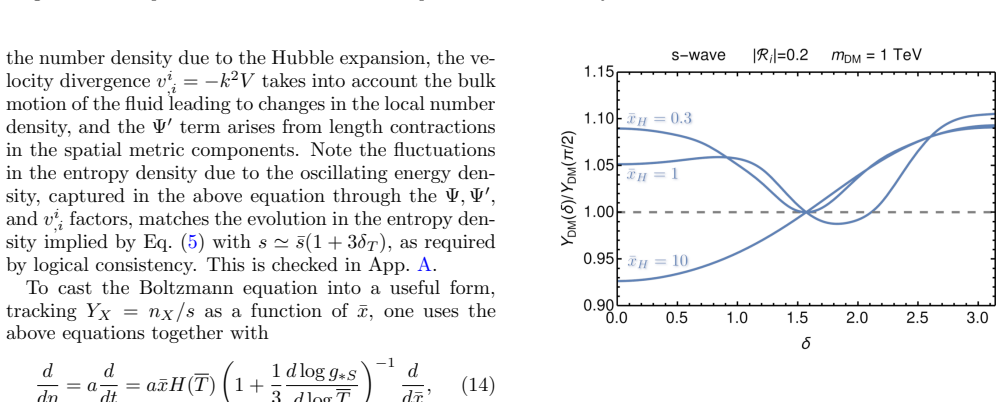
In a radiation-dominated universe with a monochromatic primordial curvature perturbation of amplitude roughly 0.2 entering the horizon around the time of freeze-out, the oscillating gravitational potential makes the radiation temperature fluctuate locally. Because the dark matter is assumed to remain in kinetic equilibrium with the radiation bath, its local equilibrium abundance is modulated by the temperature fluctuation through the Boltzmann suppression factor. The annihilation yield is a nonlinear function of temperature, so spatial averaging over the oscillation phase does not cancel the effect: under-dense and over-dense regions are not symmetric once chemical decoupling has an abrupt threshold. The net result is an approximately 10 percent increase in the thermally averaged cross section needed to end at the observed relic abundance, growing with the partial-wave index, and a milder length-scale dependence in which longer-wavelength perturbations produce cancellations and can even slightly lower the required cross section.
Load-bearing premise
The calculation assumes dark matter stays in kinetic equilibrium with the radiation bath throughout chemical freeze-out, so that the local dark matter temperature and bulk velocity follow the oscillating radiation temperature.
Editorial extensions
If this is right
- For curvature perturbations of amplitude about 0.2 and length scales near one Hubble radius at freeze-out, the required annihilation cross section rises by roughly 10 percent compared with standard freeze-out, and the shift grows for p- and d-wave annihilations.
- The size of the correction is nearly independent of the dark matter mass, so the result carries across WIMP mass scales.
- Long-wavelength perturbations can decrease the required cross section, because under-dense and over-dense regions cancel before significant sub-horizon evolution develops.
- Entropy production from Silk damping of the acoustic oscillations dilutes the relic by only about 3 percent at amplitude 0.2, which is below the acoustic enhancement except in the Sommerfeld-enhanced regime.
- The correction becomes observationally relevant where indirect-detection rates depend strongly on the precise cross section, such as near dark matter bound-state resonances.
Reading between the lines
- If the same calculation were repeated with a non-monochromatic, broader power spectrum of perturbations, the entropy-production dilution could grow, and the net cross-section shift might move from plus 10 percent toward net dilution; this is a testable extension using scale-invariant spectra.
- The kinetic-equilibrium assumption is the hinge: in models where dark matter kinetically decouples before chemical freeze-out, the dark matter would not track the oscillating radiation temperature, so the 10 percent enhancement would be quenched, an observable distinction if perturbations at these scales are ever measured.
- The same phase-averaging logic applies to any Boltzmann-suppressed relic whose freeze-out is abrupt, such as super-heavy dark matter, so the framework naturally extends beyond WIMPs without new ingredients.
Editorial analysis
A structured set of objections, weighed in public.
Referee Report
Summary. The paper extends the recently studied 'acoustically driven freeze-out' mechanism to thermal WIMP dark matter. For monochromatic primordial curvature perturbations with amplitude |R_i| ~ 0.2 on length scales of order the Hubble radius at freeze-out, it derives and solves a Boltzmann equation that includes the local temperature fluctuation, the metric perturbation, and the fluid velocity divergence. The main result is that the annihilation cross section required to match the observed relic abundance is enhanced by roughly 10% relative to the standard freeze-out value, with larger enhancements for higher partial waves. The paper also estimates the entropy production from Silk damping of the acoustic perturbations and finds that it reduces the required cross section by only about 3% for |R_i| = 0.2, so it is subdominant to the acoustic freeze-out effect.
Significance. If the result holds, it identifies a new, model-independent correction to thermal freeze-out in cosmological scenarios with large small-scale curvature perturbations, such as those generated by inflation, preheating, topological defects, or early phase transitions. The paper has several notable strengths: the Boltzmann equation is derived from covariant number conservation rather than postulated; the no-perturbation limit is checked against the independent code of Ref. [35]; Appendix A provides an analytic self-consistency check of the entropy perturbation equation; and the key assumptions (kinetic equilibrium, monochromatic perturbations, linear metric perturbations) are stated explicitly. The main quantitative claim is modest but potentially relevant for indirect-detection signals near resonances, where a few-percent shift in the required cross section can matter.
major comments (1)
- [Sec. IV, paragraph beginning 'Having the ability to solve the Boltzmann equation'] The phase average used to define the overall DM yield is the unweighted arithmetic mean of Y_X(δ). After chemical decoupling, Y_X = n_X/s is conserved along each fluid element, but the physical DM-to-entropy ratio of the homogenized final universe is the ratio of the conserved totals, i.e. ∫ n_X U^0 sqrt(-g) d^3x / ∫ s U^0 sqrt(-g) d^3x = ∫ Y_X s U^0 sqrt(-g) d^3x / ∫ s U^0 sqrt(-g) d^3x. The local entropy density and the volume element fluctuate for sub-horizon acoustic modes, so this ratio is not equal to the unweighted average of Y_X for |R_i| ~ 0.2. The difference is second order in R_i; for |R_i| = 0.2 it is of order a few percent, which is comparable both to the claimed ~10% cross-section enhancement and to the 3% entropy-production correction computed in Sec. V. Please either compute the entropy- and metric-weighted average, for example by averaging n_X directly, or quantify the bias and demonstrate that it does not affect the quoted enhancements in Figs. 4 and 5.
minor comments (5)
- [Eqs. (14) and (15)] The Hubble parameter is written H(T) in Eq. (14) but H(\bar{x}) in Eq. (15); please clarify that H is the background Hubble rate evaluated at the averaged temperature, and also state explicitly that s(x_T) in Eq. (15) is evaluated at the local temperature, not only Y_eq and \langle\sigma v\rangle.
- [Fig. 4 caption] The caption of Fig. 4 does not state the fixed value of \bar{x}_H used in the plot; the text says m_DM = 1 TeV, but the fixed perturbation scale is needed to reproduce the figure. Please add this parameter to the caption or table.
- [Sec. III, before Eq. (12)] The assumption that DM remains in kinetic equilibrium with radiation throughout freeze-out is central to the result; please add a sentence in the conclusions noting explicitly that if kinetic decoupling occurs before chemical freeze-out, the acoustic temperature fluctuations would not be imprinted on the DM distribution and the ~10% enhancement would be suppressed.
- [Abstract] The abstract states a ~10% enhancement without quoting the benchmark values \bar{x}_H and partial wave; since Figs. 4 and 5 show a strong dependence on both, please state the benchmark (for example, \bar{x}_H = 1 and s-wave) so the headline number is not overgeneralized.
- [Sec. V] The text uses 'm´elange'; this should be 'mélange' or 'mixture' in English. There are also a few other minor typographical issues, such as missing spaces before units in the abstract.
Circularity Check
No significant circularity: the ~10% correction factor is the output of a Boltzmann solve anchored to the independent Ref. [35]; self-citations to Refs. [1,2] are methodological, not load-bearing.
full rationale
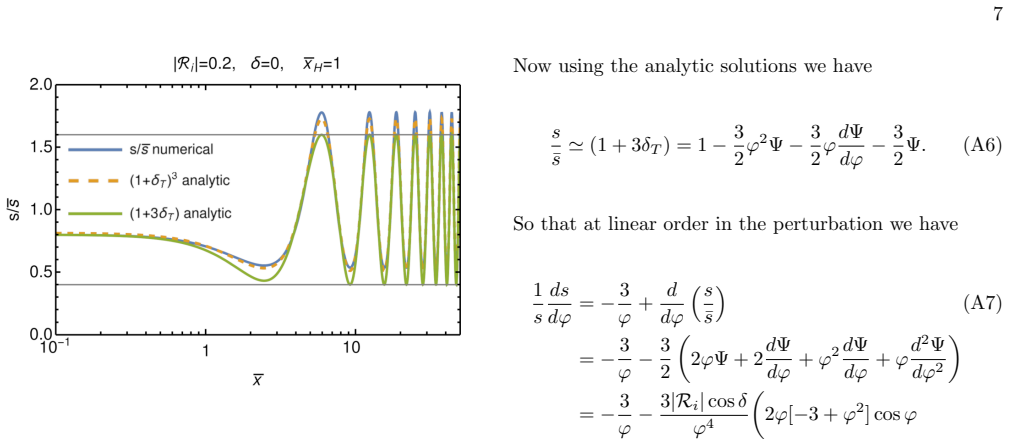
The paper's derivation chain is self-contained, and its central claim is not forced by construction. The Boltzmann equation (15) is derived in-paper from covariant number conservation (12), entropy conservation (13), and the standard time-conversion relation (14); the citation of the authors' prior leptogenesis work, Refs. [1,2], is a methodological transfer, and the same formalism is independently grounded in standard cosmology (Refs. [36,40]). The relic abundance target YDM mDM = 0.43 eV is an external input from Planck (Ref. [41]); the paper never fits a parameter to the perturbed answer and then relabels it a prediction. The output is the ratio of the cross section required with perturbations to that required without them, and the no-perturbation anchor is explicitly checked against the independent result of Ref. [35] ('Our sigma0 values agree closely with Ref. [35]'). The ~10% enhancement is the computed consequence of evaluating the exponentially suppressed equilibrium abundance, neq_X proportional to exp(-xT), at the locally fluctuating temperature; the mechanism is explained in Sec. IV, and Fig. 5 shows the required cross section can even decrease with the perturbation for long wavelengths, demonstrating the result is not definitionally fixed by the inputs. The entropy-production competition (Sec. V) uses the independent framework of Ref. [31] and yields a subdominant ~3% reduction at |Ri| = 0.2, which the paper explicitly compares against the enhancement rather than suppressing. The weakest input, the kinetic-equilibrium assumption stated before Eq. (12), is an explicit scope condition valid for standard thermal WIMP freeze-out, not a hidden or circular input. The self-citations to Refs. [1,2] (and the in-preparation Ref. [49]) are present but not load-bearing: the cited equations are re-derived in the paper, and the quantitative DM results are newly computed here. Finding: no significant circularity.
Assumptions & free parameters
free parameters (2)
- m_DM =
1 TeV
- g_X =
1
assumptions (6)
- domain assumption Radiation-dominated universe with negligible anisotropic stress, so Psi = Phi and the analytic solutions (2)-(7) apply.
- domain assumption Dark matter remains in kinetic equilibrium with the radiation bath during freeze-out.
- domain assumption Primordial perturbations are monochromatic with amplitude |Ri| <= 0.3.
- domain assumption Self-conjugate dark matter with g_X = 1.
- standard math Standard linear cosmological perturbation theory solutions for Psi, delta_T, and kV.
- ad hoc to paper g* is evaluated at the average temperature rather than the local temperature.
Cite this review
Pith. "Pith review of Acoustically driven dark matter freeze-out." pith.science (2026). https://pith.science/paper/YRCA7FPT
@misc{pith2026250611884,
  author       = {Pith},
  title        = {Pith review of: Acoustically driven dark matter freeze-out},
  year         = {2026},
  howpublished = {\url{https://pith.science/paper/YRCA7FPT}},
  note         = {Machine review of arXiv:2506.11884}
}
abstract
We extend the study of the effect of density perturbations to the well known thermal dark matter freeze-out scenario. We find $\sim 10 \, \%$ enhancements in the cross section are required to match onto the observed relic abundance for primordial curvature perturbations $\sim 0.2$ at length scales $\sim 1/$Hubble at freeze-out. Such corrections may be of importance in scenarios in which such perturbations are present and observational signals, such as the indirect detection rate, depend sensitively on the DM mass and freeze-out cross section, e.g. near resonances associated with DM bound states.
Figures


Figures from the paper (2 more)

Reference graph
Works this paper leans on
-
[35]
Precise Relic WIMP Abundance and its Impact on Searches for Dark Matter Annihilation,
Gary Steigman, Basudeb Dasgupta, and John F. Bea- com, “Precise Relic WIMP Abundance and its Impact on Searches for Dark Matter Annihilation,” Phys. Rev. D86, 023506 (2012), arXiv:1204.3622 [hep-ph]
arXiv 2012
-
[1]
Leptogenesis in the presence of density perturbations
Kenta Hotokezaka, Ryusuke Jinno, and Rin Takada, “Leptogenesis in the presence of density perturbations,” (2025), arXiv:2501.10148 [hep-ph]
work page Pith review arXiv 2025
-
[2]
Leptogenesis with perturbations in type- II and type-III seesaw models,
Iason Baldes, “Leptogenesis with perturbations in type- II and type-III seesaw models,” Eur. Phys. J. C85, 535 (2025), arXiv:2503.02936 [hep-ph]
arXiv 2025
-
[3]
Revisiting constraints on small scale perturba- tions from big-bang nucleosynthesis,
Keisuke Inomata, Masahiro Kawasaki, and Yuichiro Tada, “Revisiting constraints on small scale perturba- tions from big-bang nucleosynthesis,” Phys. Rev. D94, 043527 (2016), arXiv:1605.04646 [astro-ph.CO]
arXiv 2016
-
[4]
Quantum Fluctuations and a Nonsingular Universe,
Viatcheslav F. Mukhanov and G. V. Chibisov, “Quantum Fluctuations and a Nonsingular Universe,” JETP Lett. 33, 532–535 (1981)
work page 1981
-
[5]
Lev Kofman, Andrei D. Linde, and Alexei A. Starobin- sky, “Reheating after inflation,” Phys. Rev. Lett.73, 3195–3198 (1994), arXiv:hep-th/9405187
arXiv 1994
-
[6]
Towards the theory of reheating after infla- tion,
Lev Kofman, Andrei D. Linde, and Alexei A. Starobin- sky, “Towards the theory of reheating after infla- tion,” Phys. Rev. D56, 3258–3295 (1997), arXiv:hep- ph/9704452
arXiv 1997
-
[7]
M. B. Hindmarsh and T. W. B. Kibble, “Cosmic strings,” Rept. Prog. Phys.58, 477–562 (1995), arXiv:hep- ph/9411342
arXiv 1995
Show all 49 references
-
[8]
Vilenkin and E
A. Vilenkin and E. P. S. Shellard,Cosmic Strings and Other Topological Defects(Cambridge University Press, 2000)
2000
-
[9]
Cosmic struc- ture formation with topological defects,
R. Durrer, M. Kunz, and A. Melchiorri, “Cosmic struc- ture formation with topological defects,” Phys. Rept. 364, 1–81 (2002), arXiv:astro-ph/0110348
2002 arXiv
-
[10]
Constraining First-Order Phase Transitions with Curvature Perturbations,
Jing Liu, Ligong Bian, Rong-Gen Cai, Zong-Kuan Guo, and Shao-Jiang Wang, “Constraining First-Order Phase Transitions with Curvature Perturbations,” Phys. Rev. Lett.130, 051001 (2023), arXiv:2208.14086 [astro- ph.CO]
2023 arXiv
-
[11]
Finite Bubble Statistics Constrain Late Cosmological Phase Transitions,
Gilly Elor, Ryusuke Jinno, Soubhik Kumar, Robert McGehee, and Yuhsin Tsai, “Finite Bubble Statistics Constrain Late Cosmological Phase Transitions,” Phys. Rev. Lett.133, 211003 (2024), arXiv:2311.16222 [hep- ph]
2024 arXiv
-
[12]
Black Holes and Gravitational Waves from Slow First- Order Phase Transitions,
Marek Lewicki, Piotr Toczek, and Ville Vaskonen, “Black Holes and Gravitational Waves from Slow First- Order Phase Transitions,” Phys. Rev. Lett.133, 221003 (2024), arXiv:2402.04158 [astro-ph.CO]
2024 arXiv
-
[13]
Numerical simulations of density perturbation and grav- itational wave production from cosmological first-order phase transition,
Jintao Zou, Zhiqing Zhu, Zizhuo Zhao, and Ligong Bian, “Numerical simulations of density perturbation and grav- itational wave production from cosmological first-order phase transition,” (2025), arXiv:2502.20166 [hep-ph]
2025 arXiv
-
[14]
Curvature Perturbations from First-Order Phase Transitions: Implications to Black Holes and Gravita- tional Waves,
Gabriele Franciolini, Yann Gouttenoire, and Ryusuke Jinno, “Curvature Perturbations from First-Order Phase Transitions: Implications to Black Holes and Gravita- tional Waves,” (2025), arXiv:2503.01962 [hep-ph]
2025 arXiv
-
[15]
Dynamical generation of the weak and Dark Matter scale,
Thomas Hambye and Alessandro Strumia, “Dynamical generation of the weak and Dark Matter scale,” Phys. Rev. D88, 055022 (2013), arXiv:1306.2329 [hep-ph]
2013 arXiv
-
[16]
Gravitational waves from the asymmetric- dark-matter generating phase transition,
Iason Baldes, “Gravitational waves from the asymmetric- dark-matter generating phase transition,” JCAP05, 028 (2017), arXiv:1702.02117 [hep-ph]
2017 arXiv
-
[17]
Super-cool Dark Matter,
Thomas Hambye, Alessandro Strumia, and Daniele 8 Teresi, “Super-cool Dark Matter,” JHEP08, 188 (2018), arXiv:1805.01473 [hep-ph]
2018 arXiv
-
[18]
Strong gravita- tional radiation from a simple dark matter model,
Iason Baldes and Camilo Garcia-Cely, “Strong gravita- tional radiation from a simple dark matter model,” JHEP 05, 190 (2019), arXiv:1809.01198 [hep-ph]
2019 arXiv
-
[19]
String Fragmentation in Supercooled Confinement and Implications for Dark Matter,
Iason Baldes, Yann Gouttenoire, and Filippo Sala, “String Fragmentation in Supercooled Confinement and Implications for Dark Matter,” JHEP04, 278 (2021), arXiv:2007.08440 [hep-ph]
2021 arXiv
-
[20]
Supercool composite Dark Matter beyond 100 TeV,
Iason Baldes, Yann Gouttenoire, Filippo Sala, and G´ eraldine Servant, “Supercool composite Dark Matter beyond 100 TeV,” JHEP07, 084 (2022), arXiv:2110.13926 [hep-ph]
2022 arXiv
-
[21]
Conformal model for gravitational waves and dark matter: a status update,
Maciej Kierkla, Alexandros Karam, and Bogumila Swiezewska, “Conformal model for gravitational waves and dark matter: a status update,” JHEP03, 007 (2023), arXiv:2210.07075 [astro-ph.CO]
2023 arXiv
-
[22]
Freeze-in of WIMP dark matter,
Xiao-Rui Wong and Ke-Pan Xie, “Freeze-in of WIMP dark matter,” Phys. Rev. D108, 055035 (2023), arXiv:2304.00908 [hep-ph]
2023 arXiv
-
[23]
Sub-GeV dark mat- ter and nano-Hertz gravitational waves from a classically conformal dark sector,
Sowmiya Balan, Torsten Bringmann, Felix Kahlhoefer, Jonas Matuszak, and Carlo Tasillo, “Sub-GeV dark mat- ter and nano-Hertz gravitational waves from a classically conformal dark sector,” (2025), arXiv:2502.19478 [hep- ph]
2025
-
[24]
Dark matter isocurvature from curvature,
Ian Holst, Wayne Hu, and Leah Jenks, “Dark matter isocurvature from curvature,” Phys. Rev. D109, 063507 (2024), arXiv:2311.17164 [astro-ph.CO]
2024 arXiv
-
[25]
Generation of Isocurvature from Curvature Inhomogeneities on Super-Horizon Scales,
Albert Stebbins, “Generation of Isocurvature from Curvature Inhomogeneities on Super-Horizon Scales,” (2023), arXiv:2311.17379 [astro-ph.CO]
2023 arXiv
-
[26]
A New Source for (QCD) Axion Dark Matter Production: Curvature-Induced,
Cem Er¨ oncel, Yann Gouttenoire, Ryosuke Sato, G´ eraldine Servant, and Peera Simakachorn, “A New Source for (QCD) Axion Dark Matter Production: Curvature-Induced,” (2025), arXiv:2503.04880 [hep-ph]
2025
-
[27]
Acoustic Mis- alignment Mechanism for Axion Dark Matter,
Arushi Bodas, Raymond T. Co, Akshay Ghalsasi, Keisuke Harigaya, and Lian-Tao Wang, “Acoustic Mis- alignment Mechanism for Axion Dark Matter,” (2025), arXiv:2503.04888 [hep-ph]
2025
-
[28]
Can non-adiabatic perturbations arise after single-field inflation?
Steven Weinberg, “Can non-adiabatic perturbations arise after single-field inflation?” Phys. Rev. D70, 043541 (2004), arXiv:astro-ph/0401313
2004 arXiv
-
[29]
Must cosmological perturbations re- main non-adiabatic after multi-field inflation?
Steven Weinberg, “Must cosmological perturbations re- main non-adiabatic after multi-field inflation?” Phys. Rev. D70, 083522 (2004), arXiv:astro-ph/0405397
2004 arXiv
-
[30]
Cosmic black body radiation and galaxy formation,
Joseph Silk, “Cosmic black body radiation and galaxy formation,” Astrophys. J.151, 459–471 (1968)
1968
-
[31]
CMB at 2x2 order: The dissipation of primordial acous- tic waves and the observable part of the associated energy release,
Jens Chluba, Rishi Khatri, and Rashid A. Sunyaev, “CMB at 2x2 order: The dissipation of primordial acous- tic waves and the observable part of the associated energy release,” Mon. Not. Roy. Astron. Soc.425, 1129–1169 (2012), arXiv:1202.0057 [astro-ph.CO]
2012 arXiv
-
[32]
Probing the inflaton: Small-scale power spectrum con- straints from measurements of the CMB energy spec- trum,
Jens Chluba, Adrienne L. Erickcek, and Ido Ben-Dayan, “Probing the inflaton: Small-scale power spectrum con- straints from measurements of the CMB energy spec- trum,” Astrophys. J.758, 76 (2012), arXiv:1203.2681 [astro-ph.CO]
2012 arXiv
-
[33]
Silk damping at a redshift of a billion: a new limit on small-scale adiabatic perturbations,
Donghui Jeong, Josef Pradler, Jens Chluba, and Marc Kamionkowski, “Silk damping at a redshift of a billion: a new limit on small-scale adiabatic perturbations,” Phys. Rev. Lett.113, 061301 (2014), arXiv:1403.3697 [astro- ph.CO]
2014 arXiv
-
[34]
Reheating the Universe Once More: The Dissipation of Acoustic Waves as a Novel Probe of Pri- mordial Inhomogeneities on Even Smaller Scales,
Tomohiro Nakama, Teruaki Suyama, and Jun’ichi Yokoyama, “Reheating the Universe Once More: The Dissipation of Acoustic Waves as a Novel Probe of Pri- mordial Inhomogeneities on Even Smaller Scales,” Phys. Rev. Lett.113, 061302 (2014), arXiv:1403.5407 [astro- ph.CO]
2014 arXiv
-
[36]
Patrick Peter and Jean-Philippe Uzan,Primordial Cos- mology, Oxford Graduate Texts (Oxford University Press, 2013)
2013
-
[37]
Primordial black hole formation in the early universe: critical behaviour and self-similarity,
Ilia Musco and John C. Miller, “Primordial black hole formation in the early universe: critical behaviour and self-similarity,” Class. Quant. Grav.30, 145009 (2013), arXiv:1201.2379 [gr-qc]
2013 arXiv
-
[38]
Threshold of primordial black hole formation,
Tomohiro Harada, Chul-Moon Yoo, and Kazunori Kohri, “Threshold of primordial black hole formation,” Phys. Rev. D88, 084051 (2013), [Erratum: Phys.Rev.D 89, 029903 (2014)], arXiv:1309.4201 [astro-ph.CO]
2013 arXiv
-
[39]
The Effects of QCD Equation of State on the Relic Density of WIMP Dark Matter,
Manuel Drees, Fazlollah Hajkarim, and Ernany Rossi Schmitz, “The Effects of QCD Equation of State on the Relic Density of WIMP Dark Matter,” JCAP06, 025 (2015), arXiv:1503.03513 [hep-ph]
2015 arXiv
-
[40]
Cosmological Perturbations at Second Order and Recombination Perturbed,
Leonardo Senatore, Svetlin Tassev, and Matias Zal- darriaga, “Cosmological Perturbations at Second Order and Recombination Perturbed,” JCAP08, 031 (2009), arXiv:0812.3652 [astro-ph]
2009 arXiv
-
[41]
Planck 2018 results. VI. Cosmological parameters,
N. Aghanimet al.(Planck), “Planck 2018 results. VI. Cosmological parameters,” Astron. Astrophys.641, A6 (2020), [Erratum: Astron.Astrophys. 652, C4 (2021)], arXiv:1807.06209 [astro-ph.CO]
2020 arXiv
-
[42]
Anisotropies in the cosmic microwave background: An Analytic ap- proach,
Wayne Hu and Naoshi Sugiyama, “Anisotropies in the cosmic microwave background: An Analytic ap- proach,” Astrophys. J.444, 489–506 (1995), arXiv:astro- ph/9407093
1995
-
[43]
Scott Dodelson,Modern Cosmology(Academic Press, Amsterdam, 2003)
2003
-
[44]
WIMPonium and Boost Factors for Indirect Dark Mat- ter Detection,
John David March-Russell and Stephen Mathew West, “WIMPonium and Boost Factors for Indirect Dark Mat- ter Detection,” Phys. Lett. B676, 133–139 (2009), arXiv:0812.0559 [astro-ph]
2009 arXiv
-
[45]
Minimal dark matter,
Marco Cirelli, Nicolao Fornengo, and Alessandro Stru- mia, “Minimal dark matter,” Nucl. Phys. B753, 178–194 (2006), arXiv:hep-ph/0512090
2006 arXiv
-
[46]
Cosmological Implications of Dark Matter Bound States,
Andrea Mitridate, Michele Redi, Juri Smirnov, and Alessandro Strumia, “Cosmological Implications of Dark Matter Bound States,” JCAP05, 006 (2017), arXiv:1702.01141 [hep-ph]
2017 arXiv
-
[47]
Radiative bound-state formation in unbroken perturbative non-Abelian theories and implications for dark matter,
Julia Harz and Kalliopi Petraki, “Radiative bound-state formation in unbroken perturbative non-Abelian theories and implications for dark matter,” JHEP07, 096 (2018), arXiv:1805.01200 [hep-ph]
2018 arXiv
-
[48]
The quintuplet annihilation spec- trum,
Matthew Baumgart, Nicholas L. Rodd, Tracy R. Slatyer, and Varun Vaidya, “The quintuplet annihilation spec- trum,” JHEP01, 158 (2024), arXiv:2309.11562 [hep-ph]
2024 arXiv
-
[49]
Baldeset al., in preparation
I. Baldeset al., in preparation. (2025)
2025
Reviewed August 7, 2026 · model on record in the stance chip above.
Discussion (0). Sign in to comment.