REVIEW 2 major objections 7 minor 42 references
A light-front Faddeev treatment of three-color QCD in two dimensions finds an exactly massless chiral baryon, multi-channel gapped states, and hyperon ordering inverted from four dimensions.
Reviewed by Pith at T0; open to challenge. T0 means a machine referee read the full paper against a public rubric. the ladder, T0–T4 →
T0 review · grok-4.5
2026-07-30 22:08 UTC pith:YRRJ2UXT
load-bearing objection Solid valence Faddeev solution of Nc=3 QCD2 baryons: the channel identity and first hyperon spectroscopy are the real additions; chiral core is tight, small-ms numbers a bit softer. the 2 major comments →
Faddeev description of baryons in two-dimensional QCD with N_c=3. I. Chiral spectrum, isospin, and strangeness
The pith
A machine-rendered reading of the paper's core claim, the machinery that carries it, and where it could break.
Core claim
In the valence light-front Faddeev formulation of Nc=3 QCD₂, the chiral baryon is exactly massless (the constant pair mode selected variationally), the excitation tower reproduces Webber’s symmetric states with valence gap 1.371 M*_mes, the massless state is pure n=0 while gapped states are genuinely multi-channel—so the single-channel quark–diquark truncation has only the massless solution—and the flavored extension yields inverted Σ–Λ ordering, two-kaon-unit thresholds per strange quark, and GMO/Coleman–Glashow relations protected in mass squared.
What carries the argument
The exact light-front Faddeev coupled-channel reduction: the three-body equation is reorganized into pair channels by diagonalizing the intrinsic pair Hamiltonian, so the quark–diquark picture is precisely the single-channel (n=0) truncation, and full solutions are obtained variationally on the physical simplex with exact matrix elements.
Load-bearing premise
Only the three-quark valence sector of the light-front Hamiltonian is kept, so every gapped and flavored mass is a variational upper bound that higher Fock components may shift.
What would settle it
A full (beyond-valence) DLCQ or higher-Fock computation of the first gapped chiral baryon that moves the gap away from 1.371 times the lightest massive meson mass, or a valence flavored spectrum in which Σ-like states rise above Λ-like ones.
If this is right
- The massless chiral baryon is protected in the full theory; only the gapped tower is truncation-dependent.
- No single-channel quark–diquark equation can produce a massive chiral baryon in this model.
- With two light flavors the massless state is Δ-like; the N-like state is a 50:50 good/bad diquark mix below the lightest massive meson.
- Hyperon chiral thresholds count two kaon units per strange quark, and GMO holds in mass squared because the leading shift is a one-body octet operator.
- With non-degenerate masses the proton-like state lies below the neutron-like one and Coleman–Glashow holds at the percent level without electromagnetism.
Where Pith is reading between the lines
- The same channel weights could serve as ready-made initial states or cost functions for tensor-network and quantum-simulation studies of 1+1 hadrons.
- If higher Fock sectors mainly dilute multi-channel mixing rather than reorder levels, the inverted Σ–Λ pattern may survive beyond the valence truncation.
- The boundary-density law for strange thresholds suggests a general endpoint rule for any one-body mass deformation of light-front bound states in two dimensions.
Editorial analysis
A structured set of objections, weighed in public.
Referee Report
Summary. The authors develop a light-front Faddeev formulation of the three-quark problem in QCD₂ at N_c=3, reduce it to an exact coupled-channel system by diagonalizing the intrinsic pair ('t Hooft) Hamiltonian, and solve the resulting problem variationally on the momentum-fraction simplex with exact polynomial matrix elements. In the chiral limit they find an exactly massless ground-state baryon (the constant mode, selected variationally rather than imposed), a gapped excitation tower matching Webber's symmetric spectrum state by state with valence gap 1.371 M*_mes, and an exact projection identity showing the n=0 (quark–diquark) truncation supports only the massless solution while gapped states are genuinely multi-channel. Results are anchored against strong-coupling bosonization (0.3–4.3%) and full DLCQ (0.04% meson, 0.15% baryon at weak coupling). Flavor extensions give the I=3/2 massless quartet and I=1/2 doublet at 0.977 M*_mes, the first valence-level hyperon spectroscopy of QCD₂ (inverted Σ–Λ ordering, thresholds at 2,4,6 kaon units, GMO protected in mass squared), and isospin-breaking observables including Coleman–Glashow at the percent level. All gapped and flavored masses are valence-sector (Tamm–Dancoff) results.
Significance. The chiral-limit results are exact or near-exact and multiply anchored: the massless baryon is a variational outcome protected by a unitarity bound (so it is exact in the full theory, not only in the truncation); the excitation tower reproduces Webber's state-by-state to parts in 10⁴; bosonization and DLCQ anchors hold at 0.3–4.3% and 0.04–0.15% respectively; and the projection identity Eqs. (49)–(50) is a clean, checkable analytic result showing the single-channel quark–diquark truncation has only M²=0 solutions. The flavor extensions (inverted Σ–Λ ordering, two-kaon-unit thresholds, GMO in mass squared, Coleman–Glashow) are, as claimed, the first valence-level hyperon spectroscopy of QCD₂, are structurally falsifiable, and the explicit wavefunctions and channel weights are directly usable as benchmarks for Hamiltonian and quantum-simulation programs. No fitted parameters enter the central claims.
major comments (2)
- [Sec. VI D, Eq. (56) and Table IV] The precision claims advertised in the abstract (thresholds extrapolating to (2,4,6) kaon units within 1%; GMO defect below 0.2% for ms/g≤0.2; kaon GMOR slope reproduced to 0.06%) rest on the ms/g=0.05 and 0.10 rows of Table IV, which the manuscript itself states carry a kernel-tail extrapolation that 'need not preserve the bound.' The extrapolation procedure is not described (grid, fitting form, stability tests), and no uncertainty is attached to the resulting ratios in Eq. (56) or to the GMO defect. I note the manuscript already supplies an independent analytic cross-check for the octet thresholds (boundary densities σΣ=2.450, σΛ=4.874 from exact chiral wavefunctions vs. extrapolated 2.44, 4.83); please provide an analogous check or a demonstrated error budget for the decuplet ratios 1.91/3.89/5.93, and either attach uncertainties to the extrapolated rows or qualify the 1% and 0.2% pre
- [Sec. VI C, Eq. (55)] The endpoint-envelope prescription underlying Table IV is ambiguous as written: the main text says δs is 'the corresponding pair boundary-condition exponent, as in Sec. V G,' while the immediately following parenthetical argues the physically correct exponent at a strange leg is the kaon's (0.7–0.8 times the single-pair value) and that 'the variational optimum indeed settles there.' It is not stated which exponent (or scan range) was actually used for each entry of Table IV, nor how sensitive the low-ms rows are to this choice. Since δs controls the near-endpoint behavior that feeds the same small-ms entries discussed above, please state the prescription precisely and quantify the sensitivity of the ms/g≤0.2 rows to δs.
minor comments (7)
- [Sec. VI D (text following Eq. (57))] Typo: 'Couloimb' should read 'Coulomb'.
- [Sec. V G, Eq. (51)] The equation number '(51)' appears inline mid-sentence in the ratio list, which reads 'Mmes/Mbar = 0.616,0.602(1),0.591(3)(51)'; reformat so the numbered equation is unambiguous.
- [Sec. V C, point (i)] The lowest eigenvalue µ²₀ = −4×10⁻¹⁴ is quoted as evidence for the exact zero mode; one sentence on the numerical origin of the small negative value (orthogonalization threshold τ vs. quadrature) would help the reader.
- [Sec. V F and Fig. 2] The leading-trajectory slope is quoted as 'near 0.82 of the meson's through n=16'; please indicate the spread of the local-slope values or a fit uncertainty, since the two-class separation of trajectories is one of the structural claims.
- [Sec. V G] The statement that the bosonization ratio 0.618 carries O(m/g) corrections at finite mass is plausible but is given no reference or estimate; a citation or a brief derivation would strengthen the discussion of the 0.2% agreement at m/g=0.2.
- [Sec. VI B] The kaon basis (1−x)^{δs}Pn(2x−1) treats the two endpoints asymmetrically (exponent only at the massive leg). A sentence justifying the massless-endpoint boundary condition relative to the standard 't Hooft endpoint analysis would be useful.
- [References] Ref. [1] (Hansson and Konishi, 1978) appears to lack journal/publication information; please complete the entry or annotate it as an unpublished preprint.
Circularity Check
No significant circularity: chiral masslessness, channel identity, and flavored spectroscopy are derived within the valence Faddeev equations and checked against external benchmarks.
full rationale
The load-bearing chiral results follow from the light-front three-body equation and the simplex variational principle, not from fitted inputs or self-justifying definitions. The constant mode is an exact zero of every pair kernel (and is selected variationally among ~30 orthonormal directions, not imposed); the projection identity then shows that every gapped state has vanishing n=0 Faddeev component, so the single-channel quark–diquark truncation admits only M²_B=0. The excitation tower and gap are Rayleigh–Ritz upper bounds compared state-by-state to Webber (1979) and, at finite mass, to independent DLCQ and strong-coupling bosonization numbers; unit conversions are fixed by matching one Hamiltonian (App. B), not by fitting the target ratios. Flavor extensions reuse the same kernel with Fermi statistics and mass terms; Σ-below-Λ, two-kaon-unit thresholds, and GMO/Coleman–Glashow structure are model outputs, not renamings of four-dimensional data. No uniqueness theorem or ansatz is imported from overlapping-author prior work. The valence Tamm–Dancoff truncation and small-m_s kernel-tail extrapolations are disclosed limitations on accuracy, not circular reductions of claim to input.
Axiom & Free-Parameter Ledger
free parameters (2)
- Polynomial truncation L (or D) and Löwdin threshold τ =
L=14, τ=10^{-11} (30 retained states)
- Endpoint envelope exponent δ_s =
settles at 0.7–0.8 times single-pair value
axioms (4)
- domain assumption Light-front valence three-quark Hamiltonian with principal-value Coulomb kernel κ=2σ=2g²/3 is the correct dynamical starting point for QCD2 baryons
- domain assumption Color wavefunction is the antisymmetric singlet, so Fermi statistics forces the flavor⊗spatial wavefunction to be totally symmetric (or mixed when flavor allows)
- standard math Simplex inner product with measure s ds dz makes the kernel quadratic form self-adjoint and positive semidefinite, with the constant mode an exact zero eigenvalue when m̄=0
- domain assumption Excited valence masses are variational upper bounds; only M²=0 is protected in the full theory by unitarity
read the original abstract
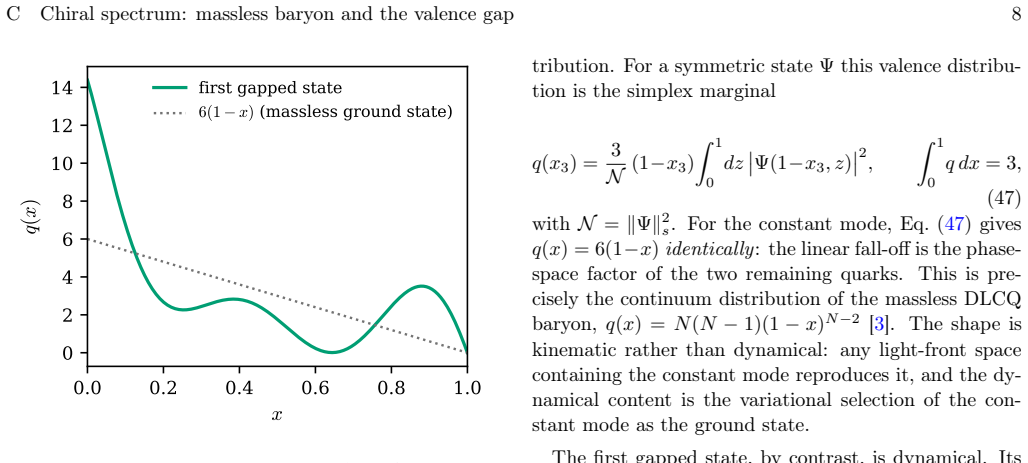
We develop a light-front Faddeev description of baryons in two-dimensional QCD at $N_c=3$, in which an exact coupled-channel representation identifies the quark--diquark picture as a single-channel truncation, and solve it variationally with exact matrix elements. In the chiral limit we find an exactly massless lightest baryon, in agreement with the classic valence solutions, DLCQ, and bosonization; the excitation tower reproduces Webber's spectrum state by state and sets the valence gap $1.371\,M^{\ast}_{\rm mes}$. The channel content distinguishes these states: the massless baryon is single-channel, the gapped states are genuinely multi-channel, and all baryon Regge trajectories are of the meson class. The calculation is anchored at both ends of the coupling range: the meson-to-baryon mass ratio agrees with strong-coupling bosonization to $0.3$--$4.3\%$, while the valence masses reproduce the full discretized light cone quantization (DLCQ) masses to $0.04\%$ (meson) and $0.15\%$ (baryon) at weak coupling. Extending to two degenerate flavors, we find the massless baryon to be the $\Delta$-like quartet, while the $N$-like doublet at $0.977\,M^{\ast}_{\rm mes}$ is an exact $50\!:\!50$ superposition of good- and bad-diquark channels. Adding a massive strange quark, we obtain, to our knowledge for the first time at the valence three-quark level, the hyperon spectroscopy of QCD$_2$: $\Sigma$-like states fall below $\Lambda$-like ones, inverting the four-dimensional ordering, the chiral thresholds count two kaon units per strange quark, and the Gell-Mann--Okubo relation is protected in mass squared. With all three quark masses non-degenerate, the proton-like state falls below the neutron-like one, $\Sigma^0$--$\Lambda$ mixing appears, and the Coleman--Glashow relation holds at the percent level.
Figures


Reference graph
Works this paper leans on
-
[1]
Semiclassical slope estimate 16
-
[2]
Coupling conventions and the mass gap 17 References 18 arXiv:2607.23435v1 [hep-ph] 26 Jul 2026 2 I
Relation to large-Nc baryon scaling 17 B. Coupling conventions and the mass gap 17 References 18 arXiv:2607.23435v1 [hep-ph] 26 Jul 2026 2 I. INTRODUCTION The relativistic three-body problem is a central non- perturbative challenge in quantum field theory. In QCD, confinement implies that baryons are not weakly bound systems of nearly free constituents, b...
Pith/arXiv arXiv 2026
-
[3]
Light Cone Quantized QCD in (1+1)- Dimensions,
Kent Hornbostel, Stanley J. Brodsky, and Hans Chris- tian Pauli, “Light Cone Quantized QCD in (1+1)- Dimensions,” Phys. Rev. D41, 3814 (1990)
1990
-
[4]
Semiclassical slope estimate At high excitationn≫1the wavefunction oscillates rapidly and a semiclassical treatment applies: channel mixing induced by the permutation operator in Eq. (17) becomes subleading, and the dynamics is governed by the intrinsic pair Hamiltonian (28) through the diagonal of the coupled-channel equation (32), M 2 B ≈ ϵ2 n s + ¯m2 1...
-
[5]
Relation to large-N c baryon scaling A baryon Hamiltonian built from three pair kernels is compatible with Witten’s large-Nc analysis [34] (whose group-theoreticcontentmatchesthequarkmodelatlarge Nc [35]), in which the baryon mass grows asMB ∼N c rather than as the number of quark pairsNc(Nc −1)/2; compatibility requires keeping the color factors and the ...
-
[6]
M2 in units ofm2 +g 2/πare quanti- ties employed directly in the program
The string-tension convention of Secs. II–III,κ= 2σ= 2g 2 κ/3, matches the physical pair coefficientg2cqq /π forg 2 κ =g 2/π. For the valence gap of Eq. (46),µ2 1 = 11.062in Web- ber units (equivalently a raw pair-normalized eigenvalue 2µ2 1 = 22.125), the dictionary gives Mgap g = 2.17, Mgap gW = 3.06, Mgap gκ = 3.84, (B2) one number in three normalizati...
-
[7]
good” and “bad
of the baryon equation in QCD2, both at equal time and on the light front, into a complete and computation- ally viable framework atNc = 3. Two conceptual points organize the analysis. First, the Faddeev equations are not a new dynamical theory but an exact reorganization of the three-body problem into pairwise channels; the as- sociated channel decomposi...
2038
-
[8]
MULTI - QUARK HADRONS IN TWO-DIMENSIONAL QCD,
T. H. Hansson and K. Konishi, “MULTI - QUARK HADRONS IN TWO-DIMENSIONAL QCD,” (1978)
1978
-
[9]
Solution of a Two-dimensional QCD Model for Baryons,
B. R. Webber, “Solution of a Two-dimensional QCD Model for Baryons,” Nucl. Phys. B153, 455–466 (1979)
1979
-
[10]
The Virial Theorem and the Structure of the Deuteron in (1+1)-dimensional QCD on the Light Cone,
M. Burkardt, “The Virial Theorem and the Structure of the Deuteron in (1+1)-dimensional QCD on the Light Cone,” Nucl. Phys. A504, 762–776 (1989)
1989
-
[11]
Baryons and Baryonium in QCD in Two-dimensions,
Paul J. Steinhardt, “Baryons and Baryonium in QCD in Two-dimensions,” Nucl. Phys. B176, 100–112 (1980)
1980
-
[12]
The Spectrum of Multiflavor QCD in Two-dimensions,
Ghanashyam Date, Y. Frishman, and J. Sonnenschein, “The Spectrum of Multiflavor QCD in Two-dimensions,” Nucl. Phys. B283, 365–380 (1987)
1987
-
[13]
Scattering Theory for a Three-Particle System,
L. D. Faddeev, “Scattering Theory for a Three-Particle System,” Sov. Phys. JETP12, 1014–1019 (1961)
1961
-
[14]
Baryons as relativistic three-quark bound states,
Gernot Eichmann, Helios Sanchis-Alepuz, Richard Williams, Reinhard Alkofer, and Christian S. Fischer, “Baryons as relativistic three-quark bound states,” Prog. Part. Nucl. Phys.91, 1–100 (2016), arXiv:1606.09602 [hep-ph]
Pith/arXiv arXiv 2016
-
[15]
Solving Field Theory in One Space One Time Dimension,
Hans Christian Pauli and Stanley J. Brodsky, “Solving Field Theory in One Space One Time Dimension,” Phys. Rev. D32, 1993 (1985)
1993
-
[16]
Dis- cretized Light Cone Quantization: Solution to a Field Theory in One Space One Time Dimensions,
Hans Christian Pauli and Stanley J. Brodsky, “Dis- cretized Light Cone Quantization: Solution to a Field Theory in One Space One Time Dimensions,” Phys. Rev. D32, 2001 (1985)
2001
-
[17]
Preparations for quantum simulations of quan- tum chromodynamics in 1+1 dimensions. I. Axial gauge,
Roland C. Farrell, Ivan A. Chernyshev, Sarah J. M. Pow- ell, Nikita A. Zemlevskiy, Marc Illa, and Martin J. Savage, “Preparations for quantum simulations of quan- tum chromodynamics in 1+1 dimensions. I. Axial gauge,” Phys. Rev. D107, 054512 (2023), arXiv:2207.01731 [quant-ph]
Pith/arXiv arXiv 2023
-
[18]
Baryon Wave Functions and Strangeness Content in QCD in Two-dimensions,
Y. Frishman and M. Karliner, “Baryon Wave Functions and Strangeness Content in QCD in Two-dimensions,” Nucl. Phys. B344, 393–400 (1990)
1990
-
[19]
Exotic baryons in two-dimensionalQCD,
John R. Ellis and Yitzhak Frishman, “Exotic baryons in two-dimensionalQCD,” JHEP08,081(2005),arXiv:hep- ph/0502193
arXiv 2005
-
[20]
Exotic baryons in two-dimensional QCD and the generalized sine-Gordon solitons,
Harold Blas, “Exotic baryons in two-dimensional QCD and the generalized sine-Gordon solitons,” JHEP03, 055 (2007), arXiv:hep-th/0702197
Pith/arXiv arXiv 2007
-
[21]
Exact symmetries and threshold states in two- dimensional models for QCD,
Ross Dempsey, Igor R. Klebanov, and Silviu S. Pufu, “Exact symmetries and threshold states in two- dimensional models for QCD,” JHEP10, 096 (2021), arXiv:2101.05432 [hep-th]
Pith/arXiv arXiv 2021
-
[22]
Diego Delmastro, Jaume Gomis, and Matthew Yu, “Infrared phases of 2d QCD,” JHEP02, 157 (2023), arXiv:2108.02202 [hep-th]
Pith/arXiv arXiv 2023
-
[23]
2d QCD and integrability. Part I. ’t Hooft model,
Federico Ambrosino and Shota Komatsu, “2d QCD and integrability. Part I. ’t Hooft model,” JHEP02, 126 (2025), arXiv:2312.15598 [hep-th]
Pith/arXiv arXiv 2025
-
[24]
SU(2) hadrons on a quantum computer via a vari- ational approach,
Yasar Y. Atas, Jinglei Zhang, Randy Lewis, Amin Ja- hanpour, Jan F. Haase, and Christine A. Muschik, “SU(2) hadrons on a quantum computer via a vari- ational approach,” Nature Commun.12, 6499 (2021), arXiv:2102.08920 [quant-ph]
Pith/arXiv arXiv 2021
-
[25]
Baryon Bethe-Salpeter Equation in Minkowski- Space QCD2,
Satvir Kaur, Sreeraj Nair, Chandan Mondal, Jiangshan Lan, Xingbo Zhao, J. P. B. C. de Melo, and Tobias Fred- erico, “Baryon Bethe-Salpeter Equation in Minkowski- Space QCD2,” (2026), arXiv:2605.07095 [hep-ph]
Pith/arXiv arXiv 2026
-
[26]
Poincare and Gauge In- variant Two-Dimensional QCD,
I. Bars and Michael B. Green, “Poincare and Gauge In- variant Two-Dimensional QCD,” Phys. Rev. D17, 537 (1978)
1978
-
[27]
thesis, Stanford University (1988)
Kent Hornbostel,THE APPLICATION OF LIGHT CONE QUANTIZATION TO QUANTUM CHROMO- DYNAMICS IN (1+1)-DIMENSIONS, Ph.d. thesis, Stanford University (1988)
1988
-
[28]
Exact Equivalence of Chromodynamics to a String Theory,
Itzhak Bars, “Exact Equivalence of Chromodynamics to a String Theory,” Phys. Rev. Lett.36, 1521 (1976)
1976
-
[29]
A Quantum String Theory of Hadrons and Its Relation to Quantum Chromodynamics in Two- Dimensions,
I. Bars, “A Quantum String Theory of Hadrons and Its Relation to Quantum Chromodynamics in Two- Dimensions,” Nucl. Phys. B111, 413–440 (1976)
1976
-
[30]
Baryon Bound State in Two-Dimensional SU(N) Gauge Theory,
Metin Durgut, “Baryon Bound State in Two-Dimensional SU(N) Gauge Theory,” Nucl. Phys. B116, 233–252 (1976)
1976
-
[31]
Bosonization and QCD in two-dimensions,
Y. Frishman and J. Sonnenschein, “Bosonization and QCD in two-dimensions,” Phys. Rept.223, 309–348 (1993), arXiv:hep-th/9207017
Pith/arXiv arXiv 1993
-
[32]
Universality in two- dimensional gauge theory,
D. Kutasov and A. Schwimmer, “Universality in two- dimensional gauge theory,” Nucl. Phys. B442, 447–460 (1995), arXiv:hep-th/9501024
Pith/arXiv arXiv 1995
-
[33]
Screening versus confinement in (1+1)-dimensions,
David J. Gross, Igor R. Klebanov, Andrei V. Matytsin, and Andrei V. Smilga, “Screening versus confinement in (1+1)-dimensions,” Nucl. Phys. B461, 109–130 (1996), arXiv:hep-th/9511104
Pith/arXiv arXiv 1996
-
[34]
Behav- ior of current divergences under SU(3) x SU(3),
Murray Gell-Mann, R. J. Oakes, and B. Renner, “Behav- ior of current divergences under SU(3) x SU(3),” Phys. Rev.175, 2195–2199 (1968)
1968
-
[35]
OnChiralSymmetryBreakinginQCD in Two-dimensions (Nc →Infinity),
A.R.Zhitnitsky,“OnChiralSymmetryBreakinginQCD in Two-dimensions (Nc →Infinity),” Phys. Lett. B165, 405–409 (1985)
1985
-
[36]
QCD2 ’t Hooft model: Two-flavor 19 mesons spectrum,
Aleksandr Artemev, Alexey Litvinov, and Pavel Meshcheriakov, “QCD2 ’t Hooft model: Two-flavor 19 mesons spectrum,” Phys. Rev. D111, 125001 (2025), arXiv:2504.12081 [hep-th]
Pith/arXiv arXiv 2025
-
[37]
Symmetries of baryons and mesons,
Murray Gell-Mann, “Symmetries of baryons and mesons,” Phys. Rev.125, 1067–1084 (1962)
1962
-
[38]
Note on unitary symmetry in strong interactions,
Susumu Okubo, “Note on unitary symmetry in strong interactions,” Prog. Theor. Phys.27, 949–966 (1962)
1962
-
[39]
Electro- dynamic properties of baryons in the unitary symmetry scheme,
Sidney R. Coleman and Sheldon Lee Glashow, “Electro- dynamic properties of baryons in the unitary symmetry scheme,” Phys. Rev. Lett.6, 423 (1961)
1961
-
[40]
Baryons in the 1/n Expansion,
Edward Witten, “Baryons in the 1/n Expansion,” Nucl. Phys. B160, 57–115 (1979)
1979
-
[41]
Equivalence of the Chiral Soliton and Quark Models in Large N,
Aneesh V. Manohar, “Equivalence of the Chiral Soliton and Quark Models in Large N,” Nucl. Phys. B248, 19 (1984)
1984
-
[42]
A Planar Diagram Theory for Strong Interactions,
Gerard ’t Hooft, “A Planar Diagram Theory for Strong Interactions,” Nucl. Phys. B72, 461 (1974)
1974
discussion (0)
Sign in with ORCID, Apple, or X to comment. Anyone can read and Pith papers without signing in.