REVIEW 2 major objections 5 minor 51 references
A frozen, pretrained pixel-space diffusion model can improve its own generation by using the discrepancy between an intermediate and its final prediction as a self-guidance direction during sampling.
Reviewed by Pith at T0; open to challenge. T0 means a machine referee read the full paper against a public rubric. the ladder, T0–T4 →
T0 review · deepseek-v4-flash
2026-08-03 13:18 UTC pith:YTFCIHKB
load-bearing objection A solid, well-ablated plug-in result—frozen pixel diffusion model plus synthetic-trained adapter gives consistent FID gains—though the mechanism story rests on thinner evidence than the empirical payoff. the 2 major comments →
A Frozen Pixel-Space Diffusion Model Can Guide Itself with Its Own Samples
The pith
A machine-rendered reading of the paper's core claim, the machinery that carries it, and where it could break.
Core claim
On the paper's own terms, the central discovery is that a frozen pretrained pixel diffusion model can use its own representations as a weak reference for self-guidance. The authors show that an intermediate transformer layer, decoded by a lightweight adapter, yields a coarse low-frequency clean-image prediction, while the model's final prediction refines high-frequency detail. The residual between them is therefore a refinement direction, and extrapolating along it during sampling — x_guided = x_inter + w(x_final − x_inter) — pushes the generation further toward the high-frequency detail that pixel diffusion tends to underfit. The adapter itself can be trained entirely on synthetic samples g
What carries the argument
The mechanism is the self-guidance identity x_guided = x_inter + w(x_final − x_inter), where x_inter is a coarse clean-image prediction decoded from an intermediate layer of the frozen transformer by a lightweight adapter, and x_final is the model's standard final prediction. The identity treats the intermediate prediction as a weak reference and the difference x_final − x_inter as a refinement direction that concentrates on high-frequency detail; when w > 1 the sampler extrapolates along this direction. The adapter is trained with the flow-matching objective on synthetic samples from the same frozen model, so the backbone is never updated.
Load-bearing premise
The load-bearing premise is that the residual direction from the intermediate prediction to the final prediction is consistently a refinement toward high-frequency detail across timesteps, classes, architectures, and resolutions; if for some model the intermediate prediction is not a valid low-frequency weak counterpart, the extrapolation in x_guided = x_inter + w(x_final − x_inter) would degrade samples instead of improving them.
What would settle it
Take a pretrained pixel diffusion model of a different architecture (e.g., a hierarchical one) and attach the adapter at its recommended intermediate layer; run SSG across a wide range of w. If FID never improves over baseline, the claimed intermediate-to-final refinement direction does not generalize beyond the tested plain-transformer style. A direct check is to compute the radial power of intermediate versus final predictions on any candidate model: if the intermediate prediction's high-frequency band power is not clearly below that of the final prediction, the guidance equation should not
If this is right
- Pretrained pixel diffusion models can be improved post hoc without retraining the backbone and without any real training images; adapter training costs under 1% of full-model compute.
- The same internal coarse-to-fine structure appears across model families (JiT, PixelREPA, DeCo) and resolutions (256, 512), so SSG transfers without per-model architecture changes.
- Without classifier-free guidance, SSG reduces FID by more than 50% on the evaluated JiT variants, making high-quality class-conditional generation feasible with simpler sampling.
- SSG is compatible with CFG and still improves strong baselines, e.g., JiT-H/16 1.86→1.67 and PixelREPA-H/16 1.81→1.59.
- Model-generated samples are sufficient (and even superior) training data for the guidance adapter, so no additional real-data collection is needed.
Where Pith is reading between the lines
- The residual direction x_final − x_inter might serve as a general, model-specific high-frequency enhancement operator beyond sampling guidance — for instance, as a post-hoc sharpening step on the final clean prediction — though the paper does not test this.
- If the coarse-to-fine internal structure is a general property of large diffusion transformers, the same frozen-backbone self-guidance recipe could extend to latent diffusion and text-to-image models; the paper only demonstrates class-conditional ImageNet pixel models.
- Because the adapter is trained on the model's own samples, repeated application could create a feedback loop; the paper does not study iterative self-training cycles, and its synthetic-to-real gap analysis is limited to a single Fourier power comparison.
- The finding that synthetic samples beat real images for training the weak-reference head suggests a broader principle: for auxiliary heads used as weak references, matching the backbone's own output statistics may matter more than matching ground-truth image statistics.
Editorial analysis
A structured set of objections, weighed in public.
Referee Report
Summary. The paper proposes Synthetic Self-Guidance (SSG), a plug-in method for frozen pretrained pixel-space diffusion transformers. A lightweight adapter is attached to an intermediate layer, trained on model-generated synthetic images, and used during sampling to extrapolate the final prediction away from the intermediate prediction: x_guided = x_inter + w(x_final - x_inter). The authors argue that intermediate layers provide a low-frequency 'weak' prediction while final layers refine high-frequency detail, so this self-guidance improves sample quality. They report consistent FID gains on ImageNet across JiT-B/L/H variants, PixelREPA-H, and DeCo-XL at 256 and 512 resolutions, with adapter training compute below 1% of full-model training. They also report that synthetic training data for the adapter outperform real ImageNet data in most settings.
Significance. If the reported results hold, SSG is a practically valuable contribution: it is a low-cost, plug-in improvement for existing pixel diffusion models, requires no retraining of the backbone, and can be used with or without classifier-free guidance. The empirical evaluation is substantial: improvements are shown over multiple backbones, resolutions, and both with and without CFG, and the fixed-CFG sweeps (Fig. 5b, Fig. S1) address the concern that gains come solely from a larger guidance-scale search. The paper also makes an interesting and falsifiable observation that model-generated samples can serve as a better training set than real images for this particular adapter. The main reservation is that the mechanistic explanation is supported by spectral evidence only at a single timestep and with a real-trained adapter, while the deployed configuration uses a synthetic-trained adapter over the full sampling trajectory; this gap needs to be closed or the claims qualified.
major comments (2)
- [Method, 'Observation and Motivation' (Fig. 3/4, Eq. 6)] The central mechanism — that x_final - x_inter is a meaningful 'refinement direction' toward high-frequency detail — is quantitatively supported only at t=0.5 (Fig. 3a). Fig. 4 shows visualizations at t=0.3 and 0.6 but no quantitative frequency analysis, and the method applies Eq. (6) throughout sampling without CFG and over t∈[0.1,1.0] with CFG. The paper should either provide per-timestep spectral evidence (e.g., band-power versus t for t=0.1,...,0.9) or restrict the mechanism claim to the verified interval. Without this, the mechanism as stated is under-supported, and the large no-CFG gains could arise from a timestep-local effect rather than the claimed global coarse-to-fine refinement. An ablation that applies SSG only in sub-intervals (e.g., near t=0.5) would help clarify this.
- [Training the Adapter with Synthetic Samples / Frequency-Domain Analysis Details] The layer-wise band-power evidence in Fig. 3(a) is obtained from adapters trained on real ImageNet images, while the deployed SSG adapters are trained on model-generated synthetic samples. The paper itself shows that adapter training data changes the behavior (Fig. 3b), so the coarse-to-fine property is not directly established for the actual synthetic-trained adapter. Please provide the same layer-wise spectral analysis for the synthetic-trained adapter, or explicitly state that Fig. 3(a) is an illustrative analysis with real-trained adapters and provide corresponding evidence for the configuration actually used in SSG.
minor comments (5)
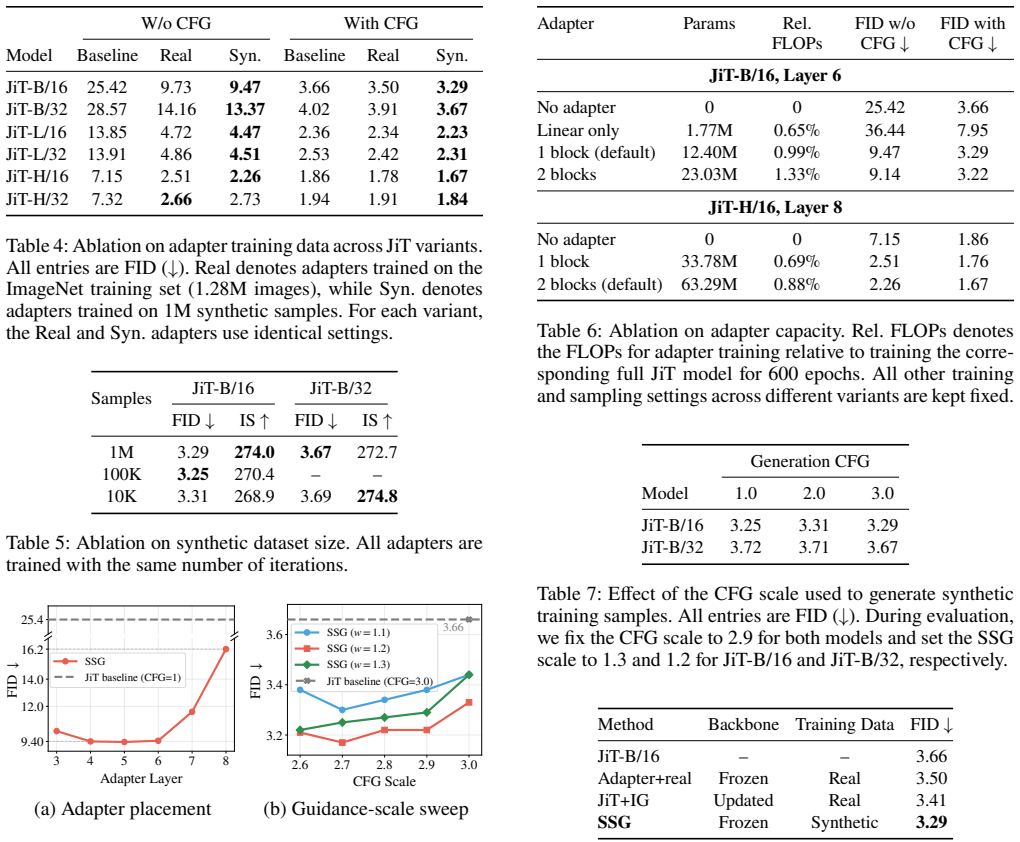
- [Abstract and Table 4] The claim that synthetic samples 'outperform real images' for adapter training is too broad. In Table 4, JiT-H/32 without CFG gives synthetic FID 2.73 versus real FID 2.66, so there is at least one exception. The conclusion says 'nearly all settings', which is accurate, but the abstract and introduction should carry the same caveat.
- [Experiments, evaluation protocol] All FID/IS/Precision/Recall numbers appear to be single-run point estimates with no error bars. Given that some key comparisons are close (e.g., Table 5: 3.25 vs 3.29 vs 3.31; Table 4 synthetic vs real), the authors should report variance across multiple evaluation runs or seeds, or at least acknowledge that small differences are within expected noise.
- [Table 3 and Discussion] Without CFG, SSG consistently improves precision but reduces recall (e.g., JiT-B/16: precision 0.54→0.70, recall 0.66→0.57; JiT-H/16: 0.68→0.78, recall 0.67→0.62). This precision-recall trade-off is not discussed. The paper should address whether this is inherent to extrapolative self-guidance and how it relates to the high-frequency-detail mechanism.
- [Fig. 5(a)] The x-axis of Fig. 5(a) is confusing: it appears to use a normalized depth scale with layer-number tick labels, but this is not explained in the caption or text. Please clarify the axis definition and the relationship between the normalized axis and the actual adapter layer indices.
- [Table 8] The comparison with IG uses an implementation by the authors on JiT rather than an official IG checkpoint. If the official IG model is not available for pixel-space JiT, this should be stated explicitly, and the comparison should be framed as an informal baseline rather than a direct head-to-head.
Circularity Check
No significant circularity: SSG's gains are validated against external ImageNet FID, not derived from its own construction.
full rationale
The paper's central construction is empirical and self-contained with respect to an external benchmark. Equation (6), x_guided = x_inter + w(x_final - x_inter), is an extrapolation formula taken from the established AG/IG guidance form, applied to an intermediate clean prediction produced by a separately trained lightweight adapter. The adapter is trained with the same flow-matching objective (Eq. 1) on synthetic samples, and the guidance scales are swept and reported (Table S1) rather than fitted to the FID targets. FID, IS, Precision, and Recall are all computed against the ImageNet validation set using the standard 50K-sample protocol, so the reported improvements are not forced by the construction. The coarse-to-fine premise is supported by independent Fourier analysis on validation images (Fig. 3a) and by visualizations (Fig. 4), not assumed by definition. The use of the model's own synthetic samples for adapter training is a self-referential training-data choice, but it is not a derivational circularity: the adapter is an auxiliary module, and its effect is measured externally. No load-bearing self-citation appears; the paper's own limitation statement (Supplementary E) candidly notes that generalization to text-conditioned models and other domains is unverified, which is an empirical scope caveat, not a circular step. Therefore no circular step meets the required evidentiary standard.
Axiom & Free-Parameter Ledger
free parameters (5)
- SSG guidance scale w =
1.05–1.7 per model (Table S1)
- CFG scale c =
1.9–2.9 per model (Table S1)
- Adapter attachment layer =
Layer 6 (JiT-B/L) or layer 8 (JiT-H, PixelREPA, DeCo encoder)
- Adapter depth =
1 block (JiT-B/L) or 2 blocks (JiT-H, PixelREPA, DeCo)
- SSG timestep interval =
[0.1, 1.0] with CFG; [0,1] without CFG
axioms (5)
- standard math Flow-matching objective (Eq. 1) and the velocity/clean-prediction relation (Eq. 4) hold for the pretrained models.
- domain assumption Extrapolating a strong prediction away from a weak prediction (autoguidance, Eq. 5) improves sample quality.
- domain assumption A lightweight adapter (1–2 transformer blocks) can decode intermediate representations into valid clean-image predictions.
- domain assumption Training the adapter on synthetic samples from the same model provides a stable training signal; no self-training collapse occurs within the training budget.
- standard math FID computed on 50K generated samples against the ImageNet validation set is a reliable evaluation of generation quality.
read the original abstract
Pixel-space diffusion models aim to learn an end-to-end generator directly over raw pixels. This is challenging because a single model must capture both global structure and local texture in the same high-dimensional space. While recent work improves pixel diffusion through alternative prediction targets, training objectives, and architectures, these advances typically require training a new model from scratch. We show there is a cheaper, complementary strategy: \textbf{a frozen, pretrained pixel diffusion model can guide itself}. Our key observation is that intermediate layers of a pretrained pixel diffusion transformer can be decoded into coarse predictions that capture the main low-frequency structure, while the final layers progressively refine local, high-frequency details. We therefore attach a lightweight prediction head to an intermediate layer, keep the backbone frozen, and use the discrepancy between the intermediate and final predictions as a self-guidance direction during sampling. To train this head, we further find that real images are not necessary. Instead, model-generated samples suffice and even outperform real images for training the head, especially in enhancing the high-frequency components that pixel diffusion tends to underfit. Across multiple pixel diffusion models on ImageNet, our \textbf{Synthetic Self-Guidance (SSG)} consistently improves generation while adapter training requires less than 1$\%$ of full-model training compute: it reduces FID by over 50$\%$ across the evaluated JiT variants without classifier-free guidance (CFG) and further improves strong baselines with CFG, e.g., JiT-H/16 from 1.86 to 1.67 and PixelREPA-H/16 from 1.81 to 1.59. Our code is available at https://github.com/zfu006/SSG.
Figures


Reference graph
Works this paper leans on
-
[1]
Communication, Simulation, and Intelligent Agents: Implications of Personal Intelligent Machines for Medical Education
Clancey, William J. Communication, Simulation, and Intelligent Agents: Implications of Personal Intelligent Machines for Medical Education. Proceedings of the Eighth International Joint Conference on Artificial Intelligence (IJCAI-83)
-
[2]
Classification Problem Solving
Clancey, William J. Classification Problem Solving. Proceedings of the Fourth National Conference on Artificial Intelligence
-
[3]
, title =
Robinson, Arthur L. , title =. 1980 , doi =. https://science.sciencemag.org/content/208/4447/1019.full.pdf , journal =
1980
-
[4]
New Ways to Make Microcircuits Smaller---Duplicate Entry
Robinson, Arthur L. New Ways to Make Microcircuits Smaller---Duplicate Entry. Science
-
[5]
Clancey and Glenn Rennels , abstract =
Diane Warner Hasling and William J. Clancey and Glenn Rennels , abstract =. Strategic explanations for a diagnostic consultation system , journal =. 1984 , issn =. doi:https://doi.org/10.1016/S0020-7373(84)80003-6 , url =
-
[6]
and Rennels, Glenn R
Hasling, Diane Warner and Clancey, William J. and Rennels, Glenn R. and Test, Thomas. Strategic Explanations in Consultation---Duplicate. The International Journal of Man-Machine Studies
-
[7]
Poligon: A System for Parallel Problem Solving
Rice, James. Poligon: A System for Parallel Problem Solving
-
[8]
Transfer of Rule-Based Expertise through a Tutorial Dialogue
Clancey, William J. Transfer of Rule-Based Expertise through a Tutorial Dialogue
-
[9]
The Engineering of Qualitative Models
Clancey, William J. The Engineering of Qualitative Models
-
[10]
2023 , eprint=
Attention Is All You Need , author=. 2023 , eprint=
2023
-
[11]
Pluto: The 'Other' Red Planet
NASA. Pluto: The 'Other' Red Planet
-
[12]
Proceedings of the IEEE/CVF conference on computer vision and pattern recognition , pages=
High-resolution image synthesis with latent diffusion models , author=. Proceedings of the IEEE/CVF conference on computer vision and pattern recognition , pages=
-
[13]
Proceedings of the IEEE/CVF Conference on Computer Vision and Pattern Recognition , pages=
Back to basics: Let denoising generative models denoise , author=. Proceedings of the IEEE/CVF Conference on Computer Vision and Pattern Recognition , pages=
-
[14]
arXiv preprint arXiv:2602.02493 , year=
PixelGen: Pixel Diffusion Beats Latent Diffusion with Perceptual Loss , author=. arXiv preprint arXiv:2602.02493 , year=
-
[15]
arXiv preprint arXiv:2603.14366 , year=
Representation alignment for just image transformers is not easier than you think , author=. arXiv preprint arXiv:2603.14366 , year=
-
[16]
Proceedings of the IEEE/CVF Conference on Computer Vision and Pattern Recognition , pages=
Pixeldit: Pixel diffusion transformers for image generation , author=. Proceedings of the IEEE/CVF Conference on Computer Vision and Pattern Recognition , pages=
-
[17]
Proceedings of the IEEE/CVF Conference on Computer Vision and Pattern Recognition , pages=
Deco: Frequency-decoupled pixel diffusion for end-to-end image generation , author=. Proceedings of the IEEE/CVF Conference on Computer Vision and Pattern Recognition , pages=
-
[18]
arXiv preprint arXiv:2602.11401 , year=
Latent forcing: Reordering the diffusion trajectory for pixel-space image generation , author=. arXiv preprint arXiv:2602.11401 , year=
-
[19]
arXiv preprint arXiv:2606.27760 , year=
PixelU: A U-Shaped Transformer for Efficient End-to-End Pixel Diffusion , author=. arXiv preprint arXiv:2606.27760 , year=
-
[20]
Advances in neural information processing systems , volume=
Diffusion models beat gans on image synthesis , author=. Advances in neural information processing systems , volume=
-
[21]
arXiv preprint arXiv:2410.06940 , year=
Representation alignment for generation: Training diffusion transformers is easier than you think , author=. arXiv preprint arXiv:2410.06940 , year=
-
[22]
Proceedings of the IEEE/CVF international conference on computer vision , pages=
Scalable diffusion models with transformers , author=. Proceedings of the IEEE/CVF international conference on computer vision , pages=
-
[23]
European Conference on Computer Vision , pages=
Sit: Exploring flow and diffusion-based generative models with scalable interpolant transformers , author=. European Conference on Computer Vision , pages=. 2024 , organization=
2024
-
[24]
Advances in neural information processing systems , volume=
Denoising diffusion probabilistic models , author=. Advances in neural information processing systems , volume=
-
[25]
arXiv preprint arXiv:2209.03003 , year=
Flow straight and fast: Learning to generate and transfer data with rectified flow , author=. arXiv preprint arXiv:2209.03003 , year=
-
[26]
generation: Taming optimization dilemma in latent diffusion models , author=
Reconstruction vs. generation: Taming optimization dilemma in latent diffusion models , author=. Proceedings of the Computer Vision and Pattern Recognition Conference , pages=
-
[27]
arXiv preprint arXiv:2510.11690 , year=
Diffusion transformers with representation autoencoders , author=. arXiv preprint arXiv:2510.11690 , year=
-
[28]
International Conference on Medical image computing and computer-assisted intervention , pages=
U-net: Convolutional networks for biomedical image segmentation , author=. International Conference on Medical image computing and computer-assisted intervention , pages=. 2015 , organization=
2015
-
[29]
arXiv preprint arXiv:2010.11929 , year=
An image is worth 16x16 words: Transformers for image recognition at scale , author=. arXiv preprint arXiv:2010.11929 , year=
Pith/arXiv arXiv 2010
-
[30]
Proceedings of the IEEE/CVF Conference on Computer Vision and Pattern Recognition , pages=
Dip: Taming diffusion models in pixel space , author=. Proceedings of the IEEE/CVF Conference on Computer Vision and Pattern Recognition , pages=
-
[31]
arXiv preprint arXiv:2510.12586 , year=
There is no vae: End-to-end pixel-space generative modeling via self-supervised pre-training , author=. arXiv preprint arXiv:2510.12586 , year=
-
[32]
European conference on computer vision , pages=
Perceptual losses for real-time style transfer and super-resolution , author=. European conference on computer vision , pages=. 2016 , organization=
2016
-
[33]
arXiv preprint arXiv:2207.12598 , year=
Classifier-free diffusion guidance , author=. arXiv preprint arXiv:2207.12598 , year=
-
[34]
Advances in Neural Information Processing Systems , volume=
Guiding a diffusion model with a bad version of itself , author=. Advances in Neural Information Processing Systems , volume=
-
[35]
Proceedings of the IEEE/CVF Conference on Computer Vision and Pattern Recognition , pages=
Guiding a diffusion transformer with the internal dynamics of itself , author=. Proceedings of the IEEE/CVF Conference on Computer Vision and Pattern Recognition , pages=
-
[36]
arXiv preprint arXiv:2605.18324 , year=
Improved baselines with representation autoencoders , author=. arXiv preprint arXiv:2605.18324 , year=
-
[37]
arXiv preprint arXiv:2210.02747 , year=
Flow matching for generative modeling , author=. arXiv preprint arXiv:2210.02747 , year=
-
[38]
Advances in neural information processing systems , volume=
Attention is all you need , author=. Advances in neural information processing systems , volume=
-
[39]
Advances in neural information processing systems , volume=
Gans trained by a two time-scale update rule converge to a local nash equilibrium , author=. Advances in neural information processing systems , volume=
-
[40]
Advances in neural information processing systems , volume=
Improved techniques for training gans , author=. Advances in neural information processing systems , volume=
-
[41]
Advances in neural information processing systems , volume=
Improved precision and recall metric for assessing generative models , author=. Advances in neural information processing systems , volume=
-
[42]
Proceedings of the IEEE/CVF Conference on Computer Vision and Pattern Recognition , pages=
Ddt: Decoupled diffusion transformer , author=. Proceedings of the IEEE/CVF Conference on Computer Vision and Pattern Recognition , pages=
-
[43]
arXiv preprint arXiv:2212.11972 , year=
Scalable adaptive computation for iterative generation , author=. arXiv preprint arXiv:2212.11972 , year=
-
[44]
Advances in Neural Information Processing Systems , volume=
Understanding diffusion objectives as the elbo with simple data augmentation , author=. Advances in Neural Information Processing Systems , volume=
-
[45]
arXiv preprint arXiv:2502.17437 , year=
Fractal generative models , author=. arXiv preprint arXiv:2502.17437 , year=
-
[46]
arXiv preprint arXiv:2504.07963 , year=
Pixelflow: Pixel-space generative models with flow , author=. arXiv preprint arXiv:2504.07963 , year=
-
[47]
arXiv preprint arXiv:2507.23268 , year=
Pixnerd: Pixel neural field diffusion , author=. arXiv preprint arXiv:2507.23268 , year=
-
[48]
International journal of computer vision , volume=
Imagenet large scale visual recognition challenge , author=. International journal of computer vision , volume=. 2015 , publisher=
2015
-
[49]
arXiv preprint arXiv:2408.16333 , year=
Self-improving diffusion models with synthetic data , author=. arXiv preprint arXiv:2408.16333 , year=
-
[50]
arXiv preprint arXiv:2510.03597 , year=
Neon: Negative Extrapolation From Self-Training Improves Image Generation , author=. arXiv preprint arXiv:2510.03597 , year=
-
[51]
arXiv preprint arXiv:1412.6980 , year=
Adam: A method for stochastic optimization , author=. arXiv preprint arXiv:1412.6980 , year=
discussion (0)
Sign in with ORCID, Apple, or X to comment. Anyone can read and Pith papers without signing in.