REVIEW 3 major objections 5 minor 156 references
An Increase in the Galactic Planet Host Fraction Fails to Reproduce the Galactic Height Trend in Planet Occurrence
T0 review · 3 major / 5 minor · reviewed 2026-08-06 · deepseek-v4-flash
Pith's one-line read This paper claims that a time-dependent increase in the Milky Way's small-planet host fraction, whether stepped or gradual, cannot reproduce the steep decline in planet occurrence with height above the Galactic midplane, and that only…
desk verdict A transparent forward-modeling test that likely rules out gradual increases in the planet host fraction as the sole explanation for Z23's steep occurrence–height trend, but the exclusion leans on a shaky age–Zmax calibration. read the letter →
The pith
A machine-rendered reading of the paper's core claim, the machinery that carries it, and where it could break.
The reading
What carries the argument
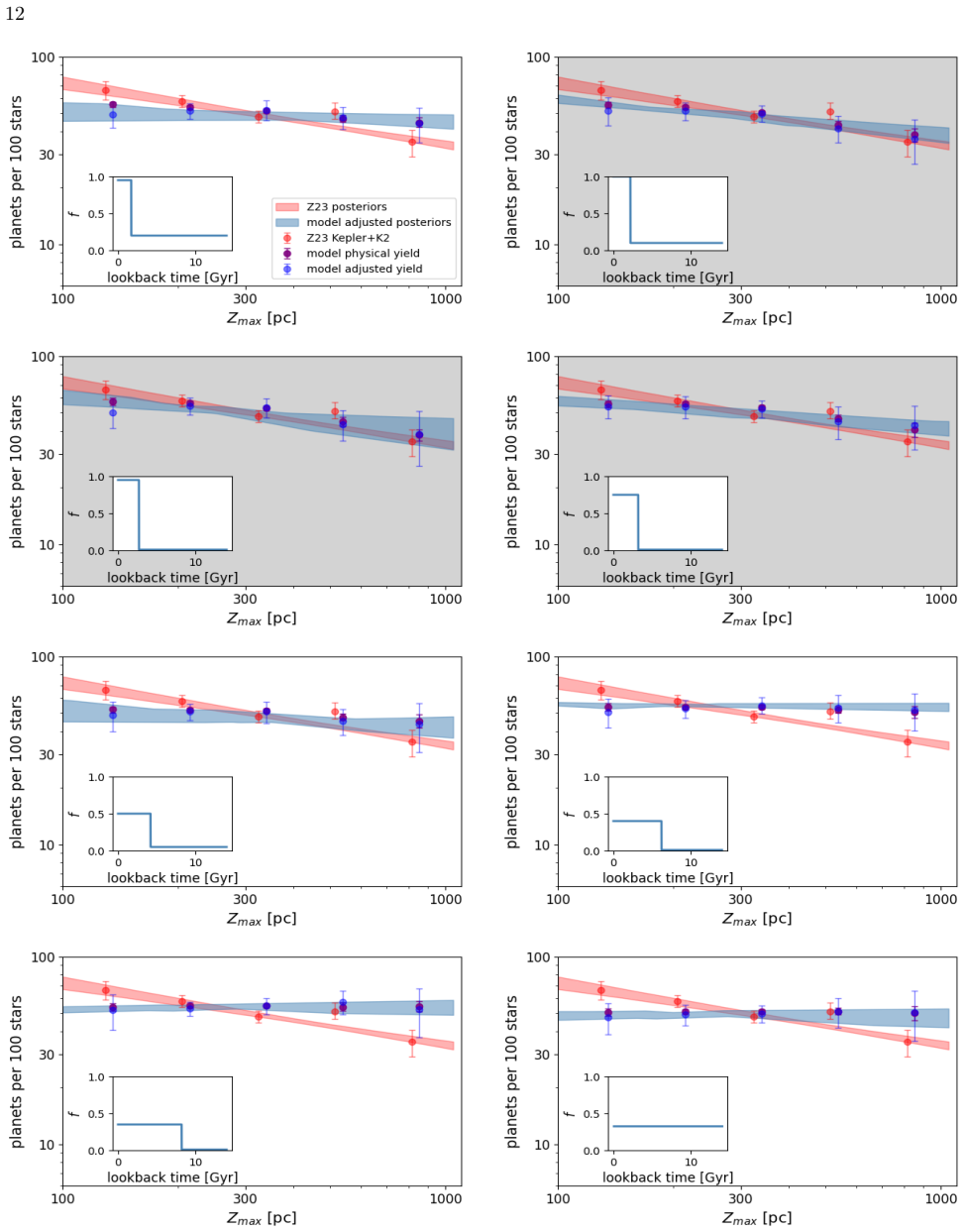
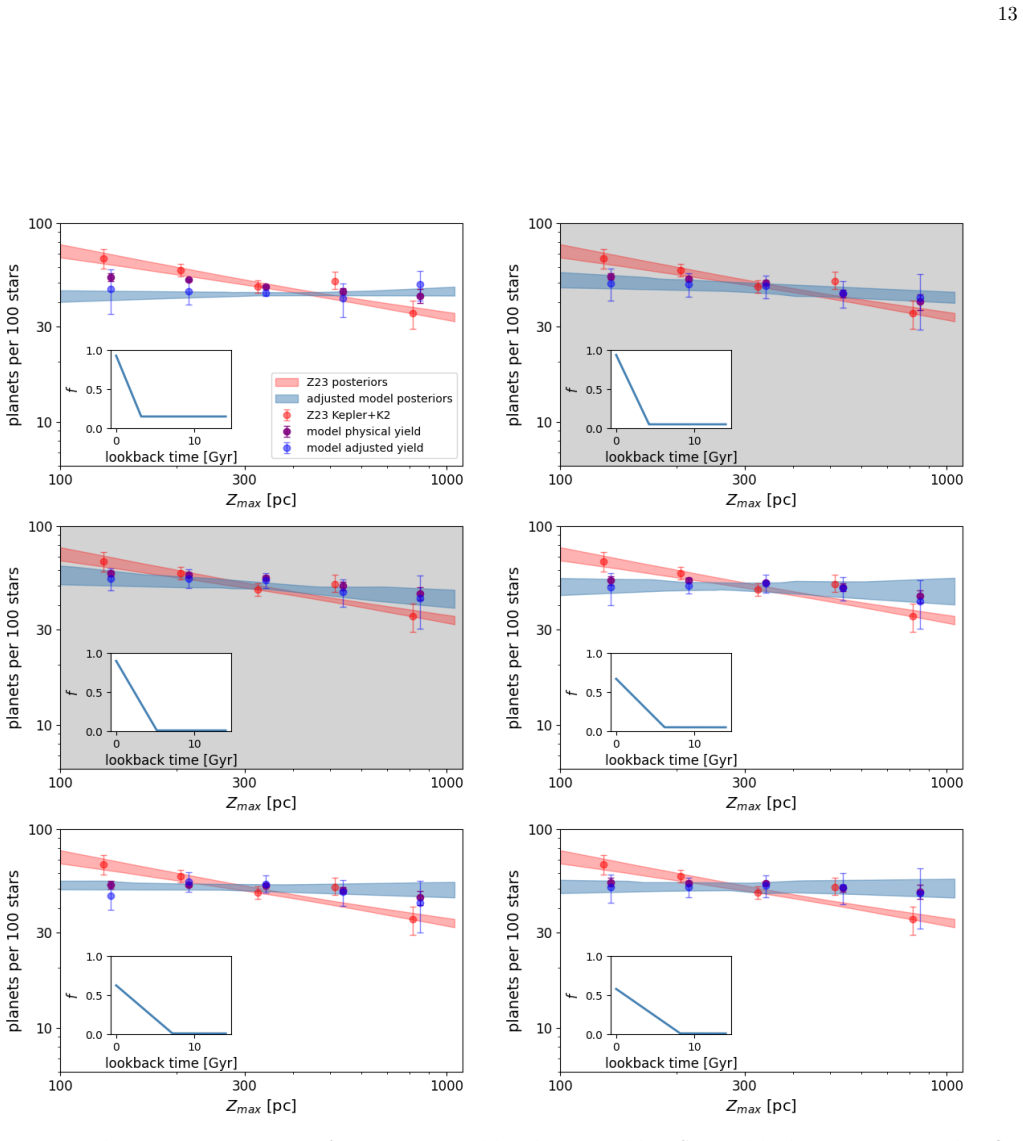
The machinery is a new planetary-system population-synthesis code, psps, combined with two ways of building the stellar sample. For the real sample, Kepler and K2 stars are taken from the homogeneous HU25 catalog, given isochrone ages from B20 and B25, and assigned a maximum vertical oscillation amplitude $Z_{\rm max}$ by integrating orbits in a Milky Way potential model with the Gala package. The synthetic sample is generated with TRILEGAL, whose built-in kinematic heating maps stellar age to height with much smaller age uncertainties. The host-fraction models are step functions or piecewise-linear ramps from a low early fraction $f_1$ to a present-day $f_2$ at a lookback time $t$, all normalized to a present-day 30–35% host fraction; psps assigns either dynamically compact cold multi-planet architectures or dynamically hot single or two-planet architectures, draws planets and transits, and applies Kepler and K2 detection sensitivity maps. The output is a completeness-corrected occurrence rate per height bin, fit to a power law $y = 100\,\eta\,Z_{\rm max}^{\tau}$, whose slope $\tau$ is compared with the Z23 trend.
What would settle it
Measure the age–$Z_{\rm max}$ relation for the joint Kepler–K2 sample using asteroseismic ages that are much more precise than the isochrone ages used here; if that relation turns out to be substantially steeper than the soft trend in the paper's Figure 3, the synthetic occurrence–height slopes would steepen and an increasing host fraction could reproduce the Z23 trend, undercutting the paper's central claim.
Extended reading notes
Core claim
The central claim is that a time-dependent planet host fraction $f$—rising from a primordial $f_1$ to a present-day $f_2$ either instantaneously or gradually—cannot, under the models tested, reproduce the steep decline in small-planet occurrence with $Z_{\rm max}$ measured by Zink et al. (2023, hereafter Z23). Applied to a joint Kepler–K2 sample with isochrone ages, almost every step and piecewise model yields an occurrence–height slope $\tau$ flatter than the observed $\tau \approx -0.28 \pm 0.08$, and the handful that come within one standard deviation require $f_1 \approx 1\%$ or $f_2 \approx 100\%$ at thresholds 2.2–3.2 Gyr ago. Using TRILEGAL synthetic stars with roughly 1 Gyr age uncertainties, gradual increases in $f$ are ruled out even in the idealized case, while the best step matches remain anchored at an extreme $f_2 = 100\%$. An independently derived Kepler-only occurrence–height trend has slope $-0.25 \pm 0.05$, close to the combined trend, and is somewhat easier for a step increase to match. The conclusion is that an increase in $f$ alone is insufficient; the paper suggests a time-evolving fraction of compact multi-planet systems, or separate $f$ histories for Super-Earths and Sub-Neptunes, as more flexible alternatives.
Load-bearing premise
The whole test rests on the assumption that the measured age-to-maximum-height relation is tight and unbiased; if older stars do not systematically reach larger $Z_{\rm max}$ in the real sample, or if the true relation is much steeper than the soft isochrone-age trend, a time-dependent host fraction could produce the observed slope and the paper's main exclusion would weaken.
Editorial extensions
If this is right
- If the paper's exclusion holds, any explanation of the occurrence–height trend must involve something beyond a simple age-dependent boost in the number of stars that host small close-in planets, such as separate host-fraction histories for Super-Earths and Sub-Neptunes or a time-evolving fraction of compact multi-planet systems.
- The timing constraints narrow possible physical triggers: step thresholds that nearly match are 2.2–3.2 Gyr ago, so earlier Galactic events such as the Gaia-Enceladus merger and the first Sagittarius passage are disfavored as the dominant cause.
- The independently derived Kepler-only occurrence–height slope agrees with the joint trend within uncertainties, indicating the effect is not an artifact of combining two surveys with different detection sensitivities.
- A gradual rise in the planet host fraction is excluded even with age uncertainties as small as about 1 Gyr, which strengthens the conclusion that a sudden, relatively recent process is required if the host fraction participates at all.
Reading between the lines
- An immediate extension would be to treat the fraction of intact compact multi-planet systems as a free parameter; since the paper's models are consistently too shallow, an increase in that fraction with time should steepen the predicted occurrence–$Z_{\rm max}$ trend and could remove the need for extreme $f_1$ or $f_2$ values.
- The paper's timing constraints are conditional on the isochrone age–$Z_{\rm max}$ relation; a steeper relation, as may come from asteroseismic ages, would re-open the step and gradual models the paper excludes.
- A larger uniformly aged K2 sample would be a useful check: the joint sample here contains only 141 K2 stars, and the K2 ages come from a planet-host-only catalog, so the relative weight of the two surveys in the observed trend is not yet measured as precisely as the Kepler part.
- Replacing $Z_{\rm max}$ with the vertical action $J_z$, which correlates more tightly with age, is a natural next test; if the occurrence–height trend persists in $J_z$, a time-dependent host fraction would have to be reconsidered.
Editorial analysis
A structured set of objections, weighed in public.
Referee Report
Summary. The paper asks whether an increase over time in the fraction of FGK stars hosting small close-in planets can explain the Zink et al. (2023) decline of planet occurrence with maximum Galactic height Zmax. The authors construct a real Kepler+K2 sample with isochrone ages from the HU25/B20/B25 catalogs and a synthetic TRILEGAL sample with much more precise ages, prescribe step and piecewise host-fraction histories f1→f2 at lookback time t (all normalized to a present-day host fraction of roughly 30-35%), synthesize planetary systems with the new psps code, apply Kepler/K2 completeness models, and fit a power law to occurrence versus Zmax. They find that most models produce slopes τ shallower than the observed τ=-0.28±0.08, with only extreme late-time step increases approaching the observed trend, and that gradual increases remain too shallow even in the TRILEGAL sample. A Kepler-only analysis yields a less steep observed trend that a step increase can match.
Significance. If the result holds, it demonstrates that a purely time-dependent planet host fraction is not sufficient to explain the Z23 occurrence–height trend, pointing toward size-dependent or architectural evolution as additional ingredients. The paper's strengths include the two independent sample constructions, the transparent listing of all model fits in Table 2, the public psps code, and the explicit acknowledgment in Section 4 that the weak age–Zmax relation is a possible source of dilution. However, the strength of the central exclusion is limited by the calibration of the age–Zmax mapping: in the real sample this mapping is built from large-uncertainty isochrone ages, and in the TRILEGAL experiment it is an assumed kinematic heating law rather than an empirically calibrated relation. The conclusion is plausible but conditional; robustness tests against these two points are needed before the exclusion can be regarded as fully established.
major comments (3)
- [Sections 2.1.2–2.1.3, Figs. 3 and 6, Section 4] The central exclusion rests on how steeply stellar age maps to Zmax. In the real sample this map is only a 'soft positive trend' built from isochrone ages with mean upper uncertainties of 2.8 Gyr (Kepler) and 5.6 Gyr (K2), and the 30 redraws resample the same posteriors, so they cannot correct a systematic flattening if old high-Zmax stars are assigned younger ages. In the TRILEGAL experiment the age precision is high, but the age–Zmax link is not empirical: it is the adopted heating law h_z=z0(1+t/t0)^α with α=5/3 and a two-step star-formation history. If the true age–Zmax gradient is steeper—the paper itself cites asteroseismic estimates of ~4 Gyr/kpc—the same f1→f2 histories would yield steeper occurrence–Zmax slopes, potentially bringing gradual models within 1σ of Z23. The paper flags this possibility in Section 4, but it does not quantify it. I request a sensitivity test (for example, rerunning the TRILEGAL experiment with alternate α values or with an empirically calibrated age–Zmax relation) before the claim that gradual models are ruled out 'even with very precise ages' is accepted.
- [Section 3.3, Fig. 12, and Abstract/Conclusion] The abstract's unqualified statement that 'an increase in f is insufficient to reproduce the strength of the observed trend' is in tension with the paper's own Kepler-only analysis: the step model {f1=20%, f2=100%, t=2.2 Gyr} yields τ=-0.20±0.07 against the derived Kepler-only observed τ=-0.25±0.05, which the authors call a relatively good match. The joint-sample exclusion therefore depends on the K2 component, which after all cuts contains only 141 stars, and whose completeness maps are shot-noise dominated (Section 2.4, Fig. 8). The authors should either demonstrate that the joint exclusion is robust to K2 sample size and noise (for example, by jackknifing over K2 campaigns or repeating the analysis without K2), or qualify the central claim so that it applies to the joint sample but not to the Kepler-only trend.
- [Section 2.2 and Section 3.1, Table 2] The argument that testing the limits f1=1% and f2=100% 'sets the maximum slope' of the occurrence–Zmax trend for any given t is asserted but not demonstrated. Table 2 contains no model with both f1=1% and f2=100% simultaneously; the models with t=2.7 and t=3.2 Gyr have f1=1%, f2=95% and f1=1%, f2=75%, respectively. If the true steepest model compatible with the present-day host-fraction constraint lies outside the tested grid, the claim to 'rule out entire t' intervals is stronger than the evidence. The authors should either show that the predicted τ is monotonic in f1 and f2 (decreasing as f1 decreases and f2 increases), or perform a small optimization over the (f1,f2) plane for each threshold t.
minor comments (5)
- [Figure 1 caption and Section 2.1.1] The text interprets a KS p-value of 7e-4 as indicating 'a very high probability' that the two age distributions are drawn from the same population; with large samples, small p-values can accompany small distribution differences, so the p-value alone does not support the phrase used. Please rephrase in terms of the small CDF separation or report an effect size.
- [Equation (8), Section 3.1] The normalization states dlnZmax = 0.0011, but five evenly log-spaced bins from 100 to 1000 pc imply dlnZmax ≈ 0.46; please clarify whether this is a typo or whether a different binning was used, since it affects the reported normalization η.
- [Figure 12 caption vs. Section 3.3] The Figure 12 top-panel caption says the model is {f1=5%, f2=80%, t=9.5 Gyr}, while the text describes the matched model as {f1=20%, f2=100%, t=2.2 Gyr}; these are inconsistent and should be reconciled.
- [Figure 7 and Section 2.2] The model parameters are sometimes written without units (for example 't=1.7' rather than '1.7 Gyr ago'); please label the lookback time consistently in the figure insets and table headers.
- [Figure 5 caption] The histogram panel for 'height' compares TRILEGAL instantaneous height with HU25-B20-B25 Zmax; the caption notes this but using different vertical coordinates in the same normalized panel can mislead readers. Please state explicitly in the caption that the two quantities are not directly comparable.
Circularity Check
No significant circularity: the time-dependent host-fraction models are forward-modeled against the independent Zink et al. (2023) trend, with f1, f2, and t anchored only to the externally measured present-day host fraction.
full rationale
The paper's central claim is a falsification test, not a fit. The model parameters f1, f2, and t are hand-scanned and normalized to the externally measured present-day planet-host fraction of 30–35% (Zhu et al. 2018); they are never fit to the target occurrence–Galactic-height slope. The Z23 trend (τ = -0.28±0.08 after the authors' re-fit) is an external observed benchmark, and the modeled yields are compared to it after independent completeness corrections. The 'steepest possible' bounding argument (f1=1%, f2=100%) is a model-derived limit, not an input assumption equivalent to the conclusion. The only self-referential element is the constant hot/cold system fraction adopted from Lam & Ballard (2024), but that is an externally published empirical prior, not a parameter fitted in this paper; the authors explicitly identify relaxing the intact fraction as future work, showing it is an assumption rather than a circular reduction. Likewise, the weak age–Zmax relation is explicitly flagged as a potential systematic (Section 4) and is a measurement/calibration limitation, not a case where an equation reduces to itself. No step in the derivation chain equates the target result to an input by construction.
Assumptions & free parameters
free parameters (4)
- f1 (primordial host fraction) =
0.01 to 0.20 across 13 models
- f2 (present-day host fraction) =
0.35 to 1.00 across 13 models
- t (threshold lookback time) =
1.7 to 8.2 Gyr ago
- intact STIPs fraction =
18% ± 10% (normal prior)
assumptions (6)
- domain assumption Age-Zmax relation from Gala orbits and isochrone ages is a valid proxy for galactic height history.
- domain assumption TRILEGAL's two-step star formation history and kinematic heating (h_z = z0(1+t/t0)^alpha) describe the Milky Way thin disk.
- domain assumption Present-day planet host fraction around FGK dwarfs is 30-35%.
- domain assumption Fraction of dynamically cool compact multi systems is ~18% and independent of age.
- domain assumption Detection completeness maps (Thompson 2018, Zink 2021) and the inverse detection efficiency method are valid per Zmax bin.
- domain assumption The Milky Way is 13.7 Gyr old.
Cite this review
Pith. "Pith review of An Increase in the Galactic Planet Host Fraction Fails to Reproduce the Galactic Height Trend in Planet Occurrence." pith.science (2026). https://pith.science/paper/YTHI3ICI
@misc{pith2026250721250,
  author       = {Pith},
  title        = {Pith review of: An Increase in the Galactic Planet Host Fraction Fails to Reproduce the Galactic Height Trend in Planet Occurrence},
  year         = {2026},
  howpublished = {\url{https://pith.science/paper/YTHI3ICI}},
  note         = {Machine review of arXiv:2507.21250}
}
read the original abstract
While stellar metallicity has long been known to correlate with planetary properties, the galactic metallicity gradient alone does not account for the observed strong trend in planet occurrence with Galactic height. In this study, we investigate the observable effect of a time-dependent planet occurrence rate upon a sample of stars selected uniformly from the Kepler and K2 surveys. Using a novel planetary system population synthesis code, psps, we impose several prescriptions for a time-variable planet host fraction, f, in which a primordial f1 either instantaneously or gradually increased to a present-day f2. We then simulate the expected small planet occurrence rate around FGK dwarfs as a function of galactic height. Finally, we compare the modeled trends to the observed result from the missions themselves. We find that using a joint Kepler-K2 sample with isochrone ages, an increase in f is insufficient to reproduce the strength of the observed trend between occurrence and Galactic height. We show that not all of this is due to insufficient age precision: using a synthetic stellar population from the TRILEGAL framework, we show that even with very precise ages, we can rule out models of gradually increasing f. We also derive the Kepler occurrence-height relation and find that an increase in f is better able to match this trend. An analysis using more precise ages and incorporating an evolving compact multi fraction could furnish a realistic relation in planet occurrence with Galactic height that matches the observed Kepler-K2 trend.
Figures


Figures from the paper (9 more)




Reference graph
Works this paper leans on
-
[1]
Adibekyan, V., Dorn, C., Sousa, S. G., et al. 2021, Science, 374, 330, 10.1126/science.abg8794
-
[2]
Adibekyan, V. Z., Sousa, S. G., Santos, N. C., et al. 2012, Astronomy and Astrophysics, 545, A32, 10.1051/0004-6361/201219401
-
[3]
Andrews, S. M., Rosenfeld, K. A., Kraus, A. L., & Wilner, D. J. 2013, The Astrophysical Journal, 771, 129, 10.1088/0004-637X/771/2/129
-
[4]
2018, Nature, 561, 360, 10.1038/s41586-018-0510-7
Antoja, T., Helmi, A., Romero-G´ omez, M., et al. 2018, Nature, 561, 360, 10.1038/s41586-018-0510-7
-
[5]
Armitage, P. J. 2011, ARA&A, 49, 195, 10.1146/annurev-astro-081710-102521
-
[6]
Ballard, S., & Johnson, J. A. 2016, The Astrophysical Journal, 816, 66, 10.3847/0004-637X/816/2/66
-
[7]
1967, ApJ, 150, 461, 10.1086/149349
Barbanis, B., & Woltjer, L. 1967, ApJ, 150, 461, 10.1086/149349
doi:10.1086/149349 1967
-
[8]
2004, arXiv e-prints, physics/0406120, 10.48550/arXiv.physics/0406120
Barlow, R. 2004, arXiv e-prints, physics/0406120, 10.48550/arXiv.physics/0406120
Show all 156 references
-
[9]
2022, Monthly Notices of the Royal Astronomical Society, 510, 3449, 10.1093/mnras/stab3596
Bashi, D., & Zucker, S. 2022, Monthly Notices of the Royal Astronomical Society, 510, 3449, 10.1093/mnras/stab3596
2022 doi
-
[10]
E., Ness, M
Beane, A., Sanderson, R. E., Ness, M. K., et al. 2019, The Astrophysical Journal, 883, 103, 10.3847/1538-4357/ab3d3c
2019 doi
-
[11]
Deason, A. J. 2018, Monthly Notices of the Royal Astronomical Society, 478, 611, 10.1093/mnras/sty982 Beraldo e Silva, L., Debattista, V. P., Khachaturyants, T., &
2018 doi
-
[12]
2020, MNRAS, 492, 4716, 10.1093/mnras/staa065
Nidever, D. 2020, MNRAS, 492, 4716, 10.1093/mnras/staa065
2020 doi
-
[13]
A., Huber, D., Gaidos, E., Van Saders, J
Berger, T. A., Huber, D., Gaidos, E., Van Saders, J. L., & Weiss, L. M. 2020a, The Astronomical Journal, 160, 108, 10.3847/1538-3881/aba18a
-
[14]
A., Huber, D., Van Saders, J
Berger, T. A., Huber, D., Van Saders, J. L., et al. 2020b, The Astronomical Journal, 159, 280, 10.3847/1538-3881/159/6/280
-
[15]
A., Schlieder, J
Berger, T. A., Schlieder, J. E., & Huber, D. 2025, The Astronomical Journal, 171, 23, 10.3847/1538-3881/ae0e76
2025 doi
-
[16]
C., Kazantzidis, S., & Weinberg, D
Bird, J. C., Kazantzidis, S., & Weinberg, D. H. 2012, MNRAS, 420, 913, 10.1111/j.1365-2966.2011.19728.x
2012
-
[17]
C., Loebman, S
Bird, J. C., Loebman, S. R., Weinberg, D. H., et al. 2021, MNRAS, 503, 1815, 10.1093/mnras/stab289
2021 doi
-
[18]
2016, ARA&A, 54, 529, 10.1146/annurev-astro-081915-023441
Bland-Hawthorn, J., & Gerhard, O. 2016, ARA&A, 54, 529, 10.1146/annurev-astro-081915-023441
2016 doi
-
[19]
2025, arXiv e-prints, arXiv:2502.01895, 10.48550/arXiv.2502.01895
Bland-Hawthorn, J., Tepper-Garcia, T., Agertz, O., et al. 2025, arXiv e-prints, arXiv:2502.01895, 10.48550/arXiv.2502.01895
2025 doi
-
[20]
A., Parker, R
Blaylock-Squibbs, G. A., Parker, R. J., & Daffern-Powell, E. C. 2024, The Astrophysical Journal, 968, 108, 10.3847/1538-4357/ad4be0
2024 doi
-
[21]
2024, Astronomy & Astrophysics, 692, A150, 10.1051/0004-6361/202451537
Boettner, C., Viswanathan, A., & Dayal, P. 2024, Astronomy & Astrophysics, 692, A150, 10.1051/0004-6361/202451537
2024 doi
-
[22]
M., Christiansen, J
Boley, K. M., Christiansen, J. L., Zink, J., et al. 2024, The Astronomical Journal, 168, 128, 10.3847/1538-3881/ad6570
2024 doi
-
[23]
G., Hillenbrand, L
Bouma, L. G., Hillenbrand, L. A., Howard, A. W., et al. 2024, The Astrophysical Journal, 976, 234, 10.3847/1538-4357/ad855f
2024 doi
-
[24]
G., & Martig, M
Bournaud, F., Elmegreen, B. G., & Martig, M. 2009, ApJ, 707, L1, 10.1088/0004-637X/707/1/L1
2009 doi
-
[25]
2015, The Astrophysical Journal Supplement Series, Volume 216, Issue 2, article id
Bovy, J. 2015, The Astrophysical Journal Supplement Series, Volume 216, Issue 2, article id. 29, <NUMPAGES>27</NUMPAGES>pp. (2015)., 216, 29, 10.1088/0067-0049/216/2/29
2015 doi
-
[26]
M., Wang, S., Fischer, D
Brewer, J. M., Wang, S., Fischer, D. A., & Foreman-Mackey, D. 2018, The Astrophysical Journal Letters, 867, L3, 10.3847/2041-8213/aae710
2018 doi
-
[27]
B., Kawata, D., Gibson, B
Brook, C. B., Kawata, D., Gibson, B. K., & Freeman, K. C. 2004, ApJ, 612, 894, 10.1086/422709
2004 doi
-
[28]
L., & Lee, E
Bryan, M. L., & Lee, E. J. 2024, The Astrophysical Journal Letters, 968, L25, 10.3847/2041-8213/ad5013
2024 doi
-
[29]
A., Latham, D
Buchhave, L. A., Latham, D. W., Johansen, A., et al. 2012, Nature, 486, 375, 10.1038/nature11121
2012 doi
- [30]
- [31]
-
[32]
K., Hawkins, K., et al
Carrillo, A., Ness, M. K., Hawkins, K., et al. 2023, The Astrophysical Journal, 942, 35, 10.3847/1538-4357/aca1c7
2023 doi
-
[33]
J., et al
Casagrande, L., Silva Aguirre, V., Schlesinger, K. J., et al. 2016, Monthly Notices of the Royal Astronomical Society, 455, 987, 10.1093/mnras/stv2320
2016 doi
-
[34]
E., Wetherill, G
Chambers, J. E., Wetherill, G. W., & Boss, A. P. 1996, Icarus, 119, 261, 10.1006/icar.1996.0019
1996
- [35]
-
[36]
2021, The Astronomical Journal, 162, 100, 10.3847/1538-3881/ac0f08
Chen, D.-C., Yang, J.-Y., Xie, J.-W., et al. 2021, The Astronomical Journal, 162, 100, 10.3847/1538-3881/ac0f08
2021 doi
-
[37]
2016, The Astrophysical Journal, 834, 17, 10.3847/1538-4357/834/1/17
Chen, J., & Kipping, D. 2016, The Astrophysical Journal, 834, 17, 10.3847/1538-4357/834/1/17
2016 doi
-
[38]
L., Jenkins, J
Christiansen, J. L., Jenkins, J. M., Caldwell, D. A., et al. 2012, Publications of the Astronomical Society of the Pacific, 124, 1279, 10.1086/668847
2012 doi
- [39]
-
[40]
A., & Gil-Hutton, R
Correa-Otto, J. A., & Gil-Hutton, R. A. 2017, Astronomy & Astrophysics, 608, A116, 10.1051/0004-6361/201731229
2017 doi
-
[41]
2019, ApJ, 882, 111, 10.3847/1538-4357/ab341a
Kawaguchi, C., & Loebman, S. 2019, ApJ, 882, 111, 10.3847/1538-4357/ab341a
2019 doi
-
[42]
J., & Wyse, R
Daniel, K. J., & Wyse, R. F. G. 2015, MNRAS, 447, 3576, 10.1093/mnras/stu2683
2015 doi
-
[43]
I., Lee, E
Dawson, R. I., Lee, E. J., & Chiang, E. 2016, The Astrophysical Journal, 822, 54, 10.3847/0004-637X/822/1/54 D’Onghia, E., Vogelsberger, M., & Hernquist, L. 2013, ApJ, 766, 34, 10.1088/0004-637X/766/1/34
2016 doi
-
[44]
Donlon, T., & Newberg, H. J. 2023, ApJ, 944, 169, 10.3847/1538-4357/acb150
2023 doi
-
[45]
J., Sanderson, R., et al
Donlon, T., Newberg, H. J., Sanderson, R., et al. 2024, Monthly Notices of the Royal Astronomical Society, 531, 1422, 10.1093/mnras/stae1264
2024 doi
-
[46]
J., Sanderson, R., & Widrow, L
Donlon, T., Newberg, H. J., Sanderson, R., & Widrow, L. M. 2020, The Astrophysical Journal, 902, 119, 10.3847/1538-4357/abb5f6
2020 doi
-
[47]
J., Weiss, J., Amy, P., & Thompson, J
Donlon, T., Newberg, H. J., Weiss, J., Amy, P., & Thompson, J. 2019, The Astrophysical Journal, 886, 76, 10.3847/1538-4357/ab4f72
2019 doi
-
[48]
J., Kim, B., & L´ epine, S
Donlon, II, T., Newberg, H. J., Kim, B., & L´ epine, S. 2022, ApJ, 932, L16, 10.3847/2041-8213/ac7531
2022 doi
-
[49]
2016, ApJ, 820, 131, 10.3847/0004-637X/820/2/131
El-Badry, K., Wetzel, A., Geha, M., et al. 2016, ApJ, 820, 131, 10.3847/0004-637X/820/2/131
2016 doi
-
[50]
L., Mendel, J
Ellison, S. L., Mendel, J. T., Patton, D. R., & Scudder, J. M. 2013, Monthly Notices of the Royal Astronomical Society, 435, 3627, 10.1093/mnras/stt1562
2013 doi
- [51]
-
[52]
V., Albrecht, S., Huang, X., et al
Eylen, V. V., Albrecht, S., Huang, X., et al. 2019, The Astronomical Journal, 157, 61, 10.3847/1538-3881/aaf22f
2019 doi
-
[53]
C., Lissauer, J
Fabrycky, D. C., Lissauer, J. J., Ragozzine, D., et al. 2014, The Astrophysical Journal, 790, 146, 10.1088/0004-637X/790/2/146
2014 doi
-
[54]
A., & Valenti, J
Fischer, D. A., & Valenti, J. 2005, The Astrophysical Journal, 622, 1102, 10.1086/428383
2005 doi
-
[55]
2020, ApJ, 896, 15, 10.3847/1538-4357/ab910c
Frankel, N., Sanders, J., Ting, Y.-S., & Rix, H.-W. 2020, ApJ, 896, 15, 10.3847/1538-4357/ab910c
2020 doi
-
[56]
2013, The Astrophysical Journal, 766, 81, 10.1088/0004-637X/766/2/81
Fressin, F., Torres, G., Charbonneau, D., et al. 2013, The Astrophysical Journal, 766, 81, 10.1088/0004-637X/766/2/81
2013 doi
-
[57]
J., & Petigura, E
Fulton, B. J., & Petigura, E. A. 2018, AJ, 156, 264, 10.3847/1538-3881/aae828
2018 doi
-
[58]
Furlan, E., & Howell, S. B. 2020, ApJ, 898, 47, 10.3847/1538-4357/ab9c9c Gaia Collaboration, Prusti, T., de Bruijne, J. H. J., et al. 2016, A&A, 595, A1, 10.1051/0004-6361/201629272
2020 doi
-
[59]
J., Brook, C
Gallart, C., Bernard, E. J., Brook, C. B., et al. 2019, Nature Astronomy, 3, 932, 10.1038/s41550-019-0829-5
2019 doi
-
[60]
Girardi, L., Groenewegen, M. A. T., Hatziminaoglou, E., & da Costa, L. 2005, Astronomy and Astrophysics, 436, 895, 10.1051/0004-6361:20042352
2005 doi
-
[61]
J., Catala, C., Samadi, R., et al
Goupil, M. J., Catala, C., Samadi, R., et al. 2024, Astronomy & Astrophysics, 683, A78, 10.1051/0004-6361/202348111
2024 doi
-
[62]
Grand, R. J. J., Springel, V., G´ omez, F. A., et al. 2016, MNRAS, 459, 199, 10.1093/mnras/stw601
2016 doi
-
[63]
Hallatt, T., & Lee, E. J. 2025, The Astrophysical Journal, 979, 120, 10.3847/1538-4357/ad9aa1 20
2025 doi
-
[64]
K., Bergsten, G
Hardegree-Ullman, K. K., Bergsten, G. J., Christiansen, J. L., et al. 2025, The Astronomical Journal, 170, 183, 10.3847/1538-3881/adf633
2025 doi
-
[65]
R., Bland-Hawthorn, J., Sharma, S., et al
Hayden, M. R., Bland-Hawthorn, J., Sharma, S., et al. 2020, MNRAS, 493, 2952, 10.1093/mnras/staa335
2020 doi
-
[66]
Y., Ford, E
He, M. Y., Ford, E. B., & Ragozzine, D. 2020a, The Astronomical Journal, 161, 16, 10.3847/1538-3881/abc68b
-
[67]
Y., Ford, E
He, M. Y., Ford, E. B., Ragozzine, D., & Carrera, D. 2020b, The Astronomical Journal, 160, 276, 10.3847/1538-3881/abba18
-
[68]
H., et al
Helmi, A., Babusiaux, C., Koppelman, H. H., et al. 2018, Nature, 563, 85, 10.1038/s41586-018-0625-x
2018 doi
-
[69]
P., Mackereth, J
Horta, D., Schiavon, R. P., Mackereth, J. T., et al. 2021, MNRAS, 500, 1385, 10.1093/mnras/staa2987
2021 doi
-
[70]
W., Marcy, G
Howard, A. W., Marcy, G. W., Bryson, S. T., et al. 2012, The Astrophysical Journal Supplement Series, 201, 15, 10.1088/0067-0049/201/2/15
2012 doi
-
[71]
C., Ford, E
Hsu, D. C., Ford, E. B., Ragozzine, D., & Morehead, R. C. 2018, The Astronomical Journal, 155, 205, 10.3847/1538-3881/aab9a8
2018 doi
-
[72]
T., Haas, M
Huber, D., Bryson, S. T., Haas, M. R., et al. 2016, The Astrophysical Journal Supplement Series, 224, 2, 10.3847/0067-0049/224/1/2
2016 doi
-
[73]
2021, Monthly Notices of the Royal Astronomical Society, 502, 5686, 10.1093/mnras/stab005
Iorio, G., & Belokurov, V. 2021, Monthly Notices of the Royal Astronomical Society, 502, 5686, 10.1093/mnras/stab005
2021 doi
-
[74]
1990, MNRAS, 245, 305
Jenkins, A., & Binney, J. 1990, MNRAS, 245, 305
1990
-
[75]
B., et al
Jontof-Hutter, D., Wolfgang, A., Ford, E. B., et al. 2021, The Astronomical Journal, 161, 246, 10.3847/1538-3881/abd93f
2021 doi
-
[76]
A., Raymond, S
Kaib, N. A., Raymond, S. N., & Duncan, M. 2013, Nature, 493, 381, 10.1038/nature11780
2013 doi
-
[77]
Daniel, K. J. 2022, MNRAS, 512, 3500, 10.1093/mnras/stac606
2022 doi
-
[78]
L., Ireland, M
Kraus, A. L., Ireland, M. J., Huber, D., Mann, A. W., & Dupuy, T. J. 2016, AJ, 152, 8, 10.3847/0004-6256/152/1/8
2016 doi
-
[79]
Kruijssen, J. M. D., Longmore, S. N., & Chevance, M. 2020, The Astrophysical Journal Letters, 905, L18, 10.3847/2041-8213/abccc3
2020 doi
- [80]
-
[81]
Kruijssen, J. M. D., Pfeffer, J. L., Chevance, M., et al. 2020, MNRAS, 498, 2472, 10.1093/mnras/staa2452
2020 doi
-
[82]
2021, The Astronomical Journal, 162, 69, 10.3847/1538-3881/ac0431
Kutra, T., Wu, Y., & Qian, Y. 2021, The Astronomical Journal, 162, 69, 10.3847/1538-3881/ac0431
2021 doi
-
[83]
Lacey, C. G. 1984, MNRAS, 208, 687, 10.1093/mnras/208.4.687
1984 doi
-
[84]
2024, The Astronomical Journal, 167, 254, 10.3847/1538-3881/ad3804
Lam, C., & Ballard, S. 2024, The Astronomical Journal, 167, 254, 10.3847/1538-3881/ad3804
2024 doi
-
[85]
Laporte, C. F. P., Minchev, I., Johnston, K. V., & G´ omez, F. A. 2019, Monthly Notices of the Royal Astronomical Society, 485, 3134, 10.1093/mnras/stz583
2019 doi
-
[86]
Laskar, J., & Petit, A. C. 2017, Astronomy & Astrophysics, 605, A72, 10.1051/0004-6361/201630022
2017 doi
-
[87]
Lian, J., Bergemann, M., Pillepich, A., Zasowski, G., & Lane, R. R. 2023, Nature Astronomy, 7, 951, 10.1038/s41550-023-01977-z
2023 doi
-
[88]
L., Ness, M
Lu, Y. L., Ness, M. K., Buck, T., & Carr, C. 2022, Monthly Notices of the Royal Astronomical Society, 512, 4697, 10.1093/mnras/stac780
2022 doi
-
[89]
L., Minchev, I., Buck, T., et al
Lu, Y. L., Minchev, I., Buck, T., et al. 2024, MNRAS, 535, 392, 10.1093/mnras/stae2364
2024 doi
-
[90]
T., Bovy, J., Leung, H
Mackereth, J. T., Bovy, J., Leung, H. W., et al. 2019, Monthly Notices of the Royal Astronomical Society, 489, 176, 10.1093/mnras/stz1521
2019 doi
-
[91]
D., Giardino, G., Biazzo, K., et al
Marchi, G. D., Giardino, G., Biazzo, K., et al. 2024, The Astrophysical Journal, 977, 214, 10.3847/1538-4357/ad7a63
2024 doi
-
[93]
R., et al
McCluskey, F., Wetzel, A., Loebman, S. R., et al. 2024, Monthly Notices of the Royal Astronomical Society, 527, 6926, 10.1093/mnras/stad3547
2024 doi
-
[94]
T., et al
Miglio, A., Chiappini, C., Mackereth, J. T., et al. 2021, Astronomy & Astrophysics, 645, A85, 10.1051/0004-6361/202038307
2021 doi
-
[95]
2010, ApJ, 722, 112, 10.1088/0004-637X/722/1/112
Minchev, I., & Famaey, B. 2010, ApJ, 722, 112, 10.1088/0004-637X/722/1/112
2010 doi
-
[96]
Minchev, I., & Quillen, A. C. 2006, MNRAS, 368, 623, 10.1111/j.1365-2966.2006.10129.x
2006
-
[97]
2023, The Astronomical Journal, 166, 209, 10.3847/1538-3881/acff71
Miyazaki, S., & Masuda, K. 2023, The Astronomical Journal, 166, 209, 10.3847/1538-3881/acff71
2023 doi
-
[98]
Moe, M., & Kratter, K. M. 2021, Monthly Notices of the Royal Astronomical Society, 507, 3593, 10.1093/mnras/stab2328
2021 doi
-
[99]
M., & Badenes, C
Moe, M., Kratter, K. M., & Badenes, C. 2019, ApJ, 875, 61, 10.3847/1538-4357/ab0d88
2019 doi
-
[100]
M., et al
Montalto, M., Piotto, G., Marrese, P. M., et al. 2021, Astronomy & Astrophysics, Volume 653, id.A98, <NUMPAGES>23</NUMPAGES>pp., 653, A98, 10.1051/0004-6361/202140717
2021 doi
-
[101]
2012, A&A, 541, A97, 10.1051/0004-6361/201117350
Mordasini, C., Alibert, Y., Benz, W., Klahr, H., & Henning, T. 2012, A&A, 541, A97, 10.1051/0004-6361/201117350
2012 doi
-
[102]
D., & Johnson, J
Morton, T. D., & Johnson, J. A. 2011, The Astrophysical Journal, 729, 138, 10.1088/0004-637X/729/2/138
2011 doi
-
[103]
S., Dressing, C
Muirhead, P. S., Dressing, C. D., Mann, A. W., et al. 2018, The Astronomical Journal, 155, 180, 10.3847/1538-3881/aab710
2018 doi
-
[104]
D., Pascucci, I., & Apai, D
Mulders, G. D., Pascucci, I., & Apai, D. 2015, The Astrophysical Journal, 814, 130, 10.1088/0004-637X/814/2/130
2015 doi
-
[105]
J., Lambrechts, M., & Davies, M
Mustill, A. J., Lambrechts, M., & Davies, M. B. 2022, Astronomy & Astrophysics, 658, A199, 10.1051/0004-6361/202140921
2022 doi
-
[106]
2016, Annual Review of Astronomy and Astrophysics, 54, 441, 10.1146/annurev-astro-081915-023315
Naoz, S. 2016, Annual Review of Astronomy and Astrophysics, 54, 441, 10.1146/annurev-astro-081915-023315
2016 doi
-
[107]
F., Frenk, C
Navarro, J. F., Frenk, C. S., & White, S. D. M. 1996, The Astrophysical Journal, 462, 563, 10.1086/177173
1996 doi
-
[108]
R., Bergemann, M., Eitner, P., & Johansen, A
Nielsen, J., Gent, M. R., Bergemann, M., Eitner, P., & Johansen, A. 2023, Astronomy & Astrophysics, 678, A74, 10.1051/0004-6361/202346697
2023 doi
- [109]
-
[110]
A., Marcy, G
Petigura, E. A., Marcy, G. W., Winn, J. N., et al. 2018, The Astronomical Journal, 155, 89, 10.3847/1538-3881/aaa54c
2018 doi
-
[111]
2019, Composable Effects for Flexible and Accelerated Probabilistic Programming in NumPyro, arXiv, 10.48550/arXiv.1912.11554
Phan, D., Pradhan, N., & Jankowiak, M. 2019, Composable Effects for Flexible and Accelerated Probabilistic Programming in NumPyro, arXiv, 10.48550/arXiv.1912.11554
-
[112]
2020, adrn/gala: v1.3, v1.3, Zenodo, 10.5281/zenodo.4159870
Price-Whelan, A., Sip˝ ocz, B., Lenz, D., et al. 2020, adrn/gala: v1.3, v1.3, Zenodo, 10.5281/zenodo.4159870
2020 doi
-
[113]
Price-Whelan, A. M. 2017, The Journal of Open Source Software, 2, 10.21105/joss.00388
2017 doi
-
[114]
M., Hunt, J
Price-Whelan, A. M., Hunt, J. A. S., Horta, D., et al. 2025, The Astrophysical Journal, 979, 115, 10.3847/1538-4357/ad969a
2025 doi
-
[115]
2015, The Astrophysical Journal, 807, 44, 10.1088/0004-637X/807/1/44
Pu, B., & Wu, Y. 2015, The Astrophysical Journal, 807, 44, 10.1088/0004-637X/807/1/44
2015 doi
-
[116]
J., Hernquist, L., & Fullagar, D
Quinn, P. J., Hernquist, L., & Fullagar, D. P. 1993, ApJ, 403, 74, 10.1086/172184
1993 doi
- [117]
-
[118]
2014, Experimental Astronomy, 38, 249, 10.1007/s10686-014-9383-4
Rauer, H., Catala, C., Aerts, C., et al. 2014, Experimental Astronomy, 38, 249, 10.1007/s10686-014-9383-4
2014 doi
-
[119]
2021, The Astrophysical Journal, 913, 104, 10.3847/1538-4357/abf8a7 Roˇ skar, R., Debattista, V
Rodet, L., Su, Y., & Lai, D. 2021, The Astrophysical Journal, 913, 104, 10.3847/1538-4357/abf8a7 Roˇ skar, R., Debattista, V. P., Brooks, A. M., et al. 2010, MNRAS, 408, 783, 10.1111/j.1365-2966.2010.17178.x
2021
-
[120]
J., & Cassisi, S
Ruiz-Lara, T., Gallart, C., Bernard, E. J., & Cassisi, S. 2020, Nature Astronomy, 4, 965, 10.1038/s41550-020-1097-0
2020 doi
-
[121]
M., Ballard, S., et al
Sagear, S., Price-Whelan, A. M., Ballard, S., et al. 2024, The Astrophysical Journal, 977, 49, 10.3847/1538-4357/ad8b26
2024 doi
-
[122]
Saha, K., Tseng, Y.-H., & Taam, R. E. 2010, ApJ, 721, 1878, 10.1088/0004-637X/721/2/1878
2010 doi
-
[123]
L., & Binney, J
Sanders, J. L., & Binney, J. 2016, Monthly Notices of the Royal Astronomical Society, Volume 457, Issue 2, p.2107-2121, 457, 2107, 10.1093/mnras/stw106
2016 doi
-
[124]
C., Israelian, G., & Mayor, M
Santos, N. C., Israelian, G., & Mayor, M. 2001, Astronomy & Astrophysics, 373, 1019, 10.1051/0004-6361:20010648
2001 doi
-
[125]
A., et al
Sayeed, M., Angus, R., Berger, T. A., et al. 2025, The Astronomical Journal, 169, 112, 10.3847/1538-3881/ada8a1
2025 doi
-
[126]
Schoettler, C., & Owen, J. E. 2024, The effect of dynamical interactions in stellar birth environments on the orbits of young close-in planetary systems, arXiv. http://arxiv.org/abs/2407.21601
2024 arXiv
-
[127]
Sellwood, J. A. 2013, ApJ, 769, L24, 10.1088/2041-8205/769/2/L24
2013 doi
-
[129]
W., & Lissauer, J
Smith, A. W., & Lissauer, J. J. 2009, Icarus, 201, 381, 10.1016/j.icarus.2008.12.027
2009 doi
-
[130]
A., Verma, K., & Stokholm, A
Spitoni, E., Børsen-Koch, V. A., Verma, K., & Stokholm, A. 2022, Astronomy & Astrophysics, 663, A174, 10.1051/0004-6361/202142469
2022 doi
-
[131]
1951, ApJ, 114, 385, 10.1086/145478
Spitzer, Jr., L., & Schwarzschild, M. 1951, ApJ, 114, 385, 10.1086/145478
1951 doi
-
[132]
2025, ApJ, 979, 103, 10.3847/1538-4357/ad9d41
Sun, W., Shen, H., Jiang, B., & Liu, X. 2025, ApJ, 979, 103, 10.3847/1538-4357/ad9d41
2025 doi
-
[133]
S., & Dressing, C
Tamburo, P., Muirhead, P. S., & Dressing, C. D. 2023, The Astronomical Journal, 165, 251, 10.3847/1538-3881/acd1de
2023 doi
-
[134]
2025, Astronomische Nachrichten, e20240076, 10.1002/asna.20240076
Teixeira, J., Adibekyan, V., & Bossini, D. 2025, Astronomische Nachrichten, e20240076, 10.1002/asna.20240076
2025 doi
-
[135]
E., Coughlin, J
Thompson, S. E., Coughlin, J. L., Hoffman, K., et al. 2018, The Astrophysical Journal Supplement Series, 235, 38, 10.3847/1538-4365/aab4f9
2018 doi
- [136]
-
[137]
B., Dom ´ ınguez-Tenreiro, R., Scannapieco, C., & S´ aiz, A
Tissera, P. B., Dom ´ ınguez-Tenreiro, R., Scannapieco, C., & S´ aiz, A. 2002, Monthly Notices of the Royal Astronomical Society, 333, 327, 10.1046/j.1365-8711.2002.05385.x
2002
-
[138]
2015, The Astrophysical Journal, 807, 157, 10.1088/0004-637X/807/2/157 van Saders, J
Tremaine, S. 2015, The Astrophysical Journal, 807, 157, 10.1088/0004-637X/807/2/157 van Saders, J. L., Pinsonneault, M. H., & Barbieri, M. 2019, The Astrophysical Journal, 872, 128, 10.3847/1538-4357/aafafe Van Eylen, V., Agentoft, C., Lundkvist, M. S., et al. 2018, Monthly No...
2015 doi
-
[139]
Veras, D., & Evans, N. W. 2013, Monthly Notices of the Royal Astronomical Society, 430, 403, 10.1093/mnras/sts647 Villalobos, ´A., & Helmi, A. 2008, MNRAS, 391, 1806, 10.1111/j.1365-2966.2008.13979.x
2013
-
[140]
K., Zinn, R., Andrews, P., et al
Vivas, A. K., Zinn, R., Andrews, P., et al. 2001, ApJ, 554, L33, 10.1086/320915
2001 doi
-
[141]
2015, The Astrophysical Journal Letters, 806, L26, 10.1088/2041-8205/806/2/L26
Volk, K., & Gladman, B. 2015, The Astrophysical Journal Letters, 806, L26, 10.1088/2041-8205/806/2/L26
2015 doi
-
[142]
Wang, Y.-H., Leigh, N. W. C., Perna, R., & Shara, M. M. 2020, The Astrophysical Journal, 905, 136, 10.3847/1538-4357/abc619
2020 doi
-
[143]
1996, A&A, 314, 438
Wielen, R., Fuchs, B., & Dettbarn, C. 1996, A&A, 314, 438
1996
-
[144]
P., & Cieza, L
Williams, J. P., & Cieza, L. A. 2011, ARA&A, 49, 67, 10.1146/annurev-astro-081710-102548
2011 doi
- [145]
-
[146]
N., & Fabrycky, D
Winn, J. N., & Fabrycky, D. C. 2015, ARA&A, 53, 409, 10.1146/annurev-astro-082214-122246
2015 doi
-
[147]
J., Benisty, M., & Andrews, S
Winter, A. J., Benisty, M., & Andrews, S. M. 2024, The Astrophysical Journal Letters, 972, L9, 10.3847/2041-8213/ad6d5d
2024 doi
-
[148]
J., Kruijssen, J
Winter, A. J., Kruijssen, J. M. D., Longmore, S. N., & Chevance, M. 2020, Nature, 586, 528, 10.1038/s41586-020-2800-0
2020 doi
-
[149]
2021, Monthly Notices of the Royal Astronomical Society, 501, 4917, 10.1093/mnras/staa3949
Wu, Y., Xiang, M., Chen, Y., et al. 2021, Monthly Notices of the Royal Astronomical Society, 501, 4917, 10.1093/mnras/staa3949
2021 doi
-
[150]
2022, Nature, Volume 603, Issue 7902, p.599-603, 603, 599, 10.1038/s41586-022-04496-5
Xiang, M., & Rix, H.-W. 2022, Nature, Volume 603, Issue 7902, p.599-603, 603, 599, 10.1038/s41586-022-04496-5
2022 doi
-
[151]
2019, The Astrophysical Journal, 880, 36, 10.3847/1538-4357/ab287d
Yan, Y., Du, C., Liu, S., et al. 2019, The Astrophysical Journal, 880, 36, 10.3847/1538-4357/ab287d
2019 doi
-
[152]
2020, The Astronomical
Yang, J.-Y., Xie, J.-W., & Zhou, J.-L. 2020, The Astronomical
2020
-
[153]
(2020), 159, 164, 10.3847/1538-3881/ab7373
Journal, Volume 159, Issue 4, id.164, <NUMPAGES>24</NUMPAGES>pp. (2020), 159, 164, 10.3847/1538-3881/ab7373
2020 doi
-
[154]
2023, The Astronomical Journal, 166, 243, 10.3847/1538-3881/ad0368
Yang, J.-Y., Chen, D.-C., Xie, J.-W., et al. 2023, The Astronomical Journal, 166, 243, 10.3847/1538-3881/ad0368
2023 doi
-
[155]
L., & Tremaine, S
Zakamska, N. L., & Tremaine, S. 2004, The Astronomical Journal, 128, 869, 10.1086/422023
2004 doi
-
[156]
Zawadzki, B., Carrera, D., & Ford, E. B. 2022, The Astrophysical Journal, 937, 53, 10.3847/1538-4357/ac8b04
2022 doi
-
[157]
2018, The Astrophysical Journal, 860, 101, 10.3847/1538-4357/aac6d5
Zhu, W., Petrovich, C., Wu, Y., Dong, S., & Xie, J. 2018, The Astrophysical Journal, 860, 101, 10.3847/1538-4357/aac6d5
2018 doi
-
[158]
K., Hardegree-Ullman, K
Zink, J. K., Hardegree-Ullman, K. K., Christiansen, J. L., et al. 2021, The Astronomical Journal, 162, 259, 10.3847/1538-3881/ac2309 —. 2023, The Astronomical Journal, 165, 262, 10.3847/1538-3881/acd24c
2021 doi
Reviewed August 6, 2026 · model on record in the stance chip above.
Discussion (0). Sign in to comment.