REVIEW 3 major objections 6 minor 43 references
Cluster-level truncation sampling unlocks higher sample diversity in autoregressive text-to-image models while keeping quality and prompt alignment intact.
Reviewed by Pith at T0; open to challenge. T0 means a machine referee read the full paper against a public rubric. the ladder, T0–T4 →
T0 review · grok-4.5
2026-07-14 10:58 UTC pith:YTJM6UU3
load-bearing objection Solid first multi-model study of sample diversity in next-token AR T2I plus a simple cluster-level p-less fix that actually moves the Pareto frontier for most of the models they tried. the 3 major comments →
Improving Sample Diversity in Autoregressive Text-to-Image Generation via Cluster Truncation
The pith
A machine-rendered reading of the paper's core claim, the machinery that carries it, and where it could break.
Core claim
p-less cluster—a decoding strategy that partitions the visual token vocabulary into clusters of similar codes and then performs entropy-based truncation and two-stage sampling at the cluster level rather than the token level—unlocks the greatest per-prompt sample diversity across most evaluated autoregressive text-to-image models and datasets while maintaining image quality and prompt alignment.
What carries the argument
p-less cluster: offline K-means on codebook vectors, followed by aggregation of token probabilities into cluster probabilities, Rényi-entropy (p-less) truncation of those clusters, then two-stage sampling (draw a surviving cluster, then a token inside it). The mechanism turns high within-cluster visual redundancy into controlled cross-cluster exploration.
Load-bearing premise
The method assumes offline clusters of codebook vectors group tokens that are nearly interchangeable, so within-cluster swaps barely change the image while cross-cluster swaps change it a lot.
What would settle it
If, on the same models and prompt sets, p-less cluster fails to raise DINOv2 or Vendi diversity above default and dynamic-temperature baselines while VLM quality and alignment stay above 3.0, or if within-cluster token swaps produce image distances as large as cross-cluster swaps, the central claim is false.
If this is right
- Autoregressive T2I models already beat the tested diffusion baselines on sample diversity; decoding can widen that gap further.
- Complex and open-ended prompts receive the largest diversity gains from cluster-level truncation.
- Lower classifier-free guidance plus p-less cluster can raise diversity still more when quality remains acceptable.
- Temperature can be pushed higher under cluster truncation before quality collapses.
- Static offline clustering of the codebook is enough; per-step re-clustering is not required for the reported gains.
Where Pith is reading between the lines
- The same cluster-level truncation idea may transfer to other high-redundancy discrete spaces such as audio or video tokens where token-level nucleus sampling underperforms.
- If future AR models use larger or more continuous-like codebooks, the optimal cluster count will likely need to scale with vocabulary size to keep the redundancy assumption valid.
- Creative interfaces that display multiple candidates side-by-side would see immediate practical value if AR backends adopted cluster truncation by default.
Editorial analysis
A structured set of objections, weighed in public.
Referee Report
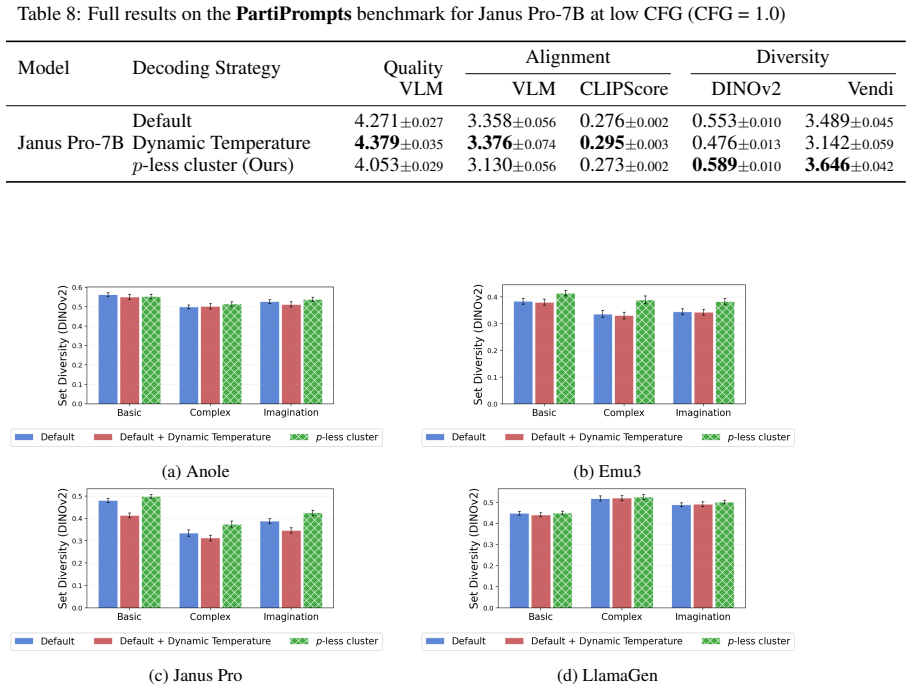
Summary. The paper studies per-prompt sample diversity in next-token autoregressive text-to-image models and argues that high token-level entropy plus redundancy in visual codebooks limit standard token-level truncation methods. It proposes p-less cluster: offline K-means partitioning of the codebook, p-less truncation on the induced cluster distribution, then two-stage sampling (cluster then token). Experiments on four AR models (Anole, Emu3, Janus Pro-7B, LLaMAGen) and two prompt suites (GenEval, PartiPrompts), with diffusion baselines (Flux), report DINOv2/Vendi diversity, VLM quality/alignment, and CLIPScore, plus temperature sweeps, category breakdowns, cluster-size ablations, qualitative examples, and a short HSLP-token argument. The central claim is that p-less cluster yields the highest diversity for most model–dataset pairs while keeping quality and alignment acceptable (VLM scores typically >3).
Significance. If the results hold, this is a useful and timely contribution: the first systematic decoding study for sample diversity in token-wise AR T2I, with a simple inference-time method that exploits visual codebook geometry rather than only token probabilities. Strengths include multi-model coverage across three codebook families, bootstrap standard errors, Pareto-style temperature sweeps, prompt-category analysis, and an explicit (if brief) theoretical account of High-Support Low-Probability tokens that survive only under cluster-level truncation. The work is practically relevant for creative multi-sample interfaces and for understanding why text-style decoding does not transfer cleanly to images. It does not claim a new training paradigm or a universal fix for diversity collapse, but it does push the reported diversity–quality frontier for AR models under i.i.d. sampling.
major comments (3)
- [Introduction / Results] Introduction (p. 2) states that results are substantiated with human evaluations, but the manuscript never reports a human study (protocol, raters, agreement, or scores). Either add the human evaluation results with the same model/dataset coverage as the automatic metrics, or remove/qualify that claim. Automatic VLM-as-judge scores alone cannot fully substitute for the promised human evidence.
- [§5.1, Tables 1, 5–6] §5.1 and Tables 1, 5–6: the abstract and main claim say p-less cluster unlocks the greatest diversity across most models and datasets, yet on GenEval at default CFG it does not beat Default for Emu3 (tied DINOv2, slightly lower Vendi) and underperforms Default for Janus Pro on both diversity metrics while Dynamic Temperature collapses diversity further. The paper already notes mixed gains and stronger effects on Complex/Imagination prompts and at low CFG (Table 2), but the abstract and §5.1 framing should state more precisely when the method wins (e.g., open-ended prompts; low-CFG Janus) versus when Default remains competitive, so the central claim matches the tables.
- [§3.3, Figure 2(b)] §3.3 Observation 2 / Figure 2(b): the method rests on offline K-means of static codebook vectors producing perceptually redundant clusters. Figure 2(b) is the main empirical support (within-cluster swaps keep DINOv2 distance <0.4). That evidence is for Janus Pro only and uses random swaps rather than sampling under the actual truncated distribution. A short multi-model check (or at least one additional codebook family) that within-cluster vs cross-cluster swaps behave similarly would make the load-bearing geometric assumption more robust; otherwise the generality of cluster-level truncation remains partly model-specific.
minor comments (6)
- [§4.3, Appendix E] §4.3 and Appendix E: VLM-as-judge (InternVL3-14B, 1–5) is well motivated given CLIPScore’s weakness on artifacts, but inter-run variance and correlation with human preference are not quantified beyond averaging three runs. A brief reliability note would help.
- [Appendix C, Table 4] Table 4 / Appendix C: optimal (T, k, n) differ by model and dataset; the 2×2 grid is small and practical, but the main text should state more clearly that reported “best” diversity points are after this per-setting selection on a held-out prompt subset, not a single fixed hyperparameter set.
- [Figure 4, Figure 11] Figure 4 and Figure 11: Pareto plots use a reduced prompt subset (120/90). State that explicitly in the figure captions so readers do not equate them with full-benchmark Tables 1–2.
- [Appendix D / C] Typo: “Addtional experimental results” (Appendix D heading); “Hyperpameter” (C.2); “Partiprompts” inconsistently capitalized. Clean these up.
- [§2.1–2.2] Related work §2.1 correctly notes DiverseAR targets bitwise/next-scale AR; a one-sentence note on whether cluster truncation could transfer to next-scale or mask-based AR would clarify scope without expanding experiments.
- [Appendix H] Appendix H Proposition H.1 uses Rényi-2 collision probability as the p-less threshold; the main method allows k∈{1.5,2.0}. Align the proposition statement with the k used in experiments or note that the HSLP argument is for the k=2 case.
Circularity Check
No significant circularity: empirical decoding method with comparative tables, not a first-principles derivation that reduces to its inputs.
full rationale
This is an empirical methods paper proposing a cluster-level truncation sampler (p-less cluster) for autoregressive T2I models. The central claim is comparative performance (higher DINOv2/Vendi diversity while VLM quality/alignment remain acceptable) across four models and two datasets, not a prediction derived from fitted parameters or a uniqueness theorem. Hyperparameters (k, n, T) are tuned on a held-out prompt subset and then evaluated on the full benchmarks; that is ordinary model selection, not a fitted input renamed as prediction. Observation 2 (within-cluster token swaps produce small image change; cross-cluster swaps produce large change) is an empirical measurement on the codebook (Figure 2(b)), not a definition that forces the diversity gains. Appendix H's HSLP proposition is a short inequality proof under stated conditions (HSLP-1, HSLP-2) showing that certain tokens receive strictly higher probability under cluster-level p-less than under token-level p-less; the proof does not assume the experimental outcome. Self-citations to the authors' prior p-less work supply the truncation rule but are not load-bearing uniqueness claims that forbid alternatives. No step reduces by construction to its own inputs. Score 0 is therefore appropriate.
Axiom & Free-Parameter Ledger
free parameters (3)
- number of clusters n =
typically 500
- Rényi order k =
1.5 or 2.0
- sampling temperature T =
model-specific, often 2.5–4.0
axioms (3)
- domain assumption Offline K-means on codebook vectors yields clusters of visually redundant tokens
- domain assumption VLM-as-judge (InternVL3-14B) scores on a 1–5 scale are reliable proxies for human perceptual quality and prompt alignment
- domain assumption i.i.d. sampling without cross-sample coupling is the correct setting for measuring sample diversity
invented entities (2)
-
p-less cluster decoding
no independent evidence
-
High-Support Low-Probability (HSLP) tokens
no independent evidence
read the original abstract
While diffusion models achieve state-of-the-art image quality for text-to-image (T2I) generation, recent work has demonstrated that they suffer from sample diversity collapse. In this work, we investigate whether autoregressive (AR) image generation models can push the Pareto frontier between image quality and sample diversity. With recent advances in quality and efficiency, AR models have emerged as a viable alternative to diffusion-based image generation. Beyond enabling new use cases such as interleaved image-text generation, their sequential generation process makes them compatible with a wide range of token-based decoding strategies originally developed to improve diversity in text generation. Motivated by the potential of a better diversity-quality tradeoff in the AR paradigm, we present the first systematic study of sample diversity in AR image generation models. We show that two key properties of AR image generation, persistently high token-level entropy and substantial redundancy in visual token spaces, limit the effectiveness of existing token-level decoding methods for diversity enhancement. We therefore propose $p$-less cluster, a new decoding strategy that performs entropy-based truncation sampling at cluster level rather than at token level. We evaluate our approach and baseline decoding methods across four autoregressive T2I models and two datasets using a comprehensive suite of metrics spanning image quality, prompt alignment, and diversity. Our results show that $p$-less cluster unlocks the greatest diversity across most evaluated autoregressive T2I models and datasets while maintaining image quality and prompt alignment.
Figures




Reference graph
Works this paper leans on
-
[1]
S. AI. Stable diffusion 3.5 technical release. https://stability.ai/news/ introducing-stable-diffusion-3-5, 2024. Accessed: 2026-05-06
2024
-
[2]
Angelova
N. Angelova. Integration of artificial intelligence into traditional graphic designer software products–a relief and a challenge. InAIP Conference Proceedings, volume 3274, page 080008. AIP Publishing LLC, 2025
2025
-
[3]
X. Chen, Z. Wu, X. Liu, Z. Pan, W. Liu, Z. Xie, X. Yu, and C. Ruan. Janus-pro: Uni- fied multimodal understanding and generation with data and model scaling.arXiv preprint arXiv:2501.17811, 2025. URLhttps://arxiv.org/abs/2501.17811
Pith/arXiv arXiv 2025
-
[4]
E. Chern, Z. Su, et al. Anole: An open, autoregressive, native large multimodal models for interleaved image-text generation.arXiv preprint arXiv:2407.06135, 2024. URL https: //arxiv.org/abs/2407.06135
Pith/arXiv arXiv 2024
-
[5]
J. Cho, Y . Hu, R. Garg, P. Anderson, R. Krishna, J. Baldridge, M. Bansal, J. Pont-Tuset, and S. Wang. Davidsonian scene graph: Improving reliability in fine-grained evaluation for text-to-image generation.arXiv preprint arXiv:2310.18235, 2023
Pith/arXiv arXiv 2023
-
[6]
A. Fan, M. Lewis, and Y . Dauphin. Hierarchical neural story generation.arXiv preprint arXiv:1805.04833, 2018
Pith/arXiv arXiv 2018
-
[7]
D. Friedman and A. B. Dieng. The vendi score: A diversity evaluation metric for machine learning.arXiv preprint arXiv:2210.02410, 2022
Pith/arXiv arXiv 2022
-
[8]
Gandikota and D
R. Gandikota and D. Bau. Distilling diversity and control in diffusion models. InProceedings of the IEEE/CVF Winter Conference on Applications of Computer Vision (WACV), pages 1304–1313, March 2026
2026
-
[9]
A. Ghosh et al. Geneval: An object-focused framework for evaluating text-to-image alignment. InAdvances in Neural Information Processing Systems, 2023. URL https://arxiv.org/ abs/2310.11513
Pith/arXiv arXiv 2023
-
[10]
J. Han, J. Liu, J. Yi, B. Yan, Y . Zhang, Z. Yuan, B. Peng, and X. Liu. Infinity: Scaling bitwise autoregressive modeling for high-resolution image synthesis. InProceedings of the IEEE/CVF Conference on Computer Vision and Pattern Recognition (CVPR), pages 15733– 15744, 2025. URL https://openaccess.thecvf.com/content/CVPR2025/html/Han_ Infinity_Scaling_Bi...
2025
-
[11]
Y . He, F. Chen, Y . He, S. He, H. Zhou, K. Zhang, and B. Zhuang. Zipar: Accelerating auto-regressive image generation through spatial locality.arXiv preprint arXiv:2412.04062, 2024
Pith/arXiv arXiv 2024
-
[12]
Heusel, H
M. Heusel, H. Ramsauer, T. Unterthiner, B. Nessler, and S. Hochreiter. Gans trained by a two time-scale update rule converge to a local nash equilibrium. InAdvances in Neural Information Processing Systems, volume 30, pages 6626–6637, 2017
2017
-
[13]
Holtzman, J
A. Holtzman, J. Buys, L. Du, M. Forbes, and Y . Choi. The curious case of neural text degeneration. InInternational Conference on Learning Representations
-
[14]
Y . Hu, B. Liu, J. Kasai, Y . Wang, M. Ostendorf, R. Krishna, and N. A. Smith. Tifa: Accurate and interpretable text-to-image faithfulness evaluation with question answering. InProceedings of the IEEE/CVF International Conference on Computer Vision, pages 20406–20417, 2023
2023
-
[15]
B. F. Labs. Flux.https://github.com/black-forest-labs/flux, 2024
2024
-
[16]
T. Li, Y . Tian, H. Li, M. Deng, and K. He. Autoregressive image generation without vector quantization.Advances in Neural Information Processing Systems, 37:56424–56445, 2024
2024
-
[17]
J. Liu, J. Han, B. Yan, F. Zhu, X. Wang, Y . Jiang, B. PENG, Z. Yuan, et al. Infinitystar: Unified spacetime autoregressive modeling for visual generation.Advances in neural information processing systems, 38, 2025. 10
2025
-
[18]
X. Ma, F. Zhao, P. Ling, H. Qiu, Z. Wei, H. Yu, J. Huang, Z. Zeng, and L. Ma. Towards better & faster autoregressive image generation: From the perspective of entropy. InThe Thirty-ninth Annual Conference on Neural Information Processing Systems, 2026. URL https: //openreview.net/forum?id=LiQH1MOCMs
2026
-
[19]
J. Mu, N. Vasconcelos, and X. Wang. Editar: Unified conditional generation with autoregressive models. InProceedings of the Computer Vision and Pattern Recognition Conference, pages 7899–7909, 2025
2025
-
[20]
M. N. Nguyen, A. Baker, C. Neo, A. Roush, A. Kirsch, and R. Shwartz-Ziv. Turning up the heat: Min-p sampling for creative and coherent llm outputs.arXiv preprint arXiv:2407.01082, 2024
arXiv 2024
-
[21]
M. Oquab, T. Darcet, et al. Dinov2: Learning robust visual features without supervision.arXiv preprint arXiv:2304.07193, 2023. URLhttps://arxiv.org/abs/2304.07193
Pith/arXiv arXiv 2023
-
[22]
Parmar, O
G. Parmar, O. Patashnik, D. Ostashev, K.-C. J. Wang, K. Aberman, S. Narasimhan, and J.-Y . Zhu. Scaling group inference for diverse and high-quality generation. InThe Fourteenth International Conference on Learning Representations, 2026. URL https://openreview. net/forum?id=IyTNxjTuWT
2026
-
[23]
A. Ramesh, P. Dhariwal, A. Nichol, C. Chu, and M. Chen. Hierarchical text-conditional image generation with clip latents.arXiv preprint arXiv:2204.06125, 1(2):3, 2022
Pith/arXiv arXiv 2022
-
[24]
Razavi, A
A. Razavi, A. Van den Oord, and O. Vinyals. Generating diverse high-fidelity images with vq-vae-2.Advances in neural information processing systems, 32, 2019
2019
-
[25]
Saharia, W
C. Saharia, W. Chan, S. Saxena, L. Li, J. Whang, E. L. Denton, K. Ghasemipour, R. Gon- tijo Lopes, B. Karagol Ayan, T. Salimans, et al. Photorealistic text-to-image diffusion models with deep language understanding.Advances in neural information processing systems, 35: 36479–36494, 2022
2022
-
[26]
P. Sun, Y . Jiang, Z. Chen, J. Yuan, et al. Autoregressive model beats diffusion: Llama for scalable image generation.arXiv preprint arXiv:2406.06525, 2024. URL https://arxiv. org/abs/2406.06525
Pith/arXiv arXiv 2024
-
[27]
R. Tan, S. Wu, and P. Howard. p-less sampling: A robust hyperparameter-free approach for llm decoding. InThe Fourteenth International Conference on Learning Representations
-
[28]
R. Tan, S. Wu, and P. Howard. p-less sampling: A robust hyperparameter-free approach for llm decoding.arXiv preprint arXiv:2509.23234, 2025. URL https://arxiv.org/abs/2509. 23234. [cs.AI, cs.CL]
arXiv 2025
-
[29]
Y . Teng, F. Wang, X. Liu, et al. Speculative jacobi-denoising decoding for accelerating autore- gressive text-to-image generation. InThe Thirteenth International Conference on Learning Representations, 2025. URLhttps://openreview.net/forum?id=y2eWc6jrlu
2025
-
[30]
K. Tian, Y . Jiang, Z. Yuan, B. Peng, and L. Wang. Visual autoregressive modeling: Scalable image generation via next-scale prediction.Advances in neural information processing systems, 37:84839–84865, 2024
2024
-
[31]
Van den Oord, N
A. Van den Oord, N. Kalchbrenner, L. Espeholt, O. Vinyals, A. Graves, et al. Conditional image generation with pixelcnn decoders.Advances in neural information processing systems, 29, 2016
2016
-
[32]
Van Den Oord, N
A. Van Den Oord, N. Kalchbrenner, and K. Kavukcuoglu. Pixel recurrent neural networks. In International conference on machine learning, pages 1747–1756. PMLR, 2016
2016
-
[33]
F. Wang, Y . Teng, X. Liu, et al. Diverse text-to-image generation via contrastive noise opti- mization. InThirty-ninth Conference on Neural Information Processing Systems, 2025. URL https://openreview.net/forum?id=EVRMnAREc3
2025
-
[34]
X. Wang, Z. Zhang, et al. Emu3: Next-token prediction is all you need.arXiv preprint arXiv:2409.18869, 2024. URLhttps://arxiv.org/abs/2409.18869. 11
Pith/arXiv arXiv 2024
-
[35]
Y . Yang, Z. Lv, T. Pan, H. Wang, B. Yang, H. Yin, C. Li, and C. Si. Diversear: Boosting diversity in bitwise autoregressive image generation.arXiv preprint arXiv:2512.02931, 2025
arXiv 2025
-
[36]
T. Yao, Y . Li, Y . Pan, Z. Qiu, and T. Mei. Denoising token prediction in masked autoregressive models. InProceedings of the IEEE/CVF international conference on computer vision, pages 18024–18033, 2025
2025
-
[37]
T. Yin, M. Gharbi, T. Park, R. Zhang, E. Shechtman, F. Durand, and W. T. Freeman. Improved distribution matching distillation for fast image synthesis. InNeurIPS, 2024
2024
-
[38]
J. Yu, X. Li, J. Y . Koh, H. Zhang, R. Pang, J. Qin, A. Ku, Y . Xu, J. Baldridge, and Y . Wu. Vector- quantized image modeling with improved vqgan. InInternational Conference on Learning Representations, 2022
2022
-
[39]
J. Yu, Y . Xu, J. Y . Koh, T. Luong, G. Baid, et al. Scaling autoregressive models for content- rich text-to-image generation. InTransactions on Machine Learning Research, 2022. URL https://arxiv.org/abs/2206.10789
Pith/arXiv arXiv 2022
-
[40]
S. Zhang, Y . Bao, and S. Huang. Edt: Improving large language models’ generation by entropy-based dynamic temperature sampling (2024).URL https://arxiv. org/abs/2403.14541
Pith/arXiv arXiv 2024
-
[41]
Topic: {prompt}. Generate a descriptive image caption using N tokens
J. Zhu, W. Wang, Z. Chen, Z. Liu, S. Ye, L. Gu, H. Tian, Y . Duan, W. Su, J. Shao, et al. Internvl3: Exploring advanced training and test-time recipes for open-source multimodal models.arXiv preprint arXiv:2504.10479, 2025. 12 A Limitations & Broader Impacts Limitations.Our approach operates purely at inference time, and its effectiveness is therefore bou...
Pith/arXiv arXiv 2025
-
[42]
Visual quality (1–5) Assess the intrinsic quality of the image, independent of the prompt: •5 – Excellent: Sharp, well-lit, natural colors, zero artifacts, professional-grade composition •4 – Good: Minor imperfections (slight blur, minor noise) that don’t detract from the image •3 – Acceptable: Noticeable issues (soft focus, unnatural lighting, minor dist...
-
[43]
quality_score
Prompt alignment (1–5) Assess how faithfully the image represents the prompt. Consider: subject, attributes (color, size, texture), spatial relationships, style, and mood: •5 – Perfect: All prompt elements present and accurately depicted •4 – Good: Core elements present; minor attributes missing or slightly off •3 – Partial: Main subject recognizable but ...
discussion (0)
Sign in with ORCID, Apple, or X to comment. Anyone can read and Pith papers without signing in.