REVIEW 2 major objections 4 minor 120 references
Small Foundation Models of Human Cognition and Behaviour
T0 review · 2 major / 4 minor · reviewed 2026-08-08 · deepseek-v4-flash
Pith's one-line read Within the 160 experiments of Psych-101, 0.6B-to-1B parameter models match a 70B baseline on held-out participants; scale matters only for transfer to unseen paradigms, and ablations show predictions rest on stimulus content, not…
desk verdict Solid scaling and ablation results with an honest but load-bearing caveat: the in-distribution plateau is plausibly a data noise ceiling, but the paper cannot rule out that it is an SFT/LoRA ceiling. read the letter →
The pith
A machine-rendered reading of the paper's core claim, the machinery that carries it, and where it could break.
The reading
What carries the argument
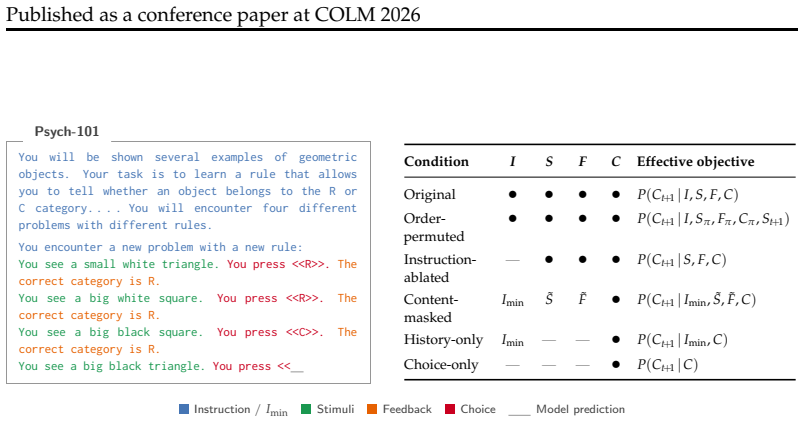
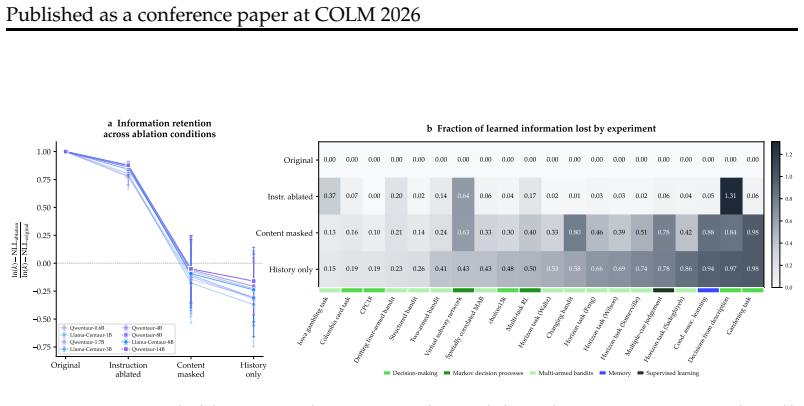
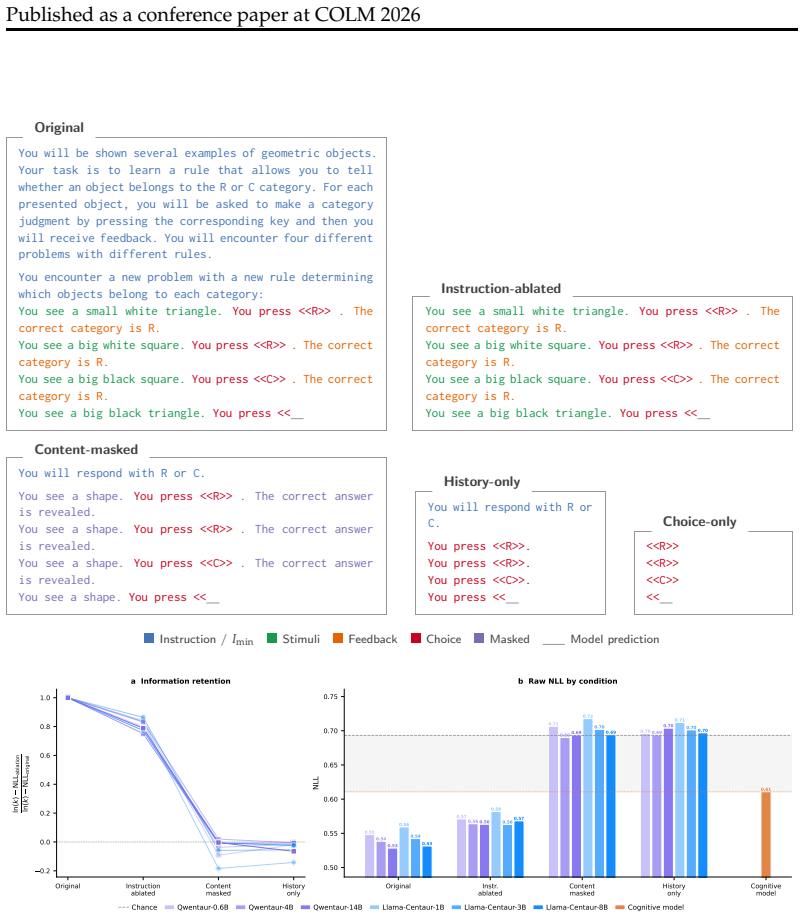
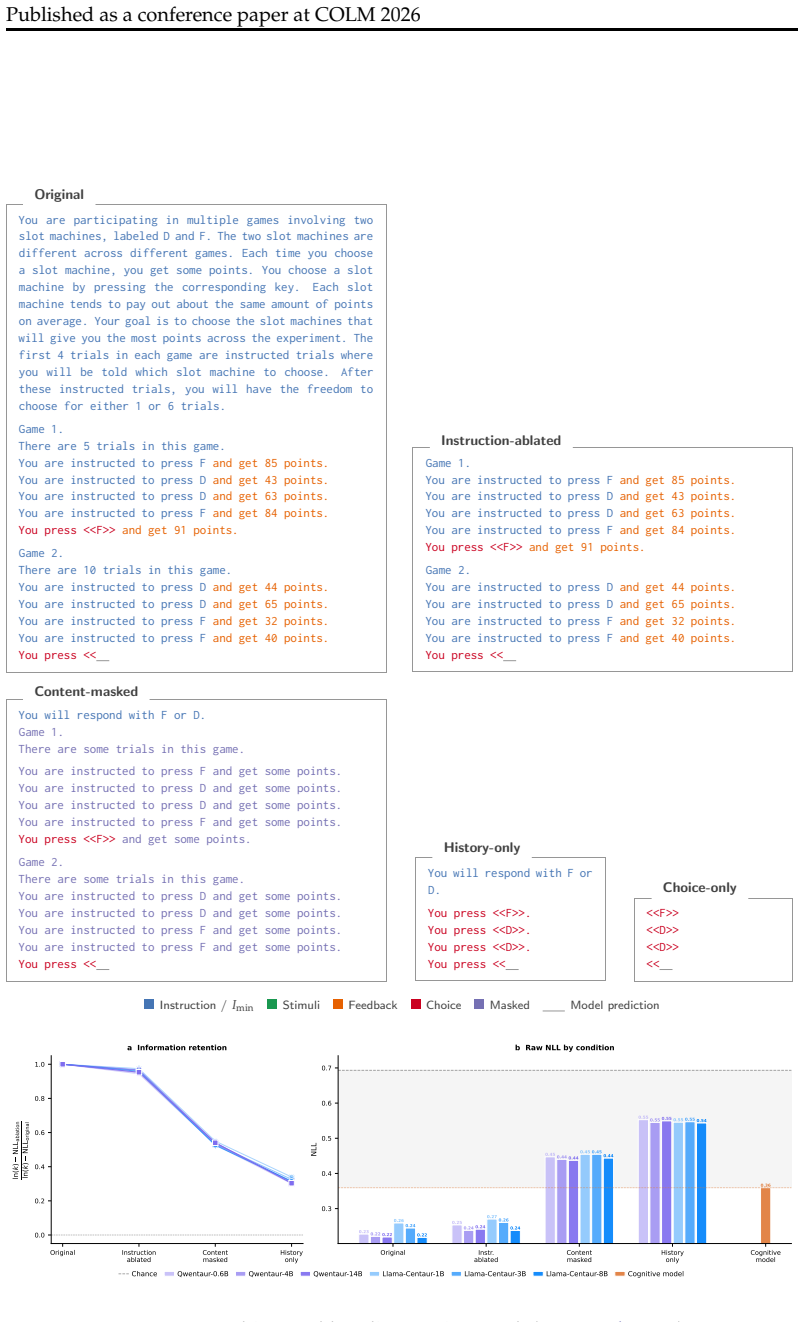
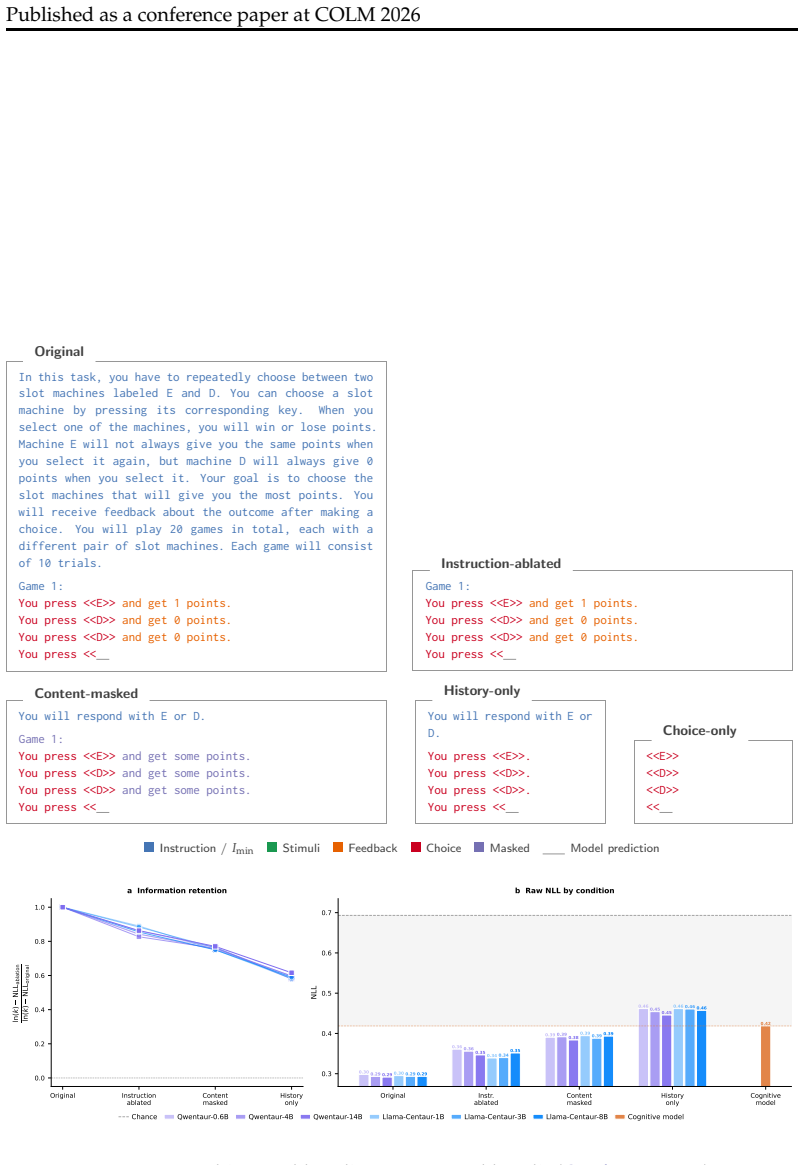
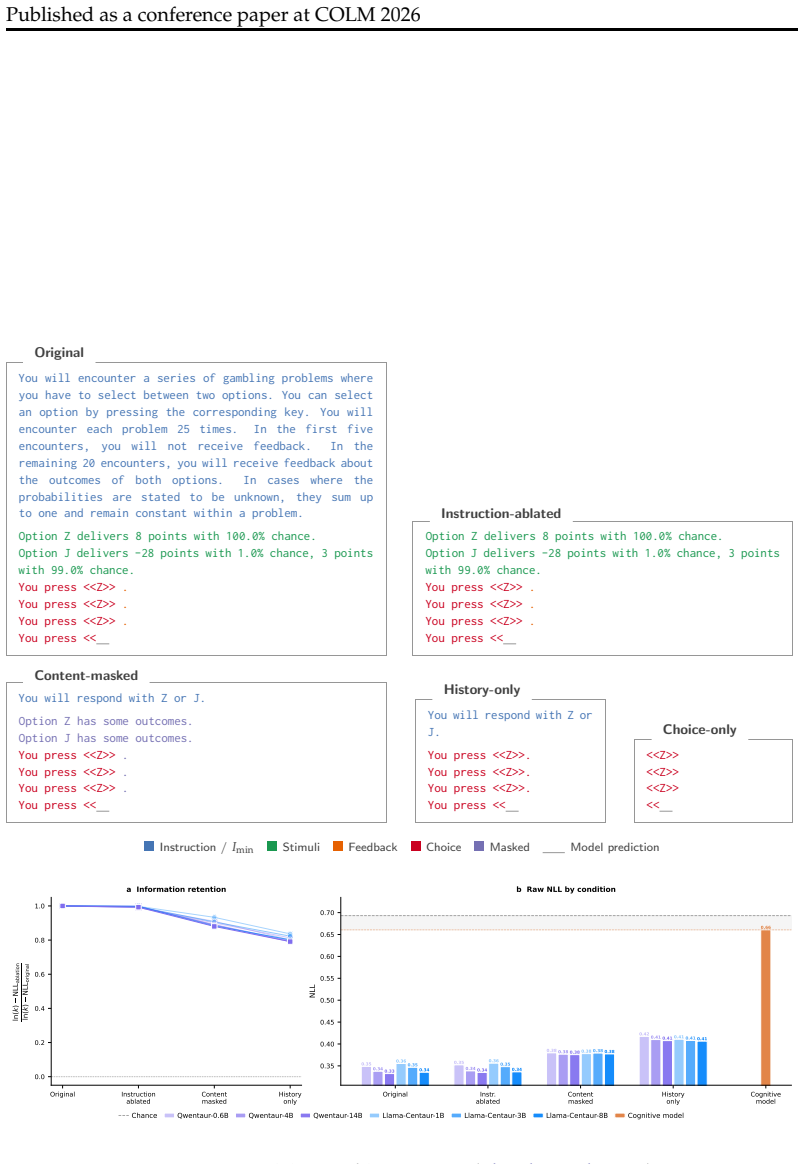
The carrying instrument is the four-channel decomposition of the training objective, $P(C_{t+1}\mid I, S_{1:t+1}, F_{1:t}, C_{1:t})$, which separates task instructions ($I$), upcoming and past stimuli ($S$), outcome feedback ($F$), and the participant's choice history ($C$). The content-masked ablation is the discriminating probe: it replaces specific stimulus values and feedback outcomes with generic placeholders while preserving trial format, so any drop in accuracy is attributable to informational content rather than to the template. Information retention is measured by $R = (\ln k - \mathrm{NLL}_{\mathrm{ablation}}) / (\ln k - \mathrm{NLL}_{\mathrm{original}})$, with $k$ response options, which yields the paper's partition of lost information (75.7% content, 12.5% instruction, 11.7% template). The other half of the machinery is the adapter-rank sweep, which shows that 0.6B-1B parameter models at high rank match the 70B baseline at low rank, establishing that in-distribution accuracy is capacity-independent.
What would settle it
Train the same small models with full fine-tuning or a reinforcement-learning objective on the same corpus; if the narrow band narrows further or shifts below the current 0.5-nats floor, the plateau belongs to the supervised objective, not to human unpredictability, and the noise-ceiling reading fails.
Extended reading notes
Core claim
The central discovery is an in-distribution ceiling with an out-of-distribution slope. Fourteen models from four base-model families, from 135M to 14B parameters, are fine-tuned on Psych-101, a corpus of 10.7 million trial-level choices from 160 experiments, using rank-stabilised low-rank adapters. On held-out participants within those experiments the eight matched models span only 0.028 nats of mean negative log-likelihood, from 0.509 to 0.537, a band that contains the reproduced 70B baseline, and the parameter count needed to match that baseline falls from 8B at adapter rank 4 to 0.6B at rank 32; fine-tuning itself contributes roughly ten times more than scale. On eighteen held-out experiments from Psych-201, the same models spread across 0.244 nats, with the largest model in each family clearly best. Under prompt decomposition, removing instructions costs 12.5% of learned information, masking the content of stimuli and feedback costs 75.7% and sends models below chance, and the trial template accounts for 11.7%; permutation tests show order-invariance on an exchangeable similarity task and order-sensitivity on an adaptive choice task. The paper concludes that small cognitively fine-tuned transformers are adequate noise-ceiling estimators within the paradigms they were trained on, with capacity limiting transfer rather than in-distribution fit.
Load-bearing premise
The entire claim depends on the assumption that the flat performance band on familiar tasks comes from genuine randomness in human behaviour, not from a ceiling imposed by the supervised fine-tuning method itself — the paper explicitly says it cannot rule out the latter.
Editorial extensions
If this is right
- Computing budgets for behavioural foundation models can drop by roughly two orders of magnitude for in-distribution use: a 0.6B model with a high-rank adapter matches a 70B baseline trained and evaluated under the same protocol.
- Scale and money should be spent on out-of-distribution transfer, since the scaling gradient on unseen experiments is steep and shows no saturation within the sizes tested.
- A noise-ceiling estimate from these models is only as broad as the training corpus: for paradigms inside Psych-101 it is informative, for paradigms outside it is unvalidated.
- The shortcut hypothesis is refuted in its strong and format-only forms for sequential tasks: choice history alone performs below chance on average, and masking content destroys most of the learned information.
- New training data should add breadth (new experimental paradigms) rather than depth (more participants), since returns per additional participant are already diminishing within covered paradigms.
Reading between the lines
- The authors' own caveat suggests a decisive test of the ceiling interpretation: if full fine-tuning or a reinforcement-learning objective on the same corpus pulls the in-distribution band below 0.5 nats, part of the 'noise ceiling' belongs to the supervised objective, not to human unpredictability.
- The exchangeability diagnostic could be turned into a general validation protocol for cognitive proxies: before trusting a model on a task, check that its sensitivity to trial order matches the task's contingency structure.
- Cross-task datasets where the same participants complete several paradigms would let ceiling estimates separate person-level stability from task-level predictability, a decomposition the paper notes is currently impossible.
- If the plateau is data-derived, other behavioural datasets could be mined similarly: train a small fine-tuned model, measure the ceiling, and use the gap between it and interpretable theories as a map of where theory-building has the most room to improve.
Editorial analysis
A structured set of objections, weighed in public.
Referee Report
Summary. The paper trains fourteen small language models (135M-14B parameters) across four architecture families with rank-stabilised LoRA on the Psych-101 dataset and compares them against a reproduced Centaur-70B baseline. It reports that in-distribution predictive performance is nearly flat in model size, with 0.6B-1B models matching Centaur-70B on held-out participants once adapter rank is sufficiently high, while out-of-distribution performance on Psych-201-RT retains a clear scaling gradient. The paper then decomposes the prompt into instruction, stimuli, feedback, and choice-history channels, showing that content-masking destroys most learned information, and pairs this with order-permutation tests on one exchangeable and one adaptive task. The authors conclude that small cognitively fine-tuned models can serve as noise-ceiling estimators within trained paradigms, provided their predictions rest on the content participants actually saw.
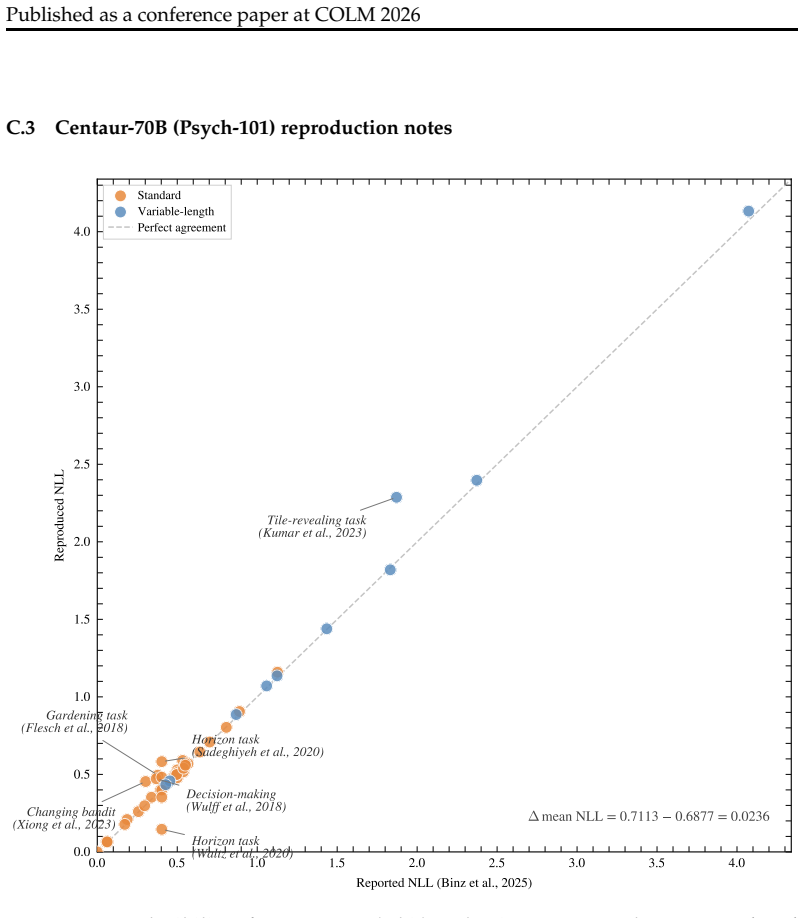
Significance. The empirical contributions are solid and useful. The scale/rank/data decomposition is clean, the Centaur-70B reproduction reported in Appendix C.3 (r=0.994) is a genuine reproducibility asset, per-experiment results are provided for all 46 Psych-101 and 18 Psych-201 experiments, and the content-masking ablation is a methodological step beyond the four-experiment shortcut studies in prior work. If the noise-ceiling interpretation survives, the paper makes a strong practical case that small cognitively fine-tuned transformers are inexpensive estimators of predictable behavioural structure. The principal caveat is that the in-distribution plateau is observed only under LoRA adaptation; the paper itself flags this in Sections 4.1.2 and 6, and the central 'noise ceiling' label depends on resolving it.
major comments (2)
- [Sections 4.1.2, 5, and 6] The central claim that small models are noise-ceiling estimators assumes that the in-distribution plateau (0.509-0.537 at rank 16) is a property of the behavioural data rather than of the rank-stabilised LoRA training regime. All fourteen models use LoRA with r at most 64, and the 70B baseline is 4-bit QLoRA, so the plateau could be an adapter ceiling. Section 4.1.1 itself shows that Qwentaur-0.6B improves from 0.528 at r=16 to 0.513 at r=64, so the band moves with adapter capacity. Section 6 acknowledges that full fine-tuning at small scales would separate a genuine data ceiling from a low-rank adaptation ceiling. Because the licence argument in Section 5 uses content use to justify treating the models as ceilings, and content use is necessary but not sufficient for that conclusion, this is a load-bearing unresolved confound. The manuscript should either run full fine-tuning on at least one small model, such as Qwen3-0.6B, and show that in-distribution NLL does not fall materially below the LoRA band, or systematically replace the 'noise ceiling' language with 'low-rank SFT bound' and restrict the claims accordingly.
- [Section 4.2.3] The task-adaptive information use conclusion rests on exactly two permutation experiments, one primary exchangeable task and one adaptive negative control, and the text notes that only one exchangeable task is available in Psych-101. The variance and ECDF plots in Figure 5 are descriptive; no significance test, effect size, or confidence interval is reported for the fine-tuned versus base model variance difference on THINGS odd-one-out. Since this result is used in the Discussion to support the interpretation that the models respect exchangeability rather than defaulting to sequential heuristics, a quantitative summary of the permutation variance comparison, or additional exchangeable tasks where available, would materially strengthen the claim.
minor comments (4)
- [Figures 1, 2, 4, and 5] The axis labels and legend text in several figures render as corrupted character codes in the submitted PDF; please repair the font embedding or vector text so that the figures are readable.
- [Abstract and Section 4.1.1] The abstract states that '0.6B to 1B parameters suffice to match a 70B baseline' without the qualifier that this holds at LoRA ranks 32-64 on the full training set; adding that qualifier would make the claim more precise.
- [Section 4.2.2] The retention statistic R is defined with ln k as the chance level, but the per-experiment figure caption excludes experiments with delta > 1 under the history-only condition; please clarify whether the mean retention reported in Figure 4a includes those experiments or only the subset shown in Figure 4b.
- [Appendix C.3] The Centaur-70B reproduction has mean deviation +0.024 nats from the published values; while modest, this difference is in the direction of making the 'matching' threshold slightly easier, and it would be useful to state explicitly that the rank-sweep matching conclusions are robust to this mean offset.
Circularity Check
No significant circularity: the central claims are direct measurements, and the noise-ceiling interpretation is explicitly hedged against a method-ceiling alternative.
full rationale
The paper's central claims are empirical measurements rather than derivations. (i) The in-distribution plateau is a directly evaluated held-out NLL band across fourteen independently trained LoRA adapters (Section 4.1.1). (ii) The claim that smaller models match the Centaur-70B baseline is read off a rank sweep (Figure 1), and Centaur-70B itself is independently reproduced under matched software conditions (Appendix C.3) rather than taken on citation. (iii) The content-use claim rests on a new diagnostic, the content-masked condition (Section 4.2.1), whose retention metric R is computed directly from NLL; no parameter is fitted on the evaluation set and later relabeled as a prediction, and the 75.7% figure is a direct partition of measured retention drops, not a fitted quantity. The one load-bearing interpretive step is naming the plateau a noise ceiling, and there the paper does the opposite of what a circular argument would do: Section 4.1.2 states 'Psych-101 may contain structure that supervised fine-tuning on next-choice prediction is unable to extract, in which case the limit belongs to the method rather than the data,' and Section 6 states 'Full fine-tuning at the smallest scales would separate a genuine ceiling on the learnable signal from one imposed by low-rank adaptation.' The LoRA-versus-data-ceiling confound is thus disclosed as an open question rather than assumed away, so the ceiling inference is a hedged empirical conjecture, not an equation that reduces to its inputs. Self-citations (Gobet et al. 2001; Simon & Gobet 2000; Gobet & Ritter 2000) are background and limitation-context references and are not load-bearing for any main result; the load-bearing external inputs (Psych-101 data, prompt templates, cognitive baselines) come from Binz et al. (2025), an independent prior work, and from the paper's own training runs. Remaining reviewer concerns are correctness and validity risks, not circularity: all fourteen models and the 70B baseline use LoRA/QLoRA, so the plateau could be an adapter ceiling (explicitly acknowledged by the paper), and the abstract's '0.6B to 1B suffices' threshold holds at r>=32 while the reference configuration is r=16. Neither makes any claim true by construction or by definition.
Assumptions & free parameters
free parameters (1)
- No free parameters fitted for the central claims
assumptions (4)
- domain assumption Psych-101 train-test splits and prompt templates faithfully encode the experimental structure as used by Centaur.
- domain assumption A well-trained neural model's held-out NLL lower-bounds achievable prediction, i.e., the noise-ceiling logic.
- domain assumption Mean NLL over the 38 Psych-101 tasks with published cognitive baselines is a valid aggregate for judging model equivalence.
- ad hoc to paper THINGS odd-one-out and intertemporal choice are representative anchors of exchangeable versus adaptive task structure.
Cite this review
Pith. "Pith review of Small Foundation Models of Human Cognition and Behaviour." pith.science (2026). https://pith.science/paper/YUK5EAFQ
@misc{pith2026260805224,
  author       = {Pith},
  title        = {Pith review of: Small Foundation Models of Human Cognition and Behaviour},
  year         = {2026},
  howpublished = {\url{https://pith.science/paper/YUK5EAFQ}},
  note         = {Machine review of arXiv:2608.05224}
}
read the original abstract
Large language models fine-tuned on human behavioural data have emerged as general-purpose cognitive proxies, but the scale this requires, and whether these models process task structure or exploit statistical shortcuts, remain open questions. We train fourteen models from 135M to 14B parameters across four architecture families on Psych-101, a dataset of 10.7 million trial-level choices from 160 experiments. In-distribution, scale barely matters. The models fall within a narrow band, as though against a ceiling, and 0.6B to 1B parameters suffice to match a 70B baseline on held-out participants. Out-of-distribution, that band opens into a markedly steeper scaling gradient, with larger models clearly advantaged in generalisation to novel task structure. To determine what information these models use, we run two diagnostics. We progressively strip four prompt channels -- task instructions, experimental stimuli, outcome feedback, and choice history -- across 27 experiments, and permute trial order. Masking the content of stimuli and feedback destroys 75.7% of learned information and pushes models below chance, demonstrating that choice history alone does not account for performance. Permutation reveals invariance on tasks with independent trials but sensitivity where trial order is determined by prior responses. Small cognitively fine-tuned models therefore show promise as noise ceiling estimators for psychological experiments, though their scope remains bounded by the paradigms seen in training.
Figures


Figures from the paper (49 more)












Reference graph
Works this paper leans on
-
[1]
Nature , volume=
A foundation model to predict and capture human cognition , author=. Nature , volume=. 2025 , publisher=
2025
-
[2]
arXiv preprint arXiv:2505.11614 , year=
Using reinforcement learning to train large language models to explain human decisions , author=. arXiv preprint arXiv:2505.11614 , year=
-
[3]
fm: Open foundation models for human behavior , author=
Be. fm: Open foundation models for human behavior , author=. arXiv preprint arXiv:2505.23058 , year=
-
[4]
arXiv preprint arXiv:2601.15793 , year=
HumanLLM: Towards Personalized Understanding and Simulation of Human Nature , author=. arXiv preprint arXiv:2601.15793 , year=
-
[5]
arXiv preprint arXiv:2502.00879 , year=
Generating computational cognitive models using large language models , author=. arXiv preprint arXiv:2502.00879 , year=
-
[6]
Proceedings of the 2025 Conference on Empirical Methods in Natural Language Processing , pages=
Finetuning llms for human behavior prediction in social science experiments , author=. Proceedings of the 2025 Conference on Empirical Methods in Natural Language Processing , pages=
2025
-
[7]
Science , volume=
Using large-scale experiments and machine learning to discover theories of human decision-making , author=. Science , volume=. 2021 , publisher=
2021
-
[8]
, author=
Deficits in category learning in older adults: Rule-based versus clustering accounts. , author=. Psychology and Aging , volume=. 2017 , publisher=
2017
Show all 120 references
-
[9]
2020 , howpublished =
4 Arm Bandit Task Dataset , author =. 2020 , howpublished =
2020
-
[10]
Proceedings of the National Academy of Sciences , volume=
Large-scale analysis of test--retest reliabilities of self-regulation measures , author=. Proceedings of the National Academy of Sciences , volume=. 2019 , publisher=
2019
-
[11]
Scientific reports , volume=
The dynamics of explore--exploit decisions reveal a signal-to-noise mechanism for random exploration , author=. Scientific reports , volume=. 2021 , publisher=
2021
-
[12]
Scientific reports , volume=
Temporal discounting correlates with directed exploration but not with random exploration , author=. Scientific reports , volume=. 2020 , publisher=
2020
-
[13]
, author=
Charting the expansion of strategic exploratory behavior during adolescence. , author=. Journal of experimental psychology: general , volume=. 2017 , publisher=
2017
-
[14]
Computational Psychiatry (Cambridge, Mass.) , volume=
Differential effects of psychotic illness on directed and random exploration , author=. Computational Psychiatry (Cambridge, Mass.) , volume=
-
[15]
, author=
Humans use directed and random exploration to solve the explore--exploit dilemma. , author=. Journal of experimental psychology: General , volume=. 2014 , publisher=
2014
-
[16]
Proceedings of the National Academy of Sciences , volume=
Comparing continual task learning in minds and machines , author=. Proceedings of the National Academy of Sciences , volume=. 2018 , publisher=
2018
-
[17]
Science advances , volume=
Risk preference shares the psychometric structure of major psychological traits , author=. Science advances , volume=. 2017 , publisher=
2017
-
[18]
Cognition , volume=
Deconstructing the human algorithms for exploration , author=. Cognition , volume=. 2018 , publisher=
2018
-
[19]
Journal of Neuroscience , volume=
Working memory contributions to reinforcement learning impairments in schizophrenia , author=. Journal of Neuroscience , volume=. 2014 , publisher=
2014
-
[20]
Elife , volume=
THINGS-data, a multimodal collection of large-scale datasets for investigating object representations in human brain and behavior , author=. Elife , volume=. 2023 , publisher=
2023
-
[21]
Psychonomic bulletin & review , volume=
Generalized outcome-based strategy classification: Comparing deterministic and probabilistic choice models , author=. Psychonomic bulletin & review , volume=. 2014 , publisher=
2014
-
[22]
PLoS computational biology , volume=
When does model-based control pay off? , author=. PLoS computational biology , volume=. 2016 , publisher=
2016
-
[23]
Psychological science , volume=
Cost-benefit arbitration between multiple reinforcement-learning systems , author=. Psychological science , volume=. 2017 , publisher=
2017
-
[24]
2023 , howpublished =
Data from two-step task pilots , author =. 2023 , howpublished =
2023
-
[25]
Nature human behaviour , volume=
Behavioural and neural characterization of optimistic reinforcement learning , author=. Nature human behaviour , volume=. 2017 , publisher=
2017
-
[26]
Memory & cognition , volume=
Revisiting the linear separability constraint: New implications for theories of human category learning , author=. Memory & cognition , volume=. 2020 , publisher=
2020
-
[27]
Conference on Cognitive Computational Neuroscience (CCN 2023) , pages=
Human Multi-Task Learning: the Why and What , author=. Conference on Cognitive Computational Neuroscience (CCN 2023) , pages=
2023
-
[28]
Unpublished Manuscript , year=
When and how can social scientists add value to data scientists? A choice prediction competition for human decision making , author=. Unpublished Manuscript , year=
-
[29]
Nature Human Behaviour , volume=
The globalizability of temporal discounting , author=. Nature Human Behaviour , volume=. 2022 , publisher=
2022
-
[30]
Cognitive psychology , volume=
Finding structure in multi-armed bandits , author=. Cognitive psychology , volume=. 2020 , publisher=
2020
-
[31]
Neuroscience & Biobehavioral Reviews , volume=
Learning strategies in amnesia , author=. Neuroscience & Biobehavioral Reviews , volume=. 2008 , publisher=
2008
-
[32]
many labs
Data from 617 healthy participants performing the Iowa Gambling Task: A “many labs” collaboration , author=. Journal of Open Psychology Data , volume=
-
[33]
PLoS computational biology , volume=
Discovery of hierarchical representations for efficient planning , author=. PLoS computational biology , volume=. 2020 , publisher=
2020
-
[34]
Nature Human Behaviour , volume=
Multi-task reinforcement learning in humans , author=. Nature Human Behaviour , volume=. 2021 , publisher=
2021
-
[35]
Scientific reports , volume=
Chunking as a rational solution to the speed--accuracy trade-off in a serial reaction time task , author=. Scientific reports , volume=. 2023 , publisher=
2023
-
[36]
, author=
A meta-analytic review of two modes of learning and the description-experience gap. , author=. Psychological bulletin , volume=. 2018 , publisher=
2018
-
[37]
Proceedings of the Conference on Computational Cognitive Neuroscience (CCN) , year =
Neural network modeling reveals diverse human exploration behaviors via state space analysis , author =. Proceedings of the Conference on Computational Cognitive Neuroscience (CCN) , year =
-
[38]
Cognition , volume=
Is numerical information always beneficial? Verbal and numerical cue-integration in additive and non-additive tasks , author=. Cognition , volume=. 2023 , publisher=
2023
-
[39]
, author=
Information and processes underlying semantic and episodic memory across tasks, items, and individuals. , author=. Journal of Experimental Psychology: General , volume=. 2018 , publisher=
2018
-
[40]
Nature human behaviour , volume=
Experiential values are underweighted in decisions involving symbolic options , author=. Nature human behaviour , volume=. 2023 , publisher=
2023
-
[41]
Nature Human Behaviour , volume=
A rational model of the Dunning--Kruger effect supports insensitivity to evidence in low performers , author=. Nature Human Behaviour , volume=. 2021 , publisher=
2021
-
[42]
, author=
Identifying resource-rational heuristics for risky choice. , author=. Psychological Review , volume=. 2024 , publisher=
2024
-
[43]
PLoS computational biology , volume=
Disentangling abstraction from statistical pattern matching in human and machine learning , author=. PLoS computational biology , volume=. 2023 , publisher=
2023
-
[44]
, author=
Intent matters: Resolving the intentional versus incidental learning paradox in episodic long-term memory. , author=. Journal of Experimental Psychology: General , volume=. 2023 , publisher=
2023
-
[45]
PLoS computational biology , volume=
A computational account of threat-related attentional bias , author=. PLoS computational biology , volume=. 2019 , publisher=
2019
-
[46]
Nature human behaviour , volume=
Generalization guides human exploration in vast decision spaces , author=. Nature human behaviour , volume=. 2018 , publisher=
2018
-
[47]
, author=
The Bayesian sampler: Generic Bayesian inference causes incoherence in human probability judgments. , author=. Psychological review , volume=. 2020 , publisher=
2020
-
[48]
1986 , publisher=
Parallel distributed processing: Explorations in the microstructure of cognition: Foundations , author=. 1986 , publisher=
1986
-
[49]
1987 , publisher=
Parallel distributed processing: Explorations in the microstructure of cognition: Psychological and biological models , author=. 1987 , publisher=
1987
-
[50]
arXiv preprint arXiv:2511.00206 , year=
Advancing cognitive science with llms , author=. arXiv preprint arXiv:2511.00206 , year=
-
[51]
Journal of Social Computing , volume=
Evaluating the Use of Large Language Models as Synthetic Social Agents in Social Science Research , author=. Journal of Social Computing , volume=. 2025 , publisher=
2025
-
[52]
2025 , howpublished =
Xie, Hanbo and Zhu, Jian-Qiao , title =. 2025 , howpublished =
2025
-
[53]
2025 , howpublished =
Liu, Wei and Ding, Nai , title =. 2025 , howpublished =
2025
-
[54]
Nature Human Behaviour , volume=
Comparing experience-and description-based economic preferences across 11 countries , author=. Nature Human Behaviour , volume=. 2024 , publisher=
2024
-
[55]
Science Advances , volume=
Two sides of the same coin: Beneficial and detrimental consequences of range adaptation in human reinforcement learning , author=. Science Advances , volume=. 2021 , publisher=
2021
-
[56]
Psychophysiology , volume=
Individual peak alpha frequency does not index individual differences in inhibitory cognitive control , author=. Psychophysiology , volume=. 2024 , publisher=
2024
-
[57]
Nature human behaviour , volume=
Explicit knowledge of task structure is a primary determinant of human model-based action , author=. Nature human behaviour , volume=. 2022 , publisher=
2022
-
[58]
Nature Human Behaviour , volume=
Trait somatic anxiety is associated with reduced directed exploration and underestimation of uncertainty , author=. Nature Human Behaviour , volume=. 2023 , publisher=
2023
-
[59]
arXiv preprint arXiv:2406.09012 , year=
Bayesian statistical modeling with predictors from LLMs , author=. arXiv preprint arXiv:2406.09012 , year=
-
[60]
population-level probabilistic modeling , author=
Reasoning in reference games: Individual-vs. population-level probabilistic modeling , author=. PloS one , volume=. 2016 , publisher=
2016
-
[61]
Journal of Memory and Language , volume=
Semantic transparency is not invisibility: A computational model of perceptually-grounded conceptual combination in word processing , author=. Journal of Memory and Language , volume=. 2020 , publisher=
2020
-
[62]
Proceedings of the National Academy of Sciences , volume=
Systematic testing of three Language Models reveals low language accuracy, absence of response stability, and a yes-response bias , author=. Proceedings of the National Academy of Sciences , volume=. 2023 , publisher=
2023
-
[63]
PLoS computational biology , volume=
Confirmation bias in human reinforcement learning: Evidence from counterfactual feedback processing , author=. PLoS computational biology , volume=. 2017 , publisher=
2017
-
[64]
2023 , publisher=
Risky decision and happiness task: The Great Brain Experiment smartphone app , author=. 2023 , publisher=
2023
-
[65]
PLoS computational biology , volume=
Improving the reliability of model-based decision-making estimates in the two-stage decision task with reaction-times and drift-diffusion modeling , author=. PLoS computational biology , volume=. 2019 , publisher=
2019
-
[66]
, author=
Absolute and relative stability of loss aversion across contexts. , author=. Journal of Experimental Psychology: General , volume=. 2024 , publisher=
2024
-
[67]
Experiments in Linguistic Meaning , volume=
The role of relevance, competence, and priors for scalar inferences , author=. Experiments in Linguistic Meaning , volume=
-
[68]
Psychological Medicine , volume=
Contextual influence of reinforcement learning performance of depression: evidence for a negativity bias? , author=. Psychological Medicine , volume=. 2023 , publisher=
2023
-
[69]
Proceedings of the 2023 CHI Conference on Human Factors in Computing Systems , pages=
Augmenting human cognition with an AI-mediated intelligent visual feedback , author=. Proceedings of the 2023 CHI Conference on Human Factors in Computing Systems , pages=
2023
-
[70]
Nature Communications , volume=
Trait anxiety is associated with hidden state inference during aversive reversal learning , author=. Nature Communications , volume=. 2023 , publisher=
2023
-
[71]
2024 , eprint=
Hermes 3 Technical Report , author=. 2024 , eprint=
2024
-
[72]
2025 , eprint=
Hermes 4 Technical Report , author=. 2025 , eprint=
2025
-
[73]
2025 , eprint=
Llama-Nemotron: Efficient Reasoning Models , author=. 2025 , eprint=
2025
-
[74]
Nature neuroscience , volume=
A recurrent network model of planning explains hippocampal replay and human behavior , author=. Nature neuroscience , volume=. 2024 , publisher=
2024
-
[75]
Scientific reports , volume=
Using deep neural networks as a guide for modeling human planning , author=. Scientific reports , volume=. 2023 , publisher=
2023
-
[76]
Nature , volume=
Expertise increases planning depth in human gameplay , author=. Nature , volume=. 2023 , publisher=
2023
-
[77]
Cognitive science , volume=
Time spent thinking in online chess reflects the value of computation , author=. Cognitive science , volume=. 2025 , publisher=
2025
-
[78]
Communications Psychology , volume=
Sequence-to-sequence models with attention mechanistically map to the architecture of human memory search , author=. Communications Psychology , volume=. 2025 , publisher=
2025
-
[79]
Advances in neural information processing systems , volume=
Linking in-context learning in transformers to human episodic memory , author=. Advances in neural information processing systems , volume=
-
[80]
Nature human behaviour , volume=
A generative model of memory construction and consolidation , author=. Nature human behaviour , volume=. 2024 , publisher=
2024
-
[81]
Scientific Reports , volume=
Judgments of learning distinguish humans from large language models in predicting memory , author=. Scientific Reports , volume=. 2025 , publisher=
2025
-
[82]
arXiv preprint arXiv:2509.17138 , year=
Analyzing Memory Effects in Large Language Models through the lens of Cognitive Psychology , author=. arXiv preprint arXiv:2509.17138 , year=
-
[83]
Trends in Cognitive Sciences , year=
Towards large language models with human-like episodic memory , author=. Trends in Cognitive Sciences , year=
-
[84]
Nature neuroscience , volume=
Task representations in neural networks trained to perform many cognitive tasks , author=. Nature neuroscience , volume=. 2019 , publisher=
2019
-
[85]
Proceedings of the National Academy of Sciences , volume=
Scaling up psychology via scientific regret minimization , author=. Proceedings of the National Academy of Sciences , volume=. 2020 , publisher=
2020
-
[86]
Nature Human Behaviour , volume=
Capturing the complexity of human strategic decision-making with machine learning , author=. Nature Human Behaviour , volume=. 2025 , publisher=
2025
-
[87]
Scientific reports , volume=
Using deep learning to predict human decisions and using cognitive models to explain deep learning models , author=. Scientific reports , volume=. 2022 , publisher=
2022
-
[88]
Nature Computational Science , volume=
Human-like intuitive behavior and reasoning biases emerged in large language models but disappeared in ChatGPT , author=. Nature Computational Science , volume=. 2023 , publisher=
2023
-
[89]
arXiv preprint arXiv:2510.03311 , year=
Not Even Wrong: On the Limits of Prediction as Explanation in Cognitive Science , author=. arXiv preprint arXiv:2510.03311 , year=
-
[90]
Behavioral Sciences , volume=
Snake Oil or Panacea? How to Misuse AI in Scientific Inquiries of the Human Mind , author=. Behavioral Sciences , volume=
-
[91]
On the misuse of LLMs as models of mind: A case study of Centaur , author=
-
[92]
AI Surrogacy in Psychological Research , author=
-
[93]
arXiv preprint arXiv:2508.07887 , year=
Not Yet AlphaFold for the Mind: Evaluating Centaur as a Synthetic Participant , author=. arXiv preprint arXiv:2508.07887 , year=
-
[94]
YOU CAN'T PLAY 20 QUESTIONS WITH NATURE AND WIN: PROJECTIVE COMMENTS ON THE PAPERS OF THIS SYMPOSIUM , author=
-
[95]
Simon and Allen Newell , title =
Herbert A. Simon and Allen Newell , title =. American Psychologist , year =
-
[96]
Psychological science , volume=
The roles of recognition processes and look-ahead search in time-constrained expert problem solving: Evidence from grand-master-level chess , author=. Psychological science , volume=. 1996 , publisher=
1996
-
[97]
2024 , eprint=
The Llama 3 Herd of Models , author=. 2024 , eprint=
2024
-
[98]
2025 , eprint=
Qwen3 Technical Report , author=. 2025 , eprint=
2025
-
[99]
arXiv preprint arXiv:2501.17161 , year=
Sft memorizes, rl generalizes: A comparative study of foundation model post-training , author=. arXiv preprint arXiv:2501.17161 , year=
-
[100]
Gobet, Fernand and Lane, Peter C. R. and Croker, Stephen and Cheng, Peter C.-H. and Jones, Gareth and Oliver, Ian and Pine, Julian M. , title =. Trends in Cognitive Sciences , year =
-
[101]
1990 , publisher =
Newell, Allen , title =. 1990 , publisher =
1990
-
[102]
, title =
Laird, John E. , title =. 2012 , publisher =
2012
-
[103]
and Lebiere, Christian , title =
Anderson, John R. and Lebiere, Christian , title =. 1998 , publisher =
1998
-
[104]
and Diederich, Adele , title =
Busemeyer, Jerome R. and Diederich, Adele , title =. 2010 , publisher =
2010
-
[105]
and Gobet, Fernand , title =
Simon, Herbert A. and Gobet, Fernand , title =. Psychological Review , year =
-
[106]
, title =
Gobet, Fernand and Ritter, Frank E. , title =. Proceedings of the Third International Conference on Cognitive Modeling (ICCM 2000) , year =
2000
-
[107]
Advances in neural information processing systems , volume=
Qlora: Efficient finetuning of quantized llms , author=. Advances in neural information processing systems , volume=
-
[108]
arXiv preprint arXiv:2402.05445 , year=
Accurate lora-finetuning quantization of llms via information retention , author=. arXiv preprint arXiv:2402.05445 , year=
-
[109]
arXiv preprint arXiv:2310.08659 , year=
Loftq: Lora-fine-tuning-aware quantization for large language models , author=. arXiv preprint arXiv:2310.08659 , year=
-
[110]
, title =
Simon, Herbert A. , title =. 1969 , publisher =
1969
-
[111]
Annual Review of Psychology , volume=
Cognitive modeling using artificial intelligence , author=. Annual Review of Psychology , volume=. 2026 , publisher=
2026
-
[112]
2025 , eprint=
Nemotron-H: A Family of Accurate and Efficient Hybrid Mamba-Transformer Models , author=. 2025 , eprint=
2025
-
[113]
2024 , eprint=
Mixtral of Experts , author=. 2024 , eprint=
2024
-
[114]
First conference on language modeling , year=
Mamba: Linear-time sequence modeling with selective state spaces , author=. First conference on language modeling , year=
-
[115]
2025 , eprint=
2 OLMo 2 Furious , author=. 2025 , eprint=
2025
-
[116]
2026 , eprint=
Olmo 3 , author=. 2026 , eprint=
2026
-
[117]
2025 , eprint=
SmolLM2: When Smol Goes Big -- Data-Centric Training of a Small Language Model , author=. 2025 , eprint=
2025
-
[118]
Bakouch, Elie and Ben Allal, Loubna and Lozhkov, Anton and Tazi, Nouamane and Tunstall, Lewis and Patiño, Carlos Miguel and Beeching, Edward and Roucher, Aymeric and Reedi, Aksel Joonas and Gallouédec, Quentin and Rasul, Kashif and Habib, Nathan and Fourrier, Clémentine and Ky...
-
[119]
2026 , eprint=
Post-training makes large language models less human-like , author=. 2026 , eprint=
2026
-
[120]
Nature computational science , volume=
Increasing alignment of large language models with language processing in the human brain , author=. Nature computational science , volume=. 2025 , publisher=
2025
Reviewed August 8, 2026 · model on record in the stance chip above.
Discussion (0). Continue with ORCID to comment.