REVIEW 3 major objections 4 minor 235 references
Reasoning-Driven Question-Answering for Natural Language Understanding
T0 review · 3 major / 4 minor · reviewed 2026-08-14 · deepseek-v4-flash
Pith's one-line read QA systems that reason over semantic abstractions beat retrieval and neural baselines on science and biology exams, and a formal model shows why multi-step reasoning has limits.
desk verdict A solid compilation of previously published empirical work whose only new piece—the formal theory chapter—is missing from the supplied text, leaving the strongest claim unverified. read the letter →
The pith
A machine-rendered reading of the paper's core claim, the machinery that carries it, and where it could break.
The reading
What carries the argument
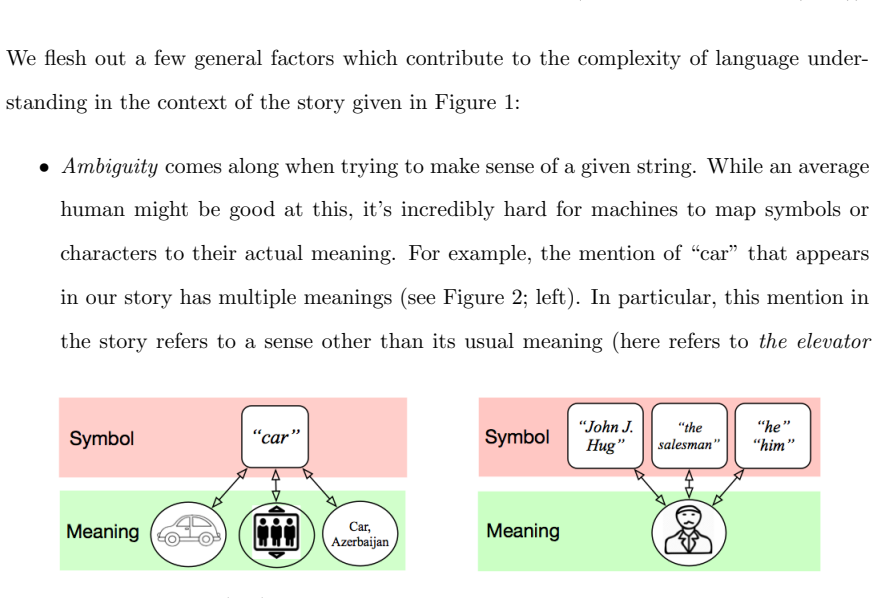
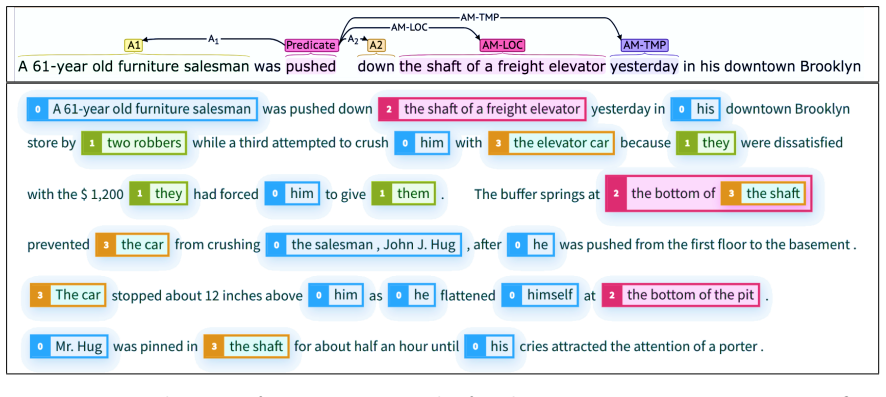
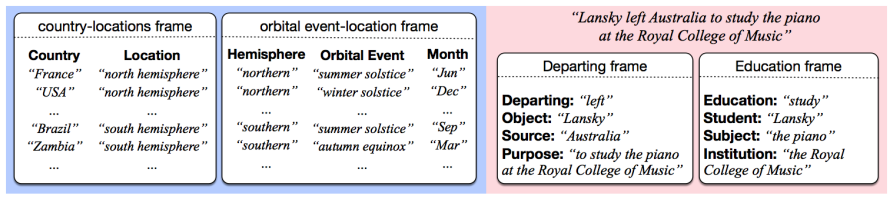
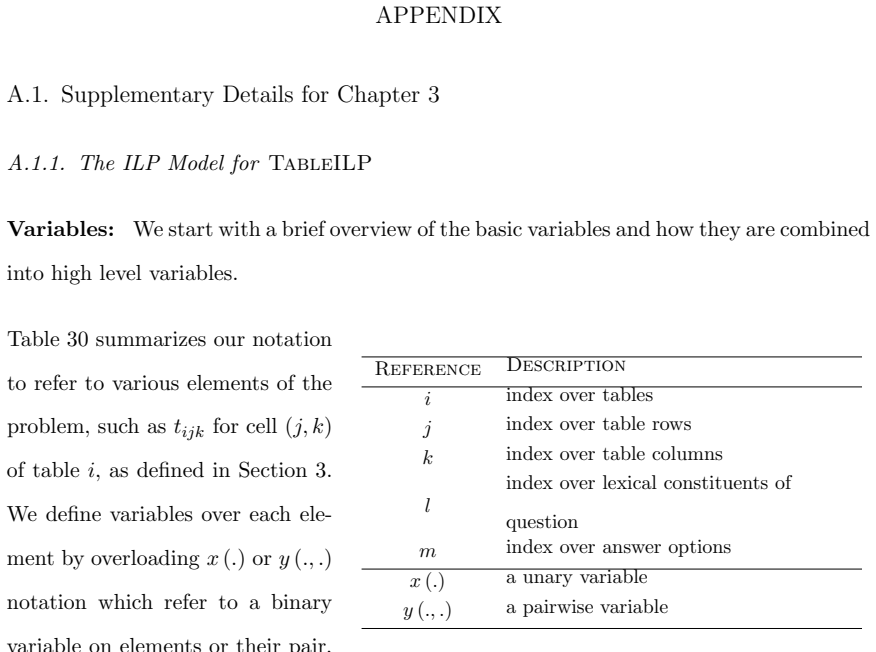
The load-bearing object is the support graph: a subgraph of an augmented graph whose nodes are question constituents, answer options, and knowledge units (table cells or semantic-graph nodes), with edges weighted by entailment or similarity. An ILP formulation selects the support graph that maximizes weighted alignments while enforcing connectivity, evidence-chaining, and semantic-relation constraints; the same template powers the two system chapters, over tables and over semantic graphs. For the limitations result, the carrying object is the meaning-symbol interface: a two-layer model in which a clean, unique meaning space is observed only through a noisy, incomplete, variable symbol space. The proof of limits uses a cut-based construction that separates meaning pairs that are connected from those that are disconnected, showing that any algorithm relying on local symbol-graph distances must fail in the noisy regime.
What would settle it
One concrete check is to assemble a benchmark whose instances are independently verified to require multi-sentence chaining and temporal common sense, and then show that a model with no explicit reasoning component, trained on enough data, matches or exceeds human accuracy; that outcome would contradict the thesis's claim that reasoning over abstractions and world knowledge is needed for QA progress.
Extended reading notes
Core claim
On the author's own terms, the central claim is that question answering should be treated as abductive reasoning: the system must find the best support graph connecting a question to exactly one answer through available knowledge, where 'best' is defined by structural constraints and soft preferences over alignments. Casting this search as an integer linear program lets the same machinery operate over curated tables, relation-extraction tuples, and multi-view semantic graphs, and it beats the retrieval and neural baselines on unseen exam questions. The theoretical companion claim is that reasoning over natural language happens in a noisy symbol space that only approximates a clean meaning space; the thesis constructs a connectivity-reasoning model and proves both when accurate recovery of meaning-space connectivity is possible and when it is provably impossible. This is offered as the first formal framework for multi-step reasoning algorithms under incompleteness, ambiguity, and variability.
Load-bearing premise
The load-bearing premise is that accuracy on static question-answering benchmarks measures real progress toward natural language understanding, even though the thesis itself concedes that such benchmarks are skewed toward simplicity and give a biased estimate of the space of questions.
Editorial extensions
If this is right
- A QA system that explicitly chains evidence through structured abstractions can outperform broad-coverage retrieval and a specialized neural reader on small-data reasoning domains, with 2–6 percent absolute gains on science exams and near-parity with a domain-specific biology system.
- Because the same optimization template is applied to tables, tuples, and semantic graphs, new semantic abstractions can be added to the framework without changing the reasoning machinery.
- Forcing solvers to use question terms that are predicted to be essential makes them more robust to distractors; the thesis reports up to 5 percent absolute gains for a retrieval solver and a 41.7 percent error reduction on a curated hard set.
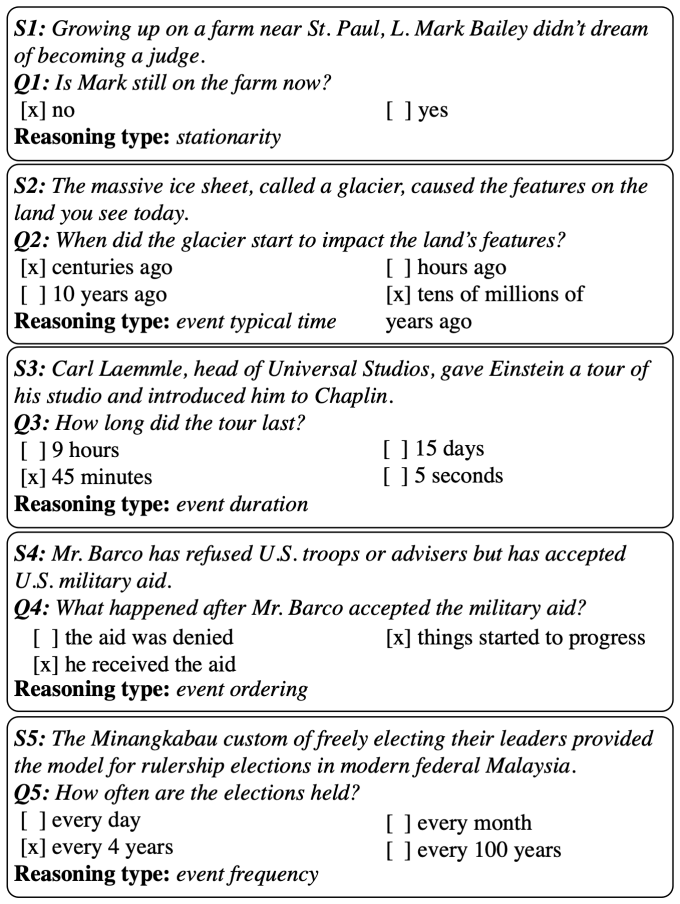
- The proposed multi-sentence and temporal-common-sense benchmarks imply that existing datasets understate the difficulty of NLU, and systems trained on current benchmarks should show a large gap to human performance on these new instances.
- The formal limitation result implies that brittleness in multi-step reasoning over language is not only an engineering problem: within the model's assumptions, no symbol-space algorithm can always recover meaning-space connectivity.
Reading between the lines
- Editorial inference: the formal limitation suggests a lower-bound-style claim—within the model, more training data alone cannot remove the ambiguity injected by the symbol space, so progress will require grounding or additional structured world knowledge.
- Editorial inference: the support-graph/ILP formulation can be hybridized with modern neural models by using neural similarity scores as edge weights and keeping the ILP as a trainable inference layer; the thesis provides a clean interface for that combination.
- Editorial inference: the essential-terms study points to a cheaper supervision signal—annotating which terms matter instead of full answers—that could transfer to other NLU tasks and could be used to audit neural attention mechanisms.
- Editorial inference: the thesis's own warning that static benchmarks are biased toward simplicity implies a testable research program: build evaluation sets by construction, verifying that each instance requires multi-step chaining, and use those sets to measure progress rather than relying on sampled corpora.
Signed reviews
Editorial analysis
A structured set of objections, weighed in public.
Referee Report
Summary. This dissertation-style manuscript investigates natural language understanding (NLU) through the question answering (QA) task and is organized into three parts. Part I develops reasoning-driven QA systems: TableILP, which casts QA as an integer linear program over semi-structured tabular knowledge and is evaluated on elementary science exams; SemanticILP, which generalizes this formulation to raw text by reasoning over semantic abstractions from off-the-shelf NLP tools; and a supervised essential-term classifier that identifies critical question words and is shown to improve an IR-based solver. Part II introduces two challenge datasets: MultiRC, requiring multi-sentence reading comprehension, and TacoQA, requiring temporal commonsense reasoning. Part III announces a formal framework for multi-step reasoning algorithms and claims to prove fundamental limitations of such algorithms under properties of language use such as incompleteness and ambiguity. The abstract and introduction present this theoretical contribution as a central claim, but the corresponding Chapter 8 is absent from the provided text; only its table-of-contents entry and references to it in earlier chapters are visible. The empirical chapters present clear experimental designs with baselines, ablations, and significance tests, and several datasets and code bases are released publicly.
Significance. If the results hold, the thesis offers a coherent and useful body of work: an ILP-based reasoning framework that outperforms structured baselines on science QA with limited training data; a crowd-sourced dataset and classifier for essential question terms; two QA datasets that push beyond single-sentence and static-benchmark settings; and, potentially, a formal analysis of the limits of reasoning algorithms in natural language. The empirical chapters are carefully presented: they include baselines, ablations, statistical significance tests, hidden test sets, and public releases of code and datasets, which are strengths that should be acknowledged. The most distinctive claim, however, is the theoretical framework of Chapter 8, which cannot be inspected in the current manuscript because the chapter body and Appendix A.2 are missing. Since Part III is the only part of the thesis that is not already published as peer-reviewed empirical work, the headline theoretical claim is unverified as submitted, and the overall significance of the thesis cannot be fully assessed without it.
major comments (3)
- [Chapter 8 / Appendix A.2] The central theoretical claim of the dissertation—presenting 'the first formal framework for multi-step reasoning algorithms' and proving 'fundamental limitations' for reasoning algorithms—is stated in the abstract and introduction, and Chapters 2 and 3 explicitly defer to Chapter 8 (e.g., Section 3.5 says the brittleness of multi-step reasoning is studied in Chapter 8). However, the submitted text contains only the table-of-contents entry for Chapter 8; the chapter body and its supplementary appendix (A.2) are not included. I therefore cannot inspect the meaning-symbol interface, the noise model (epsilon+, p-), Definition 9, or the proof in Section 8.6. This is a load-bearing omission because Part III is the only part of the thesis that is not already published as peer-reviewed empirical work. The authors must supply the complete text of Chapter 8 and Appendix A.2 (or the full content of the corresponding publication) so that the theoretical claims can be evaluated.
- [Section 5.3.1 / Table 18] The text states that the ET classifier 'has a 5% higher AUC (area under the curve)' relative to baselines, but Table 18 reports AUC of 0.79 for the ET Classifier, equal to PropSurf and lower than PropLem's 0.80. This numerical inconsistency contradicts the table as printed. The sentence must be corrected and the AUC claim reworded to match the reported data; the F1 and MAP advantages remain supported by the tables, but the AUC statement is not.
- [Section 5.4.2] The demonstration that essentiality information improves the TableILP solver is based on only 12 curated questions (the QR set). The reported '41.7% error reduction' corresponds to correcting 5 of 12 errors made by vanilla TableILP. This sample is too small to support the general conclusion that the ET cascade helps TableILP cope with distracting terms. The section should either be expanded with a larger evaluation or explicitly framed as a small case study with limited statistical power, so that readers are not misled about the strength of the evidence.
minor comments (4)
- [Section 1.4 and cross-references] Several internal cross-references are inconsistent with the actual chapter numbering. The thesis outline says Chapter 5 presents MultiRC and Chapter 6 presents TacoQA, but the actual chapters are 6 and 7 respectively; Section 2.4.5 refers to 'Chapter 6' for temporal commonsense reasoning, which is actually Chapter 7. These should be corrected throughout.
- [Section 2.3.1] The sentence 'In Chapter 2, 3 we use elementary-school science tests' appears to contain a typo; it should presumably read 'In Chapters 3 and 4, we use elementary-school science tests.'
- [Section 4.5] There are grammatical errors in the final paragraph: 'a major portion of our understanding come is only implied from text' and 'lack explicit explicit attention' contain typos and should be proofread.
- [Section 5.3.1] The phrase 'Binomial 10 exact test' appears to be a typo; it should read 'binomial exact test.'
Circularity Check
No significant circularity: empirical claims are benchmark-tested and self-contained; Chapter 8 is missing but not circular.
full rationale
The derivation chain in this thesis is empirical rather than deductive. The systems (TableILP, SemanticILP, ET classifier) are evaluated on held-out standardized exams, ProcessBank, and crowd-annotated essentiality data, with public release of datasets and code; ablations identify which components matter. No prediction is obtained by fitting a parameter to the same quantity it is said to predict: the ET classifier is trained on human annotations and evaluated on disjoint test terms, and the IR+ET threshold is tuned on training questions while reported scores are on test sets. The MultiRC and TacoQA datasets are constructed with explicit verification steps (multi-sentence validation via crowd workers) rather than being derived from the systems being benchmarked. The only potentially load-bearing self-referential element is Chapter 8's formal theory, which is absent from the supplied text; however, the abstract's claim is not shown to reduce to an equation in the input, and absence of the chapter is a completeness issue, not circularity. Self-citations in the text are provenance for previously published chapters and toolkits (e.g., CogCompNLP), and are not used to justify the empirical conclusions, which are reproduced in the thesis itself. Therefore no significant circularity is established.
Assumptions & free parameters
free parameters (6)
- TableILP objective weights =
not stated in excerpt
- Alignment thresholds (e.g., MinCellCellAlignment) =
not stated in excerpt
- Knowledge filtering counts (top 7 tables, 20 rows) =
7 tables, 20 rows
- ET classifier threshold xi =
0.36 for IR+ET; cascades (0.4, 0.6, 0.8, 1.0)
- SemanticILP ensemble weights =
not stated
- Noise parameters in Chapter 8 model (epsilon+, p-, lambda) =
epsilon+ = 0.7, lambda = 3 used in Figure 29
assumptions (4)
- domain assumption QA over static datasets is a valid proxy for NLU progress
- domain assumption NLP semantic annotators (SRL, coreference, etc.) produce sufficiently accurate abstractions for reasoning
- standard math ILP with industrial solvers is a practical optimization framework for NLP
- ad hoc to paper The meaning-symbol interface model in Chapter 8 captures essential properties of language (incompleteness, ambiguity)
invented entities (2)
-
Essential question terms
independent evidence
-
Support graph
Cite this review
Pith. "Pith review of Reasoning-Driven Question-Answering for Natural Language Understanding." pith.science (2026). https://pith.science/paper/YUMXHJPX
@misc{pith2026190804926,
  author       = {Pith},
  title        = {Pith review of: Reasoning-Driven Question-Answering for Natural Language Understanding},
  year         = {2026},
  howpublished = {\url{https://pith.science/paper/YUMXHJPX}},
  note         = {Machine review of arXiv:1908.04926}
}
read the original abstract
Natural language understanding (NLU) of text is a fundamental challenge in AI, and it has received significant attention throughout the history of NLP research. This primary goal has been studied under different tasks, such as Question Answering (QA) and Textual Entailment (TE). In this thesis, we investigate the NLU problem through the QA task and focus on the aspects that make it a challenge for the current state-of-the-art technology. This thesis is organized into three main parts: In the first part, we explore multiple formalisms to improve existing machine comprehension systems. We propose a formulation for abductive reasoning in natural language and show its effectiveness, especially in domains with limited training data. Additionally, to help reasoning systems cope with irrelevant or redundant information, we create a supervised approach to learn and detect the essential terms in questions. In the second part, we propose two new challenge datasets. In particular, we create two datasets of natural language questions where (i) the first one requires reasoning over multiple sentences; (ii) the second one requires temporal common sense reasoning. We hope that the two proposed datasets will motivate the field to address more complex problems. In the final part, we present the first formal framework for multi-step reasoning algorithms, in the presence of a few important properties of language use, such as incompleteness, ambiguity, etc. We apply this framework to prove fundamental limitations for reasoning algorithms. These theoretical results provide extra intuition into the existing empirical evidence in the field.
Figures
Figures from the paper (37 more)









Reference graph
Works this paper leans on
-
[1]
Achterberg
T. Achterberg. SCIP: solving constraint integer programs . Math. Prog. Computation, 1 0 (1): 0 1--41, 2009
2009
-
[2]
Angeli and C
G. Angeli and C. D. Manning. NaturalLI: Natural Logic Inference for Common Sense Reasoning . In Proc. of the Conference on Empirical Methods for Natural Language Processing (EMNLP), 2014
2014
-
[3]
Arivazhagan, C
N. Arivazhagan, C. Christodoulopoulos, and D. Roth. Labeling the semantic roles of commas. In AAAI, 2016
2016
-
[4]
C. F. Baker, C. J. Fillmore, and J. B. Lowe. The berkeley framenet project . In Proc. of the Annual Meeting of the Association of Computational Linguistics (ACL), pages 86--90, 1998
1998
-
[5]
Bamman, B
D. Bamman, B. O'Connor, and N. A. Smith. Learning Latent Personas of Film Characters . In Proceedings of the 51st Annual Meeting of the Association for Computational Linguistics, ACL 2013, Volume 1: Long Papers , pages 352--361, 2013. URL http://aclweb.org/anthology/P/P13/P13-1035.pdf
2013
-
[6]
Banarescu, C
L. Banarescu, C. Bonial, S. Cai, M. Georgescu, K. Griffitt, U. Hermjakob, K. Knight, M. Palmer, and N. Schneider. Abstract meaning representation for sembanking . In Linguistic Annotation Workshop and Interoperability with Discourse, 2013
2013
-
[7]
Banko, M
M. Banko, M. J. Cafarella, S. Soderland, M. Broadhead, and O. Etzioni. Open Information Extraction from the Web . In Proc. of the International Joint Conference on Artificial Intelligence (IJCAI), 2007
2007
-
[8]
Bar-Haim, I
R. Bar-Haim, I. Dagan, and J. Berant. Knowledge-Based Textual Inference via Parse-Tree Transformations. J. Artif. Intell. Res.(JAIR), 54: 0 1--57, 2015
2015
Show all 235 references
-
[9]
Bauer, Y
L. Bauer, Y. Wang, and M. Bansal. Commonsense for Generative Multi-Hop Question Answering Tasks . In Proc. of the Conference on Empirical Methods for Natural Language Processing (EMNLP), pages 4220--4230, 2018
2018
-
[10]
Bentivogli, P
L. Bentivogli, P. Clark, I. Dagan, and D. Giampiccolo. The Sixth PASCAL Recognizing Textual Entailment Challenge . In TAC, 2008
2008
-
[11]
Berant, I
J. Berant, I. Dagan, and J. Goldberger. Global learning of focused entailment graphs . In Proc. of the Annual Meeting of the Association of Computational Linguistics (ACL), pages 1220--1229, 2010
2010
-
[12]
Berant, V
J. Berant, V. Srikumar, P.-C. Chen, A. V. Linden, B. Harding, B. Huang, P. Clark, and C. D. Manning. Modeling Biological Processes for Reading Comprehension. In Proc. of the Conference on Empirical Methods for Natural Language Processing (EMNLP), 2014
2014
-
[13]
V. W. Berninger, W. Nagy, and S. Beers. Child writers’ construction and reconstruction of single sentences and construction of multi-sentence texts: Contributions of syntax and transcription to translation . Reading and writing, 24 0 (2): 0 151--182, 2011
2011
-
[14]
A. M. Bisantz and K. J. Vicente. Making the abstraction hierarchy concrete . International Journal of human-computer studies, 40 0 (1): 0 83--117, 1994
1994
-
[15]
D. G. Bobrow. Natural language input for a computer problem solving system . Technical report, MIT, 1964
1964
-
[16]
Bollacker, C
K. Bollacker, C. Evans, P. Paritosh, T. Sturge, and J. Taylor. Freebase : A collaboratively created graph database for structuring human knowledge . In ICMD, pages 1247--1250. ACM, 2008
2008
-
[17]
Brachman, D
R. Brachman, D. Gunning, S. Bringsjord, M. Genesereth, L. Hirschman, and L. Ferro. Selected Grand Challenges in Cognitive Science . Technical report, MITRE Technical Report 05-1218, 2005
2005
-
[18]
Brill, S
E. Brill, S. Dumais, and M. Banko. An analysis of the AskMSR question-answering system . In Proceedings of EMNLP, pages 257--264, 2002
2002
-
[19]
P. F. Brown, P. V. Desouza, R. L. Mercer, V. J. D. Pietra, and J. C. Lai. Class-based n-gram models of natural language . Computational linguistics, 18 0 (4): 0 467--479, 1992
1992
-
[20]
J. G. Carbonell and R. D. Brown. Anaphora resolution: a multi-strategy approach . In Proceedings of the 12th conference on Computational linguistics-Volume 1, pages 96--101. Association for Computational Linguistics, 1988
1988
-
[21]
Carlson, J
A. Carlson, J. Betteridge, B. Kisiel, B. Settles, E. R. H. Jr., and T. M. Mitchell. Toward an Architecture for Never-Ending Language Learning . In Proceedings of the National Conference on Artificial Intelligence (AAAI), 2010
2010
-
[22]
Chang, S
K.-W. Chang, S. Upadhyay, M.-W. Chang, V. Srikumar, and D. Roth. Illinois-SL : A JAVA library for structured prediction . arXiv preprint arXiv:1509.07179, 2015
2015 arXiv
-
[23]
Chang, L
M.-W. Chang, L. Ratinov, N. Rizzolo, and D. Roth. Learning and inference with constraints. In Proc. of the Conference on Artificial Intelligence (AAAI), 7 2008. URL http://cogcomp.org/papers/CRRR08.pdf
2008
-
[24]
Chang, D
M.-W. Chang, D. Goldwasser, D. Roth, and V. Srikumar. Discriminative Learning over Constrained Latent Representations . Proceedings of Human Language Technologies: The 2010 Annual Conference of the North American Chapter of the Association for Computational Linguistics (HLT 20...
2010
-
[25]
Chang, L
M.-W. Chang, L. Ratinov, and D. Roth. Structured learning with constrained conditional models. Machine Learning, 88 0 (3): 0 399--431, 6 2012. URL http://cogcomp.org/papers/ChangRaRo12.pdf
2012
-
[26]
D. Chen, J. Bolton, and C. D. Manning. A Thorough Examination of the CNN/Daily Mail Reading Comprehension Task . In Proceedings of the 54th Annual Meeting of the Association for Computational Linguistics, ACL 2016, Volume 1: Long Papers , 2016. URL http://aclweb.org/anthology/...
2016
-
[27]
Q. Chen, X. Zhu, Z. Ling, S. Wei, H. Jiang, and D. Inkpen. Enhanced LSTM for Natural Language Inference . In Proceedings of the 55th Annual Meeting of the Association for Computational Linguistics (ACL 2017), Vancouver, July 2017. ACL
2017
-
[28]
Chklovski and P
T. Chklovski and P. Pantel. VerbOcean: Mining the Web for Fine-Grained Semantic Verb Relations . In EMNLP, 2004
2004
-
[29]
Chung and L
F. Chung and L. Lu. The average distances in random graphs with given expected degrees . Proceedings of the National Academy of Sciences, 99 0 (25): 0 15879--15882, 2002
2002
-
[30]
K. W. Church and P. Hanks. Word Association Norms, Mutual Information and Lexicography . In 27thACL, pages 76--83, 1989
1989
-
[31]
P. Clark. Elementary School Science and Math Tests as a Driver for AI: Take the A risto Challenge! In 29th AAAI/IAAI, pages 4019--4021, Austin, TX, 2015
2015
-
[32]
Clark and O
P. Clark and O. Etzioni. My Computer is an Honor Student — but how Intelligent is it? Standardized Tests as a Measure of AI . AI Magazine , 2016. (To appear)
2016
-
[33]
Clark, N
P. Clark, N. Balasubramanian, S. Bhakthavatsalam, K. Humphreys, J. Kinkead, A. Sabharwal, and O. Tafjord. Automatic Construction of Inference-Supporting Knowledge Bases . In 4thAKBC Workshop, Montreal, Canada, 2014
2014
-
[34]
Clark, O
P. Clark, O. Etzioni, T. Khot, A. Sabharwal, O. Tafjord, P. Turney, and D. Khashabi. Combining Retrieval, Statistics, and Inference to Answer Elementary Science Questions . In Proceedings of the National Conference on Artificial Intelligence (AAAI), 2016
2016
-
[35]
Clark, I
P. Clark, I. Cowhey, O. Etzioni, T. Khot, A. Sabharwal, C. Schoenick, and O. Tafjord. Think you have Solved Question Answering? Try ARC, the AI2 Reasoning Challenge . CoRR, abs/1803.05457, 2018
2018 arXiv
-
[36]
Clarke and M
J. Clarke and M. Lapata. Global inference for sentence compression: An integer linear programming approach . Journal of Artificial Intelligence Research, 31: 0 399--429, 2008
2008
-
[37]
Clarke, D
J. Clarke, D. Goldwasser, M.-W. Chang, and D. Roth. Driving semantic parsing from the world's response. In Proc. of the Conference on Computational Natural Language Learning (CoNLL), 7 2010. URL http://cogcomp.org/papers/CGCR10.pdf
2010
-
[38]
Cocos, V
A. Cocos, V. Wharton, E. Pavlick, M. Apidianaki, and C. Callison-Burch. Learning Scalar Adjective Intensity from Paraphrases . In Proceedings of the 2018 Conference on Empirical Methods in Natural Language Processing, pages 1752--1762, 2018
2018
-
[39]
T. H. Cormen, C. E. Leiserson, R. L. Rivest, and C. Stein. Introduction to algorithms . MIT press, 2009
2009
-
[40]
Dagan, D
I. Dagan, D. Roth, M. Sammons, and F. M. Zanzoto. Recognizing textual entailment: Models and applications. 7 2013
2013
-
[41]
Dalvi, S
B. Dalvi, S. Bhakthavatsalam, and P. Clark. IKE - An Interactive Tool for Knowledge Extraction . In 5thAKBC Workshop, 2016
2016
-
[42]
H. T. Dang and M. Palmer. The role of semantic roles in disambiguating verb senses . In Proceedings of the 43rd Annual Meeting on Association for Computational Linguistics, pages 42--49. Association for Computational Linguistics, 2005
2005
-
[43]
H. A. Davidson. Alfarabi, Avicenna, and Averroes on intellect: their cosmologies, theories of the active intellect, and theories of human intellect . Oxford University Press, 1992
1992
-
[44]
E. Davis. The Limitations of Standardized Science Tests as Benchmarks for Artificial Intelligence Research: Position Paper . CoRR, abs/1411.1629, 2014. URL http://arxiv.org/abs/1411.1629
2014 arXiv
-
[45]
R. Dechter. Reasoning with Probabilistic and Deterministic Graphical Models: Exact Algorithms . In Reasoning with Probabilistic and Deterministic Graphical Models: Exact Algorithms, 2013
2013
-
[46]
Devlin, M.-W
J. Devlin, M.-W. Chang, K. Lee, and K. Toutanova. Bert: Pre-training of deep bidirectional transformers for language understanding . arXiv preprint arXiv:1810.04805, 2018
2018 arXiv
-
[47]
X. Ding, T. Jiang, et al. Spectral distributions of adjacency and Laplacian matrices of random graphs . The annals of applied probability, 20 0 (6): 0 2086--2117, 2010
2010
-
[48]
A. N. P. DivyeKhilnani and S. B. D. Jurafsky. Using Query Patterns to Learn the Duration of Events . Computational Semantics IWCS 2011, page 145, 2011
2011
-
[49]
Q. Do, Y. S. Chan, and D. Roth. Minimally supervised event causality identification. In Proc. of the Conference on Empirical Methods in Natural Language Processing (EMNLP), Edinburgh, Scotland, 7 2011. URL http://cogcomp.org/papers/DoChaRo11.pdf
2011
-
[50]
Q. Do, W. Lu, and D. Roth. Joint inference for event timeline construction. In Proc. of the Conference on Empirical Methods in Natural Language Processing (EMNLP), 2012. URL http://cogcomp.org/papers/DoLuRo12.pdf
2012
-
[51]
L. Dong, F. Wei, M. Zhou, and K. Xu. Question Answering over Freebase with Multi-Column Convolutional Neural Networks . In Proc. of the Annual Meeting of the Association of Computational Linguistics (ACL), 2015
2015
-
[52]
Erdos and A
P. Erdos and A. R \'e nyi. On the evolution of random graphs . Publ. Math. Inst. Hung. Acad. Sci, 5 0 (1): 0 17--60, 1960
1960
-
[53]
Etzioni, M
O. Etzioni, M. Banko, S. Soderland, and D. Weld. Open information extraction from the web . Communications of the ACM, 51 0 (12): 0 68--74, 2008
2008
-
[54]
J. S. B. Evans, S. E. Newstead, and R. M. Byrne. Human reasoning: The psychology of deduction . Psychology Press, 1993
1993
-
[55]
Fader, L
A. Fader, L. Zettlemoyer, and O. Etzioni. Open question answering over curated and extracted knowledge bases . In Proceedings of SIGKDD, pages 1156--1165, 2014
2014
-
[56]
Ferrucci, E
D. Ferrucci, E. Brown, J. Chu-Carroll, J. Fan, D. Gondek, A. A. Kalyanpur, A. Lally, J. W. Murdock, E. Nyberg, J. Prager, et al. Building W atson: An overview of the DeepQA project . AI Magazine, 31 0 (3): 0 59--79, 2010
2010
-
[57]
Fikes and T
R. Fikes and T. Kehler. The role of frame-based representation in reasoning . Communications of the ACM, 28 0 (9): 0 904--920, 1985
1985
-
[58]
C. J. Fillmore. Scenes-and-frames semantics . Linguistic structures processing, 59: 0 55--88, 1977
1977
-
[59]
J. L. Fleiss. Measuring nominal scale agreement among many raters. Psychological bulletin, 76 0 (5): 0 378, 1971
1971
-
[60]
Forbes and Y
M. Forbes and Y. Choi. Verb Physics: Relative Physical Knowledge of Actions and Objects . In Proceedings of the 55th Annual Meeting of the Association for Computational Linguistics (Volume 1: Long Papers), volume 1, pages 266--276, 2017
2017
-
[61]
R. M. French. The Turing Test: the first 50 years . Trends in cognitive sciences, 4 0 (3): 0 115--122, 2000
2000
-
[62]
Fried, P
D. Fried, P. Jansen, G. Hahn-Powell, M. Surdeanu, and P. Clark. Higher-order lexical semantic models for non-factoid answer reranking . Transactions of the Association for Computational Linguistics, 3: 0 197--210, 2015
2015
-
[63]
Funahashi
K.-I. Funahashi. On the approximate realization of continuous mappings by neural networks . Neural networks, 2 0 (3): 0 183--192, 1989
1989
-
[64]
Gabrilovich and S
E. Gabrilovich and S. Markovitch. Computing semantic relatedness using wikipedia-based explicit semantic analysis. In IJcAI, volume 7, pages 1606--1611, 2007
2007
-
[65]
Gardner, P
M. Gardner, P. Talukdar, and T. Mitchell. Combining vector space embeddings with symbolic logical inference over open-domain text . In AAAI spring symposium, 2015
2015
-
[66]
Gardner, J
M. Gardner, J. Grus, M. Neumann, O. Tafjord, P. Dasigi, N. Liu, M. Peters, M. Schmitz, and L. Zettlemoyer. AllenNLP: A Deep Semantic Natural Language Processing Platform . 2018
2018
-
[67]
E. N. Gilbert. Random graphs . The Annals of Mathematical Statistics, 30 0 (4): 0 1141--1144, 1959
1959
-
[68]
Gildea and D
D. Gildea and D. Jurafsky. Automatic labeling of semantic roles . Computational linguistics, 28 0 (3): 0 245--288, 2002
2002
-
[69]
Goldwasser and D
D. Goldwasser and D. Roth. Learning from natural instructions. Machine Learning, 94 0 (2): 0 205--232, 2 2014. URL http://cogcomp.org/papers/GoldwasserRo14.pdf
2014
-
[70]
Granroth-Wilding and S
M. Granroth-Wilding and S. Clark. What happens next? event prediction using a compositional neural network model . In Proceedings of the Thirtieth AAAI Conference on Artificial Intelligence, pages 2727--2733. AAAI Press, 2016
2016
-
[71]
Gunning, V
D. Gunning, V. Chaudhri, P. Clark, K. Barker, J. Chaw, and M. Greaves. P roject H alo Update - Progress Toward Digital A ristotle . AI Magazine, 31 0 (3), 2010
2010
-
[72]
Gururangan, S
S. Gururangan, S. Swayamdipta, O. Levy, R. Schwartz, S. Bowman, and N. A. Smith. Annotation Artifacts in Natural Language Inference Data . In Proceedings of the 2018 Conference of the North American Chapter of the Association for Computational Linguistics: Human Language Techn...
2018
-
[73]
S. Harnad. The symbol grounding problem . Physica D: Nonlinear Phenomena, 42 0 (1-3): 0 335--346, 1990
1990
-
[74]
S. Harnad. The Turing Test is not a trick: Turing indistinguishability is a scientific criterion . ACM SIGART Bulletin, 3 0 (4): 0 9--10, 1992
1992
-
[75]
K. M. Hermann, T. Kocisk \' y , E. Grefenstette, L. Espeholt, W. Kay, M. Suleyman, and P. Blunsom. Teaching Machines to Read and Comprehend . In Advances in Neural Information Processing Systems 28: Annual Conference on Neural Information Processing Systems 2015, pages 1693--1...
2015
-
[76]
Hernandez-Orallo
J. Hernandez-Orallo. Beyond the Turing test . Journal of Logic, Language and Information, 9 0 (4): 0 447--466, 2000
2000
-
[77]
Hirschman, M
L. Hirschman, M. Light, E. Breck, and J. D. Burger. Deep Read: A Reading Comprehension System . In 27th Annual Meeting of the Association for Computational Linguistics, ACL 1999 , 1999. URL http://www.aclweb.org/anthology/P99-1042
1999
-
[78]
J. R. Hobbs, M. E. Stickel, P. A. Martin, and D. Edwards. Interpretation as Abduction . Artif. Intell., 63: 0 69--142, 1988
1988
-
[79]
J. R. Hobbs, M. E. Stickel, D. E. Appelt, and P. Martin. Interpretation as abduction . Artificial intelligence, 63 0 (1-2): 0 69--142, 1993
1993
-
[80]
J. H. Holland, K. J. Holyoak, R. E. Nisbett, and P. R. Thagard. Induction: Processes of inference, learning, and discovery . MIT press, 1989
1989
-
[81]
Hori and F
C. Hori and F. Sadaoki. Speech summarization: an approach through word extraction and a method for evaluation . IEICE TRANSACTIONS on Information and Systems, 87 0 (1): 0 15--25, 2004
2004
-
[82]
M. J. Hosseini, H. Hajishirzi, O. Etzioni, and N. Kushman. Learning to Solve Arithmetic Word Problems with Verb Categorization . In 2014EMNLP, pages 523--533, 2014
2014
-
[83]
D. Howell. Statistical methods for psychology . Cengage Learning, 2012
2012
-
[84]
M. Hu, Y. Peng, Z. Huang, X. Qiu, F. Wei, and M. Zhou. Reinforced mnemonic reader for machine reading comprehension. In Proceedings of the 27th International Joint Conference on Artificial Intelligence, pages 4099--4106. AAAI Press, 2018
2018
-
[85]
Ide and K
N. Ide and K. Suderman. Integrating Linguistic Resources: The American National Corpus Model . In Proceedings of the Fifth International Conference on Language Resources and Evaluation, LREC 2006 , pages 621--624, 2006. URL http://www.lrec-conf.org/proceedings/lrec2006/pdf/560_pdf.pdf
2006
-
[86]
N. Ide, C. F. Baker, C. Fellbaum, C. J. Fillmore, and R. J. Passonneau. MASC: the Manually Annotated Sub-Corpus of American English . In Proceedings of the International Conference on Language Resources and Evaluation, LREC 2008 , 2008. URL http://www.lrec-conf.org/proceedings...
2008
-
[87]
Jansen, N
P. Jansen, N. Balasubramanian, M. Surdeanu, and P. Clark. What's in an Explanation? Characterizing Knowledge and Inference Requirements for Elementary Science Exams . In Proc. the International Conference on Computational Linguistics (COLING), pages 2956--2965, 2016
2016
-
[88]
Jansen, R
P. Jansen, R. Sharp, M. Surdeanu, and P. Clark. Framing QA as Building and Ranking Intersentence Answer Justifications . Computational Linguistics, 2017
2017
-
[89]
P. A. Jansen. A Study of Automatically Acquiring Explanatory Inference Patterns from Corpora of Explanations: Lessons from Elementary Science Exams . In AKBC, 2016
2016
-
[90]
P. A. Jansen, E. Wainwright, S. Marmorstein, and C. T. Morrison. WorldTree: A Corpus of Explanation Graphs for Elementary Science Questions supporting Multi-Hop Inference . CoRR, abs/1802.03052, 2018
2018 arXiv
-
[91]
M. E. Janzen and K. J. Vicente. Attention allocation within the abstraction hierarchy . In Proceedings of the Human Factors and Ergonomics Society Annual Meeting, volume 41, pages 274--278. SAGE Publications, 1997
1997
-
[92]
Jia and P
P. Jia and P. Liang. Adversarial Examples for Evaluating Reading Comprehension Systems . Proc. of the Conference on Empirical Methods for Natural Language Processing (EMNLP), 2017
2017
-
[93]
Joachims
T. Joachims. Text categorization with support vector machines: Learning with many relevant features . Machine learning: ECML-98, pages 137--142, 1998
1998
-
[94]
Johnson and R
A. Johnson and R. W. Proctor. Attention: Theory and practice . Sage Publications, 2004
2004
-
[95]
P. N. Johnson-Laird. Mental models in cognitive science . Cognitive science, 4 0 (1): 0 71--115, 1980
1980
-
[96]
Joshi, E
M. Joshi, E. Choi, D. S. Weld, and L. Zettlemoyer. TriviaQA: A Large Scale Distantly Supervised Challenge Dataset for Reading Comprehension . In Proceedings of the 55th Annual Meeting of the Association for Computational Linguistics, ACL 2017, Volume 1: Long Papers , pages 160...
2017 doi
-
[97]
Kaisser and B
M. Kaisser and B. Webber. Question answering based on semantic roles . In Proceedings of the workshop on deep linguistic processing, pages 41--48, 2007
2007
-
[98]
R. M. Kaplan, J. Bresnan, et al. Lexical-functional grammar: A formal system for grammatical representation . In The Mental Representation of Grammatical Relations. The MIT Press, 1982
1982
-
[99]
R. J. Kate and R. J. Mooney. Probabilistic Abduction using Markov Logic Networks . In In: IJCAI-09 Workshop on Plan, Activity, and Intent Recognition, 2009
2009
-
[100]
Kaushik and Z
D. Kaushik and Z. C. Lipton. How Much Reading Does Reading Comprehension Require? A Critical Investigation of Popular Benchmarks . In Proceedings of the 2018 Conference on Empirical Methods in Natural Language Processing, pages 5010--5015, 2018
2018
-
[101]
Kembhavi, M
A. Kembhavi, M. Seo, D. Schwenk, J. Choi, A. Farhadi, and H. Hajishirzi. Are You Smarter Than A Sixth Grader? Textbook Question Answering for Multimodal Machine Comprehension . The IEEE Conference on Computer Vision and Pattern Recognition (CVPR), 2017
2017
-
[102]
Khashabi, T
D. Khashabi, T. Khot, A. Sabharwal, P. Clark, O. Etzioni, and D. Roth. Question answering via integer programming over semi-structured knowledge. In Proc. of the International Joint Conference on Artificial Intelligence (IJCAI), 2016. URL http://cogcomp.org/papers/KKSCER16.pdf
2016
-
[103]
Khashabi, T
D. Khashabi, T. Khot, A. Sabharwal, and D. Roth. Learning what is essential in questions. In The Conference on Computational Natural Language Learning (Proc. of the Conference on Computational Natural Language Learning (CoNLL)), 2017. URL http://cogcomp.org/papers/2017_conll_e...
2017
-
[104]
Khashabi, S
D. Khashabi, S. Chaturvedi, M. Roth, S. Upadhyay, and D. Roth. Looking beyond the surface: A challenge set for reading comprehension over multiple sentences. In Proceedings of the Annual Conference of the North American Chapter of the Association for Computational Linguistics ...
2018
-
[105]
Khashabi, T
D. Khashabi, T. Khot, A. Sabharwal, and D. Roth. Question answering as global reasoning over semantic abstractions. In Proceedings of The Conference on Artificial Intelligence (Proc. of the Conference on Artificial Intelligence (AAAI)), 2018 b . URL http://cogcomp.org/papers/2...
2018
-
[106]
Khashabi, M
D. Khashabi, M. Sammons, B. Zhou, T. Redman, C. Christodoulopoulos, V. Srikumar, N. Rizzolo, L. Ratinov, G. Luo, Q. Do, C.-T. Tsai, S. Roy, S. Mayhew, Z. Feng, J. Wieting, X. Yu, Y. Song, S. Gupta, S. Upadhyay, N. Arivazhagan, Q. Ning, S. Ling, and D. Roth. Cogcompnlp: Your sw...
2018
-
[107]
Khashabi, E
D. Khashabi, E. S. Azer, T. Khot, A. Sabharwal, and D. Roth. On the capabilities and limitations of reasoning for natural language understanding, 2019. under review
2019
-
[108]
T. Khot, N. Balasubramanian, E. Gribkoff, A. Sabharwal, P. Clark, and O. Etzioni. Exploring M arkov Logic Networks for Question Answering . In 2015EMNLP, Lisbon, Portugal, 2015
2015
-
[109]
T. Khot, A. Sabharwal, and P. Clark. Answering Complex Questions Using Open Information Extraction . Proc. of the Annual Meeting of the Association of Computational Linguistics (ACL), 2017
2017
-
[110]
Kingsbury and M
P. Kingsbury and M. Palmer. From TreeBank to PropBank. In LREC, pages 1989--1993, 2002
1989
-
[111]
G. S. Kirk, J. E. Raven, and M. Schofield. The presocratic philosophers: A critical history with a selcetion of texts . Cambridge University Press, 1983
1983
-
[112]
Knight and D
K. Knight and D. Marcu. Summarization beyond sentence extraction: A probabilistic approach to sentence compression . Artificial Intelligence, 139 0 (1): 0 91--107, 2002
2002
-
[113]
J. Ko, E. Nyberg, and L. Si. A probabilistic graphical model for joint answer ranking in question answering . In Proceedings of SIGIR, pages 343--350, 2007
2007
-
[114]
Kozareva and E
Z. Kozareva and E. Hovy. Learning temporal information for states and events . In Fifth International Conference on Semantic Computing, pages 424--429. IEEE, 2011
2011
-
[115]
Krishnamurthy, O
J. Krishnamurthy, O. Tafjord, and A. Kembhavi. Semantic parsing to probabilistic programs for situated question answering . Proc. of the Conference on Empirical Methods for Natural Language Processing (EMNLP), 2016
2016
-
[116]
C. C. T. Kwok, O. Etzioni, and D. S. Weld. Scaling question answering to the Web . In The International World Wide Web Conference, 2001
2001
-
[117]
G. Lai, Q. Xie, H. Liu, Y. Yang, and E. H. Hovy. RACE: Large-scale ReAding Comprehension Dataset From Examinations . In Proceedings of the 2017 Conference on Empirical Methods in Natural Language Processing, EMNLP 2017 , pages 785--794, 2017. URL https://aclanthology.info/pape...
2017
-
[118]
H. Lee, Y. Peirsman, A. Chang, N. Chambers, M. Surdeanu, and D. Jurafsky. Stanford's multi-pass sieve coreference resolution system at the CoNLL-2011 shared task . In CONLL Shared Task, pages 28--34, 2011
2011
-
[119]
H. Lee, A. Chang, Y. Peirsman, N. Chambers, M. Surdeanu, and D. Jurafsky. Deterministic coreference resolution based on entity-centric, precision-ranked rules . Computational Linguistics, 39 0 (4): 0 885--916, 2013
2013
-
[120]
K. Lee, Y. Artzi, J. Dodge, and L. Zettlemoyer. Context-dependent semantic parsing for time expressions. In ACL (1), pages 1437--1447, 2014
2014
-
[121]
Leeuwenberg and M.-F
A. Leeuwenberg and M.-F. Moens. Temporal Information Extraction by Predicting Relative Time-lines . Proc. of the Conference on Empirical Methods for Natural Language Processing (EMNLP), 2018
2018
-
[122]
W. G. Lehnert. The Process of Question Answering. PhD thesis, Yale University, 1977
1977
-
[123]
D. B. Lenat. CYC: A large-scale investment in knowledge infrastructure . Communications of the ACM, 38 0 (11): 0 33--38, 1995
1995
-
[124]
Levy and Y
O. Levy and Y. Goldberg. Linguistic regularities in sparse and explicit word representations . In Proceedings of the eighteenth conference on computational natural language learning, pages 171--180, 2014
2014
-
[125]
F. Li, X. Zhang, J. Yuan, and X. Zhu. Classifying What-Type Questions by Head Noun Tagging . In Proceedings 22nd International Conference on Computational Linguistics (COLING), 2007
2007
-
[126]
Li and D
X. Li and D. Roth. Learning Question Classifiers . In Proceedings of the 19th International Conference on Computational Linguistics - Volume 1, COLING '02, pages 1--7, Stroudsburg, PA, USA, 2002. Association for Computational Linguistics
2002
-
[127]
Y. Li, L. Xu, F. Tian, L. Jiang, X. Zhong, and E. Chen. Word Embedding Revisited: A New Representation Learning and Explicit Matrix Factorization Perspective. In Proc. of the International Joint Conference on Artificial Intelligence (IJCAI), pages 3650--3656, 2015
2015
-
[128]
Z. Li, X. Ding, and T. Liu. Constructing Narrative Event Evolutionary Graph for Script Event Prediction . Proc. of the International Joint Conference on Artificial Intelligence (IJCAI), 2018
2018
-
[129]
X. V. Lin, R. Socher, and C. Xiong. Multi-Hop Knowledge Graph Reasoning with Reward Shaping . In Proc. of the Conference on Empirical Methods for Natural Language Processing (EMNLP), 2018
2018
-
[130]
Liu and P
H. Liu and P. Singh. ConceptNet—a practical commonsense reasoning tool-kit . BT technology journal, 22 0 (4): 0 211--226, 2004
2004
-
[131]
X. Liu, Y. Shen, K. Duh, and J. Gao. Stochastic answer networks for machine reading comprehension. In Proceedings of the 56th Annual Meeting of the Association for Computational Linguistics (Volume 1: Long Papers), pages 1694--1704, 2018
2018
-
[132]
A. A. Mahabal, D. Roth, and S. Mittal. Robust handling of polysemy via sparse representations. In *SEM, 2018. URL http://cogcomp.org/papers/MahabalRoMi18.pdf
2018
-
[133]
McCallum, A
A. McCallum, A. Neelakantan, R. Das, and D. Belanger. Chains of Reasoning over Entities, Relations, and Text using Recurrent Neural Networks . In EACL , pages 132--141, 2017
2017
-
[134]
McCarthy
J. McCarthy. Programs with common sense . Defense Technical Information Center, 1963
1963
-
[135]
McCarthy
J. McCarthy. An example for natural language understanding and the AI problems it raises . Formalizing Common Sense: Papers by John McCarthy, 355, 1976
1976
-
[136]
McCarthy and M
J. McCarthy and M. I. Levin. LISP 1.5 programmer's manual . MIT press, 1965
1965
-
[137]
McCarthy and V
J. McCarthy and V. Lifschitz. Formalizing common sense: papers , volume 5. Intellect Books, 1990
1990
-
[138]
J. F. McCarthy. Using decision trees for coreference resolution . In Proc. 14th International Joint Conf. on Artificial Intelligence (IJCAI), Quebec, Canada, Aug. 1995, 1995
1995
-
[139]
Merkhofer, J
E. Merkhofer, J. Henderson, D. Bloom, L. Strickhart, and G. Zarrella. MITRE at SemEval-2018 Task 11: Commonsense Reasoning without Commonsense Knowledge . In Proceedings of the International Workshop on Semantic Evaluation (SemEval-2018), New Orleans, LA, USA, 2018
2018
-
[140]
Meyers, R
A. Meyers, R. Reeves, C. Macleod, R. Szekely, V. Zielinska, B. Young, and R. Grishman. The NomBank project: An interim report . In HLT-NAACL 2004 workshop: Frontiers in corpus annotation, volume 24, page 31, 2004
2004
-
[141]
Mihalcea and A
R. Mihalcea and A. Csomai. Wikify!: linking documents to encyclopedic knowledge . In CIKM, pages 233--242, 2007
2007
-
[142]
Mikolov, K
T. Mikolov, K. Chen, G. Corrado, and J. Dean. Efficient estimation of word representations in vector space . arXiv preprint arXiv:1301.3781, 2013
2013 arXiv
-
[143]
S. Milgram. Six degrees of separation . Psychology Today, 2: 0 60--64, 1967
1967
-
[144]
G. Miller. WordNet: a lexical database for English . Communications of the ACM, 38 0 (11): 0 39--41, 1995
1995
-
[145]
S. Min, M. J. Seo, and H. Hajishirzi. Question Answering through Transfer Learning from Large Fine-grained Supervision Data . In Proceedings of the 55th Annual Meeting of the Association for Computational Linguistics, ACL 2017, Volume 2: Short Papers , pages 510--517, 2017. UR...
2017 doi
-
[146]
M. Minsky. A Framework for Representing Knowledge . Technical report, Massachusetts Institute of Technology, Cambridge, MA, USA, 1974
1974
-
[147]
M. Minsky. Society of mind . Simon and Schuster, 1988
1988
-
[148]
Minsky and S
M. Minsky and S. Papert. Perceptron: an introduction to computational geometry . The MIT Press, Cambridge, expanded edition, 19: 0 88, 1969
1969
-
[149]
T. M. Mitchell, J. Betteridge, A. Carlson, E. Hruschka, and R. Wang. Populating the semantic web by macro-reading internet text . In International Semantic Web Conference, pages 998--1002. Springer, 2009
2009
-
[150]
Moldovan, M
D. Moldovan, M. Pa s ca, S. Harabagiu, and M. Surdeanu. Performance issues and error analysis in an open-domain question answering system . ACM Transactions on Information Systems (TOIS), 21 0 (2): 0 133--154, 2003
2003
-
[151]
Moreda, H
P. Moreda, H. Llorens, E. S. Bor \'o , and M. Palomar. Combining semantic information in question answering systems . Inf. Process. Manage., 47: 0 870--885, 2011
2011
-
[152]
Narasimhan and R
K. Narasimhan and R. Barzilay. Machine Comprehension with Discourse Relations . In Proceedings of the 53rd Annual Meeting of the Association for Computational Linguistics and the 7th International Joint Conference on Natural Language Processing of the Asian Federation of Natur...
2015
-
[153]
B. K. Natarajan. Sparse approximate solutions to linear systems . SIAM journal on computing, 24 0 (2): 0 227--234, 1995
1995
-
[154]
Nguyen, M
T. Nguyen, M. Rosenberg, X. Song, J. Gao, S. Tiwary, R. Majumder, and L. Deng. MS MARCO: A Human Generated MAchine Reading COmprehension Dataset . CoRR, abs/1611.09268, 2016. URL http://arxiv.org/abs/1611.09268
2016 arXiv
-
[155]
J. Ni, C. Zhu, W. Chen, and J. McAuley. Learning to attend on essential terms: An enhanced retriever-reader model for scientific question answering . arXiv preprint arXiv:1808.09492, 2018
2018 arXiv
-
[156]
Q. Ning, H. Wu, H. Peng, and D. Roth. Improving Temporal Relation Extraction with a Globally Acquired Statistical Resource . In Proc. of the Annual Meeting of the North American Association of Computational Linguistics (NAACL), pages 841--851, New Orleans, Louisiana, 6 2018 a ...
2018
-
[157]
Q. Ning, B. Zhou, Z. Feng, H. Peng, and D. Roth. CogCompTime: A Tool for Understanding Time in Natural Language . In EMNLP (Demo Track), Brussels, Belgium, 11 2018 b . Association for Computational Linguistics. URL http://cogcomp.org/papers/NZFPR18.pdf
2018
-
[158]
G. Novak. Representations of Knowledge in a Program for Solving Physics Problems . In IJCAI-77, 1977
1977
-
[159]
Ostermann, M
S. Ostermann, M. Roth, A. Modi, S. Thater, and M. Pinkal. SemEval-2018 Task 11: Machine Comprehension using Commonsense Knowledge . In Proceedings of The 12th International Workshop on Semantic Evaluation, pages 747--757, 2018
2018
-
[160]
Palmer, D
M. Palmer, D. Gildea, and P. Kingsbury. The proposition bank: An annotated corpus of semantic roles . Computational linguistics, 31 0 (1): 0 71--106, 2005
2005
-
[161]
a ckstr\
A. P. Parikh, O. T \"a ckstr\" o m, D. Das, and J. Uszkoreit. A Decomposable Attention Model for Natural Language Inference . In Proc. of the Conference on Empirical Methods for Natural Language Processing (EMNLP), 2016
2016
-
[162]
J. H. Park and W. B. Croft. Using key concepts in a translation model for retrieval . In Proceedings of the 38th International ACM SIGIR Conference on Research and Development in Information Retrieval, pages 927--930. ACM, 2015
2015
-
[163]
J. Pearl. Probabilistic Reasoning in Intelligent Systems: Networks of Plausible Inference . Morgan Kaufmann Publishers Inc., San Francisco, CA, USA, 1988. ISBN 1558604790
1988
-
[164]
C. S. Peirce. A Theory of Probable Inference . In Studies in Logic by Members of the Johns Hopkins University , pages 126--181. Little, Brown, and Company, 1883
-
[165]
Pennington, R
J. Pennington, R. Socher, and C. Manning. Glove: Global vectors for word representation . In Proceedings of the 2014 conference on empirical methods in natural language processing (EMNLP), pages 1532--1543, 2014
2014
-
[166]
Peters, M
M. Peters, M. Neumann, M. Iyyer, M. Gardner, C. Clark, K. Lee, and L. Zettlemoyer. Deep Contextualized Word Representations . In Proceedings of the 2018 Conference of the North American Chapter of the Association for Computational Linguistics: Human Language Technologies, Volu...
2018
-
[167]
L. A. Pizzato and D. Moll \'a . Indexing on semantic roles for question answering . In 2nd workshop on Information Retrieval for Question Answering, pages 74--81, 2008
2008
-
[168]
Poliak, J
A. Poliak, J. Naradowsky, A. Haldar, R. Rudinger, and B. V. Durme. Hypothesis Only Baselines in Natural Language Inference . In Proceedings of the Seventh Joint Conference on Lexical and Computational Semantics, pages 180--191, 2018
2018
-
[169]
D. Poole. A methodology for using a default and abductive reasoning system . Int. J. Intell. Syst., 5: 0 521--548, 1990
1990
-
[170]
Punyakanok and D
V. Punyakanok and D. Roth. The use of classifiers in sequential inference. In Proc. of the Conference on Neural Information Processing Systems (NIPS), pages 995--1001. MIT Press, 2001. URL http://cogcomp.org/papers/nips01.pdf
2001
-
[171]
Punyakanok, D
V. Punyakanok, D. Roth, and W. Yih. Mapping Dependencies Trees: An Application to Question Answering . AIM, 1 2004. URL http://cogcomp.org/papers/PunyakanokRoYi04a.pdf
2004
-
[172]
Punyakanok, D
V. Punyakanok, D. Roth, and W. tau Yih. The importance of syntactic parsing and inference in semantic role labeling. Computational Linguistics, 2008
2008
-
[173]
M. R. Quillan. Semantic memory . Technical report, BOLT BERANEK AND NEWMAN INC CAMBRIDGE MA, 1966
1966
-
[174]
Rajpurkar, J
P. Rajpurkar, J. Zhang, K. Lopyrev, and P. Liang. SQuAD : 100,000+ Questions for Machine Comprehension of Text . In Proc. of the Conference on Empirical Methods for Natural Language Processing (EMNLP), 2016
2016
-
[175]
Rajpurkar, R
P. Rajpurkar, R. Jia, and P. Liang. Know What You Don't Know: Unanswerable Questions for SQuAD . In Proc. of the Annual Meeting of the Association of Computational Linguistics (ACL), 2018
2018
-
[176]
Rashkin, M
H. Rashkin, M. Sap, E. Allaway, N. A. Smith, and Y. Choi. Event2Mind: Commonsense Inference on Events, Intents, and Reactions . In Proc. of the Annual Meeting of the Association of Computational Linguistics (ACL), pages 463--473, 2018
2018
-
[177]
Rasmussen
J. Rasmussen. The role of hierarchical knowledge representation in decisionmaking and system management . Systems, Man and Cybernetics, IEEE Transactions on, pages 234--243, 1985
1985
-
[178]
Ratinov and D
L. Ratinov and D. Roth. Design challenges and misconceptions in named entity recognition. In Proc. of the Conference on Computational Natural Language Learning (CoNLL), 6 2009. URL http://cogcomp.org/papers/RatinovRo09.pdf
2009
-
[179]
Ratinov, D
L. Ratinov, D. Roth, D. Downey, and M. Anderson. Local and global algorithms for disambiguation to wikipedia. In Proc. of the Annual Meeting of the Association for Computational Linguistics (ACL), 2011. URL http://cogcomp.org/papers/RRDA11.pdf
2011
-
[180]
a ckstr \
S. Reddy, O. T \"a ckstr \"o m, S. Petrov, M. Steedman, and M. Lapata. Universal Semantic Parsing . In Proc. of the Conference on Empirical Methods for Natural Language Processing (EMNLP), pages 89--101, 2017
2017
-
[181]
Redman, M
T. Redman, M. Sammons, and D. Roth. Illinois Named Entity Recognizer: Addendum to R atinov and R oth '09 reporting improved results , 2016. URL http://cogcomp.org/papers/ner-addendum.pdf. Tech Report
2016
-
[182]
Richardson and P
M. Richardson and P. Domingos. M arkov Logic Networks . Machine learning, 62 0 (1--2): 0 107--136, 2006
2006
-
[183]
Richardson, C
M. Richardson, C. J. C. Burges, and E. Renshaw. MCTest: A Challenge Dataset for the Open-Domain Machine Comprehension of Text . In Proceedings of the 2013 Conference on Empirical Methods in Natural Language Processing, EMNLP 2013 , pages 193--203, 2013. URL http://aclweb.org/a...
2013
-
[184]
Rosenblatt
F. Rosenblatt. The perceptron: a probabilistic model for information storage and organization in the brain. Psychological review, 65 0 (6): 0 386, 1958
1958
-
[185]
Roth and W
D. Roth and W. Yih. A linear programming formulation for global inference in natural language tasks. In H. T. Ng and E. Riloff, editors, Proc. of the Conference on Computational Natural Language Learning (CoNLL), pages 1--8. Association for Computational Linguistics, 2004. URL...
2004
-
[186]
Roth and D
D. Roth and D. Zelenko. Part of speech tagging using a network of linear separators. In ACL-COLING, 1998
1998
-
[187]
Roth and M
M. Roth and M. Lapata. Neural semantic role labeling with dependency path embeddings . Proc. of the Annual Meeting of the Association of Computational Linguistics (ACL), 2016
2016
-
[188]
S. Roy, T. Vieira, and D. Roth. Reasoning about quantities in natural language. Transactions of the Association for Computational Linguistics (TACL), 3, 2015. URL http://cogcomp.org/papers/RoyViRo15.pdf
2015
-
[189]
D. E. Rumelhart, G. E. Hinton, and R. J. Williams. Learning representations by back-propagating errors . Cognitive modeling, 5, 1988
1988
-
[190]
R. C. Schank. Conceptual dependency: A theory of natural language understanding . Cognitive psychology, 3 0 (4): 0 552--631, 1972
1972
-
[191]
R. C. Schank and R. P. Abelson. Scripts, plans, and knowledge . In Proc. of the International Joint Conference on Artificial Intelligence (IJCAI), pages 151--157, 1975
1975
-
[192]
Selman and H
B. Selman and H. J. Levesque. Abductive and Default Reasoning: A Computational Core . In Proceedings of the National Conference on Artificial Intelligence (AAAI), 1990
1990
-
[193]
M. Seo, A. Kembhavi, A. Farhadi, and H. Hajishirzi. Bidirectional attention flow for machine comprehension . ICLR, 2016
2016
-
[194]
Shen and M
D. Shen and M. Lapata. Using Semantic Roles to Improve Question Answering. In EMNLP-CoNLL, pages 12--21, 2007
2007
-
[195]
Socher, D
R. Socher, D. Chen, C. D. Manning, and A. Y. Ng. Reasoning With Neural Tensor Networks for Knowledge Base Completion . In The Conference on Advances in Neural Information Processing Systems (NIPS), 2013
2013
-
[196]
Srikumar and D
V. Srikumar and D. Roth. A Joint Model for Extended Semantic Role Labeling . In Proc. of the Conference on Empirical Methods for Natural Language Processing (EMNLP), Edinburgh, Scotland, 2011. URL http://cogcomp.org/papers/SrikumarRo11.pdf
2011
-
[197]
Srikumar and D
V. Srikumar and D. Roth. Modeling semantic relations expressed by prepositions. 1: 0 231--242, 2013. URL http://cogcomp.org/papers/SrikumarRo13.pdf
2013
-
[198]
Steedman and J
M. Steedman and J. Baldridge. Combinatory categorial grammar . Non-Transformational Syntax: Formal and explicit models of grammar, pages 181--224, 2011
2011
-
[199]
Stern, R
A. Stern, R. Stern, I. Dagan, and A. Felner. Efficient search for transformation-based inference . In Proc. of the Annual Meeting of the Association of Computational Linguistics (ACL), pages 283--291, 2012
2012
-
[200]
M. Steup. Epistemology . In E. N. Zalta, editor, The Stanford Encyclopedia of Philosophy. http://plato.stanford.edu/archives/spr2014/entries/epistemology/, spring 2014 edition, 2014
2014
-
[201]
K. Sun, D. Yu, D. Yu, and C. Cardie. Improving machine reading comprehension with general reading strategies . In Proc. of the Annual Meeting of the North American Association of Computational Linguistics (NAACL), 2019
2019
-
[202]
W. t. Yih, X. He, and C. Meek. Semantic Parsing for Single-Relation Question Answering. In 52ndACL, pages 643--648. Citeseer, 2014
2014
-
[203]
Taddeo and L
M. Taddeo and L. Floridi. Solving the symbol grounding problem: a critical review of fifteen years of research . Journal of Experimental & Theoretical Artificial Intelligence, 17 0 (4): 0 419--445, 2005
2005
-
[204]
P. P. Talukdar, M. Jacob, M. S. Mehmood, K. Crammer, Z. G. Ives, F. Pereira, and S. Guha. Learning to create data-integrating queries . Proceedings of the VLDB Endowment, 1 0 (1): 0 785--796, 2008
2008
-
[205]
P. P. Talukdar, Z. G. Ives, and F. Pereira. Automatically incorporating new sources in keyword search-based data integration . In Proceedings of the 2010 ACM SIGMOD International Conference on Management of data, pages 387--398. ACM, 2010
2010
-
[206]
Tandon, B
N. Tandon, B. Dalvi, J. Grus, W. tau Yih, A. Bosselut, and P. Clark. Reasoning about Actions and State Changes by Injecting Commonsense Knowledge . In Proc. of the Conference on Empirical Methods for Natural Language Processing (EMNLP), pages 57--66, 2018
2018
-
[207]
Toutanova and D
K. Toutanova and D. Chen. Observed versus latent features for knowledge base and text inference . In CVSC workshop, 2015
2015
-
[208]
Trivedi, H
H. Trivedi, H. Kwon, T. Khot, A. Sabharwal, and N. Balasubramanian. Entailment-based Question Answering over Multiple Sentences . In Proc. of the Annual Meeting of the North American Association of Computational Linguistics (NAACL), 2019
2019
-
[209]
A. M. Turing. Computing machinery and intelligence . Mind, 59 0 (236): 0 433, 1950
1950
-
[210]
P. D. Turney. Distributional semantics beyond words: Supervised learning of analogy and paraphrase . TACL, 1: 0 353--366, 2013
2013
-
[211]
P. D. Turney and P. Pantel. From frequency to meaning: Vector space models of semantics . Journal of artificial intelligence research, 37: 0 141--188, 2010
2010
-
[212]
Tymoshenko, D
K. Tymoshenko, D. Bonadiman, and A. Moschitti. Convolutional Neural Networks vs. Convolution Kernels: Feature Engineering for Answer Sentence Reranking . In HLT-NAACL, 2016
2016
-
[213]
Unger, L
C. Unger, L. B \"u hmann, J. Lehmann, A.-C. N. Ngomo, D. Gerber, and P. Cimiano. Template-based question answering over RDF data . In Proceedings of the 21st international conference on World Wide Web, pages 639--648. ACM, 2012
2012
-
[214]
Vempala, E
A. Vempala, E. Blanco, and A. Palmer. Determining Event Durations: Models and Error Analysis . In Proceedings of the 2018 Conference of the North American Chapter of the Association for Computational Linguistics: Human Language Technologies, Volume 2 (Short Papers), volume 2, ...
2018
-
[215]
B. Wang, K. Liu, and J. Zhao. Inner Attention based Recurrent Neural Networks for Answer Selection . In Proc. of the Annual Meeting of the Association of Computational Linguistics (ACL), 2016
2016
-
[216]
C. Wang, N. Xue, S. Pradhan, and S. Pradhan. A Transition-based Algorithm for AMR Parsing. In HLT-NAACL, pages 366--375, 2015
2015
-
[217]
H. Wang, D. Yu, K. Sun, J. Chen, D. Yu, D. Roth, and D. McAllester. Evidence Sentence Extraction for Machine Reading Comprehension . arXiv preprint arXiv:1902.08852, 2019
1902 arXiv
-
[218]
W. Wang, M. Yan, and C. Wu. Multi-granularity hierarchical attention fusion networks for reading comprehension and question answering. In Proceedings of the 56th Annual Meeting of the Association for Computational Linguistics (Volume 1: Long Papers), pages 1705--1714, 2018
2018
-
[219]
D. J. Watts and S. H. Strogatz. Collective dynamics of ‘small-world’networks . nature, 393 0 (6684): 0 440, 1998
1998
-
[220]
Wieting, M
J. Wieting, M. Bansal, K. Gimpel, K. Livescu, and D. Roth. From Paraphrase Database to Compositional Paraphrase Model and Back . TACL, 3: 0 345--358, 2015
2015
-
[221]
Williams
J. Williams. Extracting fine-grained durations for verbs from Twitter . In Proceedings of ACL 2012 Student Research Workshop, pages 49--54. Association for Computational Linguistics, 2012
2012
-
[222]
Winograd
T. Winograd. Understanding natural language . Cognitive psychology, 3 0 (1): 0 1--191, 1972
1972
-
[223]
W. A. Woods. Progress in natural language understanding: an application to lunar geology . In Proceedings of the June 4-8, 1973, national computer conference and exposition, pages 441--450. ACM, 1973
1973
-
[224]
S. Yang, L. Zou, Z. Wang, J. Yan, and J.-R. Wen. Efficiently Answering Technical Questions-A Knowledge Graph Approach. In Proceedings of the National Conference on Artificial Intelligence (AAAI), pages 3111--3118, 2017
2017
-
[225]
Y. Yang, W. Yih, and C. Meek. WikiQA: A Challenge Dataset for Open-Domain Question Answering . In Proceedings of the 2015 Conference on Empirical Methods in Natural Language Processing, EMNLP 2015 , pages 2013--2018, 2015. URL http://aclweb.org/anthology/D/D15/D15-1237.pdf
2015
-
[226]
Y. Yang, L. Birnbaum, J.-P. Wang, and D. Downey. Extracting Commonsense Properties from Embeddings with Limited Human Guidance . In Proceedings of the 56th Annual Meeting of the Association for Computational Linguistics (Volume 2: Short Papers), volume 2, pages 644--649, 2018
2018
-
[227]
Yao and B
X. Yao and B. V. Durme. Information extraction over structured data: Question answering with F reebase . In 52ndACL, 2014
2014
-
[228]
W. Yin, S. Ebert, and H. Sch \"u tze. Attention-based convolutional neural network for machine comprehension . In NAACL HCQA Workshop, 2016
2016
-
[229]
L. A. Zadeh. The concept of a linguistic variable and its application to approximate reasoning—I . Information sciences, 8 0 (3): 0 199--249, 1975
1975
-
[230]
L. A. Zadeh. PRUF—a meaning representation language for natural languages . International Journal of man-machine studies, 10 0 (4): 0 395--460, 1978
1978
-
[231]
Zellers, Y
R. Zellers, Y. Bisk, R. Schwartz, and Y. Choi. SWAG: A Large-Scale Adversarial Dataset for Grounded Commonsense Inference . In Proceedings of the 2018 Conference on Empirical Methods in Natural Language Processing, pages 93--104, 2018
2018
-
[232]
L. S. Zettlemoyer and M. Collins. Learning to map sentences to logical form: Structured classification with probabilistic categorial grammars . UAI, 2005
2005
-
[233]
Zhang, R
S. Zhang, R. Rudinger, K. Duh, and B. V. Durme. Ordinal Common-sense Inference . Transactions of the Association of Computational Linguistics, 5 0 (1): 0 379--395, 2017
2017
-
[234]
B. Zhou, D. Khashabi, Q. Ning, and D. Roth. ``going on a vacation'' takes longer than ``going for a walk'': A study of temporal commonsense understanding. In Proceedings of the Conference on Empirical Methods in Natural Language Processing (EMNLP), 2019
2019
-
[235]
L. Zou, R. Huang, H. Wang, J. X. Yu, W. He, and D. Zhao. Natural language question answering over RDF : a graph data driven approach . In SIGMOD, pages 313--324, 2014
2014
Reviewed August 14, 2026 · model on record in the stance chip above.
Discussion (0). Continue with ORCID to comment.