REVIEW 3 major objections 6 minor 1 cited by
Controlled Partial Gravity Platform for Milligravity in Drop Tower Experiments
T0 review · 3 major / 6 minor · reviewed 2026-08-12 · deepseek-v4-flash
Pith's one-line read A drop tower plus a precision linear stage creates a controlled partial-gravity environment down to the mm/s^2 range with low jitter.
desk verdict A genuinely useful partial-g platform paper whose performance claims outrun the encoder-only evidence; worth reviewing with a request for independent acceleration data. read the letter →
The pith
A machine-rendered reading of the paper's core claim, the machinery that carries it, and where it could break.
The reading
What carries the argument
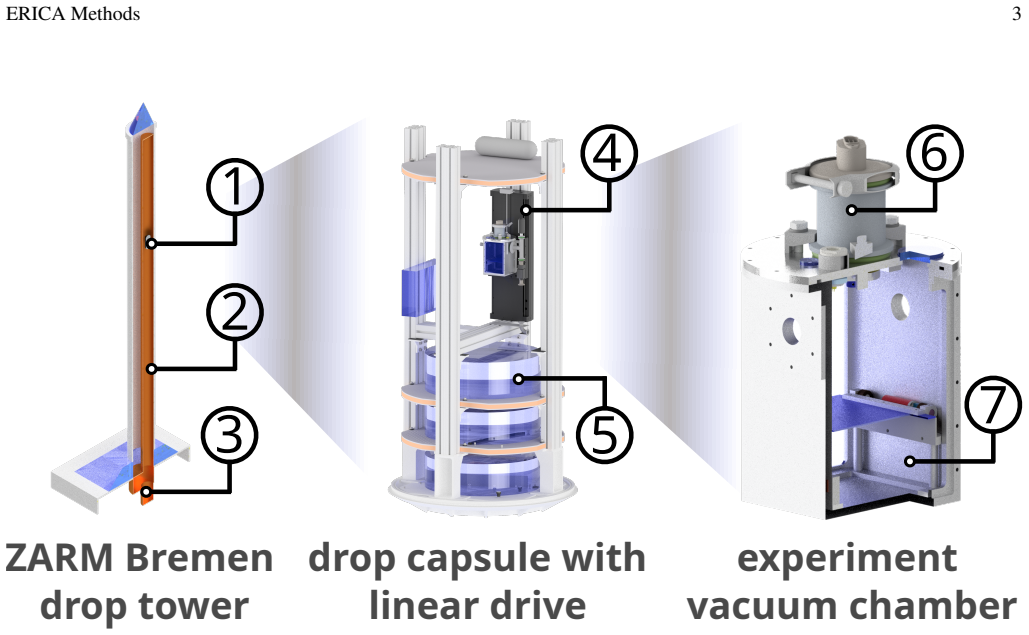
The load-bearing component is the two-stage gravity conversion: the drop tower supplies microgravity by free fall, and a closed-loop linear stage with a 300 mm travel range accelerates the experiment chamber at a constant, programmable rate, effectively replacing the missing gravitational acceleration. The stage's encoder, read by its motion controller at high rate, provides the trajectory data used to verify the parabola fit; the chamber is a vacuum vessel with cameras, lighting, a retainer cover for the granular bed, and a magnet-and-motor launcher that releases impactors at speeds down to a few centimeters per second. The key identity is the parabolic trajectory $x(t) = 0.5 a t^2 + v_0 t + x_0$, whose fitted acceleration $a$ is the delivered partial-gravity level and whose residuals are the measure of g-jitter.
What would settle it
Mount an independent accelerometer on the experiment chamber itself during a drop and compare its recorded acceleration with the commanded parabola from the stage encoder; if the chamber's measured acceleration deviates from the commanded constant value by more than the mm/$s^{2}$ scale claimed, the central performance claim would be refuted.
Extended reading notes
Core claim
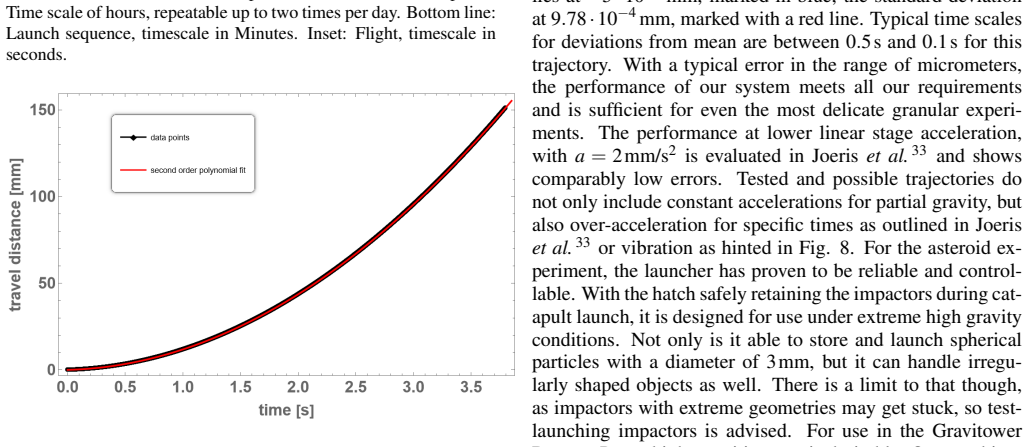
On its own terms, the paper's central claim is that a constant-acceleration linear stage mounted inside a free-falling drop-tower capsule converts the tower's microgravity into a precisely controllable partial-gravity level, and that the resulting environment is clean enough for the most delicate granular experiments. The supporting evidence is a fit of the stage's encoder position data to $x(t) = 0.5 a t^2 + v_0 t + x_0$; after a short equilibration, residuals stay below $3.16 \times 10^{-3}\,\mathrm{mm}$ with a standard deviation of $9.78 \times 10^{-4}\,\mathrm{mm}$, which the authors take as proof that accelerations can be commanded down to the mm/$s^{2}$ range with jitter far below the target gravity. In the science demonstration, the platform produced asteroid-like conditions under vacuum and yielded a nonmonotonic coefficient of restitution versus bed particle size, interpreted as evidence that cohesion influences rebounding impacts. The authors explicitly offer the platform to outside groups, with 9.3 s of partial gravity per catapult launch and a demonstrated high-repetition-rate mode in a smaller actively driven tower.
Load-bearing premise
The load-bearing premise is that the stage encoder's residual deviations (standard deviation $9.78 \times 10^{-4}$ mm) equal the acceleration actually felt by the experiment chamber, because no independent accelerometer is mounted on the chamber and mechanical compliance between sled and chamber is not characterized.
Editorial extensions
If this is right
- Asteroid regolith experiments can be performed on the ground at accelerations of $10^{-2}$ to $10^{-4}\,g$ with jitter low enough that granular contacts are not disturbed.
- The platform provides 9.3 s of steady partial gravity per catapult launch, and a high-repetition mode in an actively driven drop tower that achieved 15 repetitions per half-day.
- Because the stage acceleration is programmable, experimenters can design time-varying gravity profiles, such as a short settling over-acceleration followed by the target level.
- The vacuum chamber, low-velocity launcher, and camera system together allow controlled impact experiments on regolith simulants, extending ejecta and restitution data to low-energy asteroid conditions.
- Coefficient-of-restitution measurements under milligravity show a nonmonotonic dependence on bed particle size, supporting cohesion-influenced rebound behavior and motivating more complex sorting theories.
Reading between the lines
- The performance evidence would be stronger with an on-chamber accelerometer; without one, structural modes between sled and chamber could in principle add jitter beyond what the encoder reports.
- The same two-stage principle could be extended to time-varying gravity sequences (e.g., landing or tidal profiles) by programming the stage trajectory, since the controller accepts non-constant accelerations.
- Ballistic tracking of free particles inside the chamber, already used as one verification method, could be formalized as the standard cross-check for delivered gravity level in future campaigns.
- If the milligravity environment is as clean as claimed, it could serve as a testbed for cohesion-dominated granular processes such as planetesimal accretion and electrostatic aggregation, not just impact physics.
Editorial analysis
A structured set of objections, weighed in public.
Referee Report
Summary. The manuscript describes a two-stage platform for partial-gravity experiments: the ZARM drop tower provides about 9.3 s of microgravity in either drop or catapult mode, and a Newport M-IMS300LM-S linear stage mounted inside the capsule accelerates an experiment vacuum chamber at a constant rate to produce a defined partial gravity level. The authors detail the mechanical, electrical, vacuum, launcher, and camera subsystems, give an operational timeline for a catapult campaign, and present a performance evaluation based on a parabolic fit to the stage's integrated encoder, reporting a residual standard deviation of 9.78e-4 mm at a = 20 mm/s^2. They also summarize prior scientific results obtained with the platform (impact and settling experiments) and position the platform as an open user facility.
Significance. The platform concept addresses a real gap: no existing facility combines asteroid-level partial gravity (10^-2 to 10^-4 g) with low jitter, vacuum, and 9.3 s duration, and the linear-stage approach avoids the Coriolis and gradient artifacts of centrifuges. If the performance claims are validated, the facility would be valuable for granular physics and asteroid-surface studies. The paper is transparent about the evidence it presents, but that evidence is currently one encoder-only trajectory at 20 mm/s^2; the advertised lower end of the range is cited to a prior paper rather than measured here. The central claim is directly testable, and the paper itself names ballistic particle tracking as a suitable validation method, which strengthens the path to verification.
major comments (3)
- [Section V, Figs. 9 and 10] The central 'low g-jitter' claim is supported only by the parabolic fit to the stage's own encoder data. Because the encoder is part of the closed control loop that generates the commanded trajectory, a small fit residual demonstrates tracking accuracy, not the acceleration experienced by the experiment chamber. The quoted residual statistics do not by themselves bound g-jitter at the mm/s^2 scale: treating the 9.78e-4 mm standard deviation as a sinusoidal displacement with period 0.5 s and 0.1 s yields acceleration amplitudes of about 0.15 mm/s^2 and 3.9 mm/s^2, respectively, and the 3.16e-3 mm peak residual raises these to about 0.5 mm/s^2 and 12 mm/s^2. These are the same order as, or larger than, the accelerations the platform is designed to deliver. An accelerometer mounted on the chamber, or the ballistic particle tracking mentioned in Section V, is required to substantiate the claim that the system is 'sufficient for even the most delicate granular experiments.'
- [Section V, lower-acceleration claim] The abstract advertises controlled partial gravity down to the mm/s^2 range, but the only quantitative data in this manuscript are for a = 20 mm/s^2. The 2 mm/s^2 result is delegated to reference 33, and Section V indicates that the earlier campaign used a different stage (Thorlabs DDS220/M) whose high-rate position output was not available. To support the advertised range, the authors should present a 2 mm/s^2 trajectory from the Newport stage described here, or explicitly state that the mm/s^2-range claim rests on a different, previously published apparatus.
- [Section V, residual statistics] The reported fit and residuals are for a single trajectory. There is no run-to-run variability, no dependence on acceleration level, and no check with a representative payload mass. Since the paper presents the platform as an open facility, a single representative run is insufficient evidence that the performance is general; at minimum, multiple runs at several accelerations, including the lowest advertised one, should be reported.
minor comments (6)
- [Section III F] The turbomolecular pump is introduced as 'XXTypeXX'; this unresolved placeholder should be replaced by the actual model designation.
- [Throughout] There are numerous typographical errors (e.g., 'T ower' in the title, 'PERFOMANCE', 'whith', 'break' used for 'brake', 'vaccum', 'dusturbances', 'interation', 'beween', 'peneumatic', 'resitution', 'mircrogravity', 'actily', 'serveral', 'esaily'); a thorough proofread is needed.
- [Section IV, Phase 3] The sequence is described as 'the break is released' and later 'the peneumatic break is engaged again'; the intended component is the braking system described in Section III A, and the terminology should be made consistent.
- [Section VIII] The 'Author Declarations' section is left blank before the conflict-of-interest statement; this section should either be filled in or removed.
- [Section III D] The sentence 'Lowest tested impact speeds range down below 4cms2' presumably means 4 cm/s; the units should be corrected.
- [Fig. 3] The axis label 'stage acceleration[m/s^2]' with values from 0.005 to 0.050 m/s^2 is correct, but the text elsewhere describes accelerations in mm/s^2; using a consistent notation or a secondary axis would improve readability.
Circularity Check
No circular derivation; the platform performance claim rests on direct encoder measurement, and the sole self-citation is supporting rather than load-bearing in a circular sense.
full rationale
This paper is an instrumentation and measurement report, not a derivation chain. The central performance claim—controlled partial gravity down to the mm/s^2 range with low g-jitter—is supported by the linear-stage encoder data shown in Fig. 9 and the residual statistics in Fig. 10. The parabolic fit x(t)=0.5*a*t^2+v0*t+x0 is a diagnostic of the stage's commanded trajectory, not a model parameter fitted to one dataset and then reused as a prediction of another quantity. The residual standard deviation of 9.78e-4 mm is presented as a direct measurement of stage tracking error, not as an output derived from an input assumption. The only self-citation that touches the performance claim is the sentence in Section V: 'The performance at lower linear stage acceleration, with a = 2mm/s^2 is evaluated in Joeris et al. 33 and shows comparably low errors.' This is a reference to a separate same-group measurement campaign and does not feed a fitted parameter from the present paper back into the claim; it is externally published, context-specific, and falsifiable in its own right. Under the review rules, such a citation is real evidence and does not by itself create circularity. The skeptic's concern that encoder residuals may not equal the acceleration actually experienced by the experiment chamber is a measurement-validity and calibration issue, not a circularity of the argument, because the paper does not claim to derive payload acceleration solely from the commanded trajectory; it reports residuals of the stage position. No step satisfies the requirement of exhibiting Eq. X = Eq. Y by construction or a fitted input renamed as a prediction. The paper's claims are therefore not circular.
Assumptions & free parameters
assumptions (4)
- domain assumption The ZARM drop tower provides microgravity with residual acceleration below 1e-6 g.
- domain assumption The linear stage's encoder position accurately represents the acceleration experienced by the experiment chamber.
- domain assumption The stage controller's closed-loop system maintains the programmed trajectory with negligible deviation.
- ad hoc to paper The 2 mm/s^2 performance claim is supported by the cited prior work (Joeris et al. 2021).
Cite this review
Pith. "Pith review of Controlled Partial Gravity Platform for Milligravity in Drop Tower Experiments." pith.science (2026). https://pith.science/paper/YUPKQN5F
@misc{pith2026241112391,
  author       = {Pith},
  title        = {Pith review of: Controlled Partial Gravity Platform for Milligravity in Drop Tower Experiments},
  year         = {2026},
  howpublished = {\url{https://pith.science/paper/YUPKQN5F}},
  note         = {Machine review of arXiv:2411.12391}
}
abstract
We detail a platform for partial g environment and an experiment for simulated impacts on asteroid surfaces based on it. The partial g environment is created by a two stage approach: First, create microgravity using the ZARM drop tower. Second, convert microgravity to partial gravity by steady acceleration of experiment volume on linear drive inside microgravity environment. The experiment we conducted on this platform simulates low-velocity impacts into a simulated asteroid surface. To recreate the asteroid environment, in addition to the partial gravity, a vacuum chamber is used. We explain requirements, setup and operation of partial gravity platform and experiment and discuss its performance. Finally, we are open for requests for external experiments which might benefit from our platform with $9.3\,$s of controlled partial gravity down to the mm/s$^2$ range with low g-jitter.
Figures


Figures from the paper (8 more)




Forward citations
Cited by 1 Pith paper
-
Ultra Low Velocity Ejecta Generated by Slow Impacts on Rubble Pile Asteroids
Slow impacts on granular beds under milligravity produce ejecta velocities that follow the same scaling as earlier low-gravity experiments, and a gravity-dependent observational cutoff explains the deviation of Earth-...
Reference graph
Works this paper leans on
-
[1]
author author P. S \'a nchez , author K. E. \ Daniels , author H. Jaeger , \ and\ author T. Shinbrot ,\ title title Effects of reduced gravity on the granular fluid-solid transition: underexplored forces can dominate soft matter behaviors , \ @noop journal journal arXiv preprint arXiv:2307.03673 \ ( year 2023 ) NoStop
work page Pith review arXiv 2023
-
[2]
author author R. T. \ Daly , author C. M. \ Ernst , author O. S. \ Barnouin , author N. L. \ Chabot , author A. S. \ Rivkin , author A. F. \ Cheng , author E. Y. \ Adams , author H. F. \ Agrusa , author E. D. \ Abel , author A. L. \ Alford , et al. ,\ title title Successful kinetic impact into an asteroid for planetary defence , \ @noop journal journal Na...
work page 2023
-
[3]
Fujiwara , author J
author author A. Fujiwara , author J. Kawaguchi , author D. K. \ Yeomans , author M. Abe , author T. Mukai , author T. Okada , author J. Saito , author H. Yano , author M. Yoshikawa , author D. J. \ Scheeres , author O. Barnouin-Jha , author A. F. \ Cheng , author H. Demura , author R. W. \ Gaskell , author N. Hirata , author H. Ikeda , author T. Kominato...
-
[4]
author author D. Lauretta , author S. Balram-Knutson , author E. Beshore , author W. Boynton , author C. Drouet d’Aubigny , author D. DellaGiustina , author H. Enos , author D. Golish , author C. Hergenrother , author E. Howell , et al. ,\ title title Osiris-rex: sample return from asteroid (101955) bennu , \ @noop journal journal Space Science Reviews \ ...
work page 2017
-
[5]
author author T. Shinbrot , author T. Sabuwala , author T. Siu , author M. V. \ Lazo , \ and\ author P. Chakraborty ,\ title title Size Sorting on the Rubble-Pile Asteroid Itokawa , \ 10.1103/PhysRevLett.118.111101 journal journal Phys. Rev. Lett. \ volume 118 ( year 2017 ),\ 10.1103/PhysRevLett.118.111101 NoStop
-
[6]
author author P. Michel , author R.-L. \ Ballouz , author O. Barnouin , author M. Jutzi , author K. Walsh , author B. May , author C. Manzoni , author D. Richardson , author S. Schwartz , author S. Sugita , et al. ,\ title title Collisional formation of top-shaped asteroids and implications for the origins of ryugu and bennu , \ @noop journal journal Natu...
work page 2020
-
[7]
author author K. Joeris , author L. Sch \"o nau , author M. Keulen , author P. Born , \ and\ author J. E. \ Kollmer ,\ title title The influence of interparticle cohesion on rebounding slow impacts on rubble pile asteroids , \ @noop journal journal npj Microgravity \ volume 8 ,\ pages 36 ( year 2022 ) NoStop
work page 2022
-
[8]
author author O. Barnouin , author M. Daly , author E. Palmer , author R. Gaskell , author J. Weirich , author C. Johnson , author M. Al Asad , author J. Roberts , author M. Perry , author H. Susorney , et al. ,\ title title Shape of (101955) bennu indicative of a rubble pile with internal stiffness , \ @noop journal journal Nature geoscience \ volume 12 ...
work page 2019
Show all 33 references
-
[9]
\ Ballouz , author K
author author R.-L. \ Ballouz , author K. Walsh , author P. Sanchez , author K. Holsapple , author P. Michel , author D. Scheeres , author Y. Zhang , author D. Richardson , author O. Barnouin , author M. Nolan , et al. ,\ title title Modified granular impact force laws for the...
2021
-
[10]
author author K. J. \ Walsh , author R.-L. \ Ballouz , author E. R. \ Jawin , author C. Avdellidou , author O. S. \ Barnouin , author C. A. \ Bennett , author E. B. \ Bierhaus , author B. J. \ Bos , author S. Cambioni , author H. C. \ Connolly Jr , et al. ,\ title title Near-z...
2022
-
[11]
Yano , author T
author author H. Yano , author T. Kubota , author H. Miyamoto , author T. Okada , author D. Scheeres , author Y. Takagi , author K. Yoshida , author M. Abe , author S. Abe , author O. Barnouin-Jha , et al. ,\ title title Touchdown of the hayabusa spacecraft at the muses sea on...
2006
-
[12]
author author D. S. \ Lauretta , author H. L. \ Enos , author A. T. \ Polit , author H. L. \ Roper , \ and\ author C. W. \ Wolner ,\ title title Osiris-rex at bennu: Overcoming challenges to collect a sample of the early solar system , \ in\ @noop booktitle Sample return missi...
2021
-
[13]
Steinpilz , author K
author author T. Steinpilz , author K. Joeris , author F. Jungmann , author D. Wolf , author L. Brendel , author J. Teiser , author T. Shinbrot , \ and\ author G. Wurm ,\ title title Electrical charging overcomes the bouncing barrier in planet formation , \ 10.1038/s41567-019-...
-
[14]
Wurm \ and\ author J
author author G. Wurm \ and\ author J. Teiser ,\ title title Understanding planet formation using microgravity experiments , \ @noop journal journal Nature Reviews Physics \ volume 3 ,\ pages 405--421 ( year 2021 ) NoStop
2021
-
[15]
Creech , author J
author author S. Creech , author J. Guidi , \ and\ author D. Elburn ,\ title title Artemis: an overview of nasa's activities to return humans to the moon , \ in\ @noop booktitle 2022 ieee aerospace conference (aero) \ ( organization IEEE ,\ year 2022 )\ pp.\ pages 1--7 NoStop
2022
-
[16]
author author K. A. \ Farley , author K. H. \ Williford , author K. M. \ Stack , author R. Bhartia , author A. Chen , author M. de la Torre , author K. Hand , author Y. Goreva , author C. D. \ Herd , author R. Hueso , et al. ,\ title title Mars 2020 mission overview , \ @noop ...
2020
-
[17]
author author C. E. \ Carr , author N. C. \ Bryan , author K. N. \ Saboda , author S. A. \ Bhattaru , author G. Ruvkun , \ and\ author M. T. \ Zuber ,\ title title Acceleration profiles and processing methods for parabolic flight , \ @noop journal journal npj Microgravity \ vo...
2018
-
[18]
Barmatz , author I
author author M. Barmatz , author I. Hahn , author J. Lipa , \ and\ author R. Duncan ,\ title title Critical phenomena in microgravity: Past, present, and future , \ @noop journal journal Reviews of modern physics \ volume 79 ,\ pages 1 ( year 2007 ) NoStop
2007
-
[19]
Steinpilz , author G
author author T. Steinpilz , author G. Musiolik , author M. Kruss , author F. Jungmann , author T. Demirci , author M. Aderholz , author J. E. \ Kollmer , author J. Teiser , author T. Bila , author E. Guay , et al. ,\ title title Arise: A granular matter experiment on the inte...
2019
-
[20]
Thomas , author N
author author V. Thomas , author N. Prasad , \ and\ author C. A. M. \ Reddy ,\ title title Microgravity research platforms--a study , \ @noop journal journal Current science \ ,\ pages 336--340 ( year 2000 ) NoStop
2000
-
[21]
Bila , author G
author author T. Bila , author G. Wurm , author K. Stuers , author K. Joeris , \ and\ author J. Teiser ,\ title title Dry downhill particle motion on mars , \ 10.3847/PSJ/ad3df4 journal journal The Planetary Science Journal \ volume 5 ,\ pages 115 ( year 2024 ) NoStop
-
[22]
Ozaki , author G
author author S. Ozaki , author G. Ishigami , author M. Otsuki , author H. Miyamoto , author K. Wada , author Y. Watanabe , author T. Nishino , author H. Kojima , author K. Soda , author Y. Nakao , et al. ,\ title title Granular flow experiment using artificial gravity generat...
2023
-
[23]
Musiolik , author M
author author G. Musiolik , author M. Kruss , author T. Demirci , author B. Schrinski , author J. Teiser , author F. Daerden , author M. D. \ Smith , author L. Neary , \ and\ author G. Wurm ,\ title title Saltation under martian gravity and its influence on the global dust dis...
2018
-
[24]
Beysens , author P
author author D. Beysens , author P. Guenoun , \ and\ author F. Perrot ,\ title title Phase separation of critical binary fluids under microgravity: Comparison with matched-density conditions , \ @noop journal journal Physical Review A \ volume 38 ,\ pages 4173 ( year 1988 ) NoStop
1988
-
[25]
Mitarai \ and\ author F
author author N. Mitarai \ and\ author F. Nori ,\ title title Wet granular materials , \ @noop journal journal Advances in physics \ volume 55 ,\ pages 1--45 ( year 2006 ) NoStop
2006
-
[26]
Selig , author H
author author H. Selig , author H. Dittus , \ and\ author C. L \"a mmerzahl ,\ title title Drop tower microgravity improvement towards the nano-g level for the microscope payload tests , \ @noop journal journal Microgravity Science and Technology \ volume 22 ,\ pages 539--549 ...
2010
-
[27]
Von Kampen , author U
author author P. Von Kampen , author U. Kaczmarczik , \ and\ author H. J. \ Rath ,\ title title The new drop tower catapult system , \ @noop journal journal Acta Astronautica \ volume 59 ,\ pages 278--283 ( year 2006 ) NoStop
2006
-
[28]
o nemann , \ and\ author C. L \
author author A. Gierse , author U. Kaczmarczik , author A. Greif , author H. Selig , author P. von Kampen , author T. K \"o nemann , \ and\ author C. L \"a mmerzahl ,\ title title A fast and self-acting release-caging-mechanism for actively driven drop tower systems , \ @noop...
2017
-
[29]
Lotz , author T
author author C. Lotz , author T. Frob \"o se , author A. Wanner , author L. Overmeyer , \ and\ author W. Ertmer ,\ title title Einstein-elevator: A new facility for research from to 5 , \ @noop journal journal Gravitational and Space Research \ volume 5 ,\ pages 11--27 ( year...
2017
-
[30]
author author F. m. \ ZARM ,\ @noop title Bremen drop tower payload user's guide version 1.2 , \ ( year 2022 ),\ note https://www.zarm.uni-bremen.de/fileadmin/user_upload/drop_tower/ZARM_BDT_PUG_ver1.2.pdf [Accessed: 2024/05/07] NoStop
2022
-
[31]
author author I. MKS Instruments ,\ @noop title Ds-112001 ims-lm-s datasheet\_00/20 , \ ( year 2020 a ),\ note https://www.newport.com/mam/celum/celum_assets/resources/IMS-LM-S_Data_Sheet.pdf?3 [Accessed: 2024/05/07] NoStop
2020
-
[32]
author author I. MKS Instruments ,\ @noop title Xps-rld universal high-performance 1-4 axis motion controller and driver , \ ( year 2020 b ),\ note https://www.newport.com/mam/celum/celum_assets/resources/XPS-RLD_Datasheet.pdf?2 [Accessed: 2024/05/30] NoStop
2020
-
[33]
Joeris , author L
author author K. Joeris , author L. Schönau , author L. Schmidt , author M. Keulen , author V. Desai , author P. Born , \ and\ author J. Kollmer ,\ title title Experiments on rebounding slow impacts under asteroid conditions , \ 10.1051/epjconf/202124913003 journal journal EPJ...
Reviewed August 12, 2026 · model on record in the stance chip above.
Discussion (0). Continue with ORCID to comment.