REVIEW 4 major objections 5 minor 29 references
Iterative Update and Unified Representation for Multi-Agent Reinforcement Learning
T0 review · 4 major / 5 minor · reviewed 2026-08-14 · deepseek-v4-flash
Pith's one-line read One shared network trains all agents and beats MADDPG
desk verdict A useful parameter-sharing speedup, but the paper's iterative-update mechanism is contradicted by its own algorithm and the headline claim is not supported. read the letter →
The pith
A machine-rendered reading of the paper's core claim, the machinery that carries it, and where it could break.
The reading
What carries the argument
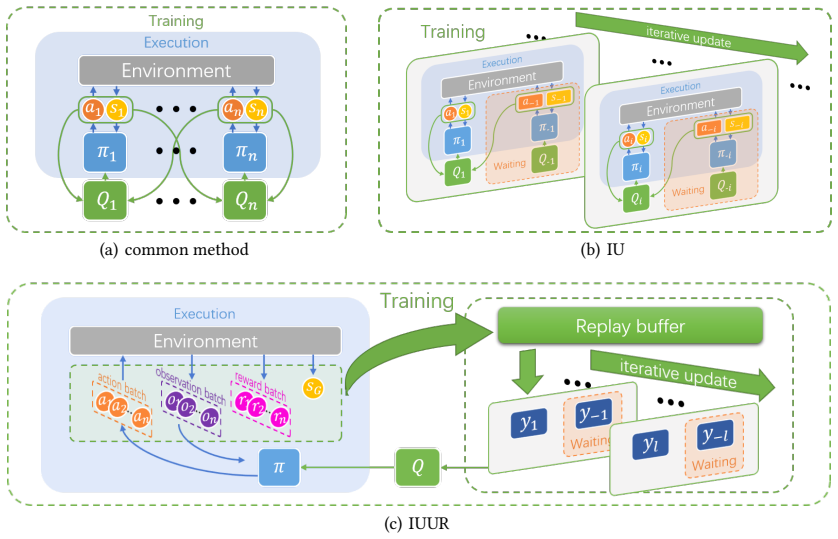
The key machinery is the value-fixing target for iterative update inside a unified network. For the current learning agent $i$, the critic target is $y_i = r_i + \gamma Q'(s, o_i, a'_1, \dots, a'_N)$ with $a'_j = \mu'(o_j)$; for waiting agents $-i$, the target is simply $y_{-i} = Q'(s, o_{-i}, a'_1, \dots, a'_N)$, so no Bellman update is applied to their part of the Q function. This is meant to keep the gradient of the waiting agents' policy objective near zero, fixing their strategies while the current agent improves. The unified representation adds each agent's own observation $o_i$ as a first-person perspective, so one network can produce distinct policies for all agents and enable batch computation.
What would settle it
Run IUUR on Spread_10 and record the action distributions of waiting agents immediately before and after the current agent's update. If the KL divergence between those distributions is large while the stated L2-norm bound on their policy gradient is small, then the value-fixing step does not actually keep waiting agents fixed, and the method's stated mechanism is not what drives the reported gains.
Extended reading notes
Core claim
The paper claims that a single policy network can represent all agents in a multi-agent system, and that this representation can be trained stably by updating one agent at a time. The central discovery is a value-fixing rule based on the Bellman equation: for the agent currently being trained, the critic target uses the reward plus the discounted target-Q value, while for all other agents the target is taken directly from the target critic network without a Bellman expansion. The authors argue that this makes the policy gradient for the waiting agents small in L2 norm, so their policies stay approximately fixed even though they share the same network weights. This iterative update, combined with the unified one-network representation, is claimed to mitigate nonstationarity and to achieve state-of-the-art performance compared with MADDPG while saving significant wall-clock time, with the advantage growing as the number of agents increases.
Load-bearing premise
The load-bearing premise is that making the waiting agents' policy-gradient norm small is enough to keep their policies fixed, even though all agents share one network and any parameter update necessarily changes the network's outputs for every agent's observations.
Editorial extensions
If this is right
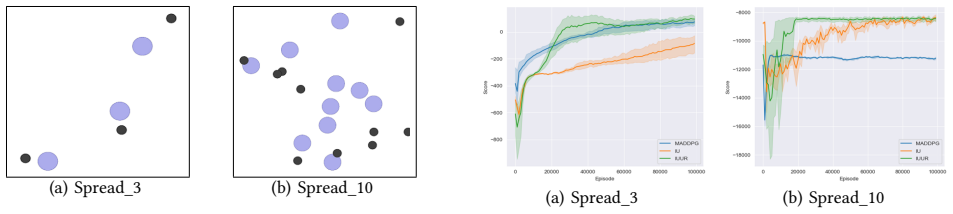
- In fully cooperative tasks with many agents, iterative update reduces nonstationarity and outperforms the MADDPG baseline, with the gap growing as the number of agents increases.
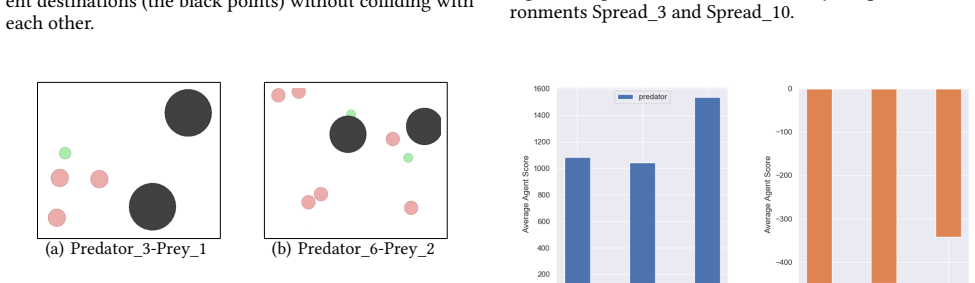
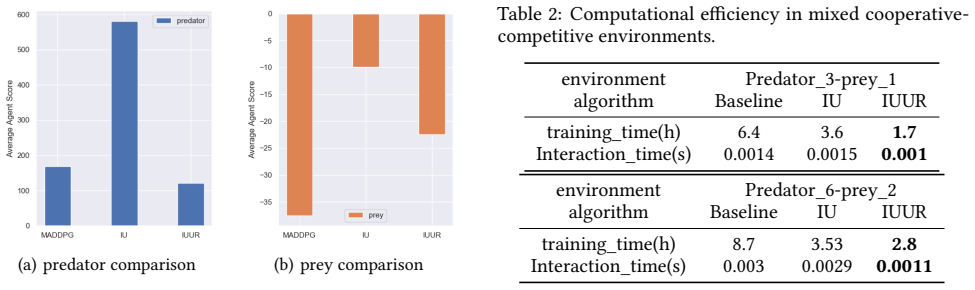
- In mixed cooperative-competitive tasks, the unified representation matches or beats MADDPG in most comparisons, with the paper noting a few cases where shared-network Q-value error hurts performance.
- Wall-clock training time and environment interaction time drop substantially under IUUR, and interaction time no longer grows linearly with the number of agents.
- Because policies are still computed from each agent's own observation, the method preserves decentralized execution and distributed deployment.
- The paper states that the approach is compatible with other multi-agent algorithms such as IQL, VDN, and QMIX.
Reading between the lines
- A natural test the authors leave implicit is to log the L2 norm of the waiting agents' policy gradients during IUUR training; if the norm is not actually smaller than under a Bellman target, the value-fixing premise fails in practice even if results are good.
- The learning-frequency hyperparameter $K$ controls the balance between stability and the learning speed of waiting agents; the paper tunes it by experience, suggesting that annealing $K$ or adapting it per environment could widen the performance gains.
- The single shared network may act as an implicit regularizer, forcing agents to share features; this could explain the fast convergence in Spread_3 and could be tested by ablating the first-person perspective encoding.
- If the value-fixing target is sound, it should port to value-based MARL methods such as VDN and QMIX, where the critic is central and Bellman targets are already well defined.
Signed reviews
Editorial analysis
A structured set of objections, weighed in public.
Referee Report
Summary. The paper proposes two interlocking ideas for multi-agent reinforcement learning: iterative update (IU), in which only one agent is trained at a time while the policies of the other agents are held fixed, and unified representation (IUUR), in which all agents share a single policy network conditioned on first-person observations. The authors claim that IUUR mitigates nonstationarity, improves performance over MADDPG, reduces memory usage, and decreases wall-clock time, especially as the number of agents grows. The method is evaluated on cooperative (Spread) and mixed cooperative-competitive (Predator-Prey) continuous-control tasks, and the source code is made available online.
Significance. If the central mechanism worked as stated, the paper would make a useful practical contribution: parameter sharing via first-person perspective is a sensible way to reduce memory and computation in MARL, and fixing waiting agents' policies is a principled way to reduce nonstationarity. The availability of source code and the use of an external baseline (MADDPG) rather than fitted constants are strengths. However, the paper's own text and Algorithm 1 are inconsistent about which agents are updated, the value-fixing guarantee is asserted rather than proved or measured, and the headline performance claim is contradicted by one of the reported environments. As it stands, the experiments do not isolate the mechanism the paper claims to test.
major comments (4)
- [Algorithm 1] The actor update in Algorithm 1 sums over all agents: ∇θJ(μ|oi) ≈ (1/NB) Σ_i Σ_j (∇θμ(oi)∇_ai Q(...)), with no mask selecting the current learning agent l. This directly contradicts Section 3's statement that 'only the current particular agent is trained.' As written, every shared parameter update changes all agents' policies, so the training procedure degenerates to a shared-network version of MADDPG and the reported experiments would not test the iterative-update mechanism. Please correct the pseudocode to update only the current learning agent (or otherwise explicitly suppress waiting-agent gradients), and state clearly which version of the algorithm produced the reported results. If the implementation followed the printed pseudocode, the nonstationarity-related performance claims need to be rerun with the intended masking.
- [Section 3] The claimed guarantee in the paragraph beginning 'Luckily we can usually guarantee a smaller L2 norm of its gradient' is not established. Because all agents share the same parameters θ, any gradient step changes μ(o_-i) for waiting agents; a smaller L2 norm of the policy gradient does not imply that the waiting agents' policies are fixed, and no bound on the resulting policy change is given. The inequality is asserted without proof, and Section 5 later concedes that the equation 'cannot strictly hold.' Please provide a derivation under explicit assumptions, or empirically measure waiting-agent policy drift (for example, mean action distance or KL divergence between target policies before and after updates).
- [Section 3] The value-fixing target for waiting agents, y_-i = Q'(s, o_-i, a'_1, ..., a'_N), omits the immediate reward r_-i. Since Q is meant to represent a discounted return, regressing Q toward this target does not correspond to a Bellman fixed point for agent -i unless an additional argument is supplied. The paper should define the exact loss for waiting agents and explain why this target is valid; otherwise the value-fixing mechanism is underspecified and the reported training objective is ambiguous.
- [Section 4.2.1] In the Predator_6-Prey_2 predator-replacement condition, the paper reports that IUUR performs worse than MADDPG (Figure 6(a) and the accompanying text), attributing this to 'update error introduced by unified representation.' This is a direct counterexample to the abstract's unqualified statement that the algorithm 'achieves state-of-the-art performance.' Please qualify the performance claim to the environments and settings where the improvement is observed, and discuss whether the negative result is consistent with the value-fixing approximation or indicates a more fundamental limitation.
minor comments (5)
- [Section 2] The text 'For each agent's policy ri : S×A1×...×AN → R' reuses the reward notation for a policy; this should be πi.
- [Section 3 and Algorithm 1] The target notation y_-i = Q'(s, o_-i, ...) is confusing because Q is defined as Q(s, o_i, a_1, ..., a_N); please clarify which observation argument is used in the critic and targets.
- [Section 4.2.1] The caption of Figure 6 states 'In (a), IU outperforms MADDPG a lot and IU's performance is worse than that of MADDPG,' which is internally inconsistent; the text indicates that IUUR, not IU, is the worse-performing method in that condition.
- [Section 4.2.2] The wall-clock time savings are reported as single numbers without variance, number of runs, or details about batching/GPU utilization; adding this information would make the computational-efficiency claim more robust.
- [Section 4.2] Only one value of the new hyperparameter K is used (K=5000), with no sensitivity analysis; a short ablation or at least a discussion of how K affects the performance/nonstationarity trade-off would strengthen the paper.
Circularity Check
No significant circularity: IUUR is benchmarked against external MADDPG, and the value-fixing target is a heuristic rather than a fitted prediction.
full rationale
The derivation chain is not circular. The central performance claim is tested against MADDPG, an external baseline, and no parameter of IUUR is fitted to reproduce that baseline; the hyperparameter K is hand-tuned, which is a standard hyperparameter rather than a fitted constant that encodes the result. The value-fixing step in Section 3 defines the waiting-agent target as y_-i = Q'(s,o_-i,a') without a reward term, which is a heuristic bootstrap target, not a prediction equivalent by construction to the claimed outcome. The paper explicitly concedes the approximation: Section 3 states 'Though we can't hold the equation accurately, this method can substantially fix the other agents' polices which mitigate the nonstationarity effectively in practice,' and Section 5 states 'The value fixing method based on Bellman Equation can only guarantee a smaller L2 norm of its gradients and cannot strictly hold the equation.' These are admitted limitations, not disguised inputs. The asserted smaller L2 norm is not derived rigorously, but an unsupported inequality is a correctness risk, not circularity. The Algorithm 1 actor update sums the policy gradient over all agents with no mask selecting the current learning agent, which appears inconsistent with the paper's 'only the current particular agent is trained' claim; again, this is an implementation/correctness issue rather than a circular reduction. No load-bearing self-citation is present: the cited works on MADDPG, GANs, and continual learning are external and not authored by the current paper's authors. Since the reported results are externally benchmarked and the proposed mechanism is not a renamed fit of its own outputs, the circularity burden is not met.
Assumptions & free parameters
free parameters (1)
- K =
5000
assumptions (3)
- domain assumption Value-fixing approximation: making the L2 norm of waiting agents' policy gradients smaller than the Bellman-based alternative is sufficient to approximately fix their policies under shared parameters.
- domain assumption A single network with first-person perspective information can represent distinct, valid policies for all agents without per-agent parameters.
- domain assumption Fixing other agents' policies reduces the multi-agent problem to a single-agent MDP for the learning agent.
Cite this review
Pith. "Pith review of Iterative Update and Unified Representation for Multi-Agent Reinforcement Learning." pith.science (2026). https://pith.science/paper/YUTF5NHR
@misc{pith2026190806758,
  author       = {Pith},
  title        = {Pith review of: Iterative Update and Unified Representation for Multi-Agent Reinforcement Learning},
  year         = {2026},
  howpublished = {\url{https://pith.science/paper/YUTF5NHR}},
  note         = {Machine review of arXiv:1908.06758}
}
read the original abstract
Multi-agent systems have a wide range of applications in cooperative and competitive tasks. As the number of agents increases, nonstationarity gets more serious in multi-agent reinforcement learning (MARL), which brings great difficulties to the learning process. Besides, current mainstream algorithms configure each agent an independent network,so that the memory usage increases linearly with the number of agents which greatly slows down the interaction with the environment. Inspired by Generative Adversarial Networks (GAN), this paper proposes an iterative update method (IU) to stabilize the nonstationary environment. Further, we add first-person perspective and represent all agents by only one network which can change agents' policies from sequential compute to batch compute. Similar to continual lifelong learning, we realize the iterative update method in this unified representative network (IUUR). In this method, iterative update can greatly alleviate the nonstationarity of the environment, unified representation can speed up the interaction with environment and avoid the linear growth of memory usage. Besides, this method does not bother decentralized execution and distributed deployment. Experiments show that compared with MADDPG, our algorithm achieves state-of-the-art performance and saves wall-clock time by a large margin especially with more agents.
Figures
Figures from the paper (1 more)
Reference graph
Works this paper leans on
-
[1]
Nikos Vlassis. A concise introduction to multiagent systems and distributed arti/f_icial intelligence.Synthesis Lectures on Arti/f_icial Intelligence and Machine Learning, 1(1):1–71, 2007
work page 2007
-
[2]
Multiagent systems: A survey from a machine learning perspective
Peter Stone and Manuela Veloso. Multiagent systems: A survey from a machine learning perspective. Autonomous Robots, 8(3):345–383, 2000
work page 2000
-
[3]
Multiagent systems: a modern approach to distributed arti/f_icial intelligence
Gerhard Weiss. Multiagent systems: a modern approach to distributed arti/f_icial intelligence. MIT press, 1999
work page 1999
-
[4]
Re- inforcement learning for cooperating and communicating reactive agents in electrical power grids
Martin Riedmiller, Andrew Moore, and Jeff Schneider. Re- inforcement learning for cooperating and communicating reactive agents in electrical power grids. In Workshop on Balancing Reactivity and Social Deliberation in Multi-Agent Systems, pages 137–149. Springer, 2000
work page 2000
-
[5]
Game theory and multi-agent reinforcement learning
Ann Nowé, Peter Vrancx, and Yann-Michaël De Hauwere. Game theory and multi-agent reinforcement learning. In Reinforcement Learning, pages 441–470. Springer, 2012
work page 2012
-
[6]
Multi-agent reinforcement learning: An overview
Lucian Buşoniu, Robert Babuška, and Bart De Schutter. Multi-agent reinforcement learning: An overview. In In- novations in multi-agent systems and applications-1 , pages 183–221. Springer, 2010
work page 2010
-
[7]
Reinforcement learn- ing: An introduction
Richard S Sutton and Andrew G Barto. Reinforcement learn- ing: An introduction. MIT press, 2018
2018
-
[8]
Markov games as a framework for multi- agent reinforcement learning
Michael L Littman. Markov games as a framework for multi- agent reinforcement learning. In Machine learning proceed- ings 1994, pages 157–163. Elsevier, 1994
work page 1994
Show all 29 references
-
[9]
Nash q-learning for general-sum stochastic games
Junling Hu and Michael P Wellman. Nash q-learning for general-sum stochastic games. Journal of machine learning research, 4(Nov):1039–1069, 2003
2003
-
[10]
Multiagent bidirectionally-coordinated nets: Emergence of human-level coordination in learning to play starcraft combat games
Peng Peng, Ying Wen, Yaodong Yang, Quan Yuan, Zhenkun Tang, Haitao Long, and Jun Wang. Multiagent bidirectionally-coordinated nets: Emergence of human-level coordination in learning to play starcraft combat games. arXiv preprint arXiv:1703.10069, 2017
2017 arXiv
-
[11]
Generative adversarial nets
Ian Goodfellow, Jean Pouget-Abadie, Mehdi Mirza, Bing Xu, David Warde-Farley, Sherjil Ozair, Aaron Courville, and Yoshua Bengio. Generative adversarial nets. In Advances in neural information processing systems , pages 2672–2680, 2014
2014
-
[12]
Continual lifelong learning with neural networks: A review
German I Parisi, Ronald Kemker, Jose L Part, Christopher Kanan, and Stefan Wermter. Continual lifelong learning with neural networks: A review. Neural Networks, 2019
2019
-
[13]
Multi-agent actor-critic for mixed cooperative-competitive environments
Ryan Lowe, Yi Wu, Aviv Tamar, Jean Harb, OpenAI Pieter Abbeel, and Igor Mordatch. Multi-agent actor-critic for mixed cooperative-competitive environments. In Advances in Neural Information Processing Systems , pages 6379–6390, 2017
2017
-
[14]
Partially observable markov decision processes for spoken dialog systems
Jason D Williams and Steve Young. Partially observable markov decision processes for spoken dialog systems. Com- puter Speech & Language , 21(2):393–422, 2007
2007
-
[15]
Multi-agent reinforcement learning: Independent vs
Ming Tan. Multi-agent reinforcement learning: Independent vs. cooperative agents. In Proceedings of the tenth interna- tional conference on machine learning , pages 330–337, 1993
1993
-
[16]
Q-learning
Christopher JCH Watkins and Peter Dayan. Q-learning. Machine learning, 8(3-4):279–292, 1992
1992
-
[17]
Op- timal and approximate q-value functions for decentralized pomdps
Frans A Oliehoek, Matthijs TJ Spaan, and Nikos Vlassis. Op- timal and approximate q-value functions for decentralized pomdps. Journal of Arti/f_icial Intelligence Research, 32:289– 353, 2008
2008
-
[18]
Continuous control with deep reinforcement learning
Timothy P Lillicrap, Jonathan J Hunt, Alexander Pritzel, Nicolas Heess, Tom Erez, Yuval Tassa, David Silver, and Daan Wierstra. Continuous control with deep reinforcement learning. arXiv preprint arXiv:1509.02971, 2015
2015 arXiv
-
[19]
Value-decomposition networks for cooperative multi-agent learning
Peter Sunehag, Guy Lever, Audrunas Gruslys, Wojciech Mar- ian Czarnecki, Vinicius Zambaldi, Max Jaderberg, Marc Lanctot, Nicolas Sonnerat, Joel Z Leibo, Karl Tuyls, et al. Value-decomposition networks for cooperative multi-agent learning. arXiv preprint arXiv:1706.05296, 2017
2017 arXiv
-
[20]
Qmix: Monotonic value function factorisation for deep multi-agent reinforcement learning
Tabish Rashid, Mikayel Samvelyan, Christian Schroeder de Witt, Gregory Farquhar, Jakob Foerster, and Shimon Whiteson. Qmix: Monotonic value function factorisation for deep multi-agent reinforcement learning. arXiv preprint arXiv:1803.11485, 2018
2018 arXiv
-
[21]
Counterfactual multi-agent policy gradients
Jakob N Foerster, Gregory Farquhar, Triantafyllos Afouras, Nantas Nardelli, and Shimon Whiteson. Counterfactual multi-agent policy gradients. In Thirty-Second AAAI Con- ference on Arti/f_icial Intelligence, 2018
2018
-
[22]
Contin- ual match based training in pommerman: Technical report
Peng Peng, Liang Pang, Yufeng Yuan, and Chao Gao. Contin- ual match based training in pommerman: Technical report. arXiv preprint arXiv:1812.07297, 2018
2018 arXiv
-
[23]
Human-level performance in /f_irst-person multiplayer games with population-based deep reinforcement learning
Max Jaderberg, Wojciech M Czarnecki, Iain Dunning, Luke Marris, Guy Lever, Antonio Garcia Castaneda, Charles Beat- tie, Neil C Rabinowitz, Ari S Morcos, Avraham Ruderman, et al. Human-level performance in /f_irst-person multiplayer games with population-based deep reinforcemen...
2018 arXiv
-
[24]
Popu- lation based training of neural networks
Max Jaderberg, Valentin Dalibard, Simon Osindero, Woj- ciech M Czarnecki, Jeff Donahue, Ali Razavi, Oriol Vinyals, Tim Green, Iain Dunning, Karen Simonyan, et al. Popu- lation based training of neural networks. arXiv preprint arXiv:1711.09846, 2017
2017 arXiv
-
[25]
A generalized dynamic programming princi- ple and hamilton-jacobi-bellman equation
Shige Peng. A generalized dynamic programming princi- ple and hamilton-jacobi-bellman equation. Stochastics: An International Journal of Probability and Stochastic Processes , 38(2):119–134, 1992
1992
-
[26]
Convex optimiza- tion
Stephen Boyd and Lieven Vandenberghe. Convex optimiza- tion. Cambridge university press, 2004
2004
-
[27]
Policy gradient methods for reinforcement learning with function approximation
Richard S Sutton, David A McAllester, Satinder P Singh, and Yishay Mansour. Policy gradient methods for reinforcement learning with function approximation. InAdvances in neural information processing systems, pages 1057–1063, 2000
2000
-
[28]
Wasserstein gan
Martin Arjovsky, Soumith Chintala, and Léon Bottou. Wasserstein gan. arXiv preprint arXiv:1701.07875, 2017
2017 arXiv
-
[29]
Improved training of wasserstein gans
Ishaan Gulrajani, Faruk Ahmed, Martin Arjovsky, Vincent Dumoulin, and Aaron C Courville. Improved training of wasserstein gans. In Advances in Neural Information Process- ing Systems, pages 5767–5777, 2017. 7
2017
Reviewed August 14, 2026 · model on record in the stance chip above.
Discussion (0). Continue with ORCID to comment.