Transient Bias for CP Domain Wall Decay and Dark Matter
Pith reviewed 2026-06-26 20:40 UTC · model grok-4.3
The pith
A new scalar field generates a transient bias that decays CP domain walls after they form, while its later oscillations supply dark matter and leave low-energy CP structure unchanged.
A machine-rendered reading of the paper's core claim, the machinery that carries it, and where it could break.
Core claim
Spontaneous CP violation after inflation produces stable domain walls unless the reheat temperature lies below the CP-breaking scale. The authors introduce an auxiliary scalar that acquires a large early-universe value with a complex phase; a higher-dimensional interaction then splits the energies of the degenerate CP vacua by an amount that shrinks as the auxiliary field rolls to zero. The resulting bias is large enough to trigger wall decay while the auxiliary field is still displaced, yet disappears at late times so that the low-energy CP-odd phase remains exactly as in the original model. The auxiliary field's residual oscillations automatically constitute a viable dark-matter candidate
What carries the argument
Transient bias generated by a higher-dimensional coupling between a new scalar (with early large vev and nontrivial phase) and the CP-breaking scalar, which splits the energies of degenerate CP vacua only while the new scalar is displaced from the origin.
If this is right
- The maximum temperature of the universe can exceed the CP-breaking scale without leaving observable domain walls.
- The low-energy effective theory below the scale of the new scalar is identical to the original spontaneous-CP-violation model.
- The dark-matter abundance is fixed by the initial amplitude and phase of the new scalar, linking the domain-wall solution to the relic density.
- No additional explicit CP violation is introduced at any scale.
Where Pith is reading between the lines
- The mechanism may be testable through the equation-of-state evolution of the oscillating scalar during the radiation era.
- Similar transient biases could be applied to other topological defects whose stability is tied to discrete symmetries.
- If the new scalar couples to the visible sector, its late decays could produce observable entropy injection or non-thermal dark-matter components.
Load-bearing premise
The new scalar must begin displaced from the origin with a phase that is not aligned with the CP-breaking scalar's phase.
What would settle it
A direct calculation showing that the bias term cannot exceed the wall tension for any choice of the higher-dimensional coefficient and initial field value within the regime where the scalar's oscillations later match the observed dark-matter density.
Figures
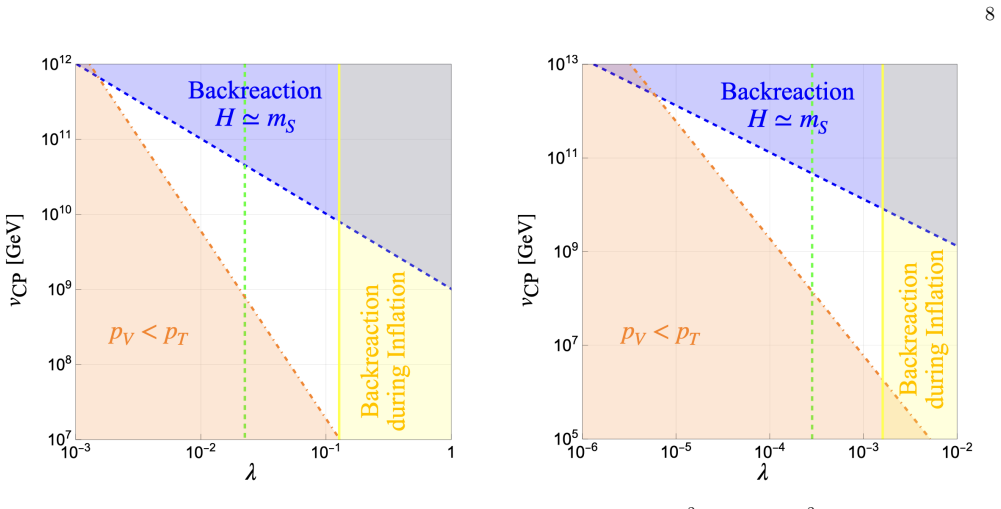
read the original abstract
Spontaneous CP violation (SCPV) provides an attractive solution to the strong CP problem. However, SCPV after inflation suffers from the formation of CP domain walls, requiring the maximal temperature of the Universe to lie below the CP-breaking scale. In the present work, we then propose a dynamical mechanism that removes this cosmological constraint without introducing permanent explicit CPV. We consider a new scalar field that acquires a large field value with a nontrivial phase in the early Universe and induces a transient bias among degenerate CP vacua through a higher-dimensional interaction with a CP-breaking scalar field. This bias triggers the decay of CP domain walls after they form. As the new scalar field evolves toward the origin, the bias disappears, leaving the low-energy CP structure intact. We derive the conditions for successful domain wall decay and identify the viable parameter space. Furthermore, we point out that the coherent oscillation of the new scalar field naturally survives as dark matter, linking the resolution of the CP domain wall problem to the origin of dark matter.
Editorial analysis
A structured set of objections, weighed in public.
Referee Report
Summary. The paper proposes a dynamical mechanism to evade the cosmological domain-wall constraint on spontaneous CP violation (SCPV) after inflation. A new scalar acquires a large early-Universe vev with nontrivial phase and generates a transient bias among degenerate CP vacua via a higher-dimensional operator; this bias triggers domain-wall decay. As the scalar relaxes to the origin the bias vanishes, leaving the low-energy CP structure intact. The coherent oscillations of the same scalar are claimed to constitute dark matter. Conditions for successful decay are derived and viable parameter space is identified.
Significance. If the mechanism is robust, it removes a major obstacle to post-inflationary SCPV without introducing permanent explicit CP violation and simultaneously supplies a dark-matter candidate, thereby linking two longstanding cosmological problems. The explicit derivation of decay conditions and the mapping to viable parameter space would constitute a concrete, falsifiable advance in the SCPV literature.
major comments (2)
- [Abstract, §3] Abstract and §3 (domain-wall bias section): the claim that the bias is 'transient' and disappears without affecting the low-energy CP structure rests on the higher-dimensional operator vanishing as the new scalar reaches the origin. The explicit form of this operator, the resulting effective potential for the CP-breaking field, and the condition that the bias term falls below the wall tension before the walls annihilate are not visible in the provided text; these must be shown to hold for the quoted parameter ranges.
- [§4] §4 (dark-matter abundance): the statement that 'the coherent oscillation of the new scalar field naturally survives as dark matter' requires a calculation of the relic density, including the initial amplitude, the decay rate after the bias phase, and any entropy dilution. No such calculation or comparison to the observed Ω_DM is supplied in the available material.
Simulated Author's Rebuttal
We thank the referee for their thorough review and valuable comments on our manuscript. We address each major comment below and indicate the revisions we plan to make to improve the clarity and completeness of the presentation.
read point-by-point responses
-
Referee: [Abstract, §3] Abstract and §3 (domain-wall bias section): the claim that the bias is 'transient' and disappears without affecting the low-energy CP structure rests on the higher-dimensional operator vanishing as the new scalar reaches the origin. The explicit form of this operator, the resulting effective potential for the CP-breaking field, and the condition that the bias term falls below the wall tension before the walls annihilate are not visible in the provided text; these must be shown to hold for the quoted parameter ranges.
Authors: We acknowledge that the explicit details of the higher-dimensional operator and the derivation of the bias term's evolution should be presented more clearly. In the revised manuscript, we will explicitly state the form of the higher-dimensional operator, derive the resulting effective potential for the CP-breaking field, and demonstrate that the bias term falls below the wall tension prior to annihilation for the parameter ranges discussed in the paper. revision: yes
-
Referee: [§4] §4 (dark-matter abundance): the statement that 'the coherent oscillation of the new scalar field naturally survives as dark matter' requires a calculation of the relic density, including the initial amplitude, the decay rate after the bias phase, and any entropy dilution. No such calculation or comparison to the observed Ω_DM is supplied in the available material.
Authors: We agree that a quantitative calculation of the relic density would strengthen the dark matter claim. While the manuscript qualitatively points out that the oscillations can constitute dark matter, we will add in the revised version a calculation of the relic density, incorporating the initial amplitude, decay rate, possible entropy dilution effects, and a comparison to the observed dark matter abundance within the viable parameter space. revision: yes
Circularity Check
No significant circularity identified
full rationale
The paper is a model-building proposal that introduces a new scalar field acquiring a large early-Universe vev and phase, which sources a transient bias via higher-dimensional operators to trigger CP domain wall decay. The abstract states that conditions for successful decay are derived and viable parameter space is identified from this setup. No load-bearing step reduces the claimed outcome to a fitted input, self-definition, or self-citation chain; the mechanism is presented as independent of the low-energy CP structure it preserves, and the subsequent oscillation as dark matter follows directly as a dynamical consequence without circular renaming or ansatz smuggling.
Axiom & Free-Parameter Ledger
invented entities (1)
-
new scalar field
no independent evidence
Reference graph
Works this paper leans on
-
[1]
Inflation era The essence of our mechanism for CP domain wall de- cay lies in the assumption that the scalarSacquires a large field value during inflation. In this epoch, the to- tal energy density is dominated by the inflaton potential, Vinf ≃3H 2 inf M2 Pl (Hinf is the Hubble parameter during in- flation), which induces a negative mass term forS. The re...
-
[2]
Radiation-domination era The radiation-domination (RD) era follows the infla- tion era. In the present paper, we simply assume the in- stantaneous reheating process, 2 where the temperature after the completion of reheating is given by TRH ∼ 90 π2g∗ 1 4p MPlHinf ≃10 15 GeV Hinf 1012 GeV 1 2 .(6) 2 The intermediate epoch can be dominated by the inflaton os...
-
[3]
C. A. Bakeret al., Phys. Rev. Lett.97, 131801 (2006), arXiv:hep-ex/0602020
Pith/arXiv arXiv 2006
-
[4]
J. M. Pendleburyet al., Phys. Rev. D92, 092003 (2015), arXiv:1509.04411 [hep-ex]
Pith/arXiv arXiv 2015
-
[5]
A. E. Nelson, Phys. Lett. B136, 387 (1984)
1984
-
[6]
S. M. Barr, Phys. Rev. Lett.53, 329 (1984)
1984
-
[7]
S. M. Barr, Phys. Rev. D30, 1805 (1984)
1984
-
[8]
Bento, G
L. Bento, G. C. Branco, and P. A. Parada, Phys. Lett. B267, 95 (1991)
1991
-
[9]
S. M. Barr and G. Segre, Phys. Rev. D48, 302 (1993)
1993
-
[10]
M. Dine, R. G. Leigh, and A. Kagan, Phys. Rev. D48, 2214 (1993), arXiv:hep-ph/9303296
Pith/arXiv arXiv 1993
-
[11]
G. Hiller and M. Schmaltz, Phys. Lett. B514, 263 (2001), arXiv:hep-ph/0105254
Pith/arXiv arXiv 2001
-
[12]
G. Hiller and M. Schmaltz, Phys. Rev. D65, 096009 (2002), arXiv:hep-ph/0201251
Pith/arXiv arXiv 2002
-
[13]
Vecchi, JHEP04, 149 (2017), arXiv:1412.3805 [hep- ph]
L. Vecchi, JHEP04, 149 (2017), arXiv:1412.3805 [hep- ph]
Pith/arXiv arXiv 2017
-
[14]
M. Dine and P. Draper, JHEP08, 132 (2015), arXiv:1506.05433 [hep-ph]
Pith/arXiv arXiv 2015
-
[15]
O. Davidi, R. S. Gupta, G. Perez, D. Redigolo, and A. Shalit, Phys. Rev. D99, 035014 (2019), arXiv:1711.00858 [hep-ph]
Pith/arXiv arXiv 2019
- [16]
- [17]
-
[18]
K. Fujikura, Y. Nakai, R. Sato, and M. Yamada, JHEP 04, 105 (2022), arXiv:2202.08278 [hep-ph]
arXiv 2022
-
[19]
S. Girmohanta, S. J. Lee, Y. Nakai, and M. Suzuki, JHEP12, 024 (2022), arXiv:2203.09002 [hep-ph]
arXiv 2022
- [20]
- [21]
-
[22]
F. Feruglio, A. Strumia, and A. Titov, JHEP07, 027 (2023), arXiv:2305.08908 [hep-ph]
arXiv 2023
-
[23]
M. Dine, G. Perez, W. Ratzinger, and I. Savoray, Phys. Rev. D111, 015049 (2025), arXiv:2405.06744 [hep-ph]
Pith/arXiv arXiv 2025
-
[24]
S. Nakagawa, Y. Nakai, and Y. Wang, JHEP09, 105 (2024), arXiv:2406.01260 [hep-ph]
arXiv 2024
-
[25]
F. Feruglio, M. Parriciatu, A. Strumia, and A. Titov, JHEP08, 214 (2024), arXiv:2406.01689 [hep-ph]
arXiv 2024
- [26]
-
[27]
R. Ferro-Hernandez, S. Morisi, and E. Peinado, Phys. Rev. D111, 073009 (2025), arXiv:2407.18161 [hep-ph]
arXiv 2025
-
[28]
Y. Jiang and N. Yokozaki, Phys. Lett. B862, 139331 (2025), arXiv:2408.13990 [hep-ph]
arXiv 2025
- [29]
- [30]
-
[31]
F. Feruglio, A. Marrone, A. Strumia, and A. Titov, JHEP08, 076 (2025), arXiv:2505.20395 [hep-ph]
arXiv 2025
-
[32]
F. Liu, S. Nakagawa, Y. Nakai, and Y. Wang, JHEP04, 178 (2026), arXiv:2510.23033 [hep-ph]
Pith/arXiv arXiv 2026
-
[33]
Fukugita and T
M. Fukugita and T. Yanagida, Phys. Lett. B174, 45 (1986)
1986
-
[34]
M. Dine, R. G. Leigh, and D. A. MacIntire, Phys. Rev. Lett.69, 2030 (1992), arXiv:hep-th/9205011
Pith/arXiv arXiv 2030
-
[35]
K.-w. Choi, D. B. Kaplan, and A. E. Nelson, Nucl. Phys. B391, 515 (1993), arXiv:hep-ph/9205202
Pith/arXiv arXiv 1993
-
[36]
M. Ibe, S. Kobayashi, M. Suzuki, and T. T. Yanagida, Phys. Rev. D101, 035029 (2020), arXiv:1909.01604 [hep- ph]
arXiv 2020
-
[37]
S. Y. Hao, S. Nakagawa, Y. Nakai, and M. Suzuki, (2025), arXiv:2507.12268 [hep-ph]
arXiv 2025
-
[38]
K. Harigaya, M. Ibe, M. Kawasaki, and T. T. Yanagida, JCAP11, 003 (2015), arXiv:1507.00119 [hep-ph]
Pith/arXiv arXiv 2015
-
[39]
G. R. Dvali and G. Senjanovic, Phys. Rev. Lett.74, 5178 (1995), arXiv:hep-ph/9501387
Pith/arXiv arXiv 1995
-
[40]
G. R. Dvali, A. Melfo, and G. Senjanovic, Phys. Rev. D 54, 7857 (1996), arXiv:hep-ph/9601376
Pith/arXiv arXiv 1996
-
[41]
I. Baldes and G. Servant, JHEP10, 053 (2018), arXiv:1807.08770 [hep-ph]
Pith/arXiv arXiv 2018
-
[42]
A. Glioti, R. Rattazzi, and L. Vecchi, JHEP04, 027 (2019), arXiv:1811.11740 [hep-ph]
Pith/arXiv arXiv 2019
-
[43]
P. Meade and H. Ramani, Phys. Rev. Lett.122, 041802 (2019), arXiv:1807.07578 [hep-ph]
Pith/arXiv arXiv 2019
- [44]
-
[45]
S. Nakagawa, Y. Nakai, Y.-C. Qiu, L. Wang, and Y. Wang, Phys. Lett. B873, 140177 (2026), arXiv:2509.24812 [hep-ph]
arXiv 2026
-
[46]
Coulson, Z
D. Coulson, Z. Lalak, and B. A. Ovrut, Phys. Rev. D 53, 4237 (1996)
1996
-
[47]
S. E. Larsson, S. Sarkar, and P. L. White, Phys. Rev. D 55, 5129 (1997), arXiv:hep-ph/9608319
Pith/arXiv arXiv 1997
-
[48]
Goto and M
T. Goto and M. Yamaguchi, Phys. Lett. B276, 103 (1992)
1992
- [49]
-
[50]
A. G. Cohen and D. B. Kaplan, Phys. Lett. B199, 251 (1987)
1987
-
[51]
A. De Simone and T. Kobayashi, JCAP08, 052 (2016), arXiv:1605.00670 [hep-ph]
Pith/arXiv arXiv 2016
-
[52]
R. Daido, N. Kitajima, and F. Takahashi, JCAP07, 046 (2015), arXiv:1504.07917 [hep-ph]
Pith/arXiv arXiv 2015
-
[53]
A. Mariotti, X. Nagels, A. Rase, and M. Vanvlasselaer, JHEP03, 199 (2025), arXiv:2411.13494 [hep-ph]
arXiv 2025
discussion (0)
Sign in with ORCID, Apple, or X to comment. Anyone can read and Pith papers without signing in.