REVIEW 4 major objections 5 minor 69 references
DeSPITE: Exploring Contrastive Deep Skeleton-Pointcloud-IMU-Text Embeddings for Advanced Point Cloud Human Activity Understanding
T0 review · 4 major / 5 minor · reviewed 2026-08-07 · deepseek-v4-flash
Pith's one-line read This paper argues that LiDAR point clouds can replace RGB as the binding visual modality in multi-modal contrastive learning, enabling cross-modal matching, temporal moment retrieval, and state-of-the-art point cloud human activity…
desk verdict DeSPITE delivers a genuinely novel LiDAR-centric multi-modal embedding and a useful new dataset, but the SOTA claims are overstated and the text-binding rests on a qualitative alignment check. read the letter →
The pith
A machine-rendered reading of the paper's core claim, the machinery that carries it, and where it could break.
The reading
What carries the argument
The load-bearing object is the multi-modal contrastive training loop over LIPD-Babel. Four encoders, a point spatio-temporal transformer for point clouds, an LSTM for IMU, a transformer-based skeleton encoder, and a frozen language-image text encoder, produce embeddings for 24-frame windows. A symmetric InfoNCE loss is applied to all modality pairs among point cloud, skeleton, and IMU, with a masked text-binding term that only acts on batch elements that carry Babel labels. The dataset itself is the second piece of machinery: LIPD-Babel aligns LIPD's 10 FPS point cloud, skeleton, and IMU sequences to Babel's 30 FPS text labels by downsampling to 10 FPS, with sequence IDs from AMASS used to make the correspondence.
What would settle it
Take a random sample of LIPD-Babel sequences, compute a pose-similarity metric between the LIPD skeleton frames and the corresponding downsampled Babel skeleton frames at every time index, and measure the offset that maximizes agreement; if the median optimal offset is more than one frame from zero, the synchronization is wrong and the retrieval and HAR results would not be reproducible.
Extended reading notes
Core claim
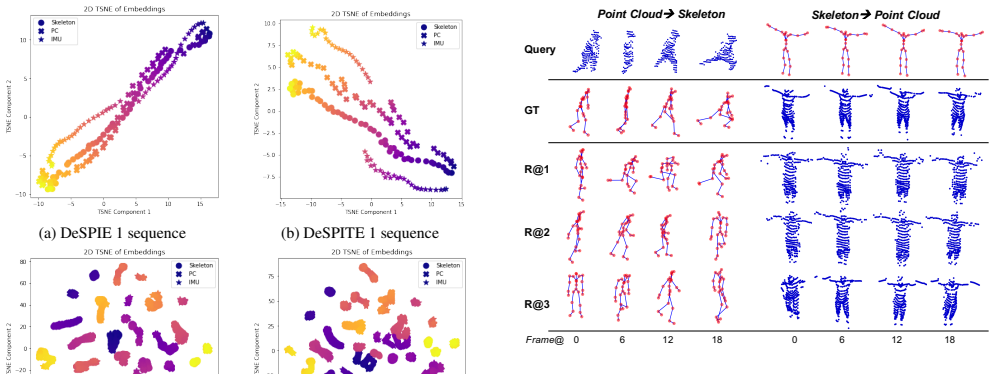
The paper's central claim is that the natural correspondence between LiDAR point clouds, human skeletons, and IMU readings, which are recordings of the same body motion from different sensors, is enough to learn a joint embedding space without RGB images, and that adding text labels makes that space more semantically organized. Trained contrastively on paired 24-frame windows, the encoders map each modality to a shared 512-dimensional space where matched motion snippets have high cosine similarity and mismatched ones are pushed apart. The result is that a query in any one modality can retrieve the same moment or the same person in any other modality, and the learned representations transfer to single-modality HAR. The authors also report that text guidance helps downstream HAR but slightly hurts matching and temporal moment retrieval compared to text-free variants.
Load-bearing premise
The load-bearing premise is that LIPD's 10 FPS point cloud, skeleton, and IMU frames line up with Babel's text labels after downsampling the text to 10 FPS, a synchronization the paper verifies only by visually inspecting skeleton poses.
Editorial extensions
If this is right
- Cross-modal matching: an IMU snippet can identify the correct person in a multi-person LiDAR scene, and skeleton snippets can do the same, which the authors frame as a privacy-preserving re-identification primitive.
- Temporal moment retrieval: a short IMU, skeleton, or point cloud query can locate the matching moment inside a long point cloud sequence, with recall measured within about 1.5 seconds of ground truth.
- Pre-training for HAR: fine-tuning a point cloud HAR model from DeSPITE-style embeddings outperforms prior uni-modal pre-training and supervised methods on MSR-Action3D and HMPEAR, despite domain shift in point density and sensor type.
- Text as a partial binder: text labels improve downstream HAR fine-tuning, while models trained without text give better matching and moment retrieval, so the two objectives are not equally served by the same loss weighting.
Reading between the lines
- A natural next step the paper leaves implicit: the same contrastive recipe should be testable with real LiDAR human activity data beyond LIPD, such as HMPEAR or future outdoor captures, to show whether the synthetic-to-real domain shift is handled by the embedding itself or only by downstream fine-tuning.
- Because text-free variants win on matching and moment retrieval, one can expect a two-stage design, train a text-free alignment first and then distill text semantics only into the downstream classifier, to get both properties at once; the paper does not explore this.
- The masking of unlabeled batch elements means the method can scale to large unlabeled LiDAR plus IMU plus skeleton corpora with only sparse text annotations, so extending LIPD-Babel with additional unlabeled sequences should continue improving the sensor-side alignment even without new text.
Editorial analysis
A structured set of objections, weighed in public.
Referee Report
Summary. DeSPITE combines the LIPD LiDAR point-cloud/IMU/skeleton dataset with BABEL text annotations to construct 'LIPD-Babel' (v1 for matching/retrieval, v2 for HAR), and trains modality encoders (PST-Transformer for point clouds, LSTM for IMU, ACTOR for skeletons, frozen CLIP for text) with an InfoNCE-style contrastive loss, masking text when unavailable. The paper evaluates many modality subsets (DeSPITE, DeSPIE, DePITE, etc.) on three tasks: (1) multi-person cross-modal matching among point cloud, IMU, and skeleton, (2) temporal moment retrieval across modalities, and (3) pre-training for point cloud HAR on MSR-Action3D, HMPEAR, and LIPD-Babel-v2. The central findings are that matching and retrieval are learned effectively on held-out LIPD, TC, and DIP test sets; text-trained variants perform worse than text-free variants on matching and retrieval; and contrastive pre-training improves HAR fine-tuning, with claims of new state-of-the-art results on HMPEAR and MSR-Action3D. The paper also reports text-to-motion retrieval compared with TMR++ and qualitative retrieval examples from AMASS and LIPD.
Significance. If the results hold, the paper's core contribution is substantial: it establishes LiDAR point clouds as a viable privacy-preserving visual anchor for multi-modal contrastive pre-training, demonstrates novel cross-modal tasks (LiDAR-IMU and LiDAR-skeleton matching and retrieval), and provides a reusable evaluation suite based on LIPD-Babel. The matching and retrieval claims rest on externally held-out test sets (TC, DIP, and LIPD test), so the central embedding claim is empirically grounded and not circular. Strengths include the unusually honest finding that text alignment hurts matching/retrieval, the extensive per-modality ablations in Tables 6-8, and the clearly specified artificial multi-person scene protocol. However, the text-binding results depend on a dataset alignment that is verified only qualitatively, the SOTA claims overstate what Table 1 and the HMPEAR protocol support, and the self-authored LIPD-Babel-v2 split needs clarification regarding possible train/test leakage. The paper does not yet ship code or data, so reproducibility rests on the promised release.
major comments (4)
- [Supplementary Section 6; Eq. (4); Table 5] The temporal alignment between LIPD (10 FPS) and BABEL (30 FPS, downsampled) is verified only "qualitatively ... by plotting them next to each other" (Supplementary Section 6). Sub-frame or phase misalignment would corrupt the text-binding loss in Eq. (4), the text-to-motion retrieval results in Table 5, and the HAR gains attributed to text in Table 3, and the paper itself asserts this limitation. Please add a quantitative alignment check, e.g., per-sequence pose similarity between LIPD skeletons and downsampled BABEL skeletons, or a frame-offset search whose offset distribution is reported; a constant per-sequence offset is enough to invalidate the text pathway. Note that the point-cloud/skeleton/IMU matching and retrieval results do not depend on text alignment and would survive such a failure, so the fix is local to the text-related claims.
- [§1 (Contributions) and §5; Table 1] The manuscript claims "new state-of-the-art performance" on MSR-Action3D, but Table 1 reports KAN-HyperpointNet at 95.59, above DeSPITE's 95.47, and §4.6 itself concedes the method "nearly matches" that number. Please restrict the claim to "state of the art among pre-training methods," correct the statements in §1 and §5, and add the missing comparison to the table or explain why supervised-only methods are excluded from the SOTA claim.
- [§4.6; Table 2] The HMPEAR comparison is not apples-to-apples: the authors acknowledge in §4.6 that their setup "uses twice the frames of previous methods," yet Table 2 still reports the comparison as new SOTA against methods evaluated with shorter windows. Please report a 12-frame variant (or otherwise control for window length) so that the improvement over PEAR-Proj and PST-Transformer is not an artifact of longer temporal context.
- [§4.1; Supplementary Section 6; Table 3] For LIPD-Babel-v2, the test set is BABEL's validation split, and the paper states that "all the remaining data of LIPD" is added to the training set. Since LIPD contains the same AMASS sequences (ACCAD, BML-Movi, CMU, TC) that BABEL annotates, it must be clarified whether the LIPD copies of BABEL validation sequences were excluded from training; as written, the test set may leak into the training set, which would inflate the fine-tuning numbers in Table 3. Please specify the exclusion rule explicitly and re-split if necessary.
minor comments (5)
- [§4.1 vs. Table 4] The main text states that 85,551 training windows have text annotations in LIPD-Babel-v1, but Table 4 reports #Text Train = 187,641; please reconcile these numbers.
- [Tables 1-3; Figures 2-3] Results are reported without error bars or standard deviations; given the small margins (e.g., 95.47 vs. 95.59 on MSR-Action3D), reporting variance over at least a few seeds or scene-sampling runs would strengthen the claims.
- [Tables 1-2 captions] The dagger (†) used to mark PST-Transformer entries is never defined in the captions; please state what it denotes.
- [§4.8; Supplementary Section 6] There are minor typos, including "T o better assess" in §4.8 and "combning" in Supplementary Section 6; a proofreading pass is recommended.
- [§1 (Contributions)] The contribution statement promises release of pre-trained encoders, code, and data; a repository URL or release footnote would help reviewers and future users verify the claims.
Circularity Check
No significant circularity: matching, retrieval, and HAR results are evaluated on held-out and external benchmarks, and no prediction reduces to a fitted input by construction.
full rationale
The paper's central claim is empirical: a joint embedding space is learned with InfoNCE-style contrastive losses (Eqs. 2-6) over paired LIPD-Babel sequences, and the claimed outcomes are matching accuracies, recall@k scores, and HAR accuracies computed after training. Matching and temporal moment retrieval are evaluated on the held-out LIPD test set, TotalCapture, and DIP (Sections 4.4-4.5), none of which supply fitted values to the reported numbers. HAR claims are tested on HMPEAR and MSR-Action3D (Tables 1-2), which are external benchmarks with domain shifts, and on the LIPD-Babel-v2 validation split used only for fine-tuning. No fitted parameter is renamed as a prediction: the CLIP text encoder is frozen, and the text loss is masked on batch elements without text pairings (Eq. 4), so text-to-modality retrieval is not forced by construction. The closest same-source element is that LIPD-Babel-v2 HAR labels and the text pre-training signal both derive from Babel annotations; however, the text signal is vocabulary-level, the HAR evaluation uses a disjoint validation split, and the main SOTA claims rest on external datasets, so this is a transfer consideration rather than a circular reduction. The supplementary's qualitative-only check of LIPD-Babel temporal alignment (Supp. Section 6) is a correctness risk, not circularity: a misalignment would invalidate the data, but no equation in the paper equates the claimed output to its input. There are no load-bearing self-citations and no imported uniqueness theorems; the derivation is self-contained against external benchmarks.
Assumptions & free parameters
free parameters (4)
- Temperature tau in InfoNCE =
learned, final value not reported
- Loss weights alpha and beta =
0.5 and 0.5
- Sliding window length =
24 frames at 10 FPS
- Point subsampling counts =
256 (pretrain), 1024 (HMPEAR), 2048 (MSR-Action3D)
assumptions (5)
- standard math InfoNCE with cosine similarity is a valid objective for aligning semantically paired sequences across modalities.
- domain assumption A frozen CLIP text encoder defines a suitable semantic anchor for human activity language.
- domain assumption Babel's 30 FPS activity annotations remain correctly synchronized with LIPD after downsampling to 10 FPS.
- domain assumption Synthetic point clouds and IMU signals generated by LIPD from AMASS SMPL poses inherit the activity semantics of the AMASS-derived Babel labels.
- domain assumption Artificial multi-person scenes formed by sampling single-person sequences are a valid proxy for real multi-person matching.
invented entities (1)
-
LIPD-Babel dataset
Cite this review
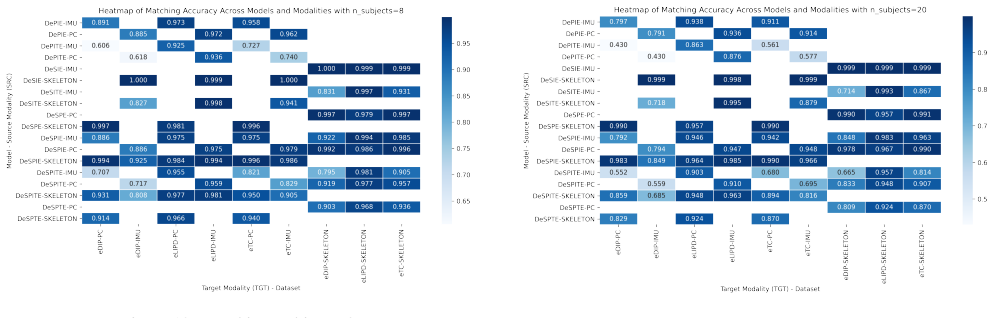
Pith. "Pith review of DeSPITE: Exploring Contrastive Deep Skeleton-Pointcloud-IMU-Text Embeddings for Advanced Point Cloud Human Activity Understanding." pith.science (2026). https://pith.science/paper/YVJCDENC
@misc{pith2026250613897,
  author       = {Pith},
  title        = {Pith review of: DeSPITE: Exploring Contrastive Deep Skeleton-Pointcloud-IMU-Text Embeddings for Advanced Point Cloud Human Activity Understanding},
  year         = {2026},
  howpublished = {\url{https://pith.science/paper/YVJCDENC}},
  note         = {Machine review of arXiv:2506.13897}
}
read the original abstract
Despite LiDAR (Light Detection and Ranging) being an effective privacy-preserving alternative to RGB cameras to perceive human activities, it remains largely underexplored in the context of multi-modal contrastive pre-training for human activity understanding (e.g., human activity recognition (HAR), retrieval, or person re-identification (RE-ID)). To close this gap, our work explores learning the correspondence between LiDAR point clouds, human skeleton poses, IMU data, and text in a joint embedding space. More specifically, we present DeSPITE, a Deep Skeleton-Pointcloud-IMU-Text Embedding model, which effectively learns a joint embedding space across these four modalities. At the heart of our empirical exploration, we have combined the existing LIPD and Babel datasets, which enabled us to synchronize data of all four modalities, allowing us to explore the learning of a new joint embedding space. Our experiments demonstrate novel human activity understanding tasks for point cloud sequences enabled through DeSPITE, including Skeleton<->Pointcloud<->IMU matching, retrieval, and temporal moment retrieval. Furthermore, we show that DeSPITE is an effective pre-training strategy for point cloud HAR through experiments in MSR-Action3D and HMPEAR.
Figures


Figures from the paper (11 more)




Reference graph
Works this paper leans on
-
[1]
Simultaneous real-time human fall detection and reidentification based on multisensors data
Matteo Bastico, Ver ´onica Ruiz Bejerano, and Alberto Belmonte-Hern´andez. Simultaneous real-time human fall detection and reidentification based on multisensors data. In Proceedings of the 15th International Conference on PErva- sive Technologies Related to Assistive Environments , pages 365–370, 2022. 1, 3
work page 2022
-
[2]
A cross- dataset study for text-based 3d human motion retrieval
L ´eore Bensabath, Mathis Petrovich, and Gul Varol. A cross- dataset study for text-based 3d human motion retrieval. In Proceedings of the IEEE/CVF Conference on Computer Vi- sion and Pattern Recognition, pages 1932–1940, 2024. 2
work page 1932
-
[3]
Is space-time attention all you need for video understanding? In ICML, page 4, 2021
Gedas Bertasius, Heng Wang, and Lorenzo Torresani. Is space-time attention all you need for video understanding? In ICML, page 4, 2021. 7
2021
-
[4]
Bryan Bo Cao, Abrar Alali, Hansi Liu, Nicholas Meegan, Marco Gruteser, Kristin Dana, Ashwin Ashok, and Shub- ham Jain. Vitag: Online wifi fine time measurements aided vision-motion identity association in multi-person environ- ments. In 2022 19th Annual IEEE International Conference on Sensing, Communication, and Networking (SECON) , pages 19–27. IEEE, 2022. 1, 3
work page 2022
-
[5]
Quo vadis, action recognition? a new model and the kinetics dataset
Joao Carreira and Andrew Zisserman. Quo vadis, action recognition? a new model and the kinetics dataset. In pro- ceedings of the IEEE Conference on Computer Vision and Pattern Recognition, pages 6299–6308, 2017. 7
2017
-
[6]
A simple framework for contrastive learning of visual representations
Ting Chen, Simon Kornblith, Mohammad Norouzi, and Ge- offrey Hinton. A simple framework for contrastive learning of visual representations. In International conference on ma- chine learning, pages 1597–1607. PmLR, 2020. 5
2020
-
[7]
KAN-HyperpointNet for Point Cloud Sequence-Based 3D Human Action Recognition
Zhaoyu Chen, Xing Li, Qian Huang, Qiang Geng, Tianjin Yang, and Shihao Han. Kan-hyperpointnet for point cloud sequence-based 3d human action recognition. arXiv preprint arXiv:2409.09444, 2024. 6, 7
work page Pith review arXiv 2024
-
[8]
Advancing multi-modal sens- ing through expandable modality alignment
Shenghong Dai, Shiqi Jiang, Yifan Yang, Ting Cao, Mo Li, Suman Banerjee, and Lili Qiu. Advancing multi-modal sens- ing through expandable modality alignment. arXiv preprint arXiv:2407.17777, 2024. 1, 2, 3
arXiv 2024
Show all 69 references
-
[9]
Bert: Pre-training of deep bidirectional trans- formers for language understanding
Jacob Devlin, Ming-Wei Chang, Kenton Lee, and Kristina Toutanova. Bert: Pre-training of deep bidirectional trans- formers for language understanding. In Proceedings of the 2019 conference of the North American chapter of the asso- ciation for computational linguistics: human l...
2019
-
[10]
Point 4d trans- former networks for spatio-temporal modeling in point cloud videos
Hehe Fan, Yi Yang, and Mohan Kankanhalli. Point 4d trans- former networks for spatio-temporal modeling in point cloud videos. In Proceedings of the IEEE/CVF conference on com- puter vision and pattern recognition , pages 14204–14213,
-
[11]
Pstnet: Point spatio-temporal convolution on point cloud sequences
Hehe Fan, Xin Yu, Yuhang Ding, Yi Yang, and Mohan Kankanhalli. Pstnet: Point spatio-temporal convolution on point cloud sequences. In International Conference on Learning Representations, 2021. 7
2021
-
[12]
Deep hierarchical representation of point cloud videos via spatio-temporal decomposition
Hehe Fan, Xin Yu, Yi Yang, and Mohan Kankanhalli. Deep hierarchical representation of point cloud videos via spatio-temporal decomposition. IEEE Transactions on Pat- tern Analysis and Machine Intelligence , 44(12):9918–9930,
-
[13]
Point spatio- temporal transformer networks for point cloud video mod- eling
Hehe Fan, Yi Yang, and Mohan Kankanhalli. Point spatio- temporal transformer networks for point cloud video mod- eling. IEEE Transactions on Pattern Analysis and Machine Intelligence, 45(2):2181–2192, 2022. 5, 7
2022
-
[14]
Slowfast networks for video recognition
Christoph Feichtenhofer, Haoqi Fan, Jitendra Malik, and Kaiming He. Slowfast networks for video recognition. In Proceedings of the IEEE/CVF international conference on computer vision, pages 6202–6211, 2019. 7
2019
-
[15]
Imagebind: One embedding space to bind them all
Rohit Girdhar, Alaaeldin El-Nouby, Zhuang Liu, Mannat Singh, Kalyan Vasudev Alwala, Armand Joulin, and Ishan Misra. Imagebind: One embedding space to bind them all. In Proceedings of the IEEE/CVF conference on computer vi- sion and pattern recognition, pages 15180–15190, 2023....
2023
-
[16]
Generating diverse and natural 3d human motions from text
Chuan Guo, Shihao Zou, Xinxin Zuo, Sen Wang, Wei Ji, Xingyu Li, and Li Cheng. Generating diverse and natural 3d human motions from text. In Proceedings of the IEEE/CVF Conference on Computer Vision and Pattern Recognition (CVPR), pages 5152–5161, 2022. 3
2022
-
[17]
Separating the” chirp” from the” chat”: Self-supervised visual grounding of sound and language
Mark Hamilton, Andrew Zisserman, John R Hershey, and William T Freeman. Separating the” chirp” from the” chat”: Self-supervised visual grounding of sound and language. In Proceedings of the IEEE/CVF conference on computer vi- sion and pattern recognition, pages 13117–13127, 2024. 3
2024
-
[18]
Masked motion prediction with semantic contrast for point cloud sequence learning
Yuehui Han, Can Xu, Rui Xu, Jianjun Qian, and Jin Xie. Masked motion prediction with semantic contrast for point cloud sequence learning. In European Conference on Com- puter Vision, pages 414–431. Springer, 2024. 3, 7
2024
-
[19]
Long short-term memory
Sepp Hochreiter and J ¨urgen Schmidhuber. Long short-term memory. Neural computation, 9(8):1735–1780, 1997. 5, 7
1997
-
[20]
Wifi and vision-integrated fingerprint for smartphone-based self-localization in public indoor scenes
Gang Huang, Zhaozheng Hu, Jie Wu, Hanbiao Xiao, and Fan Zhang. Wifi and vision-integrated fingerprint for smartphone-based self-localization in public indoor scenes. IEEE Internet of Things Journal, 7(8):6748–6761, 2020. 1
2020
-
[21]
Deep iner- tial poser: Learning to reconstruct human pose from sparse inertial measurements in real time
Yinghao Huang, Manuel Kaufmann, Emre Aksan, Michael J Black, Otmar Hilliges, and Gerard Pons-Moll. Deep iner- tial poser: Learning to reconstruct human pose from sparse inertial measurements in real time. ACM Transactions on Graphics (TOG), 37(6):1–15, 2018. 4, 1
2018
-
[22]
Adam: A method for stochastic optimization
Diederik P Kingma and Jimmy Ba. Adam: A method for stochastic optimization. arXiv preprint arXiv:1412.6980 ,
-
[23]
Coopera- tive learning of audio and video models from self-supervised synchronization
Bruno Korbar, Du Tran, and Lorenzo Torresani. Coopera- tive learning of audio and video models from self-supervised synchronization. Advances in Neural Information Process- ing Systems, 31, 2018. 3
2018
-
[24]
Li- darcap: Long-range marker-less 3d human motion capture with lidar point clouds
Jialian Li, Jingyi Zhang, Zhiyong Wang, Siqi Shen, Chenglu Wen, Yuexin Ma, Lan Xu, Jingyi Yu, and Cheng Wang. Li- darcap: Long-range marker-less 3d human motion capture with lidar point clouds. In Proceedings of the IEEE/CVF conference on computer vision and pattern recognitio...
2022
-
[25]
Uniformer: Unified transformer for efficient spatiotemporal representation learning
Kunchang Li, Yali Wang, Peng Gao, Guanglu Song, Yu Liu, Hongsheng Li, and Yu Qiao. Uniformer: Unified transformer for efficient spatiotemporal representation learning. arXiv preprint arXiv:2201.04676, 2022. 7 9
2022 arXiv
-
[26]
Ai choreographer: Music conditioned 3d dance generation with aist++
Ruilong Li, Shan Yang, David A Ross, and Angjoo Kanazawa. Ai choreographer: Music conditioned 3d dance generation with aist++. In Proceedings of the IEEE/CVF international conference on computer vision , pages 13401– 13412, 2021. 1
2021
-
[27]
Action recognition based on a bag of 3d points
Wanqing Li, Zhengyou Zhang, and Zicheng Liu. Action recognition based on a bag of 3d points. In 2010 IEEE computer society conference on computer vision and pattern recognition-workshops, pages 9–14. IEEE, 2010. 2, 3, 4
2010
-
[28]
En- hancing person identification for smart cities: Fusion of video surveillance and wearable device data based on ma- chine learning
Jia-Ming Liang, Shashank Mishra, and Chun-Che Wu. En- hancing person identification for smart cities: Fusion of video surveillance and wearable device data based on ma- chine learning. IEEE Sensors Journal, 2024. 3
2024
-
[29]
Hm- pear: A dataset for human pose estimation and action recog- nition
Yitai Lin, Zhijie Wei, Wanfa Zhang, Xiping Lin, Yudi Dai, Chenglu Wen, Siqi Shen, Lan Xu, and Cheng Wang. Hm- pear: A dataset for human pose estimation and action recog- nition. In Proceedings of the 32nd ACM International Con- ference on Multimedia, pages 2069–2078, 2024. 1, ...
2024
-
[30]
Ntu rgb+d 120: A large- scale benchmark for 3d human activity understanding
Jun Liu, Amir Shahroudy, Mauricio Perez, Gang Wang, Ling-Yu Duan, and Alex C Kot. Ntu rgb+d 120: A large- scale benchmark for 3d human activity understanding. IEEE Transactions on Pattern Analysis and Machine Intelligence, 42(10):2684–2701, 2020. 3
2020
-
[31]
Mamba4d: Efficient long-sequence point cloud video understanding with disentangled spatial-temporal state space models
Jiuming Liu, Jinru Han, Lihao Liu, Angelica I Aviles-Rivero, Chaokang Jiang, Zhe Liu, and Hesheng Wang. Mamba4d: Efficient long-sequence point cloud video understanding with disentangled spatial-temporal state space models. arXiv preprint arXiv:2405.14338, 2024. 6, 7
2024 arXiv
-
[32]
Meteor- net: Deep learning on dynamic 3d point cloud sequences
Xingyu Liu, Mengyuan Yan, and Jeannette Bohg. Meteor- net: Deep learning on dynamic 3d point cloud sequences. In Proceedings of the IEEE/CVF International Conference on Computer Vision, pages 9246–9255, 2019. 7
2019
-
[33]
Leaf: Learning frames for 4d point cloud sequence un- derstanding
Yunze Liu, Junyu Chen, Zekai Zhang, Jingwei Huang, and Li Yi. Leaf: Learning frames for 4d point cloud sequence un- derstanding. In Proceedings of the IEEE/CVF International Conference on Computer Vision, pages 604–613, 2023. 7
2023
-
[34]
Smpl: A skinned multi- person linear model
Matthew Loper, Naureen Mahmood, Javier Romero, Gerard Pons-Moll, and Michael J Black. Smpl: A skinned multi- person linear model. In Seminal Graphics Papers: Pushing the Boundaries, Volume 2, pages 851–866. 2023. 1
2023
-
[35]
Cross- modal contrastive pre-training for few-shot skeleton action recognition
Mingqi Lu, Siyuan Yang, Xiaobo Lu, and Jun Liu. Cross- modal contrastive pre-training for few-shot skeleton action recognition. IEEE Transactions on Circuits and Systems for Video Technology, 2024. 3
2024
-
[36]
Troje, Ger- ard Pons-Moll, and Michael J
Naureen Mahmood, Nima Ghorbani, Nikolaus F. Troje, Ger- ard Pons-Moll, and Michael J. Black. AMASS: Archive of motion capture as surface shapes. In International Confer- ence on Computer Vision, pages 5442–5451, 2019. 3, 4, 1
2019
-
[37]
Who goes there? exploiting silhouettes and wearable signals for subject identification in multi-person environments
Alessandro Masullo, Tilo Burghardt, Dima Damen, Toby Perrett, and Majid Mirmehdi. Who goes there? exploiting silhouettes and wearable signals for subject identification in multi-person environments. InProceedings of the IEEE/CVF International Conference on Computer Vision Work...
2019
-
[38]
Person re-id by fusion of video silhouettes and wearable signals for home monitoring appli- cations
Alessandro Masullo, Tilo Burghardt, Dima Damen, Toby Perrett, and Majid Mirmehdi. Person re-id by fusion of video silhouettes and wearable signals for home monitoring appli- cations. Sensors, 20(9):2576, 2020. 1, 3
2020
-
[39]
Imu2clip: Language-grounded motion sensor translation with multi- modal contrastive learning
Seungwhan Moon, Andrea Madotto, Zhaojiang Lin, Apara- jita Saraf, Amy Bearman, and Babak Damavandi. Imu2clip: Language-grounded motion sensor translation with multi- modal contrastive learning. In Findings of the Association for Computational Linguistics: EMNLP 2023, pages 132...
2023
-
[40]
Person tracking by fusing pos- ture data from uav video and wearable sensors.IEEE Sensors Journal, 22(24):24150–24160, 2022
Alisher Mukashev, Lan-Da Van, Susanta Sharma, M Farhan Tandia, and Yu-Chee Tseng. Person tracking by fusing pos- ture data from uav video and wearable sensors.IEEE Sensors Journal, 22(24):24150–24160, 2022. 5
2022
-
[41]
Repre- sentation learning with contrastive predictive coding
Aaron van den Oord, Yazhe Li, and Oriol Vinyals. Repre- sentation learning with contrastive predictive coding. arXiv preprint arXiv:1807.03748, 2018. 1, 3, 4
2018 arXiv
-
[42]
Dinov2: Learning robust visual features without supervision
Maxime Oquab, Timoth ´ee Darcet, Th ´eo Moutakanni, Huy V o, Marc Szafraniec, Vasil Khalidov, Pierre Fernandez, Daniel Haziza, Francisco Massa, Alaaeldin El-Nouby, et al. Dinov2: Learning robust visual features without supervision. arXiv preprint arXiv:2304.07193, 2023. 2
2023 arXiv
-
[43]
Action- conditioned 3d human motion synthesis with transformer vae
Mathis Petrovich, Michael J Black, and G ¨ul Varol. Action- conditioned 3d human motion synthesis with transformer vae. In Proceedings of the IEEE/CVF International Con- ference on Computer Vision, pages 10985–10995, 2021. 5, 7
2021
-
[44]
Tmr: Text-to-motion retrieval using contrastive 3d human motion synthesis
Mathis Petrovich, Michael J Black, and G ¨ul Varol. Tmr: Text-to-motion retrieval using contrastive 3d human motion synthesis. In Proceedings of the IEEE/CVF International Conference on Computer Vision, pages 9488–9497, 2023. 3, 5
2023
-
[45]
Punnakkal, Arjun Chandrasekaran, Nikos Athanasiou, Alejandra Quiros-Ramirez, and Michael J
Abhinanda R. Punnakkal, Arjun Chandrasekaran, Nikos Athanasiou, Alejandra Quiros-Ramirez, and Michael J. Black. BABEL: Bodies, action and behavior with english labels. In Proceedings IEEE/CVF Conf. on Computer Vision and Pattern Recognition (CVPR), pages 722–731, 2021. 2, 3, 4, 1
2021
-
[46]
Learning transferable visual models from natural language supervi- sion
Alec Radford, Jong Wook Kim, Chris Hallacy, Aditya Ramesh, Gabriel Goh, Sandhini Agarwal, Girish Sastry, Amanda Askell, Pamela Mishkin, Jack Clark, et al. Learning transferable visual models from natural language supervi- sion. In International conference on machine learning, ...
2021
-
[47]
Sam 2: Segment anything in images and videos
Nikhila Ravi, Valentin Gabeur, Yuan-Ting Hu, Ronghang Hu, Chaitanya Ryali, Tengyu Ma, Haitham Khedr, Roman R¨adle, Chloe Rolland, Laura Gustafson, Eric Mintun, Junt- ing Pan, Kalyan Vasudev Alwala, Nicolas Carion, Chao- Yuan Wu, Ross Girshick, Piotr Doll´ar, and Christoph Feic...
2024 arXiv
-
[48]
Lidar-aid inertial poser: Large-scale human motion capture by sparse inertial and lidar sensors
Yiming Ren, Chengfeng Zhao, Yannan He, Peishan Cong, Han Liang, Jingyi Yu, Lan Xu, and Yuexin Ma. Lidar-aid inertial poser: Large-scale human motion capture by sparse inertial and lidar sensors. IEEE Transactions on Visualiza- tion and Computer Graphics, 29(5):2337–2347, 2023....
2023
-
[49]
An overview of gradient descent optimiza- tion algorithms
Sebastian Ruder. An overview of gradient descent optimiza- tion algorithms. arXiv preprint arXiv:1609.04747, 2016. 5 10
2016 arXiv
-
[50]
Ntu rgb+d: A large scale dataset for 3d human activity anal- ysis
Amir Shahroudy, Jun Liu, Tian-Tsong Ng, and Gang Wang. Ntu rgb+d: A large scale dataset for 3d human activity anal- ysis. In Proceedings of the IEEE conference on computer vision and pattern recognition, pages 1010–1019, 2016. 3
2016
-
[51]
Masked spatio-temporal structure prediction for self- supervised learning on point cloud videos
Zhiqiang Shen, Xiaoxiao Sheng, Hehe Fan, Longguang Wang, Yulan Guo, Qiong Liu, Hao Wen, and Xi Zhou. Masked spatio-temporal structure prediction for self- supervised learning on point cloud videos. In Proceedings of the IEEE/CVF International Conference on Computer Vi- sion, p...
2023
-
[52]
Pointcmp: Contrastive mask prediction for self-supervised learning on point cloud videos
Zhiqiang Shen, Xiaoxiao Sheng, Longguang Wang, Yulan Guo, Qiong Liu, and Xi Zhou. Pointcmp: Contrastive mask prediction for self-supervised learning on point cloud videos. In Proceedings of the IEEE/CVF Conference on Computer Vision and Pattern Recognition, pages 1212–1222, 2023. 3, 7
2023
-
[53]
Point contrastive predic- tion with semantic clustering for self-supervised learning on point cloud videos
Xiaoxiao Sheng, Zhiqiang Shen, Gang Xiao, Longguang Wang, Yulan Guo, and Hehe Fan. Point contrastive predic- tion with semantic clustering for self-supervised learning on point cloud videos. InProceedings of the IEEE/CVF Interna- tional Conference on Computer Vision, pages 165...
-
[54]
Motionclip: Exposing human motion generation to clip space
Guy Tevet, Brian Gordon, Amir Hertz, Amit H Bermano, and Daniel Cohen-Or. Motionclip: Exposing human motion generation to clip space. In European Conference on Com- puter Vision, pages 358–374. Springer, 2022. 1, 2, 3, 4
2022
-
[55]
Total capture: 3d human pose estimation fusing video and inertial sensors
Matthew Trumble, Andrew Gilbert, Charles Malleson, Adrian Hilton, and John Collomosse. Total capture: 3d human pose estimation fusing video and inertial sensors. In Proceedings of 28th British Machine Vision Conference , pages 1–13, 2017. 4, 1
2017
-
[56]
Visualizing data using t-sne
Laurens Van der Maaten and Geoffrey Hinton. Visualizing data using t-sne. Journal of machine learning research , 9 (11), 2008. 7
2008
-
[57]
Recovering accurate 3d human pose in the wild using imus and a moving camera
Timo von Marcard, Roberto Henschel, Michael Black, Bodo Rosenhahn, and Gerard Pons-Moll. Recovering accurate 3d human pose in the wild using imus and a moving camera. In European Conference on Computer Vision (ECCV), 2018. 1, 3
2018
-
[58]
Self-supervised 4d spatio-temporal feature learning via order prediction of sequential point cloud clips
Haiyan Wang, Liang Yang, Xuejian Rong, Jinglun Feng, and Yingli Tian. Self-supervised 4d spatio-temporal feature learning via order prediction of sequential point cloud clips. In Proceedings of the IEEE/CVF Winter Conference on Ap- plications of Computer Vision, pages 3762–377...
2021
-
[59]
Pvnext: Rethinking network design and temporal motion for point cloud video recognition
Jie Wang, Tingfa Xu, Lihe Ding, Xinjie Zhang, Long Bai, and Jianan Li. Pvnext: Rethinking network design and temporal motion for point cloud video recognition. In The Thirteenth International Conference on Learning Represen- tations. 6, 7
-
[60]
Point primitive transformer for long-term 4d point cloud video understanding
Hao Wen, Yunze Liu, Jingwei Huang, Bo Duan, and Li Yi. Point primitive transformer for long-term 4d point cloud video understanding. In European Conference on Computer Vision, pages 19–35. Springer, 2022. 7
2022
-
[61]
Human-centric scene understanding for 3d large-scale scenarios
Yiteng Xu, Peishan Cong, Yichen Yao, Runnan Chen, Yue- nan Hou, Xinge Zhu, Xuming He, Jingyi Yu, and Yuexin Ma. Human-centric scene understanding for 3d large-scale scenarios. In Proceedings of the IEEE/CVF International Conference on Computer Vision, pages 20349–20359, 2023. 1, 3
2023
-
[62]
Mm-fi: Multi-modal non-intrusive 4d human dataset for versatile wireless sensing
Jianfei Yang, He Huang, Yunjiao Zhou, Xinyan Chen, Yue- cong Xu, Shenghai Yuan, Han Zou, Chris Xiaoxuan Lu, and Lihua Xie. Mm-fi: Multi-modal non-intrusive 4d human dataset for versatile wireless sensing. Advances in Neural Information Processing Systems, 36:18756–18768, 2023. 3
2023
-
[63]
Tri- modal motion retrieval by learning a joint embedding space
Kangning Yin, Shihao Zou, Yuxuan Ge, and Zheng Tian. Tri- modal motion retrieval by learning a joint embedding space. In Proceedings of the IEEE/CVF Conference on Computer Vision and Pattern Recognition, pages 1596–1605, 2024. 1, 2, 3
2024
-
[64]
Complete-to-partial 4d distillation for self-supervised point cloud sequence representation learning
Zhuoyang Zhang, Yuhao Dong, Yunze Liu, and Li Yi. Complete-to-partial 4d distillation for self-supervised point cloud sequence representation learning. In Proceedings of the IEEE/CVF conference on computer vision and pattern recognition, pages 17661–17670, 2023. 3, 7
2023
-
[65]
No pain, big gain: clas- sify dynamic point cloud sequences with static models by fitting feature-level space-time surfaces
Jia-Xing Zhong, Kaichen Zhou, Qingyong Hu, Bing Wang, Niki Trigoni, and Andrew Markham. No pain, big gain: clas- sify dynamic point cloud sequences with static models by fitting feature-level space-time surfaces. In Proceedings of the IEEE/CVF Conference on Computer Vision and...
2022
-
[66]
dataset/sequencecategory/posesequence poses.npz
More Information on LIPD-Babel LIPD [48] is a large-scale dataset combining LiDAR point clouds, IMU, and skeleton poses. It includes a mix of real and synthetic LiDAR point clouds and IMU measure- ments, taking advantage of the AMASS [36] motion cap- ture dataset. It combines ...
-
[67]
Specific Performance Scores for Matching and Temporal Moment Retrieval Figure 2 and Figure 3 in the main paper effectively visual- izes the differences in the performance of each model and parameters for matching and temporal moment retrieval, which makes a comparison at the s...
-
[68]
A Simple Improved Matching Algorithm to Associate Different Modalities in the Em- bedding Space In practice, we observe continuous streams of point cloud, skeleton, and IMU time series data. Therefore, a match- ing score can be computed not only on similarities between a singl...
-
[69]
We ablate linear/non-linear probing and freezing or fine-tuning each model when train- ing for HAR on LIPD-Babel-v2
Ablation Study on LIPD-Babel-v2 for HAR We perform a large ablation study between all modalities for downstream classification. We ablate linear/non-linear probing and freezing or fine-tuning each model when train- ing for HAR on LIPD-Babel-v2. The results are presented in Tab...
Reviewed August 7, 2026 · model on record in the stance chip above.
Discussion (0). Sign in to comment.