REVIEW 4 major objections 6 minor 25 references
The Folly of AI for Age Verification
T0 review · 4 major / 6 minor · reviewed 2026-08-07 · deepseek-v4-flash
Pith's one-line read The paper argues that allowing AI to verify ages online would produce systems that are easy to circumvent and that disproportionately misclassify minorities and lower-income users, making AI age verification folly.
desk verdict A timely policy essay using known fairness results, but the categorical 'will' overstates what the evidence shows. read the letter →
The pith
A machine-rendered reading of the paper's core claim, the machinery that carries it, and where it could break.
The reading
What carries the argument
The carrying object is the convolutional neural network (CNN) pipeline that takes a face photo, locates the face, and predicts an age label—the same architecture used in face classification and remote proctoring. The paper treats this pipeline as a black box and maps known failure modes onto it through a taxonomy of four error sources: image spoofing, low-quality images, systematic demographic bias, and model drift. That mapping is the machinery of the argument: rather than testing age-verification software directly, it transfers documented failures from neighboring tasks to the age-verification task. The taxonomy also distinguishes false positives (underage users wrongly admitted) from false negatives (adult users wrongly blocked), which lets the paper show that both users and website operators bear harms, and that different technical causes lead to different error types.
What would settle it
A direct audit of a commercial age-verification API on a balanced photo set labeled by age, sex, and skin tone, plus a USB virtual-camera spoof test, would settle the claim: near-zero demographic error differences and near-zero spoof success would contradict the paper's prediction.
Extended reading notes
Core claim
The central claim the paper tries to establish is that age-verification AI, if permitted by regulators, will predictably fail on two fronts at once. It will be easy for determined underage users to defeat, because webcam-based deployments lack cryptographic verification and can be spoofed with virtual USB cameras, printed images, videos, or 3D masks. It will also be inequitable, because commercial face-analysis systems already underperform systematically on darker-skinned users and in low-quality conditions, and age-verification models share the same convolutional-neural-network pipeline and camera hardware. The paper claims these failures are structural rather than incidental: they follow from the cost structure of training data, the physical limitations of commodity webcams, and the fact that models degrade as real-world appearances drift. Therefore, the author concludes, the economically rational path is government-ID-based verification, and permitting AI age verification is folly.
Load-bearing premise
The paper's equity claim depends on the assumption that age-estimation models will inherit the demographic biases documented in gender classification and remote proctoring; it presents no direct error-rate data for age-verification systems themselves.
Editorial extensions
If this is right
- Regulators should not accept AI-only age checks without audited demographic parity and spoof-resistance testing, because the paper predicts both will fail in practice.
- Age-gating mandates that permit 'commercially reasonable methods' would, if AI is used, shift costs onto low-SES users who lack high-quality cameras and lighting.
- Webcam-based verification without cryptographic attestation will let underage users pass as adults, so the legal age gate would not actually block the target group.
- Because models drift as hairstyles and appearances change, any deployed system would require continuous retraining; the paper implies this maintenance burden makes ID-based verification the cheaper option.
- Government ID verification becomes the default safe option; AI systems would not merely be imperfect but more expensive to fix than the alternative.
Reading between the lines
- The paper leaves implicit a concrete audit design: measuring an age-verification API's error rates across skin tone, age, and camera quality would directly test its prediction, and the same method could be applied before any government approves such systems.
- If the analogy holds, then every new face-based task (liveness detection, emotion recognition, deepfake screening) that shares the CNN backbone should be assumed biased until shown otherwise; regulators could require a demographic-accuracy audit as a precondition for any such deployment.
- The spoofing analysis suggests an arms race: adding cryptographic camera attestation would close USB spoofing but would exclude low-end and desktop hardware, which would likely deepen the socioeconomic disparity the paper identifies.
- A further implication is that age thresholds amplify bias: if errors are not symmetric around the threshold, a small systematic over-estimate of age could let a cohort of minors through, while a small under-estimate would block many adults; the paper does not quantify this threshold effect.
Editorial analysis
A structured set of objections, weighed in public.
Referee Report
Summary. The paper argues that if a governmental body permits AI-based age verification for online age gating, the resulting system will be both easily circumvented and disproportionately misclassify minorities and low socioeconomic status users. The argument is analogical: it draws on documented bias in commercial gender classification (Gender Shades) and in remote proctoring software, and on known limitations of computer vision systems (low-quality inputs, model drift), to predict that age-estimation models will inherit these problems. The paper proposes a taxonomy of error sources and concludes that because these biases are technically difficult to eliminate below the cost of government ID-based verification, deploying AI for age verification is 'folly.' The paper is a position/argument piece with no original experiments or data.
Significance. If the paper's predictions are correct, the result would be policy-relevant: it would caution regulators against accepting AI-based age checks without strong auditing and would support the continuing use of government ID-based verification. The paper's main strength is its clear, honest survey of known failure modes in adjacent facial-analysis tasks and its explicit identification of spoofing and demographic bias as likely risks. However, the absence of age-estimation-specific error data and the internal inconsistencies in the error taxonomy mean the paper currently functions as a plausible risk argument rather than a demonstrated prediction.
major comments (4)
- [Abstract and Model Errors] The central claim that AI age verification 'will disproportionately misclassify minorities and low socioeconomic status users' is supported only by analogy with gender classification (Buolamwini and Gebru 2018) and remote proctoring (Burgess et al. 2022). No direct error-rate data for age-estimation models, by demographic group or image quality, are presented, and the analogy is not automatic: age estimation is a regression task with threshold-dependent labels, training corpora differ, and face-detection preprocessing can either amplify or attenuate bias. The categorical 'will' therefore overstates what the cited evidence supports. Please either provide direct evidence from age-verification systems or revise the claim to 'likely' or 'at risk of'.
- [Table 1 and Image Spoofing] The taxonomy contradicts the paper's own definitions. The paper defines a false negative as the model incorrectly classifying an underage user as above age ('Image Spoofing', first paragraph), yet Table 1 assigns 'USB Webcam Spoofing' and 'Physical Image Spoofing' to 'false positive', and the text states 'This type of spoofing attack leads to false positives.' Conversely, Table 1 lists 'Low Quality Images' as a 'false negative' source, while the text says that an 'uncertain' (e.g., blurry/dark) image is likely to cause the developer to reject the user, which is a false positive under the paper's definition. Because the taxonomy is the paper's organizing framework, these swaps make it difficult to evaluate which harms are being claimed.
- [Image Spoofing] The claim that the system 'will be easily circumvented' is qualified by the paper's own statement that 'software and hardware based spoofing are not possible on modern cellphone cameras as they do implement cryptographic verification systems.' Since a large share of age-gated access occurs on smartphones, the blanket statement in the abstract and conclusion needs a platform-dependent qualification or evidence about webcam-only deployment; otherwise the central 'easily circumvented' claim is overstated.
- [Conclusion and Abstract] The claim that the necessary fixes 'will be difficult to overcome below the cost of government ID-based age verification' is asserted without supporting cost data or comparison. The paper provides no evidence on the cost of collecting balanced training data, hardware upgrades, or continuous re-training, nor on the cost, accessibility, and privacy implications of government ID-based verification (which excludes populations without IDs). This cost-superiority premise is load-bearing for the conclusion that AI-based age verification is 'folly' rather than merely immature. Please add a comparative analysis or limit the conclusion to 'AI-based age verification cannot currently be trusted for regulatory age gating.'
minor comments (6)
- [Abstract] The phrase 'Thus in, the near future' is a typo; it should read 'Thus, in the near future,'.
- [Application Context] The question-and-answer format (e.g., 'What does it do? There are many AI systems...') reads like an internal template and should be removed or rewritten for a formal paper.
- [Remote Proctoring Systems] The word 'mat ´eriel' should be 'matériel' (or 'equipment') for readability.
- [Application Context] The claim that 'most [AI age-verification systems] are used for internal tools' lacks a citation; if this is asserted as fact, please provide a source or mark it as speculation.
- [References] The reference to Heilweil (2020) is a Vox news article; consider replacing it with a peer-reviewed source for the claim that remote proctoring systems have issues with darker-skinned individuals, or keep it but acknowledge that it is a journalistic source.
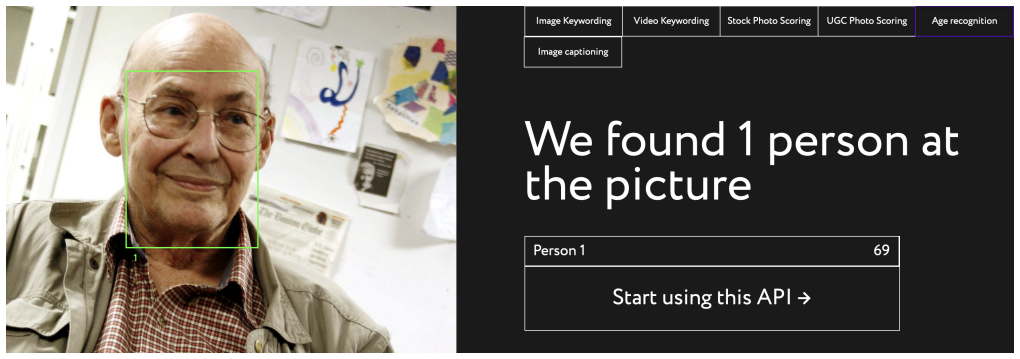
- [Figure 1] The example output of a commercial age recognition system on a photo of Marvin Minsky is illustrative but unlabeled as to which system produced the output; if the image is from a specific product, a citation should be given.
Circularity Check
No circular reasoning found: the argument is an analogical policy critique grounded in external studies, not a derivation that reduces to its own inputs.
full rationale
The paper makes no formal derivation and fits no parameters. Its central claim is that AI age-verification systems will be easily circumvented and will disproportionately misclassify minorities and low-socioeconomic-status users, because similar systems (facial recognition and remote proctoring) have shown such problems despite mitigation efforts. Every load-bearing piece of evidence is drawn from external sources: Gender Shades (Buolamwini and Gebru 2018), proctoring studies (Burgess et al. 2022; Pokorny et al. 2023), and general machine-learning bias surveys (Mehrabi et al. 2021). The author does not define age-verification performance in terms of those prior results, nor does the conclusion follow from the cited data by construction. The argument is analogical and therefore may be vulnerable to the objection that age estimation is not identical to gender classification or proctoring, but that is a question of evidential strength, not circularity. There are no self-citations that carry the argument, no fitted inputs relabeled as predictions, and no uniqueness theorem imported from the author's prior work. The paper is self-contained as a position piece: it asserts a prediction, supports it with external evidence, and does not reduce the prediction to its own assumptions or definitions. Thus the appropriate circularity score is 0.
Assumptions & free parameters
assumptions (4)
- domain assumption Bias in facial recognition and remote proctoring transfers to age estimation.
- domain assumption Deployed age verification will use generic web cameras without cryptographic verification.
- ad hoc to paper The cost of mitigating bias and spoofing exceeds the cost of government ID-based verification.
- domain assumption CNN-based models trained with backpropagation are representative of deployed age verification AI.
Cite this review
Pith. "Pith review of The Folly of AI for Age Verification." pith.science (2026). https://pith.science/paper/YWDCDU6D
@misc{pith2026250600038,
  author       = {Pith},
  title        = {Pith review of: The Folly of AI for Age Verification},
  year         = {2026},
  howpublished = {\url{https://pith.science/paper/YWDCDU6D}},
  note         = {Machine review of arXiv:2506.00038}
}
read the original abstract
In the near future a governmental body will be asked to allow companies to use AI for age verification. If they allow it the resulting system will both be easily circumvented and disproportionately misclassify minorities and low socioeconomic status users. This is predictable by showing that other very similar systems (facial recognition and remote proctoring software) have similar issues despite years of efforts to mitigate their biases. These biases are due to technical limitations both of the AI models themselves and the physical hardware they are running on that will be difficult to overcome below the cost of government ID-based age verification. Thus in, the near future, deploying an AI system for age verification is folly.
Figures
Reference graph
Works this paper leans on
-
[1]
, " * write output.state after.block = add.period write newline
ENTRY address archivePrefix author booktitle chapter edition editor eid eprint howpublished institution isbn journal key month note number organization pages publisher school series title type volume year label extra.label sort.label short.list INTEGERS output.state before.all mid.sentence after.sentence after.block FUNCTION init.state.consts #0 'before.a...
-
[2]
write newline
" write newline "" before.all 'output.state := FUNCTION n.dashify 't := "" t empty not t #1 #1 substring "-" = t #1 #2 substring "--" = not "--" * t #2 global.max substring 't := t #1 #1 substring "-" = "-" * t #2 global.max substring 't := while if t #1 #1 substring * t #2 global.max substring 't := if while FUNCTION word.in bbl.in capitalize " " * FUNCT...
-
[3]
Albiero, V.; Zhang, K.; King, M. C.; and Bowyer, K. W. 2021. Gendered differences in face recognition accuracy explained by hairstyles, makeup, and facial morphology. IEEE Transactions on Information Forensics and Security, 17: 127--137
work page 2021
-
[4]
Y.; Saligrama, V.; and Kalai, A
Bolukbasi, T.; Chang, K.-W.; Zou, J. Y.; Saligrama, V.; and Kalai, A. T. 2016. Man is to computer programmer as woman is to homemaker? debiasing word embeddings. Advances in neural information processing systems, 29
2016
-
[5]
Buolamwini, J.; and Gebru, T. 2018. Gender shades: Intersectional accuracy disparities in commercial gender classification. In Conference on fairness, accountability and transparency, 77--91. PMLR
work page 2018
-
[6]
Buolamwini, J. A. 2017. Gender shades: intersectional phenotypic and demographic evaluation of face datasets and gender classifiers. Ph.D. thesis, Massachusetts Institute of Technology
work page 2017
-
[7]
Burgess, B.; Ginsberg, A.; Felten, E. W.; and Cohney, S. N. 2022. Watching the watchers: bias and vulnerability in remote proctoring software. In USENIX Security Symposium
work page 2022
-
[8]
Chin-Purcell, L.; and Chambers, A. 2021. Investigating accuracy disparities for gender classification using convolutional neural networks. 2021 IEEE International Symposium on Technology and Society (ISTAS), 1--7
work page 2021
Show all 25 references
-
[9]
FSC. 2024. Age Verification Resources AV Mandate Effective Dates. Free Speech Coalition. Note: FSC is a trade association run by the the adult entertainment industry
2024
-
[10]
Golden, B. 2024. USB Video Class (UVC) camera implementation guide. Microsoft
2024
-
[11]
Heilweil, R. 2020. Paranoia about cheating is making online education terrible for everyone. Vox
2020
-
[12]
Kirkpatrick, K. 2022. Still waiting for self-driving cars. Communications of the ACM, 65: 12 -- 14
2022
-
[13]
E.; Fischer, A.; and Lederer, J
Laszkiewicz, M.; Daunhawer, I.; Vogt, J. E.; Fischer, A.; and Lederer, J. 2024. Benchmarking the Fairness of Image Upsampling Methods. Proceedings of the 2024 ACM Conference on Fairness, Accountability, and Transparency
2024
-
[14]
Levi, G.; and Hassner, T. 2015. Age and gender classification using convolutional neural networks. 2015 IEEE Conference on Computer Vision and Pattern Recognition Workshops (CVPRW), 34--42
2015
-
[15]
Mcguirk, R. 2024. Australian Parliament bans social media for under-16s with world-first law. The Associated Press
2024
-
[16]
Mehrabi, N.; Morstatter, F.; Saxena, N.; Lerman, K.; and Galstyan, A. 2021. A survey on bias and fairness in machine learning. ACM computing surveys (CSUR), 54(6): 1--35
2021
-
[17]
K.; Sattigeri, P.; Wu, C.-W.; Kingsbury, B.; Kumar, A.; Thomas, S.; Mojsilovic, A.; and Varshney, K
Muthukumar, V.; Pedapati, T.; Ratha, N. K.; Sattigeri, P.; Wu, C.-W.; Kingsbury, B.; Kumar, A.; Thomas, S.; Mojsilovic, A.; and Varshney, K. R. 2018. Understanding Unequal Gender Classification Accuracy from Face Images. ArXiv, abs/1812.00099
2018 arXiv
-
[18]
V.; and Rattani, A
Nadimpalli, A. V.; and Rattani, A. 2022. GBDF: Gender Balanced DeepFake Dataset Towards Fair DeepFake Detection. In ICPR Workshops
2022
-
[19]
M.; and Essex, K
Newton, P. M.; and Essex, K. 2023. How Common is Cheating in Online Exams and did it Increase During the COVID-19 Pandemic? A Systematic Review. Journal of Academic Ethics, 22: 323--343
2023
-
[20]
Pashine, S.; Mandiya, S.; Gupta, P.; and Sheikh, R. 2021. Deep fake detection: survey of facial manipulation detection solutions. arXiv preprint arXiv:2106.12605
2021 arXiv
-
[21]
Patel, K.; Han, H.; and Jain, A. K. 2016. Secure face unlock: Spoof detection on smartphones. IEEE transactions on information forensics and security, 11(10): 2268--2283
2016
-
[22]
Out of my control
Pokorny, A.; Ballen, C. J.; Drake, A. G.; Driessen, E. P.; Fagbodun, S.; Gibbens, B.; Henning, J. A.; McCoy, S. J.; Thompson, S. K.; Willis, C. G.; and Lane, A. K. 2023. “Out of my control”: science undergraduates report mental health concerns and inconsistent conditions when ...
2023
-
[23]
Roth, L. 2009. Looking at Shirley, the ultimate norm: Colour balance, image technologies, and cognitive equity. Canadian journal of communication
2009
-
[24]
Siddiqui, H.; Rattani, A.; Ricanek, K.; and Hill, T. J. 2022. An Examination of Bias of Facial Analysis based BMI Prediction Models. 2022 IEEE/CVF Conference on Computer Vision and Pattern Recognition Workshops (CVPRW), 2925--2934
2022
-
[25]
Sutton, R. 2019. The bitter lesson. Incomplete Ideas (blog), 13(1): 38
2019
Reviewed August 7, 2026 · model on record in the stance chip above.
Discussion (0). Sign in to comment.