REVIEW 2 major objections 4 minor 69 references
Distance-informed Neural Processes
T0 review · 2 major / 4 minor · reviewed 2026-08-05 · deepseek-v4-flash
Pith's one-line read Distance-informed Neural Processes claim that a bi-Lipschitz-regularized local latent variable makes uncertainty calibrated and separates in-distribution from out-of-distribution data.
desk verdict Solid incremental NP variant with strong experiments, but the paper's central OOD mechanism is contradicted by its own equations; the variance aggregation in Eq. 6 is invalid, and the reverting-to-prior claim does not hold. read the letter →
The pith
A machine-rendered reading of the paper's core claim, the machinery that carries it, and where it could break.
The reading
What carries the argument
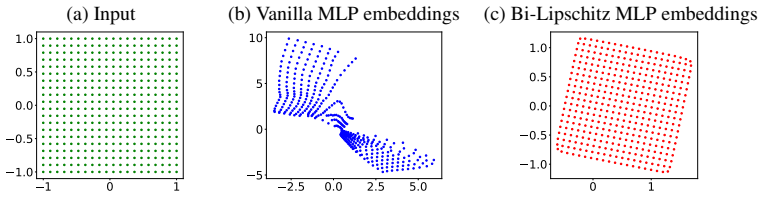
The carrying mechanism is the local latent path: a shared encoder h maps inputs to embeddings u; bi-Lipschitz regularization (Eq. 4) constrains each layer's smallest and largest singular values to [λ1, λ2], so relative input distances are roughly preserved. Laplace cross-attention (Eq. 5) then weights context points by exp(−||ut−uc||/√du), and those weights aggregate per-context Gaussian parameters into the target-specific local prior p(z_t|x_t,x_C,y_C). The distance preservation is what makes the attention weights trustworthy and what makes the prior collapse to a non-informative standard normal for far targets.
What would settle it
Take a trained DNP and a fixed context set, then evaluate the local prior's mean and covariance for queries placed at increasing distance. If the attention weights do not decay to zero and the covariance does not approach the identity, the claimed OOD non-informative prior fails. Separately, compute the Jacobian singular values of the encoder on OOD inputs: values outside [λ1,λ2] would show the bi-Lipschitz guarantee is broken exactly where it matters.
Extended reading notes
Core claim
On the paper's own terms, DNP establishes that integrating a global latent variable with a distance-aware local latent variable—regularized so the encoder is nearly isometric—improves both uncertainty calibration and OOD detection in Neural Processes. The local prior for each target is a Gaussian whose mean and covariance are attention-weighted aggregates of per-context Gaussian parameters, with attention weights computed by Laplace cross-attention over the distance-preserving embeddings. For targets far from the context, the weights tend to zero and the prior becomes a standard normal, so the model expresses ignorance rather than false confidence. The paper presents evidence that this mecha
Load-bearing premise
The load-bearing premise is that Eq. 6's variance aggregation—summing exp(alpha_c^t Sigma_thetaL(x_c,y_c)) over context points—is a mathematically correct combination of per-context covariances; if that formula is a typo or unjustified, the local latent prior is mis-specified and the OOD reversion to a standard normal may not hold.
Editorial extensions
If this is right
- Lower expected calibration error (ECE) than CNP, NP, ConvCNP, ConvNP, AttnNP, and DSVNP across most regression settings, including noisy observations, and on CIFAR-10/100 classification.
- Higher OOD detection AUPR against SVHN, CIFAR, and TinyImageNet, with larger predictive entropy on OOD inputs—so the model is less silently confident.
- Bi-Lipschitz regularization is the active ingredient: ablations show removing it raises ECE and lowers AUPR, and it outperforms two-sided gradient penalty, orthogonal regularization, and spectral-norm regularization on the same DNP architecture.
- Because the model satisfies exchangeability and marginal consistency, it defines a valid stochastic process, so it can be used as a principled prior over functions.
- DNP avoids self-attention over the context set, giving O(NM) prediction complexity instead of O(M^2+NM) for AttnNP/DSVNP, at some added LOBPCG cost during training.
Reading between the lines
- The same distance-aware local prior could be attached to other meta-learning or GP-inspired architectures; the paper's contribution is the mechanism, not a specific decoder.
- Implementing Eq. 6 naively with covariance outputs may not produce a standard normal when attention vanishes; ensuring the intended non-informative limit likely requires weighting log-variances additively rather than exponentiating per context.
- The bi-Lipschitz constraint is only approximate; on inputs far from the training manifold, the encoder may still violate the bounds. Probing the actual singular values of the encoder Jacobian on OOD inputs would show how much of the claimed OOD behavior degrades in practice.
- Extending the distance measure beyond Euclidean (e.g., geodesic or task-specific metrics) is a natural next step, as the paper itself notes; this would let the same mechanism apply to structured inputs.
Signed reviews
Editorial analysis
A structured set of objections, weighed in public.
Referee Report
Summary. The paper proposes Distance-informed Neural Process (DNP), an NP variant that augments the standard global latent variable with a target-specific local latent variable. The local latent is obtained from bi-Lipschitz-regularized input embeddings and Laplace cross-attention over the context set. The authors claim that this local prior reverts to a standard normal for OOD targets, yielding better-calibrated uncertainty and improved OOD detection. Training uses an ELBO augmented with a bi-Lipschitz regularization loss. Experiments cover 1D synthetic regression, Lotka–Volterra transfer, three multi-output regression benchmarks, and CIFAR-10/100 classification with OOD detection, together with ablations over context size, latent dimensions, Lipschitz bounds, the trade-off weight, and attention type.
Significance. If the proposed mechanism were mathematically sound, distance-aware local latent variables regularized by bi-Lipschitz constraints would be a useful addition to the NP family. The paper is commendably broad empirically: it includes code, many baselines, and systematic ablations. However, the central advertised mechanism—that the local prior becomes a standard normal far from the context—does not follow from the equations as written, and the exchangeability proof is for a simplified generative model that is not the model used in inference. The claimed OOD behavior and the stochastic-process justification therefore need substantial rework before the paper's central claims are supported.
major comments (2)
- [Sec. 3.2, Eqs. (5)-(6)] The OOD mechanism is inconsistent with the model. In Eq. (5), α_c^t are softmax weights, so Σ_c α_c^t = 1 for every target; as ||u_t||→∞, α_c^t → 1/|C|, not 0. Thus Eq. (6)'s local prior does not 'approach a standard normal,' as claimed in Sec. 3.2. Even if the weights did tend to zero, the variance term Σ_c exp(α_c^t Σ_θL(x_c,y_c)) would tend to |C| I, not I. Independently, that variance aggregation is not a valid covariance combination: if Σ_θL outputs log-variances, exp(α log σ²)=σ^{2α} and summing powered variances is not a covariance; if Σ_θL outputs variances, exponentiating a scaled covariance has no Gaussian justification. The paper's explanation for OOD detection therefore does not follow from the stated model. This needs a corrected derivation, a corrected model, or a substantially weakened claim.
- [Appendix C / Proposition 1] Proposition 1 and its proof concern the simplified generative model in Eq. (15), where each local latent has prior p(z_i|x_i). This is not the model used in training or inference. The actual local prior is p_θL(z_t|x_t,x_C,y_C) in Eq. (6), and Eq. (12) uses the same context-conditioned prior at test time; the ELBO in Eq. (10) also uses this prior. The proof in Appendix C does not establish exchangeability or marginal consistency for this context-dependent prior, because the factorization in Eq. (16) does not hold once the local prior depends on the full context set. A proof for the actual model, or a precise statement of the additional assumptions under which Eq. (7) is equivalent to the inference model, is required before the stochastic-process claim is made.
minor comments (4)
- [Sec. 5.1 / Table 1] Many ECE differences are within one standard deviation of the baselines (e.g., RBF ECE 0.093±0.054 vs. CNP 0.122±0.061). Reporting confidence intervals or paired significance tests would strengthen the calibration claims.
- [Sec. 3.4, Eq. (9)] Equation (9) has an extra closing parenthesis in the definition of q_φL. Please correct.
- [Table 7 vs. Sec. 3.2/3.4] Table 7 lists the prior and recognition model as q(z_i|x_C,y_C,x_i) and p(z_i|x_C,y_C,x_i), while the main text defines q_φL(z_t|x_t,y_t,x_C,y_C) and p_θL(z_t|x_t,x_C,y_C) and the generative model uses p(z_i|x_i). This notation is inconsistent and should be harmonized.
- [Sec. 5.4] Typo: 'uisng' should be 'using'. Also, the entropy numbers in Tables 4 and 5 are reported with a direction (↑) that is appropriate for OOD but might confuse for ID entropy; consider labeling as 'ID entropy (↓)' and 'OOD entropy (↑)' explicitly.
Circularity Check
No significant circularity: DNP is an empirical architecture paper whose central equations are self-contained; self-citations are peripheral and not load-bearing.
full rationale
The paper's core derivation chain is self-contained: the local prior (Eq. 6), the bi-Lipschitz regularizer (Eq. 4), and the ELBO (Eq. 10) are defined by explicit model equations, and the reported results are empirical comparisons against external baselines. No fitted parameter is renamed as a prediction, and no uniqueness claim is imported from the authors' prior work. The self-citations ([56,57,58]) appear only as general references for overconfident predictions and similarity-based retrieval; they do not justify the distance-aware latent mechanism or the OOD-detection claim. The bi-Lipschitz constraint is adopted from external prior work ([35,53,66]) and functions as a regularizer rather than as an input-dependent fitted quantity. Hyperparameters (β, λ1, λ2) are manually tuned on validation data, which is standard practice and not circular. Separately, and outside the definition of circularity, the paper's stated OOD mechanism is questionable: the softmax-normalized weights in Eq. 5 always sum to 1, so for a far target they approach 1/|C|, not zero, and the variance aggregation in Eq. 6 is not a standard combination of covariances. These are correctness concerns, not evidence that the derivation reduces to its own inputs.
Assumptions & free parameters
free parameters (5)
- lambda1 =
0.1
- lambda2 =
1.0
- beta =
1.0 (regression), 0.5 (classification)
- latent dimensions du, dz =
64-128 regression, 256/512 classification
- number of context points =
100 at test time
assumptions (4)
- standard math Kolmogorov Extension Theorem applies to the generative model, guaranteeing exchangeability and marginal consistency.
- standard math Fubini-Tonelli theorem can be applied to interchange integrals in the marginal consistency proof.
- domain assumption The bi-Lipschitz regularizer combined with LOBPCG approximation yields a latent space that approximately preserves input distances.
- ad hoc to paper The generative model in Eq. 7 (with prior p(z_i|x_i)) is equivalent to the actual inference model that uses context-dependent local prior p(z_t|x_t, x_C, y_C).
invented entities (1)
-
distance-preserving local latent variable z_t
Cite this review
Pith. "Pith review of Distance-informed Neural Processes." pith.science (2026). https://pith.science/paper/YWJPXO3M
@misc{pith2026250818903,
  author       = {Pith},
  title        = {Pith review of: Distance-informed Neural Processes},
  year         = {2026},
  howpublished = {\url{https://pith.science/paper/YWJPXO3M}},
  note         = {Machine review of arXiv:2508.18903}
}
read the original abstract
We propose the Distance-informed Neural Process (DNP), a novel variant of Neural Processes that improves uncertainty estimation by combining global and distance-aware local latent structures. Standard Neural Processes (NPs) often rely on a global latent variable and struggle with uncertainty calibration and capturing local data dependencies. DNP addresses these limitations by introducing a global latent variable to model task-level variations and a local latent variable to capture input similarity within a distance-preserving latent space. This is achieved through bi-Lipschitz regularization, which bounds distortions in input relationships and encourages the preservation of relative distances in the latent space. This modeling approach allows DNP to produce better-calibrated uncertainty estimates and more effectively distinguish in- from out-of-distribution data. Empirical results demonstrate that DNP achieves strong predictive performance and improved uncertainty calibration across regression and classification tasks.
Figures


Reference graph
Works this paper leans on
-
[1]
A review of uncertainty quantification in deep learning: Techniques, applications and challenges
Moloud Abdar, Farhad Pourpanah, Sadiq Hussain, Dana Rezazadegan, Li Liu, Mohammad Ghavamzadeh, Paul Fieguth, Xiaochun Cao, Abbas Khosravi, U Rajendra Acharya, et al. A review of uncertainty quantification in deep learning: Techniques, applications and challenges. Information fusion, 76:243–297, 2021
work page 2021
-
[2]
Jens Behrmann, Will Grathwohl, Ricky TQ Chen, David Duvenaud, and Jörn-Henrik Jacobsen. Invertible residual networks. In International conference on machine learning, pages 573–582. PMLR, 2019
work page 2019
-
[3]
Weight uncertainty in neural network
Charles Blundell, Julien Cornebise, Koray Kavukcuoglu, and Daan Wierstra. Weight uncertainty in neural network. In International conference on machine learning, pages 1613–1622. PMLR, 2015
work page 2015
-
[4]
Neural photo editing with introspective adversarial networks
Andrew Brock, Theodore Lim, James M Ritchie, and Nick Weston. Neural photo editing with introspective adversarial networks. arXiv preprint arXiv:1609.07093, 2016
arXiv 2016
-
[5]
Deep learning in computer vision: A critical review of emerging techniques and application scenarios
Junyi Chai, Hao Zeng, Anming Li, and Eric WT Ngai. Deep learning in computer vision: A critical review of emerging techniques and application scenarios. Machine Learning with Applications, 6:100134, 2021
work page 2021
-
[6]
Fast and accurate deep network learning by exponential linear units (elus)
Djork-Arné Clevert, Thomas Unterthiner, and Sepp Hochreiter. Fast and accurate deep network learning by exponential linear units (elus). arXiv preprint arXiv:1511.07289, 2015
arXiv 2015
-
[7]
Predicting chemical parameters of river water quality from bioindicator data
Sašo Džeroski, Damjan Demšar, and Jasna Grbovi´c. Predicting chemical parameters of river water quality from bioindicator data. Applied Intelligence, 13:7–17, 2000
work page 2000
-
[8]
Meta-learning stationary stochastic process prediction with convolutional neural processes
Andrew Foong, Wessel Bruinsma, Jonathan Gordon, Yann Dubois, James Requeima, and Richard Turner. Meta-learning stationary stochastic process prediction with convolutional neural processes. Advances in Neural Information Processing Systems, 33:8284–8295, 2020
work page 2020
Show all 69 references
-
[9]
An introduction to deep reinforcement learning
Vincent François-Lavet, Peter Henderson, Riashat Islam, Marc G Bellemare, Joelle Pineau, et al. An introduction to deep reinforcement learning. Foundations and Trends® in Machine Learning, 11(3-4):219–354, 2018
2018
-
[10]
Dropout as a bayesian approximation: Representing model uncertainty in deep learning
Yarin Gal and Zoubin Ghahramani. Dropout as a bayesian approximation: Representing model uncertainty in deep learning. Ininternational conference on machine learning, pages 1050–1059. PMLR, 2016. 10
2016
-
[11]
Conditional neural processes
Marta Garnelo, Dan Rosenbaum, Christopher Maddison, Tiago Ramalho, David Saxton, Murray Shanahan, Yee Whye Teh, Danilo Rezende, and SM Ali Eslami. Conditional neural processes. In International conference on machine learning, pages 1704–1713. PMLR, 2018
2018
-
[12]
Neural processes
Marta Garnelo, Jonathan Schwarz, Dan Rosenbaum, Fabio Viola, Danilo J Rezende, SM Eslami, and Yee Whye Teh. Neural processes. arXiv preprint arXiv:1807.01622, 2018
2018 arXiv
-
[13]
Function contrastive learning of transferable meta-representations
Muhammad Waleed Gondal, Shruti Joshi, Nasim Rahaman, Stefan Bauer, Manuel Wuthrich, and Bernhard Schölkopf. Function contrastive learning of transferable meta-representations. In International Conference on Machine Learning, pages 3755–3765. PMLR, 2021
2021
-
[14]
Convolutional conditional neural processes.arXiv preprint arXiv:1910.13556, 2019
Jonathan Gordon, Wessel P Bruinsma, Andrew YK Foong, James Requeima, Yann Dubois, and Richard E Turner. Convolutional conditional neural processes.arXiv preprint arXiv:1910.13556, 2019
1910 arXiv
-
[15]
Practical variational inference for neural networks.Advances in neural information processing systems, 24, 2011
Alex Graves. Practical variational inference for neural networks.Advances in neural information processing systems, 24, 2011
2011
-
[16]
Improved training of wasserstein gans
Ishaan Gulrajani, Faruk Ahmed, Martin Arjovsky, Vincent Dumoulin, and Aaron C Courville. Improved training of wasserstein gans. Advances in neural information processing systems, 30, 2017
2017
-
[17]
On calibration of modern neural networks
Chuan Guo, Geoff Pleiss, Yu Sun, and Kilian Q Weinberger. On calibration of modern neural networks. In International conference on machine learning, pages 1321–1330. PMLR, 2017
2017
-
[18]
Delving deep into rectifiers: Surpassing human-level performance on imagenet classification
Kaiming He, Xiangyu Zhang, Shaoqing Ren, and Jian Sun. Delving deep into rectifiers: Surpassing human-level performance on imagenet classification. In Proceedings of the IEEE international conference on computer vision, pages 1026–1034, 2015
2015
-
[19]
Robust learning with jacobian regularization
Judy Hoffman, Daniel A Roberts, and Sho Yaida. Robust learning with jacobian regularization. arXiv preprint arXiv:1908.02729, 2019
1908 arXiv
-
[20]
Meta-learning in neural networks: A survey
Timothy Hospedales, Antreas Antoniou, Paul Micaelli, and Amos Storkey. Meta-learning in neural networks: A survey. IEEE transactions on pattern analysis and machine intelligence, 44(9):5149–5169, 2021
2021
-
[21]
i-revnet: Deep invertible networks
Jörn-Henrik Jacobsen, Arnold Smeulders, and Edouard Oyallon. i-revnet: Deep invertible networks. arXiv preprint arXiv:1802.07088, 2018
2018 arXiv
-
[22]
Transformers are rnns: Fast autoregressive transformers with linear attention
Angelos Katharopoulos, Apoorv Vyas, Nikolaos Pappas, and François Fleuret. Transformers are rnns: Fast autoregressive transformers with linear attention. In International conference on machine learning, pages 5156–5165. PMLR, 2020
2020
-
[23]
What uncertainties do we need in bayesian deep learning for computer vision? Advances in neural information processing systems, 30, 2017
Alex Kendall and Yarin Gal. What uncertainties do we need in bayesian deep learning for computer vision? Advances in neural information processing systems, 30, 2017
2017
-
[24]
Multi-task learning using uncertainty to weigh losses for scene geometry and semantics
Alex Kendall, Yarin Gal, and Roberto Cipolla. Multi-task learning using uncertainty to weigh losses for scene geometry and semantics. In Proceedings of the IEEE conference on computer vision and pattern recognition, pages 7482–7491, 2018
2018
-
[25]
Attentive neural processes.arXiv preprint arXiv:1901.05761, 2019
Hyunjik Kim, Andriy Mnih, Jonathan Schwarz, Marta Garnelo, Ali Eslami, Dan Rosenbaum, Oriol Vinyals, and Yee Whye Teh. Attentive neural processes.arXiv preprint arXiv:1901.05761, 2019
1901 arXiv
-
[26]
Adam: A method for stochastic optimization
Diederik P Kingma and Jimmy Ba. Adam: A method for stochastic optimization. arXiv preprint arXiv:1412.6980, 2014
2014 arXiv
-
[27]
An introduction to variational autoencoders
Diederik P Kingma, Max Welling, et al. An introduction to variational autoencoders. Founda- tions and Trends® in Machine Learning, 12(4):307–392, 2019
2019
-
[28]
Toward the optimal preconditioned eigensolver: Locally optimal block preconditioned conjugate gradient method
Andrew V Knyazev. Toward the optimal preconditioned eigensolver: Locally optimal block preconditioned conjugate gradient method. SIAM journal on scientific computing, 23(2):517– 541, 2001. 11
2001
-
[29]
Learning multiple layers of features from tiny images
Alex Krizhevsky, Geoffrey Hinton, et al. Learning multiple layers of features from tiny images. 2009
2009
-
[30]
Accurate uncertainties for deep learning using calibrated regression
V olodymyr Kuleshov, Nathan Fenner, and Stefano Ermon. Accurate uncertainties for deep learning using calibrated regression. In International conference on machine learning, pages 2796–2804. PMLR, 2018
2018
-
[31]
Simple and scalable predictive uncertainty estimation using deep ensembles
Balaji Lakshminarayanan, Alexander Pritzel, and Charles Blundell. Simple and scalable predictive uncertainty estimation using deep ensembles. Advances in neural information processing systems, 30, 2017
2017
-
[32]
Tiny imagenet visual recognition challenge
Yann Le and Xuan Yang. Tiny imagenet visual recognition challenge. CS 231N, 7(7):3, 2015
2015
-
[33]
Bootstrapping neural processes
Juho Lee, Yoonho Lee, Jungtaek Kim, Eunho Yang, Sung Ju Hwang, and Yee Whye Teh. Bootstrapping neural processes. Advances in neural information processing systems, 33:6606– 6615, 2020
2020
-
[34]
The ecological role of volterra’s equations
E Leigh. The ecological role of volterra’s equations. Some mathematical problems in biology., pages 1–61, 1968
1968
-
[35]
Simple and principled uncertainty estimation with deterministic deep learning via distance awareness
Jeremiah Liu, Zi Lin, Shreyas Padhy, Dustin Tran, Tania Bedrax Weiss, and Balaji Lakshmi- narayanan. Simple and principled uncertainty estimation with deterministic deep learning via distance awareness. Advances in neural information processing systems, 33:7498–7512, 2020
2020
-
[36]
The functional neural process
Christos Louizos, Xiahan Shi, Klamer Schutte, and Max Welling. The functional neural process. Advances in Neural Information Processing Systems, 32, 2019
2019
-
[37]
Rectifier nonlinearities improve neural network acoustic models
Andrew L Maas, Awni Y Hannun, Andrew Y Ng, et al. Rectifier nonlinearities improve neural network acoustic models. In Proc. icml, volume 30, page 3. Atlanta, GA, 2013
2013
-
[38]
Spectral normalization for generative adversarial networks
Takeru Miyato, Toshiki Kataoka, Masanori Koyama, and Yuichi Yoshida. Spectral normalization for generative adversarial networks. arXiv preprint arXiv:1802.05957, 2018
2018 arXiv
-
[39]
Transformer neural processes: Uncertainty-aware meta learning via sequence modeling
Tung Nguyen and Aditya Grover. Transformer neural processes: Uncertainty-aware meta learning via sequence modeling. arXiv preprint arXiv:2207.04179, 2022
2022 arXiv
-
[40]
Stochastic differential equations
Bernt Øksendal and Bernt Øksendal. Stochastic differential equations. Springer, 2003
2003
-
[41]
A survey of the usages of deep learning for natural language processing
Daniel W Otter, Julian R Medina, and Jugal K Kalita. A survey of the usages of deep learning for natural language processing. IEEE transactions on neural networks and learning systems, 32(2):604–624, 2020
2020
-
[42]
Pytorch: An imperative style, high-performance deep learning library
A Paszke. Pytorch: An imperative style, high-performance deep learning library. arXiv preprint arXiv:1912.01703, 2019
1912 arXiv
-
[43]
Fubini’s theorem and tonelli’s theorem
H A Priestley. Fubini’s theorem and tonelli’s theorem. In Introduction to Integration. Oxford University Press, 08 1997
1997
-
[44]
Convolutional neural networks applied to house numbers digit classification
Pierre Sermanet, Soumith Chintala, and Yann LeCun. Convolutional neural networks applied to house numbers digit classification. In Proceedings of the 21st international conference on pattern recognition (ICPR2012), pages 3288–3291. IEEE, 2012
2012
-
[45]
A comprehensive guide to bayesian convolutional neural network with variational inference
Kumar Shridhar, Felix Laumann, and Marcus Liwicki. A comprehensive guide to bayesian convolutional neural network with variational inference. arXiv preprint arXiv:1901.02731, 2019
1901 arXiv
-
[46]
Very deep convolutional networks for large-scale image recognition
Karen Simonyan and Andrew Zisserman. Very deep convolutional networks for large-scale image recognition. arXiv preprint arXiv:1409.1556, 2014
2014 arXiv
-
[47]
Sparse gaussian processes using pseudo-inputs
Edward Snelson and Zoubin Ghahramani. Sparse gaussian processes using pseudo-inputs. Advances in neural information processing systems, 18, 2005
2005
-
[48]
Multi-target regression via input space expansion: treating targets as inputs
Eleftherios Spyromitros-Xioufis, Grigorios Tsoumakas, William Groves, and Ioannis Vlahavas. Multi-target regression via input space expansion: treating targets as inputs. Machine Learning, 104:55–98, 2016. 12
2016
-
[49]
A block orthogonalization procedure with constant synchronization requirements
Andreas Stathopoulos and Kesheng Wu. A block orthogonalization procedure with constant synchronization requirements. SIAM Journal on Scientific Computing, 23(6):2165–2182, 2002
2002
-
[50]
Exploiting inferential structure in neural processes
Dharmesh Tailor, Mohammad Emtiyaz Khan, and Eric Nalisnick. Exploiting inferential structure in neural processes. In Uncertainty in Artificial Intelligence, pages 2089–2098. PMLR, 2023
-
[51]
Sparse sinkhorn attention
Yi Tay, Dara Bahri, Liu Yang, Donald Metzler, and Da-Cheng Juan. Sparse sinkhorn attention. In International conference on machine learning, pages 9438–9447. PMLR, 2020
2020
-
[52]
Variational learning of inducing variables in sparse gaussian processes
Michalis Titsias. Variational learning of inducing variables in sparse gaussian processes. In Artificial intelligence and statistics, pages 567–574. PMLR, 2009
2009
-
[53]
On fea- ture collapse and deep kernel learning for single forward pass uncertainty
Joost Van Amersfoort, Lewis Smith, Andrew Jesson, Oscar Key, and Yarin Gal. On fea- ture collapse and deep kernel learning for single forward pass uncertainty. arXiv preprint arXiv:2102.11409, 2021
2021 arXiv
-
[54]
Uncertainty estimation using a single deep deterministic neural network
Joost Van Amersfoort, Lewis Smith, Yee Whye Teh, and Yarin Gal. Uncertainty estimation using a single deep deterministic neural network. In International conference on machine learning, pages 9690–9700. PMLR, 2020
2020
-
[55]
Attention is all you need
Ashish Vaswani, Noam Shazeer, Niki Parmar, Jakob Uszkoreit, Llion Jones, Aidan N Gomez, Łukasz Kaiser, and Illia Polosukhin. Attention is all you need. Advances in neural information processing systems, 30, 2017
2017
-
[56]
Gaussian latent representations for uncertainty estimation using mahalanobis distance in deep classifiers
Aishwarya Venkataramanan, Assia Benbihi, Martin Laviale, and Cédric Pradalier. Gaussian latent representations for uncertainty estimation using mahalanobis distance in deep classifiers. In Proceedings of the IEEE/CVF International Conference on Computer Vision, pages 4488– 4497, 2023
2023
-
[57]
Probabilistic embeddings for frozen vision-language models: Uncertainty quantification with gaussian process latent variable models
Aishwarya Venkataramanan, Paul Bodesheim, and Joachim Denzler. Probabilistic embeddings for frozen vision-language models: Uncertainty quantification with gaussian process latent variable models. arXiv preprint arXiv:2505.05163, 2025
2025 arXiv
-
[58]
Integrating visual and semantic similarity using hierarchies for image retrieval
Aishwarya Venkataramanan, Martin Laviale, and Cédric Pradalier. Integrating visual and semantic similarity using hierarchies for image retrieval. In International Conference on Computer Vision Systems, pages 422–431. Springer, 2023
2023
-
[59]
Locally weighted projection regression: An o (n) algorithm for incremental real time learning in high dimensional space
Sethu Vijayakumar and Stefan Schaal. Locally weighted projection regression: An o (n) algorithm for incremental real time learning in high dimensional space. In Proceedings of the seventeenth international conference on machine learning (ICML 2000), volume 1, pages 288–293. Mo...
2000
-
[60]
Bridge the inference gaps of neural processes via expectation maximization
Qi Wang, Marco Federici, and Herke van Hoof. Bridge the inference gaps of neural processes via expectation maximization. arXiv preprint arXiv:2501.03264, 2025
2025 arXiv
-
[61]
Doubly stochastic variational inference for neural processes with hierarchical latent variables
Qi Wang and Herke Van Hoof. Doubly stochastic variational inference for neural processes with hierarchical latent variables. In International Conference on Machine Learning, pages 10018–10028. PMLR, 2020
2020
-
[62]
Learning expressive meta-representations with mixture of expert neural processes
Qi Wang and Herke Van Hoof. Learning expressive meta-representations with mixture of expert neural processes. Advances in neural information processing systems, 35:26242–26255, 2022
2022
-
[63]
Stochastic modelling for systems biology
Darren J Wilkinson. Stochastic modelling for systems biology. Chapman and Hall/CRC, 2018
2018
-
[64]
MIT press Cambridge, MA, 2006
Christopher KI Williams and Carl Edward Rasmussen.Gaussian processes for machine learning, volume 2. MIT press Cambridge, MA, 2006
2006
-
[65]
Deep kernel learning
Andrew Gordon Wilson, Zhiting Hu, Ruslan Salakhutdinov, and Eric P Xing. Deep kernel learning. In Artificial intelligence and statistics, pages 370–378. PMLR, 2016
2016
-
[66]
Spectral norm regularization for improving the generaliz- ability of deep learning
Yuichi Yoshida and Takeru Miyato. Spectral norm regularization for improving the generaliz- ability of deep learning. arXiv preprint arXiv:1705.10941, 2017
2017 arXiv
-
[67]
Rank-n-contrast: Learning continuous representations for regression
Kaiwen Zha, Peng Cao, Jeany Son, Yuzhe Yang, and Dina Katabi. Rank-n-contrast: Learning continuous representations for regression. Advances in Neural Information Processing Systems, 36:17882–17903, 2023. 13 A Implementation Details Table 7: Comparison of different Neural Proce...
2023
-
[68]
, N}; that is, px1:N (y1:N ) = pxπ(1:N ) (yπ(1:N )) (14)
Permutation Invariance (Exchangeability): The joint distribution px1:N (y1:N ) must be invariant under any permutation π of the indices {1, . . . , N}; that is, px1:N (y1:N ) = pxπ(1:N ) (yπ(1:N )) (14)
-
[69]
, yM } of the outputs must be recoverable by integrating out the remaining variables from the joint distribution px1:N (y1:N )
Consistency (Marginalization): For any N and any M < N, the marginal distribution over any subset {y1, . . . , yM } of the outputs must be recoverable by integrating out the remaining variables from the joint distribution px1:N (y1:N ). We now prove each of these in turn. For ...
Reviewed August 5, 2026 · model on record in the stance chip above.
Discussion (0). Continue with ORCID to comment.