REVIEW 4 major objections 5 minor 1 cited by
This paper claims that generating mesh vertices and connectivity in two separate flow stages, anchored to a shared coarse scaffold, beats joint-latent generation and unlocks part-wise scaling and topology-adaptive editing.
Reviewed by Pith at T0; open to challenge. T0 means a machine referee read the full paper against a public rubric. the ladder, T0–T4 →
T0 review · deepseek-v4-flash
2026-08-02 07:11 UTC pith:YWSPEGEM
load-bearing objection LATO.2 is a genuinely useful factorized mesh-generation recipe, but the central claim that factorization explains the gains is underdetermined without a matched joint-latent ablation. the 4 major comments →
LATO.2: Factorized 3D Mesh Generation with Vertex and Topology Flow
The pith
A machine-rendered reading of the paper's core claim, the machinery that carries it, and where it could break.
Core claim
The central claim is that the discreteness of mesh connectivity is an artifact of modeling it jointly with geometry: conditioned on realized vertices, connectivity reduces to relations among known points in space and can be represented as continuous per-vertex features that decode into pairwise edge probabilities. The paper builds two autoencoders—a vertex VAE that recovers vertices at sub-voxel precision using a per-vertex drift vector, and a topology VAE that learns a per-vertex latent from adjacency-masked attention—and trains two flow matching models over these latents, with a shared coarse voxel scaffold anchoring both stages. Quantitatively, the full pipeline reports lower Chamfer dist
What carries the argument
The central machinery is the factorization itself: a two-stage flow matching pipeline over two dedicated latent spaces, connected by a shared coarse voxel scaffold. The vertex stage (V-VAE + V-Flow) compresses vertex displacement fields into a sparse latent and decodes high-resolution vertices through coarse-to-fine subdivision, pruning, and a per-vertex drift vector that corrects quantization error; the topology stage (T-VAE + T-Flow) encodes connectivity as per-vertex latent features using adjacency-masked attention, and decodes edge probabilities with a pairwise MLP, with faces recovered by loop detection. The topology flow is conditioned on realized vertex positions and a coarse geometri
Load-bearing premise
The load-bearing premise is that the topology flow learns a conditional distribution that generalizes to vertex sets far outside those it trained on—specifically unions of parts, edited or rotated vertices, and stitched components—and that vertex-stage errors, which the paper states cannot be corrected during topology synthesis, remain small enough that the second stage can still recover valid connectivity.
What would settle it
Take a held-out mesh, rotate one part, stitch together vertex sets from two different meshes, or generate a part-wise result, then run the topology flow and measure topology validity directly (count non-manifold edges, self-intersections, and boundary gaps, and compare face counts against ground truth). If connectivity quality on these vertex sets degrades far below whole-mesh generation, the claimed unique advantages collapse even if Table 2's small metric gains hold.
If this is right
- Vertex-count controllability: specifying a target vertex count steers mesh density while preserving shape, giving users direct control over resolution.
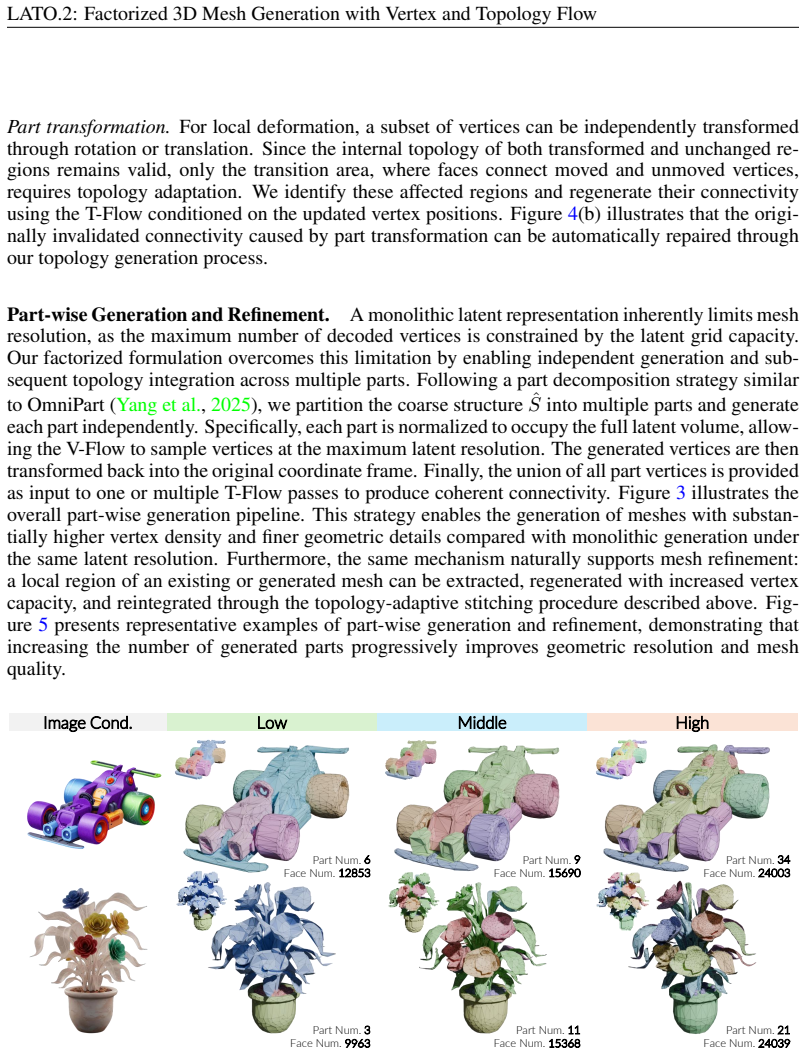
- Part-wise generation: partitioning the coarse scaffold and generating each part at full latent capacity yields meshes with substantially more faces and finer detail than a monolithic latent permits.
- Topology-adaptive editing: user edits, rotations, or stitching of vertex sets propagate to connectivity simply by re-running the topology flow, avoiding hand-crafted topology rules.
- Error localization: the paper's ablations indicate the V-VAE reconstructs vertices near-perfectly and the main error comes from the generative flows, so improving the flow stages directly improves final mesh quality.
- The paper argues that modeling connectivity as a sampled conditional distribution beats deterministic feed-forward edge completion, supporting the use of latent flow for topology.
Where Pith is reading between the lines
- A testable extension is to train the topology flow on vertex sets from external sources (scans or deformed meshes) to see whether connectivity prediction generalizes to geometry beyond the training distribution; the paper's editing results suggest it might, but no quantitative topology-validity metrics are reported for those cases.
- Since the paper concedes that vertex-stage inaccuracies cannot be corrected during topology synthesis, the practical ceiling of the whole pipeline is set by vertex precision; improving vertex regression (e.g., continuous coordinate prediction instead of offset-from-voxel-center) could yield disproportionate gains.
- The quadratic O(N^2) topology decoding will likely become the bottleneck at very high face counts; a hierarchical or blockwise topology flow would be a natural next step and could be evaluated against the current full-scoring decoder.
- If the factorization's generalization holds, it could decouple geometry and connectivity research entirely: vertex generators and topology generators could be developed, trained, and swapped independently, sharing only a coarse scaffold.
Editorial analysis
A structured set of objections, weighed in public.
Referee Report
Summary. The paper proposes LATO.2, a factorized flow-matching framework for explicit 3D mesh generation. The method splits generation into a vertex flow (V-Flow) that produces vertex positions from a coarse voxel scaffold and image/point-cloud conditions, and a topology flow (T-Flow) that generates per-vertex topology latents conditioned on the realized vertices, with a dedicated VAE for each stage. The paper claims state-of-the-art geometric fidelity and connectivity quality (Table 2), and claims two advantages unique to the factorization: part-wise high-resolution generation and topology-adaptive editing (§3.3). Experiments compare against autoregressive and latent-flow baselines, with ablations of the vertex branch (Table 4) and topology branch (Table 5).
Significance. If the central claim is validated, the factorized vertex-then-connectivity recipe is a meaningful contribution to explicit mesh generation, and the sub-voxel offset head is a clean, effective idea for improving vertex reconstruction. The paper is thorough in scope: it evaluates against eight baselines, provides ablations for both branches, reports reconstruction upper bounds, and releases code. However, the evidence for the factorized design's causal benefit is incomplete. The headline improvement over LATO is small (CD 0.0407 vs 0.0421, a 3% relative difference), the reported numbers have no error bars, and the two 'unique advantages' are only qualitatively demonstrated. The central claim is therefore plausible but not yet proven.
major comments (4)
- [§4.4, Table 2] The central claim that factorization itself drives the quality improvement is underdetermined. Table 2 compares complete systems that differ in VAE design, flow transformer, training data (including the 100K procedural meshes), vertex-count control, and inference procedure. The ablations in Tables 4–5 only remove components within the factorized design; no experiment removes the factorization while holding data, capacity, and backbone fixed. A matched joint-latent control — e.g., sampling [z_v; z_t] jointly with the same V-VAE/T-VAE latents, same flow transformer, and same training budget — is needed to attribute the gains to factorization rather than to the many concurrent engineering changes.
- [Table 3] The reported numbers are inconsistent with the expected error hierarchy and have no uncertainty estimates. GT-Verts + T-Flow (CD 0.0399) should upper-bound V-VAE + T-Flow (CD 0.0393), yet the reverse is observed. This inversion indicates noise at the 0.001–0.005 CD level, which is the same order as the headline margin over LATO (0.0421 vs 0.0407). The authors should report means and standard deviations over multiple seeds or runs and, ideally, significance tests, before claiming that the small differences in Table 2 are meaningful.
- [§3.3, Figs. 4–5] The two 'unique advantages' of the factorization — part-wise generation and topology-adaptive editing — are presented without quantitative validation. T-Flow is trained on whole-mesh vertex sets; the part-wise pipeline feeds it union-of-parts vertex sets rescaled to full latent volume, and the editing scenarios feed it rotated, stitched, or otherwise modified vertex sets. No topology-validity metrics (e.g., manifoldness, face/edge validity, self-intersection counts, genus accuracy) are reported for these applications. Given the paper's own limitation that 'geometric inaccuracies from the vertex stage cannot be corrected during topology synthesis,' these generalization claims need direct evidence rather than qualitative figures.
- [§4.1, Table 2] The claim of superior 'connectivity quality' is not directly supported by the metrics used. The only topology-related metric in Table 2 is |NC|, Normal Consistency, which measures geometric surface orientation, not topological validity. For a paper whose core contribution is topology modeling, the evaluation should include quantitative measures of mesh validity — e.g., fraction of valid faces, edge manifoldness, vertex valence distributions, or genus/connectivity accuracy. Without such metrics, the 'connectivity quality' component of the headline claim remains unsubstantiated.
minor comments (5)
- [Eq. (3)] The text says 'loss weights are omitted for clarity'; these weights should be specified in the appendix or supplementary material, as they affect the VAE training balance.
- [Abstract/Contributions] The first contribution bullet has a trailing comma after 'scaffold,'. Please proofread.
- [§3.1] There is a typo: 'the vertice positions' should be 'the vertex positions'. Also, the loop-detection process that recovers faces from predicted edges is not described or referenced; this is an important implementation detail for reproducibility.
- [References] Reference formatting issue: 'V oleti' should be 'Voleti' in the SV3D and Objaverse-XL entries.
- [Table 4] The row 'w/o Train on Synthetic Mesh' reports ACC/F1/Recall/IOU that are substantially lower than the full model, while the 'w/o Offset Head' row shows identical occupancy metrics to the full model. This is plausible, but the caption could state explicitly that the offset head is intended to affect only sub-voxel localization.
Circularity Check
No significant circularity: the two-stage flow derivation is self-contained; citations to LATO supply component reuse, not the load-bearing result.
full rationale
No circular derivation is present. The construction is a standard sequence of independently trained stages: V-VAE reconstruction with pruning, offset, and KL losses (Eqs. 2–3); T-VAE reconstruction with masked attention and a pairwise edge classifier (Eqs. 4–7); V-Flow rectified-flow training (Eq. 8); and T-Flow rectified-flow training (Eq. 9). Each objective is supervised by ground-truth vertex positions or adjacency and evaluated on held-out data (Tables 1–3), so the predictions are not encoded in the inputs by construction. The self-citations to LATO provide the VDF representation, the sparse VAE skeleton, and the pairwise edge-prediction MLP (Eq. 6), but these are inherited architectural components rather than the paper's central claim. The claim that factorization improves over joint-latent modeling is supported by comparisons to prior published systems, including LATO itself via official checkpoints, and the repository is public, making the comparison externally falsifiable. The absence of a matched joint-latent ablation is a genuine experimental confound for the causal attribution of Table 2 gains, but underdetermination is not the same as equivalence-by-construction. The paper's own limitation statement — that geometric inaccuracies from the vertex stage cannot be corrected during topology synthesis — further confirms that the two stages are not secretly the same quantity. Minor self-citations exist but are not load-bearing, so the appropriate score is 0.
Axiom & Free-Parameter Ledger
free parameters (4)
- V-VAE loss weights =
omitted
- topology latent dimension d_z =
16
- coordinate quantization bins K for T-VAE/T-Flow =
1024
- asymmetric focal loss hyperparameters =
not stated
axioms (7)
- domain assumption The Vertex Displacement Field (VDF) is a faithful continuous encoding of vertex geometry.
- domain assumption Connectivity is reconstructible from per-vertex latent features decoded into pairwise edge probabilities plus loop detection.
- domain assumption Pairwise edge scoring over all N² pairs followed by loop detection yields valid closed meshes.
- standard math Rectified flow matching over Gaussian-corrupted structured latents learns the target distribution.
- domain assumption A random rendering of the mesh plus DINOv2 features is a sufficient task condition for geometry-conditioned generation.
- ad hoc to paper The procedural 100K synthetic primitive meshes improve coverage without harmful distribution shift.
- ad hoc to paper T-Flow generalizes to vertex sets produced by part-wise unions and user edits, despite training on whole-mesh vertex sets.
invented entities (2)
-
sub-voxel drift vector δ_i per vertex
no independent evidence
-
per-vertex topology latent z_t (dim 16)
no independent evidence
read the original abstract
Flow matching over carefully designed latent representations has recently emerged as a powerful paradigm for topology-aware mesh generation. Existing approaches, however, model vertices and connectivity jointly in a joint latent space, entangling continuous vertex geometry with discrete combinatorial structure; this complicates flow learning and manifests as drifting vertices and broken surfaces. We present LATO.2, a factorized flow matching framework that decomposes mesh generation into a vertex flow followed by a connectivity flow conditioned on the realized vertices, with both stages anchored to a shared coarse voxel scaffold. Dedicated VAEs underpin the two stages, recovering vertices at sub-voxel precision and embedding discrete connectivity into a continuous latent space. We demonstrate two advantages unique to this factorization: (i) part-wise generation, in which the scaffold is partitioned and each part synthesized at full latent capacity, yielding substantially higher-resolution meshes than a monolithic latent permits; and (ii) topology-adaptive editing, in which manipulating first-stage vertices induces the corresponding connectivity without re-optimization. Experiments show that LATO.2 surpasses state-of-the-art topology-aware mesh generators in geometric fidelity and connectivity quality.
Figures




Forward citations
Cited by 1 Pith paper
-
Meshy T2: Fast Native Mesh Generation with Flow Matching
Single-image native mesh generation runs at interactive speed in Meshy T2 by flow-matching one continuous latent per vertex, then decoding vertices, edge connectivity, and face winding in one pass.
Reference graph
Works this paper leans on
-
[1]
Polydiff: Generating 3d polygonal meshes with diffusion models.arXiv preprint arXiv:2312.11417,
Antonio Alliegro, Yawar Siddiqui, Tatiana Tommasi, and Matthias Nießner. Polydiff: Generating 3d polygonal meshes with diffusion models.arXiv preprint arXiv:2312.11417,
-
[4]
Xianglong He, Junyi Chen, Di Huang, Zexiang Liu, Xiaoshui Huang, Wanli Ouyang, Chun Yuan, and Yangguang Li. Meshcraft: Exploring efficient and controllable mesh generation with flow- based dits.arXiv preprint arXiv:2503.23022,
-
[7]
Quadgpt: Native quadrilateral mesh generation with autoregressive models
Jian Liu, Chunshi Wang, Song Guo, Haohan Weng, Zhen Zhou, Zhiqi Li, Jiaao Yu, Yiling Zhu, Jing Xu, Biwen Lei, et al. Quadgpt: Native quadrilateral mesh generation with autoregressive models. arXiv preprint arXiv:2509.21420,
-
[8]
Zero-1-to-3: Zero-shot one image to 3d object
Ruoshi Liu, Rundi Wu, Basile Van Hoorick, Pavel Tokmakov, Sergey Zakharov, and Carl V ondrick. Zero-1-to-3: Zero-shot one image to 3d object. InProceedings of the IEEE/CVF international conference on computer vision, pp. 9298–9309, 2023a. Yuan Liu, Cheng Lin, Zijiao Zeng, Xiaoxiao Long, Lingjie Liu, Taku Komura, and Wenping Wang. Syncdreamer: Generating m...
2024
-
[9]
Meshdiffusion: Score-based generative 3d mesh modeling.arXiv preprint arXiv:2303.08133, 2023b
Zhen Liu, Yao Feng, Michael J Black, Derek Nowrouzezahrai, Liam Paull, and Weiyang Liu. Meshdiffusion: Score-based generative 3d mesh modeling.arXiv preprint arXiv:2303.08133, 2023b. Xiaoxiao Long, Yuan-Chen Guo, Cheng Lin, Yuan Liu, Zhiyang Dou, Lingjie Liu, Yuexin Ma, Song-Hai Zhang, Marc Habermann, Christian Theobalt, et al. Wonder3d: Single image to 3...
-
[11]
Alex Nichol, Heewoo Jun, Prafulla Dhariwal, Pamela Mishkin, and Mark Chen. Point-e: A system for generating 3d point clouds from complex prompts.arXiv preprint arXiv:2212.08751,
-
[12]
Dreamfusion: Text-to-3d using 2d diffusion.arXiv preprint arXiv:2209.14988,
Ben Poole, Ajay Jain, Jonathan T Barron, and Ben Mildenhall. Dreamfusion: Text-to-3d using 2d diffusion.arXiv preprint arXiv:2209.14988,
-
[14]
Ruoxi Shi, Hansheng Chen, Zhuoyang Zhang, Minghua Liu, Chao Xu, Xinyue Wei, Linghao Chen, Chong Zeng, and Hao Su. Zero123++: a single image to consistent multi-view diffusion base model.arXiv preprint arXiv:2310.15110,
-
[16]
Dmesh: A differentiable mesh representation.arXiv preprint arXiv:2404.13445,
Sanghyun Son, Matheus Gadelha, Yang Zhou, Zexiang Xu, Ming C Lin, and Yi Zhou. Dmesh: A differentiable mesh representation.arXiv preprint arXiv:2404.13445,
-
[17]
Mesh silksong: Auto-regressive mesh generation as weaving silk.arXiv preprint arXiv:2507.02477,
Gaochao Song, Zibo Zhao, Haohan Weng, Jingbo Zeng, Rongfei Jia, and Shenghua Gao. Mesh silksong: Auto-regressive mesh generation as weaving silk.arXiv preprint arXiv:2507.02477,
-
[19]
Edgerunner: Auto-regressive auto-encoder for artistic mesh generation
Jiaxiang Tang, Max Li, Zekun Hao, Xian Liu, Gang Zeng, Ming-Yu Liu, and Qinsheng Zhang. Edgerunner: Auto-regressive auto-encoder for artistic mesh generation. InInternational Confer- ence on Learning Representations, volume 2025, pp. 35913–35934,
2025
-
[20]
Imagedream: Image-prompt multi-view diffusion for 3d generation
Peng Wang and Yichun Shi. Imagedream: Image-prompt multi-view diffusion for 3d generation. arXiv preprint arXiv:2312.02201,
-
[21]
Llama-mesh: Unifying 3d mesh generation with language models.arXiv preprint arXiv:2411.09595,
Zhengyi Wang, Jonathan Lorraine, Yikai Wang, Hang Su, Jun Zhu, Sanja Fidler, and Xiaohui Zeng. Llama-mesh: Unifying 3d mesh generation with language models.arXiv preprint arXiv:2411.09595,
-
[22]
Pivotmesh: Generic 3d mesh generation via pivot vertices guidance.arXiv preprint arXiv:2405.16890,
Haohan Weng, Yikai Wang, Tong Zhang, CL Chen, and Jun Zhu. Pivotmesh: Generic 3d mesh generation via pivot vertices guidance.arXiv preprint arXiv:2405.16890,
-
[23]
Omnipart: Part-aware 3d generation with semantic decoupling and structural cohesion
Yunhan Yang, Yufan Zhou, Yuan-Chen Guo, Zi-Xin Zou, Yukun Huang, Ying-Tian Liu, Hao Xu, Ding Liang, Yan-Pei Cao, and Xihui Liu. Omnipart: Part-aware 3d generation with semantic decoupling and structural cohesion. InProceedings of the SIGGRAPH Asia 2025 Conference Papers, pp. 1–12,
2025
-
[24]
Deepmesh: Auto-regressive artist-mesh creation with reinforcement learning
Ruowen Zhao, Junliang Ye, Zhengyi Wang, Guangce Liu, Yiwen Chen, Yikai Wang, and Jun Zhu. Deepmesh: Auto-regressive artist-mesh creation with reinforcement learning. InProceedings of the IEEE/CVF International Conference on Computer Vision, pp. 10612–10623, 2025a. Tianhao Zhao, Youjia Zhang, Hang Long, Jinshen Zhang, Wenbing Li, Yang Yang, Gongbo Zhang, J...
-
[25]
Zibo Zhao, Zeqiang Lai, Qingxiang Lin, Yunfei Zhao, Haolin Liu, Shuhui Yang, Yifei Feng, Mingxin Yang, Sheng Zhang, Xianghui Yang, et al. Hunyuan3d 2.0: Scaling diffusion models for high resolution textured 3d assets generation.arXiv preprint arXiv:2501.12202, 2025b. 18
-
[1999]
Spacemesh: A continuous representation for learning manifold surface meshes
Tianchang Shen, Zhaoshuo Li, Marc Law, Matan Atzmon, Sanja Fidler, James Lucas, Jun Gao, and Nicholas Sharp. Spacemesh: A continuous representation for learning manifold surface meshes. InSIGGRAPH Asia 2024 Conference Papers, pp. 1–11,
2024
-
[2020]
Hierarchical transformers are more efficient language models
Piotr Nawrot, Szymon Tworkowski, Michał Tyrolski, Łukasz Kaiser, Yuhuai Wu, Christian Szegedy, and Henryk Michalewski. Hierarchical transformers are more efficient language models. In Findings of the Association for Computational Linguistics: NAACL 2022, pp. 1559–1571,
2022
-
[2021]
Dreamgaussian: Generative gaussian splatting for efficient 3d content creation
Jiaxiang Tang, Jiawei Ren, Hang Zhou, Ziwei Liu, and Gang Zeng. Dreamgaussian: Generative gaussian splatting for efficient 3d content creation. InInternational Conference on Learning Representations, volume 2024, pp. 33879–33896,
2024
-
[2022]
Meshtron: High-fidelity, artist-like 3d mesh generation at scale.arXiv preprint arXiv:2412.09548,
Zekun Hao, David W Romero, Tsung-Yi Lin, and Ming-Yu Liu. Meshtron: High-fidelity, artist-like 3d mesh generation at scale.arXiv preprint arXiv:2412.09548,
-
[2023]
Mvdream: Multi-view diffusion for 3d generation
Yichun Shi, Peng Wang, Jianglong Ye, Long Mai, Kejie Li, and Xiao Yang. Mvdream: Multi-view diffusion for 3d generation. InInternational conference on learning representations, volume 2024, pp. 39838–39859,
2024
-
[2024]
Meshanything: Artist-created mesh generation with autoregres- sive transformers
Yiwen Chen, Tong He, Di Huang, Weicai Ye, Sijin Chen, Jiaxiang Tang, Zhongang Cai, Lei Yang, Gang Yu, Guosheng Lin, et al. Meshanything: Artist-created mesh generation with autoregres- sive transformers. InInternational Conference on Learning Representations, volume 2025, pp. 51369–51389, 2025a. 14 LATO.2: Factorized 3D Mesh Generation with Vertex and Top...
2025
-
[2025]
Lrm: Large reconstruction model for single image to 3d
Yicong Hong, Kai Zhang, Jiuxiang Gu, Sai Bi, Yang Zhou, Difan Liu, Feng Liu, Kalyan Sunkavalli, Trung Bui, and Hao Tan. Lrm: Large reconstruction model for single image to 3d. InInternational Conference on Learning Representations, volume 2024, pp. 50678–50702,
2024
-
[2026]
Instant3d: Fast text-to-3d with sparse-view gen- eration and large reconstruction model
Jiahao Li, Hao Tan, Kai Zhang, Zexiang Xu, Fujun Luan, Yinghao Xu, Yicong Hong, Kalyan Sunkavalli, Greg Shakhnarovich, and Sai Bi. Instant3d: Fast text-to-3d with sparse-view gen- eration and large reconstruction model. InInternational conference on learning representations, volume 2024, pp. 21896–21920,
2024
discussion (0)
Sign in with ORCID, Apple, or X to comment. Anyone can read and Pith papers without signing in.