REVIEW 5 major objections 6 minor 29 references
Task-Conditional Flow Matching for Balanced Multilingual Text Embedding Adaptation
T0 review · 5 major / 6 minor · reviewed 2026-08-07 · deepseek-v4-flash
Pith's one-line read This paper claims that TCFM, which applies Flow Matching only to translation pairs while using contrastive, teacher-preservation, and curriculum objectives elsewhere, improves Indic MTEB scores by +3.59 on Harrier-0.6B and +1.97 on…
desk verdict Sensible training recipe with consistent gains, but the central task-conditional claim rests on a 0.04-point single-run ablation and the train/eval overlap is undocumented. read the letter →
The pith
A machine-rendered reading of the paper's core claim, the machinery that carries it, and where it could break.
The reading
What carries the argument
The carrying mechanism is a task-conditioned Flow Matching head: a velocity-prediction network conditioned on the task instruction embedding extracted from a frozen teacher encoder, trained to predict the target velocity $u = z_{tgt} - z_s$ along linear interpolation paths $z(t) = (1-t)z_s + t z_{tgt}$ between translation-pair embeddings, plus a bounded transport step that nudges encoder outputs toward the target embedding. Around this core sit a multi-positive InfoNCE contrastive loss, pointwise and relational teacher-preservation losses, a hard-negative cosine-margin repair, and a SimCSE-style monolingual consistency loss, all scheduled through three stages: translation alignment first, then classification and NLI, then retrieval with monolingual regularization.
What would settle it
A decontamination audit that searches the Table 1 training subsets for exact and near-duplicate sentences from the Indic MTEB v3 evaluation tasks would settle whether the reported gains are real; if substantial overlap exists, the gains are inflated. A second check is to retrain Stage 3 without the replay buffer: if overall scores stay flat, the curriculum claim is not load-bearing.
Extended reading notes
Core claim
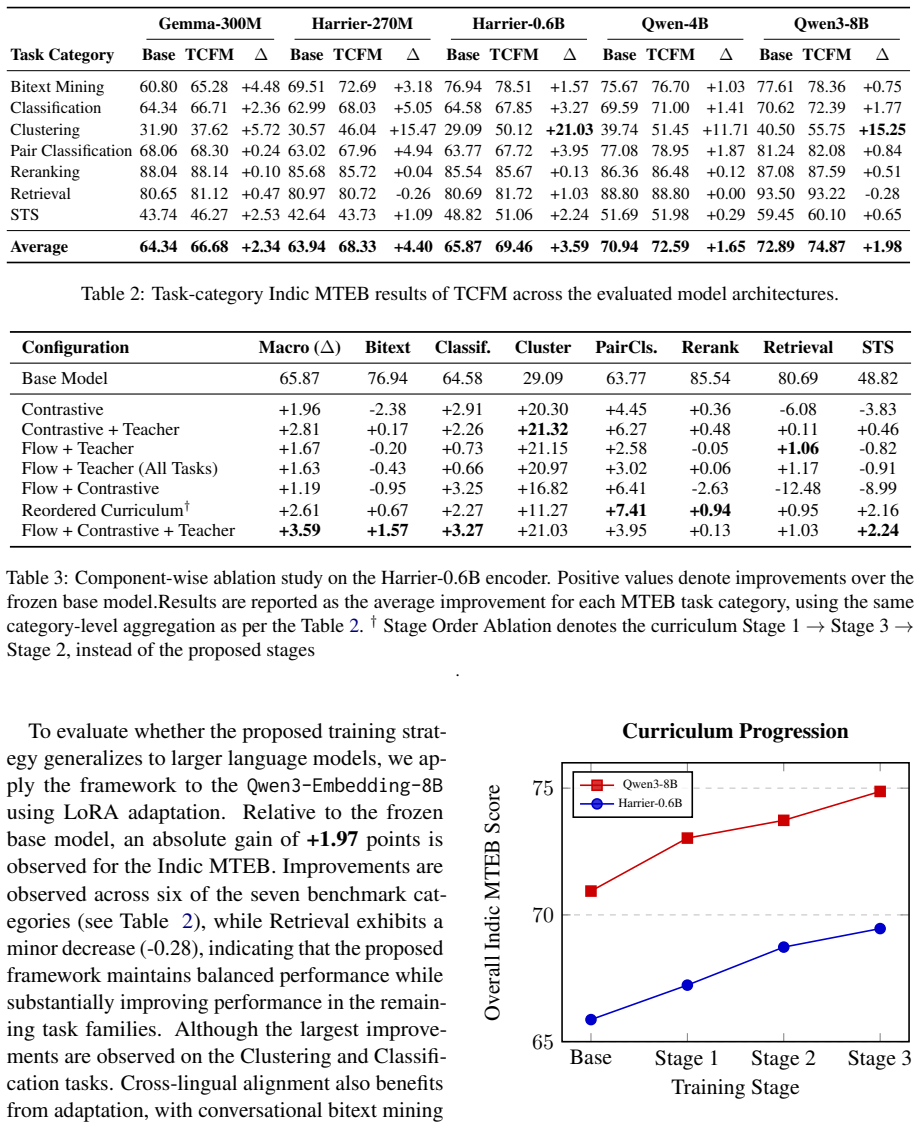
The central discovery claimed is that task-conditional objective routing outperforms single-objective adaptation for multilingual embeddings: Flow Matching should be reserved for parallel translation pairs, where source and target sentences define natural continuous transport paths, while retrieval, classification, and pair-classification tasks should keep contrastive and margin-based objectives. The paper supports this with component ablations showing that contrastive and flow objectives have complementary strengths, that teacher preservation is the main stabilizer, and that a three-stage curriculum with translation replay buffers prevents catastrophic forgetting. The result is a more balanced representation space whose clustering score jumps by 21 points on Harrier-0.6B and 15.25 points on Qwen3-Embedding-8B, at the cost of small regressions in a few tasks such as Sanskrit shloka classification and XQuAD retrieval.
Load-bearing premise
The load-bearing premise is that the public training corpora (IndicXNLI, MASSIVE, IndicSentiment, IndicMSMARCO, Samanantar) do not overlap the held-out Indic MTEB evaluation tasks, because no decontamination or split-separation protocol is described.
Editorial extensions
If this is right
- If TCFM's routing is correct, a single contrastive loss across all embedding tasks is not the right default; task-matched objectives should be selected per task family.
- The reported ablations imply that teacher preservation is the main stabilizer: removing it drops retrieval by 12.48 points and STS by 8.99 points on Harrier-0.6B.
- The three-stage curriculum, with replay buffers of roughly 40k translation pairs, is what prevents catastrophic forgetting while classification and retrieval supervision are added.
- The framework's gains generalize across model families at five scales, with the largest relative gains on the bidirectional Harrier-270M encoder (+4.40).
Reading between the lines
- Editorial: TCFM's dependence on explicit parallel sentence pairs means its benefits should shrink for zero-resource languages; testing it with machine-translated or pivot-based synthetic pairs would show how far the mechanism extends.
- Editorial: The large clustering gains may be a side effect of teacher preservation and monolingual consistency rather than Flow Matching itself; a direct geometric measurement of anisotropy before and after each objective would separate these contributions.
- Editorial: The uniform-versus-task-conditional comparison rests on a single Harrier-0.6B ablation; repeating it across seeds and at least one more backbone would establish whether the routing benefit is robust.
Editorial analysis
A structured set of objections, weighed in public.
Referee Report
Summary. The manuscript proposes Task-Conditional Flow Matching (TCFM), a multilingual embedding adaptation framework that applies Flow Matching only to translation-style pairs and routes retrieval, classification, and pair-classification tasks to contrastive and margin-based objectives. It combines these objectives with teacher-guided representation preservation and a three-stage curriculum. The paper reports improvements on Indic MTEB over frozen base models for five backbones, including +3.59 for Harrier-0.6B and +1.97 for Qwen3-Embedding-8B, and claims that task-conditional routing of Flow Matching is superior to applying Flow Matching uniformly. The main empirical evidence consists of category-level and task-level tables, stage-wise checkpoints, and component ablations on Harrier-0.6B.
Significance. The idea of routing training objectives by task family is timely and plausible, and the loss decomposition is clearly stated. The paper's strengths include evaluation across five model families, detailed stage-wise hyperparameter tables, explicit curriculum checkpoints, and a candid limitations section. The losses are standard and the teacher is a frozen external model, so there is no circular derivation. However, two load-bearing concerns weaken the contribution as currently presented: the training data overlap with the evaluation tasks is not addressed, and the central task-conditional routing claim rests on a 0.04-point single-run difference. If the decontamination question is resolved and the routing ablation is replicated with proper statistical support, the method would be a useful contribution to multilingual embedding adaptation. As written, the evidence supports a suggestive proof-of-concept rather than the paper's strong SOTA and task-conditional claims.
major comments (5)
- [Section 4.1, Table 1, Table 4] The manuscript trains on public datasets that also appear as evaluation tasks in Indic MTEB: IndicXNLI (Table 1) corresponds to the XNLI task in Table 4, MASSIVE to intent classification tasks, IndicSentiment to sentiment classification tasks, and IndicMSMARCO to retrieval-style evaluation. No decontamination statement, split-separation protocol, or overlap analysis is provided. Without an explicit statement that the evaluation splits of these tasks were never used during training, the headline gains of +3.59 and +1.97 cannot be interpreted as clean adaptation results.
- [Section 6.3] The central claim that task-conditional Flow Matching is better than uniform Flow Matching rests on a single comparison on Harrier-0.6B: +1.67 versus +1.63 overall, a 0.04-point difference. The text also concedes that uniform Flow Matching is better on Pair Classification (+3.02 vs. +2.58). No seeds, confidence intervals, or significance tests are reported. Given the multi-stage curriculum, full fine-tuning, and in-batch sampling, this difference is far below plausible run-to-run variance and cannot support the abstract's claim that the task-conditional design is validated. Please provide repeated runs and statistical tests, or temper the claim.
- [Tables 2-4 and Table 3] All results are single runs without error bars or multiple seeds. Several reported deltas are very small (e.g., Reranking +0.04 to +0.51 across backbones), and the claim that TCFM 'consistently' improves embedding quality across task families is not yet supported. At minimum, three seeds for the main backbones and for the central task-conditional ablation would allow the reader to distinguish systematic improvement from optimization noise.
- [Sections 1 and 5] The abstract and introduction claim a 'new state-of-the-art' on Indic MTEB, but the experiments compare only against frozen base models. There is no comparison with previously reported adapted multilingual embedding models or existing Indic MTEB leaderboard entries. Unless such comparisons are added, the SOTA claim is unsupported, regardless of whether the improvements over the base models are real.
- [Appendix A vs. Tables 2 and 4] Reported numbers for Harrier-270M are internally inconsistent: Table 2 gives +4.40 (63.94 to 68.33) and Clustering +15.47, Classification +5.05, Pair Classification +4.94, while Appendix A states +4.43 (63.94 to 68.36) and reports +15.38, +5.14, +5.09, plus different per-task deltas such as +14.92 versus +14.34 for SentimentAnalysisHindi and +13.52 versus +13.35 for MTOPIntentClassification. The text also gives Qwen3-8B as +1.97 while Table 2 shows +1.98. These discrepancies must be reconciled before the consistency claims can be checked.
minor comments (6)
- [Section 3.2.5] The section contains a duplicated passage: the motivation for monolingual consistency is stated twice, and the second instance contains an incomplete sentence structure ('excessive alignment can inadvertently reduce the quality of monolingual representations'). Please condense.
- [Equations (4), (6) and Table 5] The text promises complete reproducibility, but the teacher-velocity interpolation coefficient α, the transport step η, and the false-negative similarity threshold in Section 3.2.1 are not given numerical values in Table 5 or Appendix B. Also clarify what the task instruction Ir is in stages where Table 5 lists the instruction strategy as 'none'.
- [Table 3] The configuration 'Flow + Teacher (All Tasks)' is not explicitly defined in the text; please identify it as the uniform-Flow ablation described in Section 6.3 so that the table is self-contained.
- [Abstract] The percentages '5.45%' and '2.72%' are relative gains over the base scores, while the body reports absolute point gains. Please label these consistently to avoid confusion.
- [Section 5] There is a sentence fragment: 'Although the largest improvements are observed on the Clustering and Classification tasks.' This should be completed or merged with the following sentence.
- [Section 4.2] The list of evaluated models is confusing because it names Qwen3-Embedding-4B in prose but uses 'Qwen/Qwen3-Embedding-4B' while later referencing 'Qwen-4B' in Table 2. Please standardize the model names across text, tables, and appendix.
Circularity Check
No significant circularity: TCFM combines standard, externally grounded objectives and reports empirical benchmark gains rather than deriving predictions from its own fitted inputs.
full rationale
The paper's derivation chain consists of standard multi-positive contrastive loss (Eq. 1), Flow Matching with a cosine velocity loss (Eq. 5), a bounded transport objective (Eq. 7), teacher-preservation losses (Eqs. 8-9), a hard-negative margin (Eq. 10), and a SimCSE-style consistency loss (Eq. 11). The teacher encoder f0 is explicitly frozen and is an external pretrained backbone, so the teacher-guided velocity in Eq. 4 is not a self-referential circular input. The central claim is an empirical result: adapting Harrier-0.6B and Qwen3-8B with TCFM improves Indic MTEB scores by +3.59 and +1.97 over the frozen base models. This is a benchmark comparison, not a quantity that is defined in terms of itself. The closest circularity-adjacent concern is that some training datasets (IndicXNLI, MASSIVE, IndicSentiment) share task families with Indic MTEB evaluation tasks (XNLI, MTOPIntentClassification, sentiment classification), which would be a data-contamination issue rather than a circular derivation; the paper does not report a decontamination protocol, but that is outside the circularity definition because no fitted parameter is being renamed as a prediction. Section 6.3's comparison between task-conditional and uniform Flow Matching differs by 0.04 points overall, which is statistically weak but is an underpowered ablation, not a result forced by construction or by self-citation. The paper contains no load-bearing self-citations: all cited method foundations (Flow Matching, contrastive learning, MTEB, Samanantar, etc.) are external prior work. The limitations section honestly states that the geometric benefit of Flow Matching is empirically observed rather than formally proven, which further indicates the authors are not wrapping assumptions into conclusions. Overall, the framework's contributions are a combination of known objectives plus a routing choice, and the reported gains are empirical findings that could in principle fail; nothing in the paper reduces by definition to its inputs.
Assumptions & free parameters
free parameters (9)
- Contrastive temperature τ =
0.07, 0.07, 0.095 (Gemma/Harrier); 0.07, 0.07, 0.04 (Qwen)
- Contrastive loss weight λ_contrastive =
0.10, 0.30, 0.25 (0.20 for Qwen Stage 3)
- Flow loss weight λ_flow =
0.50 for all stages (0.20 for Qwen Stage 3)
- Teacher velocity interpolation coefficient α =
not reported
- Transport step η =
not reported
- False-negative similarity threshold =
not reported
- Hard-negative margin m =
0.15
- Replay buffer size =
40,000 instances
- Per-dataset training caps =
e.g., Samanantar 55k, MASSIVE 60k, IndicXNLI 5k
assumptions (5)
- domain assumption Semantically equivalent translation pairs admit linear interpolation paths in embedding space (Eq. 2).
- domain assumption Flow Matching is only appropriate for translation-style pairs; retrieval, classification, and pair classification lack continuous transport structure.
- domain assumption The frozen teacher encoder provides a stable reference that preserves semantic structure during adaptation.
- domain assumption Filtering highly similar in-batch instances from the contrastive denominator removes false negatives for translation but not for pair classification.
- domain assumption The three-stage curriculum with replay buffers prevents catastrophic forgetting of cross-lingual alignment.
Cite this review
Pith. "Pith review of Task-Conditional Flow Matching for Balanced Multilingual Text Embedding Adaptation." pith.science (2026). https://pith.science/paper/YX4SCMGI
@misc{pith2026260805785,
  author       = {Pith},
  title        = {Pith review of: Task-Conditional Flow Matching for Balanced Multilingual Text Embedding Adaptation},
  year         = {2026},
  howpublished = {\url{https://pith.science/paper/YX4SCMGI}},
  note         = {Machine review of arXiv:2608.05785}
}
read the original abstract
Multilingual text embedding models are commonly adapted using a single training objective across diverse tasks, despite different tasks requiring fundamentally different optimization strategies. We introduce Task-Conditional Flow Matching (TCFM), a multilingual embedding adaptation framework that selectively applies Flow Matching to translation tasks while optimizing retrieval, classification, and pair-classification tasks with objectives better aligned to their learning dynamics. TCFM further combines teacher-guided representation preservation with a three-stage curriculum to enable stable adaptation. Evaluated on the Indic Massive Text Embedding Benchmark, TCFM establishes a new state-of-the-art, consistently improving embedding quality across a diverse set of multilingual tasks and generalizing across embedding model families. We will publicly release the codebase and datasets upon acceptance of the paper.
Figures
Reference graph
Works this paper leans on
-
[1]
The Eleventh International Conference on Learning Representations (ICLR) , year =
Flow Matching for Generative Modeling , author =. The Eleventh International Conference on Learning Representations (ICLR) , year =
-
[2]
MMTEB: Massive Multilingual Text Embedding Benchmark , url =
Kenneth Enevoldsen and Isaac Chung and Imene Kerboua and Márton Kardos and Ashwin Mathur and David Stap and Jay Gala and Wissam Siblini and Dominik Krzemiński and Genta Indra Winata and Saba Sturua and Saiteja Utpala and Mathieu Ciancone and Marion Schaeffer and Gabriel Sequeira and Diganta Misra and Shreeya Dhakal and Jonathan Rystrøm and Roman Solomatin...
-
[3]
Findings of the Association for Computational Linguistics: ACL 2023 , pages =
One Embedder, Any Task: Instruction-Finetuned Text Embeddings , author =. Findings of the Association for Computational Linguistics: ACL 2023 , pages =
work page 2023
-
[4]
Transactions of the Association for Computational Linguistics , volume=
Samanantar: The Largest Publicly Available Parallel Corpora Collection for 11 Indic Languages , author=. Transactions of the Association for Computational Linguistics , volume=. 2022 , publisher=
work page 2022
-
[5]
MASSIVE: A 1M-Example Multilingual Natural Language Understanding Dataset with 51 Typologically-Diverse Languages , author=. Proceedings of the 60th Annual Meeting of the Association for Computational Linguistics (Volume 1: Long Papers) , pages=
-
[6]
Proceedings of the 2022 Conference on Empirical Methods in Natural Language Processing , pages=
IndicXNLI: Evaluating Multilingual Inference for Indian Languages , author=. Proceedings of the 2022 Conference on Empirical Methods in Natural Language Processing , pages=
work page 2022
-
[7]
Bhasa-Abhijnaanam: Native-script and romanized Language Identification for 22 Indic languages , author=. Proceedings of the 61st Annual Meeting of the Association for Computational Linguistics (Volume 2: Short Papers) , pages=. 2023 , publisher=
work page 2023
-
[8]
IndicRAGSuite: Large-Scale Datasets and a Benchmark for Indian Language RAG Systems
IndicRAGSuite: Large-Scale Datasets and a Benchmark for Indian Language RAG Systems , author=. arXiv preprint arXiv:2506.01615 , year=
Show all 29 references
-
[9]
arXiv preprint arXiv:2506.05176 , year=
Qwen3 Embedding: Advancing Text Embedding and Reranking Through Foundation Models , author=. arXiv preprint arXiv:2506.05176 , year=
-
[10]
arXiv preprint arXiv:2402.05672 , year=
Multilingual e5 text embeddings: A technical report , author=. arXiv preprint arXiv:2402.05672 , year=
-
[11]
2025 , url=
EmbeddingGemma: Powerful and Lightweight Text Representations , author=. 2025 , url=
2025
-
[12]
arXiv preprint arXiv:1607.06450 , year=
Layer normalization , author=. arXiv preprint arXiv:1607.06450 , year=
-
[13]
How contextual are contextualized word representations? Comparing the geometry of BERT, ELMo, and GPT-2 embeddings , author=. Proceedings of the 2019 conference on empirical methods in natural language processing and the 9th international joint conference on natural language p...
2019
-
[14]
Advances in neural information processing systems , volume=
Experience replay for continual learning , author=. Advances in neural information processing systems , volume=
-
[15]
Exploring the Impact of Negative Samples of Contrastive Learning: A Case Study of Sentence Embedding
Cao, Rui and Wang, Yihao and Liang, Yuxin and Gao, Ling and Zheng, Jie and Ren, Jie and Wang, Zheng. Exploring the Impact of Negative Samples of Contrastive Learning: A Case Study of Sentence Embedding. Findings of the Association for Computational Linguistics: ACL 2022. 2022....
2022 doi
-
[16]
Sentence- BERT : Sentence Embeddings using S iamese BERT -Networks
Reimers, Nils and Gurevych, Iryna. Sentence- BERT : Sentence Embeddings using S iamese BERT -Networks. Proceedings of the 2019 Conference on Empirical Methods in Natural Language Processing and the 9th International Joint Conference on Natural Language Processing (EMNLP-IJCNLP...
2019 doi
-
[17]
Gao, Tianyu and Yao, Xingcheng and Chen, Danqi , booktitle=
-
[18]
Transactions of the Association for Computational Linguistics , volume=
Massively Multilingual Sentence Embeddings for Zero-Shot Cross-Lingual Transfer and Beyond , author=. Transactions of the Association for Computational Linguistics , volume=
-
[19]
Language-agnostic
Feng, Fangxiaoyu and Yang, Yinfei and Cer, Daniel and Arivazhagan, Naveen and Wang, Wei , booktitle=. Language-agnostic
-
[20]
arXiv preprint arXiv:1807.03748 , year=
Representation learning with contrastive predictive coding , author=. arXiv preprint arXiv:1807.03748 , year=
-
[21]
Advances in Neural Information Processing Systems , volume=
Debiased Contrastive Learning , author=. Advances in Neural Information Processing Systems , volume=
-
[22]
Advances in Neural Information Processing Systems , volume=
Supervised Contrastive Learning , author=. Advances in Neural Information Processing Systems , volume=
-
[23]
Proceedings of the 58th Annual Meeting of the Association for Computational Linguistics , month = jul, year =
Balancing Training for Multilingual Neural Machine Translation , author =. Proceedings of the 58th Annual Meeting of the Association for Computational Linguistics , month = jul, year =. doi:10.18653/v1/2020.acl-main.754 , pages =
2020 doi
-
[24]
Proceedings of the IEEE/CVF Conference on Computer Vision and Pattern Recognition (CVPR) , pages =
Understanding the Behaviour of Contrastive Loss , author =. Proceedings of the IEEE/CVF Conference on Computer Vision and Pattern Recognition (CVPR) , pages =
-
[25]
Proceedings of the 17th Conference of the European Chapter of the Association for Computational Linguistics , pages =
Muennighoff, Niklas and Tazi, Nouamane and Magne, Lo. Proceedings of the 17th Conference of the European Chapter of the Association for Computational Linguistics , pages =. 2023 , publisher =
2023
-
[26]
Proceedings of the 58th Annual Meeting of the Association for Computational Linguistics , pages =
Unsupervised Cross-lingual Representation Learning at Scale , author =. Proceedings of the 58th Annual Meeting of the Association for Computational Linguistics , pages =. 2020 , publisher =
2020
-
[27]
Proceedings of the 2021 Conference on Empirical Methods in Natural Language Processing , month = nov, year =
Muppet: Massive Multi-task Representations with Pre-Finetuning , author =. Proceedings of the 2021 Conference on Empirical Methods in Natural Language Processing , month = nov, year =
2021
-
[28]
2024 , publisher =
Zhang, Xin and Zhang, Yanzhao and Long, Dingkun and Xie, Wen and Dai, Ziqi and Tang, Jialong and Lin, Huan and Yang, Baosong and Xie, Pengjun and Huang, Fei and Zhang, Meishan and Li, Wenjie and Zhang, Min , booktitle =. 2024 , publisher =
2024
-
[29]
Chen, Jianlv and Xiao, Shitao and Zhang, Peitian and Luo, Kun and Lian, Defu and Liu, Zheng , journal =
Reviewed August 7, 2026 · model on record in the stance chip above.
Discussion (0). Continue with ORCID to comment.