REVIEW 3 major objections 4 minor 18 references
Finding your MUSE: Mining Unexpected Solutions Engine
T0 review · 3 major / 4 minor · reviewed 2026-08-05 · deepseek-v4-flash
Pith's one-line read MUSE claims that graph-sampled functional analogies from 500K patents raised users' creative idea ratio from 49% to 75% in a sentence-condition user study.
desk verdict Substantial graph-building resource with a suggestive but under-controlled user study; worth reviewing, but the creativity claim needs a real baseline. read the letter →
The pith
A machine-rendered reading of the paper's core claim, the machinery that carries it, and where it could break.
The reading
What carries the argument
The load-bearing object is the Functional Concept Graph (FCG): purpose nodes from clustered purpose tags, solution nodes from mechanism tags clustered by co-occurrence, and directed edges encoding 'mechanism achieves purpose' and 'purpose is more abstract than purpose'. The abstraction edges come from a natural-language-inference (NLI) entailment model—a classifier that checks whether one sentence is implied by another—run on representative purpose tags with an 'I want' prefix, then cleaned by cycle removal and transitive-edge removal; virtual nodes proposed by an LLM and verb-synonym groups add far links. MUSE samples the classic analogy v-structure—one or two 'up' steps to an abstraction a
What would settle it
Compare the sentence condition against a control that receives the same number of purpose+mechanism sentences sampled at random from the graph, or from non-abstraction paths. If random sentences produce a similar ratio of creative solutions, MUSE's abstraction structure is not the cause of the 75% versus 49% gain; if they do not, the effect is attributable to the FCG paths. A cheaper check is to manually audit 100 sampled NLI abstraction edges and measure precision against human abstraction judgments.
Extended reading notes
Core claim
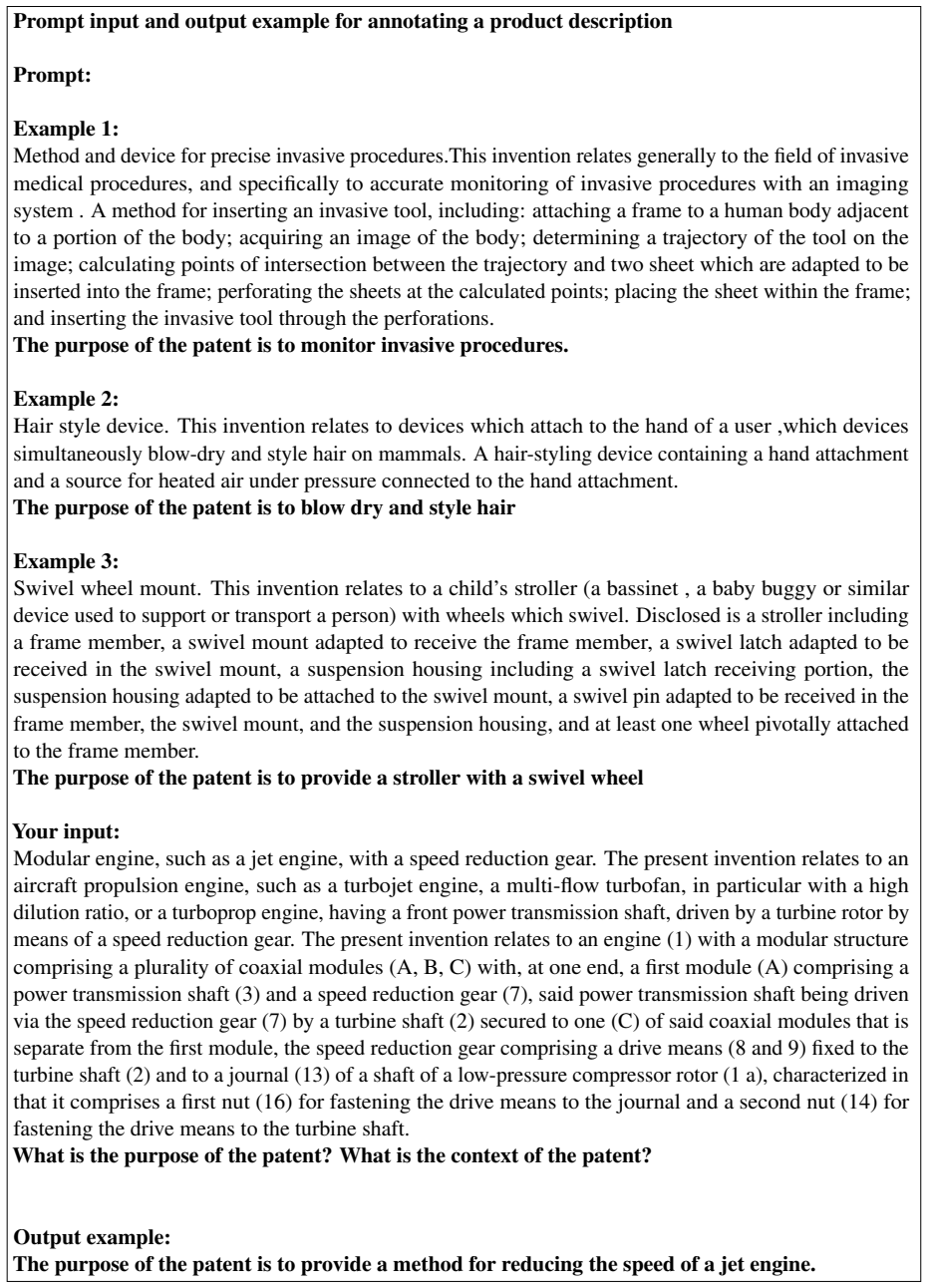
Patents become purpose and mechanism tags; similar purposes form problem nodes, mechanisms cluster by co-occurrence, and problem nodes link through abstraction edges scored by a natural-language entailment model plus LLM and verb virtual nodes. MUSE embeds a user problem, finds its nearest node, and samples 'up-up-down' analogy paths with diversity reranking. In a 61-participant study, the purpose+mechanism-sentence condition yielded 75% creative ideas (k=2) versus 49% with no inspirations, plus the most creative ideas in absolute terms. The paper reads this as evidence that structured functional analogy reduces fixation; the 500K-patent graph is released.
Load-bearing premise
The claim collapses if the entailment-based abstraction edges do not faithfully represent real 'is a more general problem' relations; noisy edges would make MUSE's 'up' steps land on arbitrary nodes, and any creativity gain could then come from generic distraction rather than functional analogy.
Editorial extensions
If this is right
- The released FCG over 500K patents gives other researchers a reusable map of functional analogies, not just a demo corpus.
- Design tools can present 'purpose + mechanism sentences' rather than bare keywords; the sentence condition showed the strongest creativity gain.
- MUSE-style sampling can be added to LLM prompting pipelines, possibly reducing the online-rehashed solutions the paper observes from a state-of-the-art LLM.
- The time-course result implies inspiration tools need a warm-up: users start slower but overtake uninspired users, so evaluation should not be cut short.
- The same graph structure can reframe a problem before solution search: going up an abstraction edge changes the problem statement itself, not just candidate answers.
Reading between the lines
- If the active ingredient is simply receiving any structured external prompt, a random-purpose control could produce a similar lift; the paper did not include such a condition, so this is an open alternative explanation.
- The NLI abstraction edges are computed from one representative tag per cluster; aggregating multiple tags could strengthen edge precision and possibly make the strict novelty threshold significant.
- The graph's patents are US, English, and from three CPC sections; a multilingual or cross-domain FCG could reveal far analogies across cultures, directly testing the paper's geographic-bias limitation.
- MUSE-inspired ideation could be measured by downstream solution quality rather than human novelty ratings, which would connect the ratio increase to real-world innovation.
Editorial analysis
A structured set of objections, weighed in public.
Referee Report
Summary. The paper proposes a scalable pipeline for building Functional Concept Graphs (FCGs) from patent data, where nodes are purpose/mechanism clusters and edges encode problem–solution and abstraction relations. The authors also introduce MUSE, an algorithm that samples inspiration nodes from the FCG via "up–down" paths, and report a user study with 61 participants on two everyday problems ("Seal a leak" and "Cool a room"). The central empirical claim is that inspirations from the FCG increase the ratio of creative solutions, with the purpose+mechanism-sentence condition yielding 75% creative solutions versus 49% in the empty condition. The paper releases the graph, code, and data.
Significance. If the central claim holds, the paper would make a useful contribution to computational creativity and design-by-analogy: it scales functional concept graphs to 500K patents, explicitly encodes abstraction relations, and provides a concrete inspiration-sampling mechanism. The release of the graph and pipeline is a valuable resource. The user study design also goes beyond many prior systems by testing the inspirations with human participants and by analyzing trajectory types (NLI, LLM, verb) in Section 7.2. However, the strength of the empirical conclusion is currently limited by the absence of a non-MUSE inspiration baseline and by the incomplete statistical reporting.
major comments (3)
- [§7.1, Table 1] The headline RQ1 claim is that FCG inspirations enhance creativity, but the experiment has no control condition in which participants receive inspirations from a non-MUSE source (e.g., random patent nodes, keyword-search results, or unrelated concepts). All three non-empty arms draw from the FCG and differ only in display format. Thus the observed 26-point gap in creative ratio (75% vs. 49%) is consistent with the possibility that any external stimulus, demand characteristics, or the extra time spent reading before generating ideas improves the ratio. A non-MUSE baseline is load-bearing for the paper's central claim and should be added or, if impossible, the claims must be correspondingly restricted.
- [§7.1] The text states that "participants in all inspiration-based conditions produced a significantly higher ratio of creative ideas compared to participants in the empty condition," but the only reported inferential test is a t-test between the sentence and empty conditions at novelty threshold k=2 (p=0.004). The k=3 test is reported as not significant (p=0.07), and no significance tests are reported for the purpose or purpose+mechanism conditions. To substantiate the "all conditions" claim, the authors should report pairwise comparisons (or an overall ANOVA/permutation test) for each condition and threshold, with appropriate multiple-comparison correction. Alternatively, the claim should be softened to what the data actually support.
- [§4.3, Appendix C.4] The abstraction edges—the "up" steps in MUSE—are induced by NLI entailment on a single randomly selected representative purpose tag per cluster, using the prefix "I want" and a threshold t=0.5 chosen with recall 0.65 and precision 0.9. If the representative tag is noisy, the abstraction step can lead to semantically arbitrary nodes, and the creativity gain could come from any surprising external stimulus rather than meaningful functional abstraction. The paper currently validates the graph only indirectly through the user study outcomes. A direct validation of abstraction-edge quality, or a sensitivity analysis varying the representative tag, prefix, and threshold, would substantially strengthen the claim that MUSE's specific traversal mechanism, not merely graph connectivity, drives the improvement.
minor comments (4)
- [Appendix C.3] Typo: "we rub agglomerative clustering" should be "we run agglomerative clustering."
- [§4.3] The subsection header "V erb-based connections" contains an extra space; should be "Verb-based connections."
- [Table 1] The text in §7.1 says the sentence condition provided the highest absolute number of feasible solutions, but Table 1 shows the sentence and empty conditions both have 4.8 feasible solutions on average. The wording should acknowledge the tie.
- [Figure 3] The caption and text describe line styles, but the figure's legend should be checked to ensure the colors/line types match the text (e.g., "purpose solid blue" and "purpose+mechanism sentence dashed green"). If the figure is rendered in grayscale, line styles alone should be distinguishable.
Circularity Check
No circular derivation: the creativity claim rests on an external user study, not on fitted graph parameters; only minor, non-load-bearing self-citation to prior FCG work.
full rationale
The paper's central claim—that MUSE inspirations increase creative output (75% vs 49% creative solutions)—is an empirical result from a user study with 61 participants and judge-rated solutions. It is not derived from the graph construction by construction. The graph parameters are chosen via separate quality metrics: agglomerative clustering threshold is selected on a 30-sentence evaluation set using purity/NMI (Section 4.2, Appendix C.3), and the NLI entailment threshold is selected using precision/recall (Appendix C.4). No parameter is fitted to the creativity labels. MUSE's path scheme (1-2 abstraction steps then one concretion step) is a fixed design choice, not a consequence of the user-study outcome, so there is no fitted-input-called-prediction or self-definitional circularity. The only self-citations are to Hope et al. (2022) for the FCG concept and Hope et al. (2017) for the creativity definition. These include a co-author (Dafna Shahaf) but are not load-bearing: the paper explicitly reimplements graph construction with LLMs and evaluates the new pipeline independently. No uniqueness theorem or ansatz is imported from the authors' prior work to force the design. The paper does overstate statistical support in Section 7.1: it claims 'participants in all inspiration-based conditions produced a significantly higher ratio of creative ideas' but only reports a significant t-test for sentence vs. empty at k=2 (p=0.004), with k=3 not significant (p=0.07) and no tests for the other arms. It also lacks a non-MUSE inspiration baseline (e.g., random or keyword-based inspirations), which is a validity threat but not a circularity. The derivation chain is otherwise self-contained and externally benchmarked by human evaluation.
Assumptions & free parameters
free parameters (8)
- Agglomerative clustering similarity threshold =
0.2 (cosine)
- Number of loose K-means clusters =
10,000
- NLI entailment threshold =
0.5 with prefix 'I want'
- RoBERTa mechanism classifier training set =
1,500 manually tagged CPC tags; F1=0.88
- MUSE path lengths and sampling limits =
1-2 abstraction steps up, 1 down; up to 5 nodes per path/source; up to 30 total
- Candidate node selection for LLM/verb connections =
height >= hmax-3, distance 2; K=5 for candidate clustering
- CPC section filter =
Sections A, B, F (3 of 9 top-level)
- GPT-3 (Babbage) annotation prompt =
3-shot in-context template
assumptions (8)
- domain assumption Patent title and abstract contain sufficient information to infer the purpose (problem) and mechanism (solution).
- domain assumption CPC tags, after classification, are good mechanism descriptors.
- domain assumption NLI entailment between sentences generated from purpose tags captures abstraction relations.
- domain assumption Sentence-BERT cosine similarity reflects functional similarity of purpose tags.
- domain assumption The nearest FCG node to a problem description, found by embedding similarity, is a good anchor for inspiration search.
- domain assumption Verb overlap and LLM-generated abstractions create useful analogy connections.
- domain assumption The 30-sentence evaluation set is representative for tuning the clustering threshold.
- domain assumption Creativity can be measured by binary feasibility plus a 3-level novelty score by 3 judges.
invented entities (2)
-
LLM-based virtual nodes
-
Verb-based virtual nodes
Cite this review
Pith. "Pith review of Finding your MUSE: Mining Unexpected Solutions Engine." pith.science (2026). https://pith.science/paper/YXGC7T4S
@misc{pith2026250905072,
  author       = {Pith},
  title        = {Pith review of: Finding your MUSE: Mining Unexpected Solutions Engine},
  year         = {2026},
  howpublished = {\url{https://pith.science/paper/YXGC7T4S}},
  note         = {Machine review of arXiv:2509.05072}
}
read the original abstract
Innovators often exhibit cognitive fixation on existing solutions or nascent ideas, hindering the exploration of novel alternatives. This paper introduces a methodology for constructing Functional Concept Graphs (FCGs), interconnected representations of functional elements that support abstraction, problem reframing, and analogical inspiration. Our approach yields large-scale, high-quality FCGs with explicit abstraction relations, overcoming limitations of prior work. We further present MUSE, an algorithm leveraging FCGs to generate creative inspirations for a given problem. We demonstrate our method by computing an FCG on 500K patents, which we release for further research.
Figures


Figures from the paper (5 more)



Reference graph
Works this paper leans on
-
[1]
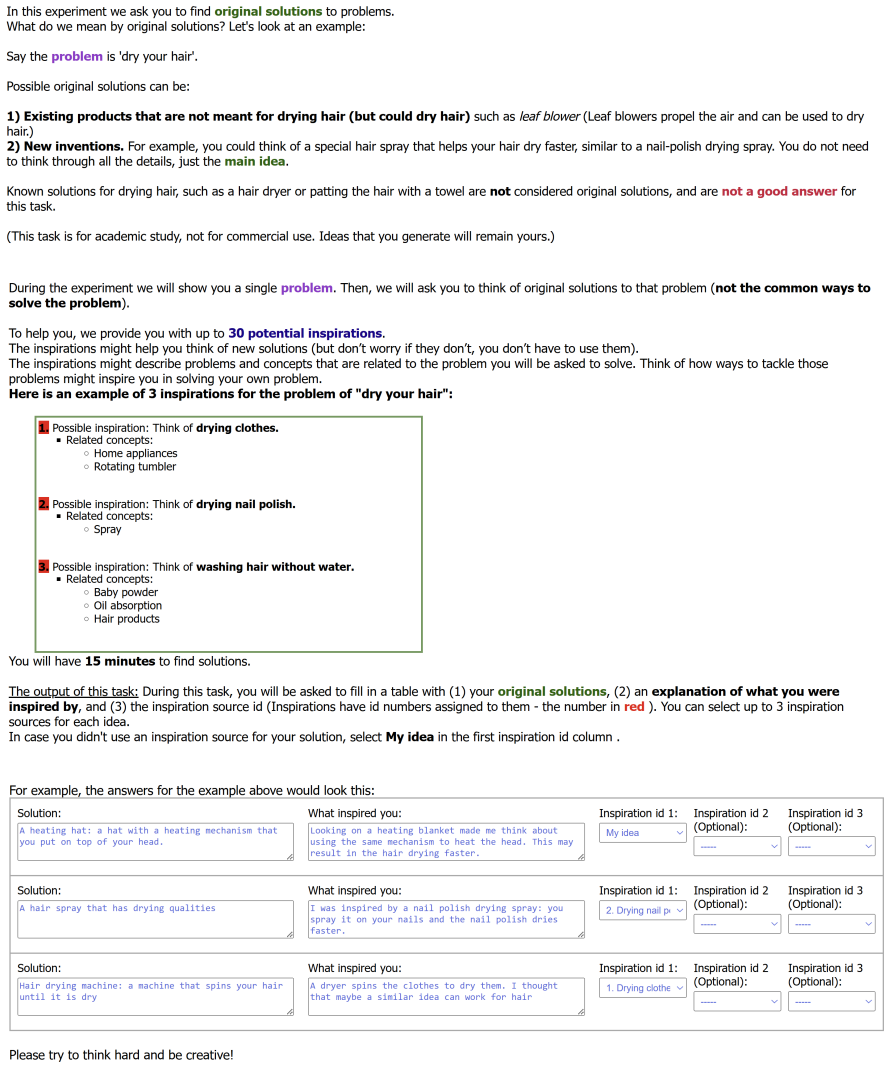
Possible inspiration: Think ofa method and apparatus for cooling a work piece
-
[2]
Possible inspiration: Think ofa system for cooling a person
-
[3]
Possible inspiration: Think ofa water cooled door
-
[4]
Possible inspiration: Think ofa computer cooling assembly
-
[5]
Possible inspiration: Think ofa cooling bed system Condition 2: Purpose + Mechanism
-
[9]
Possible inspiration: Think ofa method and apparatus for cooling a work pieceRelated concepts: • Heat-exchange apparatus
-
[10]
Possible inspiration: Think ofa system for cooling a personRelated concepts: • Air-humidification
-
[11]
Possible inspiration: Think ofa water cooled doorRelated concepts: • Combustion engines
Show all 18 references
-
[12]
Possible inspiration: Think ofa computer cooling assemblyRelated concepts: • Vehicle cooling systems
-
[13]
Possible inspiration: Think ofa cooling bed systemRelated concepts: • Therapeutic cooling beds Condition 3: Purpose + Mechanism sentence
-
[14]
Possible inspiration: Think ofa method and apparatus for cooling a work pieceRelated concepts: • Heat-exchange apparatus without direct contact enables precise workpiece cooling
-
[15]
Possible inspiration: Think ofa system for cooling a personRelated concepts: • Air-humidification enhances evaporative cooling effects for personal comfort
-
[16]
Possible inspiration: Think ofa water cooled doorRelated concepts: • Combustion engines employ water cooling technologies for component protection
-
[17]
Possible inspiration: Think ofa computer cooling assemblyRelated concepts: • Vehicle cooling systems inform compact computer cooling assembly design
-
[18]
Cool a room
Possible inspiration: Think ofa cooling bed systemRelated concepts: • Medical science applications incorporate therapeutic cooling beds for patient care Figure 7: Examples for inspirations sampled for the problem “Cool a room”. We provide 5 examples for each condition. For cla...
-
[2007]
I want” and “The patent provides
On the measurement of ideation quality.Jour- nal of Management Information Systems, 23(4):143– 161. Serhad Sarica, Jianxi Luo, and Kristin L Wood. 2020. Technet: Technology semantic network based on patent data.Expert Systems with Applications, 142:112995. Robert B Stone and K...
2020 arXiv
-
[2018]
James MacQueen
Two-phase clustering algorithm with density exploring distance measure.CAAI Transactions on Intelligence Technology, 3(1):59–64. James MacQueen. 1967. Some methods for classifica- tion and analysis of multivariate observations. In Proceedings of the Fifth Berkeley Symposium on...
1967 arXiv
-
[2022]
Aaron Hurst, Adam Lerer, Adam P Goucher, Adam Perelman, Aditya Ramesh, Aidan Clark, AJ Ostrow, Akila Welihinda, Alan Hayes, Alec Radford, and 1 others
Scaling creative inspiration with fine-grained functional aspects of ideas. Aaron Hurst, Adam Lerer, Adam P Goucher, Adam Perelman, Aditya Ramesh, Aidan Clark, AJ Ostrow, Akila Welihinda, Alan Hayes, Alec Radford, and 1 others. 2024. Gpt-4o system card.arXiv preprint arXiv:241...
2024 arXiv
Reviewed August 5, 2026 · model on record in the stance chip above.
Discussion (0). Sign in to comment.