REVIEW 3 major objections 4 minor 4 cited by
New study of the line profiles of sodium perturbed by H2
T0 review · 3 major / 4 minor · reviewed 2026-08-14 · deepseek-v4-flash
Pith's one-line read The paper claims that new unified sodium–H2 line profiles, computed from improved ab initio potentials and valid to H2 densities of $10^{21}\,\mathrm{cm}^{-3}$, should replace Lorentzian and older pseudo-potential treatments of sodium…
desk verdict A genuinely useful update to the Na–H2 opacity tables, but the two-orientation, fixed-H2 potentials carry an unquantified systematic error that a referee should push on. read the letter →
The pith
A machine-rendered reading of the paper's core claim, the machinery that carries it, and where it could break.
The reading
What carries the argument
The load-bearing object is the unified line-shape machinery: the absorption profile is the Fourier transform of a dipole autocorrelation function, $I(\Delta\omega)=\frac{1}{\pi}\mathrm{Re}\int_0^\infty \Phi(s)e^{-i\Delta\omega s}\,ds$, with $\Phi(s)=e^{-n_p g(s)}$ for a perturber density $n_p$. The calculation uses ab initio Na–H2 potential energy surfaces in the linear ($C_{\infty v}$) and T-shaped ($C_{2v}$) geometries, with the H2 bond frozen at its equilibrium length, together with transition dipole moments and a spin-orbit coupling treatment that separates the D1 and D2 components. To reach high densities the paper expands the autocorrelation function in powers of density, splitting $g(s)$ into averaged and oscillating parts; this is what allows opacity tables valid to $n_{\mathrm{H_2}}=10^{21}\,\mathrm{cm}^{-3}$ rather than the previous $10^{19}\,\mathrm{cm}^{-3}$.
What would settle it
A laboratory measurement of the sodium D1 and D2 absorption wings in a cell with a known density of H2 at roughly 1000–1500 K, looking for the predicted blue satellite near 5170 Å and the density-dependent shoulder near 4800 Å, would settle the central claim: if the satellite position or wing shape deviates strongly from the unified profiles, the potentials are wrong.
Extended reading notes
Core claim
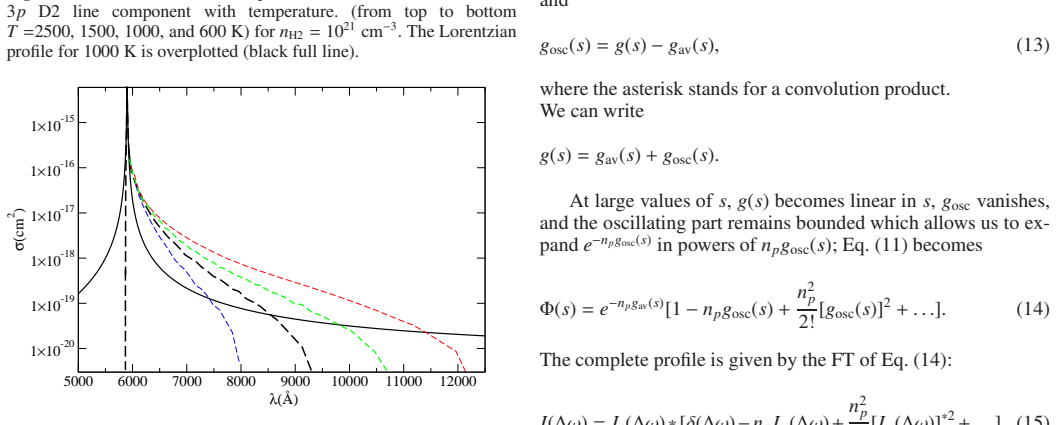
The core discovery, stated on the paper's own terms, is that the improved potentials make the Na–H2 resonance line widths obey simple density-linear, temperature-power-law forms, with $w_{\mathrm{D1}}=0.169\times10^{-20} n_{\mathrm{H_2}} T^{0.33}$ and $w_{\mathrm{D2}}=0.242\times10^{-20} n_{\mathrm{H_2}} T^{0.39}$ (w in cm$^{-1}$, $n_{\mathrm{H_2}}$ in cm$^{-3}$, $T$ in K), valid from 500 to at least 3000 K. The unified profiles also place the first blue satellite near 5170 Å and, at $n_{\mathrm{H_2}}=10^{21}\,\mathrm{cm}^{-3}$, a second shoulder near 4800 Å arising from multiple-perturber effects. The blue wing is markedly less extended than in the older RP85 profiles while the red wing remains similar. The paper concludes that Lorentzian profiles are not appropriate for these line wings and that unified profiles should be incorporated into spectral models.
Load-bearing premise
The load-bearing premise is that the Na–H2 potential energy surfaces are realistic, yet they are computed for only two geometries with the H2 bond length fixed and are never compared to molecular data, only to sodium atomic transition energies.
Editorial extensions
If this is right
- The D1 and D2 line widths can be computed directly from the two power-law formulas in the 500–3000 K range, replacing interpolation of full profiles for the core width.
- Opacity tables now reach $n_{\mathrm{H_2}}=10^{21}\,\mathrm{cm}^{-3}$, two orders of magnitude higher than the previous $10^{19}\,\mathrm{cm}^{-3}$ tables.
- The blue wing is less extended than in RP85-based profiles, so sodium pseudo-continuum opacity in the blue optical is weaker in brown dwarf and hot Jupiter models.
- In the hot Jupiter model presented, the new profiles produce more greenhouse heating in deep atmospheric layers and slightly cooler upper layers than the old profiles.
- Lorentzian profiles are unsuitable for the sodium doublet line wings; unified profiles are needed to reproduce the satellite position and wing shape.
- The blue satellite lies closer to line center than in RP85 profiles, shifting the optical pseudo-continuum compared with previous model spectra.
Reading between the lines
- The paper does not test the potential surfaces against molecular data; a natural next step is to repeat the calculation with a flexible H2 bond and an average over approach angles, which would show how much the frozen-bond, two-geometry choice affects the satellite position and widths.
- The same machinery should transfer to K–H2, since potassium wings shape the Y-band flux of self-luminous planets; by analogy with sodium, updated K profiles could shift the pseudo-continuum and the inferred temperature structure.
- If the power-law widths are imported into retrieval codes, they carry a validity limit: near $10^{20}$–$10^{21}\,\mathrm{cm}^{-3}$ the far blue wing is nonlinearly density-dependent, so a pure line-center treatment cannot be extrapolated.
Signed reviews
Editorial analysis
A structured set of objections, weighed in public.
Referee Report
Summary. The paper presents unified, semi-classical line profiles for the Na I 3s–3p doublet perturbed by H2, computed from new ab initio S17 potential energy surfaces that include spin-orbit coupling and transition dipole moments. It reports temperature- and density-dependent widths via power laws (Eqs. 7–8), a blue satellite at 5170 Å, opacity tables claimed to be valid up to n_H2 = 10^21 cm^-3, and applications to petitCODE models of self-luminous atmospheres and hot Jupiters. The intended contribution is to replace Lorentzian and older RP85-based wing treatments with profiles based on improved molecular data.
Significance. If substantiated, these profiles would be a practical improvement for brown dwarf and exoplanet opacity modeling, since Na–H2 wings are a major pseudo-continuum source and current tables are based on older potentials. The inclusion of spin-orbit coupling for the doublet, the diabatization of the 3p/4s crossing, and the explicit unified-theory treatment at densities up to 10^21 cm^-3 are clear advances. The paper also delivers ready-to-use parameterizations and states that tables and generation code will be archived at the CDS, which is valuable for the community. The width parameterizations are derived from the potentials rather than fitted to observed line widths, which is a strength. However, the accuracy claim rests on the molecular potentials and on an underspecified treatment of the H2 orientation, so the significance is conditional on the issues below.
major comments (3)
- [Sect. 2 and Sect. 3, Eq. (11)] The manuscript does not specify how the two computed Na–H2 geometries are used in the line-shape calculation. The S17 potentials are computed only for C∞v and C2v with the H2 bond frozen at r_e = 1.401 a.u., yet Eq. (11) uses a single pair autocorrelation function g(s). For a non-spherical perturber, g(s) must include a thermal average over the H2 orientation angle, or an equivalent justified approximation. The text contains no such average, no weighting of the linear and T-shaped geometries, and no estimate of the error from omitting intermediate orientations. Because the blue satellite position and the wing shapes are controlled by the difference potential ΔV(R, θ), this missing step directly affects the numerical results in Eqs. (7)–(8), Fig. 7, and the opacity tables. Please either document the orientation averaging or justify that one geometry dominates over the relevant R and T range.
- [Sect. 3.1 and Table 1] The only validation reported is the sodium atomic transition energies, with errors up to 25 cm^-1. No comparison is made between the S17 molecular potential energy surfaces and experimental or high-level reference data, and no error bars are propagated to the line widths or satellite position. Since the paper's central claim is that these profiles are accurate enough to replace previous treatments, the manuscript should include at least one molecular-level validation, such as a comparison with an experimental Na–H2 absorption spectrum or with independent high-level electronic structure calculations, or an explicit uncertainty analysis. This is a load-bearing gap rather than a cosmetic one.
- [Sect. 3.3] The statement that the new opacity tables are 'constructed to a higher order' of the density expansion does not specify the truncation order, and no convergence test is shown for the claimed validity up to n_H2 = 10^21 cm^-3. The density expansion in Eq. (14) can break down if n_p g_osc is not small; a brief comparison of the retained order with the next order, or with the exact Fourier transform of Eq. (11) at high density, is needed to support the table's quoted range.
minor comments (4)
- [Fig. 6 caption] The Fig. 6 caption lists the D2 power-law exponent as 0.32, while Eq. (8) and the abstract give 0.39; please correct this inconsistency.
- [Fig. 1 bottom panel] The label 'triangular-NaH2' is not consistent with the text's 'T-shape (C2v)' terminology; please unify the nomenclature for the same geometry.
- [Eq. (12)] The Gaussian A(s) is introduced without defining its width or the criterion used to separate g_av from g_osc; a one-sentence definition would improve reproducibility.
- [Eq. (16)] The oscillator strength f is used in Eq. (16) without an explicit definition or specification of which transition it refers to; please clarify.
Circularity Check
No significant circularity: the Na-H2 line profiles, widths, and opacity tables are numerical outputs of ab initio potentials and a general unified line-shape theory, not re-imported inputs.
full rationale
The paper's derivation chain is: S17 ab initio Na-H2 potentials and transition dipole moments (Sect. 2) are inputs to the unified line-shape formalism of Allard et al. (1999), producing the computed D1/D2 profiles, the line widths summarized by the power laws in Eqs. (7)-(8), the blue satellite at 5170 Å, and the density-expansion opacity tables. None of these outputs is used to define the potentials or the theory. The power laws in Eqs. (7)-(8) are explicitly fits to the numerically computed widths ('These expressions accurately represent the numerical results as shown in Fig. 6'), not fits to observed line widths or atmospheric spectra, so they are not fitted inputs renamed as predictions. The self-citations to Allard et al. (1999), Allard et al. (2003), Allard et al. (2012b), and earlier papers establish methodological lineage and provide the unified theory and previous profile versions, but the theory itself is parameter-free with stated assumptions (stationary radiator, independent perturbers, adiabatic scalar-additive potentials) and does not contain the Na-H2 line-width result. No uniqueness theorem is imported from the authors' prior work to forbid alternative potentials, and no ansatz is smuggled in via citation: the potentials are newly computed ab initio in this paper. The astrophysical applications with petitCODE are comparisons of the new versus old profiles, not inversions that assume the quoted widths. The absence of an independent benchmark for the molecular potential energy surfaces is a legitimate accuracy and robustness concern, but it is not a circularity: the derivation does not reduce to its own output by construction.
Assumptions & free parameters
free parameters (5)
- Na core-polarization parameters (alpha, rho_c) =
alpha=0.997 a0^3, rho_c=0.62
- Line-width power-law coefficients for D1 =
0.169e-20, exponent 0.33
- Line-width power-law coefficients for D2 =
0.242e-20, exponent 0.39
- Gaussian splitting width A(s) =
not specified
- Order of density expansion =
not specified; 'higher order'
assumptions (4)
- domain assumption H2 bond length fixed at r_e = 1.401 a.u. and only C2v (T-shape) and C_infinity v (linear) Na-H2 geometries are computed.
- domain assumption Semi-classical unified line shape assumptions: stationary radiator, independent perturbers, adiabatic scalar-additive potentials.
- domain assumption Cohen-Schneider atom-in-molecule spin-orbit approximation: molecular SO matrix elements are replaced by asymptotic atomic values, with a 3p/4s diabatization.
- domain assumption MRCI/CAS single-active-electron plus core-polarization calculation yields accurate Na-H2 potential energy surfaces.
Cite this review
Pith. "Pith review of New study of the line profiles of sodium perturbed by H2." pith.science (2026). https://pith.science/paper/YY3JGWF6
@misc{pith2026190801989,
  author       = {Pith},
  title        = {Pith review of: New study of the line profiles of sodium perturbed by H2},
  year         = {2026},
  howpublished = {\url{https://pith.science/paper/YY3JGWF6}},
  note         = {Machine review of arXiv:1908.01989}
}
read the original abstract
The opacity of alkali atoms, most importantly of Na and K, plays a crucial role in the atmospheres of brown dwarfs and exoplanets. We present a comprehensive study of NaH2 collisional profiles at temperatures from 500 to 3000 K, the temperatures prevailing in the atmosphere of brown dwarfs and Jupiter-mass planets.The relevant H2 perturber densities reach several 10^19 cm^-3 in hot Teff > 1500 K Jupiter-mass planets and can exceed 10^20 cm^-3 for more massive or cooler objects. Accurate pressure-broadened profiles that are valid at high densities of H2 should be incorporated into spectral models. Unified profiles of sodium perturbed by molecular hydrogen were calculated in the semi-classical approach using up-to-date molecular data.New NaH2 collisional profiles and their effects on the synthetic spectra of brown dwarfs and hot Jupiters computed with petitCODE are presented.
Figures


Figures from the paper (7 more)




Forward citations
Cited by 4 Pith papers
-
Mitigating Charge Migration in JWST NIRISS Reveals That KELT-7 b is a Metal-enriched Ultra-hot Jupiter Orbiting a Young Metal-rich Star
Correcting NIRISS charge migration reveals KELT-7 b as a metal-enriched (~92x solar) ultra-hot Jupiter with H2O, CO2 and TiO but no H- or clouds, orbiting a young metal-rich star.
-
Pyrat Bay 2.0: an Upgraded Framework for Exoplanet Atmosphere Modeling in the JWST Era
Pyrat Bay 2.0 adds equilibrium chemistry, radiative equilibrium, and vertically varying abundance retrieval, and simulations indicate JWST-quality spectra can recover such variations.
-
The Sonora Substellar Atmosphere Models. VII. Flame Skimmer: Cloud-free Atmospheric and Evolutionary Models for the Coldest Substellar Objects
A new cloud-free grid of atmospheric and evolutionary models for ultra-cool substellar objects spanning 50 to 2400 K, with updated disequilibrium chemistry and public data.
-
A parameterised approach to disequilibrium retrievals in the JWST era: Application to NIRCam observations of HD 189733b
A quench-pressure parameterisation with two free parameters recovers unbiased C/O and [M/H] from synthetic JWST spectra with vertical mixing, and tentatively detects quenching and photochemical H2S depletion in HD 189...
Reference graph
Works this paper leans on
-
[1]
Allard, N. F. & Alekseev, V . A. 2014, Advances Space Research, 54, 1248
work page 2014
-
[2]
Allard, N. F., Allard, F., Hauschildt, P . H., Kielkopf, J. F. , & Machin, L. 2003, A&A, 411, L473
work page 2003
-
[3]
F., Spiegelman, F., & Kielkopf, J
Allard, N. F., Spiegelman, F., & Kielkopf, J. F. 2016, A&A, 58 9, A21
work page 2016
- [4]
- [5]
-
[6]
Baudino, J.-L., Mollière, P ., V enot, O., et al. 2017, ApJ, 850, 150
work page 2017
-
[7]
Burrows, A., Hubbard, W. B., Lunine, J. I., & Liebert, J. 2001 , Rev. Mod. Phys., 73, 719
work page 2001
-
[8]
& V olobuyev, M
Burrows, A. & V olobuyev, M. 2003, ApJ, 583, 985
2003
Show all 24 references
-
[9]
M., Noyes, R
Charbonneau, D., Brown, T. M., Noyes, R. W., & Gilliland, R. L . 2002, ApJ, 568, 377
2002
-
[10]
Cohen, J. S. & Schneider, B. 1974, J. Chem. Phys., 61, 3230
1974
-
[11]
Kolb, A. C. & Griem, H. 1958, Physical Review, 111, 514
1958
-
[12]
D., Barman, T., & Koskinen, T
Lothringer, J. D., Barman, T., & Koskinen, T. 2018, ApJ, 866, 27
2018
-
[13]
Lothringer, J. D. & Barman, T. S. 2019, arXiv e-prints [ arXiv:1903.12183] Mollière, P ., van Boekel, R., Bouwman, J., et al. 2017, A&A, 6 00, A10 Mollière, P ., van Boekel, R., Dullemond, C., Henning, T., & Mordasini, C. 2015, ApJ, 813, 47
2019 arXiv
-
[14]
Moore, C. E. 1971, in BAAS, V ol. 3, Bulletin of the American As tronomical Society, 154–155 Müller, W., Flesch, J., & Meyer, W. 1984, J. Chem. Phys., 80, 3 297
1971
-
[15]
Nicklass, A., Dolg, M., Stoll, H., & Preuss, H. 1995, J. Chem. Phys., 102, 8942
1995
-
[16]
K., Fortney, J
Nikolov, N., Sing, D. K., Fortney, J. J., et al. 2018, Nature, 557, 526
2018
-
[17]
2018, A&A, 6 12, A53
Pino, L., Ehrenreich, D., Wyttenbach, A., et al. 2018, A&A, 6 12, A53
2018
-
[18]
& Pascale, J
Rossi, F. & Pascale, J. 1985, Phys. Rev. A, 32, 2657
1985
-
[19]
1971, Phys
Royer, A. 1971, Phys. Rev. A, 3, 2044
1971
-
[20]
& Kirby, K
Santra, R. & Kirby, K. 2005, J. Chem. Phys., 123, 214309
2005
-
[21]
K., Fortney, J
Sing, D. K., Fortney, J. J., Nikolov, N., et al. 2016, Nature, 529, 59
2016
-
[22]
A., Albretch, S., Mooij, E
Snellen, I. A., Albretch, S., Mooij, E. J. W., & Poole, R. S. L. 2008, A & A, 487, 357
2008
-
[23]
2007, Na ture, 448, 169
Tinetti, G., Vidal-Madjar, A., Liang, M.-C., et al. 2007, Na ture, 448, 169
2007
-
[24]
https: //www.molpro.net
Werner, H.-J. , Knowles, P . J., Knizia, G. , Manby, F. R. and Sc hütz, M. (2012), Molpro: a general-purpose quantum chemistry progr am package. WIREs Comput. Mol. Sci., 2: 242-253. doi:10.1002 /wcms.82; Werner, H.- J., Knowles, P . J., Knizia, G., et al., MOLPRO, version 2019...
2012
Reviewed August 14, 2026 · model on record in the stance chip above.
Discussion (0). Continue with ORCID to comment.