REVIEW 4 major objections 6 minor 75 references
FinSAgent argues that SEC filing QA fails because model priors misalign with how filings are written, and corrects both query generation and evidence selection with corpus-side conditioning.
Reviewed by Pith at T0; open to challenge. T0 means a machine referee read the full paper against a public rubric. the ladder, T0–T4 →
T0 review · deepseek-v4-flash
2026-08-01 15:59 UTC pith:YYZBHUSS
load-bearing objection A well-built SEC-filing QA system with a plausible but not yet isolated mechanism claim, and an abstract that overstates an online experiment the body never describes. the 4 major comments →
FinSAgent: Corpus-Aligned Multi-Agent RAG Framework for Evidence-Grounded SEC Filing Question Answering
The pith
A machine-rendered reading of the paper's core claim, the machinery that carries it, and where it could break.
Core claim
The paper's central discovery is that the two observed failure modes in SEC filing QA — missed evidence and false-positive boilerplate — have one cause: prior–corpus misalignment. It claims that conditioning retrieval planning on a lightweight view of the local corpus and gating reranking by non-semantic validity features corrects both ends. The evidence includes component ablations showing each addition improves recall on at least some corpora, matched-budget comparisons showing the gains are not from extra retrieval perspectives, and a double-dissociation showing the two mechanisms help different corpora for different reasons. The authors state the conclusion directly: SEC filing QA is bes
What carries the argument
The load-bearing mechanism is the feature-gated reranker: a semantic cross-encoder score is multiplied by a penalty (1 − λ(1 − p̂)), where p̂ is a gradient-boosted tree's estimate of evidential validity from 31 non-semantic features such as path provenance, path scores, lexical overlap, and chunk metadata. Because the penalty scales with the reranker's own confidence, high-scoring boilerplate is demoted more than low-scoring chunks. The second mechanism is database-aware query decomposition: before generating sub-queries, each agent retrieves a small set of section-level summaries of the local corpus and conditions its sub-queries on that view. Together they instantiate the paper's principle
Load-bearing premise
The gate's training labels come from the system's own pipeline — an LLM writes synthetic questions from random chunks, the retrieval pipeline returns candidates, and chunks matching the seed chunk are called positive — so the gate may be learning to recognize the synthetic question style rather than true evidential validity.
What would settle it
Train the feature gate on human-annotated evidence-validity labels, or replace it with an independent claim-entailment verifier, holding everything else fixed. If retrieval coverage and answer correctness do not improve over the ungated reranker, the central mechanism is an artifact of self-labeling; if the gains persist, the mechanism genuinely separates validity from semantics.
If this is right
- If correct, the same two-end correction should transfer to any standardized, redundancy-heavy corpus, such as patents, clinical trial reports, or regulatory disclosures, where boilerplate can outrank company- or case-specific evidence.
- Reranking pipelines that rely purely on semantic similarity may be leaving cheap, non-semantic signals on the table; a learned gate over retrieval-path and lexical features can separate evidential validity from topical similarity.
- Planned, corpus-aware retrieval can outperform handing an entire document to a long-context model, even on a single-document benchmark designed to favor the long-context approach.
- The error analysis implies that once retrieval and comprehension failures are suppressed, the remaining bottleneck shifts to fine-grained numerical precision, pointing to a clear next target for financial QA systems.
Where Pith is reading between the lines
- Editorial inference: the prior–corpus misalignment framing suggests a direct transfer test — applying the same database-aware decomposition and feature gate to another standardized corpus should reproduce the recall and correctness gains if the cause is truly structural rather than SEC-specific.
- Editorial inference: the paper's own future-work comparison against an NLI-style claim verifier would clarify whether the statistical gate learns evidential validity or merely the style of the synthetic training questions; a human-labeled validation set would settle the same question.
- Editorial inference: the online user study and the five benchmarks measure different question mixes; breaking down gains by question type (quantitative, legal, market, company) could show which role specializations earn their inference cost and which are optional.
Editorial analysis
A structured set of objections, weighed in public.
Referee Report
Summary. The paper proposes FinSAgent, a multi-agent retrieval-augmented framework for evidence-grounded question answering over SEC filings. Its central claim is that SEC filing QA is hampered by 'prior–corpus misalignment': model priors cause query decomposition to miss corpus-specific evidence and semantic reranking to favor topically similar but evidentially invalid chunks. FinSAgent instantiates three mechanisms: role-specialized agents anchored to the 10-K item structure, database-aware query decomposition conditioned on a lightweight summary-level corpus view, and multi-path retrieval with a learned feature-gated reranker that combines semantic scores with non-semantic validity features. The paper evaluates on five benchmarks (Lotus, Zeekr, FinanceBench, FinDER, and a 100-question SECQUE subset), reporting improvements in retrieval Macro-Recall and answer correctness over single-agent and multi-agent baselines, plus ablations, a matched-budget fairness study, a blind human validation, a full-document long-context comparison, RAGAS noise sensitivity, overhead measurements, and an error analysis.
Significance. The paper addresses a practical and timely problem: answering complex financial questions over long, standardized, and redundant SEC filings. The proposed 'corpus-side conditioning' principle is a coherent and potentially useful design lens, and the system-level results are broad: five datasets, multiple backbone models, matched retrieval budgets, human validation on 150 answers, and a long-context baseline. The strengths are the breadth of evaluation, the matched-budget study (Appendix B), the blind human check (Table 4), and the honest Limitations section, which explicitly identifies the missing separated baselines. If the mechanism-level claims are confirmed with direct ablations and the evaluation is tightened statistically, the work would be a solid systems contribution. As it stands, the core attribution of gains to the two named mechanisms is not yet isolated, and the gate's training labels derive from the very pipeline it is supposed to regulate, so the headline claims require further support.
major comments (4)
- [§3.4.2, Appendix C.2] The feature-gate training labels are generated by FinSAgent's own pipeline: an LLM synthesizes questions from random chunks, the full retrieval/reranking pipeline produces top-k candidates, and chunks matching the seed chunk are labeled positive. This is an in-distribution, pipeline-specific labeling scheme, not an external gold standard. The gate may therefore learn to recognize artifacts of the synthetic-question style or retrieval behavior rather than true evidential validity. This is load-bearing for the back-end claim (e.g., Table 3 Lotus recall 41→50 and Table 5 noise-sensitivity attribution). Please add a validation set with human/expert-annotated evidential-validity labels (or at least an independently sourced label set) and report gate performance on it, or otherwise show that the self-labeled training data does not drive the reported gains.
- [§4.3, Limitations (end of main text)] Table 3 is a cumulative ablation in a fixed order; it does not include either mechanism alone or leave-one-out configurations. The authors explicitly concede in the Limitations paragraph: 'Our evidence for the two mechanisms currently rests on full-system ablations and fixed-pool comparisons.' As a result, the gains attributed to database-aware decomposition and feature-gated reranking could in principle come from generic added context, extra retrieval paths, or other confounds. The FinanceBench row is instructive: the full system drops relative to '+ DB-Aware Decomp.' (76 vs 80), which the text explains as an order/interference effect; this further shows cumulative contributions do not isolate stable mechanism-level effects. The planned separated baselines (static corpus-overview prompt vs. database-aware decomposition; NLI/claim verifier vs. feature-gated reranker) are exactly what is
- [§1, §2, Abstract; §4.2] The abstract claims 'a three-arm randomized online experiment with 1,000 anonymous user ratings,' but the body never describes such an experiment and §1 instead refers to '~1,400 anonymous user ratings.' The discrepancy is not merely numerical: no protocol, randomization details, rating instrument, or statistical analysis for this experiment is provided anywhere in the paper. Since the abstract's headline claim rests on this experiment, and the offline head-to-head results in Table 2 are reported without error bars, confidence intervals, or significance tests, the evaluation is not yet statistically grounded. Please unify the numbers, present the online-experiment protocol and results, and add variance estimates/significance tests (or clearly label the offline comparisons as descriptive).
- [§4.3, Table 3; §4.2, Table 2] The matched-budget study (Appendix B; Table 7) is a valuable control, but it gives the baselines FinSAgent's budgets with the two mechanisms simply disabled. This does not directly test the mechanisms: the baselines also lack the role-specific prompts, the orchestrator, and other pipeline components. Consequently the phrase 'the advantage comes from database-aware decomposition and feature-gated reranking, not from having more retrieval perspectives' (Appendix B) overstates what the design can establish. Please add a budget-matched baseline that includes a static corpus-overview prompt (or an equivalent non-database-aware decomposition) with the same role structure, and a baseline that replaces the feature gate with an NLI/claim verifier, so the two mechanisms are isolated.
minor comments (6)
- [Table 2] The LC (long-context) rows are shown as zeros on Lotus, SECQUE, FinDER, and Zeekr; it would be clearer to mark these as 'not applicable' or explain why long-context is infeasible there.
- [§4.2, Table 2] FinGPT is described as a 'single-agent tool-augmented reasoner' but is given web/MCP access (§A.3). The comparison is reasonable, but the caption should note that FinGPT is not strictly a document-retrieval-only baseline.
- [§4.5] RAGAS is mentioned without a reference; please add a citation for the RAGAS framework and for the noise-sensitivity metric.
- [Abstract and §4.1] The abstract mentions 'five offline financial QA benchmarks' but the SECQUE subset is only 100 of 565 questions; please state this sampling explicitly in the abstract or keep the 'five benchmarks' phrasing but note the subset size in the main text (already in §4.1 and Appendix A.2).
- [§4.3, Figure 3] The co-retrieval heatmap is useful, but the caption and text could clarify whether the counts are per-query averaged or raw totals across the full evaluated set.
- [General] Some sentences are overly programmatic (e.g., 'we read this as evidence that the remaining bottleneck has moved downstream' in §4.8). A more measured phrasing would better match the results presented.
Circularity Check
Partial circularity in the feature-gate 'validity' labels; core benchmark results remain independent.
specific steps
-
fitted input called prediction
[§3.4.2 Feature-Gated Evidence Reranking; Appendix C.2 Gating Model Training]
"Using targeted hard-negative mining, an LLM generates questions from random chunks; these are run through the full retrieval and reranking pipeline; within the top-𝑘 results, chunks matching the chosen ground truth are labeled positive and the rest serve as competitive hard negatives..."
The gate's 'validity' label is not an external evidence standard: positive means the seed chunk that survives FinSAgent's own full retrieval/reranking pipeline for an LLM-written question, and negative means the pipeline's other top-k chunks. Thus the LightGBM output p̂=M(x), later called a 'validity estimate' that 'separates evidential validity from semantic similarity,' is by construction an estimate of seed-chunk identity under the same pipeline being corrected. The validity signal is partly the pipeline's own echo. External Macro-Recall benchmarks provide an independent check, so this is partial rather than total circularity.
full rationale
The load-bearing evaluation is external: FinanceBench, FinDER, SECQUE, Lotus, and Zeekr use annotated relevance labels, and a blind human study and matched-budget comparison add independent checks. So the overall claim that FinSAgent improves retrieval coverage and answer correctness is not forced by construction. The one genuinely circular element is the feature gate's training objective: positive labels are generated by the pipeline itself, then the fitted model is presented as a predictor of evidential validity. The Limitations section admits 'Our evidence for the two mechanisms currently rests on full-system ablations and fixed-pool comparisons' and plans direct separated baselines; that is a causal-attribution gap, not a circularity, and I weigh it as such rather than raising the score further. Self-citations (FinSage, VeritasFi, R2R) are descriptive related-work or baselines and are not load-bearing; no uniqueness theorem or ansatz is imported from the authors' prior work. Cumulative ablations make mechanism attribution uncertain but do not make the derivation circular.
Axiom & Free-Parameter Ledger
free parameters (6)
- Per-agent gating strength lambda_a =
0.1–0.3 per agent (validation-tuned; case study uses 0.30)
- Retrieval budgets (k0, k, ke; final context ~35 chunks) =
k0 summaries; top-k per path; ke final; ~35 chunks
- Near-duplicate removal threshold tau_sim =
BGE-M3 cosine threshold (not numerically specified)
- Gate training positive rate =
≈20%
- Agent roles / 10-K item mapping =
5 roles (general, quantitative, market, legal, company)
- 31-feature set for the gate =
31 features across 5 groups
axioms (5)
- domain assumption The mandated 10-K item structure is a stable, useful decomposition of evidence for filing QA.
- domain assumption A query-dependent, summary-level view of the corpus (top-k0 FAISS-retrieved section summaries) is sufficient signal to align sub-query generation.
- domain assumption Non-semantic features (retrieval paths, lexical overlap, metadata) carry signal about evidential validity beyond the cross-encoder.
- domain assumption LLM-as-judge scores (Likert 1–5) are valid and comparable across systems after blinding and order randomization.
- domain assumption Averaging 1–5 Likert scores yields an interval-scale correctness metric.
read the original abstract
Financial question answering over U.S. Securities and Exchange Commission (SEC) filings requires retrieving and synthesizing heterogeneous evidence dispersed across long, standardized, and highly redundant disclosures. Existing retrieval-augmented and multi-agent systems typically derive retrieval queries directly from the user's question and rank candidates by semantic similarity. Together, these choices create prior-corpus misalignment: a mismatch between model priors and the target filings' structure, terminology, and evidence standards. As a result, query generation misses corpus-specific evidence, while semantic reranking favors topically similar but evidentially invalid false-positive chunks. We propose FinSAgent, an evidence-grounded multi-agent framework that reframes SEC filing QA as corpus-aligned retrieval planning and corrects both ends with a single principle: inject corpus-side conditioning wherever model priors would otherwise dominate. FinSAgent combines (1) role-specialized agents anchored to the mandated 10-K item structure, (2) database-aware query decomposition that conditions each agent's sub-queries on a lightweight, summary-level view of the local corpus, and (3) multi-path retrieval with a learned feature-gated reranker that separates evidential validity from semantic similarity. Across five offline financial QA benchmarks, FinSAgent improves retrieval coverage and answer correctness over strong single-agent and multi-agent baselines; in a three-arm randomized online experiment with 1,000 anonymous user ratings, it also receives higher scores than baselines.
Figures




Reference graph
Works this paper leans on
-
[1]
Gagan Bhatia, El Moatez Billah Nagoudi, Hasan Cavusoglu, and Muhammad Abdul-Mageed. 2024. FinTral: A Family of GPT-4 Level Multimodal Finan- cial Large Language Models. InFindings of the Association for Computational Linguistics: ACL 2024, Lun-Wei Ku, Andre Martins, and Vivek Srikumar (Eds.). Association for Computational Linguistics, Bangkok, Thailand, 1...
-
[2]
Tianshi Cai, Guanxu Li, Nijia Han, Ce Huang, Zimu Wang, Changyu Zeng, Yuqi Wang, Jingshi Zhou, Haiyang Zhang, Qi Chen, et al . 2025. FinDebate: Multi- Agent Collaborative Intelligence for Financial Analysis. InProceedings of The 10th Workshop on Financial Technology and Natural Language Processing. 268–282
2025
-
[3]
Xinran Chen, Xuanang Chen, Ben He, Tengfei Wen, and Le Sun. 2024. Ana- lyze, Generate and Refine: Query Expansion with LLMs for Zero-Shot Open- Domain QA. InFindings of the Association for Computational Linguistics: ACL 2024, Lun-Wei Ku, Andre Martins, and Vivek Srikumar (Eds.). Association for Computational Linguistics, Bangkok, Thailand, 11908–11922. do...
doi:10.18653/v1/ 2024
-
[4]
Zhiyu Chen, Wenhu Chen, Charese Smiley, Sameena Shah, Iana Borova, Dylan Langdon, Reema Moussa, Matt Beane, Ting-Hao Huang, Bryan Routledge, and William Yang Wang. 2021. FinQA: A Dataset of Numerical Reasoning over Financial Data. InProceedings of the 2021 Conference on Empirical Methods in Natural Language Processing, Marie-Francine Moens, Xuanjing Huang...
2021
-
[5]
Zhiyu Chen, Shiyang Li, Charese Smiley, Zhiqiang Ma, Sameena Shah, and William Yang Wang. 2022. Convfinqa: Exploring the chain of numerical rea- soning in conversational finance question answering. InProceedings of the 2022 conference on empirical methods in natural language processing. 6279–6292
2022
-
[6]
Chanyeol Choi, Jihoon Kwon, Jaeseon Ha, Hojun Choi, Chaewoon Kim, Yong- jae Lee, Jy yong Sohn, and Alejandro Lopez-Lira. 2025. FinDER: Financial Dataset for Question Answering and Evaluating Retrieval-Augmented Genera- tion. arXiv:2504.15800 [cs.IR] https://arxiv.org/abs/2504.15800
Pith/arXiv arXiv 2025
-
[7]
Abhishek Darji, Fenil Kheni, Dhruvil Chodvadia, Parth Goel, Dweepna Garg, and Bankim Patel. 2024. Enhancing Financial Risk Analysis using RAG-based Large Language Models. In2024 3rd International Conference on Automation, Computing and Renewable Systems (ICACRS). 754–760. doi:10.1109/ICACRS62842. 2024.10841711
arXiv 2024
-
[8]
Matthijs Douze, Alexandr Guzhva, Chengqi Deng, Jeff Johnson, Gergely Szilvasy, Pierre-Emmanuel Mazaré, Maria Lomeli, Lucas Hosseini, and Hervé Jégou. 2025. The faiss library.IEEE Transactions on Big Data(2025)
2025
-
[9]
Lavanya Gupta, Saket Sharma, and Yiyun Zhao. 2024. Systematic evaluation of long-context LLMs on financial concepts. InProceedings of the 2024 Conference on Empirical Methods in Natural Language Processing: Industry Track. 1163–1175
2024
-
[10]
Siwei Han, Peng Xia, Ruiyi Zhang, Tong Sun, Yun Li, Hongtu Zhu, and Huaxiu Yao. 2025. Mdocagent: A multi-modal multi-agent framework for document understanding.arXiv preprint arXiv:2503.13964(2025)
Pith/arXiv arXiv 2025
-
[11]
Suchow, Xiao-Yang Liu, Benyou Wang, Alejandro Lopez-Lira, Qianqian Xie, Sophia Ananiadou, and Junichi Tsujii
Jimin Huang, Mengxi Xiao, Dong Li, Zihao Jiang, Yuzhe Yang, Yifei Zhang, Lingfei Qian, Yan Wang, Xueqing Peng, Yang Ren, Ruoyu Xiang, Zhengyu Chen, Xiao Zhang, Yueru He, Weiguang Han, Shunian Chen, Lihang Shen, Daniel Kim, Yangyang Yu, Yupeng Cao, Zhiyang Deng, Haohang Li, Duanyu Feng, Yongfu Dai, VijayaSai Somasundaram, Peng Lu, Guojun Xiong, Zhiwei Liu,...
-
[13]
Pranab Islam, Anand Kannappan, Douwe Kiela, Rebecca Qian, Nino Scherrer, and Bertie Vidgen. 2023. Financebench: A new benchmark for financial question answering.arXiv preprint arXiv:2311.11944(2023)
Pith/arXiv arXiv 2023
-
[14]
Yidong Jiang, Junrong Chen, Eftychia Makri, Jialin Chen, Peiwen Li, Ali Maatouk, Leandros Tassiulas, Eliot Brenner, Bing Xiang, and Rex Ying. 2026. Fin-RATE: A Real-world Financial Analytics and Tracking Evaluation Benchmark for LLMs on SEC Filings.arXiv preprint arXiv:2602.07294(2026)
Pith/arXiv arXiv 2026
-
[15]
Jiajie Jin, Yuyao Zhang, Yimeng Xu, Hongjin Qian, Yutao Zhu, and Zhicheng Dou. 2025. Finsight: Towards real-world financial deep research.arXiv preprint arXiv:2510.16844(2025)
arXiv 2025
-
[16]
Guolin Ke, Qi Meng, Thomas Finley, Taifeng Wang, Wei Chen, Weidong Ma, Qiwei Ye, and Tie-Yan Liu. 2017. LightGBM: A Highly Efficient Gradient Boosting Decision Tree. InAdvances in Neural Information Processing Systems (NeurIPS), Vol. 30
2017
-
[17]
Electronics Engineers, author
Tung Sum Thomas Kwok, Chi-Hua Wang, Guang Cheng, Institute of Electrical, and issuing body. Electronics Engineers, author. 2025.GReaTER: Generate Realistic Tabular data after data Enhancement and Reduction. IEEE, [Place of publication not identified] :
2025
-
[18]
Tung Sum Thomas Kwok, Xinyu Wang, Hengzhi He, Xiaofeng Lin, Peng Lu, Liheng Ma, Chunhe Wang, Ying Nian Wu, Lei Ding, and Guang Cheng
-
[19]
Bennett, and Marti A
Philippe Laban, Tobias Schnabel, Paul N. Bennett, and Marti A. Hearst. 2022. SummaC: Re-Visiting NLI-based Models for Inconsistency Detection in Summa- rization.Transactions of the Association for Computational Linguistics (TACL)10 (2022), 163–177
2022
-
[20]
Changlun Li, Yao SHI, Chen Wang, Qiqi Duan, Runke RUAN, Weijie Huang, Hao- nan Long, Lijun Huang, Nan Tang, and Yuyu Luo. 2025. Time Travel is Cheating: Going Live with DeepFund for Real-Time Fund Investment Benchmarking. In The Thirty-ninth Annual Conference on Neural Information Processing Systems Datasets and Benchmarks Track. https://openreview.net/fo...
2025
-
[21]
Rensis Likert. 1932. A technique for the measurement of attitudes.Archives of psychology(1932)
1932
-
[22]
Aditya Prakash
Haoxin Liu, Chenghao Liu, and B. Aditya Prakash. 2025. A Picture is Worth A Thousand Numbers: Enabling LLMs Reason about Time Series via Visualization. InProceedings of the 2025 Conference of the Nations of the Americas Chapter of the Association for Computational Linguistics: Human Language Technologies (Volume 1: Long Papers), Luis Chiruzzo, Alan Ritter...
2025
-
[23]
Xiao-Yang Liu, Guoxuan Wang, Hongyang Yang, and Daochen Zha. 2023. Fingpt: Democratizing internet-scale data for financial large language models.arXiv preprint arXiv:2307.10485(2023)
Pith/arXiv arXiv 2023
-
[24]
Yue Liu, Zhongying Ru, Shimin Di, Jipeng Zhang, Ruiyuan Zhang, and Xiaofang Zhou. 2026. Faithful in Steps: Improving Generalization and Citation in RAG via Query Decomposition. InProceedings of the AAAI Conference on Artificial Intelligence, Vol. 40. 35671–35679
2026
-
[25]
Qi Luo, Xiaonan Li, Yuxin Wang, Tingshuo Fan, Yuan Li, Xinchi Chen, and Xipeng Qiu. 2025. MARAG-R1: Beyond Single Retriever via Reinforcement-Learned Multi-Tool Agentic Retrieval.arXiv preprint arXiv:2510.27569(2025)
arXiv 2025
-
[27]
Lebede Ngartera, Saralees Nadarajah, and Rodoumta Koina. 2026. Bayesian RAG: uncertainty-aware retrieval for reliable financial question answering. (2026)
2026
-
[28]
Thang Nguyen, Peter Chin, and Yu-Wing Tai. 2025. Ma-rag: Multi-agent retrieval- augmented generation via collaborative chain-of-thought reasoning.arXiv preprint arXiv:2505.20096(2025)
arXiv 2025
-
[29]
Min Pan, Yu Liu, Jinguang Chen, Ellen Anne Huang, and Jimmy X. Huang
-
[30]
Roxana Petcu, Kenton Murray, Daniel Khashabi, Evangelos Kanoulas, Maarten de Rijke, Dawn Lawrie, and Kevin Duh. 2025. Query Decomposition for RAG: Balancing Exploration-Exploitation.arXiv preprint arXiv:2510.18633(2025)
arXiv 2025
-
[31]
Varshini Reddy, Rik Koncel-Kedziorski, Viet Dac Lai, Michael Krumdick, Charles Lovering, and Chris Tanner. 2024. Docfinqa: A long-context financial reason- ing dataset. InProceedings of the 62nd Annual Meeting of the Association for Computational Linguistics (Volume 2: Short Papers). 445–458
2024
-
[32]
Zhenghan Tai, Hanwei Wu, Qingchen Hu, Jijun Chi, Hailin He, Lei Ding, Tung Sum Thomas Kwok, Bohuai Xiao, Yuchen Hua, Suyuchen Wang, et al . 2025. VeritasFi: An Adaptable, Multi-tiered RAG Framework for Multi-modal Financial Question Answering.arXiv preprint arXiv:2510.10828(2025)
arXiv 2025
-
[33]
James Thorne, Andreas Vlachos, Christos Christodoulopoulos, and Arpit Mittal
-
[34]
Bin Wang, Chao Xu, Xiaomeng Zhao, Linke Ouyang, Fan Wu, Zhiyuan Zhao, Rui Xu, Kaiwen Liu, Yuan Qu, Fukai Shang, et al. 2024. Mineru: An open-source solution for precise document content extraction.arXiv preprint arXiv:2409.18839 (2024)
Pith/arXiv arXiv 2024
-
[35]
Feng Wang, Yiding Sun, Jiaxin Mao, Xue Wei, and Danqing Xu. 2025. FinS- Pilot: A Benchmark for Online Financial RAG System. InProceedings of the 34th ACM International Conference on Information and Knowledge Management(Seoul, Republic of Korea)(CIKM ’25). Association for Computing Machinery, New York, NY, USA, 6544–6548. doi:10.1145/3746252.3761643
arXiv 2025
-
[36]
Junlin Wang, Jue Wang, Ben Athiwaratkun, Ce Zhang, and James Zou. 2024. Mixture-of-agents enhances large language model capabilities.arXiv preprint arXiv:2406.04692(2024)
Pith/arXiv arXiv 2024
-
[37]
Xinyu Wang, Jijun Chi, Zhenghan Tai, Tung Sum Thomas Kwok, Hailin He, Zhuhong Li, Yuchen Hua, Muzhi Li, Peng Lu, Suyucheng Wang, et al . 2025. Finsage: A multi-aspect rag system for financial filings question answering. InProceedings of the 34th ACM International Conference on Information and Knowledge Management. 6144–6152
2025
-
[38]
Ziao Wang, Yuhang Li, Junda Wu, Jaehyeon Soon, and Xiaofeng Zhang. 2023. FinVis-GPT: A Multimodal Large Language Model for Financial Chart Analysis. arXiv:2308.01430 [cs.CL] https://arxiv.org/abs/2308.01430
Pith/arXiv arXiv 2023
-
[39]
2026.R 2R: A Post-training Framework for Multi-domain Decoder-Only Rerankers
Hanwei Wu, Qingchen Hu, Zhenghan Tai, Jingrui Tian, Lei Ding, Jijun Chi, Hailin He, Tung Sum Thomas Kwok, Yufei Cui, Sicheng Lyu, Muzhi Li, Mingze Li, Xinyue Yu, Ling Zhou, Peng Lu, and Xinyu Wang. 2026.R 2R: A Post-training Framework for Multi-domain Decoder-Only Rerankers. InAdvances in Knowledge Discovery and Data Mining, Raymond Chi-Wing Wong, Hanghan...
2026
-
[40]
Qingyun Wu, Gagan Bansal, Jieyu Zhang, Yiran Wu, Beibin Li, Erkang Zhu, Li Jiang, Xiaoyun Zhang, Shaokun Zhang, Jiale Liu, et al. 2024. Autogen: Enabling next-gen LLM applications via multi-agent conversations. InFirst conference on language modeling
2024
-
[41]
Shijie Wu, Ozan Irsoy, Steven Lu, Vadim Dabravolski, Mark Dredze, Sebas- tian Gehrmann, Prabhanjan Kambadur, David Rosenberg, and Gideon Mann
-
[42]
Yihong Wu, Liheng Ma, Muzhi Li, Jiaming Zhou, Lei Ding, Jianye Hao, Ho-fung Leung, Irwin King, Yingxue Zhang, and Jian-Yun Nie. 2025. Advancing Multi- Agent RAG Systems with Minimalist Reinforcement Learning.arXiv preprint arXiv:2505.17086(2025)
Pith/arXiv arXiv 2025
-
[43]
Yingqian Wu, Qiushi Wang, Zefei Long, Rong Ye, Zhongtian Lu, Xianyin Zhang, Bingxuan Li, Wei Chen, Liwen Zhang, and Zhongyu Wei. 2025. FinTeam: A Multi- agent Collaborative Intelligence System for Comprehensive Financial Scenarios. InCCF International Conference on Natural Language Processing and Chinese Computing. Springer, 443–455
2025
-
[44]
Xiaobo Xing, Wei Yuan, Tong Chen, Quoc Viet Hung Nguyen, Xiangliang Zhang, and Hongzhi Yin. 2025. TableDART: Dynamic Adaptive Multi-Modal Routing for Table Understanding.arXiv preprint arXiv:2509.14671(2025)
arXiv 2025
-
[45]
Shi-Qi Yan, Ya Li, Quan Liu, and Zhen-Hua Ling. 2026. Learn to be Honest: Mitigate LLMs’ Overconfidence for Improving Hallucination Detection with Self-Hesitation Activation. https://openreview.net/forum?id=FRtKUpgEZ9
2026
-
[46]
Antonio Jimeno Yepes, Yao You, Jan Milczek, Sebastian Laverde, and Renyu Li
-
[47]
Noga Ben Yoash, Meni Brief, Oded Ovadia, Gil Shenderovitz, Moshik Mishaeli, Rachel Lemberg, and Eitam Sheetrit. 2025. SECQUE: A Benchmark for Evaluating Real-World Financial Analysis Capabilities.arXiv preprint arXiv:2504.04596 (2025)
Pith/arXiv arXiv 2025
-
[48]
Le Zhang, Yihong Wu, Qian Yang, and Jian-Yun Nie. 2024. Exploring the Best Practices of Query Expansion with Large Language Models. InFindings of the Association for Computational Linguistics: EMNLP 2024, Yaser Al-Onaizan, Mohit Bansal, and Yun-Nung Chen (Eds.). Association for Computational Linguistics, Miami, Florida, USA, 1872–1883. doi:10.18653/v1/202...
-
[49]
Xuanyu Zhang and Qing Yang. 2023. Xuanyuan 2.0: A large chinese financial chat model with hundreds of billions parameters. InProceedings of the 32nd ACM international conference on information and knowledge management. 4435–4439
2023
-
[50]
Suifeng Zhao, Zhuoran Jin, Sujian Li, and Jun Gao. 2025. FinRAGBench-V: A Benchmark for Multimodal RAG with Visual Citation in the Financial Domain. InProceedings of the 2025 Conference on Empirical Methods in Natural Language Processing, Christos Christodoulopoulos, Tanmoy Chakraborty, Carolyn Rose, and Violet Peng (Eds.). Association for Computational L...
-
[51]
Andy Zhu and Yingjun Du. 2025. A Role-Aware Multi-Agent Framework for Financial Education QA. InProceedings of the 6th ACM International Conference on AI in Finance. 483–491
2025
-
[52]
arXiv preprint arXiv:2402.05131(2024)
Financial report chunking for effective retrieval augmented generation. arXiv preprint arXiv:2402.05131(2024)
Pith/arXiv arXiv 2024
-
[53]
Fengbin Zhu, Ziyang Liu, Fuli Feng, Chao Wang, Moxin Li, and Tat Seng Chua
-
[59]
InProceedings of the 5th ACM International Conference on AI in Finance
Tat-llm: A specialized language model for discrete reasoning over financial tabular and textual data. InProceedings of the 5th ACM International Conference on AI in Finance. 310–318
-
[61]
TAT-LLM: A Specialized Language Model for Discrete Reasoning over Financial Tabular and Textual Data. InProceedings of the 5th ACM International Conference on AI in Finance(Brooklyn, NY, USA)(ICAIF ’24). Association for Com- puting Machinery, New York, NY, USA, 310–318. doi:10.1145/3677052.3698685 A Datasets, Preprocessing, and Baselines A.1 Corpus Constr...
-
[62]
(Do silently.)
For open-ended question, first infer the user’s intent. (Do silently.)
-
[63]
Every sub-question must stay tightly anchored to the original intent
-
[64]
If the original question is already atomic and data-seeking, include it as one of the sub-questions
-
[65]
Not found in provided data
If the question asks for quater data, then it refers to the three-month period, not the cumulative data, unless explicitly stated. Return only a JSON array of strings. User question: {question} History: {history} Phase 2: Answer Generation You are a Quant Analysis Specialist.Rules: - No speculation. If data is missing, say "Not found in provided data". - ...
-
[66]
Key Findings (bullet points with period + number)
-
[67]
Supporting Evidence (table refs / snippets)
-
[68]
Computations (show formula + steps)
-
[69]
Accounting Policy Notes (ONLY if the question asks policy or the evidence explicitly affects interpretation)
-
[70]
Not found in provided evidence
Missing Data (only items blocking the answer) Figure 10: The instruction prompts for the Quant Analysis Agent, outlining the role description, query rewriting, and answering phases. FinSAgent: Corpus-Aligned Multi-Agent RAG Framework for Evidence-Grounded SEC Filing Question Answering Prompt for Company Agent Role Description Summary:Focuses on company hi...
-
[71]
Company & Industry Overview - Company growth: - Founder/management background:
-
[72]
History & Ownership Structure - Timeline (chronological bullets with dates): - Equity/Control events: - Special arrangements:
-
[73]
Not evidenced in provided documents
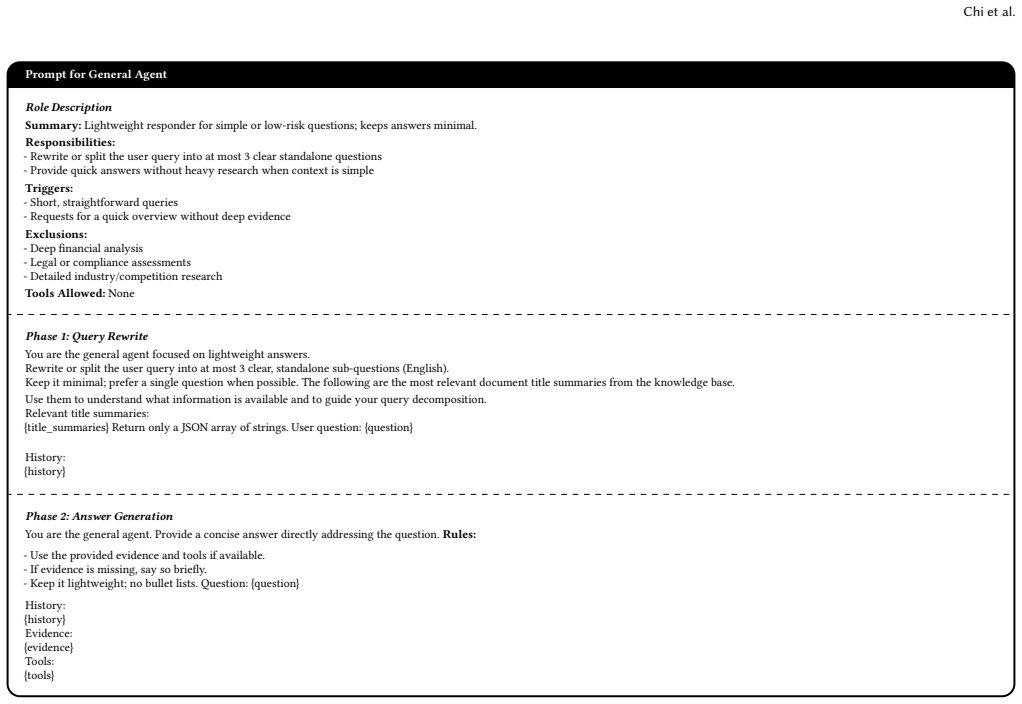
Uncertainties Figure 11: The instruction prompts for the Company Researcher Agent, outlining the role description, query rewriting, and answering phases. Chi et al. Prompt for General Agent Role Description Summary:Lightweight responder for simple or low-risk questions; keeps answers minimal. Responsibilities: - Rewrite or split the user query into at mos...
-
[74]
Extracted Evidence (short quoted snippets + where found)
-
[75]
Risk Assessment (risk→mechanism→severity→confidence)
-
[76]
Compliance Checklist (items found vs not found)
-
[77]
Deal Terms Summary (if deal context)
-
[78]
Not found in provided evidence
Missing Documents / Questions for Counsel Figure 13: The instruction prompts for the Legal & Risk Agent, outlining the role description, query rewriting, and answering phases. Chi et al. Prompt for Market Agent Role Description Summary:Covers industry and market context for the user question. Responsibilities: - Industry/market size and growth - Company m...
-
[2018]
In Proceedings of NAACL-HLT
FEVER: a Large-scale Dataset for Fact Extraction and VERification. In Proceedings of NAACL-HLT
-
[2023]
Bloomberggpt: A large language model for finance.arXiv preprint arXiv:2303.17564(2023)
Pith/arXiv arXiv 2023
-
[2024]
doi:10.1038/s41598- 024-82871-0
A multi-dimensional semantic pseudo-relevance feedback framework for information retrieval.Scientific Reports14, 1 (2024), 31806. doi:10.1038/s41598- 024-82871-0
doi:10.1038/s41598- 2024
-
[2025]
arXiv:2408.11878 [cs.CL] https://arxiv.org/abs/2408.11878
Open-FinLLMs: Open Multimodal Large Language Models for Financial Applications. arXiv:2408.11878 [cs.CL] https://arxiv.org/abs/2408.11878
-
[2026]
Enhancing TableQA through Verifiable Reasoning Trace Reward. Chi et al. arXiv:2601.22530 [cs.AI] https://arxiv.org/abs/2601.22530
discussion (0)
Sign in with ORCID, Apple, or X to comment. Anyone can read and Pith papers without signing in.