Glass-forming ability of Lennard-Jones trimers
Pith reviewed 2026-05-25 10:28 UTC · model grok-4.3
The pith
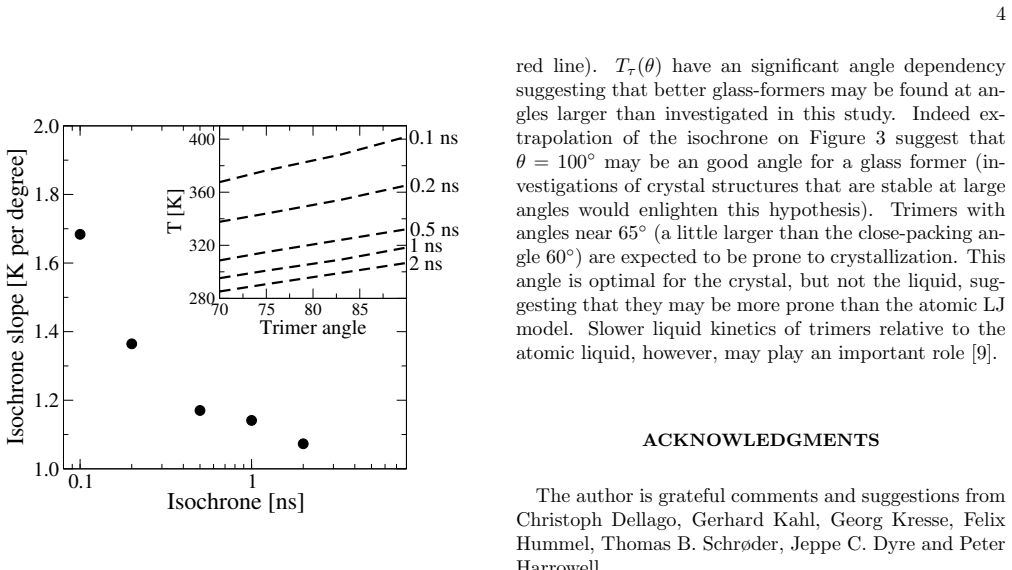
An 83-degree angle in Lennard-Jones trimers produces the largest separation between isochrones and melting temperature.
A machine-rendered reading of the paper's core claim, the machinery that carries it, and where it could break.
Core claim
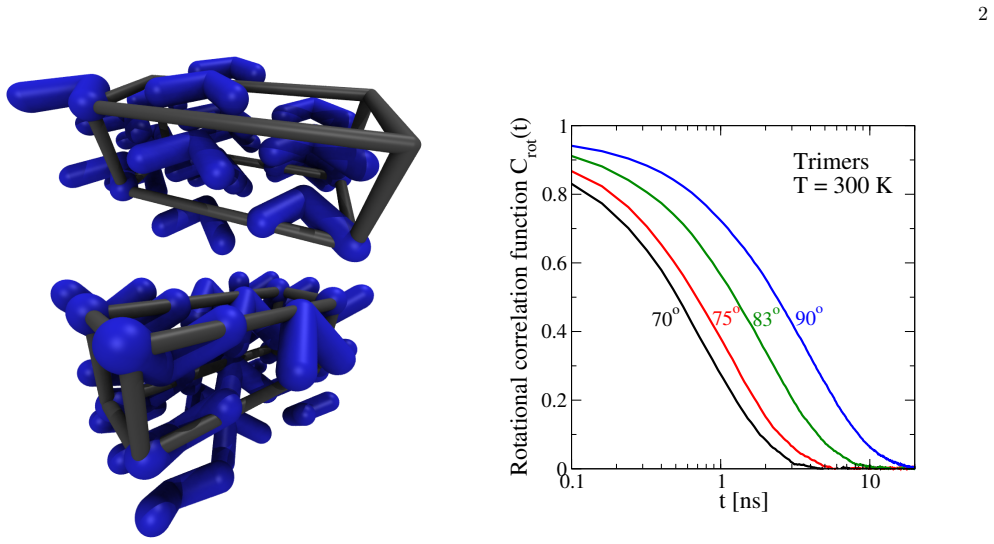
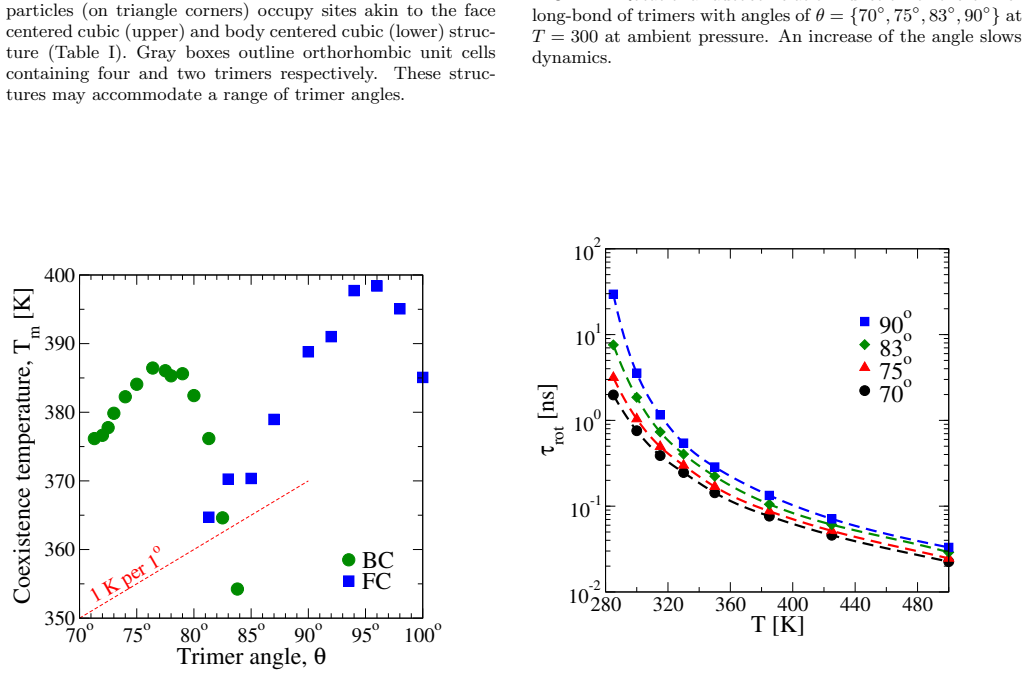
Melting temperatures are located for a distorted body-centered-cubic structure (preferred angle 77 degrees) and a distorted face-centered-cubic structure (preferred angle 96 degrees). Relaxation dynamics in the liquid slow monotonically with increasing trimer angle. The vertical distance between isochrones and the melting temperature is largest at 83 degrees, which is therefore identified as the angle of optimal glass-forming ability; angles beyond 100 degrees are conjectured to yield still better glass formers.
What carries the argument
Distance between isochrones (constant relaxation-time contours in the temperature-density plane) and the melting temperature, serving as the indicator of glass-forming ability.
If this is right
- Liquid dynamics become progressively slower at larger trimer angles while the melting line shifts.
- The two considered crystal lattices have distinct preferred angles, creating a competition that is strongest near 83 degrees.
- Glass-forming ability is predicted to improve further if angles above 100 degrees are examined.
- The same isochrone-melting separation can be used to rank other molecular shapes for glass-forming tendency.
Where Pith is reading between the lines
- The 83-degree optimum may arise from geometric frustration that penalizes both crystal packings equally.
- Similar angle scans could be performed on rigid molecules with different interaction potentials to map a broader design space for glass formers.
- If the isochrone criterion holds, it offers a simulation route to screen candidate glass-forming molecules before synthesis.
- The monotonic slowing of dynamics with angle suggests a possible link between molecular shape asymmetry and kinetic arrest.
Load-bearing premise
The distance between isochrones and melting temperature reliably ranks glass-forming ability, and the two distorted crystal structures are the only competing ordered phases.
What would settle it
Observation of a third crystal structure with lower free energy than either the distorted BCC or FCC phase at 83 degrees, or direct measurement showing faster nucleation at 83 degrees than at neighboring angles.
Figures
read the original abstract
Melting temperatures at ambient pressure of systems of isosceles Lennard-Jones trimers with angles ranging from 70 degrees to 100 degrees are determined. Two crystal structures are considered: a distorted body centered cubic structure and a distorted face centered cubic structure with preferred angles of 77 and 96 degrees, respectively. Liquid dynamics are slowed down when the angle is increased. A trimer angle of 83 degrees yields the largest distance between isochrones and the melting temperature, suggesting that this value gives the optimal glass-forming ability. It is conjectured that better glass-formers may be found at angles larger than the ones considered in this study.
Editorial analysis
A structured set of objections, weighed in public.
Referee Report
Summary. The manuscript determines melting temperatures at ambient pressure for isosceles Lennard-Jones trimers with angles from 70° to 100° using molecular dynamics. Two crystal structures are considered: a distorted BCC (preferred angle 77°) and a distorted FCC (preferred angle 96°). Liquid dynamics are reported to slow with increasing angle. The central claim is that 83° maximizes the distance between isochrones and the melting temperature, indicating optimal glass-forming ability, with a conjecture that better glass-formers exist at larger angles.
Significance. If the result holds, the work supplies concrete simulation data on how trimer angle influences melting points and relaxation dynamics in a simple model, offering a potential design principle for glass-forming ability. The explicit computation of melting temperatures and isochrone distances from direct simulations (rather than parameter fitting) is a positive feature that supports falsifiable comparisons.
major comments (1)
- [Abstract] Abstract: The claim that 83° yields the largest isochrone-Tm distance (and thus optimal GFA) is computed from melting temperatures obtained only for the distorted BCC and FCC structures. It is not demonstrated that these are the global-minimum-Tm phases for angles near 83°; a different lattice (e.g., monoclinic or hexagonal variant) that stabilizes with higher Tm at 83° would shrink the reported distance and could reorder the angle ranking.
minor comments (2)
- The abstract provides no error bars, system-size details, or explicit criteria for locating melting points and isochrones, which are needed to assess the statistical significance of the 83° maximum.
- A methods section should specify the interaction cutoff, thermostat/barostat choices, and the precise protocol used to identify the two crystal structures as the relevant competing phases.
Simulated Author's Rebuttal
We thank the referee for their careful reading of the manuscript and for highlighting this important limitation in our analysis. We respond to the major comment below.
read point-by-point responses
-
Referee: [Abstract] Abstract: The claim that 83° yields the largest isochrone-Tm distance (and thus optimal GFA) is computed from melting temperatures obtained only for the distorted BCC and FCC structures. It is not demonstrated that these are the global-minimum-Tm phases for angles near 83°; a different lattice (e.g., monoclinic or hexagonal variant) that stabilizes with higher Tm at 83° would shrink the reported distance and could reorder the angle ranking.
Authors: We agree that the manuscript only reports melting temperatures for the distorted BCC (preferred angle ~77°) and distorted FCC (preferred angle ~96°) structures. These were selected because they are the lattices that spontaneously form or are compatible with the isosceles trimer geometry in our simulations and because they are standard reference structures for simple molecular models. We did not perform an exhaustive enumeration or free-energy comparison against all other possible space groups (e.g., monoclinic, hexagonal, or other variants). Consequently, it remains possible that an unexamined structure could exhibit a higher Tm near 83° and thereby reduce the reported isochrone–Tm separation. In the revised version we will (i) qualify the abstract claim to state that the 83° optimum is obtained with respect to the two structures examined, (ii) add an explicit statement of this limitation in the discussion section, and (iii) note that a more comprehensive crystal-structure search would be required to confirm global optimality. The relative trends in liquid dynamics with angle and the comparison between the two lattices remain unchanged. revision: yes
Circularity Check
No circularity; results from direct simulation of Tm and isochrones for specified structures.
full rationale
The paper reports explicit molecular-dynamics computations of melting temperatures for two chosen crystal lattices (distorted BCC at 77° preference, distorted FCC at 96° preference) and of isochrone locations in the liquid. The 83° optimum is identified by direct numerical comparison of the resulting isochrone–Tm separations. No parameter is fitted to a subset and then re-used as a prediction, no self-citation supplies a load-bearing uniqueness theorem, and no ansatz is smuggled via prior work. The derivation chain therefore remains self-contained against external benchmarks and does not reduce to its inputs by construction.
Axiom & Free-Parameter Ledger
axioms (1)
- domain assumption Standard molecular dynamics assumptions hold, including periodic boundaries, sufficient equilibration, and that the chosen force field captures relevant physics.
Reference graph
Works this paper leans on
- [1]
- [2]
-
[3]
L. J. Lewis and G. Wahnstr¨ om, Solid State Commun 86, 295 (1993)
work page 1993
-
[4]
L. J. Lewis and G. Wahnstr¨ om, Non-Cryst. Solids 96, 172 (1994)
work page 1994
-
[5]
U. R. Pedersen, T. B. Schrøder, J. C. Dyre, and P. Harrowell, Phys. Rev. Lett. 104, 105701 (2010)
work page 2010
-
[6]
S. Toxvaerd, U. R. Pedersen, T. B. Schrøder, and J. C. Dyre, J. Chem. Phys. 130, 224501 (2009)
work page 2009
-
[7]
U. R. Pedersen, T. S. Hudson, and P. Harrowell, J. Chem. Phys. 134, 114501 (2011)
work page 2011
-
[8]
V. Molinero, S. Sastry, and C. A. Angell, Phys. Rev. Lett. 97, 075701 (2006)
work page 2006
-
[9]
U. R. Pedersen and P. Harrowell, J. Phys. Chem. B 115, 14205 (2011)
work page 2011
-
[10]
U. R. Pedersen, J. Chem. Phys. 139, 104102 (2013)
work page 2013
-
[11]
U. R. Pedersen, F. Hummel, G. Kresse, G. Kahl, and C. Dellago, Phys. Rev. B 88, 094101 (2013)
work page 2013
- [12]
- [13]
-
[14]
A. Gavezzotti, Molecular Aggregation: Structure analysis and molecular simulation of crystals and liq- 5 uids, IUCr Monographs on Crystallography science series, Vol. 19 (Oxford science publications, 2007)
work page 2007
-
[15]
Relaxations in complex systems,
C. A. Angell, “Relaxations in complex systems,” (U.S. GPO, Washington, D. C., 1985) Chap. Strong and fragile liquids, pp. 3–11
work page 1985
-
[16]
D. Frenkel and B. Smit, Understanding Molecular Simulation: From Algorithms to Applications , 2nd ed., edited by D. Frenkel, M. Klein, M. Parrinello, and B. Smit, Computational Science Series, Vol. 1 (Academic Press, 2002)
work page 2002
discussion (0)
Sign in with ORCID, Apple, or X to comment. Anyone can read and Pith papers without signing in.