REVIEW 3 major objections 5 minor 1 cited by
Two future long-baseline neutrino experiments would split the job of testing whether the neutrino mixing matrix is truly unitary.
Reviewed by Pith at T0; open to challenge. T0 means a machine referee read the full paper against a public rubric. the ladder, T0–T4 →
T0 review · deepseek-v4-flash
2026-08-02 19:47 UTC pith:Z23ZQWGI
load-bearing objection The paper's headline claim—P2SO's sensitivity to α33 and its improved bound—is likely an artifact of an incorrect matter Hamiltonian in the GLoBES implementation; the rest is a competent but incremental configuration study. the 3 major comments →
Probing non-unitarity of the PMNS matrix in P2SO and comparison with DUNE
The pith
A machine-rendered reading of the paper's core claim, the machinery that carries it, and where it could break.
Core claim
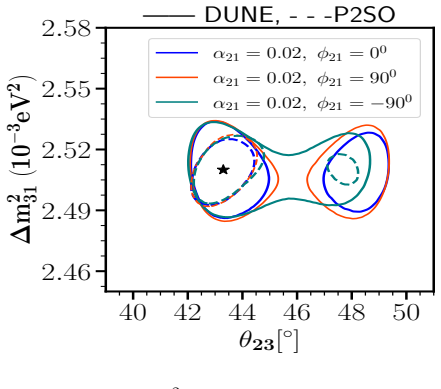
The central claim is that DUNE and P2SO have complementary sensitivity to non-unitarity of the leptonic mixing matrix: DUNE gives stronger bounds on the diagonal parameter α11 and the off-diagonal magnitude |α21|, while P2SO gives stronger bounds on α22 and α33, with the α33 advantage driven by P2SO's longer baseline (2595 km) and stronger matter effects. Within current allowed ranges, the paper finds that DUNE can improve the existing lower bound on α11 and P2SO can improve the existing lower bound on α33. It further shows that the presence of NU alters the experiments' ability to determine the mass hierarchy, the octant of θ23, and the CP-violating phase δCP, sometimes increasing and somet
What carries the argument
The triangular parametrization N = N_NP U, where N_NP is a lower-triangular matrix carrying three real diagonal parameters α11, α22, α33 and complex off-diagonal parameters αij; the paper focuses on α11, α22, α33, and the off-diagonal pair (|α21|, φ21). The analytic oscillation probabilities (Eqs. 7 and 10) show that α11 enters only the νe appearance channel, α22 enters both appearance and disappearance, and α33 enters neither vacuum probability—only matter effects. P2SO's 2595 km baseline and denser detector amplify matter effects, which is the mechanism behind its α33 advantage, while DUNE's larger statistics and beam configuration drive its superior α11 and |α21| bounds.
Load-bearing premise
The entire P2SO advantage, including the claimed α33 improvement, is computed for a specific assumed detector configuration—Super-ORCA ten times denser than ORCA, 450 kW beam, 4×10^20 POT/year, six-year run—with backgrounds and systematics imported from earlier studies by the same authors and never quantified in this paper; if the real detector's density, efficiency, or background rejection differs, the P2SO curves move and the α33 bound could slip below the current limit.
What would settle it
Measure the actual P2SO detector performance (density, efficiency, background rates) and rerun the α33 sensitivity calculation; alternatively, obtain an independent, matter-free measurement of α33 from a short-baseline disappearance channel or a different experimental setup and compare it with the P2SO-projected bound. If the real detector performs noticeably worse than the 10×-ORCA assumption, or if a matter-free α33 measurement disagrees with the P2SO projection, the paper's central complementarity claim would be falsified.
If this is right
- DUNE should be able to tighten the current bound on α11, while P2SO should tighten the current bound on α33; these are the two concrete improvements the paper claims.
- If NU is present at currently allowed levels, mass-hierarchy, octant, and CP-violation sensitivities computed under strict unitarity will be biased—hierarchy sensitivity drops with α11, rises with α22, and octant and CPV sensitivities shift non-monotonically.
- The bound on |α21| depends strongly on the phase φ21; marginalizing over φ21 weakens it, and CP-violation measurements must fit δCP and φ21 together rather than fixing the NU phase.
- The unusual kink/dip structure in the α33 sensitivity curves is traced to degeneracy with θ23 and to matter effects; removing θ23 or using vacuum would erase those features.
- The two experiments are complementary in NU parameter space, so a robust global picture requires combining both rather than relying on either alone.
Where Pith is reading between the lines
- A combined fit of DUNE and P2SO with all six NU parameters free would likely sharpen both α11 and α33 bounds beyond either experiment individually, because the two experiments' strongest constraints are nearly orthogonal in parameter space.
- Because α33 enters only through matter effects, P2SO's α33 bound carries a direct systematic dependence on the assumed Earth density profile along 2595 km; the paper does not quantify this, so the real-world bound could be looser than quoted.
- The 'six dof' scan still omits α31 and α32, so the quoted bounds are not full six-parameter results; reinserting those parameters with current global constraints could shift the allowed regions.
- A natural testable extension is to scan over the assumed Super-ORCA detector density (the paper uses 10× ORCA); if the real density or background rejection differs, the relative ordering of DUNE and P2SO on α22 and α33 could change.
Editorial analysis
A structured set of objections, weighed in public.
Referee Report
Summary. The manuscript uses GLoBES to simulate the upcoming P2SO and DUNE long-baseline experiments and derives projected constraints on the non-unitarity (NU) parameters α11, α22, α33, and |α21| in the triangular parametrization. It claims that DUNE will give stronger bounds on α11 and |α21|, while P2SO will give stronger bounds on α22 and α33, with DUNE (P2SO) improving the current bound on α11 (α33). It further studies correlations with standard oscillation parameters and quantifies the impact of NU on mass-hierarchy, octant, and CP-violation sensitivities. The methodology is mostly field-standard: Poisson likelihood with pull systematics, NuFIT 6.0 inputs, official DUNE TDR GLoBES files, and published NU probability formulas. The internal diagnostics in Figs. 5 and 7 are careful and valuable. However, the central α33 claim is inconsistent with the standard non-unitary matter evolution, and the P2SO simulation inputs are not quantified. These issues make the main conclusion unsupported as presented.
Significance. If the results were correct, the paper would provide a useful comparison of two complementary long-baseline experiments for NU searches and would quantify how NU distorts standard precision measurements. The authors deserve credit for explicitly investigating the origin of the kinks and dips in their sensitivity curves rather than leaving them unexplained, and for using external global-fit inputs. That said, the headline complementarity claim rests on the α33 sensitivity of P2SO, which appears to be an artifact of an incorrect matter Hamiltonian. Because the abstract and the conclusions rest on this claim, the significance of the paper cannot be assessed as stated; a corrected version could be valuable, but the current central result is not reliable.
major comments (3)
- [VI.A, Fig. 1, Table II] The α33 sensitivity is not predicted by the standard non-unitary matter formalism. With the triangular parametrization and α31=α32=0, the matter Hamiltonian in the mass basis is H_m = M/(2E) + N† V_f N = M/(2E) + |α11|² V_CC U_e U_e†, and the amplitudes are (N e^{-iH_m L}N†)_{βα}. For β,α=e,μ, neither N nor H_m contains α33, so P_μe and P_μμ are independent of α33 in vacuum and in matter. The statement that α33 'does not enter the vacuum oscillation probabilities, but contributes in matter' is therefore incorrect for the channels analyzed. No ν_τ appearance sample is described in Secs. IV–V, and the diagnostics in Figs. 5 and 7 use only P_μe/P_μμ. I conclude that the α33 curves in Fig. 1, the α33 rows of Table II, and all α33-dependent sensitivity results are artifacts of the probability engine (apparently replacing U by N in the flavor-basis matter Hamiltonian). The claim that P2SO impr
- [IV.A, V] The P2SO projections are not reproducible from the information given. Detector response, energy resolution, efficiencies, background rates, systematic pulls, and matter density profile are not specified; they are only delegated to refs [51,58–61], several of which are co-authored by the present authors. The only quantitative new ingredient is 'Super-ORCA detector 10 times more dense.' Because the P2SO advantage on α22 (and the purported one on α33) depends on these inherited assumptions, the reader cannot judge the robustness of the results. A table listing the simulated channels, signal/background efficiencies, systematic uncertainties, and matter profile should be added.
- [Table II, Sec. VI] The column labeled 'six dof' is misleading. In the text, α31 and α32 are fixed to zero and only four NU parameters (plus φ21) are varied. Thus the marginalized bounds are four-degree-of-freedom bounds, not six-parameter marginalized bounds. The comparison with the current limits from [36] is therefore not apples-to-apples. Either include α31 and α32 in the marginalization, or rename the column and explicitly justify fixing them.
minor comments (5)
- [Eq. (11)] The symbol 'cos(I_123)' is undefined. It should presumably be cos(δCP + Δm²31 L/(4E)) or an explicitly defined phase.
- [Table II] The column structure of Table II is hard to read. Add explicit column headers in the caption so that the one-dof and six-dof entries for DUNE and P2SO are unambiguous.
- [Fig. 1] The dashed curves for the α33 panel, corresponding to θ23 fixed at its true value, are not explained in the caption. The caption should identify all curves.
- [Sec. VI.B] The phrase 'assuming NU does not exist in Nature' is imprecise. The simulations use benchmark true values with αii=1 and αij=0; this is a choice of true parameters, not an assumption about data.
- [Secs. IV–V] The paper should state explicitly whether ν_τ charged-current events are included in the GLoBES simulation. If they are not, α33 cannot be constrained by the channels used; if they are, the channel list and efficiencies should be documented.
Circularity Check
No significant circularity: the projected NU bounds are forward GLoBES simulations benchmarked against external fits; self-citations supply experimental inputs, not the derived conclusions.
full rationale
The central claims (DUNE constrains α11/α21 better; P2SO constrains α22/α33 better; NU affects hierarchy/octant/CPV sensitivities) are outputs of a forward simulation: GLoBES event generation + Poisson likelihood (Eq. 14) with pull systematics, not results obtained by re-inserting the target quantities. The benchmark for 'improving current bounds' is the external global fit Ref. [36], and the standard oscillation inputs are NuFIT 6.0, so the comparison is externally anchored. The analytical probabilities in Eqs. (7) and (10) are taken from the external formalism of Ref. [27]; the statement that α33 enters only through matter is attributed to Refs. [25,46], with [25] being an independent external paper. Even if the α33 matter implementation in the modified GLoBES engine is wrong (the skeptical concern), that would be a correctness/validity error in the Hamiltonian, not a circular reduction of the prediction to its input. Self-citations are present: S. Roy co-authors Refs. [38,46], and Ghosh/Mohanta co-author the P2SO configuration papers [51,59-61]. However, these are used as experimental inputs and supporting formalism, not as the derivation of the new bounds; the P2SO configuration also rests on the external Ref. [58], and the α31/α32 neglect is consistent with the external current limits of Ref. [36]. Minor caveats (the 'six dof' scan actually varies four NU parameters after dropping α31,α32; the α33 sensitivity is not shown at the probability level) are presentation/completeness issues, not circularity. Therefore no claim in this paper reduces by construction to a fitted parameter, a self-citation chain, or a renamed input.
Axiom & Free-Parameter Ledger
free parameters (3)
- Standard oscillation parameters (true values) =
NuFIT 6.0 best fit (Table I): sin²θ23=0.470, δCP=212°, Δm²31=2.513×10⁻³ eV², etc.
- Benchmark NU values for correlation plots =
α11=0.95/0.90, α22=0.99/0.98, α33=0.95/0.90, |α21|=0.02/0.04, φ21=0°, ±90°
- P2SO detector response, systematics, and matter profile =
not stated in the paper
axioms (6)
- domain assumption The 3×3 mixing matrix is written N = N_NP U (lower-triangular times unitary), with heavy states integrated out (Eq. 3).
- domain assumption Pμe = α11²|α21|² + α11²α22² P3×3_μe + α11²α22|α21| P^I_μe (Eq. 7), dropping cubic terms in α21, sinθ13, Δm²21; analogous Pμμ expression (Eqs. 10–13).
- domain assumption α31 and α32 have negligible effects within current limits [38] and are excluded, including from the 'six dof' scans.
- domain assumption Matter evolution is computed in a modified GLoBES engine that includes NU; heavy states do not participate in oscillation (averaged-out regime).
- domain assumption P2SO experimental specifications: 450 kW beam, 4×10^20 POT/yr, six-year run, Super-ORCA 10× ORCA density, 0.2–10 GeV window.
- standard math Poisson log-likelihood with pull systematics; θ23 and Δm²31 marginalized within NuFIT 6.0 3σ ranges; δCP and φ21 fully marginalized.
read the original abstract
We compare the sensitivity of the upcoming long-baseline neutrino experiments Protvino to Super-ORCA (P2SO) and the Deep Underground Neutrino Experiment (DUNE) to non-unitarity (NU) of the leptonic mixing matrix in a model-independent framework. NU can arise in theories beyond the Standard Model that include heavy neutral leptons. These effects can modify neutrino oscillation probabilities and introduce new sources of CP violation, which may affect precision measurements of neutrino parameters. We find that DUNE provides stronger bounds on $\alpha_{11}$ and $|\alpha_{21}|$, while P2SO shows better sensitivity to $\alpha_{22}$ and $\alpha_{33}$, mainly due to its longer baseline and stronger matter effects. Our results show that DUNE (P2SO) will be able to improve the current bounds of $\alpha_{11}$ ($\alpha_{33}$). We further examine correlations with standard oscillation parameters and quantify the impact of NU on mass hierarchy, octant, and CP-violation sensitivities. Our results show that these sensitivities depend upon NU in a non-trivial way interconnecting the parameter degeneracies and matter effects. Our results demonstrate the complementarity of P2SO and DUNE in probing NU and show that NU can significantly influence next-generation precision oscillation studies.
Figures




Forward citations
Cited by 1 Pith paper
-
Impact of matter effects on the unitarity test of lepton mixing
The authors examine extraction of lepton mixing matrix elements from spectral data in neutrino oscillation experiments including matter effects and test unitarity via a vanishing quantity in a four-generation model.
Reference graph
Works this paper leans on
-
[1]
one dof”), whereas in the next column, we give the bounds by varying all NU parameters simultaneously (which we refer as “six dof
It remains unclear if the value is greater (normal hierarchy) or less (inverted hierarchy) than zero. Regarding the CP-violating phase δCP, it is still one of the most unsettled issues in the neutrino field. It is crucial to ascertain the CP violating phase since it offers an indication to answer the matter-antimatter asym- metry of the universe through l...
-
[2]
A. B. McDonald, Rev. Mod. Phys.88, 030502 (2016)
2016
-
[3]
For the panels withα ii (i= 1,2,3), the rightmost point represents the standard case, while forα 21, the zero value corresponds to standard oscillation scenario. The closed nature of these contours 11 0.85 0.90 0.95 1.00 α11 2.44 2.48 2.52 2.56 2.60 ∆m 2 31 (10−3eV2) DUNE P2SO 0.85 0.90 0.95 1.00 α22 2.44 2.48 2.52 2.56 2.60 ∆m 2 31 (10−3eV2) DUNE P2SO 0....
2023
-
[4]
Kajita, Rev
T. Kajita, Rev. Mod. Phys.88, 030501 (2016)
2016
-
[5]
Abbasiet al.((IceCube Collaboration)∥, IceCube), Phys
R. Abbasiet al.((IceCube Collaboration)∥, IceCube), Phys. Rev. Lett.134, 091801 (2025), arXiv:2405.02163 [hep-ex]
Pith/arXiv arXiv 2025
-
[6]
M. A. Aceroet al.(NOvA), Phys. Rev. D106, 032004 (2022), arXiv:2108.08219 [hep-ex]
Pith/arXiv arXiv 2022
-
[7]
Abeet al.(T2K), (2025), arXiv:2506.05889 [hep-ex]
K. Abeet al.(T2K), (2025), arXiv:2506.05889 [hep-ex]
arXiv 2025
-
[8]
T. Endoh, S. Kaneko, S. K. Kang, T. Morozumi, and M. Tanimoto, Phys. Rev. Lett.89, 231601 (2002), arXiv:hep-ph/0209020
Pith/arXiv arXiv 2002
-
[9]
Fukugita and T
M. Fukugita and T. Yanagida, Phys. Lett. B174, 45 (1986)
1986
-
[10]
A. S. Joshipura, E. A. Paschos, and W. Rodejohann, JHEP08, 029 (2001), arXiv:hep- ph/0105175
arXiv 2001
-
[11]
Akeret al.(KATRIN), Science388, adq9592 (2025), arXiv:2406.13516 [nucl-ex]
M. Akeret al.(KATRIN), Science388, adq9592 (2025), arXiv:2406.13516 [nucl-ex]
arXiv 2025
-
[12]
W. Buchmuller, R. D. Peccei, and T. Yanagida, Ann. Rev. Nucl. Part. Sci.55, 311 (2005), arXiv:hep-ph/0502169
Pith/arXiv arXiv 2005
-
[13]
Abubakaret al.(T2K, NOvA), Nature646, 818 (2025), arXiv:2510.19888 [hep-ex]
S. Abubakaret al.(T2K, NOvA), Nature646, 818 (2025), arXiv:2510.19888 [hep-ex]
arXiv 2025
-
[14]
Garcia-Quinteroet al.(DESI), (2025), arXiv:2504.18464 [astro-ph.CO]
C. Garcia-Quinteroet al.(DESI), (2025), arXiv:2504.18464 [astro-ph.CO]
Pith/arXiv arXiv 2025
-
[15]
A. G. Adameet al.(DESI), JCAP07, 028 (2025), arXiv:2411.12022 [astro-ph.CO]
Pith/arXiv arXiv 2025
-
[16]
H. Shao, J. J. Givans, J. Dunkley, M. Madhavacheril, F. J. Qu, G. Farren, and B. Sherwin, Phys. Rev. D111, 083535 (2025), arXiv:2409.02295 [astro-ph.CO]
Pith/arXiv arXiv 2025
-
[17]
Schechter and J
J. Schechter and J. W. F. Valle, Phys. Rev. D22, 2227 (1980)
1980
-
[18]
R. N. Mohapatra and G. Senjanovic, Phys. Rev. Lett.44, 912 (1980). 23
1980
-
[19]
M. Gell-Mann, P. Ramond, and R. Slansky, Conf. Proc. C790927, 315 (1979), arXiv:1306.4669 [hep-th]
Pith/arXiv arXiv 1979
-
[20]
A. A. Aguilar-Arevaloet al.(MiniBooNE), Phys. Rev. Lett.121, 221801 (2018), arXiv:1805.12028 [hep-ex]
Pith/arXiv arXiv 2018
-
[21]
J. W. F. Valle and J. C. Romao,Neutrinos in high energy and astroparticle physics, Physics textbook (Wiley-VCH, Weinheim, 2015)
2015
-
[22]
Z. Maki, M. Nakagawa, and S. Sakata, Prog. Theor. Phys.28, 870 (1962)
1962
-
[23]
P. Huber, Phys. Rev. C84, 024617 (2011), [Erratum: Phys.Rev.C 85, 029901 (2012)], arXiv:1106.0687 [hep-ph]
Pith/arXiv arXiv 2011
-
[24]
A. Aguilaret al.(LSND), Phys. Rev. D64, 112007 (2001), arXiv:hep-ex/0104049
Pith/arXiv arXiv 2001
-
[25]
G. Mention, M. Fechner, T. Lasserre, T. A. Mueller, D. Lhuillier, M. Cribier, and A. Le- tourneau, Phys. Rev. D83, 073006 (2011), arXiv:1101.2755 [hep-ex]
Pith/arXiv arXiv 2011
-
[26]
S. Antusch, C. Biggio, E. Fernandez-Martinez, M. B. Gavela, and J. Lopez-Pavon, JHEP10, 084 (2006), arXiv:hep-ph/0607020
Pith/arXiv arXiv 2006
-
[27]
K. N. Abazajianet al., (2012), arXiv:1204.5379 [hep-ph]
Pith/arXiv arXiv 2012
-
[28]
M. Blennow, P. Coloma, E. Fernandez-Martinez, J. Hernandez-Garcia, and J. Lopez-Pavon, JHEP04, 153 (2017), arXiv:1609.08637 [hep-ph]
Pith/arXiv arXiv 2017
-
[29]
Gronau, C
M. Gronau, C. N. Leung, and J. L. Rosner, Phys. Rev. D29, 2539 (1984)
1984
-
[30]
F. J. Escrihuela, D. V. Forero, O. G. Miranda, M. Tortola, and J. W. F. Valle, Phys. Rev. D 92, 053009 (2015), [Erratum: Phys.Rev.D 93, 119905 (2016)], arXiv:1503.08879 [hep-ph]
Pith/arXiv arXiv 2015
-
[31]
Figure 3 shows how∆m2 31 depends on the NU parameters;α11 (upper-left),α 22 (upper-right),α 33 (lower-left), andα 21 (lower- right)
with NU parameters, assuming NU does not exist in nature. Figure 3 shows how∆m2 31 depends on the NU parameters;α11 (upper-left),α 22 (upper-right),α 33 (lower-left), andα 21 (lower- right). In each panel, blue and magenta contours represent allowed parameter space for the DUNE and P2SO experiments, respectively, with all contours plotted at the3σconfiden...
-
[32]
M. Blennow, P. Coloma, E. Fernández-Martínez, J. Hernández-García, J. López-Pavón, X. Marcano, D. Naredo-Tuero, and S. Urrea, Nucl. Phys. B1017, 116944 (2025), arXiv:2502.19480 [hep-ph]
Pith/arXiv arXiv 2025
-
[33]
E. Nardi, E. Roulet, and D. Tommasini, Phys. Lett. B327, 319 (1994), arXiv:hep-ph/9402224
Pith/arXiv arXiv 1994
-
[34]
S. Goswami and T. Ota, Phys. Rev. D78, 033012 (2008), arXiv:0802.1434 [hep-ph]
Pith/arXiv arXiv 2008
-
[35]
A. Atre, T. Han, S. Pascoli, and B. Zhang, JHEP05, 030 (2009), arXiv:0901.3589 [hep-ph]
Pith/arXiv arXiv 2009
-
[36]
F. J. Escrihuela, D. V. Forero, O. G. Miranda, M. Tórtola, and J. W. F. Valle, New J. Phys. 19, 093005 (2017), arXiv:1612.07377 [hep-ph]
Pith/arXiv arXiv 2017
-
[37]
E. Fernandez-Martinez, J. Hernandez-Garcia, and J. Lopez-Pavon, JHEP08, 033 (2016), arXiv:1605.08774 [hep-ph]
Pith/arXiv arXiv 2016
-
[38]
M. Blennow, E. Fernández-Martínez, J. Hernández-García, J. López-Pavón, X. Marcano, and D. Naredo-Tuero, JHEP08, 030 (2023), arXiv:2306.01040 [hep-ph]
Pith/arXiv arXiv 2023
-
[39]
D. V. Forero, C. Giunti, C. A. Ternes, and M. Tortola, Phys. Rev. D104, 075030 (2021), arXiv:2103.01998 [hep-ph]
Pith/arXiv arXiv 2021
-
[40]
P. B. Denton and J. Gehrlein, JHEP06, 135 (2022), arXiv:2109.14575 [hep-ph]
Pith/arXiv arXiv 2022
-
[41]
D. Dutta and S. Roy, J. Phys. G48, 045004 (2021), arXiv:1901.11298 [hep-ph]. 24
Pith/arXiv arXiv 2021
-
[42]
S.-F. Ge, P. Pasquini, M. Tortola, and J. W. F. Valle, Phys. Rev. D95, 033005 (2017), arXiv:1605.01670 [hep-ph]
Pith/arXiv arXiv 2017
-
[43]
D. Meloni, T. Ohlsson, W. Winter, and H. Zhang, JHEP04, 041 (2010), arXiv:0912.2735 [hep-ph]
Pith/arXiv arXiv 2010
-
[44]
O. G. Miranda, P. Pasquini, M. Tórtola, and J. W. F. Valle, Phys. Rev. D97, 095026 (2018), arXiv:1802.02133 [hep-ph]
Pith/arXiv arXiv 2018
-
[45]
S. C and R. Mohanta, (2017), arXiv:1708.05372 [hep-ph]
Pith/arXiv arXiv 2017
-
[46]
O. G. Miranda, D. K. Papoulias, O. Sanders, M. Tórtola, and J. W. F. Valle, Phys. Rev. D 102, 113014 (2020), arXiv:2008.02759 [hep-ph]
Pith/arXiv arXiv 2020
-
[47]
P. Coloma, J. López-Pavón, S. Rosauro-Alcaraz, and S. Urrea, JHEP08, 065 (2021), arXiv:2105.11466 [hep-ph]
Pith/arXiv arXiv 2021
-
[48]
S. K. Agarwalla, S. Das, A. Giarnetti, and D. Meloni, JHEP07, 121 (2022), arXiv:2111.00329 [hep-ph]
Pith/arXiv arXiv 2022
-
[49]
D. Dutta, P. Ghoshal, and S. Roy, Nucl. Phys. B920, 385 (2017), arXiv:1609.07094 [hep-ph]
Pith/arXiv arXiv 2017
-
[50]
J. Hernandez-Garcia and J. Lopez-Pavon, inProspects in Neutrino Physics(2017) arXiv:1705.01840 [hep-ph]
Pith/arXiv arXiv 2017
-
[51]
S. S. Chatterjee, O. G. Miranda, M. Tórtola, and J. W. F. Valle, Phys. Rev. D106, 075016 (2022), arXiv:2111.08673 [hep-ph]
Pith/arXiv arXiv 2022
-
[52]
A. M. G. Trzeciak, H. Nunokawa, and A. A. Quiroga, JHEP11, 059 (2025), arXiv:2502.10873 [hep-ph]
arXiv 2025
-
[53]
D. Kaur, N. R. Khan Chowdhury, and U. Rahaman, Eur. Phys. J. C84, 118 (2024), arXiv:2110.02917 [hep-ph]
Pith/arXiv arXiv 2024
-
[54]
D. K. Singha, M. Ghosh, R. Majhi, and R. Mohanta, JHEP05, 117 (2022), arXiv:2112.04876 [hep-ph]
Pith/arXiv arXiv 2022
-
[55]
S. K. Raut, R. S. Singh, and S. U. Sankar, Phys. Lett. B696, 227 (2011), arXiv:0908.3741 [hep-ph]
Pith/arXiv arXiv 2011
-
[56]
A. Dighe, S. Goswami, and S. Ray, Phys. Rev. Lett.105, 261802 (2010), arXiv:1009.1093 [hep-ph]
Pith/arXiv arXiv 2010
-
[57]
P. B. Denton, J. Gehrlein, and C.-F. Kong, Nucl. Phys. B1018, 117040 (2025), arXiv:2502.14027 [hep-ph]
Pith/arXiv arXiv 2025
-
[58]
Z.-z. Xing, Phys. Rev. D85, 013008 (2012), arXiv:1110.0083 [hep-ph]
Pith/arXiv arXiv 2012
-
[59]
E. Fernandez-Martinez, M. B. Gavela, J. Lopez-Pavon, and O. Yasuda, Phys. Lett. B649, 427 (2007), arXiv:hep-ph/0703098
Pith/arXiv arXiv 2007
-
[60]
H. Hettmansperger, M. Lindner, and W. Rodejohann, JHEP04, 123 (2011), arXiv:1102.3432 [hep-ph]
Pith/arXiv arXiv 2011
-
[61]
A. V. Akindinovet al., Eur. Phys. J. C79, 758 (2019), arXiv:1902.06083 [physics.ins-det]
Pith/arXiv arXiv 2019
-
[62]
D. K. Singha, M. Ghosh, R. Majhi, and R. Mohanta, Phys. Rev. D107, 075039 (2023), arXiv:2211.01816 [hep-ph]. 25
Pith/arXiv arXiv 2023
-
[63]
R. Majhi, D. K. Singha, M. Ghosh, and R. Mohanta, Phys. Rev. D107, 075036 (2023), arXiv:2212.07244 [hep-ph]
Pith/arXiv arXiv 2023
-
[64]
D. K. Singha, R. Majhi, L. Panda, M. Ghosh, and R. Mohanta, Phys. Rev. D109, 095038 (2024), arXiv:2308.10789 [hep-ph]
Pith/arXiv arXiv 2024
-
[65]
Abiet al.(DUNE), (2021), arXiv:2103.04797 [hep-ex]
B. Abiet al.(DUNE), (2021), arXiv:2103.04797 [hep-ex]
arXiv 2021
-
[66]
B. Abiet al.(DUNE), Eur. Phys. J. C80, 978 (2020), arXiv:2006.16043 [hep-ex]
arXiv 2020
- [67]
-
[68]
P. Huber, J. Kopp, M. Lindner, M. Rolinec, and W. Winter, Comput. Phys. Commun.177, 432 (2007), arXiv:hep-ph/0701187
Pith/arXiv arXiv 2007
-
[69]
G. L. Fogli, E. Lisi, A. Marrone, D. Montanino, and A. Palazzo, Phys. Rev. D66, 053010 (2002), arXiv:hep-ph/0206162
Pith/arXiv arXiv 2002
-
[70]
P. Huber, M. Lindner, and W. Winter, Nucl. Phys. B645, 3 (2002), arXiv:hep-ph/0204352
Pith/arXiv arXiv 2002
-
[71]
I. Esteban, M. C. Gonzalez-Garcia, M. Maltoni, I. Martinez-Soler, J. P. Pinheiro, and T. Schwetz, JHEP12, 216 (2024), arXiv:2410.05380 [hep-ph]. 26
Pith/arXiv arXiv 2024
discussion (0)
Sign in with ORCID, Apple, or X to comment. Anyone can read and Pith papers without signing in.