REVIEW 4 major objections 5 minor 48 references
DeepUKF-VIN: Adaptively-tuned Deep Unscented Kalman Filter for 3D Visual-Inertial Navigation based on IMU-Vision-Net
T0 review · 4 major / 5 minor · reviewed 2026-08-09 · deepseek-v4-flash
Pith's one-line read This paper claims that a quaternion-based Unscented Kalman Filter whose noise covariances are set by two small neural networks—one reading recent IMU measurements and one reading stereo images—consistently beats the standard UKF for…
desk verdict The derivation is clean and the idea is plausible, but the paper's own Table III contradicts the central claim of consistent superiority on held-out data, and the training/validation split is misreported. read the letter →
The pith
A machine-rendered reading of the paper's core claim, the machinery that carries it, and where it could break.
The reading
What carries the argument
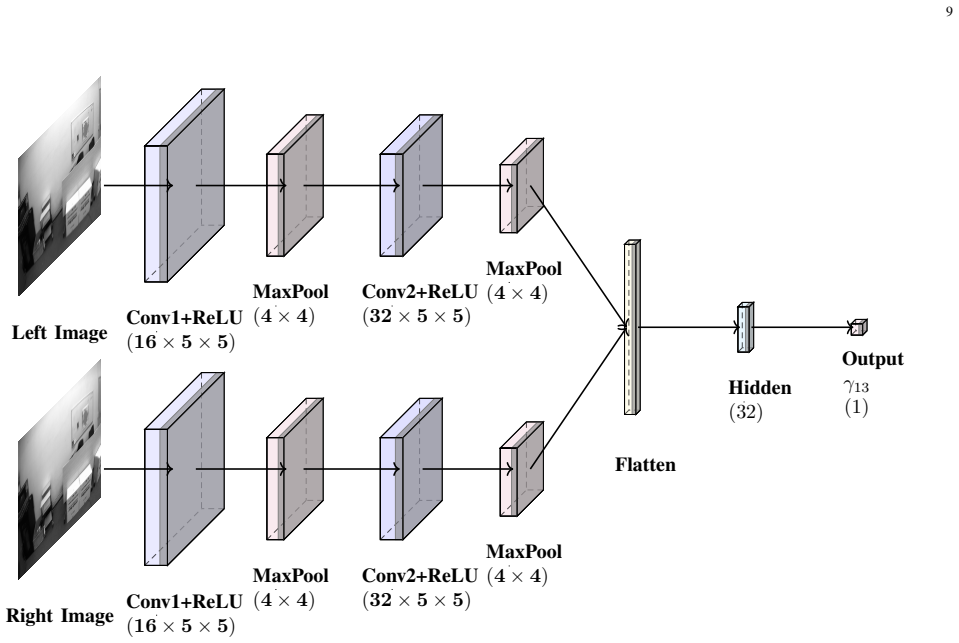
The central machinery is a quaternion-based Unscented Kalman Filter whose noise covariance matrices are not fixed but recomputed at each step by the Deep Learning-based Adaptation Mechanism (DLAM). IMU-Net is a two-layer bidirectional GRU that maps the last ten IMU measurements to twelve scaling factors for the gyroscope, accelerometer, and bias covariances; Vision-Net is a small convolutional network that maps the current stereo pair to a single scaling factor for the landmark measurement covariance. The scaling rule c_i = c̄_i $10^{{υ tanh γ_i}}$ keeps the learned covariances positive and bounded around offline-tuned nominal values. The filter itself handles quaternions with the ⊞/⊟ operations, weighted quaternion averaging via the largest eigenvalue of the weighted outer-product matrix, and intermittent vision updates by aggregating IMU steps between image frames.
What would settle it
Run DeepUKF-VIN and the standard UKF on a visual-inertial sequence where landmark world coordinates are not supplied ahead of time and must be estimated online together with pose (e.g., a mapless or SLAM-style setup), using identical nominal covariances and training data; if the learned filter no longer beats the standard UKF, the improvement is attributable to the map, not the learned covariances.
Extended reading notes
Core claim
The central claim is that learned covariance scaling transfers from an EKF-trained model to UKF inference and improves all navigation outputs. The filter represents attitude as a unit quaternion, propagates $\sigma$ points through the discrete navigation kinematics, computes quaternion-weighted means, and corrects with a Kalman update; the noise covariances in that correction are driven by scaling factors γ from the two networks via c_i = c̄_i $10^{{υ tanh γ_i}}$. The paper reports that on the V1_02 medium sequence (used only for validation, not training for the UKF case) and the V2_02 medium sequence (never seen in training), DeepUKF-VIN outperforms both the standard UKF-VIN and the DeepEKF in orientation, position, and velocity MSE.
Load-bearing premise
The reported gains depend on the assumptions that the world-frame positions of tracked visual landmarks are known well enough (they are said to be triangulated from stereo, but the paper does not show how these coordinates are initialized or corrected without using the pose being estimated) and that noise covariances learned under an EKF improve an UKF without retraining.
Editorial extensions
If this is right
- If the reported comparison holds, noise-covariance matrices for a UKF can be produced by a small learned network instead of manual trial-and-error tuning.
- The same DLAM training, done with an EKF for gradient simplicity, improves a different filter type at inference, suggesting the learned noise model is not filter-specific.
- The improvement is simultaneous across orientation, position, and velocity, not a trade-off among state components.
- The filter remains stable and accurate with low-rate vision (20 Hz) and low-cost IMU data, the regime where manual tuning is most fragile.
Reading between the lines
- Because the scaling rule only multiplies nominal covariances, applying the same DLAM to other Kalman-type filters, as the authors suggest, is straightforward; the main risk is not architecture but the assumption that the noise model learned from one trajectory family transfers to different motion profiles.
- A direct testable extension would use the same IMU-Net and Vision-Net outputs to adapt covariances in a system that estimates landmark positions online; the paper's own validation uses pre-triangulated landmark coordinates, so the claim currently covers fixed-map navigation.
- The loss weights wq = 1000, wp = 600, wv = 100 imply the method prioritizes orientation accuracy; deployments that care equally about position would need those weights rebalanced, which the paper does not explore.
Editorial analysis
A structured set of objections, weighed in public.
Referee Report
Summary. The paper proposes DeepUKF-VIN, a quaternion-based Unscented Kalman Filter for 3D visual-inertial navigation in which the measurement and process noise covariance matrices are scaled at each time step by two neural networks: IMU-Net, a bidirectional GRU stack, and Vision-Net, a convolutional network. The networks are trained end-to-end by differentiating a weighted mean-square-error loss through the filtering recursion; to avoid differentiation through eigenvalue and singular-value decompositions, an EKF is substituted for the UKF during training. The paper reports experiments on the EuRoC V1_02_medium and V2_02_medium sequences and claims that DeepUKF-VIN consistently outperforms a standard UKF-VIN and a DeepEKF across orientation, position, and velocity estimation.
Significance. The idea of learning covariance corrections from raw sensor data and transferring them to a nonlinear filter is potentially useful, and the quaternion-based UKF formulation in Section IV is technically detailed and mostly coherent. The paper also evaluates on real-world data with a public dataset, which is a strength. However, the central empirical claim of consistent superiority is contradicted by the paper's own held-out results, and the training/evaluation protocol is internally inconsistent. Because the main contribution is empirical validation of an adaptive filtering mechanism, these problems are load-bearing rather than cosmetic.
major comments (4)
- [Table III; Section VII; Abstract] The claim that DeepUKF-VIN consistently outperforms UKF-VIN across all navigation components is contradicted by Table III on the held-out V2_02_medium sequence: the orientation MSE is 0.0080 for DeepUKF-VIN versus 0.0026 for UKF-VIN, a factor-of-three degradation. Table II shows essentially no loss improvement on that sequence (250 vs. 251). Since Section VII explicitly identifies V2_02_medium as not used in training, this is not a training-set artifact; the central empirical claim fails on the paper's own test data.
- [Section VI vs. Section VII] Section VI states that 'The V1_02_medium part of the EuRoC dataset has been utilized for training,' yet Section VII says that 'DeepUKF-VIN was never trained on either experiment' and presents V1_02_medium as a validation experiment. These statements are mutually inconsistent. Moreover, the loss weights, nominal standard deviations, deviation bound, and loss transient cutoff were chosen with access to V1 data, so the V1 comparison in Table II and Table III is a fit-versus-baseline comparison rather than an independent evaluation.
- [Section VI, Algorithm 1] The training procedure explicitly replaces the UKF with an EKF to make gradient computation tractable and then hypothesizes that the learned covariance model transfers to the UKF. This hypothesis is never tested: Section VII does not retrain the network with a UKF, does not compare EKF-trained versus UKF-trained covariance models, and does not analyze whether the learned covariances are consistent with the UKF's noise assumptions. Without such evidence, the reported UKF results cannot be attributed to the DLAM mechanism.
- [Eq. (25); Section VI] The measurement update in Eq. (25) uses world-frame landmark coordinates l_w,i, but the manuscript only says that these points are computed by stereo triangulation. It does not specify how l_w,i is initialized or updated relative to the pose being estimated. If l_w,i is derived using the estimated trajectory, Eq. (25) introduces a hidden coupling that can bias the innovation; if l_w,i comes from a prior map, the system is not operating in the fully map-free setting implied by the paper. This point must be clarified for the experiments to be interpretable.
minor comments (5)
- [Section IV-A] The first sentence reads 'he filter is initialized' and is missing the leading 'T'; this should be corrected.
- [Section V, Eq. (47)] The notation for the IMU-Net input is inconsistent: the text around Eq. (47) uses 'uk−11:k−1', while the definition and Fig. 3 use 'uk−1−dGRU:k−1'; one notation should be used throughout.
- [Section VII, Table III] No error bars, repeated-run statistics, or significance tests are reported, so differences such as position MSE 0.3011 versus 0.3070 on V2_02_medium are within plausible random variation and should not be described as consistent improvement.
- [Algorithm 1, step 10] The gradient clipping step is written as 'Gradientmini-batch ← max(Gradientmini-batch, 1)', which reads as clipping from below at 1; if a norm cap of 1 is intended, the operation should be stated precisely.
- [Section VI] The numerical values of the nominal standard deviations, the deviation bound upsilon, and the UKF tuning parameters (lambda, alpha, beta) are not reported, which hinders reproducibility even though the loss weights are stated.
Circularity Check
V1 validation is a training-set fit, and the held-out V2 result contradicts the claimed consistent superiority.
-
fitted input called prediction
[Section VI, 'Training and Implementation'; Section VII, 'Experimental Validation'; Eq. (58); Tables II and III]
"The V1 02 medium part of the EuRoC dataset [43] has been utilized for training. ... the total loss is computed as the weighted sum of the mean square errors (MSE) of the individual errors defined in (57). ... To validate the effectiveness of quaternion-based DeepUKF-VIN, the algorithm is tested using the real-world V1 02 medium EuRoC dataset."
The networks are trained end-to-end on V1 02 medium to minimize the loss in Eq. (58), which is a weighted MSE of exactly the orientation, position, and velocity errors defined in Eq. (57) and reported in Table III. Therefore the V1 row of Tables II and III is a comparison of the trained model on its own training set against untrained baselines; any V1 improvement is a fitted outcome, not a prediction. The paper further states that 'DeepUKF-VIN was never trained on either experiment,' which is contradicted by the Section VI training sentence. Hence part of the central claim of consistent superiority reduces, by construction, to evaluating a fit on the data used to produce that fit.
full rationale
The filter derivation itself is largely self-contained: the quaternion UKF equations are standard, and the DLAM covariance-scaling formula in Eq. (50) is explicitly attributed to external prior work [32,33]. The significant circularity enters at the evaluation stage. The networks are trained on V1 02 medium to minimize Eq. (58), which is the weighted MSE of exactly the orientation, position, and velocity errors reported in Table III; consequently, the V1 comparison in Tables II and III is a training-set comparison rather than an independent prediction. The paper's assertion that DeepUKF-VIN 'was never trained on either experiment' is contradicted by Section VI. The genuinely held-out V2 experiment is the only independent test, and it does not rescue the central claim: Table III shows DeepUKF-VIN orientation MSE 0.0080 versus 0.0026 for UKF-VIN, about a factor of three worse, while the overall loss is essentially tied (250 versus 251). Thus the claimed consistent superiority over all components and both scenarios is not established; for one of the two experiments it is a fitted input being presented as validation. The EKF-for-training substitution is a plausible transfer hypothesis rather than circularity, because V2 could in principle test it, but the V2 results provide mixed to negative evidence. Overall, the circularity is partial rather than total, located in the evaluation evidence chain rather than the filter mathematics.
Assumptions & free parameters
free parameters (5)
- nominal standard deviations cbar_i (13 values) =
not disclosed
- deviation bound upsilon =
not disclosed
- loss weights wq, wp, wv =
wq=1000, wp=600, wv=100
- UKF tuning parameters lambda, alpha, beta =
not disclosed
- loss transient cutoff =
first 50 time steps excluded
assumptions (4)
- domain assumption IMU noise is zero-mean white Gaussian with diagonal covariance
- domain assumption Landmark coordinates in the world frame l_w,i are known
- ad hoc to paper Covariance model learned with an EKF transfers to the UKF
- domain assumption Ground truth from Vicon is accurate enough for training labels
Cite this review
Pith. "Pith review of DeepUKF-VIN: Adaptively-tuned Deep Unscented Kalman Filter for 3D Visual-Inertial Navigation based on IMU-Vision-Net." pith.science (2026). https://pith.science/paper/Z2HVVKZ2
@misc{pith2026250200575,
  author       = {Pith},
  title        = {Pith review of: DeepUKF-VIN: Adaptively-tuned Deep Unscented Kalman Filter for 3D Visual-Inertial Navigation based on IMU-Vision-Net},
  year         = {2026},
  howpublished = {\url{https://pith.science/paper/Z2HVVKZ2}},
  note         = {Machine review of arXiv:2502.00575}
}
read the original abstract
This paper addresses the challenge of estimating the orientation, position, and velocity of a vehicle operating in three-dimensional (3D) space with six degrees of freedom (6-DoF). A Deep Learning-based Adaptation Mechanism (DLAM) is proposed to adaptively tune the noise covariance matrices of Kalman-type filters for the Visual-Inertial Navigation (VIN) problem, leveraging IMU-Vision-Net. Subsequently, an adaptively tuned Deep Learning Unscented Kalman Filter for 3D VIN (DeepUKF-VIN) is introduced to utilize the proposed DLAM, thereby robustly estimating key navigation components, including orientation, position, and linear velocity. The proposed DeepUKF-VIN integrates data from onboard sensors, specifically an inertial measurement unit (IMU) and visual feature points extracted from a camera, and is applicable for GPS-denied navigation. Its quaternion-based design effectively captures navigation nonlinearities and avoids the singularities commonly encountered with Euler-angle-based filters. Implemented in discrete space, the DeepUKF-VIN facilitates practical filter deployment. The filter's performance is evaluated using real-world data collected from an IMU and a stereo camera at low sampling rates. The results demonstrate filter stability and rapid attenuation of estimation errors, highlighting its high estimation accuracy. Furthermore, comparative testing against the standard Unscented Kalman Filter (UKF) in two scenarios consistently shows superior performance across all navigation components, thereby validating the efficacy and robustness of the proposed DeepUKF-VIN. Keywords: Deep Learning, Unscented Kalman Filter, Adaptive tuning, Estimation, Navigation, Unmanned Aerial Vehicle, Sensor-fusion.
Figures


Figures from the paper (3 more)


Reference graph
Works this paper leans on
-
[1]
H. A. Hashim, “Advances in UA V Avionics Systems Architecture, Classification and Integration: A Comprehensive Review and Future Perspectives,” Results in Engineering , vol. 25, p. 103786, 2025
work page 2025
-
[2]
H. A. Hashim, M. Abouheaf, and M. A. Abido, “Geometric Stochastic Filter with Guaranteed Performance for Autonomous Navigation based on IMU and Feature Sensor Fusion,” Control Engineering Practice, vol. 116, p. 104926, 2021
work page 2021
-
[3]
Mtrajplan- ner: A multiple-trajectory planning algorithm for autonomous underwa- ter vehicles,
Y .-J. Gong, T. Huang, Y .-N. Ma, S.-W. Jeon, and J. Zhang, “Mtrajplan- ner: A multiple-trajectory planning algorithm for autonomous underwa- ter vehicles,” IEEE Transactions on Intelligent Transportation Systems , vol. 24, no. 4, pp. 3714–3727, 2023
work page 2023
-
[4]
Homecare robotic systems for healthcare 4.0: Visions and enabling technologies,
G. Yang and et al., “Homecare robotic systems for healthcare 4.0: Visions and enabling technologies,” IEEE journal of biomedical and health informatics, vol. 24, no. 9, pp. 2535–2549, 2020
work page 2020
-
[5]
Efficient package delivery task assignment for truck and high capacity drone,
X. Bai, Y . Ye, B. Zhang, and S. S. Ge, “Efficient package delivery task assignment for truck and high capacity drone,” IEEE Transactions on Intelligent Transportation Systems , vol. 24, no. 11, pp. 13 422–13 435, 2024
work page 2024
-
[6]
Fault-tolerant cooperative navigation of networked uav swarms for forest fire moni- toring,
J. Hu, H. Niu, J. Carrasco, B. Lennox, and F. Arvin, “Fault-tolerant cooperative navigation of networked uav swarms for forest fire moni- toring,” Aerospace Science and Technology , vol. 123, p. 107494, 2022
work page 2022
-
[7]
Heterogeneity in ice-wedge per- mafrost degradation revealed across spatial scales,
K. N. Braun and C. G. Andresen, “Heterogeneity in ice-wedge per- mafrost degradation revealed across spatial scales,” Remote Sensing of Environment, vol. 311, p. 114299, 2024
work page 2024
-
[8]
Augmented reality navigation for minimally invasive knee surgery using enhanced arthroscopy,
F. Chen and wt al., “Augmented reality navigation for minimally invasive knee surgery using enhanced arthroscopy,” Computer Methods and Programs in Biomedicine , vol. 201, p. 105952, 2021
work page 2021
Show all 48 references
-
[9]
Multiparticle kalman filter for object localization in symmetric environments,
R. Korkin, I. Oseledets, and A. Katrutsa, “Multiparticle kalman filter for object localization in symmetric environments,” Expert Systems with Applications, vol. 237, p. 121408, 2024
2024
-
[10]
Magnetometer-based attitude determination extended kalman filter and optimization tech- niques,
S. Wattanarungsan, T. Kuwahara, and S. Fujita, “Magnetometer-based attitude determination extended kalman filter and optimization tech- niques,” IEEE Transactions on Aerospace and Electronic Systems , vol. 59, no. 6, pp. 7993–8004, 2023
2023
-
[11]
Pedestrian dead reckoning with wearable sensors: A systematic review,
X. Hou and J. Bergmann, “Pedestrian dead reckoning with wearable sensors: A systematic review,” IEEE Sensors Journal, vol. 21, no. 1, pp. 143–152, 2021. 13
2021
-
[12]
UWB Ranging and IMU Data Fusion: Overview and Nonlinear Stochastic Filter for Inertial Navigation,
H. A. Hashim, A. E. Eltoukhy, and K. G. Vamvoudakis, “UWB Ranging and IMU Data Fusion: Overview and Nonlinear Stochastic Filter for Inertial Navigation,” IEEE Transactions on Intelligent Transportation Systems, vol. 25, no. 1, pp. 359–369, 2024
2024
-
[13]
Airtag of the clones: Shenanigans with liberated item finders,
T. M. Roth, F. Freyer, M. Hollick, and J. Classen, “Airtag of the clones: Shenanigans with liberated item finders,” 2022 IEEE Security and Privacy Workshops (SPW) , pp. 301–311, 2022
2022
-
[14]
Exponentially Stable Observer-based Controller for VTOL-UA Vs without Velocity Measurements,
H. A. Hashim, “Exponentially Stable Observer-based Controller for VTOL-UA Vs without Velocity Measurements,”International Journal of Control, vol. 96, no. 8, pp. 1946–1960, 2023
1946
-
[15]
Method for registration of 3-d shapes,
P. J. Besl and N. D. McKay, “Method for registration of 3-d shapes,” in Sensor fusion IV: control paradigms and data structures , vol. 1611. Spie, 1992, pp. 586–606
1992
-
[16]
Point set registration: Coherent point drift,
A. Myronenko and X. Song, “Point set registration: Coherent point drift,” IEEE transactions on pattern analysis and machine intelligence, vol. 32, no. 12, pp. 2262–2275, 2010
2010
-
[17]
Robust inertial-aided underwa- ter localization based on imaging sonar keyframes,
Y . Xu, R. Zheng, S. Zhang, and M. Liu, “Robust inertial-aided underwa- ter localization based on imaging sonar keyframes,” IEEE Transactions on Instrumentation and Measurement , vol. 71, pp. 1–12, 2022
2022
-
[18]
A survey of lidar technology and its use in spacecraft relative navigation,
J. A. Christian and S. Cryan, “A survey of lidar technology and its use in spacecraft relative navigation,” in AIAA Guidance, Navigation, and Control (GNC) Conference, 2013, p. 4641
2013
-
[19]
GPS-denied Navigation: Attitude, Position, linear Ve- locity, and Gravity Estimation with Nonlinear Stochastic Observer,
H. A. Hashim, “GPS-denied Navigation: Attitude, Position, linear Ve- locity, and Gravity Estimation with Nonlinear Stochastic Observer,” in 2021 American Control Conference (ACC) . IEEE, 2021, pp. 1146– 1151
2021
-
[20]
Distinctive image features from scale-invariant keypoints,
D. G. Lowe, “Distinctive image features from scale-invariant keypoints,” International journal of computer vision , vol. 60, pp. 91–110, 2004
2004
-
[21]
Good features to track,
J. Shi et al. , “Good features to track,” in 1994 Proceedings of IEEE conference on computer vision and pattern recognition . IEEE, 1994, pp. 593–600
1994
-
[22]
Visual–inertial naviga- tion systems for aerial robotics: Sensor fusion and technology,
F. Santoso, M. A. Garratt, and S. G. Anavatti, “Visual–inertial naviga- tion systems for aerial robotics: Sensor fusion and technology,” IEEE Transactions on Automation Science and Engineering , vol. 14, no. 1, pp. 260–275, 2016
2016
-
[23]
A multi-state constraint kalman filter for vision-aided inertial navigation,
A. I. Mourikis and S. I. Roumeliotis, “A multi-state constraint kalman filter for vision-aided inertial navigation,” in Proceedings 2007 IEEE international conference on robotics and automation . IEEE, 2007, pp. 3565–3572
2007
-
[24]
Robust stereo visual inertial odometry for fast autonomous flight,
K. Sun and et al., “Robust stereo visual inertial odometry for fast autonomous flight,” IEEE Robotics and Automation Letters, vol. 3, no. 2, pp. 965–972, 2018
2018
-
[25]
Kalman filter for mobile- robot attitude estimation: Novel optimized and adaptive solutions,
A. Odry, R. Fuller, I. J. Rudas, and P. Odry, “Kalman filter for mobile- robot attitude estimation: Novel optimized and adaptive solutions,” Mechanical systems and signal processing, vol. 110, pp. 569–589, 2018
2018
-
[26]
Quaternion-based Unscented Kalman Filter for 6-DoF Vision-based Inertial Navigation in GPS-denied Regions,
K. Ghanizadegan and H. A. Hashim, “Quaternion-based Unscented Kalman Filter for 6-DoF Vision-based Inertial Navigation in GPS-denied Regions,” IEEE Transactions on Instrumentation and Measurement , vol. 74, no. 1, pp. 1–13, 2025
2025
-
[27]
Nonlinear Stochastic At- titude Filters on the Special Orthogonal Group 3: Ito and Stratonovich,
H. A. Hashim, L. J. Brown, and K. McIsaac, “Nonlinear Stochastic At- titude Filters on the Special Orthogonal Group 3: Ito and Stratonovich,” IEEE Transactions on Systems, Man, and Cybernetics: Systems , vol. 49, no. 9, pp. 1853–1865, 2019
2019
-
[28]
Systematic Convergence of Nonlinear Stochastic Esti- mators on the Special Orthogonal Group SO(3),
H. A. Hashim, “Systematic Convergence of Nonlinear Stochastic Esti- mators on the Special Orthogonal Group SO(3),” International Journal of Robust and Nonlinear Control , vol. 30, no. 10, pp. 3848–3870, 2020
2020
-
[29]
Fusing inertial sensor data in an extended kalman filter for 3d camera tracking,
A. T. Erdem and A. O. Ercan, “Fusing inertial sensor data in an extended kalman filter for 3d camera tracking,” IEEE Transactions on Image Processing, vol. 24, no. 2, pp. 538–548, 2014
2014
-
[30]
The unscented kalman filter,
E. A. Wan and R. Van Der Merwe, “The unscented kalman filter,” Kalman filtering and neural networks , pp. 221–280, 2001
2001
-
[31]
On noise covariance estimation for kalman filter-based damage localization,
S. Wernitz, E. Chatzi, B. Hofmeister, M. Wolniak, W. Shen, and R. Rolfes, “On noise covariance estimation for kalman filter-based damage localization,” Mechanical Systems and Signal Processing , vol. 170, p. 108808, 2022
2022
-
[32]
Ai-imu dead-reckoning,
M. Brossard, A. Barrau, and S. Bonnabel, “Ai-imu dead-reckoning,” IEEE Transactions on Intelligent Vehicles , vol. 5, no. 4, pp. 585–595, 2020
2020
-
[33]
Imu dead-reckoning localization with rnn-iekf algorithm,
H. Zhou and et al., “Imu dead-reckoning localization with rnn-iekf algorithm,” in 2022 IEEE/RSJ International Conference on Intelligent Robots and Systems (IROS) . IEEE, 2022, pp. 11 382–11 387
2022
-
[34]
Learning vehicle trajectory uncertainty,
B. Or and I. Klein, “Learning vehicle trajectory uncertainty,” Engineer- ing Applications of Artificial Intelligence , vol. 122, p. 106101, 2023
2023
-
[35]
Multi-level deep learning kalman filter,
S. Yan, Y . Liang, and B. Wang, “Multi-level deep learning kalman filter,” in 2023 International Conference on Advanced Robotics and Mechatronics (ICARM). IEEE, 2023, pp. 1113–1118
2023
-
[36]
Special Orthogonal Group SO(3), Euler Angles, Angle- axis, Rodriguez Vector and Unit-quaternion: Overview, Mapping and Challenges,
H. A. Hashim, “Special Orthogonal Group SO(3), Euler Angles, Angle- axis, Rodriguez Vector and Unit-quaternion: Overview, Mapping and Challenges,” arXiv preprint arXiv:1909.06669 , 2019
1909 arXiv
-
[37]
A review of irregular time series data handling with gated recurrent neural networks,
P. B. Weerakody, K. W. Wong, G. Wang, and W. Ela, “A review of irregular time series data handling with gated recurrent neural networks,” Neurocomputing, vol. 441, pp. 161–178, 2021
2021
-
[38]
Unicornn: A recurrent model for learning very long time dependencies,
T. K. Rusch and S. Mishra, “Unicornn: A recurrent model for learning very long time dependencies,” in International Conference on Machine Learning. PMLR, 2021, pp. 9168–9178
2021
-
[39]
Learning long-term dependencies in irregularly-sampled time series,
M. Lechner and R. M. Hasani, “Learning long-term dependencies in irregularly-sampled time series,” ArXiv, vol. abs/2006.04418,
2006 arXiv
-
[40]
Remaining useful life prognosis based on ensemble long short-term memory neural network,
Y . Cheng, J. Wu, H. Zhu, S. W. Or, and X. Shao, “Remaining useful life prognosis based on ensemble long short-term memory neural network,” IEEE Transactions on Instrumentation and Measurement , vol. 70, pp. 1–12, 2020
2020
-
[41]
Gate-variants of gated recurrent unit (gru) neural networks,
R. Dey and F. M. Salem, “Gate-variants of gated recurrent unit (gru) neural networks,” 2017 IEEE 60th International Midwest Symposium on Circuits and Systems (MWSCAS) , pp. 1597–1600, 2017. [Online]. Available: https://api.semanticscholar.org/CorpusID:8492900
2017
-
[42]
Performance evaluation of deep neural networks applied to speech recognition: Rnn, lstm and gru,
A. N. Shewalkar, D. Nyavanandi, and S. A. Ludwig, “Performance evaluation of deep neural networks applied to speech recognition: Rnn, lstm and gru,” Journal of Artificial Intelligence and Soft Computing Research, vol. 9, pp. 235 – 245, 2019
2019
-
[43]
The EuRoC micro aerial vehicle datasets,
M. Burri and et al., “The EuRoC micro aerial vehicle datasets,” The International Journal of Robotics Research , vol. 35, no. 10, pp. 1157– 1163, 2016
2016
-
[44]
Adam: A method for stochastic optimization,
D. P. Kingma, “Adam: A method for stochastic optimization,” arXiv preprint arXiv:1412.6980, 2014
2014 arXiv
-
[45]
Towards understanding con- vergence and generalization of adamw,
P. Zhou, X. Xie, Z. Lin, and S. Yan, “Towards understanding con- vergence and generalization of adamw,” IEEE Transactions on Pattern Analysis and Machine Intelligence , 2024
2024
-
[46]
Accelerating 3d deep learning with pytorch3d,
N. Ravi, J. Reizenstein, D. Novotny, T. Gordon, W.-Y . Lo, J. Johnson, and G. Gkioxari, “Accelerating 3d deep learning with pytorch3d,” arXiv:2007.08501, 2020
2007 arXiv
-
[47]
Hartley and A
R. Hartley and A. Zisserman, Multiple view geometry in computer vision. Cambridge university press, 2003
2003
-
[2020]
Available: https://api.semanticscholar.org/CorpusID: 219530825
[Online]. Available: https://api.semanticscholar.org/CorpusID: 219530825
Reviewed August 9, 2026 · model on record in the stance chip above.
Discussion (0). Continue with ORCID to comment.