REVIEW 3 major objections 6 minor 41 references
A Kinetic Energy Perspective of Flow Matching
T0 review · 3 major / 6 minor · reviewed 2026-08-03 · deepseek-v4-flash
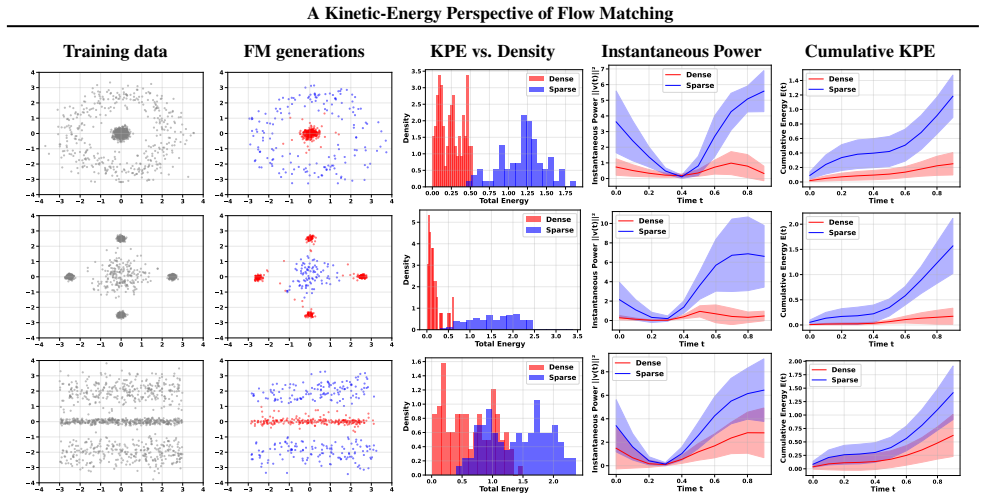
Pith's one-line read The kinetic energy accumulated along a flow-matching trajectory — computed for free during sampling — predicts both semantic fidelity and rarity, until extreme energy tips into memorization.
desk verdict KPE diagnostic and KTS are worth a look, but the paper's main energy–density theorem is unproven: the additive constants in the pointwise bound blow up non-integrably at t=1. read the letter →
The pith
A machine-rendered reading of the paper's core claim, the machinery that carries it, and where it could break.
The reading
What carries the argument
The central object is Kinetic Path Energy, E = ½∫₀¹∥v_θ(x(t),t)∥² dt, an action-like scalar accumulated along the sampling ODE. It does two kinds of work: as a diagnostic, it converts a high-dimensional trajectory into a single per-sample number that empirically tracks CLIP score/margin and estimated density; as a dynamical quantity, it inherits the score-decomposition identity u*(z,t) = α(t)∇ log p_t + β(t)z, which yields the energy–density proportionality under posterior dominance (Theorem 4.2) and reveals the 1/(1−t) softmax singularity in the closed-form empirical velocity (Proposition 5.2), the mechanism that drives memorization. KTS is a time-dependent gain η(t) that boosts velocity be
What would settle it
Check the pointwise ratio ∥u*(z,t)∥² / (−log p_t(z)) along trajectories that cross the region where two training components are equally responsible; if the ratio leaves the Θ(1) band implied by Theorem 4.2 in that region, the energy–density proportionality is not universal and holds only in the posterior-dominance regime.
Extended reading notes
Core claim
The central claim is that the kinetic path energy of a sampling ODE trajectory is a dual indicator: it tracks how semantically precise the generated sample is and how rare its location is on the data manifold. The mechanism is the identity u*(z,t) = α(t)∇z log p_t(z) + β(t)z, expressing the optimal empirical velocity as a mixture-score plus drift; from this the authors prove the affine proportionality ∥u*(z,t)∥² ≍ −log p_t(z) whenever a single training component dominates the posterior. The counterpoint is the terminal singularity of the same closed-form field: because the optimal velocity is 1/(1−t) times a softmax-weighted sum of training atoms, any trajectory that keeps a fixed gap from t
Load-bearing premise
Load-bearing premise: at every point along the trajectory some single training example must dominate the posterior (responsibility ≥ 1−ε) for the theorem ∥u*∥² ≍ −log p_t to hold; near t=0 or between equally weighted examples it fails, and the real-data rarity finding additionally rests on a descriptor-space density proxy, which the authors call representation-dependent.
Editorial extensions
If this is right
- KPE can be read off any ODE-based flow sampler at zero extra cost, giving per-sample quality and rarity estimates without image-level metrics or density estimation.
- Memorization in the regression-optimal empirical flow field is a structural property (the 1/(1−t) terminal singularity), not simply an optimization artifact, so matching the regression objective exactly is explicitly the wrong target if memorization avoidance matters.
- An inference-time velocity rescaling (boost early, damp late) yields a tunable quality–memorization trade-off on both CelebA and ImageNet without retraining, consistent with the Goldilocks principle.
- Under posterior dominance, KPE is a finite-time observable proxy for the integrated negative log-density of the intermediate Gaussian mixture, so the diagnostic is theoretically grounded, not merely heuristic.
Reading between the lines
- If the energy–density proportionality is taken at face value, per-sample KPE becomes a cheap memorization/novelty risk meter during training runs, long before retrieving nearest neighbors; the paper shows KPE and memorization rising together but does not propose this monitoring use explicitly.
- The posterior-dominance caveat suggests the KPE–density correlation should be weakest at small t (where all mixture weights are comparable) and near mode boundaries; a practitioner wanting reliable rarity ranking might restrict the diagnostic to the late-time portion of the trajectory, t ≳ 0.5.
- The terminal-blow-up argument is generic to any deterministic transport that must land exactly on one of finitely many atoms at t = 1; the same 1/(1−t) cost structure would apply to rectified flows or stochastic interpolants targeting empirical distributions, so the memorization paradox likely extends beyond the specific flow-matching setting studied here.
Signed reviews
Editorial analysis
A structured set of objections, weighed in public.
Referee Report
Summary. The paper introduces Kinetic Path Energy (KPE), defined as the time integral of squared velocity along a flow-matching ODE trajectory, and proposes it as a per-sample diagnostic. Empirically, the authors report that high-KPE trajectories correlate with higher CLIP-based semantic fidelity on ImageNet and with lower estimated training-data density on synthetic datasets, CIFAR-10, and ImageNet. The theoretical section analyzes empirical flow matching (EFM), gives a pointwise energy–density bound under a posterior-dominance assumption (Theorem 4.2 / Theorem B.1), and claims an integrated form E = Θ(∫ −log p̂_t dt) + O(1) (Eq. 11). The paper further identifies a terminal 1/(1−t) singularity in closed-form EFM as a memorization mechanism and proposes Kinetic Trajectory Shaping (KTS), a training-free inference-time velocity rescaling that boosts early motion and damps late motion. Experiments on CelebA and ImageNet show tunable FID/memorization trade-offs.
Significance. KPE is a simple, zero-overhead path-level diagnostic, and the Goldilocks picture — moderate, well-timed kinetic effort improves quality while excessive terminal energy causes memorization — is intuitively appealing and supported by the closed-form EFM analysis. The pointwise energy–density theorem has explicit constants and is internally coherent under its posterior-dominance assumption, and the KTS experiments are a useful training-free contribution. However, the integrated energy–density relation stated as Eq. (11) is not established by the supplied proof, and the real-data density evidence is admittedly representation-dependent. If Eq. (11) can be proved with integrable constants, the theoretical claim would be significant; as written, the central theoretical guarantee is overclaimed.
major comments (3)
- [§4.3, Remark 4.3; Appendix B.5, Eq. (54)] Eq. (11) does not follow from integrating Eq. (10). For the linear bridge γ(t)=t, Lemma B.5 gives C′_t ≥ C−(t), with C−(t) = m(t)²∥μ_{i*}(t)∥²/2 + 2F_t² and F_t ≥ ∥b_t∥ = ∥x^(i*)/(1−t)∥. Hence C′_t ≥ const/(1−t)², so ∫₀¹ C′_t dt = ∞ and the integrated bound (54) is vacuous: E ≤ +∞ and E ≥ −∞. The claimed O(1) remainder is not a consequence. A concrete check: d=1, N=1, x^(1)=1, trajectory x(t)=t satisfies posterior dominance with λ=1 for every t, yet KPE = 1/2 and ∫₀¹ −log p̂_t(z(t)) dt is finite, while the lemma's C′_t is Θ((1−t)⁻²). Thus the current proof cannot establish Eq. (11) even in an ideal posterior-dominated case. This requires either a genuinely integrable additive-constant argument or a reformulation of the density claim as pointwise and conditional only.
- [§4.3, Theorem 4.2 (posterior dominance assumption)] Even the pointwise theorem is conditional on λ_{i*}(z,t) ≥ 1−ε at the evaluated (z,t). No argument is provided that sampled trajectories satisfy this condition on the whole interval [0,1]; near t=0 and in overlap regions the responsibilities are comparable, so the bound (10) may fail exactly where the integrated density integral is path-dependent. The empirical density validation does not fill this gap, because it uses k-NN/KDE in a 2D PCA descriptor space, which the authors themselves call a representation-dependent proxy (§4.2 Limitation). The theoretical claim should be explicitly restricted to the posterior-dominance regime, and the real-data claim should be phrased at the same level of generality as the proxy.
- [§4.2, Figs. 4–5] The real-data validation of the KPE–density correspondence is carried out in a 2D PCA descriptor space (RGB statistics, Gabor responses, edge density) rather than in pixel space. The authors acknowledge this limitation, but the abstract and Finding 2 state the result as 'low-density manifold frontiers.' This is stronger than the evidence supports. The revised manuscript should carefully separate the descriptor-space proxy result from the geometric statement about the data manifold, or provide validation that the proxy tracks manifold density.
minor comments (6)
- [§4.2] The text says '22D descriptors'; this should read '2D descriptors.'
- [Figure 2] The x-axis labels show CFG = 1.0, 1.5, 2.0, while the caption and Table 1 refer to CFG 1.0/1.5/4.0. Please reconcile.
- [Appendix B.4] The heading 'Lemma 2' should refer to Lemma B.3 to match the numbering scheme.
- [Algorithm 1] Line 10 uses x_{t+Δt} on both sides; this is not a standard time-indexed update. Use an explicit Euler step notation, e.g., x_{k+1} = x_k + η(t_k) v_θ(x_k,t_k) Δt.
- [§5.1 and Appendix D] Lemma 5.1 and Proposition 5.2 are named 'informal' but are presented as if they are formal results. Either state them with full assumptions in the main text or label them as claims/conjectures.
- [Tables 3–4] The hyperparameters α₀, β₀, τ_split, k are varied in a small grid, but no selection rule, confidence intervals, or multiple-seed statistics are reported. Since KTS is proposed as a practical inference-time method, this should be clarified.
Circularity Check
No significant circularity: central derivations are self-contained; a non-integrability gap in Eq. (11) is a correctness issue, not a circular one.
full rationale
KPE is defined directly as the time integral of squared ODE velocity (Eq. 6), independent of CLIP score, density estimates, or memorization measures, so the empirical correlations in Sections 4.1 and 4.2 are not true by construction. The theoretical energy-density link (Theorem 4.2 / Theorem B.1) is derived from the Gaussian-mixture score identity (Lemma 4.1 / B.2) with explicit constants and no fitted parameters. The closed-form EFM velocity is attributed to external prior work (Bertrand et al., 2025) and re-derived in Appendix C; Proposition 5.2's terminal blow-up follows from softmax concentration and Cauchy-Schwarz rather than being assumed as the conclusion. KTS is a heuristic phase-modulation strategy whose hyperparameters are selected after observing the energy spike; this is post-hoc method design, not a prediction forced by definition. The paper itself acknowledges that its density estimates are 'representation-dependent proxies' (Section 4.2 Limitation), an honest limitation rather than a circular step. The main non-circular concern is that Eq. (11) is asserted by 'integrating (10)', but for gamma(t)=t the appendix's additive constant C'_t scales like ||x*||^2/(1-t)^2, so the O(1) remainder may diverge; this is an integrability/proof gap, not an input-output equivalence. No load-bearing self-citation or imported uniqueness theorem appears in the argument, and the empirical benchmarks are external and not used as fitted inputs to the theory.
Assumptions & free parameters
free parameters (6)
- KTS alpha0 (Kinetic Launch gain) =
0.01–0.05 by dataset grid search
- KTS beta0 (Kinetic Soft-Landing damping) =
0.001–0.02 by dataset grid search
- KTS tau_split =
0.6
- KTS k (soft-landing exponential rate) =
3
- k-NN neighborhood size for density proxy =
50
- PCA descriptor dimension for real-data density =
2
assumptions (4)
- domain assumption Linear interpolation bridge x_t = t x^(i) + (1-t) ε with ε ~ N(0,I) and γ(t)=t
- ad hoc to paper Posterior dominance: at each (z,t) there is a dominant component i* with λ_i*(z,t) ≥ 1−ε
- ad hoc to paper Real-image density can be approximated by k-NN/KDE in a 2D PCA descriptor space
- domain assumption Learned neural velocity field approximates the conditional expectation v*(x,t) of the CFM regression objective
Cite this review
Pith. "Pith review of A Kinetic Energy Perspective of Flow Matching." pith.science (2026). https://pith.science/paper/Z2WTNZKJ
@misc{pith2026260207928,
  author       = {Pith},
  title        = {Pith review of: A Kinetic Energy Perspective of Flow Matching},
  year         = {2026},
  howpublished = {\url{https://pith.science/paper/Z2WTNZKJ}},
  note         = {Machine review of arXiv:2602.07928}
}
read the original abstract
Flow-based generative models can be viewed through a physics lens: sampling transports a particle from noise to data by integrating a learned velocity field, and each sample corresponds to a trajectory with its own dynamical effort. Motivated by classical mechanics, we introduce Kinetic Path Energy (KPE), an action-like, per-sample diagnostic that measures the accumulated kinetic effort along an ordinary differential equation (ODE) trajectory. Empirically, KPE exhibits two robust correspondences: {i} higher KPE predicts stronger semantic fidelity; {ii} high-KPE trajectories land in sparse representation regions. We further provide theoretical guarantees linking trajectory energy to data sparsity. Paradoxically, this correlation is non-monotonic. At sufficiently high energy, generation can degenerate into memorization. Leveraging the closed-form formula of empirical flow matching, we show that extreme energies drive trajectories toward near-copies of training examples. This yields a Goldilocks principle and motivates Kinetic Trajectory Shaping (KTS), a training-free two-phase inference strategy that boosts early motion and enforces a late-time soft landing, reducing memorization and improving generation quality across benchmark tasks.
Figures


Figures from the paper (12 more)


Reference graph
Works this paper leans on
-
[1]
Albergo, M. S. and Vanden-Eijnden, E. Stochastic interpolants: A unifying framework for flows and diffusions. arXiv preprint arXiv:2303.08797, 2023
arXiv 2023
-
[2]
Baptista, R., Dasgupta, A., Kovachki, N. B., Oberai, A., and Stuart, A. M. Memorization and regularization in generative diffusion models. arXiv preprint arXiv:2501.15785, 2025
arXiv 2025
-
[3]
and Brenier, Y
Benamou, J.-D. and Brenier, Y. A computational fluid mechanics solution to the monge-kantorovich mass transfer problem. Numerische Mathematik, 84 0 (3): 0 375--393, 2000
2000
-
[4]
On the closed-form of flow matching: Generalization does not arise from target stochasticity
Bertrand, Q., Gagneux, A., Massias, M., and Emonet, R. On the closed-form of flow matching: Generalization does not arise from target stochasticity. arXiv preprint arXiv:2506.03719, 2025
arXiv 2025
-
[5]
Why diffusion models don't memorize: The role of implicit dynamical regularization in training
Bonnaire, T., Urfin, R., Biroli, G., and M \'e zard, M. Why diffusion models don't memorize: The role of implicit dynamical regularization in training. In Advances in Neural Information Processing Systems, 2025. NeurIPS 2025
2025
-
[6]
T., Rubanova, Y., Bettencourt, J., and Duvenaud, D
Chen, R. T., Rubanova, Y., Bettencourt, J., and Duvenaud, D. K. Neural ordinary differential equations. In Advances in neural information processing systems, volume 31, 2018
2018
-
[7]
Du, Y., Mao, J., and Tenenbaum, J. B. Learning iterative reasoning through energy diffusion. In International Conference on Machine Learning, pp.\ 11764--11776. PMLR, 2024
2024
-
[8]
Feynman, R. P. and Hibbs, A. R. Quantum Mechanics and Path Integrals. McGraw-Hill, New York, 1965
1965
Show all 41 references
-
[9]
Finlay, C., Jacobsen, J.-H., Nurbekyan, L., and Oberman, A. M. How to train your neural ode. arXiv preprint arXiv:2002.02798, 2, 2020
2002 arXiv
-
[10]
and Li, M
Gao, W. and Li, M. How do flow matching models memorize and generalize in sample data subspaces? arXiv preprint arXiv:2410.23594, 2024
2024 arXiv
-
[11]
P., and Safko, J
Goldstein, H., Poole, C. P., and Safko, J. Classical mechanics, volume 2. Addison-wesley Reading, MA, 1950
1950
-
[12]
On the relation between rectified flows and optimal transport
Hertrich, J., Chambolle, A., and Delon, J. On the relation between rectified flows and optimal transport. arXiv preprint arXiv:2505.19712, 2025
2025
-
[13]
Gans trained by a two time-scale update rule converge to a local nash equilibrium
Heusel, M., Ramsauer, H., Unterthiner, T., Nessler, B., and Hochreiter, S. Gans trained by a two time-scale update rule converge to a local nash equilibrium. In Advances in Neural Information Processing Systems, volume 30, 2017
2017
-
[14]
Understanding diffusion models by feynman’s path integral
Hirono, Y., Tanaka, A., and Fukushima, K. Understanding diffusion models by feynman’s path integral. In International Conference on Machine Learning, pp.\ 18324--18351. PMLR, 2024
2024
-
[15]
and Salimans, T
Ho, J. and Salimans, T. Classifier-free diffusion guidance. arXiv preprint arXiv:2207.12598, 2022
2022 arXiv
-
[16]
Speed-accuracy relations for diffusion models: Wisdom from nonequilibrium thermodynamics and optimal transport
Ikeda, K., Uda, T., Okanohara, D., and Ito, S. Speed-accuracy relations for diffusion models: Wisdom from nonequilibrium thermodynamics and optimal transport. Physical Review X, 15 0 (3): 0 031031, 2025
2025
-
[17]
Rethinking fid: Towards a better evaluation metric for image generation
Jayasumana, S., Ramalingam, S., Veit, A., Glasner, D., Chakrabarti, A., and Kumar, S. Rethinking fid: Towards a better evaluation metric for image generation. In Proceedings of the IEEE/CVF Conference on Computer Vision and Pattern Recognition, pp.\ 9307--9315, 2024
2024
-
[18]
Distribution estimation via flow matching with L ipschitz guarantees
Kunkel, L. Distribution estimation via flow matching with L ipschitz guarantees. arXiv preprint arXiv:2509.02337, 2025
2025
-
[19]
T., Ben-Hamu, H., Nickel, M., and Le, M
Lipman, Y., Chen, R. T., Ben-Hamu, H., Nickel, M., and Le, M. Flow matching for generative modeling. arXiv preprint arXiv:2210.02747, 2022
2022 arXiv
-
[20]
T., Lopez-Paz, D., Ben-Hamu, H., and Gat, I
Lipman, Y., Havasi, M., Holderrieth, P., Shaul, N., Le, M., Karrer, B., Chen, R. T., Lopez-Paz, D., Ben-Hamu, H., and Gat, I. Flow matching guide and code. arXiv preprint arXiv:2412.06264, 2024
2024 arXiv
-
[21]
Flow straight and fast: Learning to generate and transfer data with rectified flow
Liu, X., Gong, C., and Liu, Q. Flow straight and fast: Learning to generate and transfer data with rectified flow. arXiv preprint arXiv:2209.03003, 2022
2022 arXiv
-
[22]
S., Boffi, N
Ma, N., Goldstein, M., Albergo, M. S., Boffi, N. M., Vanden-Eijnden, E., and Xie, S. Sit: Exploring flow and diffusion-based generative models with scalable interpolant transformers. In European Conference on Computer Vision, pp.\ 23--40. Springer, 2024
2024
-
[23]
K., and Wasserman, L
Mena, G., Kuchibhotla, A. K., and Wasserman, L. Statistical properties of rectified flow. arXiv preprint arXiv:2511.03193, 2025
2025
-
[24]
Score-based generative models detect manifolds
Pidstrigach, J. Score-based generative models detect manifolds. Advances in Neural Information Processing Systems, 35: 0 35852--35865, 2022
2022
-
[25]
Pooladian, A.-A., Ben-Hamu, H., Domingo-Enrich, C., Amos, B., Lipman, Y., and Chen, R. T. Multisample flow matching: Straightening flows with minibatch couplings. In International Conference on Machine Learning, pp.\ 28100--28127. PMLR, 2023
2023
-
[26]
Scarvelis, C., Borde, H. S. d. O., and Solomon, J. Closed-form diffusion models. arXiv preprint arXiv:2310.12395, 2023
2023 arXiv
-
[27]
Stochastic thermodynamics, fluctuation theorems and molecular machines
Seifert, U. Stochastic thermodynamics, fluctuation theorems and molecular machines. Reports on Progress in Physics, 75 0 (12): 0 126001, 2012
2012
-
[28]
T., Nickel, M., Le, M., and Lipman, Y
Shaul, N., Chen, R. T., Nickel, M., Le, M., and Lipman, Y. On kinetic optimal probability paths for generative models. In International Conference on Machine Learning, pp.\ 30883--30907. PMLR, 2023
2023
-
[29]
Denoising diffusion implicit models
Song, J., Meng, C., and Ermon, S. Denoising diffusion implicit models. arXiv preprint arXiv:2010.02502, 2020
2010 arXiv
-
[30]
P., Kumar, A., Ermon, S., and Poole, B
Song, Y., Sohl-Dickstein, J., Kingma, D. P., Kumar, A., Ermon, S., and Poole, B. Score-based generative modeling through stochastic differential equations. International Conference on Learning Representations, 2021
2021
-
[31]
Improving and generalizing flow-based generative models with minibatch optimal transport
Tong, A., Fatras, K., Malkin, N., Huguet, G., Zhang, Y., Rector-Brooks, J., Wolf, G., and Bengio, Y. Improving and generalizing flow-based generative models with minibatch optimal transport. Transactions on Machine Learning Research, pp.\ 1--34, 2024
2024
-
[32]
Villani, C. et al. Optimal transport: old and new, volume 338. Springer, 2008
2008
-
[33]
and Steidl, G
Wald, C. and Steidl, G. Flow matching: M arkov kernels, stochastic processes and transport plans. Variational and Information Flows in Machine Learning and Optimal Transport, 2025
2025
-
[34]
Elucidating flow matching ode dynamics via data geometry and denoisers
Wan, Z., Wang, Q., Mishne, G., and Wang, Y. Elucidating flow matching ode dynamics via data geometry and denoisers. In Forty-second International Conference on Machine Learning
-
[35]
Energy-based diffusion language models for text generation
Xu, M., Geffner, T., Kreis, K., Nie, W., Xu, Y., Leskovec, J., Ermon, S., and Vahdat, A. Energy-based diffusion language models for text generation. In The Thirteenth International Conference on Learning Representations, 2024
2024
-
[36]
Provable separations between memorization and generalization in diffusion models
Ye, Z., Zhu, Q., Tao, M., and Chen, M. Provable separations between memorization and generalization in diffusion models. arXiv preprint arXiv:2511.03202, 2025
2025
-
[37]
Y., Kwon, S., and Ryu, E
Yoon, T., Choi, J. Y., Kwon, S., and Ryu, E. K. Diffusion probabilistic models generalize when they fail to memorize. In ICML 2023 workshop on structured probabilistic inference and generative modeling, 2023
2023
-
[38]
Freedom: Training-free energy-guided conditional diffusion model
Yu, J., Wang, Y., Zhao, C., Ghanem, B., and Zhang, J. Freedom: Training-free energy-guided conditional diffusion model. In 2023 IEEE/CVF International Conference on Computer Vision (ICCV), pp.\ 23117--23127. IEEE, 2023
2023
-
[39]
and Chen, Y
Zhang, Q. and Chen, Y. Path integral sampler: a stochastic control approach for sampling. International Conference on Learning Representations, 2023
2023
-
[40]
and Liu, W
Zhou, Z. and Liu, W. An error analysis of flow matching for deep generative modeling. In Forty-second International Conference on Machine Learning
-
[41]
write newline
" write newline "" before.all 'output.state := FUNCTION n.dashify 't := "" t empty not t #1 #1 substring "-" = t #1 #2 substring "--" = not "--" * t #2 global.max substring 't := t #1 #1 substring "-" = "-" * t #2 global.max substring 't := while if t #1 #1 substring * t #2 gl...
Reviewed August 3, 2026 · model on record in the stance chip above.
Discussion (0). Continue with ORCID to comment.