REVIEW 3 major objections 4 minor 61 references
Origin and Evolution of Ultraflatbands in Twisted Bilayer Transition Metal Dichalcogenides: Realization of Triangular Quantum Dot Array
T0 review · 3 major / 4 minor · reviewed 2026-08-14 · deepseek-v4-flash
Pith's one-line read Twisted bilayer MoS2 near 60° forms flatbands that match eigenstates of a triangular quantum well.
desk verdict The triangular-quantum-dot claim for twisted bilayer MoS2 near 60 degrees is genuinely new and mostly convincing, but the paper needs to face the force-field validation and convergence questions head-on. read the letter →
The pith
A machine-rendered reading of the paper's core claim, the machinery that carries it, and where it could break.
The reading
What carries the argument
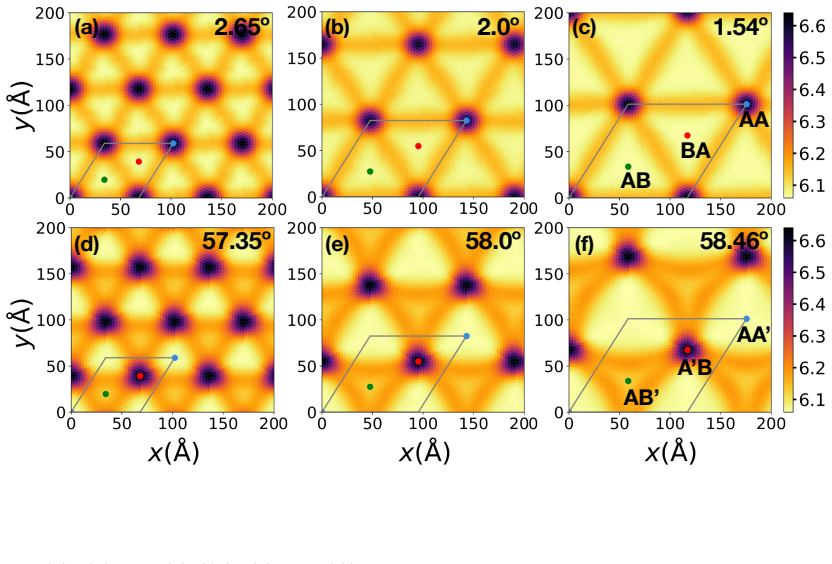
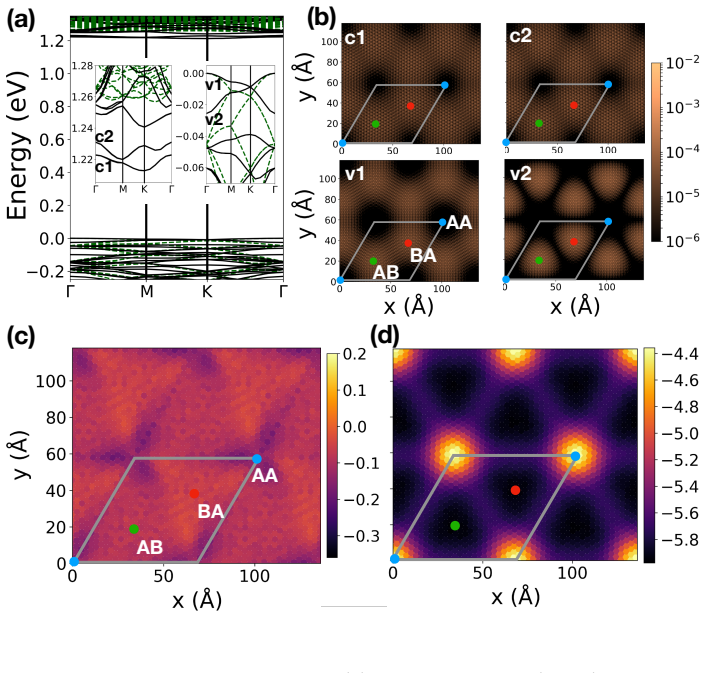
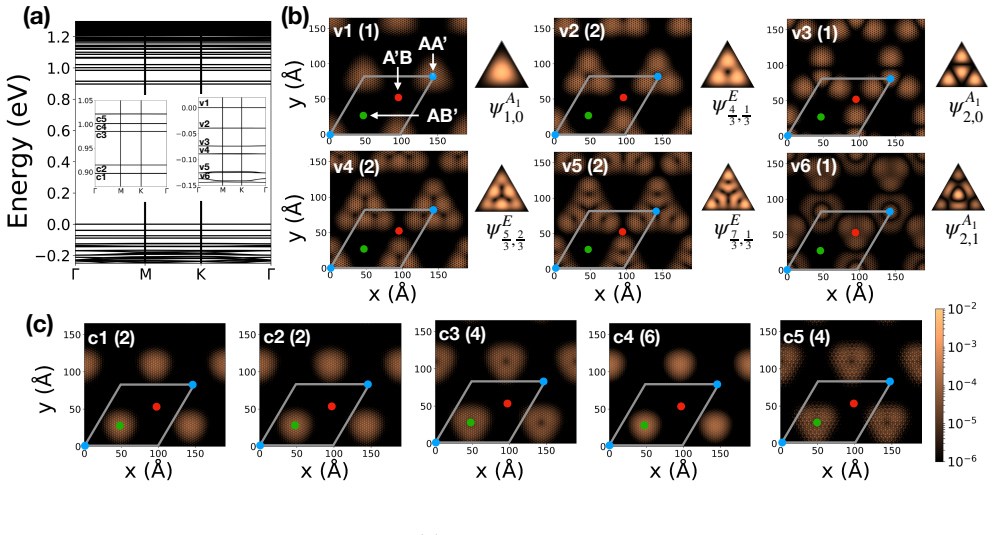
The load-bearing object is the relaxed moiré superlattice of twisted bilayer MoS2 near 60°, specifically the strain-built triangular confining potential $\Delta V(x_{\mathrm{Mo}},y_{\mathrm{Mo}})$, defined as the macroscopically averaged self-consistent DFT potential minus the unit-cell average of the AA' stacking. This potential has equilateral-triangle wells at AB' sites. The paper identifies the resulting flatband spectrum with eigenstates of an infinite equilateral triangle well, whose energies are $E_{p,q}=(p^2+q^2+pq)E_0$ with $q=0,\frac13,\frac23,\dots$ and $p=q+1,q+2,\dots$; the symmetry labels $A_1$, $A_2$, and $E$ explain the observed one-, one-, and two-fold degeneracies of the valence flatbands. The comparison object—the triangular-well eigenproblem—is what turns a computed band structure into a physical picture of confined quantum-dot states.
What would settle it
Perform a fully DFT-relaxed calculation (with van der Waals corrections) of 57.35° twisted bilayer MoS2 and recompute the band structure; if the multi-flatband spectrum and the triangular $\Delta V$ map disappear, the force-field-based prediction is not physical. Alternatively, an STM image of a relaxed ~58° bilayer at the valence band edge should show the triangular $A_1$/ $E$ envelopes; seeing none would falsify the quantum-dot claim.
Extended reading notes
Core claim
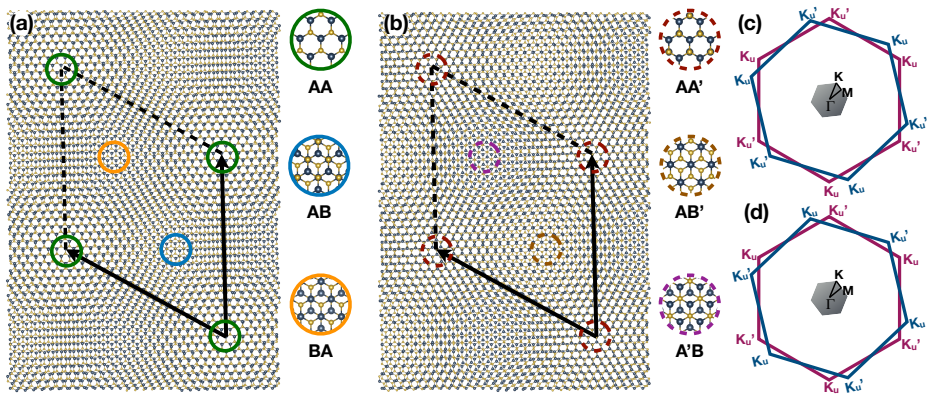
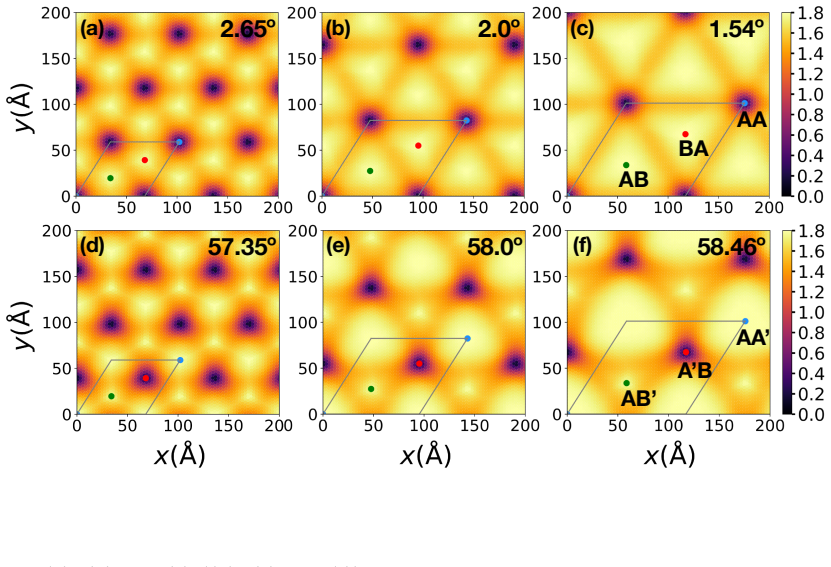
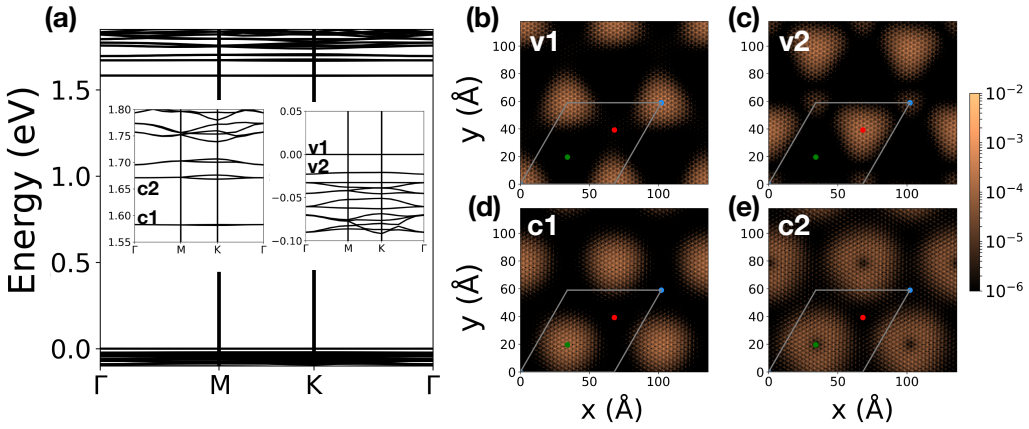
The central claim is that in relaxed twisted bilayer MoS2 with twist angle above about 56°, the moiré pattern itself acts as an array of triangular quantum dots. In-plane atomic relaxation shears the layers and concentrates strain along soliton domain walls; that strain produces a modulating potential $\Delta V$ whose wells are equilateral triangles, with minima at the AB' stacking regions and maxima at A'B and AA'. Hybridization inhomogeneity then forces holes into AA' regions and electrons into AB' regions, spatially separating the two carrier types. The first six valence flatbands reproduce the ordering, real-space envelopes, and degeneracies ($A_1$, $A_2$, $E$) of the infinite equilateral triangle well; conduction flatbands match the same envelopes with degeneracies multiplied by valley degrees of freedom. A constrained relaxation that forbids in-plane motion removes the multi-flatband structure, demonstrating that strain, not hybridization alone, creates the triangular confinement.
Load-bearing premise
The whole triangular-dot picture rests on the empirical force field reproducing the true in-plane strain pattern at small twist angles; the paper uses a force field fitted to DFT in prior work but does not revalidate it at 57–58°.
Editorial extensions
If this is right
- No unique magic angle exists: flatbands sharpen monotonically as the twist approaches either 0° or 60°, so the platform does not require precise angle tuning to 1.1°.
- Holes and electrons sit in different stacking regions, so excitons should be spatially indirect and long-lived; the paper proposes this explains moiré exciton observations in twisted TMDs.
- Because strain makes the confining potential, applying external strain offers a direct knob to reshape the wells and shift flatband spacings.
- Twist angles just above 56° provide a dry, lithography-free route to ordered arrays of triangular quantum dots whose size follows the moiré period.
Reading between the lines
- The same in-plane strain mechanism should produce triangular dot states in other twisted TMDs near 60° (for example WSe2 or MoSe2), with dot size smoothly controlled by twist angle; the paper does not test this.
- A direct STM/STS map of a relaxed 57–58° bilayer should show the predicted $A_1$ ground-state envelope and nodal $E$ states at the band edges; if the charge density is instead hexagonal or located on domain walls, the triangular-well interpretation would need revision.
- Since the well is finite-depth and periodic, only a handful of confined levels exist; increasing the well depth with a gate or by choosing a TMD with larger stacking-energy contrast might reveal higher triangular states and could be tested optically through exciton absorption.
Signed reviews
Editorial analysis
A structured set of objections, weighed in public.
Referee Report
Summary. The paper investigates the origin and evolution of ultraflatbands in twisted bilayer MoS2 using a multiscale approach: empirical force-field relaxation followed by DFT electronic-structure calculations on large moiré supercells. It reports that, unlike twisted bilayer graphene, there is no unique magic angle; ultraflatbands form for all small twist angles near 0° and for twist angles greater than about 56° near 60°. For the 60° family, the paper proposes that in-plane lattice reconstruction creates a triangular confining potential, producing multiple energy-separated ultraflatbands at both valence and conduction band edges. The wavefunctions of these bands are claimed to closely match eigenstates of an infinite equilateral triangle well, with holes confined at AA' stackings and electrons at AB' stackings, thus realizing a triangular quantum dot array. A constrained-relaxation control shows that removing in-plane relaxation destroys the multiple flatbands, supporting the strain-based origin.
Significance. If the central claims are correct, this work proposes a new and robust platform for ordered quantum dot arrays in twisted transition-metal dichalcogenides, without the fine-tuning required in twisted bilayer graphene. The multiscale computational strategy enables treatment of very large moiré cells, and the paper provides a concrete falsifiable prediction: multiple ultraflatbands with triangular quantum-dot character for twist angles above 56°. The paper also gives a clean control (Fig. 12) separating in-plane relaxation effects from interlayer-spacing effects, and it explicitly derives the confining potential from the DFT potential rather than assuming its shape. These strengths make the work significant if the underlying force-field relaxation is trustworthy.
major comments (3)
- [§II and §IV.C] The central claim that in-plane strain creates a triangular confining potential for twist angles θ>56° rests entirely on the structural relaxation obtained from the Stillinger-Weber and Kolmogorov-Crespi force field. The paper validates this force field only by citing Ref. 26, which is not shown to cover the Reuleaux-triangle reconstructed regime at these angles. Since the size, shape, and depth of the confining potential (Fig. 11) are determined by the balance between stacking energies and in-plane strain energy, an incorrect force-field description of this balance could eliminate or reshape the triangular quantum dot. The constrained-relaxation control (Fig. 12) demonstrates that in-plane relaxation is necessary within the force field, but it does not validate the force field itself. A benchmark against DFT-relaxed structures at least at one angle in the θ>56° regime should be provided.
- [§IV.B and Fig. 9] The identification of the first six valence-band flatbands and the conduction-band flatbands with eigenstates of an infinite equilateral triangle well is made by visual comparison of charge densities and by counting degeneracies. No quantitative comparison is provided, such as wavefunction overlaps with the analytic triangle-well eigenstates or a comparison of the computed energy-level spacings with the formula E_{p,q} = (p^2+q^2+pq)E_0. Given that the 'excellent agreement' is the central evidence for the quantum-dot interpretation, a quantitative metric is required to substantiate the claim.
- [§II and §IV.D] The self-consistent charge density for the moiré supercells is computed with Γ-point sampling only, and no convergence test is shown; the bandwidths reported in Fig. 16 are smaller than 1 meV, so the numerical uncertainty of the band dispersion should be quantified. In addition, the no-magic-angle conclusion is based on a discrete set of twist angles (1.54°, 2.0°, 2.65°, 2.88° and 57.12°, 57.35°, 58.0°, 58.46°); a denser angle scan around the smallest angles would strengthen the claim that no sharp resonance occurs analogous to the TBG magic angle.
minor comments (4)
- [Fig. 9 caption] The caption is confusing: the panels (b) and (c) are described but the final sentence refers to 'brackets' and to panel '(e)', which does not appear in the figure; please clarify the correspondence between the computed states and the triangle-well eigenfunctions.
- [§V] The conclusion contains a typo: 'additonal' should be 'additional'.
- [§II] The statement that van der Waals corrections do not influence the electronic band structure is somewhat terse; a supporting reference or a brief justification would help the reader assess this approximation.
- [§IV.D] The movie describing the evolution of flatband localization is only mentioned in the text and in a reference to supplementary materials; please provide a persistent link or explicit accession information.
Circularity Check
No circularity: flatband and triangular-quantum-dot claims follow from an externally parameterized force field plus DFT, with triangle-well matching used as a parameter-free diagnostic.
full rationale
The paper's derivation chain is self-contained rather than circular. Structural relaxation uses the SW+KC force field, with the KC potential fitted to vdW-corrected DFT in prior work (Ref. 26) and not fitted to the flatbands or confining potential reported here. Electronic structure is then computed from DFT on those relaxed geometries, and the local quantities Vbarr and ΔV are extracted from the DFT potential. The constrained-relaxation control (Fig. 12) isolates in-plane strain as the origin of the modulating potential, and the comparison to infinite equilateral-triangle eigenstates is a parameter-free diagnostic applied after the DFT wavefunctions are obtained. The claim that no unique magic angles exist is a direct scan over twist angles. The self-citations (Refs. 19, 26, 27) supply a prior force field and background results, but none is used to define the predicted states or to rule out alternatives by assertion; the force field is external to the present flatband data. A validation concern about the force field at these twist angles is a correctness/accuracy issue, not a circularity issue.
Assumptions & free parameters
assumptions (5)
- domain assumption The Stillinger-Weber and Kolmogorov-Crespi force field accurately reproduces DFT-relaxed structures of twisted bilayer MoS2 for the twist angles studied.
- domain assumption Gamma-point-only sampling of the moiré Brillouin zone yields a converged charge density for the large supercells.
- domain assumption The LDA exchange-correlation functional and norm-conserving pseudopotentials give an accurate description of the MoS2 band edges relevant to the flatbands.
- domain assumption The states of the infinite equilateral triangle well are an appropriate reference for the confined moiré states.
- ad hoc to paper In the constrained relaxation, removing in-plane relaxation isolates the effect of strain, with other changes (stacking distribution, interlayer spacing) playing no role in the loss of multiple flatbands.
Cite this review
Pith. "Pith review of Origin and Evolution of Ultraflatbands in Twisted Bilayer Transition Metal Dichalcogenides: Realization of Triangular Quantum Dot Array." pith.science (2026). https://pith.science/paper/Z2YP2GRV
@misc{pith2026190810399,
  author       = {Pith},
  title        = {Pith review of: Origin and Evolution of Ultraflatbands in Twisted Bilayer Transition Metal Dichalcogenides: Realization of Triangular Quantum Dot Array},
  year         = {2026},
  howpublished = {\url{https://pith.science/paper/Z2YP2GRV}},
  note         = {Machine review of arXiv:1908.10399}
}
abstract
Using a multiscale computational approach, we probe the origin and evolution of ultraflatbands in moir\'e superlattices of twisted bilayer MoS$_2$, a prototypical transition metal dichalcogenide. Unlike twisted bilayer graphene, we find no unique magic angles in twisted bilayer MoS$_2$ for flatband formation. Ultraflatbands form at the valence band edge for twist angles ($\theta$) close to 0$^\circ$ and at both the valence and conduction band edges for $\theta$ close to 60$^\circ$, and have distinct origins. For$ \theta$ close to 0$^\circ$, inhomogeneous hybridization in the reconstructed moir\'e superlattice is sufficient to explain the formation of flatbands. For $\theta$ close to 60$^\circ$, additionally, local strains cause the formation of modulating triangular potential wells such that electrons and holes are spatially separated. This leads to multiple energy-separated ultraflatbands at the band edges closely resembling eigenfunctions of a quantum particle in an equilateral triangle well. Twisted bilayer transition metal dichalcogenides are thus suitable candidates for the realisation of ordered quantum dot array.
Figures

Figures from the paper (14 more)





Reference graph
Works this paper leans on
-
[1]
author author Y. Cao , author V. Fatemi , author S. Fang , author K. Watanabe , author T. Taniguchi , author E. Kaxiras , \ and\ author P. Jarillo-Herrero ,\ @noop journal journal Nature \ ( year 2018 a ) NoStop
work page 2018
-
[2]
author author Y. Cao , author V. Fatemi , author A. Demir , author S. Fang , author S. L. \ Tomarken , author J. Y. \ Luo , author J. D. \ Sanchez-Yamagishi , author K. Watanabe , author T. Taniguchi , author E. Kaxiras , author R. C. \ Ashoori , \ and\ author P. Jarillo-Herrero ,\ @noop journal journal Nature \ ( year 2018 b ) NoStop
work page 2018
-
[3]
author author R. Bistritzer \ and\ author A. H. \ MacDonald ,\ @noop journal journal Proceedings of the National Academy of Sciences \ volume 108 ,\ pages 12233 ( year 2011 ) NoStop
work page 2011
-
[4]
author author H. C. \ Po , author L. Zou , author A. Vishwanath , \ and\ author T. Senthil ,\ 10.1103/PhysRevX.8.031089 journal journal Phys. Rev. X \ volume 8 ,\ pages 031089 ( year 2018 ) NoStop
-
[5]
author author G. Tarnopolsky , author A. J. \ Kruchkov , \ and\ author A. Vishwanath ,\ 10.1103/PhysRevLett.122.106405 journal journal Phys. Rev. Lett. \ volume 122 ,\ pages 106405 ( year 2019 ) NoStop
-
[6]
author author Y. W. \ Choi \ and\ author H. J. \ Choi ,\ 10.1103/PhysRevB.98.241412 journal journal Phys. Rev. B \ volume 98 ,\ pages 241412 ( year 2018 ) NoStop
-
[7]
author author Y. Su \ and\ author S.-Z. \ Lin ,\ 10.1103/PhysRevB.98.195101 journal journal Phys. Rev. B \ volume 98 ,\ pages 195101 ( year 2018 ) NoStop
-
[8]
author author J. Gonz\'alez \ and\ author T. Stauber ,\ 10.1103/PhysRevLett.122.026801 journal journal Phys. Rev. Lett. \ volume 122 ,\ pages 026801 ( year 2019 ) NoStop
Show all 61 references
-
[9]
Xu \ and\ author L
author author C. Xu \ and\ author L. Balents ,\ 10.1103/PhysRevLett.121.087001 journal journal Phys. Rev. Lett. \ volume 121 ,\ pages 087001 ( year 2018 ) NoStop
2018 doi
-
[10]
Wu , author A
author author F. Wu , author A. H. \ MacDonald , \ and\ author I. Martin ,\ 10.1103/PhysRevLett.121.257001 journal journal Phys. Rev. Lett. \ volume 121 ,\ pages 257001 ( year 2018 a ) NoStop
2018 doi
-
[11]
author author D. M. \ Kennes , author J. Lischner , \ and\ author C. Karrasch ,\ 10.1103/PhysRevB.98.241407 journal journal Phys. Rev. B \ volume 98 ,\ pages 241407 ( year 2018 ) NoStop
2018 doi
-
[12]
Conte , author D
author author F. Conte , author D. Ninno , \ and\ author G. Cantele ,\ 10.1103/PhysRevB.99.155429 journal journal Phys. Rev. B \ volume 99 ,\ pages 155429 ( year 2019 ) NoStop
2019 doi
-
[13]
author author N. R. \ Chebrolu , author B. L. \ Chittari , \ and\ author J. Jung ,\ 10.1103/PhysRevB.99.235417 journal journal Phys. Rev. B \ volume 99 ,\ pages 235417 ( year 2019 ) NoStop
2019 doi
-
[14]
Haddadi , author Q
author author F. Haddadi , author Q. Wu , author A. J. \ Kruchkov , \ and\ author O. V. \ Yazyev ,\ @noop journal journal arXiv e-prints \ ,\ eid arXiv:1906.00623 ( year 2019 ) ,\ http://arxiv.org/abs/1906.00623 arXiv:1906.00623 [cond-mat.mes-hall] NoStop
1906 arXiv
-
[15]
Xian , author D
author author L. Xian , author D. M. \ Kennes , author N. Tancogne-Dejean , author M. Altarelli , \ and\ author A. Rubio ,\ 10.1021/acs.nanolett.9b00986 journal journal Nano Letters \ volume 0 ,\ pages null ( year 0 ) NoStop
-
[16]
Kang , author W.-T
author author P. Kang , author W.-T. \ Zhang , author V. Michaud-Rioux , author X.-H. \ Kong , author C. Hu , author G.-H. \ Yu , \ and\ author H. Guo ,\ @noop journal journal Phys. Rev. B \ volume 96 ,\ pages 195406 ( year 2017 ) NoStop
2017
-
[17]
author author D. M. \ Kennes , author L. Xian , author M. Claassen , \ and\ author A. Rubio ,\ @noop journal journal arXiv e-prints \ ,\ eid arXiv:1905.04025 ( year 2019 ) ,\ http://arxiv.org/abs/1905.04025 1905.04025 NoStop
1905 arXiv
-
[18]
\ Zhao , author Y
author author X.-J. \ Zhao , author Y. Yang , author D.-B. \ Zhang , \ and\ author S.-H. \ Wei ,\ @noop journal journal arXiv e-prints \ ,\ eid arXiv:1906.05992 ( year 2019 ) ,\ http://arxiv.org/abs/1906.05992 arXiv:1906.05992 NoStop
1906 arXiv
-
[19]
author author M. H. \ Naik \ and\ author M. Jain ,\ 10.1103/PhysRevLett.121.266401 journal journal Phys. Rev. Lett. \ volume 121 ,\ pages 266401 ( year 2018 ) NoStop
2018 doi
-
[20]
Wu , author T
author author F. Wu , author T. Lovorn , author E. Tutuc , \ and\ author A. H. \ MacDonald ,\ 10.1103/PhysRevLett.121.026402 journal journal Phys. Rev. Lett. \ volume 121 ,\ pages 026402 ( year 2018 b ) NoStop
2018 doi
-
[21]
Carr , author S
author author S. Carr , author S. Fang , author Z. Zhu , \ and\ author E. Kaxiras ,\ 10.1103/PhysRevResearch.1.013001 journal journal Phys. Rev. Research \ volume 1 ,\ pages 013001 ( year 2019 ) NoStop
2019 doi
-
[22]
author author Z. A. H. \ Goodwin , author F. Corsetti , author A. A. \ Mostofi , \ and\ author J. Lischner ,\ @noop journal journal arXiv e-prints \ ,\ eid arXiv:1905.01887 ( year 2019 ) ,\ http://arxiv.org/abs/1905.01887 arXiv:1905.01887 NoStop
1905 arXiv
-
[23]
Tran , author G
author author K. Tran , author G. Moody , author F. Wu , author X. Lu , author J. Choi , author K. Kim , author A. Rai , author D. A. \ Sanchez , author J. Quan , author A. Singh , author J. Embley , author A. Zepeda , author M. Campbell , author T. Autry , author T. Taniguchi...
2019
-
[24]
author author E. M. \ Alexeev , author D. A. \ Ruiz-Tijerina , author M. Danovich , author M. J. \ Hamer , author D. J. \ Terry , author P. K. \ Nayak , author S. Ahn , author S. Pak , author J. Lee , author J. I. \ Sohn , author M. R. \ Molas , author M. Koperski , author K. ...
2019
-
[25]
Gargiulo \ and\ author O
author author F. Gargiulo \ and\ author O. V. \ Yazyev ,\ @noop journal journal 2D Materials \ volume 5 ,\ pages 015019 ( year 2018 ) NoStop
2018
-
[26]
author author M. H. \ Naik , author I. Maity , author P. K. \ Maiti , \ and\ author M. Jain ,\ 10.1021/acs.jpcc.8b10392 journal journal The Journal of Physical Chemistry C \ volume 123 ,\ pages 9770 ( year 2019 ) NoStop
2019 doi
-
[27]
Maity , author M
author author I. Maity , author M. H. \ Naik , author P. K. \ Maiti , author H. R. \ Krishnamurthy , \ and\ author M. Jain ,\ 10.1103/PhysRevResearch.2.013335 journal journal Phys. Rev. Research \ volume 2 ,\ pages 013335 ( year 2020 ) NoStop
-
[28]
Carr , author D
author author S. Carr , author D. Massatt , author S. B. \ Torrisi , author P. Cazeaux , author M. Luskin , \ and\ author E. Kaxiras ,\ 10.1103/PhysRevB.98.224102 journal journal Phys. Rev. B \ volume 98 ,\ pages 224102 ( year 2018 ) NoStop
-
[29]
Weston , author Y
author author A. Weston , author Y. Zou , author V. Enaldiev , author A. Summerfield , author N. Clark , author V. Z \'o lyomi , author A. Graham , author C. Yelgel , author S. Magorrian , author M. Zhou , author J. Zultak , author D. Hopkinson , author A. Barinov , author T. ...
2020
-
[30]
author author M. R. \ Rosenberger , author H.-J. \ Chuang , author M. Phillips , author V. P. \ Oleshko , author K. M. \ McCreary , author S. V. \ Sivaram , author C. S. \ Hellberg , \ and\ author B. T. \ Jonker ,\ 10.1021/acsnano.0c00088 journal journal ACS Nano \ volume 14 ,...
-
[31]
author author R. C. \ Ashoori ,\ @noop journal journal Nature \ volume 379 ,\ pages 413 ( year 1996 ) NoStop
1996
-
[32]
Banin , author Y
author author U. Banin , author Y. Cao , author D. Katz , \ and\ author O. Millo ,\ @noop journal journal Nature \ volume 400 ,\ pages 542 ( year 1999 ) NoStop
1999
-
[33]
Yu , author G.-B
author author H. Yu , author G.-B. \ Liu , author J. Tang , author X. Xu , \ and\ author W. Yao ,\ 10.1126/sciadv.1701696 journal journal Science Advances \ volume 3 ( year 2017 ),\ 10.1126/sciadv.1701696 NoStop
2017 doi
-
[34]
Xu , author D
author author S. Xu , author D. Li , \ and\ author P. Wu ,\ 10.1002/adfm.201403863 journal journal Advanced Functional Materials \ volume 25 ,\ pages 1127 ( year 2015 ) NoStop
2015 doi
-
[35]
Gopalakrishnan , author D
author author D. Gopalakrishnan , author D. Damien , \ and\ author M. M. \ Shaijumon ,\ 10.1021/nn501479e journal journal ACS Nano \ volume 8 ,\ pages 5297 ( year 2014 ) NoStop
2014 doi
-
[36]
Gan , author Q
author author Z. Gan , author Q. Gui , author Y. Shan , author P. Pan , author N. Zhang , \ and\ author L. Zhang ,\ 10.1063/1.4962318 journal journal Journal of Applied Physics \ volume 120 ,\ pages 104503 ( year 2016 ) NoStop
2016 doi
-
[37]
Perumal Veeramalai , author F
author author C. Perumal Veeramalai , author F. Li , author T. Guo , \ and\ author T. W. \ Kim ,\ 10.1039/C8DT04593C journal journal Dalton Trans. \ volume 48 ,\ pages 2422 ( year 2019 ) NoStop
2019 doi
-
[38]
author author H. D. \ Ha , author D. J. \ Han , author J. S. \ Choi , author M. Park , \ and\ author T. S. \ Seo ,\ 10.1002/smll.201400988 journal journal Small \ volume 10 ,\ pages 3858 ( year 2014 ) NoStop
2014 doi
-
[39]
Lin , author C
author author H. Lin , author C. Wang , author J. Wu , author Z. Xu , author Y. Huang , \ and\ author C. Zhang ,\ @noop journal journal New J. Chem. \ volume 39 ,\ pages 8492 ( year 2015 ) NoStop
2015
-
[40]
Wu , author X
author author M. Wu , author X. Qian , \ and\ author J. Li ,\ @noop journal journal Nano Letters \ volume 14 ,\ pages 5350 ( year 2014 ) NoStop
2014
-
[41]
Fleischmann , author R
author author M. Fleischmann , author R. Gupta , author S. Sharma , \ and\ author S. Shallcross ,\ @noop journal journal arXiv e-prints \ ,\ eid arXiv:1901.04679 ( year 2019 ) ,\ http://arxiv.org/abs/1901.04679 1901.04679 NoStop
1901 arXiv
-
[42]
author author K. L. \ Seyler , author P. Rivera , author H. Yu , author N. P. \ Wilson , author E. L. \ Ray , author D. G. \ Mandrus , author J. Yan , author W. Yao , \ and\ author X. Xu ,\ @noop journal journal Nature \ volume 567 ,\ pages 66 ( year 2019 ) NoStop
2019
-
[43]
Jin , author E
author author C. Jin , author E. C. \ Regan , author A. Yan , author M. Iqbal Bakti Utama , author D. Wang , author S. Zhao , author Y. Qin , author S. Yang , author Z. Zheng , author S. Shi , author K. Watanabe , author T. Taniguchi , author S. Tongay , author A. Zettl , \ an...
2019
-
[44]
Tran , author G
author author K. Tran , author G. Moody , author F. Wu , author X. Lu , author J. Choi , author K. Kim , author A. Rai , author D. A. \ Sanchez , author J. Quan , author A. Singh , author J. Embley , author A. Zepeda , author M. Campbell , author T. Autry , author T. Taniguchi...
2019
-
[45]
author author E. C. \ Regan , author D. Wang , author C. Jin , author M. I. B. \ Utama , author B. Gao , author X. Wei , author S. Zhao , author W. Zhao , author K. Yumigeta , author M. Blei , author J. Carlstroem , author K. Watanabe , author T. Taniguchi , author S. Tongay ,...
2019 arXiv
-
[46]
Brotons-Gisbert , author H
author author M. Brotons-Gisbert , author H. Baek , author A. Molina-S \'a nchez , author D. Scerri , author D. White , author K. Watanabe , author T. Taniguchi , author C. Bonato , \ and\ author B. D. \ Gerardot ,\ @noop journal journal arXiv e-prints \ ,\ eid arXiv:1908.0377...
1908 arXiv
-
[47]
author author M. H. \ Naik \ and\ author M. Jain ,\ @noop journal journal Phys. Rev. B \ volume 95 ,\ pages 165125 ( year 2017 ) NoStop
2017
-
[48]
@noop howpublished http://www.physics.iisc.ernet.in/ mjain/pages/software.html NoStop
-
[49]
@noop howpublished https://lammps.sandia.gov NoStop
-
[50]
Plimpton ,\ @noop journal journal Journal of Computational Physics \ volume 117 ,\ pages 1 ( year 1995 ) NoStop
author author S. Plimpton ,\ @noop journal journal Journal of Computational Physics \ volume 117 ,\ pages 1 ( year 1995 ) NoStop
1995
-
[51]
author author F. H. \ Stillinger \ and\ author T. A. \ Weber ,\ @noop journal journal Phys. Rev. B \ volume 31 ,\ pages 5262 ( year 1985 ) NoStop
1985
-
[52]
\ Jiang \ and\ author Y.-P
author author J.-W. \ Jiang \ and\ author Y.-P. \ Zhou ,\ in\ @noop booktitle Handbook of Stillinger-Weber Potential Parameters for Two-Dimensional Atomic Crystals ,\ editor edited by\ editor J.-W. \ Jiang \ and\ editor Y.-P. \ Zhou \ ( publisher IntechOpen ,\ address Rijeka ,...
2017
-
[53]
Kohn \ and\ author L
author author W. Kohn \ and\ author L. J. \ Sham ,\ @noop journal journal Phys. Rev. \ volume 140 ,\ pages A1133 ( year 1965 ) NoStop
1965
-
[54]
author author J. M. \ Soler , author E. Artacho , author J. D. \ Gale , author A. Garc \' a , author J. Junquera , author P. Ordej \' o n , \ and\ author D. S \' a nchez-Portal ,\ 10.1088/0953-8984/14/11/302 journal journal Journal of Physics: Condensed Matter \ volume 14 ,\ p...
-
[55]
Troullier \ and\ author J
author author N. Troullier \ and\ author J. L. \ Martins ,\ 10.1103/PhysRevB.43.1993 journal journal Phys. Rev. B \ volume 43 ,\ pages 1993 ( year 1991 ) NoStop
1993 doi
-
[56]
author author M. M. \ van Wijk , author A. Schuring , author M. I. \ Katsnelson , \ and\ author A. Fasolino ,\ @noop journal journal 2D Materials \ volume 2 ,\ pages 034010 ( year 2015 ) NoStop
2015
-
[57]
\ Li \ and\ author S
author author W.-K. \ Li \ and\ author S. M. \ Blinder ,\ 10.1021/ed064p130 journal journal Journal of Chemical Education \ volume 64 ,\ pages 130 ( year 1987 ) NoStop
1987 doi
-
[58]
author author H. R. \ Krishnamurthy , author H. S. \ Mani , \ and\ author H. C. \ Verma ,\ 10.1088/0305-4470/15/7/024 journal journal Journal of Physics A: Mathematical and General \ volume 15 ,\ pages 2131 ( year 1982 ) NoStop
1982 doi
-
[59]
Zhang , author C.-P
author author C. Zhang , author C.-P. \ Chuu , author X. Ren , author M.-Y. \ Li , author L.-J. \ Li , author C. Jin , author M.-Y. \ Chou , \ and\ author C.-K. \ Shih ,\ 10.1126/sciadv.1601459 journal journal Science Advances \ volume 3 ( year 2017 ),\ 10.1126/sciadv.1601459 NoStop
-
[60]
Zhang , author M.-Y
author author C. Zhang , author M.-Y. \ Li , author J. Tersoff , author Y. Han , author Y. Su , author L.-J. \ Li , author D. A. \ Muller , \ and\ author C.-K. \ Shih ,\ @noop journal journal Nature Nanotechnology \ volume 13 ,\ pages 152 ( year 2018 ) NoStop
2018
-
[61]
@noop note See Supplementary Materials for movie showing the evolution of the flatband localisation with twist-angle. Stop
Reviewed August 14, 2026 · model on record in the stance chip above.
Discussion (0). Continue with ORCID to comment.