REVIEW 3 major objections 6 minor 3 cited by
Optimal Brain Connection: Towards Efficient Structural Pruning
T0 review · 3 major / 6 minor · reviewed 2026-08-05 · deepseek-v4-flash
Pith's one-line read The paper claims that structural pruning should be guided by a Jacobian-based saliency score that sums squared loss-gradient interactions over linked parameter groups, plus an autoencoder fine-tuning step that keeps pruned connections alive
desk verdict A solid, well-tested pruning method with an overclaimed interaction story; the Jacobian criterion is a useful first-order metric but does not capture the cross-layer dependencies it advertises. read the letter →
The pith
A machine-rendered reading of the paper's core claim, the machinery that carries it, and where it could break.
The reading
What carries the argument
The load-bearing object is the Jacobian Criterion, Eq. (8), a structural saliency score that sums per-parameter quadratic forms $w_m^\top J_m^\top J_m w_m$ over a coupled group, where $J_m$ is the Jacobian of the per-batch loss vector with respect to that parameter. It is derived from the first-order expansion of the loss vector combined with a block-diagonal approximation of $J^\top J$, which makes the full matrix computation unnecessary. The second mechanism is Equivalent Pruning: paired linear layers $C$ (compressor) and $D$ (decompressor) inserted around a pruned layer as 1x1 convolutions or linear layers, initialized from the identity with pruned rows removed, fine-tuned, then multiplie
What would settle it
Choose ResNet-56 on CIFAR-10, compute the full $J^\top J$ (or a sampling of off-diagonal blocks) for two structural groups with nearly equal JC scores, prune each group alone from the pretrained model, and measure the actual validation loss change. If the group judged less important by JC consistently causes the larger loss increase, the criterion's ordering is falsified; likewise, if the empirical loss perturbation of pruning two groups together is far from the sum of their individual JC scores, the block-diagonal approximation breaks.
Extended reading notes
Core claim
The core discovery is that the squared loss perturbation caused by pruning can be approximated by a quadratic form in the loss-gradient Jacobian, $L(\Delta w) = \Delta w^\top J^\top J \Delta w$, and that for structural pruning the right saliency of a group is Eq. (8): $S(\{w_m \mid m \in G_g\}) = \sum_{m\in G_g} w_m^\top J_m^\top J_m w_m$. Unlike Taylor importance, which effectively uses a diagonal mask $I \odot J^\top J$, or Fisher's Hessian approximation, which relies on a zero-gradient assumption, JC keeps the off-diagonal blocks within each structural parameter and sums coupled parameters (filter weights, BN scale/shift, and the corresponding incoming channels of the next layer). The pap
Load-bearing premise
The ranking assumes that structural groups do not interact: the damage from removing one filter or channel is independent of the damage from removing another, so their saliency scores can simply be added.
Editorial extensions
If this is right
- If JC ranks groups accurately, global pruning without per-layer normalization becomes safe, avoiding the layer-collapse failures that normalization-based methods show at high compression rates.
- If EP works as claimed, pruned models can be fine-tuned with the same final architecture as naive pruning while retaining the original connections' information, so recovery is stronger and inference cost is unchanged.
- If the reported timings hold, JC is nearly as cheap as Taylor (2.73 s vs 2.66 s per step on ResNet-56) and orders of magnitude cheaper than Hessian-based evaluation (242.80 s), making it deployable where Hessian methods are not.
- If the generalization results hold, the same criterion applies to convolutional filters, transformer feed-forward blocks, object-detection backbones, and language-model heads, giving one unified saliency metric across architectures.
- If the ImageNet result is representative, OBC can remove more than half of ResNet-50's MACs while slightly improving accuracy (+0.42%), so pruning need not cost accuracy at moderate rates.
Reading between the lines
- Editorial extension: because JC is a Gauss-Newton-type approximation of the Hessian, a natural next step is to use low-rank off-block corrections to $J^\top J$; that would test whether the block-diagonal assumption, not the quadratic form itself, is the bottleneck at very high pruning rates.
- Editorial extension: the EP autoencoder is a trainable analogue of OBS's recalibration step; using it in iterative prune-finetune-merge cycles, or extending the merge to grouped convolutions via reshaping, would likely compound the reported gains.
- Editorial extension: the abrupt accuracy collapse in the 'Mean Mean' configuration of Table 7 suggests that when scores are averaged and normalized, the equality between the sum of per-group saliencies and the true loss perturbation degrades; a targeted experiment comparing 'Sum None' and 'Mean Mean' on the same network's full loss perturbation would isolate when the approximation fails.
Editorial analysis
A structured set of objections, weighed in public.
Referee Report
Summary. The paper proposes a structural pruning framework, Optimal Brain Connection (OBC), with two components. First, the Jacobian Criterion (JC) estimates the saliency of structural parameter groups by a first-order Taylor expansion of a squared per-batch loss-deviation vector, yielding a quadratic form (Δw)^T J^T J Δw. To make this tractable, J^T J is assumed block-diagonal over structural parameters, and group saliency is computed as a sum of per-parameter quadratic forms. Second, Equivalent Pruning (EP) inserts learnable compressor/decompressor layers (C and D) during fine-tuning, retaining all original connections while simulating the pruned topology, and later merges these layers to recover the naively pruned architecture. Experiments on ImageNet, CIFAR-10/100, ViT-B/16, YOLOv7, and Phi-3-mini report that JC outperforms several data-driven criteria and that EP improves fine-tuned accuracy. Code is released.
Significance. If the claims hold, the paper's main contributions are a cheap first-order saliency metric that captures intra-component (within-filter or within-channel) parameter interactions through the dense J_m^T J_m blocks, and a practical reparameterization that allows pruned parameters to contribute during fine-tuning without changing the final inference architecture. The paper is not circular: the saliency is computed from pre-trained network gradients and no parameter is fit to the final accuracy. The experimental breadth (CNNs, ViT, object detection, LLM) is a clear strength, and releasing code supports reproducibility. However, the central claim that the criterion 'explicitly captures both intra-component interactions and inter-layer dependencies' is only partially supported by the mathematics: intra-component interactions are modeled, but inter-layer dependencies appear only as additive aggregation of per-parameter scores, not as interaction terms. The unexplained catastrophic collapse in Table 7 under a simple configuration change further weakens the robustness claim.
major comments (3)
- [Methodology, Eqs. (4), (6), (8)] The paper claims that the Jacobian Criterion 'explicitly captures both intra-component interactions and inter-layer dependencies,' but Eq. (4) assumes J^T J is block-diagonal across the M structural parameters, setting all off-block (including cross-layer) correlations to zero. Eq. (8) then defines group saliency as a sum of per-parameter quadratic forms. For the example group {w_m^(l), b_m^(l), w'_{m+1}^(l+1)}, cross terms such as (w_m^(l))^T J_m^T J_b b_m^(l) are discarded by construction. Thus inter-layer dependencies enter only as additive aggregation, not as interaction terms. This is load-bearing because the claimed advantage over Taylor and Fisher criteria is attributed to capturing parameter connections. I request either (a) a corrected claim, (b) a computation or approximation of the cross-block terms for grouped parameters, or (c) quantitative evidence that the off-block norm o
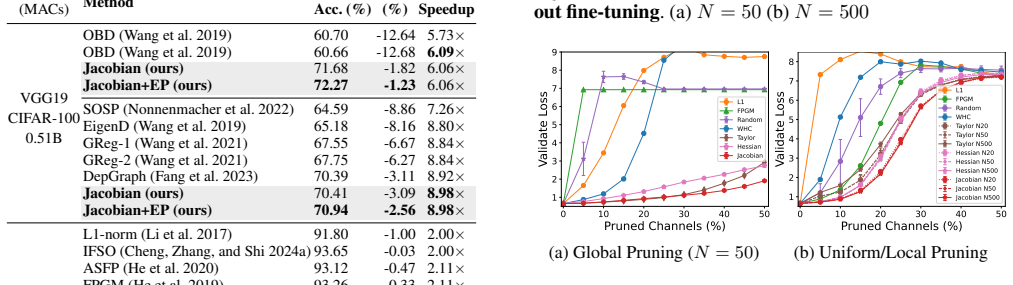
- [Table 7, 'Mean Mean' rows] For VGG-19/CIFAR-100 at 6× MACs, the Jacobian Criterion collapses to 35.94% (and 28.11% at 9×), while DepGraph retains 71.47% (68.40% at 9×); EP does not prevent the collapse (38.08% with EP at 6×). This is a catastrophic failure under a simple choice of aggregator and normalizer. The paper reports the ablation but does not discuss or explain this behavior. This directly qualifies the claim in the Methodology that JC 'achieves effective global pruning without normalization' and the narrative of robustness. Please analyze the cause (e.g., score-scale distortion, rank inversion, cancellation in the additive group score) and either fix the criterion or explicitly delimit the safe configuration space. As it stands, Table 7 shows the method is fragile to a small change in aggregation.
- [Methodology, Eqs. (1)-(3)] The saliency is derived from a squared-error proxy L(Δw) = ||l(w+Δw) − l(w)||^2, not the true loss change. The squared form is introduced without justification; the actual scalar loss degradation would be l(w+Δw) − l(w) (or its absolute value). The choice to square is consequential: it produces the quadratic form J^T J and changes the ranking (e.g., it emphasizes samples with large loss deviations). As this proxy is the foundation of the criterion, its validity should be motivated or empirically validated against the true loss change for small perturbations. Without such support, the connection between the score S and actual pruning damage is an assumption rather than a derivation.
minor comments (6)
- [Eq. (3)] 'J^T J is positive definite in practice' is generally false when the number of batches N is smaller than the number of parameters P, which is typical (N=50, P in millions). J^T J is then positive semidefinite and may have zero directions; the subsequent statement that any nonzero perturbation increases L is too strong. Please correct to positive semidefinite.
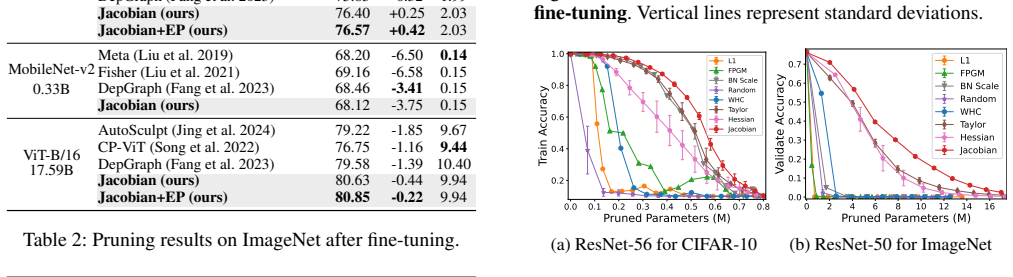
- [Figures 5 and 6] Figure 5 reports train accuracy for VGG-19, while Figure 6 reports validation accuracy for ResNet-56 and ResNet-50. The inconsistency in the evaluation metric should be clarified, and ideally the same metric should be used for all comparisons.
- [Table 2, MobileNet-v2 row] For MobileNet-v2, Jacobian (68.12) is below DepGraph (68.46) at the same MACs (0.15B). The abstract's 'outperforms several popular metrics' is true but not universal; please add a sentence interpreting this result and note any limitations for inverted-bottleneck architectures.
- [Algorithm 1] Line 10 says 'Prune (p·G) groups'; if p·G is not an integer, the behavior is undefined. Please specify rounding or impose a minimum of one group per iteration.
- [Eq. (16)] The notation 'I_{O1}[{1,...,O1} ⊘ P, :]' uses '⊘' without definition; presumably it means set difference. Please clarify the indexing notation for the identity-row selection.
- [Table 3 and references] The entries labeled 'OBD (Wang et al. 2019)' appear twice with different speedups, but the original OBD is LeCun, Denker, and Solla (1989). The citation attribution is confusing and should be corrected.
Circularity Check
No significant circularity: Jacobian Criterion and Equivalent Pruning are derived from stated approximations and trained optimization, not from the target results.
full rationale
The paper's central derivation is self-contained. The Jacobian Criterion is obtained from a first-order Taylor expansion of a squared loss-vector perturbation: Eq. (3) gives L(Δw) = ΔwᵀJᵀJΔw, and Eq. (4) introduces the block-diagonal approximation for JᵀJ as an explicit computational assumption, not as something imported from the paper's own conclusions. Eq. (8) then defines group saliency as a sum of per-parameter quadratic forms S = Σ wₘᵀJₘᵀJₘwₘ. This is a metric computed from network gradients; no parameter is fitted to the reported accuracies, and no prediction is used to set constants. The Equivalent Pruning autoencoder (C and D layers) is a learnable transformation trained during fine-tuning; training an optimization module is not circular derivation. The self-citations (WHC, coupled tensor decomposition) are background comparisons and are not load-bearing for the main claim. The block-diagonal assumption and the Table 7 'Mean Mean' collapse are legitimate correctness/robustness concerns about whether the approximation captures cross-layer interactions, but they are not circularity: the paper does not define its criterion in terms of the results, nor does it rely on a self-citation to force its choice. The derivation chain is therefore not circular, and the honest finding is a score of 0.
Assumptions & free parameters
free parameters (2)
- Number of gradient batches N =
50 (default)
- Pruning step size p =
1/400 for CIFAR, 1/100 for ImageNet
assumptions (4)
- standard math Taylor expansion of the loss vector l(w+Δw) ≈ l(w) + JΔw, ignoring higher-order terms
- domain assumption J^T J is block-diagonal over structural parameters; off-block correlations are zero
- domain assumption Pruning a group does not change saliencies of other groups, and group saliency is the sum of individual parameter saliencies
- ad hoc to paper The squared loss degradation L(Δw) is a valid proxy for pruning damage
invented entities (1)
-
Compressor C and Decompressor D layers
Cite this review
Pith. "Pith review of Optimal Brain Connection: Towards Efficient Structural Pruning." pith.science (2026). https://pith.science/paper/Z32YH2Y7
@misc{pith2026250805521,
  author       = {Pith},
  title        = {Pith review of: Optimal Brain Connection: Towards Efficient Structural Pruning},
  year         = {2026},
  howpublished = {\url{https://pith.science/paper/Z32YH2Y7}},
  note         = {Machine review of arXiv:2508.05521}
}
read the original abstract
Structural pruning has been widely studied for its effectiveness in compressing neural networks. However, existing methods often neglect the interconnections among parameters. To address this limitation, this paper proposes a structural pruning framework termed Optimal Brain Connection. First, we introduce the Jacobian Criterion, a first-order metric for evaluating the saliency of structural parameters. Unlike existing first-order methods that assess parameters in isolation, our criterion explicitly captures both intra-component interactions and inter-layer dependencies. Second, we propose the Equivalent Pruning mechanism, which utilizes autoencoders to retain the contributions of all original connection--including pruned ones--during fine-tuning. Experimental results demonstrate that the Jacobian Criterion outperforms several popular metrics in preserving model performance, while the Equivalent Pruning mechanism effectively mitigates performance degradation after fine-tuning. Code: https://github.com/ShaowuChen/Optimal_Brain_Connection
Figures



Figures from the paper (6 more)




Forward citations
Cited by 3 Pith papers
-
CoCurve: Cross-Module Co-Pruning Curvature for Training-Free Structured LLM Pruning
A training-free joint attention+FFN pruning method whose Fisher-derived interaction matrix, recovered from M single-unit ablations as a Gram product, beats node-only saliency baselines on 3B–24B models.
-
STARFISH: faST Accuracy Recovery in pruned networks From Internal State Healing
STARFISH recovers accuracy in pruned neural networks by optimizing internal state alignment to the original model with a minimal unlabeled calibration set, outperforming prior recovery methods especially at high pruni...
-
Adaptive Parallel Downloader for Large Genomic Datasets
FastBioDL uses utility-based gradient descent to adapt HTTP/FTP download concurrency in real time, reporting up to 4x faster retrieval of large genomic datasets than static-concurrency tools.
Reference graph
Works this paper leans on
-
[4]
Efficient Model Compression Techniques with FishLeg
Learning Efficient Convolutional Networks through Network Slimming. In Proceedings of the IEEE Interna- tional Conference on Computer Vision (ICCV), 2755–2763. Liu, Z.; Mu, H.; Zhang, X.; Guo, Z.; Yang, X.; Cheng, K.; and Sun, J. 2019. MetaPruning: Meta Learning for Auto- matic Neural Network Channel Pruning. In Proceedings of the IEEE International Confe...
work page Pith review arXiv 2019
-
[6]
In International Conference on Learn- ing Representations (ICLR)
Pruning Convolutional Neural Networks for Resource Efficient Inference. In International Conference on Learn- ing Representations (ICLR). Nonnenmacher, M.; Pfeil, T.; Steinwart, I.; and Reeb, D
-
[2017]
In Interna- tional Conference on Learning Representations (ICLR)
Pruning Filters for Efficient ConvNets. In Interna- tional Conference on Learning Representations (ICLR). Liao, Z.; Hezbri, N.; Qu ´etu, V .; Nguyen, V .-T.; and Tartaglione, E. 2025. Till the Layers Collapse: Compressing a Deep Neural Network through the Lenses of Batch Nor- malization Layers. In Proceedings of the AAAI Conference on Artificial Intellige...
work page 2025
-
[2019]
Importance Estimation for Neural Network Pruning. In Proceedings of the IEEE/CVF Conference on Computer Vision and Pattern Recognition (CVPR), 11264–11272. Molchanov, P.; Tyree, S.; Karras, T.; Aila, T.; and Kautz, J
-
[2020]
Asymptotic Soft Filter Pruning for Deep Convolu- tional Neural Networks. IEEE Trans. Cybern., 3594–3604. He, Y .; Liu, P.; Wang, Z.; Hu, Z.; and Yang, Y . 2019. Filter Pruning via Geometric Median for Deep Convolutional Neu- ral Networks Acceleration. In Proceedings of the IEEE/CVF Conference on Computer Vision and Pattern Recognition (CVPR), 4340–4349. H...
work page Pith review arXiv 2019
-
[2022]
Conv-BN-CCC-New BN-ReLU-DDD-Conv/Classifier
SOSP: Efficiently capturing global correlations by second-order structured pruning. International Conference on Learning Representations (ICLR). Singh, P.; Verma, V . K.; Rai, P.; and Namboodiri, V . P. 2020. Leveraging Filter Correlations for Deep Model Compres- sion. In Proceedings of the IEEE/CVF Winter Conference on Applications of Computer Vision (WA...
arXiv 2020
-
[2025]
Text-guided Sparse V oxel Pruning for Efficient 3D Visual Grounding. In Proceedings of the IEEE/CVF Confer- ence on Computer Vision and Pattern Recognition (CVPR), 3666–3675. Han, S.; Pool, J.; Tran, J.; and Dally, W. J. 2015. Learn- ing Both Weights and Connections for Efficient Neural Net- work. In Advances in Neural Information Processing Sys- tems (Ne...
work page 2015
Reviewed August 5, 2026 · model on record in the stance chip above.
Discussion (0). Sign in to comment.