REVIEW 4 major objections 5 minor 1 cited by
Multiband parameter estimation with phase coherence and extrinsic marginalization: Extracting more information from low-SNR CBC signals in LISA data
T0 review · 4 major / 5 minor · reviewed 2026-08-07 · deepseek-v4-flash
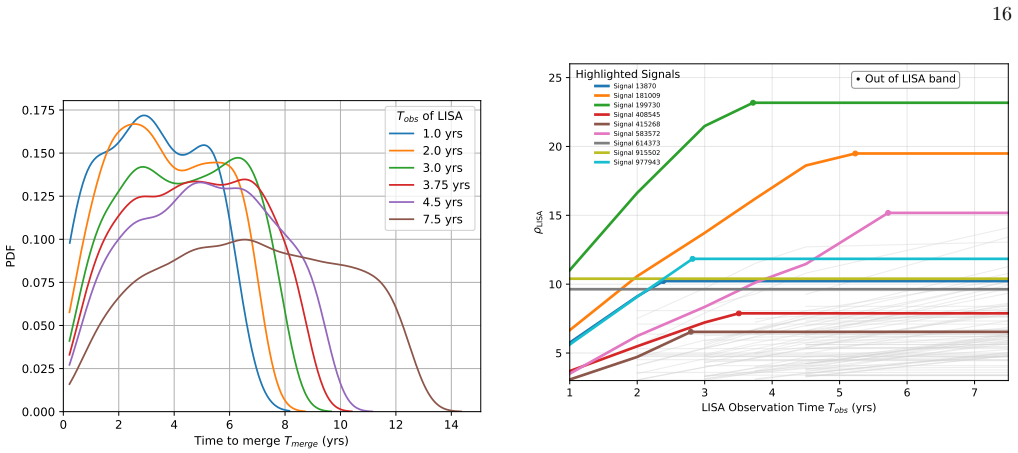
Pith's one-line read The paper claims that coherent phase-locked multiband analysis can extract reliable parameter estimates from LISA signals with SNR as low as 3, nearly doubling the available source count.
desk verdict A genuinely new coherent multiband likelihood with extrinsic marginalization, but the SNR-3 claim rests on a thin validation set; worth refereeing with a demand for coverage diagnostics. read the letter →
The pith
A machine-rendered reading of the paper's core claim, the machinery that carries it, and where it could break.
The reading
What carries the argument
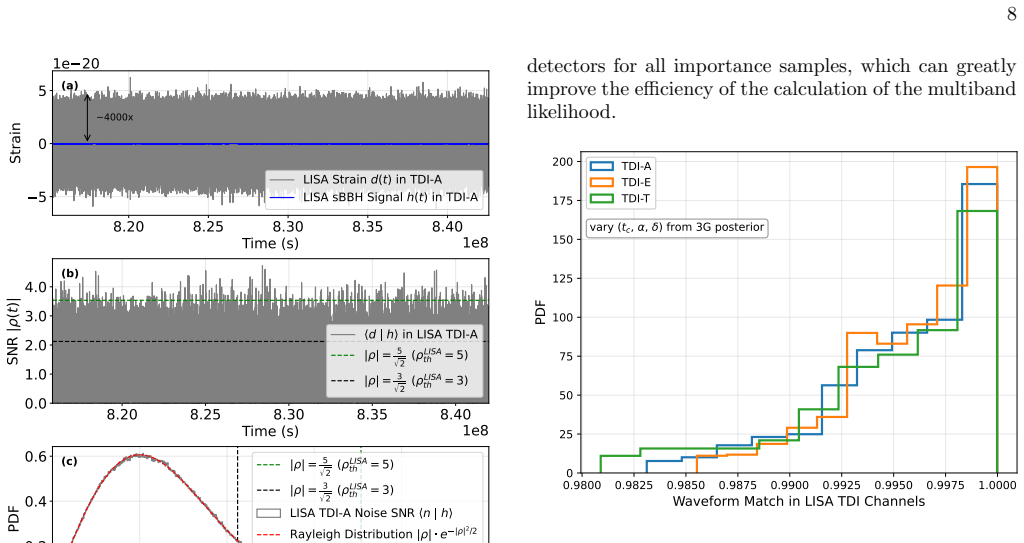
The central object is the coherent multiband likelihood, which sums the log-likelihoods of the LISA time-delay-interferometry channels and all ground-based detectors for the same physical waveform, expressed in a common geocentric frame through rotation-matrix transformations. Extrinsic parameters are marginalized to reduce the sampled parameter space: luminosity distance by a precomputed inner-product look-up table, orbital phase analytically through a modified Bessel function, and arrival time plus sky location by importance sampling using the ground-based SNR time series as the proposal distribution. Because the LISA waveform match varies by less than 2% over the ground-based posterior for the restricted waveform family used, the same extrinsic samples serve the LISA part of the likelihood, and the remaining sampling is over intrinsic parameters only.
What would settle it
Generate a mock multiband event with LISA SNR near 3 whose waveform includes precession or eccentricity, run the coherent method with the same ground-based importance proposal, and check whether the normalized importance weights remain bounded and the chirp-mass posterior stays unbiased; a collapse of the weights would show that the 2-percent waveform-match assumption is the load-bearing limit.
Extended reading notes
Core claim
The central claim is that the low-SNR barrier in multiband analysis is not fundamental: a coherent likelihood that keeps LISA and ground-based waveform phases consistent, combined with importance-sampling marginalization over extrinsic parameters, can extract information from signals with LISA SNR as low as 3, where noise-only matched-filter peaks are comparable to the signal peak. The paper demonstrates this on population scale, analyzing all simulated multiband signals with LISA SNR above 3 and showing that chirp mass, mass ratio, and spin estimates improve substantially over ground-based-only results. It also shows that even a single year of LISA data, analyzed this way, gives most multiband sources a detector-frame chirp-mass 90% credible interval below $10^{-4}\,\mathrm{M}_\odot$, exceeding the best ET+2CE-only measurements by at least an order of magnitude.
Load-bearing premise
The method assumes that, over the arrival-time and sky-location region allowed by the ground-based posterior, the LISA waveform changes by less than about 2 percent, so ground-based samples can serve as the proposal for the LISA part of the likelihood; the paper demonstrates this only for non-precessing, quasi-circular, aligned-spin waveforms with an analytic LISA orbit.
Editorial extensions
If this is right
- Multiband analyses can work at LISA SNR roughly 3, nearly doubling the number of usable sources relative to the previous threshold of 5.
- Population-scale multiband Bayesian parameter estimation becomes computationally practical, with individual runs taking days on a small CPU cluster rather than being prohibitive.
- Even one year of LISA data yields detector-frame chirp-mass 90% credible intervals below $10^{-4}\,\mathrm{M}_\odot$ for most multiband sources, beating ET+2CE-only measurements by at least an order of magnitude.
- LISA's main multiband contribution is precision on intrinsic phase-sensitive parameters such as chirp mass, mass ratio, and spins, while sky localization improves only marginally because the ground-based network already constrains it well.
- Lowering the effective LISA SNR threshold from 5 to 3 shifts the multiband event-rate bottleneck from data-analysis capability to the intrinsic LISA sensitivity and mission duration.
Reading between the lines
- If the 2%-match assumption fails for precessing, eccentric, or higher-mode waveforms, the SNR-3 threshold would likely rise, or the method would need a proposal distribution built iteratively from the multiband posterior itself.
- The same extrinsic-marginalization machinery could be applied to LISA-only or LISA-plus-current-ground-based early-warning searches, where the proposal distribution is weaker and the practical SNR threshold would be set by proposal quality rather than by the likelihood alone.
- The population-scale posterior widths already trace the underlying mass distribution, so a natural next step is hierarchical population inference that treats the multiband chirp-mass measurements as data, potentially sharpening merger-rate and formation-channel estimates.
- The claim that one LISA year is enough revises earlier mission-planning expectations and could be tested against LISA Data Challenge-style datasets that include overlapping signals and realistic confusion noise.
Editorial analysis
A structured set of objections, weighed in public.
Referee Report
Summary. The paper develops a coherent multiband Bayesian parameter-estimation method for stellar-mass and intermediate-mass binary black holes observed jointly by LISA and next-generation ground-based detectors (ET+2CE). The method evaluates a joint likelihood in a common geocentric frame using rotation matrices, marginalizes luminosity distance and orbital phase analytically/numerically, and uses importance sampling with a proposal derived from the 3G posterior for the extrinsic parameters (tc, alpha, delta). The key efficiency ingredient is the observation, illustrated in Fig. 4, that the LISA TDI waveform match varies by less than 2% over the 3G extrinsic posterior, so the 3G information can drive the marginalization. The authors validate the method on simulated GWTC-3-like populations, claim successful extraction of signals with LISA SNR as low as 3 (Sec. IV.C.5, Fig. 13), nearly doubled multiband event rates (Fig. 8), and population-scale parameter estimation with chirp-mass 90% credible intervals commonly below 1e-4 solar masses (Fig. 14). They also compare against a semi-coherent '3G posterior as LISA prior' approach and against LISA-only analysis.
Significance. If the central claims hold, this is an important step for multiband LISA+3G science: it would make population-scale Bayesian multiband inference practical, roughly double the number of usable multiband events by lowering the LISA SNR threshold from 5 to 3, and produce chirp-mass measurements far more precise than 3G-only estimation, even with one year of LISA data. The paper has concrete strengths: the code is public, the comparison with the semi-coherent approach is a useful check, the coordinate-system transformation is explicit, and the population-scale simulation campaign (20 random-seed datasets per observation scenario, plus 50 for IMBHBs) is substantially more ambitious than earlier single-event multiband studies. However, the strongest claims presently rest on a small number of example signals and on the flatness of the LISA response over the 3G extrinsic posterior, which is demonstrated only for a restricted waveform family. The significance is therefore real but conditional on additional validation and on narrowing or carefully qualifying the claims.
major comments (4)
- [Sec. IV.C.5, Fig. 13; abstract; Sec. V] The central claim that the method 'successfully analyzes all multiband signals in simulated datasets with LISA SNR greater than 3' is supported by four randomly selected signals with rho_LISA about 3 and by qualitative inspection of their posteriors. There is no quantitative success criterion (for example, fraction of runs whose 90% credible interval contains the injected values, bias relative to injection, or HPD coverage), and no importance-weight diagnostics (effective sample size or weight variance) for these low-SNR runs. Because the paper itself notes that the chirp-mass posterior has 'multiple small modes' around the true peak, the presence of a narrow peak near the truth does not by itself establish that the marginalized likelihood is unbiased. I recommend defining a success metric and applying it to all events above threshold in the simulated datasets, or explicitly stating that the SNR-3 claim is example-based rather than a demonstrated population-level property.
- [Sec. III.D, Fig. 4, Sec. IV.A, App. A] The load-bearing flatness of the LISA TDI waveform over the 3G posterior of (tc, alpha, delta), quantified as a match within 2% in Fig. 4, is demonstrated only for non-precessing, quasi-circular IMRPhenomD/HM waveforms with an analytical LISA orbit. Precession, eccentricity, additional higher modes, or a realistic dynamical LISA orbit can make the LISA response more sensitive to extrinsic parameters; in that case the proposal q(tc, alpha, delta) from Eq. (23) will undercover the LISA conditional posterior, the importance weights in Eq. (24) will have large variance, and the marginalized likelihood at rho_LISA about 3 could be biased. The paper acknowledges waveform systematics in Sec. V, but the abstract and Sec. IV.C.5 state the SNR-3 capability unconditionally. I ask either to restrict the claim to the modeled waveform family or to add a robustness study on a subset with eccentricity or precession to demonstrate that the proposal coverage remains adequate.
- [Sec. III.D.3, around Eq. (24)] The statement that in the marginalization over arrival time and sky location one can 'use (tc, alpha, delta) corresponding to maximum SNR in 3G samples for all the importance samples to accelerate' appears to replace per-sample LISA likelihood evaluations with a single evaluation at the 3G maximum-likelihood extrinsic point. If this is what is implemented, it is an additional approximation beyond standard importance sampling: the LISA contribution to each weight becomes a constant, so the LISA likelihood is not actually averaged over the proposal samples. The 2% match bound in Fig. 4 is computed for a time/phase-maximized match, whereas the joint likelihood uses a common reference frequency (5 Hz) and a fixed phase relationship; these two quantities need not have the same sensitivity to extrinsic-parameter errors. Please clarify whether per-sample LISA evaluations are performed, and if the max-point shortcut is used, validate it against the full evaluation for a subset of signals, especially near rho_LISA about 3.
- [Sec. IV.C.6, Fig. 14] The population-scale credible-interval widths are presented without posterior coverage validation. For multimodal low-SNR posteriors, the width of a 90% credible interval is not, by itself, evidence of statistical validity; the fact that a narrow mode happens to contain the true value is anecdotal. I recommend adding a coverage or P-P diagnostic for the multiband runs, or at least reporting, binned by rho_LISA, the fraction of events whose 90% credible interval contains the injected chirp mass and effective spin. This is directly relevant to the headline claim that LISA improves chirp-mass precision by two to three orders of magnitude.
minor comments (5)
- [Sec. III, after Eq. (4)] The text says 'After we have chosen a specific frame, we can convert them into the same theta', but it is not immediately clear that this conversion is performed on the fly during likelihood evaluation using the rotation matrices in App. A; please make that connection explicit.
- [Eq. (7)] The placement of the real-part operator and parentheses in Eq. (7) is ambiguous; please add brackets so the reader can see that the real part applies to the entire sum over detectors and polarizations.
- [Sec. III.D.3, Eqs. (20)-(21)] The time resolution Delta_rho of the SNR time series is used in the discrete time-delay mapping but its value or the rule for choosing it is never stated; please specify it, as it controls the accuracy of the sky-position discretization and hence the proposal prior Pi(tau).
- [Fig. 13] The labels 'signal 108528', 'signal 131308', 'signal 341522', and 'signal 344896' are not defined in the text or caption; please state whether these are dataset event IDs and list their injected parameters, including the true rho_LISA values.
- [Sec. IV.A and App. A] The restriction to non-precessing, quasi-circular IMRPhenomD/HM waveforms and to an analytical LISA orbit is stated clearly, but the same caveat should appear in the abstract or introduction where the SNR-3 and near-doubling results are advertised.
Circularity Check
No significant circularity: the multiband PE results emerge from injected-signal simulations with an independent 3G-based importance proposal, not from fit-to-target or self-referential derivation.
full rationale
The paper's derivation chain is self-contained. Its central claims—population-scale coherent multiband parameter estimation down to LISA SNR 3, chirp-mass 90% credible intervals near 10^-4 M_sun, and the near-doubling of multiband events—emerge from explicit injections drawn from a GWTC-3-based population model, with LISA TDI-2 responses computed via BBHx/IMRPhenomD/HM and ET+2CE noise curves. The importance-sampling proposal for (tc, alpha, delta) is built from the ground-based 3G posterior, which is an independent source of information; the LISA likelihood is evaluated on those proposal samples, and the 2% waveform-match check in Fig. 4 is an in-model validation of proposal coverage, not an encoded assumption of the LISA result. Self-citations (e.g., [70] for importance-sampling methodology and [71] for mock-data population generation) are used for standard or reproducible techniques and are not load-bearing circular inputs: the paper derives its own likelihood marginalization equations (Eqs. 13-24) and validates on simulated data. The main caveats—restriction to non-precessing quasi-circular waveforms, analytical LISA orbit, and the absence of full coverage diagnostics for importance weights at SNR~3—are correctness and systematics risks, not circularity. No equation reduces to its inputs by construction, and no fitted parameter is renamed as a prediction.
Assumptions & free parameters
free parameters (6)
- LISA SNR threshold rho_LISA = 3 =
3
- Local merger rate rho_0 =
22 Gpc^-3 yr^-1
- Waiting time T_wait =
5 yr
- Time-delay distribution P(tau) =
1/tau
- LISA observation durations T_obs =
1.0, 2.0, 3.0, 3.75, 4.5, 7.5 yr
- Common reference frequency f_ref =
5 Hz
assumptions (8)
- standard math Bayes theorem and the matched-filter log-likelihood ratio (Eqs. 1-4) describe the posterior for Gaussian detector noise.
- standard math Importance sampling identity Eq. (15) converges and gives an unbiased estimate of the marginalized likelihood when the proposal covers the target.
- standard math Analytic orbital-phase marginalization reduces to a modified Bessel function I0 (Eq. 19g).
- domain assumption Detector noise is Gaussian, stationary, and contains only a single injected signal in each simulation.
- domain assumption LISA and 3G waveforms are non-precessing, quasi-circular, vacuum IMRPhenomD/HM signals.
- domain assumption The analytical LISA orbit and TDI-2 response with rotation matrices are adequate for the frequency and time ranges considered.
- domain assumption The 3G posterior for (tc, alpha, delta) gives LISA waveform matches within 2%, so the LISA extrinsic likelihood is nearly flat over the proposal support.
- ad hoc to paper Using the maximum-SNR 3G extrinsic values for all importance samples accelerates the marginalization.
Cite this review
Pith. "Pith review of Multiband parameter estimation with phase coherence and extrinsic marginalization: Extracting more information from low-SNR CBC signals in LISA data." pith.science (2026). https://pith.science/paper/Z3MD6H45
@misc{pith2026250601898,
  author       = {Pith},
  title        = {Pith review of: Multiband parameter estimation with phase coherence and extrinsic marginalization: Extracting more information from low-SNR CBC signals in LISA data},
  year         = {2026},
  howpublished = {\url{https://pith.science/paper/Z3MD6H45}},
  note         = {Machine review of arXiv:2506.01898}
}
abstract
This paper presents a novel coherent multiband analysis framework for characterizing stellar- and intermediate-mass binary black holes using LISA and next-generation ground-based detectors (ET and CE), leveraging the latest developments in the \texttt{PyCBC} pipeline. Given the population parameters inferred from LVK results and LISA's sensitivity limits at high frequencies, most stellar-mass binary black holes would likely have SNRs below 5 in LISA, but the most state-of-the-art multiband parameter estimation methods, such as those using ET and CE posteriors as priors for LISA, typically struggle to analyze sources with a LISA SNR less than 5. We present a novel coherent multiband parameter estimation method that directly calculates a joint likelihood, which is highly efficient; this efficiency is enabled by multiband marginalization of the extrinsic parameter space, implemented using importance sampling, which can work robustly even when the LISA SNR is as low as 3. Having an SNR of $\sim 3$ allows LISA to contribute nearly double the number of multiband sources. Even if LISA only observes for one year, most of the multiband detector-frame chirp mass's 90\% credible interval (less than $10^{-4} \mathrm{M}_\odot$) is still better than that of the most accurately measured events for ET+2CE network in 7.5 years of observation, by at least one order of magnitude. For the first time, we show efficient multiband Bayesian parameter estimation results on the population scale, which paves the way for large-scale astrophysical tests using multibanding.
Figures


Figures from the paper (11 more)




Forward citations
Cited by 1 Pith paper
-
Constraints on Line-of-Sight Acceleration from O1-O4
All known compact binary mergers show line-of-sight accelerations consistent with zero under a new time-domain Doppler-shift model, with current detectors only sensitive to high-acceleration scenarios.
Reference graph
Works this paper leans on
-
[1]
IV A population model and the Sec
SNR Distribution of Multiband in 3G and LISA Based on the Sec. IV A population model and the Sec. IV B detector network settings and observation sce- narios, we calculate whether each randomly simulated signal satisfies our definition (see the last paragraph in Sec. IV B) of multiband signals. Since the number of events to be simulated is too large ( Tobs...
-
[2]
The difference is that we took two LISA observation durations ( Tobs=3.0 and 7.5 yrs) and three different LISA SNR thresholds ( ρth=3, 5, 8)
Detection Rate of Multiband Signal To estimate the population size detectable by multi- band, we also calculated the detection rate for multi- band signals in this study. The difference is that we took two LISA observation durations ( Tobs=3.0 and 7.5 yrs) and three different LISA SNR thresholds ( ρth=3, 5, 8). In Fig. 8, the internal plot with error bars...
-
[3]
The Time to Merger for Multiband Signals For multiband GW events, another concern is how long this signal needs to merge. On the one hand, this can be used as a guide for subsequent observations by ground- 15 500 1000 1500 2000 2500 3000 3500 ET + 2CE 5.0 7.5 10.0 12.5 15.0 17.5 20.0 22.5LISA Scatter: Tobs = 7.5 yrs LISA Tobs 1.0 yr 2.0 yrs 3.0 yrs 7.5 yr...
-
[4]
This analysis reveals how prolonged observations can en- hance signal detectability, offering new insights for mis- sion planning
How Does LISA Observation Duration affect Multiband Signals? Here we investigate the growth of multiband signal SNR in the LISA band with observation time, a fac- tor previously unexplored in prior multiband studies. This analysis reveals how prolonged observations can en- hance signal detectability, offering new insights for mis- sion planning. Fig. 10 s...
-
[5]
We randomly selected four signals with ρLISA ≃ 3 in Fig
Can We Make Use of Low-SNR Multiband Signals? We also analyzed signals with extremely low SNR in the dataset. We randomly selected four signals with ρLISA ≃ 3 in Fig. 13. We can see that our novel method with phase coherence and marginalization over extrinsic parameters is still applicable here. Our method can ac- curately find the narrow true likelihood ...
-
[6]
What Can We Learn from Population-scale Multiband Parameter Estimation? Fig. 14 summarizes our population-scale multiband pa- rameter estimation, showing the distribution of the 90% credible interval widths of the posterior of each parame- ter, with the vertical axis representing the average num- ber of events in each credible interval width bin (com- bin...
- [7]
-
[8]
α is the angular position of the LISA centroid in the SSB frame at time tLISA
T ransform between the SSB and LISA F rames We can use the following matrix to (inversely) trans- form between the SSB and LISA frames, RSL(α) = cos α − sin α 0 sin α cos α 0 0 0 1 | {z } Rz(α) · 1 2 0 − √ 3 2 0 1 0√ 3 2 0 1 2 | {z } Ry(− π 3 ) · cos α sin α 0 − sin α cos α 0 0 0 1 | {z } Rz(−α) (A1) with α = Ω0 · (tLISA + t0), (A2...
Show all 124 references
-
[9]
Using these equations, we can easily perform the (in- verse) transformation between two frames
T ransform between SSB and GEO F rame Similarly, we can do the transform from the SSB frame to the GEO frame as follows, 25 RSG(ϵ) = cos ϵ 0 sin ϵ 0 1 0 − sin ϵ 0 cos ϵ | {z } Rx(ϵ) , (A9) ˆkGEO = R⊤ SG · ˆkSSB, (A10) tGEO c = tSSB c + ˆkSSB · ˆpSSB E c , (A11) ψGEO = ...
-
[10]
Abbott et al
R. Abbott et al. (KAGRA, VIRGO, LIGO Scientific), GWTC-3: Compact Binary Coalescences Observed by LIGO and Virgo during the Second Part of the Third Observing Run, Phys. Rev. X 13, 041039 (2023), arXiv:2111.03606 [gr-qc]
2023 arXiv
-
[11]
A. H. Nitz, S. Kumar, Y.-F. Wang, S. Kastha, S. Wu, M. Sch¨ afer, R. Dhurkunde, and C. D. Capano, 4-OGC: Catalog of gravitational waves from compact-binary mergers, (2021), arXiv:2112.06878 [astro-ph.HE]
2021 arXiv
-
[12]
Olsen, T
S. Olsen, T. Venumadhav, J. Mushkin, J. Roulet, B. Za- ckay, and M. Zaldarriaga, New binary black hole merg- ers in the LIGO-Virgo O3a data, Phys. Rev. D 106, 043009 (2022), arXiv:2201.02252 [astro-ph.HE]
2022 arXiv
-
[13]
P. A. Seoane et al. , The effect of mission duration on LISA science objectives, Gen. Rel. Grav. 54, 3 (2022), arXiv:2107.09665 [astro-ph.IM]
2022 arXiv
-
[14]
C. J. Moore, D. Gerosa, and A. Klein, Are stellar-mass black-hole binaries too quiet for LISA?, Mon. Not. Roy. Astron. Soc. 488, L94 (2019), arXiv:1905.11998 [astro- ph.HE]
2019
-
[15]
Abbott et al
R. Abbott et al. (KAGRA, VIRGO, LIGO Scientific), Population of Merging Compact Binaries Inferred Using Gravitational Waves through GWTC-3, Phys. Rev. X 13, 011048 (2023), arXiv:2111.03634 [astro-ph.HE]
2023 arXiv
-
[16]
Mandel and F
I. Mandel and F. S. Broekgaarden, Rates of compact object coalescences, Living Rev. Rel. 25, 1 (2022), arXiv:2107.14239 [astro-ph.HE]
2022 arXiv
-
[17]
Colpi et al
M. Colpi et al. (LISA), LISA Definition Study Report (2024), arXiv:2402.07571 [astro-ph.CO]
2024 arXiv
-
[18]
Sesana, Prospects for Multiband Gravitational-Wave Astronomy after GW150914, Phys
A. Sesana, Prospects for Multiband Gravitational-Wave Astronomy after GW150914, Phys. Rev. Lett. 116, 231102 (2016), arXiv:1602.06951 [gr-qc]
2016 arXiv
-
[19]
Perna, D
R. Perna, D. Lazzati, and B. Giacomazzo, Short Gamma-Ray Bursts from the Merger of Two Black Holes, Astrophys. J. Lett. 821, L18 (2016), arXiv:1602.05140 [astro-ph.HE]
2016 arXiv
-
[20]
S. E. d. Mink and A. King, Electromagnetic signals fol- lowing stellar-mass black hole mergers, Astrophys. J. Lett. 839, L7 (2017), arXiv:1703.07794 [astro-ph.HE]
2017 arXiv
-
[21]
Toubiana, S
A. Toubiana, S. Babak, S. Marsat, and S. Ossokine, Detectability and parameter estimation of GWTC-3 events with LISA, Phys. Rev. D 106, 104034 (2022), arXiv:2206.12439 [gr-qc]
2022 arXiv
-
[22]
Seto and K
N. Seto and K. Kyutoku, How many extragalactic stel- lar mass binary black holes will be detected by space gravitational-wave interferometers?, Mon. Not. Roy. As- tron. Soc. 514, 4669 (2022), arXiv:2201.02766 [astro- ph.HE]
2022 arXiv
-
[23]
Buscicchio, J
R. Buscicchio, J. Torrado, C. Caprini, G. Nardini, N. Karnesis, M. Pieroni, and A. Sesana, Stellar-mass black-hole binaries in LISA: characteristics and com- plementarity with current-generation interferometers, JCAP 01, 084, arXiv:2410.18171 [astro-ph.HE]
-
[24]
K. Jani, D. Shoemaker, and C. Cutler, Detectability of Intermediate-Mass Black Holes in Multiband Gravita- tional Wave Astronomy, Nature Astron. 4, 260 (2019), arXiv:1908.04985 [gr-qc]
2019 arXiv
-
[25]
Klein et al
A. Klein et al. , The last three years: multiband gravitational-wave observations of stellar-mass binary black holes (2022), arXiv:2204.03423 [astro-ph.HE]
2022 arXiv
-
[26]
Nishizawa, E
A. Nishizawa, E. Berti, A. Klein, and A. Sesana, eLISA eccentricity measurements as tracers of binary black hole formation, Phys. Rev. D 94, 064020 (2016), arXiv:1605.01341 [gr-qc]
2016 arXiv
-
[27]
Nishizawa, A
A. Nishizawa, A. Sesana, E. Berti, and A. Klein, Con- straining stellar binary black hole formation scenarios with eLISA eccentricity measurements, Mon. Not. Roy. Astron. Soc. 465, 4375 (2017), arXiv:1606.09295 [astro- ph.HE]
2017 arXiv
-
[28]
Breivik, C
K. Breivik, C. L. Rodriguez, S. L. Larson, V. Kalogera, and F. A. Rasio, Distinguishing Between Formation Channels for Binary Black Holes with LISA, Astro- phys. J. Lett. 830, L18 (2016), arXiv:1606.09558 [astro- ph.GA]
2016 arXiv
-
[29]
Kremer et al
K. Kremer et al. , Post-Newtonian Dynamics in Dense Star Clusters: Binary Black Holes in the LISA Band, Phys. Rev. D 99, 063003 (2019), arXiv:1811.11812 [astro-ph.HE]. 26
2019 arXiv
-
[30]
Samsing and D
J. Samsing and D. J. D’Orazio, Black Hole Mergers From Globular Clusters Observable by LISA I: Eccen- tric Sources Originating From Relativistic N -body Dy- namics, Mon. Not. Roy. Astron. Soc. 481, 5445 (2018), arXiv:1804.06519 [astro-ph.HE]
2018 arXiv
-
[31]
D. J. D’Orazio and J. Samsing, Black Hole Mergers From Globular Clusters Observable by LISA II: Re- solved Eccentric Sources and the Gravitational Wave Background, Mon. Not. Roy. Astron. Soc. 481, 4775 (2018), arXiv:1805.06194 [astro-ph.HE]
2018 arXiv
-
[32]
H. Wang, I. Harry, A. Nitz, and Y.-M. Hu, Space- based gravitational wave observatories will be able to use eccentricity to unveil stellar-mass binary black hole formation, Phys. Rev. D 109, 063029 (2024), arXiv:2304.10340 [astro-ph.HE]
2024 arXiv
-
[33]
P. C. Peters, Gravitational Radiation and the Motion of Two Point Masses, Phys. Rev. 136, B1224 (1964)
1964
-
[34]
Carson and K
Z. Carson and K. Yagi, Parametrized and inspiral- merger-ringdown consistency tests of gravity with multi- band gravitational wave observations, Phys. Rev. D 101, 044047 (2020), arXiv:1911.05258 [gr-qc]
2020 arXiv
-
[35]
Ranjan, K
S. Ranjan, K. Jani, A. H. Nitz, K. Holley-Bockelmann, and C. Cutler, A Tale of Two Black Holes: Multiband Gravitational-wave Measurement of Recoil Kicks, As- trophys. J. 983, 27 (2025), arXiv:2406.11926 [gr-qc]
2025 arXiv
-
[36]
Muttoni, A
N. Muttoni, A. Mangiagli, A. Sesana, D. Laghi, W. Del Pozzo, D. Izquierdo-Villalba, and M. Rosati, Multiband gravitational wave cosmology with stellar origin black hole binaries, Phys. Rev. D 105, 043509 (2022), arXiv:2109.13934 [astro-ph.CO]
2022 arXiv
-
[37]
B. C. Seymour, H. Yu, and Y. Chen, Multiband gravi- tational wave cosmography with dark sirens, Phys. Rev. D 108, 044038 (2023), arXiv:2208.01668 [gr-qc]
2023 arXiv
-
[38]
Baker, E
T. Baker, E. Barausse, A. Chen, C. de Rham, M. Pieroni, and G. Tasinato, Testing gravitational wave propagation with multiband detections, JCAP 03, 044, arXiv:2209.14398 [gr-qc]
-
[39]
Harry and J
I. Harry and J. Noller, Probing the speed of gravity with L VK, LISA, and joint observations, Gen. Rel. Grav.54, 133 (2022), arXiv:2207.10096 [gr-qc]
2022 arXiv
-
[40]
Barausse, N
E. Barausse, N. Yunes, and K. Chamberlain, Theory- Agnostic Constraints on Black-Hole Dipole Radia- tion with Multiband Gravitational-Wave Astrophysics, Phys. Rev. Lett. 116, 241104 (2016), arXiv:1603.04075 [gr-qc]
2016 arXiv
-
[41]
Toubiana, S
A. Toubiana, S. Marsat, E. Barausse, S. Babak, and J. Baker, Tests of general relativity with stellar-mass black hole binaries observed by LISA, Phys. Rev. D101, 104038 (2020), arXiv:2004.03626 [gr-qc]
2020 arXiv
-
[42]
Gupta, S
A. Gupta, S. Datta, S. Kastha, S. Borhanian, K. G. Arun, and B. S. Sathyaprakash, Multiparameter tests of general relativity using multiband gravitational-wave observations, Phys. Rev. Lett. 125, 201101 (2020), arXiv:2005.09607 [gr-qc]
2020 arXiv
-
[43]
Bandopadhyay and C
D. Bandopadhyay and C. J. Moore, GPU-accelerated semicoherent hierarchical search for stellar-mass binary inspiral signals in LISA, Phys. Rev. D 110, 103026 (2024), arXiv:2408.13170 [gr-qc]
2024 arXiv
-
[44]
Gnocchi, A
G. Gnocchi, A. Maselli, T. Abdelsalhin, N. Giacobbo, and M. Mapelli, Bounding alternative theories of gravity with multiband GW observations, Phys. Rev. D 100, 064024 (2019), arXiv:1905.13460 [gr-qc]
2019 arXiv
-
[45]
R. Tso, D. Gerosa, and Y. Chen, Optimizing LIGO with LISA forewarnings to improve black-hole spectroscopy, Phys. Rev. D 99, 124043 (2019), arXiv:1807.00075 [gr- qc]
2019 arXiv
-
[46]
Ghosh, A
S. Ghosh, A. Weaver, J. Sanjuan, P. Fulda, and G. Mueller, Detection of the gravitational memory ef- fect in LISA using triggers from ground-based detectors, Phys. Rev. D 107, 084051 (2023), arXiv:2302.04396 [gr- qc]
2023 arXiv
-
[47]
K. W. K. Wong, E. D. Kovetz, C. Cutler, and E. Berti, Expanding the LISA Horizon from the Ground, Phys. Rev. Lett. 121, 251102 (2018), arXiv:1808.08247 [astro- ph.HE]
2018 arXiv
-
[48]
Gerosa, S
D. Gerosa, S. Ma, K. W. K. Wong, E. Berti, R. O’Shaughnessy, Y. Chen, and K. Belczynski, Multi- band gravitational-wave event rates and stellar physics, Phys. Rev. D 99, 103004 (2019), arXiv:1902.00021 [astro-ph.HE]
2019 arXiv
-
[49]
Cutler et al
C. Cutler et al. , What we can learn from multi- band observations of black hole binaries (2019), arXiv:1903.04069 [astro-ph.HE]
2019 arXiv
-
[50]
Ewing, S
B. Ewing, S. Sachdev, S. Borhanian, and B. S. Sathyaprakash, Archival searches for stellar-mass binary black holes in LISA data, Phys. Rev. D 103, 023025 (2021), arXiv:2011.03036 [gr-qc]
2021 arXiv
-
[51]
Bandopadhyay and C
D. Bandopadhyay and C. J. Moore, LISA stellar-mass black hole searches with semicoherent and particle- swarm methods, Phys. Rev. D 108, 084014 (2023), arXiv:2305.18048 [gr-qc]
2023 arXiv
-
[52]
Zackay, L
B. Zackay, L. Dai, and T. Venumadhav, Relative Bin- ning and Fast Likelihood Evaluation for Gravitational Wave Parameter Estimation (2018), arXiv:1806.08792 27 [astro-ph.IM]
2018 arXiv
-
[53]
Bandopadhyay and C
D. Bandopadhyay and C. J. Moore, Searching for stellar-origin binary black holes in LISA Data Chal- lenge 1b: Yorsh, Phys. Rev. D 111, 044039 (2025), arXiv:2412.10501 [gr-qc]
2025 arXiv
-
[54]
Vallisneri, Use and abuse of the Fisher informa- tion matrix in the assessment of gravitational-wave parameter-estimation prospects, Phys
M. Vallisneri, Use and abuse of the Fisher informa- tion matrix in the assessment of gravitational-wave parameter-estimation prospects, Phys. Rev. D 77, 042001 (2008), arXiv:gr-qc/0703086
2008 arXiv
-
[55]
C. Liu, L. Shao, J. Zhao, and Y. Gao, Multiband Ob- servation of LIGO/Virgo Binary Black Hole Mergers in the Gravitational-wave Transient Catalog GWTC- 1, Mon. Not. Roy. Astron. Soc. 496, 182 (2020), arXiv:2004.12096 [astro-ph.HE]
2020 arXiv
-
[56]
Toubiana, S
A. Toubiana, S. Marsat, S. Babak, J. Baker, and T. Dal Canton, Parameter estimation of stellar-mass black hole binaries with LISA, Phys. Rev. D 102, 124037 (2020), arXiv:2007.08544 [gr-qc]
2020 arXiv
-
[57]
Marsat, J
S. Marsat, J. G. Baker, and T. Dal Canton, Explor- ing the Bayesian parameter estimation of binary black holes with LISA, Phys. Rev. D 103, 083011 (2021), arXiv:2003.00357 [gr-qc]
2021 arXiv
-
[58]
Buscicchio, A
R. Buscicchio, A. Klein, E. Roebber, C. J. Moore, D. Gerosa, E. Finch, and A. Vecchio, Bayesian pa- rameter estimation of stellar-mass black-hole bina- ries with LISA, Phys. Rev. D 104, 044065 (2021), arXiv:2106.05259 [astro-ph.HE]
2021 arXiv
-
[59]
M. C. Digman and N. J. Cornish, Parameter estimation for stellar-origin black hole mergers in LISA, Phys. Rev. D 108, 023022 (2023), arXiv:2212.04600 [gr-qc]
2023 arXiv
-
[60]
N. J. Cornish, Fast Fisher Matrices and Lazy Likeli- hoods (2010), arXiv:1007.4820 [gr-qc]
2010 arXiv
-
[61]
Neyman and E
J. Neyman and E. S. Pearson, On the Problem of the Most Efficient Tests of Statistical Hypotheses, Phil. Trans. Roy. Soc. Lond. A 231, 289 (1933)
1933
-
[62]
Finstad and D
D. Finstad and D. A. Brown, Fast Parameter Estima- tion of Binary Mergers for Multimessenger Follow-up, Astrophys. J. Lett. 905, L9 (2020), arXiv:2009.13759 [astro-ph.IM]
2020 arXiv
-
[63]
N. J. Cornish, Heterodyned likelihood for rapid gravi- tational wave parameter inference, Phys. Rev. D 104, 104054 (2021), arXiv:2109.02728 [gr-qc]
2021 arXiv
-
[64]
Wang, Time delay interferometry with minimal null frequencies, Phys
G. Wang, Time delay interferometry with minimal null frequencies, Phys. Rev. D 110, 042005 (2024), arXiv:2403.01490 [gr-qc]
2024 arXiv
-
[65]
Tinto and S
M. Tinto and S. V. Dhurandhar, Time-delay interfer- ometry, Living Rev. Rel. 24, 1 (2021)
2021
-
[66]
Babak, A
S. Babak, A. Petiteau, and M. Hewitson, LISA Sensitivity and SNR Calculations (2021), lISA Con- sortium Technical Note LISA-LCST-SGS-TN-001, arXiv:2108.01167 [astro-ph.IM]
2021 arXiv
-
[67]
Hild et al
S. Hild et al. , Sensitivity Studies for Third-Generation Gravitational Wave Observatories, Class. Quant. Grav. 28, 094013 (2011), arXiv:1012.0908 [gr-qc]
2011 arXiv
-
[68]
Evans et al
M. Evans et al. (The Cosmic Explorer Consortium), Cosmic Explorer: A Submission to the NSF MPSAC ngGW Subcommittee, arXiv eprint (2023), submission to the NSF MPSAC Next Generation Gravitational Wave Subcommittee, arXiv:2306.13745 [astro-ph.IM]
2023 arXiv
-
[69]
Allen, W
B. Allen, W. G. Anderson, P. R. Brady, D. A. Brown, and J. D. E. Creighton, FINDCHIRP: An Algorithm for detection of gravitational waves from inspiraling com- pact binaries, Phys. Rev. D85, 122006 (2012), arXiv:gr- qc/0509116
2012
-
[70]
A. H. Nitz, Robust, Rapid, and Simple Gravitational- wave Parameter Estimation (2024), arXiv:2410.05190 [astro-ph.IM]
2024 arXiv
-
[71]
L. S. Finn, Detection, measurement and gravitational radiation, Phys. Rev. D 46, 5236 (1992), arXiv:gr- qc/9209010
1992
-
[72]
B. J. Owen and B. S. Sathyaprakash, Matched filter- ing of gravitational waves from inspiraling compact bi- naries: Computational cost and template placement, Phys. Rev. D 60, 022002 (1999), arXiv:gr-qc/9808076
1999 arXiv
-
[73]
Jaranowski and A
P. Jaranowski and A. Kr´ olak,Analysis of gravitational- wave data, Vol. 29 (Cambridge University Press, 2009)
2009
-
[74]
Linley, Probing the general dynamics of compact bi- nary systems with multi-band gravitational-wave obser- vations, Ph.D
J. Linley, Probing the general dynamics of compact bi- nary systems with multi-band gravitational-wave obser- vations, Ph.D. thesis, Glasgow U. (2022)
2022
-
[75]
M. L. Katz, S. Marsat, A. J. K. Chua, S. Babak, and S. L. Larson, GPU-accelerated massive black hole bi- nary parameter estimation with LISA, Phys. Rev. D 102, 023033 (2020), arXiv:2005.01827 [gr-qc]
2020 arXiv
-
[76]
com/gwastro/BBHX-waveform-model
The PyCBC waveform plugin of BBHx https://github. com/gwastro/BBHX-waveform-model
-
[77]
Thrane and C
E. Thrane and C. Talbot, An introduction to Bayesian inference in gravitational-wave astronomy: parame- ter estimation, model selection, and hierarchical mod- els, Publ. Astron. Soc. Austral. 36, e010 (2019), [Er- ratum: Publ.Astron.Soc.Austral. 37, e036 (2020)], arXiv:1809.02...
2019 arXiv
-
[78]
Roulet, J
J. Roulet, J. Mushkin, D. Wadekar, T. Venumadhav, B. Zackay, and M. Zaldarriaga, Fast marginalization al- gorithm for optimizing gravitational wave detection, pa- rameter estimation, and sky localization, Phys. Rev. D 110, 044010 (2024), arXiv:2404.02435 [gr-qc]
2024 arXiv
-
[79]
Vitale, D
S. Vitale, D. Gerosa, C.-J. Haster, K. Chatziioannou, and A. Zimmerman, Impact of Bayesian Priors on the Characterization of Binary Black Hole Coalescences, Phys. Rev. Lett. 119, 251103 (2017), arXiv:1707.04637 [gr-qc]
2017 arXiv
-
[80]
Wu and A
S. Wu and A. H. Nitz, Mock data study for next-generation ground-based detectors: The perfor- mance loss of matched filtering due to correlated confusion noise, Phys. Rev. D 107, 063022 (2023), arXiv:2209.03135 [astro-ph.IM]
2023 arXiv
-
[81]
Veitch and W
J. Veitch and W. Del Pozzo, Analytic marginalisation of phase parameter , Technical Note LIGO-T1300326-v1 (LIGO Document Control Center, 2013)
2013
-
[82]
Fairhurst, Localization of transient gravitational wave sources: beyond triangulation, Class
S. Fairhurst, Localization of transient gravitational wave sources: beyond triangulation, Class. Quant. Grav. 35, 105002 (2018), arXiv:1712.04724 [gr-qc]
2018 arXiv
-
[83]
Y. Zhao, Y. Lu, C. Yan, Z. Chen, and W.-T. Ni, Multi- band gravitational wave observations of stellar binary black holes at the low to middle and high frequen- cies, Mon. Not. Roy. Astron. Soc. 522, 2951 (2023), arXiv:2306.02636 [astro-ph.HE]
2023 arXiv
-
[84]
Goncharov, L
B. Goncharov, L. Donnay, and J. Harms, Inferring Fun- damental Spacetime Symmetries with Gravitational- Wave Memory: From LISA to the Einstein Telescope, Phys. Rev. Lett. 132, 241401 (2024), arXiv:2310.10718 [gr-qc]
2024 arXiv
-
[85]
Wu and J
J. Wu and J. Li, Prospects of constraining on the polar- izations of gravitational waves from binary black holes using space- and ground-based detectors, Phys. Rev. D 110, 084057 (2024), arXiv:2407.13590 [gr-qc]
2024 arXiv
-
[86]
Tahelyani, A
D. Tahelyani, A. Bhattacharyya, and A. S. Sengupta, Probing dark matter halo profiles with multiband ob- servations of gravitational waves, Phys. Rev. D 111, 083041 (2025), arXiv:2411.14063 [gr-qc]
2025 arXiv
-
[87]
Dutta Roy, P
P. Dutta Roy, P. Mahapatra, A. Samajdar, and K. G. Arun, Identifying intermediate mass binary black hole mergers in AGN disks using LISA, Phys. Rev. D 111, 104047 (2025), arXiv:2503.11721 [astro-ph.HE]
2025 arXiv
-
[88]
Robson and N
T. Robson and N. Cornish, Impact of galactic fore- ground characterization on a global analysis for the LISA gravitational wave observatory, Class. Quant. Grav. 34, 244002 (2017), arXiv:1705.09421 [gr-qc]
2017 arXiv
-
[89]
Wette, Searches for continuous gravitational waves from neutron stars: A twenty-year retrospective, As- tropart
K. Wette, Searches for continuous gravitational waves from neutron stars: A twenty-year retrospective, As- tropart. Phys. 153, 102880 (2023), arXiv:2305.07106 [gr-qc]
2023
-
[90]
C. M. Biwer, C. D. Capano, S. De, M. Cabero, D. A. Brown, A. H. Nitz, and V. Raymond, PyCBC Inference: A Python-based parameter estimation toolkit for com- pact binary coalescence signals, Publ. Astron. Soc. Pac. 131, 024503 (2019), arXiv:1807.10312 [astro-ph.IM]
2019 arXiv
-
[91]
M. J. Williams, nessai: Nested sampling with artificial intelligence (2021)
2021
-
[92]
M. J. Williams, J. Veitch, and C. Messenger, Nested sampling with normalizing flows for gravitational- wave inference, Phys. Rev. D 103, 103006 (2021), arXiv:2102.11056 [gr-qc]
2021 arXiv
-
[93]
M. J. Williams, J. Veitch, and C. Messenger, Impor- tance nested sampling with normalising flows, Mach. Learn. Sci. Tech. 4, 035011 (2023), arXiv:2302.08526 [astro-ph.IM]
2023 arXiv
-
[94]
P. A. R. Ade et al. (Planck), Planck 2015 results. XIII. Cosmological parameters, Astron. Astrophys. 594, A13 (2016), arXiv:1502.01589 [astro-ph.CO]
2016 arXiv
-
[95]
Webinar: The population of CBC inferred us- ing GWs through GWTC-3 https://dcc.ligo.org/ LIGO-G2102458/public. 28
-
[96]
with a 10 km arm length, and the CE adopts the 40km+20km scheme [59]. To consider the impact of the duration of the LISA mis- sion on the estimation of multiband parameters, we con- sidered six different observation scenarios ( Tobs=1, 2, 3, 3.75, 4.5, 7.5 years). Tobs=1 yr da...
-
[97]
N. J. Cornish and J. Crowder, LISA data analysis us- ing MCMC methods, Phys. Rev. D 72, 043005 (2005), arXiv:gr-qc/0506059
2005 arXiv
-
[98]
Littenberg, N
T. Littenberg, N. Cornish, K. Lackeos, and T. Robson, Global Analysis of the Gravitational Wave Signal from Galactic Binaries, Phys. Rev. D 101, 123021 (2020), arXiv:2004.08464 [gr-qc]
2020 arXiv
-
[99]
T. B. Littenberg and N. J. Cornish, Prototype global analysis of LISA data with multiple source types, Phys. Rev. D 107, 063004 (2023), arXiv:2301.03673 [gr-qc]
2023 arXiv
-
[100]
Rosati and T
R. Rosati and T. B. Littenberg, Prototype Stochastic Gravitational Wave Background Recovery in the LISA Global Fit Residual (2024), arXiv:2410.17180 [gr-qc]
2024 arXiv
-
[101]
S. H. Strub, L. Ferraioli, C. Schmelzbach, S. C. St¨ ahler, and D. Giardini, Global analysis of LISA data with Galactic binaries and massive black hole binaries, Phys. Rev. D 110, 024005 (2024), arXiv:2403.15318 [gr-qc]
2024 arXiv
-
[102]
M. L. Katz, N. Karnesis, N. Korsakova, J. R. Gair, and N. Stergioulas, Efficient GPU-accelerated multisource global fit pipeline for LISA data analysis, Phys. Rev. D 111, 024060 (2025), arXiv:2405.04690 [gr-qc]
2025 arXiv
-
[103]
S. Deng, S. Babak, M. Le Jeune, S. Marsat, E. Plagnol, and A. Sartirana, Modular global-fit pipeline for LISA data analysis, Phys. Rev. D 111, 103014 (2025), arXiv:2501.10277 [gr-qc]
2025 arXiv
-
[104]
Otto, Time-Delay Interferometry Simulations for the Laser Interferometer Space Antenna, Ph.D
M. Otto, Time-Delay Interferometry Simulations for the Laser Interferometer Space Antenna, Ph.D. thesis, Leib- niz U., Hannover (2015)
2015
-
[105]
S. Hild, S. Chelkowski, A. Freise, J. Franc, N. Mor- gado, R. Flaminio, and R. DeSalvo, A Xylophone Configuration for a third Generation Gravitational Wave Detector, Class. Quant. Grav. 27, 015003 (2010), arXiv:0906.2655 [gr-qc]
2010 arXiv
-
[106]
lal.in2p3.fr/challenge1b
LISA Data Challenge 1b: Yorsh https://lisa-ldc. lal.in2p3.fr/challenge1b
-
[107]
Robson, N
T. Robson, N. J. Cornish, and C. Liu, The construction and use of LISA sensitivity curves, Class. Quant. Grav. 36, 105011 (2019), arXiv:1803.01944 [astro-ph.HE]
2019 arXiv
-
[108]
Abbott et al
R. Abbott et al. (LIGO Scientific, Virgo), GW190521: A Binary Black Hole Merger with a Total Mass of 150M⊙, Phys. Rev. Lett. 125, 101102 (2020), arXiv:2009.01075 [gr-qc]
2020
-
[109]
Mangiagli, A
A. Mangiagli, A. Klein, A. Sesana, E. Barausse, and M. Colpi, Post-Newtonian phase accuracy requirements for stellar black hole binaries with LISA, Phys. Rev. D 99, 064056 (2019), arXiv:1811.01805 [gr-qc]
2019 arXiv
-
[110]
Afshordi et al
N. Afshordi et al. (LISA Consortium Waveform Work- ing Group), Waveform Modelling for the Laser In- terferometer Space Antenna , Working Group Report (LISA Consortium Waveform Working Group, 2023) arXiv:2311.01300 [gr-qc]
2023 arXiv
-
[111]
B. P. Abbott et al. (LIGO Scientific, Virgo), Search for Eccentric Binary Black Hole Mergers with Advanced LIGO and Advanced Virgo during their First and Sec- ond Observing Runs, Astrophys. J. 883, 149 (2019), arXiv:1907.09384 [astro-ph.HE]
2019 arXiv
-
[112]
I. M. Romero-Shaw, P. D. Lasky, and E. Thrane, Search- ing for Eccentricity: Signatures of Dynamical Formation in the First Gravitational-Wave Transient Catalogue of LIGO and Virgo, Mon. Not. Roy. Astron. Soc.490, 5210 (2019), arXiv:1909.05466 [astro-ph.HE]
2019 arXiv
-
[113]
S. Wu, Z. Cao, and Z.-H. Zhu, Measuring the eccen- tricity of binary black holes in GWTC-1 by using the inspiral-only waveform, Mon. Not. Roy. Astron. Soc. 495, 466 (2020), arXiv:2002.05528 [astro-ph.IM]
2020 arXiv
-
[114]
O’Shea and P
E. O’Shea and P. Kumar, Correlations in gravitational- wave reconstructions from eccentric binaries: A case study with GW151226 and GW170608, Phys. Rev. D 108, 104018 (2023), arXiv:2107.07981 [astro-ph.HE]
2023 arXiv
-
[115]
Ramos-Buades, A
A. Ramos-Buades, A. Buonanno, and J. Gair, Bayesian inference of binary black holes with inspiral-merger- ringdown waveforms using two eccentric parameters, Phys. Rev. D 108, 124063 (2023), arXiv:2309.15528 [gr- qc]
2023 arXiv
-
[116]
P¨ urrer and C.-J
M. P¨ urrer and C.-J. Haster, Gravitational waveform ac- curacy requirements for future ground-based detectors, Phys. Rev. Res. 2, 023151 (2020), arXiv:1912.10055 [gr- qc]
2020 arXiv
-
[117]
S. A. Usman et al., The PyCBC search for gravitational waves from compact binary coalescence, Class. Quant. Grav. 33, 215004 (2016), arXiv:1508.02357 [gr-qc]
2016 arXiv
-
[118]
A. Nitz, I. Harry, D. Brown, C. M. Biwer, J. Willis, T. D. Canton, C. Capano, T. Dent, L. Pekowsky, G. S. C. Davies, S. De, M. Cabero, S. Wu, A. R. Williamson, B. Machenschalk, D. Macleod, F. Pan- narale, P. Kumar, S. Reyes, dfinstad, S. Kumar, M. T´ apai, L. Singer, P. Kumar,...
2024
-
[119]
Van Rossum and F
G. Van Rossum and F. L. Drake Jr, Python tutorial , Vol. 620 (Centrum voor Wiskunde en Informatica Am- sterdam, The Netherlands, 1995)
1995
-
[120]
C. R. Harris et al. , Array programming with NumPy, Nature 585, 357 (2020), arXiv:2006.10256 [cs.MS]
2020 arXiv
-
[121]
Meurer et al
A. Meurer et al. , SymPy: symbolic computing in Python, PeerJ Comput. Sci. 3, e103 (2017)
2017
-
[122]
Virtanen et al
P. Virtanen et al. , SciPy 1.0–Fundamental Algorithms for Scientific Computing in Python, Nature Meth. 17, 261 (2020), arXiv:1907.10121 [cs.MS]
2020 arXiv
-
[123]
J. D. Hunter, Matplotlib: A 2d graphics environment, Computing in Science & Engineering 9, 90 (2007)
2007
-
[124]
Chedeau, Excalidraw, accessed: 2025-07-01
C. Chedeau, Excalidraw, accessed: 2025-07-01
2025
Reviewed August 7, 2026 · model on record in the stance chip above.
Discussion (0). Sign in to comment.