Factorization rule for multitime correlations in non-Markovian open quantum systems
Pith reviewed 2026-05-22 06:13 UTC · model grok-4.3
The pith
For time-independent Hamiltonians with finite memory time, multitime correlations factor exactly into lower-order products.
A machine-rendered reading of the paper's core claim, the machinery that carries it, and where it could break.
Core claim
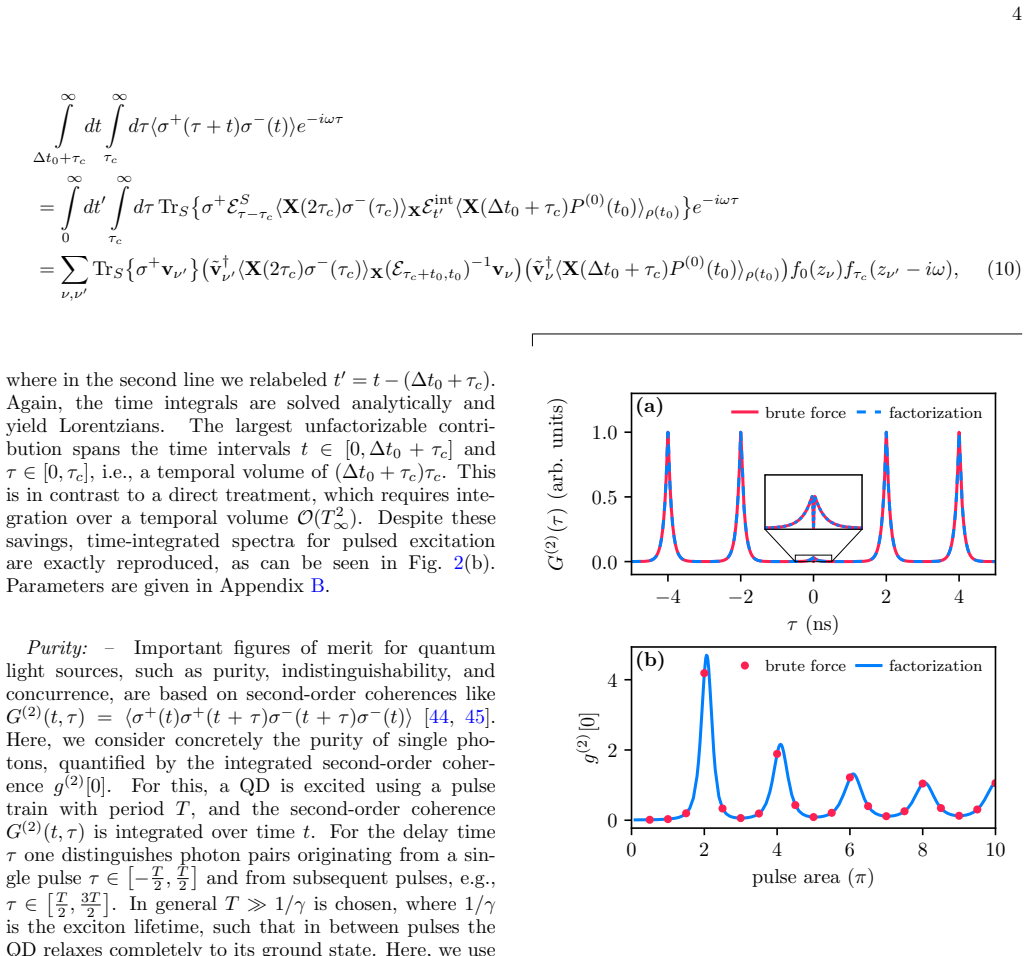
For time-independent Hamiltonians and finite memory times τ_c, an exact factorization rule exists that relates higher-order multitime correlations to products of lower-order correlations. Consequently, all information needed to reconstruct n-time correlations is contained in a temporal volume of O(τ_c^n). On the example of quantum dots coupled to phonons, this factorization makes numerical calculations of multitime correlations extremely efficient and even enables semianalytical solutions in systems where the standard QRT breaks down.
What carries the argument
The exact factorization rule that decomposes an n-time correlation into products of lower-order correlation functions, made possible by the bath correlations vanishing after a strictly finite memory time τ_c.
If this is right
- All information for n-time correlations is contained in a temporal volume scaling as O(τ_c^n).
- Numerical evaluation of multitime correlations becomes extremely efficient.
- Semianalytical solutions are possible in systems where the quantum regression theorem does not hold.
- The rule applies to any non-Markovian open quantum system satisfying the time-independent Hamiltonian and finite-memory conditions.
Where Pith is reading between the lines
- Similar factorization strategies may apply to other quantum-dynamical problems that possess a well-defined finite correlation time.
- Testing the rule on models with weakly time-dependent Hamiltonians or approximately finite memory would reveal its practical range.
- The reduction in computational volume could improve modeling of non-Markovian noise in quantum information devices.
Load-bearing premise
The Hamiltonian is time-independent and the bath correlations vanish exactly after a finite memory time τ_c.
What would settle it
A numerical computation of a higher-order correlation function in a quantum-dot phonon model that deviates from the predicted product of lower-order functions would falsify the rule.
Figures


read the original abstract
Experiments performed on quantum systems often measure multitime correlation functions. When quantum systems are weakly coupled to their environment, the time evolution of such correlation functions can be reduced to that of the reduced density matrix by the quantum regression theorem (QRT). While no QRT is available for general non-Markovian open quantum systems, we show that for time-independent Hamiltonians and finite memory times $\tau_c$, an exact factorization rule exists that relates higher-order multitime correlations to products of lower-order correlations. Consequently, all information needed to reconstruct $n$-time correlations is contained in a temporal volume of $\mathcal{O}(\tau_c^n)$. On the example of quantum dots coupled to phonons, we demonstrate that this factorization makes numerical calculations of multitime correlations extremely efficient and even enables semianalytical solutions in systems where the standard QRT breaks down.
Editorial analysis
A structured set of objections, weighed in public.
Referee Report
Summary. The manuscript claims that for non-Markovian open quantum systems with time-independent Hamiltonians and strictly finite memory time τ_c (after which bath correlations vanish exactly), an exact factorization rule exists relating higher-order multitime correlation functions to products of lower-order ones. This implies that all information required to reconstruct n-time correlations is contained within a temporal volume of O(τ_c^n). The rule is presented as enabling efficient numerical calculations and even semianalytical solutions in regimes where the quantum regression theorem fails, with a demonstration on quantum dots coupled to phonons.
Significance. If the central claim holds under the stated conditions, the factorization rule would constitute a useful technical advance for computing multitime correlations in non-Markovian settings. It directly addresses a practical limitation of the quantum regression theorem and could reduce computational cost for higher-order correlation functions, with potential relevance to experiments in quantum optics and solid-state systems that measure such quantities.
minor comments (2)
- Abstract: the claim that the factorization 'makes numerical calculations of multitime correlations extremely efficient' would be strengthened by a brief quantitative statement (e.g., scaling with n or comparison to direct integration) rather than a qualitative assertion.
- The manuscript should explicitly state whether the factorization rule is derived from first principles or obtained via a specific ansatz; a short outline of the key steps in the main text (rather than only in an appendix) would improve accessibility.
Simulated Author's Rebuttal
We thank the referee for their positive summary of our work and for recognizing the potential utility of the exact factorization rule in non-Markovian open quantum systems with finite memory time. The referee correctly identifies that the rule enables reconstruction of n-time correlations from a temporal volume of O(τ_c^n) and notes its relevance where the quantum regression theorem fails, as illustrated by our quantum-dot example. We are pleased with the recommendation for minor revision.
Circularity Check
No significant circularity
full rationale
The paper derives an exact factorization rule for multitime correlations from the stated assumptions of time-independent Hamiltonians and strictly finite memory time τ_c after which bath correlations vanish exactly. This is presented as a first-principles result conditioned on those external physical constraints rather than any fitted parameter, self-referential definition, or load-bearing self-citation. The quantum-dot demonstration serves as numerical validation in a regime where the standard QRT fails, but does not constitute the derivation itself. No step reduces by construction to its own inputs, and the central claim remains independent of the present paper's fitted values or prior author work.
Axiom & Free-Parameter Ledger
axioms (2)
- domain assumption Hamiltonian of the open system is time-independent
- domain assumption Environment memory time τ_c is finite and correlations vanish exactly beyond τ_c
Lean theorems connected to this paper
-
IndisputableMonolith/Foundation/RealityFromDistinction.leanreality_from_one_distinction unclear?
unclearRelation between the paper passage and the cited Recognition theorem.
for time-independent Hamiltonians and finite memory times τ_c, an exact factorization rule exists that relates higher-order multitime correlations to products of lower-order correlations
-
IndisputableMonolith/Cost/FunctionalEquation.leanwashburn_uniqueness_aczel unclear?
unclearRelation between the paper passage and the cited Recognition theorem.
the dynamical map becomes stationary after the memory time t ≥ τ_c
What do these tags mean?
- matches
- The paper's claim is directly supported by a theorem in the formal canon.
- supports
- The theorem supports part of the paper's argument, but the paper may add assumptions or extra steps.
- extends
- The paper goes beyond the formal theorem; the theorem is a base layer rather than the whole result.
- uses
- The paper appears to rely on the theorem as machinery.
- contradicts
- The paper's claim conflicts with a theorem or certificate in the canon.
- unclear
- Pith found a possible connection, but the passage is too broad, indirect, or ambiguous to say the theorem truly supports the claim.
Reference graph
Works this paper leans on
-
[1]
R. J. Glauber, The quantum theory of optical coherence, Phys. Rev.130, 2529 (1963)
work page 1963
-
[2]
J. H. Eberly and K. W´ odkiewicz, The time-dependent physical spectrum of light∗, J. Opt. Soc. Am.67, 1252 (1977)
work page 1977
-
[4]
Lax, Formal theory of quantum fluctuations from a driven state, Phys
M. Lax, Formal theory of quantum fluctuations from a driven state, Phys. Rev.129, 2342 (1963)
work page 1963
-
[5]
Swain, Master equation derivation of quantum regres- sion theorem, J
S. Swain, Master equation derivation of quantum regres- sion theorem, J. Phys. A: Math. Gen.14, 2577 (1981)
work page 1981
-
[6]
A. A. Budini, Operator correlations and quantum regres- sion theorem in non-markovian lindblad rate equations, J. Stat. Phys.131, 51 (2008)
work page 2008
-
[7]
S. Khan, B. K. Agarwalla, and S. Jain, Quantum regres- sion theorem for multi-time correlators: A detailed anal- ysis in the heisenberg picture, Phys. Rev. A106, 022214 (2022)
work page 2022
-
[8]
G. Guarnieri, A. Smirne, and B. Vacchini, Quantum re- gression theorem and non-markovianity of quantum dy- namics, Phys. Rev. A90, 022110 (2014)
work page 2014
-
[9]
H.-P. Breuer, E.-M. Laine, and J. Piilo, Measure for the degree of non-markovian behavior of quantum processes in open systems, Phys. Rev. Lett.103, 210401 (2009)
work page 2009
- [10]
-
[11]
Chru´ sci´ nski, Dynamical maps beyond markovian regime, Phys
D. Chru´ sci´ nski, Dynamical maps beyond markovian regime, Phys. Rep.992, 1 (2022), dynamical maps be- yond Markovian regime
work page 2022
-
[12]
T. Stauber, R. Zimmermann, and H. Castella, Electron- phonon interaction in quantum dots: A solvable model, Phys. Rev. B62, 7336 (2000)
work page 2000
-
[13]
N. Akopian, N. H. Lindner, E. Poem, Y. Berlatzky, J. Avron, D. Gershoni, B. D. Gerardot, and P. M. Petroff, Entangled photon pairs from semiconductor quantum dots, Phys. Rev. Lett.96, 130501 (2006)
work page 2006
- [14]
-
[15]
T. Heindel, J.-H. Kim, N. Gregersen, A. Rastelli, and S. Reitzenstein, Quantum dots for photonic quantum in- formation technology, Adv. Opt. Photon.15, 613 (2023)
work page 2023
-
[16]
S. Liu, Y. Wang, Y. Saleem, X. Li, H. Liu, C.-A. Yang, J. Yang, H. Ni, Z. Niu, Y. Meng, X. Hu, Y. Yu, X. Wang, M. Cygorek, and J. Liu, Quantum correlations of sponta- neous two-photon emission from a quantum dot, Nature 643, 1234–1239 (2025)
work page 2025
- [17]
-
[18]
B. Krummheuer, V. M. Axt, T. Kuhn, I. D’Amico, and F. Rossi, Pure dephasing and phonon dynamics in GaAs- and GaN-based quantum dot structures: Interplay be- tween material parameters and geometry, Phys. Rev. B 71, 235329 (2005)
work page 2005
-
[19]
D. E. Reiter, T. Kuhn, and V. M. Axt, Distinctive charac- teristics of carrier-phonon interactions in optically driven semiconductor quantum dots, Adv. Phys.: X4, 1655478 (2019)
work page 2019
-
[20]
D. E. Reiter, T. Kuhn, M. Gl¨ assl, and V. M. Axt, The role of phonons for exciton and biexciton generation in an optically driven quantum dot, J. Phys.: Condens. Matter 26, 423203 (2014)
work page 2014
-
[21]
F. Rossi and T. Kuhn, Theory of ultrafast phenomena in photoexcited semiconductors, Rev. Mod. Phys.74, 895 (2002)
work page 2002
-
[22]
J. Iles-Smith, D. P. S. McCutcheon, J. Mørk, and A. Nazir, Limits to coherent scattering and photon co- alescence from solid-state quantum emitters, Phys. Rev. B95, 201305(R) (2017)
work page 2017
-
[23]
J. Iles-Smith, D. P. S. McCutcheon, A. Nazir, and J. Mørk, Phonon scattering inhibits simultaneous near- unity efficiency and indistinguishability in semiconductor single-photon sources, Nature Photon.11, 521 (2017)
work page 2017
-
[24]
D. P. S. McCutcheon, Optical signatures of non- markovian behavior in open quantum systems, Phys. Rev. A93, 022119 (2016)
work page 2016
-
[25]
M. Cosacchi, T. Seidelmann, M. Cygorek, A. Vagov, D. E. Reiter, and V. M. Axt, Accuracy of the quantum regression theorem for photon emission from a quantum dot, Phys. Rev. Lett.127, 100402 (2021)
work page 2021
- [26]
-
[27]
D. F. McAlister and M. G. Raymer, Ultrafast photon- number correlations from dual-pulse, phase-averaged ho- modyne detection, Phys. Rev. A55, R1609(R) (1997)
work page 1997
-
[28]
T. K. Bracht, F. Kappe, M. Cygorek, T. Seidelmann, Y. Karli, V. Remesh, G. Weihs, V. M. Axt, and D. E. Reiter, Theory of time-bin-entangled photons from quan- tum emitters, Phys. Rev. A110, 063709 (2024)
work page 2024
-
[29]
E. del Valle, A. Gonzalez-Tudela, F. P. Laussy, C. Teje- dor, and M. J. Hartmann, Theory of frequency-filtered and time-resolvedn-photon correlations, Phys. Rev. Lett. 6 109, 183601 (2012)
work page 2012
-
[30]
M. Cosacchi, M. Cygorek, F. Ungar, A. M. Barth, A. Vagov, and V. M. Axt, Path-integral approach for nonequilibrium multitime correlation functions of open quantum systems coupled to markovian and non- markovian environments, Phys. Rev. B98, 125302 (2018)
work page 2018
-
[31]
D. Alonso and I. de Vega, Multiple-time correlation func- tions for non-markovian interaction: Beyond the quan- tum regression theorem, Phys. Rev. Lett.94, 200403 (2005)
work page 2005
-
[32]
M. Salamon, O. Dudgeon, A. Nazir, and J. Iles-Smith, Markovian approach ton-photon correlations beyond the quantum regression theorem, Phys. Rev. Lett.136, 080401 (2026)
work page 2026
-
[33]
M. Bundgaard-Nielsen and J. Iles-Smith, Beyond the quantum regression theorem in variational polaron master equations with low-dimensional baths (2026), arXiv:2604.13541 [quant-ph]
work page internal anchor Pith review Pith/arXiv arXiv 2026
-
[34]
G. W. Ford and R. F. O’Connell, There is no quantum regression theorem, Phys. Rev. Lett.77, 798 (1996)
work page 1996
-
[35]
M. Cygorek and E. M. Gauger, Time-nonlocal ver- sus time-local long-time extrapolation of non-markovian quantum dynamics (2025), arXiv:2505.21017 [quant-ph]
-
[36]
D. J. Strachan, A. Purkayastha, and S. R. Clark, Ex- tracting dynamical maps of non-markovian open quan- tum systems, J. Chem. Phys.161, 154105 (2024)
work page 2024
-
[37]
J. A. Gyamfi, Fundamentals of quantum mechanics in liouville space, Eur. J. Phys.41, 063002 (2020)
work page 2020
-
[38]
B. R. Mollow, Power spectrum of light scattered by two- level systems, Phys. Rev.188, 1969 (1969)
work page 1969
-
[39]
M. Cygorek, M. Cosacchi, A. Vagov, V. M. Axt, B. W. Lovett, J. Keeling, and E. M. Gauger, Simulation of open quantum systems by automated compression of arbitrary environments, Nat. Phys.18, 662 (2022)
work page 2022
-
[40]
M. Cygorek, J. Keeling, B. W. Lovett, and E. M. Gauger, Sublinear scaling in non-markovian open quantum sys- tems simulations, Phys. Rev. X14, 011010 (2024)
work page 2024
-
[41]
M. Cygorek and E. M. Gauger, Ace: A general-purpose non-markovian open quantum systems simulation toolkit based on process tensors, J. Chem. Phys.161, 074111 (2024)
work page 2024
-
[42]
K. Boos, S. K. Kim, T. Bracht, F. Sbresny, J. M. Kas- pari, M. Cygorek, H. Riedl, F. W. Bopp, W. Rauhaus, C. Calcagno, J. J. Finley, D. E. Reiter, and K. M¨ uller, Signatures of dynamically dressed states, Phys. Rev. Lett.132, 053602 (2024)
work page 2024
-
[43]
S. Liu, C. Gustin, H. Liu, X. Li, Y. Yu, H. Ni, Z. Niu, S. Hughes, X. Wang, and J. Liu, Dynamic resonance flu- orescence in solid-state cavity quantum electrodynamics, Nat. Photon.18, 318 (2024)
work page 2024
-
[44]
K. A. Fischer, K. M¨ uller, K. G. Lagoudakis, and J. Vuˇ ckovi´ c, Dynamical modeling of pulsed two-photon interference, New J. Phys.18, 113053 (2016)
work page 2016
-
[45]
L. Hanschke, K. A. Fischer, S. Appel, D. Lukin, J. Wierzbowski, S. Sun, R. Trivedi, J. Vuˇ ckovi´ c, J. J. Fin- ley, and K. M¨ uller, Quantum dot single-photon sources with ultra-low multi-photon probability, npj Quantum Inf.4, 43 (2018). Appendix A: Derivation of factorization rule The time evolution of the density matrixρ tot on a Markovian embedding of...
work page 2018
discussion (0)
Sign in with ORCID, Apple, or X to comment. Anyone can read and Pith papers without signing in.