REVIEW 3 major objections 7 minor 34 references
SHA256 at SemEval-2025 Task 4: Selective Amnesia -- Constrained Unlearning for Large Language Models via Knowledge Isolation
T0 review · 3 major / 7 minor · reviewed 2026-08-16 · deepseek-v4-flash
Pith's one-line read The paper claims that in OLMo models the facts targeted for unlearning are stored in the MLP modules of transformer layers 0–5, and that freezing all upper layers while training only those early MLPs with a joint forget/retain loss…
desk verdict A solid shared-task report with a genuinely interesting layer-localization finding for OLMo, but the causal claim is thinner than the abstract implies and the 7B failure is unexplained. read the letter →
The pith
A machine-rendered reading of the paper's core claim, the machinery that carries it, and where it could break.
The reading
What carries the argument
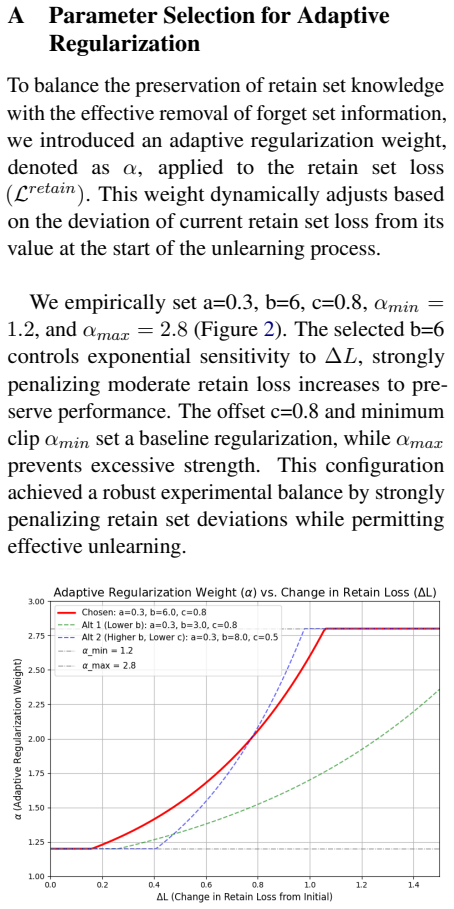
The carrying mechanism has two parts. First, causal tracing: add Gaussian noise to the subject token's embedding, run the model to see the prediction corrupt, then restore the original hidden state at candidate layer/token positions and measure whether the correct attribute prediction returns—the positions that restore prediction are judged causally responsible for storing the fact. Second, a layer-restricted joint loss $\mathcal{L}_{joint}=-\mathcal{L}^{CE}_{forget}+\alpha\,\mathcal{L}^{CE}_{retain}$ applied only to MLP parameters of layers 0–5, with an adaptive weight $\alpha=\mathrm{clip}(a\cdot b^{\Delta L}+c,\alpha_{min},\alpha_{max})$ chosen so that retain-set drift is penalized exponentially (empirically $a=0.3$, $b=6$, $c=0.8$, $\alpha_{min}=1.2$, $\alpha_{max}=2.8$). Together they turn unlearning into a targeted edit of the storage site rather than a whole-model re-optimization: the trace decides which parameters to touch, and the joint loss decides how hard to push them.
What would settle it
Run the same unlearning pipeline but edit only layers 0–5 while keeping upper layers frozen, and measure task aggregate separately per subtask (Subtask 1 creative documents, Subtask 2 PII, Subtask 3 real documents). If forget-set scores for Subtask 1 or Subtask 3 stay near baseline (knowledge not removed) or retain-set scores collapse, the localization assumption is falsified. Alternatively, repeat the causal tracing on Subtask 1 and Subtask 3 samples; if restoring hidden states in layers above 5 recovers correct output for those subtasks, the early-layer claim does not transfer.
Extended reading notes
Core claim
Using causal mediation analysis on 125 synthetic question-answering samples from the task's Subtask 2, the authors corrupt subject-token embeddings with Gaussian noise and then restore hidden states at each layer; restoring layers 0–5 of OLMo-1B and OLMo-7B recovers correct attribute predictions, identifying those early layers as the storage site for subject-attribute associations. Guided by that map, they freeze layers 6 through L and train only the MLP weights of layers 0–5 with the joint loss $\mathcal{L}_{joint}=-\mathcal{L}^{CE}_{forget}+\alpha\,\mathcal{L}^{CE}_{retain}$, where $\alpha$ grows exponentially whenever retain-set loss drifts above its epoch-0 baseline. Parameter studies (their Tables 3 and 4) show MLP-only editing removes forget-set knowledge with much less utility damage than editing both attention and MLP, or all layers. On the private test set the 1B submission reached a 0.652 final score with 0.973 task aggregate and forget-set knowledge retention reduced to 0.14 (an 86% reduction), while the 7B submission reached 0.964 task aggregate at the cost of MMLU falling from 0.509 to 0.275. The paper reads these results as evidence that causal-informed, layer-restricted editing is an efficient and precise unlearning paradigm.
Load-bearing premise
The load-bearing premise is that the causal-tracing result from 125 synthetic question-answering samples—showing that the first six layers store the subject-attribute associations—holds for all three task subtasks and for the 7-billion-parameter model; if creative documents, real documents, or the larger model store the target knowledge in other layers, freezing everything above layer 5 has no justification.
Editorial extensions
If this is right
- Unlearning a fact costs one forward/backward pass on early layers instead of full-model retraining; the approach is computationally cheap enough to run per forget request.
- General capabilities survive because upper layers are frozen: the 1B model kept about 88% of baseline MMLU while forget-set knowledge dropped 86%.
- The two-stage recipe is model-agnostic in principle: any transformer can be traced first, then edited at its own storage layers, though the paper only demonstrates OLMo.
- Task aggregate and MIA scores can simultaneously be strong (0.973 and 0.741 on 1B), suggesting that disrupting output-level regurgitation also weakens membership inference.
- Scaling is not free: the 7B run shows the same six-layer edit erases the forget set but destroys 46% of MMLU, so the layer-freezing threshold must scale nonlinearly with model depth (the paper's own caution).
Reading between the lines
- Editorial: Causal tracing on one subtask is slim ground for a universal layer map; a cheap test, run the same tracing on Subtask 1 creative documents and Subtask 3 real documents, and if the recovery peak shifts above layer 5 the early-layer claim is subtask-specific.
- Editorial: The 7B utility collapse suggests the localization itself may be scale-dependent; comparing traced layer maps between 1B and 7B on identical samples would separate a genuine mechanistic difference from an overfitting artifact.
- Editorial: The adaptive $\alpha$ rule is a manual trust-region controller; one could replace the hand-set $a,b,c$ with an online estimate of retain-loss curvature and get the same protection with zero tuning.
- Editorial: 'Unlearned' here is defined by output-level metrics; probing intermediate representations before and after editing would show whether the association is deleted from the weights or merely made unreachable, which matters for adversarial extraction.
Signed reviews
Editorial analysis
A structured set of objections, weighed in public.
Referee Report
Summary. The paper presents a system for the SemEval-2025 Task 4 targeted-unlearning challenge. The method has two stages: (1) causal mediation analysis (CMA) on 125 synthetic question-answering samples from Subtask 2 to locate factual associations in the early transformer layers (0-5) of OLMo 1B and 7B models, and (2) constrained optimization that freezes layers above 5 and trains only the MLP modules in layers 0-5 with a joint loss consisting of cross-entropy on forget-set outputs plus an adaptively weighted retain-set cross-entropy term. The authors report second place in the 1B track with final score 0.652, task aggregate 0.973, and 88% of baseline MMLU, while the 7B run reaches task aggregate 0.964 but suffers a 46% MMLU drop. The central mechanistic claim is that early-layer MLPs function as stores of subject-attribute associations and that training only those layers achieves effective unlearning with preserved utility.
Significance. If the causal-localization claim held across all three subtasks and both model sizes, the paper would make a useful practical contribution: it would show that unlearning can be reduced to updating a small, mechanistically motivated parameter subset, and the competitive leaderboard result provides external validation of the overall pipeline. The paper also releases code and reports externally measured scores, which are concrete strengths. However, the significance as stated is currently limited by the narrow evidence base for the mechanistic claim, the lack of a reproducible noise scale for the CMA, and an internal inconsistency between the paper's recommended configuration and its own tables. The work is best read as a competition system description with an interesting but not yet fully supported mechanistic hypothesis.
major comments (3)
- [3.1, Figure 1] The causal localization that justifies freezing all layers above 5 rests on 125 synthetic QA samples from Subtask 2 only. The Gaussian noise scale ν used for the corruption step is never reported, so the experiment cannot be reproduced or compared with other CMA studies. More importantly, no per-subtask evidence is provided: Subtask 1 (creative documents) and Subtask 3 (real documents) may encode the target information in different layer ranges or in attention rather than MLP pathways, and the paper gives no reason to assume the Subtask-2 QA localization transfers. Please report ν, add per-subtask heatmaps or at least per-subtask localization summaries, and either provide 7B localization evidence or explicitly limit the mechanistic claim to the tested setting.
- [4.2, Tables 3-4] The paper concludes that 'training only MLP layers is the most effective strategy' and repeats in the abstract and conclusion that MLP layers 0-5 can 'effectively remove information without causing much loss in model utility.' This is contradicted by the paper's own numbers. In Table 4, the 0-5 MLP+MHSA configuration dominates 0-5 MLP on final score (0.467 vs 0.353), task aggregate (0.775 vs 0.572), and MIA score (0.217 vs 0.010). In Table 3, MLP-only leaves forget-set knowledge at 0.292 and an MIA accuracy near 0.99, meaning the forget set remains almost perfectly identifiable. The MLP-only configuration is the best only on MMLU preservation, not on unlearning efficacy or privacy. No table or text identifies which configuration produced the submitted 1B leaderboard result, so the connection between the causal claim and the reported success is not established. Please clarify which configuration was submitted and reconcile the 'MLP-only' recommendation with the reported metrics.
- [4.1, 5] The 46% MMLU drop in the 7B model is attributed in Section 4.1 to 'overfitting on this expanded corpus' and to the suggestion that 'larger models require fewer update steps,' but no learning curves, epoch sweeps, or other evidence are provided to support this explanation. An equally consistent explanation is that the causal localization does not transfer to the 7B model or to the non-QA subtasks, so freezing upper layers prevents the removal of associations stored there and forces the optimization into an inconsistent regime. This matters because the conclusion draws a general scaling lesson ('layer freezing thresholds must scale non-linearly with model depth') from this single unexplained drop. Please provide the missing evidence or explicitly acknowledge that the scaling behavior is currently unexplained.
minor comments (7)
- [Abstract / 1] The abstract contains a duplicated phrase: 'with a with a final score of 0.652.'
- [2.2.1] 'the contents of theretain-set' is a typo; also, the distinction between public and private test sets should be stated more clearly because some numbers in Section 4.1 appear to come from the private evaluation while others come from public ablations.
- [3.1] The citation 'Vig et al., 2004' is incorrect; the Causal Mediation Analysis paper by Vig et al. is from 2020.
- [3.2] The adaptive α formula in Section 3.2 is not numbered, making it awkward to reference; please number the equations. Also, the hyperparameters a=0.3, b=6, c=0.8, α_min=1.2, α_max=2.8 are reported only in Appendix A, but no sensitivity analysis is given; a small grid over α_max or b would help the reader judge robustness.
- [4.2, Tables 3-4] The abbreviations 'Reg.' and 'Know.' are not defined in the captions; please spell out 'Regurgitation' and 'Knowledge' and clarify the direction of each score (higher/lower is better).
- [4.2] The sentence 'training different set of parameters for 8 epochs shows where that by training only MLP layers...' contains a grammatical error ('shows where that').
- [5] The conclusion asserts that 'output token cross-entropy provides a more surgical intervention than full-sequence loss calculations,' but no experiment in the paper compares these two loss variants; please either add the comparison or remove the claim.
Circularity Check
No significant circularity: the causal localization, joint loss, and external leaderboard/MMLU evaluations are distinct, independently meaningful steps.
full rationale
The paper's derivation chain is not circular. The claimed causal localization (layers 0-5 in OLMo MLPs) is obtained from causal mediation analysis on 125 Subtask-2 QA samples, measuring whether restoring corrupted hidden states recovers correct attribute predictions; this is an empirical measurement, not a definition of the target result. The joint loss L_joint = -L_forget_CE + alpha * L_retain_CE directly optimizes forget-set cross-entropy and retain-set preservation, so improvements in forget-set scores and retain-set accuracy are optimized objectives rather than predictions; however, reporting such objective-driven outcomes is standard and not circular. The parameters a=0.3, b=6, c=0.8, alpha_min=1.2, alpha_max=2.8 are fit on public data, but the paper's headline results come from the private SemEval leaderboard and the external MMLU benchmark, which are not generated by the paper's own equations or fitted values. No load-bearing self-citation appears: the cited causal-mediation, model-editing, and unlearning works (Vig et al., Geva et al., Meng et al., etc.) are external to the authors, and no uniqueness claim is imported from the authors' prior work. The main limitations (limited causal evidence per subtask, unreported noise scale, 7B utility drop) are validity or generalizability concerns, not circularity. The derivation is therefore self-contained against external evaluation, and the appropriate finding is no significant circularity.
Assumptions & free parameters
free parameters (4)
- Adaptive regularization weight parameters =
a=0.3, b=6, c=0.8, alpha_min=1.2, alpha_max=2.8
- Causal tracing noise scale nu =
not reported
- Layer range 0-5 =
layers 0-5
- Training epochs =
8 (reported in Tables 3-4)
assumptions (4)
- domain assumption Restoring corrupted hidden states at a layer and recovering the correct prediction identifies that layer as the causal storage site (causal mediation analysis assumption).
- domain assumption Subject-attribute associations localized in Subtask 2 QA samples transfer to the other forget subtasks (creative documents and real documents) and to the 7B model.
- domain assumption Early-layer MLP modules function as distributed key-value stores for factual tuples.
- domain assumption Maximizing output-token cross-entropy on forget samples reduces the task's regurgitation and knowledge scores.
Cite this review
Pith. "Pith review of SHA256 at SemEval-2025 Task 4: Selective Amnesia -- Constrained Unlearning for Large Language Models via Knowledge Isolation." pith.science (2026). https://pith.science/paper/Z4TCHZSN
@misc{pith2026250412996,
  author       = {Pith},
  title        = {Pith review of: SHA256 at SemEval-2025 Task 4: Selective Amnesia -- Constrained Unlearning for Large Language Models via Knowledge Isolation},
  year         = {2026},
  howpublished = {\url{https://pith.science/paper/Z4TCHZSN}},
  note         = {Machine review of arXiv:2504.12996}
}
read the original abstract
Large language models (LLMs) frequently memorize sensitive information during training, posing risks when deploying publicly accessible models. Current machine unlearning methods struggle to selectively remove specific data associations without degrading overall model capabilities. This paper presents our solution to SemEval-2025 Task 4 on targeted unlearning, which introduces a two-stage methodology that combines causal mediation analysis with layer-specific optimization. Through systematic causal tracing experiments on OLMo architectures (1B and 7B parameters), we identify the critical role of the first few transformer layers (layers 0-5) in storing subject-attribute associations within MLP modules. Building on this insight, we develop a constrained optimization approach that freezes upper layers while applying a novel joint loss function to lower layers-simultaneously maximizing forget set loss via output token cross-entropy penalties and minimizing retain set deviation through adaptive regularization. Our method achieves 2nd place in the 1B model track, demonstrating strong task performance while maintaining 88% of baseline MMLU accuracy. These results establish causal-informed layer optimization as a promising paradigm for efficient, precise unlearning in LLMs, offering a significant step forward in addressing data privacy concerns in AI systems.
Figures

Reference graph
Works this paper leans on
-
[1]
online" 'onlinestring :=
ENTRY address archivePrefix author booktitle chapter edition editor eid eprint eprinttype howpublished institution journal key month note number organization pages publisher school series title type volume year doi pubmed url lastchecked label extra.label sort.label short.list INTEGERS output.state before.all mid.sentence after.sentence after.block STRING...
-
[2]
write newline
" write newline "" before.all 'output.state := FUNCTION n.dashify 't := "" t empty not t #1 #1 substring "-" = t #1 #2 substring "--" = not "--" * t #2 global.max substring 't := t #1 #1 substring "-" = "-" * t #2 global.max substring 't := while if t #1 #1 substring * t #2 global.max substring 't := if while FUNCTION word.in bbl.in capitalize " " * FUNCT...
-
[3]
Stella Biderman, USVSN Sai Prashanth, Lintang Sutawika, Hailey Schoelkopf, Quentin Anthony, Shivanshu Purohit, and Edward Raff. 2023. http://papers.nips.cc/paper\_files/paper/2023/hash/59404fb89d6194641c69ae99ecdf8f6d-Abstract-Conference.html Emergent and predictable memorization in large language models . In Advances in Neural Information Processing Syst...
work page 2023
-
[4]
Nicholas Carlini, Chang Liu, \' U lfar Erlingsson, Jernej Kos, and Dawn Song. 2019. https://www.usenix.org/conference/usenixsecurity19/presentation/carlini The secret sharer: Evaluating and testing unintended memorization in neural networks . In 28th USENIX Security Symposium, USENIX Security 2019
work page 2019
-
[5]
Brown, Dawn Song, \' U lfar Erlingsson, Alina Oprea, and Colin Raffel
Nicholas Carlini, Florian Tram \` e r, Eric Wallace, Matthew Jagielski, Ariel Herbert - Voss, Katherine Lee, Adam Roberts, Tom B. Brown, Dawn Song, \' U lfar Erlingsson, Alina Oprea, and Colin Raffel. 2021. https://www.usenix.org/conference/usenixsecurity21/presentation/carlini-extracting Extracting training data from large language models . In 30th USENI...
work page 2021
-
[6]
Jiaao Chen and Diyi Yang. 2023. https://doi.org/10.18653/v1/2023.emnlp-main.738 Unlearn what you want to forget: Efficient unlearning for llms . In Proceedings of the 2023 Conference on Empirical Methods in Natural Language Processing, EMNLP 2023
-
[7]
Min Chen, Zhikun Zhang, Tianhao Wang, Michael Backes, Mathias Humbert, and Yang Zhang. 2021. http://dx.doi.org/10.1145/3460120.3484756 When machine unlearning jeopardizes privacy . In Proceedings of the 2021 ACM SIGSAC Conference on Computer and Communications Security
arXiv 2021
-
[8]
Michael Duan, Anshuman Suri, Niloofar Mireshghallah, Sewon Min, Weijia Shi, Luke Zettlemoyer, Yulia Tsvetkov, Yejin Choi, David Evans, and Hannaneh Hajishirzi. 2024. https://doi.org/10.48550/arXiv.2402.07841 Do membership inference attacks work on large language models? CoRR, abs/2402.07841
Show all 34 references
-
[9]
Mor Geva, Jasmijn Bastings, Katja Filippova, and Amir Globerson. 2023. https://doi.org/10.18653/v1/2023.emnlp-main.751 Dissecting recall of factual associations in auto-regressive language models . In Proceedings of the 2023 Conference on Empirical Methods in Natural Language ...
2023 doi
-
[10]
Dirk Groeneveld, Iz Beltagy, Evan Pete Walsh, Akshita Bhagia, Rodney Kinney, Oyvind Tafjord, Ananya Harsh Jha, Hamish Ivison, Ian Magnusson, Yizhong Wang, Shane Arora, David Atkinson, Russell Authur, Khyathi Raghavi Chandu, Arman Cohan, Jennifer Dumas, Yanai Elazar, Yuling Gu,...
2024
-
[11]
Dan Hendrycks, Collin Burns, Steven Basart, Andy Zou, Mantas Mazeika, Dawn Song, and Jacob Steinhardt. 2021. https://openreview.net/forum?id=d7KBjmI3GmQ Measuring massive multitask language understanding . In 9th International Conference on Learning Representations, ICLR 2021
2021
-
[12]
Zhehao Huang, Xinwen Cheng, JingHao Zheng, Haoran Wang, Zhengbao He, Tao Li, and Xiaolin Huang. 2024. http://papers.nips.cc/paper\_files/paper/2024/hash/2e622ac74f66df03b686a12e2e0e4424-Abstract-Conference.html Unified gradient-based machine unlearning with remain geometry enh...
2024
-
[13]
Qinbin Li, Junyuan Hong, Chulin Xie, Jeffrey Tan, Rachel Xin, Junyi Hou, Xavier Yin, Zhun Wang, Dan Hendrycks, Zhangyang Wang, Bo Li, Bingsheng He, and Dawn Song. 2024. https://www.vldb.org/pvldb/vol17/p3201-li.pdf LLM-PBE: assessing data privacy in large language models . Pro...
2024
-
[14]
Chin-Yew Lin. 2004. https://aclanthology.org/W04-1013/ ROUGE : A package for automatic evaluation of summaries . In Proc. ACL workshop on Text Summarization Branches Out
2004
-
[15]
Bo Liu, Qiang Liu, and Peter Stone. 2022. https://proceedings.mlr.press/v199/liu22a.html Continual learning and private unlearning . In Conference on Lifelong Learning Agents, CoLLAs 2022
2022
-
[16]
Xiaoze Liu, Ting Sun, Tianyang Xu, Feijie Wu, Cunxiang Wang, Xiaoqian Wang, and Jing Gao. 2024. https://aclanthology.org/2024.emnlp-main.98 SHIELD: evaluation and defense strategies for copyright compliance in LLM text generation . In Proceedings of the 2024 Conference on Empi...
2024
- [17]
-
[18]
Daniel Mela, Aitor Gonzalez - Agirre, Javier Hernando, and Marta Villegas. 2024. https://doi.org/10.18653/v1/2024.findings-acl.347 Mass-editing memory with attention in transformers: A cross-lingual exploration of knowledge . In Findings of the Association for Computational Li...
2024 doi
-
[19]
Kevin Meng, David Bau, Alex Andonian, and Yonatan Belinkov. 2022. http://papers.nips.cc/paper\_files/paper/2022/hash/6f1d43d5a82a37e89b0665b33bf3a182-Abstract-Conference.html Locating and editing factual associations in GPT . In Advances in Neural Information Processing System...
2022
-
[20]
Andonian, Yonatan Belinkov, and David Bau
Kevin Meng, Arnab Sen Sharma, Alex J. Andonian, Yonatan Belinkov, and David Bau. 2023. https://openreview.net/forum?id=MkbcAHIYgyS Mass-editing memory in a transformer . In The Eleventh International Conference on Learning Representations, ICLR 2023 . OpenReview.net
2023
-
[21]
Vaidehi Patil, Peter Hase, and Mohit Bansal. 2024. https://openreview.net/forum?id=7erlRDoaV8 Can sensitive information be deleted from llms? objectives for defending against extraction attacks . In The Twelfth International Conference on Learning Representations, ICLR 2024 . ...
2024
-
[22]
Anil Ramakrishna, Yixin Wan, Xiaomeng Jin, Kai-Wei Chang, Zhiqi Bu, Bhanukiran Vinzamuri, Volkan Cevher, Mingyi Hong, and Rahul Gupta. 2025 a . https://arxiv.org/abs/2502.15097 Lume: Llm unlearning with multitask evaluations . arXiv preprint arXiv:2502.15097
2025 arXiv
-
[23]
Anil Ramakrishna, Yixin Wan, Xiaomeng Jin, Kai-Wei Chang, Zhiqi Bu, Bhanukiran Vinzamuri, Volkan Cevher, Mingyi Hong, and Rahul Gupta. 2025 b . https://www.arxiv.org/pdf/2504.02883 Semeval-2025 task 4: Unlearning sensitive content from large language models . arXiv preprint ar...
2025 arXiv
-
[24]
Reza Shokri, Marco Stronati, Congzheng Song, and Vitaly Shmatikov. 2017. https://doi.org/10.1109/SP.2017.41 Membership inference attacks against machine learning models . In 2017 IEEE Symposium on Security and Privacy, SP 2017 . IEEE Computer Society
2017 doi
- [25]
-
[26]
Jesse Vig, Sebastian Gehrmann, Yonatan Belinkov, Sharon Qian, Daniel Nevo, Y Singer, and SM Shieber. 2004. https://arxiv.org/abs/2004.12265 Causal mediation analysis for interpreting neural nlp: the case of gender bias (2020) . CoRR arXiv, abs/2004.12265
2020 arXiv
- [27]
-
[28]
Lin, Shujian Yang, Tianqi Zhang, Weiyan Shi, Tianwei Zhang, Zhixuan Fang, Wei Xu, and Han Qiu
Rongwu Xu, Brian S. Lin, Shujian Yang, Tianqi Zhang, Weiyan Shi, Tianwei Zhang, Zhixuan Fang, Wei Xu, and Han Qiu. 2024. https://doi.org/10.18653/v1/2024.acl-long.858 The earth is flat because...: Investigating llms' belief towards misinformation via persuasive conversation . ...
2024 doi
-
[29]
Jin Yao, Eli Chien, Minxin Du, Xinyao Niu, Tianhao Wang, Zezhou Cheng, and Xiang Yue. 2024 a . https://doi.org/10.18653/v1/2024.acl-long.457 Machine unlearning of pre-trained large language models . In Proceedings of the 62nd Annual Meeting of the Association for Computational...
2024 doi
-
[30]
Yuanshun Yao, Xiaojun Xu, and Yang Liu. 2024 b . http://papers.nips.cc/paper\_files/paper/2024/hash/be52acf6bccf4a8c0a90fe2f5cfcead3-Abstract-Conference.html Large language model unlearning . In Advances in Neural Information Processing Systems 38: Annual Conference on Neural ...
2024
- [31]
- [32]
- [33]
-
[34]
Zhenhong Zhou, Jiuyang Xiang, Chaomeng Chen, and Sen Su. 2024. https://doi.org/10.1609/aaai.v38i17.29948 Quantifying and analyzing entity-level memorization in large language models . In Thirty-Eighth AAAI Conference on Artificial Intelligence, AAAI 2024, Thirty-Sixth Conferen...
2024 doi
Reviewed August 16, 2026 · model on record in the stance chip above.
Discussion (0). Continue with ORCID to comment.