REVIEW 3 major objections 5 minor 1 cited by
BRIDGE: Byzantine-resilient Decentralized Gradient Descent
T0 review · 3 major / 5 minor · reviewed 2026-08-14 · deepseek-v4-flash
Pith's one-line read BRIDGE claims that decentralized gradient descent with coordinate-wise trimmed mean reaches consensus and converges to the global risk minimizer even when up to b nodes behave Byzantine.
desk verdict A sensible algorithm with encouraging experiments, but the optimality proof in Appendix B argues against the wrong negation and leaves Theorem 1 unproved as written. read the letter →
The pith
A machine-rendered reading of the paper's core claim, the machinery that carries it, and where it could break.
The reading
What carries the argument
The load-bearing object is the coordinate-wise trimmed mean, called the screening step: for each coordinate $k$, node $j$ sorts the incoming neighbor values, removes the $b$ smallest and $b$ largest, and averages the survivors together with its own value, then subtracts a local gradient step. Because at most $b$ Byzantine nodes exist, this screening confines the influence of faulty messages in each coordinate. The consensus proof rewrites the update using only nonfaulty nodes as a time-varying stochastic matrix $Y(t)$ and appeals to convergence of products of such matrices to a rank-one limit, an argument that relies on Assumption 4 to guarantee enough redundancy in the network.
What would settle it
Construct a directed graph satisfying Assumption 4 with $b=1$ in which some nonfaulty node has exactly two neighbors; at the first iteration the trimming step removes one smallest and one largest neighbor value in each coordinate, leaving an empty neighbor set, so the node's update reduces to its own value minus a gradient step, and nonfaulty nodes need not reach consensus—contradicting Theorem 1's claim that consensus holds for every graph covered by Assumptions 1–4.
Extended reading notes
Core claim
The paper's central claim is Theorem 1: if the loss is bounded, $\lambda$-strongly convex, and $L'$-Lipschitz gradient (Assumptions 1–3), and the graph is sufficiently redundant in the sense that every reduced graph has a source component of at least $b+1$ nodes (Assumption 4), then for at most $b$ Byzantine nodes BRIDGE drives all nonfaulty models $w_j(t)$ to consensus as $t\to\infty$, and as $N\to\infty$ the consensus value converges in probability to $w^*$, the minimizer of the global statistical risk. This is a convergence guarantee for a vector-valued, all-coordinates-at-once Byzantine-resilient decentralized algorithm; the main alternative updates one coordinate per round. The proof bounds $\|w_j(t)-w^*\|$ by four terms accounting for consensus error, gradient-estimation error, and the contraction of gradient descent, with the statistical error of order $O(\sqrt{\|\bar\alpha\|_2 \log(1/\delta)/N})$.
Load-bearing premise
Each nonfaulty node must have more than $2b$ neighbors—enough for the screening step to discard the $b$ worst and $b$ best values and still have someone left to average—and the paper's stated assumptions never require this, so the theorem's guarantee silently excludes networks with sparser neighborhoods.
Editorial extensions
If this is right
- On any graph satisfying Assumption 4 with at most $b$ Byzantine nodes, a network can train a shared model without a central server and still converge to the statistically optimal model; exact consensus is reached asymptotically despite adversarial peers.
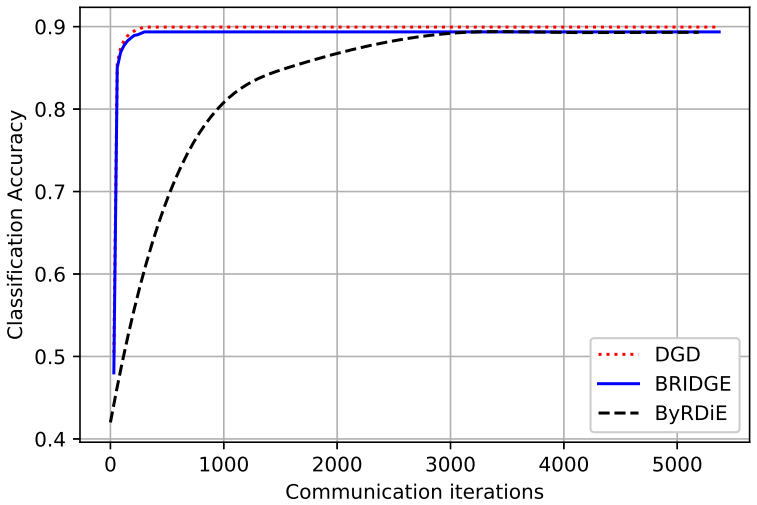
- BRIDGE updates all $d$ coordinates in each message, so it needs fewer communication rounds than coordinate-descent Byzantine-resilient methods to reach a target accuracy; the MNIST linear-classifier experiments show accuracy close to fault-free distributed gradient descent.
- With step size $\rho(t)=O(1/t)$, the consensus error decays as $O(\sqrt{d}/t)$, giving sublinear convergence in time; the statistical error after cooperation is no worse than local learning's $O(1/\sqrt{N})$ and improves by a factor related to the consensus weights.
- The same screening can be layered onto local optimizers such as Adam for nonconvex problems; experiments on a convolutional neural network show resilience against one Byzantine node, though the formal theorem covers only strongly convex objectives.
Reading between the lines
- The formal theorem silently assumes every nonfaulty node has at least $2b+1$ neighbors; without adding that condition, the algorithm is undefined or reduces to updating only from one's own value on some graphs satisfying Assumption 4, so a corrected statement would either assume minimum degree or adapt the number of trimmed values to each node's degree.
- The trimming is per-coordinate, so a Byzantine node can still influence coordinates in which its value is not among the $b$ extremes; the guarantee is worst-case in number of nodes, not necessarily against adversaries that corrupt only selected coordinates.
- A natural testable extension is to let each node trim $\min(b, \lfloor(|\mathcal{N}_j|-1)/2\rfloor)$ values adaptively; this would preserve the algorithm's spirit on sparse graphs and could be checked against the stated convergence rate.
- Because the analysis relies on strong convexity, the nonconvex CNN experiment is suggestive rather than proof; a full extension would require bounding the effect of the screening bias under nonconvex landscape assumptions such as the Polyak–Łojasiewicz condition.
Signed reviews
Editorial analysis
A structured set of objections, weighed in public.
Referee Report
Summary. The paper proposes BRIDGE, a Byzantine-resilient decentralized gradient descent algorithm that combines a coordinate-wise trimmed mean with classical distributed gradient descent. The main theoretical claim, Theorem 1, states that under Assumptions 1-4 (bounded, strongly convex, smooth risks and a graph redundancy condition), all nonfaulty nodes achieve consensus and, as both the number of local samples and iterations grow, the common iterate converges in probability to the minimizer of the global statistical risk. The paper also reports experiments on MNIST with a linear classifier and a convolutional network, comparing BRIDGE with DGD, ByRDiE, and local training.
Significance. If Theorem 1 were fully established, BRIDGE would be a meaningful contribution to Byzantine-resilient decentralized learning: it is one of the few vector-valued decentralized algorithms with an explicit statistical convergence claim, and the coordinate-wise screening approach is computationally simple and communication-efficient. The experimental comparison with ByRDiE supports the communication-efficiency advantage. The paper also makes its assumptions and algorithm description clear enough to reimplement. However, the current proof has load-bearing gaps, so the theoretical contribution is not yet demonstrated with the rigor the central claim requires.
major comments (3)
- [Appendix A, Eqs. (30)-(32)] The identity E[g2(t)] = E[∇f(v(t))] is asserted without justification. In BRIDGE, both α(t) and v(t) are functions of the entire past trajectory and therefore of the same local datasets Zj that define the empirical gradients ∇fj(v(t)). For a generic nonlinear f, E[Σ_i α_i ∇f_i(v)] is not equal to E[∇f(v)]; a simple example with f(w,z) = wz and v taken as a data-dependent nonlinearity of a single node's sample shows the bias. Since the Hoeffding bound in Eq. (32) is applied around this asserted mean, Lemma 1 does not establish the stated high-probability bound on |g2(v(t)) − E[∇f(v(t))]|. This bound is then used in Eq. (29) to prove optimality, so the gap is load-bearing.
- [Appendix B, paragraph beginning 'We prove this by contradiction'] The contradiction argument assumes that there exists ε0 > 0 such that ‖∇f̄(v(t))‖ − ε∇ > ε0 for all t. The negation of the desired conclusion '‖∇f̄(v(t))‖ ≤ ε∇ eventually' is only that the inequality ‖∇f̄(v(t))‖ > ε∇ holds for infinitely many t, possibly on a sparse sequence {t_k}. The decrease bound in Eq. (60) is valid only at those times, and Σ_k ρ(t_k) may be finite even though Σ_t ρ(t) = ∞ (for example, ρ(t) = 1/t with t_k = 2^k). A lower-bounded function can therefore decrease by a finite total amount on such a sparse set, so no contradiction follows. As written, the proof does not rule out infinitely many large-gradient epochs separated by long moderate periods, and the optimality half of Theorem 1 is unproved.
- [Section 4.1, Eq. (11)] The consensus proof relies entirely on the matrix convergence bound from [42,43], but it does not verify that the random row-stochastic matrices Y(t) defined in Eq. (9) satisfy the hypotheses of that theorem for every Byzantine behavior. In particular, the support of Y(t) depends on the trimming sets N_j^k(t), which vary with t and with the Byzantine messages, so the required product structure over any block of ν matrices is not automatic. The authors should either state the precise theorem from [42,43] and prove that each Y(t) meets its conditions, or provide a self-contained argument. Without this verification, the consensus half of Theorem 1 is also not established as written.
minor comments (5)
- [Section 3, Algorithm 1] Before presenting Algorithm 1, state explicitly that Assumption 4 together with Definition 2 implies every nonfaulty node has at least 2b+1 neighbors, so the denominator |N_j| − 2b + 1 in Eq. (7) is positive and the trimming sets are well-defined. This is a helpful clarification even though the condition is implicit in Assumption 4.
- [Section 4.1, Eq. (17)] The sentence 'as t → 0' after Eq. (17) should read 'as t → ∞'.
- [Section 4.2, Remark 3] Remark 3 states that the right-hand side of Eq. (29) 'converges to 1 as t→0 and N→0'; the intended statement is clearly about t → ∞ and N → ∞, and the wording should be corrected.
- [Section 4.2] The notation is inconsistent: the ambient dimension is denoted d in most of the paper, but the optimality analysis uses P (e.g., 'for 1 ≤ k ≤ P'). Please use one symbol throughout.
- [Appendix A, Lemma 1 statement] Lemma 1 uses sup_t |g2(v(t)) − E[∇f(v(t))]| with an absolute value, while the quantity is vector-valued; this should be a norm ‖ · ‖, consistent with the proof in Appendix A.
Circularity Check
Optimality proof is circular: Lemma 1's uniform bound assumes v(t) bounded, and boundedness is proved at the end of Appendix B using Lemma 1.
-
other
[Appendix A (Lemma 1 proof) and Appendix B (final paragraph)]
"We first claim that v(t)∈ W := {v :‖v‖∞≤ Γ} for some Γ and all t. We will verify this claim at the end of Appendix B. ... Now we take advantage of the monotone result to prove the claim we made earlier that v(t) ∈ W for all t. Since (59) can be satisfied after some t′, ... with probability 1, ¯f(v(t′ + 1)) < ¯f(v(t′)). Thus, v(t′ + 1)∈ W. Then the claim can be proven by induction."
Lemma 1's uniform-in-t concentration bound is proved by covering W, which requires the assertion that v(t)∈W for all t. That assertion is deferred to the end of Appendix B and proved using the strict-monotonicity result for ¯f(v(t)). But the monotonicity result is itself derived from Lemma 1 through condition (59). Thus the optimality half of Theorem 1 depends on a lemma whose proof assumes the very boundedness that the theorem's proof later derives from that lemma. The stated assumptions alone are not shown to imply the convergence; the argument goes in a circle.
full rationale
The paper does not exhibit the usual fitted-input or self-citation circularity: no parameter is fit to data and then renamed a prediction, and the cited consensus-matrix results [42,43] are external to the present authors. However, the proof of Theorem 1's optimality claim contains a genuine proof-level circular dependency. Lemma 1 needs the boundedness of v(t) to cover the trajectory and obtain a uniform statistical bound; the boundedness claim is only validated at the end of Appendix B by invoking the monotone-decrease result, which itself relies on Lemma 1 through inequality (59). Consequently, the central convergence conclusion is not derived from the assumptions alone as written. This is a partial circularity in the derivation chain, though not one involving renamed fits or self-citation.
Assumptions & free parameters
assumptions (4)
- ad hoc to paper Each nonfaulty node has at least 2b+1 in-neighbors (|N_j| >= 2b+1) so that the trimmed mean set N_j^k is nonempty and the denominator in Eq (7) is positive.
- domain assumption Assumption 4: every reduced graph generated from G contains a source component of cardinality at least b+1.
- domain assumption Assumptions 2 and 3: the risk function is lambda-strongly convex and has L'-Lipschitz gradients.
- standard math The matrix convergence result (11) from [42,43] applies to the time-varying row-stochastic matrices Y(t) built in Eq (9), including when Byzantine values are expressed as convex combinations with arbitrary coefficients theta_i.
Cite this review
Pith. "Pith review of BRIDGE: Byzantine-resilient Decentralized Gradient Descent." pith.science (2026). https://pith.science/paper/Z53GOZV6
@misc{pith2026190808098,
  author       = {Pith},
  title        = {Pith review of: BRIDGE: Byzantine-resilient Decentralized Gradient Descent},
  year         = {2026},
  howpublished = {\url{https://pith.science/paper/Z53GOZV6}},
  note         = {Machine review of arXiv:1908.08098}
}
read the original abstract
Machine learning has begun to play a central role in many applications. A multitude of these applications typically also involve datasets that are distributed across multiple computing devices/machines due to either design constraints (e.g., multiagent systems) or computational/privacy reasons (e.g., learning on smartphone data). Such applications often require the learning tasks to be carried out in a decentralized fashion, in which there is no central server that is directly connected to all nodes. In real-world decentralized settings, nodes are prone to undetected failures due to malfunctioning equipment, cyberattacks, etc., which are likely to crash non-robust learning algorithms. The focus of this paper is on robustification of decentralized learning in the presence of nodes that have undergone Byzantine failures. The Byzantine failure model allows faulty nodes to arbitrarily deviate from their intended behaviors, thereby ensuring designs of the most robust of algorithms. But the study of Byzantine resilience within decentralized learning, in contrast to distributed learning, is still in its infancy. In particular, existing Byzantine-resilient decentralized learning methods either do not scale well to large-scale machine learning models, or they lack statistical convergence guarantees that help characterize their generalization errors. In this paper, a scalable, Byzantine-resilient decentralized machine learning framework termed Byzantine-resilient decentralized gradient descent (BRIDGE) is introduced. Algorithmic and statistical convergence guarantees for one variant of BRIDGE are also provided in the paper for both strongly convex problems and a class of nonconvex problems. In addition, large-scale decentralized learning experiments are used to establish that the BRIDGE framework is scalable and it delivers competitive results for Byzantine-resilient convex and nonconvex learning.
Figures
Forward citations
Cited by 1 Pith paper
-
Adversary-resilient Distributed and Decentralized Statistical Inference and Machine Learning: An Overview of Recent Advances Under the Byzantine Threat Model
A structured review of Byzantine-robust distributed and decentralized inference and learning, with tables of guarantees and experimental comparisons of screening-based aggregation methods.
Reference graph
Works this paper leans on
-
[1]
F. Sebastiani. Machine learning in automated text categorization . ACM Computing Surveys (CSUR) , 34(1):1–47, 2002
work page 2002
-
[2]
S. B. Kotsiantis, I. Zaharakis, and P. Pintelas. Supervised mach ine learning: A review of classification techniques. Emerging Artificial Intell. Applicat. Comput. Eng. , 160:3–24, 2007
work page 2007
-
[3]
Y. Bengio. Learning deep architectures for AI. Found. and Trends Mach. Learning , 2(1):1–127, 2009
work page 2009
- [4]
-
[5]
J. B. Predd, S. B. Kulkarni, and H. V. Poor. Distributed learning in wireless sensor networks. IEEE Signal Process. Mag. , 23(4):56–69, 2006
work page 2006
-
[6]
S. Boyd, N. Parikh, E. Chu, B. Peleato, and J. Eckstein. Distribu ted optimization and statistical learning via the alternating direction method of multipliers. Found. and Trends Mach. Learning, 3(1):1–122, 2011
work page 2011
-
[7]
K. Driscoll, B. Hall, H. Sivencrona, and P. Zumsteq. Byzantine fau lt tolerance, from theory to reality. In Proc. Int. Conf. Computer Safety, Reliability, and Securit y (SAFECOMP’03), pages 235–248, 2003
work page 2003
-
[8]
K. Driscoll, B. Hall, M. Paulitsch, P. Zumsteq, and H. Sivencrona. T he real Byzantine generals. In Proc. Digital Avionics Syst. Conf.(DASC’04) , pages 1–11, 2004
work page 2004
Show all 49 references
-
[9]
Lamport, R
L. Lamport, R. Shostak, and M. Pease. The Byzantine generals problem. ACM Trans. Programming Languages and Syst. , 4(3):382–401, 1982
1982
-
[10]
M. J. Fischer, N. A. Lynch, and M. S. Paterson. Impossibility of distributed consensus with one faulty process. J. ACM , 32(2):374–382, 1985
1985
-
[11]
Dutta, R
P. Dutta, R. Guerraoui, and M. Vukolic. Best-case complexity o f asynchronous Byzantine consensus. Technical report, EPFL/IC/200499, 2005
2005
-
[12]
Sousa and A
J. Sousa and A. Bessani. From Byzantine consensus to BFT sta te machine replication: A latency-optimal transformation. In Proc. 9th Euro. Dependable Computing Conf.(EDCC’12) , pages 37–48, 2012
2012
-
[13]
Su and N
L. Su and N. H. Vaidya. Fault-tolerant multi-agent optimization: Optimal iterative distributed algo- rithms. In Proc. ACM Symp. Principles of Distributed Computing , pages 425–434, 2016
2016
-
[14]
Nedi´ c and A
A. Nedi´ c and A. Ozdaglar. Distributed subgradient methods f or multi-agent optimization. IEEE Trans. Autom. Control, 54(1):48–61, 2009
2009
-
[15]
S. S. Ram, A. Nedi´ c, and V.V. Veeravalli. Distributed stochast ic subgradient projection algorithms for convex optimization. J. Optim. Theory and Appl. , 147(3):516–545, 2010
2010
-
[16]
Nedi´ c and A
A. Nedi´ c and A. Olshevsky. Distributed optimization over time- varying directed graphs. IEEE Trans. Autom. Control, 60(3):601–615, 2015
2015
-
[17]
J. F. Mota, J. M. Xavier, P. M. Aquiar, and M. Puschel. D-ADMM: A communication-efficient dis- tributed algorithm for separable optimization. IEEE Trans. Signal Process. , 61(10):2718–2723, 2013
2013
-
[18]
W. Shi, Q. Ling, K. Yuan, G. Wu, and W. Yin. On the linear converge nce of the ADMM in decentralized consensus optimization. IEEE Trans. Signal Process. , 62(7):1750–1761, 2014
2014
-
[19]
P. A. Forero, A. Cano, and G. B. Giannakis. Consensus-based distributed support vector machines. J. Mach. Learning Research, 11:1663–1707, 2010
2010
-
[20]
Mokhtari
A. Mokhtari. A decentralized second-order method with exact linear convergence rate for consensus optimization. IEEE Trans. Signal Inf. Process. Netw. , 2(4):507–522, 2016. 16
2016
-
[21]
Mokhtari, Q
A. Mokhtari, Q. Ling, and A. Ribeiro. Network Newton distribute d optimization methods. IEEE Trans. Signal Process., 65(1):146–161, 2017
2017
-
[22]
Y. M. Minsky and F. B. Schneider. Tolerating malicious gossip. Distributed Computing , 16(1):49–68, 2003
2003
-
[23]
Rawat, P
A. Rawat, P. Anand, H. Chen, and P. Varshney. Collaborative s pectrum sensing in the presence of Byzantine attacks in cognitive radio networks. IEEE Trans. Signal Process. , 59(2):774–786, February 2011
2011
-
[24]
Vempaty, L
A. Vempaty, L. Tong, and P. Varshney. Distributed inference with Byzantine data: State-of-the-art review on data falsification attacks. IEEE Signal Process. Mag. , 30(5):65–75, May 2013
2013
-
[25]
Y. Chen, S. Kar, and J. M. F. Moura. Attack resilient distribute d estimation: A consensus+innovations approach. In Proc. Annu. American Control Conference (ACC’18) , pages 1015–1020, June 2018
2018
-
[26]
H. J. LeBlanc, H. Zhang, X. Koutsoukos, and S. Sundaram. Re silient asymptotic consensus in robust networks. IEEE J. Sel. Areas in Commun. , 31(4):766–781, 2013
2013
-
[27]
El Mhamdi, R
E. El Mhamdi, R. Guerraoui, and S. Rouault. The hidden vulnerab ility of distributed learning in Byzantium. In Proc. 35th Int. Conf. Machine Learning , volume 80, pages 3521–3530. PMLR, 2018
2018
-
[28]
D. Yin, Y. Chen, K. Ramchandran, and P. Bartlett. Byzantine- robust distributed learning: Towards optimal statistical rates. In Proc. 35th Int. Conf. Machine Learning , volume 80, pages 5650–5659, 2018
2018
-
[29]
Yang and W
Z. Yang and W. U. Bajwa. RD-SVM: A resilient distributed suppor t vector machine. In Proc. IEEE Int. Conf. Acoust. Speech and Signal Process. (ICASSP’16) , pages 2444–2448, 2016
2016
-
[30]
Y. Chen, L. Su, and J. Xu. Distributed statistical machine learn ing in adversarial settings: Byzantine gradient descent. In Proc. ACM Measurement and Analysis of Computing Systems , volume 1, pages 44:1–44:25, December 2017
2017
-
[31]
Blanchard, R
P. Blanchard, R. Guerraoui, and J. Stainer. Machine learning wit h adversaries: Byzantine tolerant gradient descent. In Proc. Advances in Neural Inf. Process. Syst. , pages 118–128, 2017
2017
-
[32]
Alistarh, Z
D. Alistarh, Z. Allen-Zhu, and J. Li. Byzantine stochastic gradie nt descent. In Proc. Advances in Neural Information Processing Systems , pages 4618–4628, 2018
2018
-
[33]
L. Chen, H. Wang, Z. Charles, and D. Papailiopoulos. DRACO: Byz antine-resilient distributed training via redundant gradients. In Proc. 35th International Conference on Machine Learning (I CML), pages 80:903–912, 2018
2018
-
[34]
C. Xie, O. Koyejo, and I. Gupta. Phocas: Dimensional Byzantin e-resilient stochastic gradient descent. arXiv preprint arXiv:1805.09682 , 2018
2018 arXiv
-
[35]
Su and J
L. Su and J. Xu. Securing distributed machine learning in high dimen sions. arXiv preprint arXiv:1804.10140, 2018
2018 arXiv
-
[36]
Su and S
L. Su and S. Shahrampour. Finite-time guarantees for Byzant ine-resilient distributed state estimation with noisy measurements. arXiv preprint arXiv:1810.10086 , 2018
2018 arXiv
-
[37]
N. H. Vaidya, L. Tseng, and G. Liang. Iterative approximate By zantine consensus in arbitrary directed graphs. In Proc. ACM Symp. Principles of Distributed Computing , pages 365–374, 2012
2012
-
[38]
Yang and W
Z. Yang and W. U. Bajwa. ByRDiE: Byzantine-resilient distribute d coordinate descent for decentralized learning. IEEE Trans. Signal Inform. Proc. over Netw. , June 2019. accepted for publication
2019
-
[39]
V. Vapnik. The Nature of Statistical Learning Theory . Springer-Verlag, New York, NY, second edition, 1999
1999
-
[40]
H. H. Sohrab. Basic Real Analysis . Springer, New York, NY, second edition, 2003. 17
2003
-
[41]
J. C. Duchi, A. Agarwal, and M. J. Wainwright. Dual averaging fo r distributed optimization: Conver- gence analysis and network scaling. IEEE Trans. Autom. control , 57(3):592–606, 2012
2012
-
[42]
Su and N
L. Su and N. Vaidya. Byzantine multi-agent optimization: Part I. arXiv preprint arXiv:1506.04681 , 2015
2015 arXiv
-
[43]
N. Vaidya. Matrix representation of iterative approximate Byz antine consensus in directed graphs. arXiv preprint arXiv:1203.1888 , 2012
2012 arXiv
-
[44]
Boyd and L
S. Boyd and L. Vandenberghe. Convex optimization . Cambridge university press, 2004
2004
-
[45]
LeCun, L
Y. LeCun, L. Bottou, Y. Bengio, and P. Haffner. Gradient-bas ed learning applied to document recog- nition. Proc. IEEE, 86(11):2278–2324, 1998
1998
-
[46]
Kinga and J.B
D. Kinga and J.B. Adam. A method for stochastic optimization. In Proc. Int. Conf. Learning Repre- sentations (ICLR) , volume 5, 2015
2015
-
[47]
Hoeffding
W. Hoeffding. Probability inequalities for sums of bounded random variables. J. American stat. assoc. , 58(301):13–30, 1963
1963
-
[48]
Verger-Gaugry
J. Verger-Gaugry. Covering a ball with smaller equal balls in Rn. Discrete & Computational Geometry , 33(1):143–155, 2005
2005
-
[49]
Planiden and X
C. Planiden and X. Wang. Strongly convex functions, Moreau en velopes, and the generic nature of convex functions with strong minimizers. SIAM J. Optim. , 26(2):1341–1364, 2016. 18
2016
Reviewed August 14, 2026 · model on record in the stance chip above.
Discussion (0). Continue with ORCID to comment.