REVIEW 2 major objections 4 minor 85 references
$D$ and $D^*$ mesons in isospin asymmetric nuclear medium
T0 review · 2 major / 4 minor · reviewed 2026-08-07 · deepseek-v4-flash
Pith's one-line read This paper predicts that in isospin-asymmetric nuclear matter the masses, weak decay constants, and distribution amplitudes of $D$ and $D^*$ mesons are significantly modified, with the $D^0$ mass shifting down by about $0.097$ GeV at…
desk verdict A solid, incremental extension of the group's LFQM+CQMF program to D/D* mesons in isospin asymmetric matter; the vector D* results and delta-field isospin splitting are new, but the fixed variational width beta is an addressable internal-consistency gap. read the letter →
The pith
A machine-rendered reading of the paper's core claim, the machinery that carries it, and where it could break.
The reading
What carries the argument
The load-bearing object is the in-medium constituent quark mass $m_q^* = -g_q^\sigma \sigma - g_q^\zeta \zeta - g_q^\delta I_{3q}\delta + \Delta m$, obtained by minimizing the CQMF thermodynamic potential and then used directly as the quark mass in the light-front Hamiltonian for the meson. The meson mass eigenstate is computed variationally with a Gaussian trial wave function of width $\beta$ through Eq. (28), and the same wave function determines the weak decay constants (Eqs. (31)-(32)) and the distribution amplitudes (Eqs. (35)-(36)). The hyperfine term in Eq. (19), proportional to $\langle S_q \cdot S_{\bar q}\rangle$, distinguishes pseudoscalar from vector mesons and is the reason their mass-versus-density trends differ. The confinement parameters $a$, $b$, $\alpha_s$, and $\kappa$ are kept at their vacuum values; only the quark masses are modified by the medium.
What would settle it
Measure the $D^0$ mass shift in cold nuclear matter at $\rho_B = \rho_0$ and $T \approx 0$, for example from $D$-mesic nuclei or $D$-meson production in heavy-ion collisions; a shift much smaller than $-0.097$ GeV would contradict the central prediction. A lattice calculation of the in-medium $D$-meson mass and weak decay constant at $\rho_0$ would provide an independent check.
Extended reading notes
Core claim
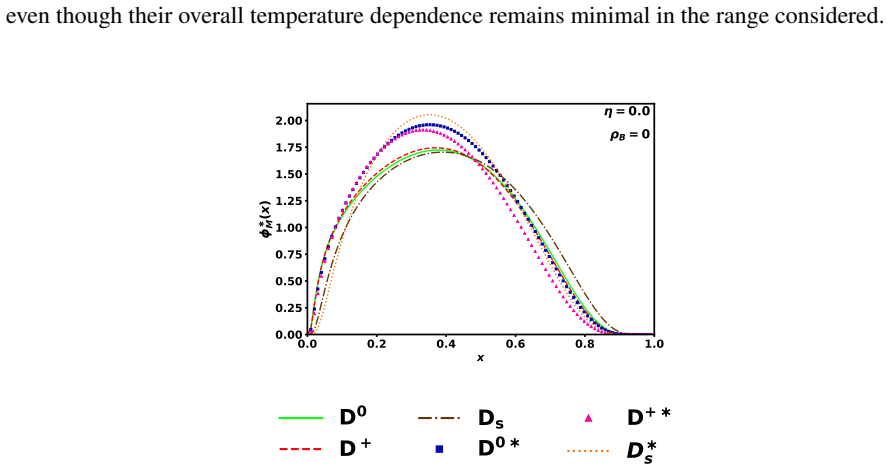
The paper claims that a hybrid treatment, in which in-medium constituent quark masses from the chiral SU(3) quark mean field model are inserted into the light-front quark model, captures the dominant medium effects on $D$ and $D^*$ mesons. At $\rho_B = \rho_0$, $T = 0$ and $\eta = 0$, the $D^0$ mass shifts downward by $-0.097$ GeV, and at $\eta = 0.5$ the shift is $-0.085$ GeV. $D^+$ behaves similarly, while $D_s$ shifts by roughly $-0.029$ GeV at $\eta=0.5$ and $D_s^*$ by $-0.024$ GeV. Vector $D^{0*}$ and $D^{+*}$ masses first drop and then rise with baryon density because the hyperfine term acts with opposite signs for vector and pseudoscalar mesons. Weak decay constant ratios $f_M^*/f_M$ fall with density, reaching $0.936$ for $D^0$ at $\rho_0$, $T=0$, $\eta=0$, and the distribution amplitudes develop a visible $D^0$/$D^+$ splitting under isospin asymmetry.
Load-bearing premise
The paper assumes that the quark inside a $D$ meson experiences the same scalar and vector mean fields as a quark confined inside a nucleon, so the in-medium quark masses from the chiral quark mean field model can be used directly in the meson wave function while the confining interaction parameters stay at their vacuum values.
Editorial extensions
If this is right
- At nuclear saturation density the $D^0$ mass shift is predicted to be about $-0.097$ GeV in symmetric matter, a signal that could be searched for in $D$-meson spectral measurements.
- Mesons containing a strange quark ($D_s$, $D_s^*$) are nearly unaffected, so isospin asymmetry acts mainly on the doublet members with $u/d$ quarks.
- The weak decay constants of the $u/d$-containing $D$ mesons are suppressed by roughly 6% at $\rho_0$ and by about 15% at $3\rho_0$, which would alter predicted $D$-meson production and decay rates in dense matter.
- Vector $D^*$ mesons show a non-monotonic mass shift with density, initially decreasing and then increasing, a signature of the hyperfine interaction that separates them from their pseudoscalar partners.
- Raising temperature from $0$ to $0.15$ GeV partially cancels the medium-induced shifts, so cold dense matter gives the cleanest signal.
Reading between the lines
- If the same mean-field assumption holds outside the nucleon sector, the predicted $-0.097$ GeV shift at $\rho_0$ could be used to estimate $D$-meson binding energies and the formation threshold of $D$-mesic nuclei.
- The predicted splitting of the $D^0$ and $D^+$ distribution amplitudes under isospin asymmetry could be probed in processes sensitive to the light-quark momentum fraction, such as $D$-meson production in asymmetric heavy-ion collisions.
- A lattice QCD computation of the $D$-meson mass and decay constant in uniform nuclear matter at $\rho_0$ would test whether the quark inside a meson feels the same mean field as the quark inside a nucleon; a null result for the decay-constant suppression would point to that assumption as the weak link.
Editorial analysis
A structured set of objections, weighed in public.
Referee Report
Summary. The manuscript studies the in-medium properties of pseudoscalar D (D0, D+, Ds) and vector D* (D0*, D+*, Ds*) mesons in isospin asymmetric nuclear matter using a hybrid approach that combines the light-front quark model (LFQM) with the chiral SU(3) quark mean field (CQMF) model. In-medium quark masses obtained from the CQMF model are inserted into the LFQM Hamiltonian, and the effective masses, weak decay constants, and distribution amplitudes are computed as functions of baryon density, isospin asymmetry, and temperature. The paper reports significant density-dependent mass shifts and decay-constant suppression for mesons containing u/d quarks, smaller effects for strange mesons, and weak temperature sensitivity. Vacuum masses and decay constants are compared with experimental data and with results from other models.
Significance. The results, if taken at face value, provide phenomenological predictions for open-charm meson modifications in dense matter that are relevant for CBM and PANDA at FAIR, and they extend earlier hybrid LFQM+CQMF studies from light and bottom mesons to D and D* mesons. The paper is built on explicit formulas and gives comparisons with several other approaches. However, the quantitative central claim rests on a variational consistency step that is not carried out in the medium, and on an unstated transferability assumption for the CQMF quark masses. These points need to be addressed before the quoted mass shifts and decay-constant ratios can be regarded as robust predictions of the hybrid framework.
major comments (2)
- [Sec. II B (Eqs. (26)-(28)), Sec. III A] The variational parameter beta is not re-minimized in the medium. The paper states in Sec. II B that beta is fixed by minimizing the expectation value of the QCD-motivated Hamiltonian, and Table II lists only vacuum values. When the in-medium quark masses m*_q from Eq. (13) are inserted into Eqs. (17)-(19) and (25), the Hamiltonian changes, so the variational minimum for beta should shift with density, isospin asymmetry, and temperature. Since beta enters not only the mass formula in Eq. (28) but also the decay constants f*_P and f*_V in Eqs. (31)-(32) and the distribution amplitudes in Eqs. (35)-(36), the reported medium modifications, including the headline shift of -0.097 GeV for the D0 mass at rho_B = rho_0, eta = 0, T = 0, are not the outcome of the model's own variational principle. The authors should recompute beta for each in-medium mass configuration and quantify how the mass shifts, decay-constant ratios, and DAs change. A sensitivity estimate is needed even if the effect turns out to be small.
- [Sec. II A (Eqs. (12)-(13)), Sec. II B (Eqs. (17)-(19))] The transferability of the CQMF in-medium quark masses to the D-meson bound state is an explicit model assumption that is not stated or tested. The effective quark masses m*_q in Sec. II A are computed for quarks confined inside nucleons via the Dirac equation in Eq. (12), but they are then used as the constituent quark masses of the quark-antiquark pair inside a D meson in the LFQM Hamiltonian, while the confinement parameters (a, b, alpha_s) and the smearing parameter kappa are kept at their vacuum values. This assumes that a quark inside a D meson experiences the same scalar and vector mean fields as a quark inside a nucleon, and that the confining interaction is medium-independent. I ask the authors to state this assumption explicitly and to provide a quantitative check of its robustness, for example by comparing with an alternative in-medium mass prescription or by varying the input m*_q within a reasonable range and reporting the resulting spread in the predicted mass shifts and decay-constant ratios.
minor comments (4)
- [Table III] The caption of Table III reads "Predicted ground-state mass spectra," but the D0 and D0* masses are fitted inputs used to fix m_u/d, m_c, alpha_s, a, b, and beta; only the D_s and D_s* rows are genuine predictions and should be labeled accordingly.
- [Sec. III A] The text quotes vacuum masses of 2.008 GeV for D_s and 2.111 GeV for D_s*, which are inconsistent with the values 2.010 and 2.112 GeV listed in Table III.
- [Throughout] There are several typographical and labeling errors, including "Additonally," "isosppin asymmetry," and the figure panel labels "B = 0" and "B = 3 0" in Figs. 8 and 9, which should read rho_B = rho_0 and rho_B = 3 rho_0.
- [Sec. III] The paper does not provide numerical tables of the in-medium quark masses m*_q or of the beta values used for the in-medium calculations; providing these numbers, at least for representative densities, would improve reproducibility and allow readers to check the LFQM inputs.
Circularity Check
No circularity: the in-medium D and D* properties are a cross-model prediction from CQMF-supplied quark masses, with no parameter fitted to the reported in-medium observables.
full rationale
The derivation chain is linear and non-circular. CQMF solves for in-medium quark masses m*_q via Eq. (13) from mean-field equations whose parameters are fixed by nuclear-matter saturation properties and meson masses in free space. These m*_q values are then inserted into LFQM formulas for the meson mass (Eq. 28), weak decay constants (Eqs. 31-32), and distribution amplitudes (Eqs. 35-36). No parameter in the LFQM or CQMF sector is fitted to the in-medium D/D* masses, decay-constant ratios, or DAs that the paper reports. The vacuum LFQM parameters (a, b, alpha_s, quark masses) are fixed by free-space D0 and D0* masses and other model inputs, and the CQMF parameters by saturation properties; the in-medium shifts, such as -0.097 GeV for D0 at rho_0, are then genuine predictions of the combined model rather than reproductions of an input. The direction of the shift is indeed inherited from the sign of the light-quark mass drop, but the magnitude is a nontrivial outcome of the Bessel, Coulomb, and hyperfine terms in Eq. (28). The self-citations (Refs. 19-23 and 59) supply the CQMF parameter set and earlier pion/kaon/B applications of the same hybrid idea, but the D-meson calculation is performed in this paper and is not a restatement of those works. One internal-consistency caveat, which is a correctness concern rather than circularity, is that the Gaussian width beta in Table II is fixed by vacuum variational minimization and is not re-minimized as m*_q changes with density; the in-medium expectation value is therefore computed with a wavefunction that is not the variational minimum of the in-medium Hamiltonian (Sec. II B, Eqs. 26-28). This could affect the numerical shifts but does not make any predicted quantity equal to an input by construction.
Assumptions & free parameters
free parameters (5)
- k0, k1, k2, k3, k4 =
4.94, 2.12, -10.16, -5.38, -0.06
- g4 =
37.4
- confinement parameters (a, b, alpha_s) =
a = -0.043 GeV, b = 0.18 GeV^2, alpha_s = 0.565
- constituent quark masses =
m_ud = 0.256, m_s = 0.457, m_c = 1.27 GeV
- Gaussian parameter beta =
0.5331, 0.5189, 0.6066 for pseudoscalar; 0.4896, 0.4681, 0.4742 for vector
assumptions (5)
- domain assumption The CQMF Lagrangian (Eqs. 5-14) with parameters from Table I describes nuclear matter and in-medium quark masses.
- ad hoc to paper In-medium quark masses derived for quarks inside nucleons apply unchanged to quarks inside D mesons.
- ad hoc to paper The vacuum confinement potential (linear plus Coulomb plus hyperfine) is unchanged in the medium.
- standard math Light-front quantization and the Gaussian trial wave function yield the meson mass eigenvalue (Eqs. 17-28).
- standard math The Gaussian smearing of the delta function in the hyperfine potential (kappa parameter) is fixed.
Cite this review
Pith. "Pith review of $D$ and $D^*$ mesons in isospin asymmetric nuclear medium." pith.science (2026). https://pith.science/paper/Z5DYNMTE
@misc{pith2026250608707,
  author       = {Pith},
  title        = {Pith review of: $D$ and $D^*$ mesons in isospin asymmetric nuclear medium},
  year         = {2026},
  howpublished = {\url{https://pith.science/paper/Z5DYNMTE}},
  note         = {Machine review of arXiv:2506.08707}
}
abstract
We investigate the properties of pseudoscalar $D$ and vector $D^*$ mesons in an isospin asymmetric nuclear medium using a hybrid approach that integrates the light-front quark model with the chiral SU(3) quark mean field model. The influence of isospin asymmetric nuclear medium is examined by utilizing the in-medium quark masses derived from the chiral SU(3) quark mean field model as an input in the light-front quark model to study the medium modification of $D$ mesons. We examine the impact of isospin asymmetry and baryon density at zero and finite temperature on the effective masses, weak decay constants, and distribution amplitudes of the pseudoscalar mesons $D^0$, $D^+$, $D_s$, and the vector mesons $D^{0*}$, $D^{+*}$, and $D_s^*$. Our results indicate significant medium-induced changes for pseudoscalar $D$ and vector $D^*$ mesons having $u/d$ as one of their constituent quarks, while a comparatively reduced effect is observed for mesons containing a strange quark. In contrast to temperature and isospin asymmetry, changes in the baryon density of the nuclear medium have a larger effect on different properties of $D$ and $D^*$ mesons.
Figures


Figures from the paper (6 more)




Reference graph
Works this paper leans on
- [49]
-
[1]
Asterik(∗)sign symbolize that the quantities are medium dependent. The boost invariant mass of meson squared, M∗2 0 is defined as M∗2 0 = k2 ⊥ +m∗ q 2 x + k2 ⊥ +m∗ ¯q 2 1−x .(25) 10 Additonally, the spin-orbit wave functionsR ∗JJz λqλ ¯q automatically satisfy the unitary condition ⟨R∗JJz λqλ ¯q |R∗JJz λqλ ¯q ⟩=1. To use a variational principle, we employ ...
-
[2]
It is important to mention that the normalized LFWF will be utilized for additional computations [49]. We perform the variational analysis to evaluate the expectation value of the QCD motivated HamiltonianH q¯q with the trial functionΦ ∗ 1S (x,k⊥)which has variational parameterβdepen- dence. Once the parameter fixing is done by minimizing the expectation ...
-
[3]
J. J. Aubertet al.[European Muon],Phys. Lett. B123, 275 (1983)
1983
-
[4]
Suzuki, M
K. Suzuki, M. Fujita, H. Geissel, H. Gilg, A. Gillitzer, R. S. Hayano, S. Hirenzaki, K. Itahashi, M. Iwasaki and P. Kienle,et al.Phys. Rev. Lett.92, 072302 (2004)
2004
-
[5]
Friedman, M
E. Friedman, M. Bauer, J. Breitschopf, H. Clement, H. Denz, E. Doroshkevich, A. Erhardt, G. J. Hof- man, R. Meier and G. J. Wagner,et al., Phys. Rev. Lett.93, 122302 (2004)
2004
-
[6]
F. Bonuttiet al.[CHAOS], Phys. Rev. Lett.77, 603 (1996). 30
work page 1996
- [7]
Show all 85 references
-
[8]
M. F. M. Lutzet al.[PANDA], [arXiv:0903.3905 [hep-ex]]
-
[9]
Ohnishi, F
H. Ohnishi, F. Sakuma and T. Takahashi, Prog. Part. Nucl. Phys.113, 103773 (2020)
2020
-
[10]
Sawada, Nucl
S. Sawada, Nucl. Phys. A782, 434 (2007)
2007
-
[11]
Sakaguchi [J-PARC-HI], PoSCORFU2018, 189 (2019)
T. Sakaguchi [J-PARC-HI], PoSCORFU2018, 189 (2019)
2019
-
[12]
Senger, Central Eur
P. Senger, Central Eur. J. Phys.10, 1289 (2012)
2012
-
[13]
V . D. Kekelidze,et al., Phys. Part. Nucl.48, 727 (2017)
2017
-
[14]
Kekelidze,et al., Nucl
V . Kekelidze,et al., Nucl. Phys. A967, 884 (2017)
2017
-
[15]
R. Rapp, D. Blaschke and P. Crochet, Prog. Part. Nucl. Phys.65, 209 (2010)
2010
-
[16]
D. N. Kim and G. A. Miller, Phys. Rev. C106, 055202 (2022)
2022
-
[17]
P. T. P. Hutauruk, Y . Oh and K. Tsushima, Phys. Rev. C99, 015202 (2019)
2019
-
[18]
C. D. Roberts and S. M. Schmidt, Prog. Part. Nucl. Phys.45, S1-S103 (2000)
2000
-
[19]
J. P. B. C. de Melo, K. Tsushima and I. Ahmed, Phys. Lett. B766, 125 (2017)
2017
-
[20]
J. P. B. C. de Melo and K. Tsushima, Phys. Lett. B788, 137 (2019)
2019
-
[21]
N. Kaur, S. Puhan, R. Pandey, A. Kumar, S. Dutt and H. Dahiya, Phys. Lett. B859, 139114 (2024)
2024
-
[22]
Singh, S
D. Singh, S. Puhan, N. Kaur, M. Kaur, A. Kumar, S. Dutt and H. Dahiya, Phys. Rev. D111, 054001 (2025)
2025
-
[23]
Puhan, N
S. Puhan, N. Kaur, A. Kumar, S. Dutt and H. Dahiya, Phys. Rev. D110, 054042 (2024)
2024
-
[24]
Puhan, N
S. Puhan, N. Kaur, A. Kumar, S. Dutt and H. Dahiya, Nucl. Phys. B1017, 116940 (2025)
2025
-
[25]
Puhan, N
Tanisha, S. Puhan, N. Kaur, A. Kumar and H. Dahiya, [arXiv:2504.21392 [nucl-th]]
-
[26]
Tsushima and J
K. Tsushima and J. P. B. C. de Melo, Few Body Syst.58, 85 (2017)
2017
-
[27]
Zschiesche, A
D. Zschiesche, A. Mishra, S. Schramm, H. Stoecker and W. Greiner, Phys. Rev. C70, 045202 (2004)
2004
-
[28]
Matsui and H
T. Matsui and H. Satz, Phys. Lett. B178, 416 (1986)
1986
-
[29]
Goninet al.[NA50], Nucl
M. Goninet al.[NA50], Nucl. Phys. A610, 404C (1996)
1996
-
[30]
Garcia-Recio, J
C. Garcia-Recio, J. Nieves and L. Tolos, Phys. Lett. B690, 369 (2010)
2010
-
[31]
Tolos, Int
L. Tolos, Int. J. Mod. Phys. E22, 1330027 (2013)
2013
-
[32]
Tsushima, D
K. Tsushima, D. H. Lu, G. Krein and A. W. Thomas, Phys. Rev. C83, 065208 (2011)
2011
-
[33]
Tolos, J
L. Tolos, J. Schaffner-Bielich and H. Stoecker, Phys. Lett. B635, 85 (2006)
2006
-
[34]
Tolos, J
L. Tolos, J. Schaffner-Bielich and A. Mishra, Phys. Rev. C70, 025203 (2004)
2004
-
[35]
M. F. M. Lutz and C. L. Korpa, Phys. Lett. B633, 43 (2006)
2006
-
[36]
Cassing, E
W. Cassing, E. L. Bratkovskaya and A. Sibirtsev, Nucl. Phys. A691, 753 (2001). 31
2001
-
[37]
Hayashigaki, Phys
A. Hayashigaki, Phys. Lett. B487, 96 (2000)
2000
-
[38]
Tsushima, D
K. Tsushima, D. H. Lu, A. W. Thomas, K. Saito and R. H. Landau, Phys. Rev. C59, 2824 (1999)
1999
-
[39]
Mishra and A
A. Mishra and A. Mazumdar, Phys. Rev. C79, 024908 (2009)
2009
-
[40]
Kumar and A
A. Kumar and A. Mishra, Eur. Phys. J. A47, 164 (2011)
2011
-
[41]
Reddy P., A
S. Reddy P., A. Jahan C. S., N. Dhale, A. Mishra and J. Schaffner-Bielich, Phys. Rev. C97, 065208 (2018)
2018
-
[42]
Kumar and A
R. Kumar and A. Kumar, Phys. Rev. C101, 015202 (2020)
2020
-
[43]
Chhabra and A
R. Chhabra and A. Kumar, Phys. Rev. C98, 025205 (2018)
2018
-
[44]
Chhabra and A
R. Chhabra and A. Kumar, Eur. Phys. J. A53, 105 (2017)
2017
-
[45]
Kumar, Adv
A. Kumar, Adv. High Energy Phys.2014, 549726 (2014)
2014
-
[46]
Kumar and R
A. Kumar and R. Chhabra, Phys. Rev. C92, 035208 (2015)
2015
-
[47]
Hosaka, T
A. Hosaka, T. Hyodo, K. Sudoh, Y . Yamaguchi and S. Yasui, Prog. Part. Nucl. Phys.96, 88 (2017)
2017
-
[48]
Chhabra and A
R. Chhabra and A. Kumar, Springer Proc. Phys.203, 657 (2018)
2018
-
[50]
A. J. Arifi, L. Happ, S. Ohno and M. Oka, Phys. Rev. D110, 014020 (2024)
2024
-
[51]
A. J. Arifi, P. T. P. Hutauruk and K. Tsushima, Phys. Rev. D107, 114010 (2023)
2023
-
[52]
S. J. Brodsky, H. C. Pauli and S. S. Pinsky, Phys. Rept.301, 299 (1998)
1998
-
[53]
K. G. Wilson, T. S. Walhout, A. Harindranath, W. M. Zhang, R. J. Perry and S. D. Glazek, Phys. Rev. D49, 6720 (1994)
1994
-
[54]
P. Wang, Z. Y . Zhang and Y . W. Yu, Commun. Theor. Phys.36, 71 (2001)
2001
-
[55]
Kumar and A
R. Kumar and A. Kumar, Eur. Phys. J. C79, 403 (2019)
2019
-
[56]
Papazoglou, D
P. Papazoglou, D. Zschiesche, S. Schramm, J. Schaffner-Bielich, H. Stoecker and W. Greiner, Phys. Rev. C59, 411 (1999)
1999
-
[57]
Kumar and A
A. Kumar and A. Mishra, Phys. Rev. C82, 045207 (2010)
2010
-
[58]
Singh, A
H. Singh, A. Kumar and H. Dahiya, Chin. Phys. C41, 094104 (2017)
2017
-
[59]
P. Wang, Z. Y . Zhang, Y . W. Yu, R. K. Su and Q. Song, Nucl. Phys. A688, 791 (2001)
2001
-
[60]
P. Wang, Z. Y . Zhang, Y . W. Yu, H. Guo, R. K. Su and H. Q. Song, Nucl. Phys. A705, 455 (2002)
2002
-
[61]
Kumar, S
A. Kumar, S. Dutt and H. Dahiya, Eur. Phys. J. A60, 4 (2024)
2024
-
[62]
Barik, B
N. Barik, B. K. Dash and M. Das, Phys. Rev. D31, 1652 (1985)
1985
-
[63]
Barik, R
N. Barik, R. N. Mishra, D. K. Mohanty, P. K. Panda and T. Frederico, Phys. Rev. C88, 015206 (2013)
2013
-
[64]
B. D. Keister and W. N. Polyzou, Adv. Nucl. Phys.20, 225 (1991). 32
1991
-
[65]
H. M. Choi and C. R. Ji, Phys. Rev. D59, 074015 (1999)
1999
-
[66]
H. M. Choi and C. R. Ji, Phys. Rev. D80, 054016 (2009)
2009
-
[67]
H. M. Choi and C. R. Ji, Phys. Lett. B460, 461 (1999)
1999
-
[68]
A. J. Arifi, H. M. Choi, C. R. ji and Y . Oh, Phys. Rev. D106, 014009 (2022)
2022
-
[69]
H. M. Choi, C. R. Ji, Z. Li and H. Y . Ryu, Phys. Rev. C92, 055203 (2015)
2015
-
[70]
Navaset al.[Particle Data Group], Phys
S. Navaset al.[Particle Data Group], Phys. Rev. D110, 030001 (2024)
2024
-
[71]
Dhiman, H
N. Dhiman, H. Dahiya, C. R. Ji and H. M. Choi, Phys. Rev. D100, 014026 (2019)
2019
-
[72]
Z. G. Wang, Eur. Phys. J. C75, 427 (2015)
2015
-
[73]
Becirevic, P
D. Becirevic, P. Boucaud, J. P. Leroy, V . Lubicz, G. Martinelli, F. Mescia and F. Rapuano, Phys. Rev. D60, 074501 (1999)
1999
-
[74]
Cvetic, C
G. Cvetic, C. S. Kim, G. L. Wang and W. Namgung, Phys. Lett. B596, 84 (2004)
2004
-
[75]
G. L. Wang, Phys. Lett. B633, 492 (2006)
2006
-
[76]
Hilger, R
T. Hilger, R. Thomas and B. Kampfer, Phys. Rev. C79, 025202 (2009)
2009
-
[77]
H. M. Choi, Phys. Rev. D75, 073016 (2007)
2007
-
[78]
Z. G. Wang, Phys. Rev. C92, 065205 (2015)
2015
-
[79]
V . L. Chernyak and A. R. Zhitnitsky, Phys. Rept.112, 173 (1984)
1984
-
[80]
G. P. Lepage and S. J. Brodsky, Phys. Rev. D22, 2157 (1980)
1980
-
[81]
H. M. Choi and C. R. Ji, Phys. Rev. D75, 034019 (2007)
2007
-
[82]
Y . Li, P. Maris and J. P. Vary, Phys. Rev. D96, 016022 (2017)
2017
-
[83]
Zhong, K
T. Zhong, K. Li, Y . Zhang and H. B. Fu, Int. J. Theor. Phys.59, 2562-2571 (2020)
2020
-
[84]
Zhang, T
Y . Zhang, T. Zhong, H. B. Fu, W. Cheng and X. G. Wu, Phys. Rev. D103, 114024 (2021)
2021
-
[85]
F. E. Serna, R. C. da Silveira, J. J. Cobos-Mart ´ınez, B. El-Bennich and E. Rojas, Eur. Phys. J. C80, 955 (2020). 33
2020
Reviewed August 7, 2026 · model on record in the stance chip above.
Discussion (0). Sign in to comment.