REVIEW 4 major objections 6 minor 106 references
High-Pass Filtering and Gaussian Process Regularization: Stellar Activity Characterization Techniques Applied to the 55 Cancri Planetary System
T0 review · 4 major / 6 minor · reviewed 2026-08-04 · deepseek-v4-flash
Pith's one-line read The paper claims that a four-planet model of 55 Cancri, with stellar activity handled by a curvature-penalized Gaussian process, matches the standard five-planet model, so planet d's existence is not required by the radial velocities alone.
desk verdict A useful GP regularization idea with an honest application, but the 4-planet/5-planet comparison rests on a hand-set penalty parameter that differs between models. read the letter →
The pith
A machine-rendered reading of the paper's core claim, the machinery that carries it, and where it could break.
The reading
What carries the argument
The carrying object is the curvature-penalized Gaussian process: a quasiperiodic GP kernel (squared-exponential times exponential-sine-squared, from Rajpaul et al. 2015) whose negative log-likelihood is augmented by a term proportional to the sum of squared second differences of the predicted activity signal. This penalty prevents the GP from interpolating short-term noise and confines it to dynamo-timescale variation. A second tool, the Gaussian high-pass filter, computes a weighted moving average trend on unevenly spaced timestamps and subtracts it, so short-period planet signals can be found in periodograms without committing to a model of the long-term variability.
What would settle it
Re-run the 4pGP versus 5pGP comparison with the curvature penalty alpha fixed by an objective rule, such as cross-validation, applied identically to both models; the paper set alpha by visual inspection and used different values for the two models, so a robust winner under a single principled alpha would settle the model-comparison claim. Independently, Gaia astrometry can decide planet d: the 5pGP fit predicts an astrometric wobble of about 1.4 mas on a ~4600-day orbit, well above Gaia's precision, so a null detection at that amplitude would support the four-planet model.
Extended reading notes
Core claim
The central claim is that modeling stellar magnetic activity with a quasiperiodic Gaussian process, regularized by a curvature penalty, removes the need for the disputed fifth planet in 55 Cancri. In the paper's comparison, the 4pGP model—Keplerian orbits for planets b, c, e, and f plus a GP for the activity cycle—achieves reduced chi-squared 0.75 and residual RMS 5.49 m/s, at least as good as the 5pGP model (0.80, 5.82 m/s) and comparable to the previously published 5-planet model (0.81, 5.38 m/s). The GP activity cycle in the four-planet model has a period of about 5000 days and amplitude ~12 m/s, consistent with earlier estimates of the magnetic cycle amplitude, while the five-planet mode
Load-bearing premise
The load-bearing premise is that the curvature penalty alpha, chosen by visual inspection and set to different values for the two models, fairly represents how flexible the activity Gaussian process should be; if the alpha values are arbitrary, the comparison between four- and five-planet models is not decisive.
Editorial extensions
If this is right
- If the 4pGP model is accepted, 55 Cnc has four confirmed planets and planet d becomes an unconfirmed candidate whose parameters are not well determined.
- The activity-cycle period of ~5000 days found by the GP is not consistent with the 3822-day strictly periodic activity model, implying that treating magnetic cycles as Keplerians can bias long-period planet parameters.
- A reanalysis of other systems with long-period planets and active stars should check whether a regularized GP can absorb the supposed outer planet signal before claiming a detection.
- Future Gaia astrometry can decide the question: the ~1.4 mas wobble predicted for planet d is measurable if it exists.
Reading between the lines
- The curvature-penalty choice is the hinge of the result; a principled, automatic selection of alpha (e.g., cross-validation) applied equally to both models would make the 4-vs-5 planet comparison more decisive. The paper itself relies on visual inspection and uses different alpha values for the two models.
- The same overfitting guard could be applied to other quasiperiodic stellar signals in RV surveys, not just long magnetic cycles, wherever a GP risks absorbing a planet.
- If astrometry does confirm planet d, the comparison would not be wasted: the exercise would still show that RV data alone cannot separate a 5000-day activity cycle from a ~4600-day planet, and that combined RV+astrometry fitting is needed.
Editorial analysis
A structured set of objections, weighed in public.
Referee Report
Summary. This paper develops two tools for RV planet searches: high-pass detrending with a Gaussian filter (GF) and a quasiperiodic Gaussian-process activity model fitted with a curvature-penalized objective (Eq. 5). The methods are applied to the 55 Cnc RV dataset of Bourrier et al. (2018). After GF detrending and periodogram searches, the authors fit two global models: 4pGP (planets b, c, e, f plus a GP for activity) and 5pGP (b, c, e, f, d plus a GP). They report similar goodness-of-fit metrics for the two models and conclude that planet d is not required by the RVs and cannot be established from RVs alone. The paper includes a public Jupyter notebook and a Zenodo archive, which is a genuine strength.
Significance. The strongest contribution is methodological: GF detrending is simple, transparent, and useful when no physical model of the long-term trend is available, and the curvature-penalized GP objective is a sensible response to the known problem of GP overfitting. The authors are also unusually candid about the heuristic nature of their choices. If the conclusion about planet d were robust, it would have substantial consequences for the 55 Cnc system. However, the central model comparison is currently not controlled: the two models use different regularization strengths, the quoted objective values are not comparable likelihoods, and the jitter treatment is post-hoc. The planet-d conclusion is therefore an interesting hypothesis rather than an established result.
major comments (4)
- [Eq. (5), Table 3, Sec. 6.2] The 4pGP and 5pGP models are optimized with different curvature penalties: α = 2×10^8 for 4pGP and α = 3×10^9 day^4 m^-2 s^2 for 5pGP. Since L(θ) in Eq. (5) includes the penalty term, the reported values −6123 and −6370 are not comparable log-likelihoods; the 5pGP GP is penalized 15 times more strongly, artificially limiting its ability to absorb long-period variability. The statement in Sec. 6.2 that the models have 'comparable L(θ)' is therefore unsupported. A controlled comparison is needed: for example, the same α for both models, the pure unpenalized log-likelihood, or cross-validated predictive scores.
- [Sec. 4.2, Sec. 6.2] The values of α are chosen by visual inspection, separately for each model, as the minimum penalties needed to prevent short-term GP interpolation. No sensitivity analysis is reported. Because the central claim is that a GP can replace planet d, the dependence of that claim on α must be quantified. The paper should show how the best-fit parameters and goodness-of-fit metrics vary over a broad range of α for both models, or adopt an algorithmic selection procedure (e.g., cross-validation) applied identically to 4pGP and 5pGP.
- [Table 3, Fig. 5] The two models place the long-period RV power in very different components: the 4pGP GP has K = 12.2 ± 6.7 m/s, while 5pGP gives planet d K = 38.6 ± 3.5 m/s and a GP amplitude of only 4.3 ± 3.0 m/s. A quasiperiodic GP with marginal standard deviation ~12 m/s will only rarely produce a coherent 38 m/s signal, so the comparison is not simply 'the GP absorbs planet d'; the two models are fitting different decompositions of the long-term variation. An injection-recovery test or posterior predictive check would clarify whether the 4pGP GP can actually generate the long-period structure that 5pGP attributes to planet d.
- [Appendix A, Tables 1 and 3] Jitter is estimated post-hoc from the residuals of each fit and then used to compute reduced χ² and the Anderson-Darling statistics. The resulting difference in reduced χ² (0.75 vs 0.80) is small and is quoted without uncertainty, and values below unity indicate overfitting or overestimated jitter. The claim that 4pGP is 'statistically superior' to 5pGP is too strong. A joint fit with jitter parameters (or an appropriate marginalization/bootstrap) is needed before this comparison can support the paper's conclusion.
minor comments (6)
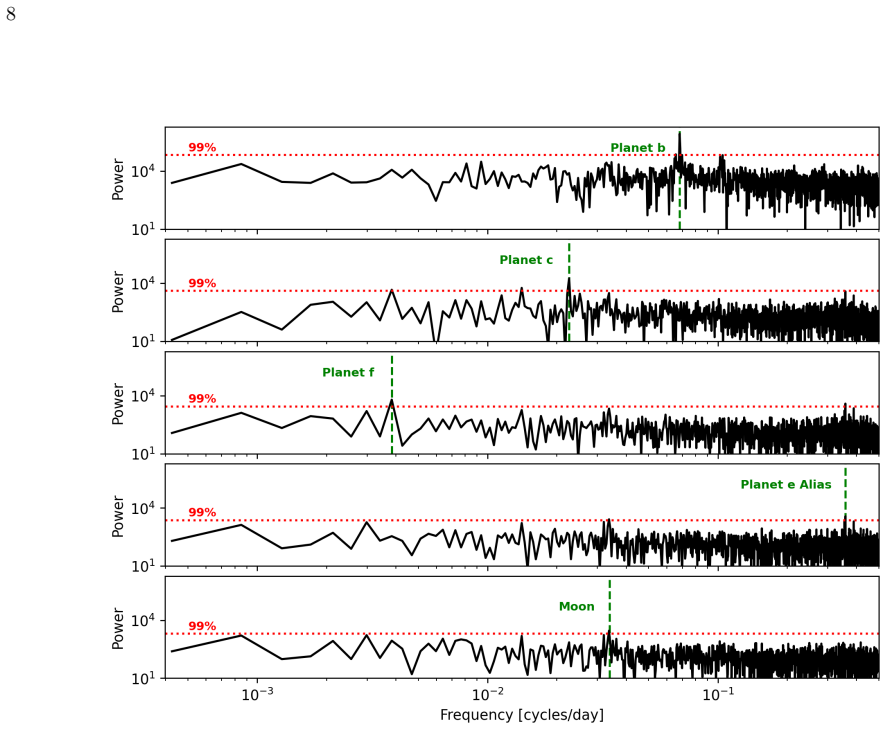
- [Sec. 5.1, Sec. 7] The absence of a planet-d peak in the periodograms is not informative because the GF with σ = 500 days explicitly removes variability on timescales ≳1000 days, and the paper itself notes this in Sec. 5.1. The later statement in Sec. 7 that there is 'no evidence for planet d in the frequency domain' is misleading without additional analysis of the unfiltered residuals.
- [Sec. 6.2] The expression for reduced χ² appears to be missing squares: it is written as [Σ (Δy_n − τ_n)/σ_y,n]/(N−γ). The standard definition is (1/(N−γ)) Σ [(Δy_n − τ_n)/σ_y,n]^2. Please correct the typo.
- [Sec. 6.1, Sec. 7] Minor language issues: 'modest affect' should be 'modest effect', and 'principle concern' should be 'principal concern'.
- [Software/References] The Zenodo DOI in the text is 10.5281/zenodo.14571274, but the reference list gives 10.5281/zenodo.14571275. Please make these consistent.
- [Sec. 6.2] The two-sample Anderson-Darling test statistic is reported as −1.20 with p = 0.99998 identically for both models. Negative statistic values and identical values for two models with different residuals need explanation; this may be a reporting artifact.
- [Eq. (5)] The curvature penalty uses central differences at sampling points m=0,...,M−1; please specify how boundary points are handled when computing τ_{m+1}−2τ_m+τ_{m−1} at the edges of the grid.
Circularity Check
Partial circularity in jitter-based goodness-of-fit; central planet-d claim is a valid degeneracy test but rests on subjective regularization.
-
fitted input called prediction
[Appendix A (jitter estimation), applied in §6.2 and Table 3]
"If jitter were not a consideration, σ_y,n would fully capture the uncertainty in y_n, so we would expect 1/(N−γ) Σ ((Δy_n−τ_n)/σ_y,n)^2 ≈ 1... Fitting a Gaussian distribution N(0,W) to the δy distribution for each instrument yields a weighting factor W that quantifies the degree to which σ_y underestimates the uncertainty in y_n."
The jitter σ_J is estimated from each model's own residuals by forcing the normalized residual variance to be approximately 1 (Equation A1). The reduced χ² values in Table 3 (0.75 for 4pGP, 0.80 for 5pGP) are then presented as goodness-of-fit evidence favoring 4pGP, but they are near unity by construction for both models. Thus the reduced-χ² comparison is not an independent test; it is a fitted quantity being used as a model-quality prediction. The residual RMS values (5.49 vs 5.82 m/s) are not circular, but the statistical superiority claim leans on a metric that is partly self-constructed.
full rationale
The paper's central claim—that a 4-planet model with a GP activity component performs as well as the 5-planet model—is a model-comparison result, not a derivation from a fitted parameter. The analysis uses public RV data, external codes (george, kepmodel, DACE), and explicitly compares against Bourrier et al. (2018). The quasiperiodic kernel is taken from Rajpaul et al. (2015) and the curvature penalty from Green & Silverman (1994), both independent of the authors. The conclusion that planet d cannot be established from RVs alone is not forced by a self-citation chain; it is a genuine degeneracy statement. However, there is partial circularity in the goodness-of-fit assessment: jitter is estimated from the residuals of each model (Appendix A) in a way that drives reduced χ² toward 1, so the reduced-χ² comparison is not fully independent. Additionally, the curvature penalty α is chosen separately for 4pGP and 5pGP by visual inspection (§4.2), making the L(θ) values in Table 3 non-comparable across models. These are methodological weaknesses and a modest statistical circularity, but the core claim about planet d is not equivalent to the model inputs. Score 3 reflects partial, non-central circularity.
Assumptions & free parameters
free parameters (8)
- alpha (4pGP) =
2e8 day4 m-2 s2
- alpha (5pGP) =
3e9 day4 m-2 s2
- GP amplitude K (4pGP) =
12.2 +/- 6.7 m/s
- GP period P (4pGP) =
4980 +/- 930 days
- lambda_e (4pGP) =
5015 +/- 3950 days
- lambda_p (4pGP) =
0.24 +/- 0.062
- Gaussian filter width sigma =
500 days
- Instrument jitter estimates =
Various, Table 1
assumptions (4)
- domain assumption The quasiperiodic GP kernel of Rajpaul et al. (2015) is an appropriate model for stellar magnetic activity cycles.
- domain assumption The long-term radial velocity variability is quasiperiodic and can be represented by a single GP without an additional Keplerian.
- domain assumption The archival RV dataset and error bars from Bourrier et al. (2018) are reliable.
- standard math Planets obey standard Keplerian orbits and the RV signal is a linear sum of Keplerians plus activity.
Cite this review
Pith. "Pith review of High-Pass Filtering and Gaussian Process Regularization: Stellar Activity Characterization Techniques Applied to the 55 Cancri Planetary System." pith.science (2026). https://pith.science/paper/Z63HQ2M3
@misc{pith2026250908076,
  author       = {Pith},
  title        = {Pith review of: High-Pass Filtering and Gaussian Process Regularization: Stellar Activity Characterization Techniques Applied to the 55 Cancri Planetary System},
  year         = {2026},
  howpublished = {\url{https://pith.science/paper/Z63HQ2M3}},
  note         = {Machine review of arXiv:2509.08076}
}
read the original abstract
Doppler planet searches are complicated by stellar activity, through which cyclical changes in the host star's photosphere and chromosphere can mask or mimic planetary signals. A popular technique for modeling stellar activity is to apply a quasiperiodic Gaussian process (GP) kernel, which provides a flexible model with rigorous error propagation. However, observers must guard against overfitting, as a GP may be flexible enough to subsume other signals besides the one it is intended to model. To counteract overfitting, we introduce a curvature-penalizing objective function for fitting GP models to long-term magnetic activity cycles. We also demonstrate that a Gaussian filter can be an effective method of detrending radial velocities (RVs) so that shorter-period signals can be extracted even in the absence of a mathematical model of the long-term trend. We apply our methods to the heavily studied 55 Cancri system, fitting Keplerian orbits plus the GP activity-cycle model. We show that a 4-Keplerian model that includes planets b, c, e, and f combined with a GP for the activity cycle performs at least as well as the widely agreed-upon 5-planet system with its own GP activity model. Our results suggest that the existence of planet d cannot be established from the RVs alone; additional data are required for confirmation.
Figures


Figures from the paper (3 more)


Reference graph
Works this paper leans on
-
[1]
, " * write output.state after.block = add.period write newline
ENTRY address archivePrefix author booktitle chapter doi edition editor eprint howpublished institution journal key month number organization pages publisher school series title misctitle type volume year version url label extra.label sort.label short.list INTEGERS output.state before.all mid.sentence after.sentence after.block FUNCTION init.state.consts ...
-
[2]
write newline
" write newline "" before.all 'output.state := FUNCTION format.url url empty "" new.block "" url * "" * if FUNCTION format.eprint eprint empty "" archivePrefix empty "" archivePrefix "arXiv" = new.block " " eprint * " " * new.block " " eprint * " " * if if if FUNCTION format.doi doi empty "" " " doi * " " * if FUNCTION format.pid doi empty eprint empty ur...
-
[3]
thebibliography [1] 20pt to REFERENCES 6pt =0pt 10pt plus 3pt =0pt =0pt =1pt plus 1pt =0pt =0pt -12pt =13pt plus 1pt =20pt =13pt plus 1pt \@M =10000 =-1.0em =0pt =0pt 0pt =0pt =1.0em @enumiv\@empty 10000 10000 `\.\@m \@noitemerr \@latex@warning Empty `thebibliography' environment \@ifnextchar \@reference \@latexerr Missing key on reference command Each re...
arXiv 2019
-
[4]
2012, , 419, 3147, 10.1111/j.1365-2966.2011.19960.x
Aigrain , S., Pont , F., & Zucker , S. 2012, , 419, 3147, 10.1111/j.1365-2966.2011.19960.x
arXiv 2012
-
[5]
Alonso-Floriano , F. J., Morales , J. C., Caballero , J. A., et al. 2015, , 577, A128, 10.1051/0004-6361/201525803
-
[6]
Ambikasaran , S., Foreman-Mackey , D., Greengard , L., Hogg , D. W., & O'Neil , M. 2015, IEEE Transactions on Pattern Analysis and Machine Intelligence, 38, 252, 10.1109/TPAMI.2015.2448083
arXiv 2015
-
[7]
Anderson, T. W., & Darling, D. A. 1952, The Annals of Mathematical Statistics, 23, 193. http://www.jstor.org/stable/2236446
arXiv 1952
-
[8]
1954, Journal of the American Statistical Association, 49, 765
---. 1954, Journal of the American Statistical Association, 49, 765. http://www.jstor.org/stable/2281537
arXiv 1954
Show all 106 references
-
[9]
2018, , 474, 2094, 10.1093/mnras/stx2109
Angus , R., Morton , T., Aigrain , S., Foreman-Mackey , D., & Rajpaul , V. 2018, , 474, 2094, 10.1093/mnras/stx2109
2018 doi
-
[10]
P., Tollerud , E
Astropy Collaboration , Robitaille , T. P., Tollerud , E. J., et al. 2013, , 558, A33, 10.1051/0004-6361/201322068
2013 doi
-
[11]
M., Sip o cz , B
Astropy Collaboration , Price-Whelan , A. M., Sip o cz , B. M., et al. 2018, , 156, 123, 10.3847/1538-3881/aabc4f
2018 doi
-
[12]
M., Lim , P
Astropy Collaboration , Price-Whelan , A. M., Lim , P. L., et al. 2022, , 935, 167, 10.3847/1538-4357/ac7c74
2022 doi
-
[13]
L., Donahue , R
Baliunas , S. L., Donahue , R. A., Soon , W. H., et al. 1995, , 438, 269, 10.1086/175072
1995 doi
-
[14]
2024, , 167, 70, 10.3847/1538-3881/ad1330
Beard , C., Robertson , P., Dai , F., et al. 2024, , 167, 70, 10.3847/1538-3881/ad1330
2024 doi
-
[15]
R., & Robinson , D
Bevington , P. R., & Robinson , D. K. 2003, Data reduction and error analysis for the physical sciences
2003
-
[16]
J., et al
Blunt , S., Carvalho , A., David , T. J., et al. 2023, , 166, 62, 10.3847/1538-3881/acde78
2023 doi
-
[17]
2011, , 528, A4, 10.1051/0004-6361/201014354
Boisse , I., Bouchy , F., H \'e brard , G., et al. 2011, , 528, A4, 10.1051/0004-6361/201014354
2011 doi
-
[18]
2021, , 161, 230, 10.3847/1538-3881/abec89
Bortle , A., Fausey , H., Ji , J., et al. 2021, , 161, 230, 10.3847/1538-3881/abec89
2021 doi
-
[19]
2014, , 569, A65, 10.1051/0004-6361/201424266
Bourrier , V., & H \'e brard , G. 2014, , 569, A65, 10.1051/0004-6361/201424266
2014 doi
-
[20]
2018, VizieR Online Data Catalog, J/A+A/615/A117
Bourrier , V., Ehrenreich , D., Lecavelier Des Etangs , A., et al. 2018, VizieR Online Data Catalog, J/A+A/615/A117
2018
-
[21]
G., Schmoll , J., Tyas , L
Bramall , D. G., Schmoll , J., Tyas , L. M. G., et al. 2012, in Society of Photo-Optical Instrumentation Engineers (SPIE) Conference Series, Vol. 8446, Ground-based and Airborne Instrumentation for Astronomy IV, ed. I. S. McLean , S. K. Ramsay , & H. Takami , 84460A, 10.1117/12.925935
2012 doi
-
[22]
2022, , 667, A68, 10.1051/0004-6361/202243167
Bugnet , L. 2022, , 667, A68, 10.1051/0004-6361/202243167
2022 doi
-
[23]
P., Marcy , G
Butler , R. P., Marcy , G. W., Williams , E., Hauser , H., & Shirts , P. 1997, , 474, L115, 10.1086/310444
1997 doi
-
[24]
P., Vogt , S
Butler , R. P., Vogt , S. S., Laughlin , G., et al. 2017, , 153, 208, 10.3847/1538-3881/aa66ca
2017 doi
-
[25]
Cabot , S. H. C., Roettenbacher , R. M., Henry , G. W., et al. 2021, , 161, 26, 10.3847/1538-3881/abc41e
2021 doi
-
[26]
L., Handberg , R., Mathur , S., et al
Campante , T. L., Handberg , R., Mathur , S., et al. 2011, , 534, A6, 10.1051/0004-6361/201116620
2011 doi
-
[27]
2014, , 567, A48, 10.1051/0004-6361/201323102
Carolo , E., Desidera , S., Gratton , R., et al. 2014, , 567, A48, 10.1051/0004-6361/201323102
2014 doi
-
[28]
Cegla , H. M. 2019, Geosciences, 9, 114, 10.3390/geosciences9030114
2019 doi
-
[29]
N., & Rozelot , J
Chowdhury , P., Kilcik , A., Yurchyshyn , V., Obridko , V. N., & Rozelot , J. P. 2019, , 294, 142, 10.1007/s11207-019-1530-7
2019 doi
-
[30]
2012, in Society of Photo-Optical Instrumentation Engineers (SPIE) Conference Series, Vol
Cosentino , R., Lovis , C., Pepe , F., et al. 2012, in Society of Photo-Optical Instrumentation Engineers (SPIE) Conference Series, Vol. 8446, Ground-based and Airborne Instrumentation for Astronomy IV, ed. I. S. McLean , S. K. Ramsay , & H. Takami , 84461V, 10.1117/12.925738
2012 doi
-
[31]
I., & Fabrycky , D
Dawson , R. I., & Fabrycky , D. C. 2010, , 722, 937, 10.1088/0004-637X/722/1/937
2010 doi
-
[32]
B., S \'e gransan , D., Dumusque , X., et al
Delisle , J. B., S \'e gransan , D., Dumusque , X., et al. 2018, , 614, A133, 10.1051/0004-6361/201732529
2018 doi
-
[33]
2011, in AAS/Division for Extreme Solar Systems Abstracts, Vol
Demory , B.-O., Gillon , M., Deming , D., & Seager , S. 2011, in AAS/Division for Extreme Solar Systems Abstracts, Vol. 2, AAS/Division for Extreme Solar Systems Abstracts, 17.04
2011
-
[34]
2016 a , , 455, 2018, 10.1093/mnras/stv2239
Demory , B.-O., Gillon , M., Madhusudhan , N., & Queloz , D. 2016 a , , 455, 2018, 10.1093/mnras/stv2239
2016 doi
-
[35]
2016 b , , 532, 207, 10.1038/nature17169
Demory , B.-O., Gillon , M., de Wit , J., et al. 2016 b , , 532, 207, 10.1038/nature17169
2016 doi
-
[36]
G., Endl , M., et al
Desidera , S., Gratton , R. G., Endl , M., et al. 2004, , 420, L27, 10.1051/0004-6361:20040155
2004 doi
-
[37]
M., Galland , F., Udry , S., & Mayor , M
Desort , M., Lagrange , A. M., Galland , F., Udry , S., & Mayor , M. 2007, , 473, 983, 10.1051/0004-6361:20078144
2007 doi
-
[38]
2024, , 167, 22, 10.3847/1538-3881/ad0c58
Dodson-Robinson , S., & Haley , C. 2024, , 167, 22, 10.3847/1538-3881/ad0c58
2024 doi
-
[39]
E., Delgado , V
Dodson-Robinson , S. E., Delgado , V. R., Harrell , J., & Haley , C. L. 2022, , 163, 169, 10.3847/1538-3881/ac52ed
2022 doi
-
[40]
2012, PhD thesis, University of Geneva, Astronomical Observatory
Dumusque , X. 2012, PhD thesis, University of Geneva, Astronomical Observatory
2012
-
[41]
C., & Monteiro , M
Dumusque , X., Udry , S., Lovis , C., Santos , N. C., & Monteiro , M. J. P. F. G. 2011, , 525, A140, 10.1051/0004-6361/201014097
2011 doi
-
[42]
2017, , 598, A133, 10.1051/0004-6361/201628671
Dumusque , X., Borsa , F., Damasso , M., et al. 2017, , 598, A133, 10.1051/0004-6361/201628671
2017 doi
-
[43]
2012, , 547, A18, 10.1051/0004-6361/201219981
Ehrenreich , D., Bourrier , V., Bonfils , X., et al. 2012, , 547, A18, 10.1051/0004-6361/201219981
2012 doi
-
[44]
A., El-Taher , A
El-Borie , M. A., El-Taher , A. M., Thabet , A. A., et al. 2020, , 898, 73, 10.3847/1538-4357/ab9d21
2020 doi
-
[45]
D., et al
Endl , M., Robertson , P., Cochran , W. D., et al. 2012, , 759, 19, 10.1088/0004-637X/759/1/19
2012 doi
-
[46]
J., de Mooij , E
Esteves , L. J., de Mooij , E. J. W., Jayawardhana , R., Watson , C., & de Kok , R. 2017, , 153, 268, 10.3847/1538-3881/aa7133
2017 doi
-
[47]
M., Pope , B
Farr , W. M., Pope , B. J. S., Davies , G. R., et al. 2018, , 865, L20, 10.3847/2041-8213/aadfde
2018 doi
-
[48]
A., Marcy , G
Fischer , D. A., Marcy , G. W., Butler , R. P., et al. 2008, , 675, 790, 10.1086/525512
2008 doi
-
[49]
A., Anglada-Escude , G., Arriagada , P., et al
Fischer , D. A., Anglada-Escude , G., Arriagada , P., et al. 2016, , 128, 066001, 10.1088/1538-3873/128/964/066001
2016 doi
-
[50]
2017, The Astronomical Journal, 154, 220, 10.3847/1538-3881/aa9332
Foreman-Mackey, D., Agol, E., Ambikasaran, S., & Angus, R. 2017, The Astronomical Journal, 154, 220, 10.3847/1538-3881/aa9332
2017 doi
-
[52]
2023 b , , 672, A149, 10.1051/0004-6361/202245201
---. 2023 b , , 672, A149, 10.1051/0004-6361/202245201
2023 doi
-
[53]
2012, Computational Optimization and Applications, 51, 259 , 10.1007/s10589-010-9329-3
Gao, F., & Han, L. 2012, Computational Optimization and Applications, 51, 259 , 10.1007/s10589-010-9329-3
2012 doi
-
[54]
1972, The analysis of tides
Godin , G. 1972, The analysis of tides. (Toronto: Univ. of Toronto Press)
1972
-
[55]
C., Bonfils , X., et al
Gomes da Silva , J., Santos , N. C., Bonfils , X., et al. 2012, , 541, A9, 10.1051/0004-6361/201118598
2012 doi
-
[56]
Gray, D. F. 2009, The Astrophysical Journal, 697, 1032, 10.1088/0004-637X/697/2/1032
2009 doi
-
[57]
1994, Nonparametric regression and generalized linear models: a roughness penalty approach (United Kingdom: Chapman and Hall)
Green, P., & Silverman, B. 1994, Nonparametric regression and generalized linear models: a roughness penalty approach (United Kingdom: Chapman and Hall)
1994
-
[58]
2024, 55Cnc\_exoplanets, v1.0.0, Zenodo, 10.5281/zenodo.14571275
Harrell, J. 2024, 55Cnc\_exoplanets, v1.0.0, Zenodo, 10.5281/zenodo.14571275
2024 doi
-
[59]
Hathaway, D. H. 2015, Living Reviews in Solar Physics, 12, 4, 10.1007/lrsp-2015-4
2015 doi
-
[60]
Hatzes , A. P. 2002, Astronomische Nachrichten, 323, 392, 10.1002/1521-3994(200208)323:3/4<392::AID-ASNA392>3.0.CO;2-M
2002 doi
-
[61]
Hatzes, A. P. 2019, The Doppler Method for the Detection of Exoplanets, 2514-3433 (IOP Publishing), 10.1088/2514-3433/ab46a3
2019 doi
-
[62]
D., Collier Cameron , A., Queloz , D., et al
Haywood , R. D., Collier Cameron , A., Queloz , D., et al. 2014, , 443, 2517, 10.1093/mnras/stu1320
2014 doi
-
[63]
L., et al
Hinshaw , G., Barnes , C., Bennett , C. L., et al. 2003, , 148, 63, 10.1086/377222
2003 doi
-
[64]
J., & Prescott, E
Hodrick, R. J., & Prescott, E. C. 1997, Journal of Money, Credit and Banking, 29, 1. http://www.jstor.org/stable/2953682
1997
-
[65]
E., & Raftery, A
Kass, R. E., & Raftery, A. E. 1995, Journal of the American Statistical Association, 90, 773, 10.1080/01621459.1995.10476572
1995
-
[66]
2019, , 623, A72, 10.1051/0004-6361/201834371
Kervella , P., Arenou , F., Mignard , F., & Th \'e venin , F. 2019, , 623, A72, 10.1051/0004-6361/201834371
2019 doi
-
[67]
L \'o pez-Morales , M., Triaud , A. H. M. J., Rodler , F., et al. 2014, , 792, L31, 10.1088/2041-8205/792/2/L31
2014 doi
-
[68]
2010, in Exoplanets, ed
Lovis , C., & Fischer , D. 2010, in Exoplanets, ed. S. Seager (University of Arizona Press), 27--53
2010
-
[69]
2021, , 162, 61, 10.3847/1538-3881/ac0057
Lubin , J., Robertson , P., Stefansson , G., et al. 2021, , 162, 61, 10.3847/1538-3881/ac0057
2021 doi
-
[70]
W., Butler , R
Marcy , G. W., Butler , R. P., Fischer , D. A., et al. 2002, , 581, 1375, 10.1086/344298
2002 doi
-
[71]
E., Endl , M., Cochran , W
McArthur , B. E., Endl , M., Cochran , W. D., et al. 2004, , 614, L81, 10.1086/425561
2004 doi
-
[72]
1999, IEEE Signal Processing Magazine, 16, 29, 10.1109/MSP.1999.790977
McClellan, J., & Schafer, R. 1999, IEEE Signal Processing Magazine, 16, 29, 10.1109/MSP.1999.790977
1999
-
[73]
Meunier , N., Desort , M., & Lagrange , A. M. 2010, , 512, A39, 10.1051/0004-6361/200913551
2010 doi
-
[74]
2013, Astronomische Nachrichten, 334, 141, https://doi.org/10.1002/asna.201211742
Meunier, N., & Lagrange, A. 2013, Astronomische Nachrichten, 334, 141, https://doi.org/10.1002/asna.201211742
2013 doi
-
[75]
A., & Mead, R
Nelder, J. A., & Mead, R. 1965, The Computer Journal, 7, 308, 10.1093/comjnl/7.4.308
1965 doi
-
[76]
R., Irwin, J., Charbonneau, D., Berta-Thompson, Z
Newton, E. R., Irwin, J., Charbonneau, D., Berta-Thompson, Z. K., & Dittmann, J. A. 2016, The Astrophysical Journal Letters, 821, L19, 10.3847/2041-8205/821/1/L19
2016 doi
-
[77]
1996, The VizieR database of astronomical catalogues, CDS, Centre de Données astronomiques de Strasbourg, 10.26093/CDS/VIZIER
Ochsenbein, F. 1996, The VizieR database of astronomical catalogues, CDS, Centre de Données astronomiques de Strasbourg, 10.26093/CDS/VIZIER
1996 doi
-
[78]
2000, , 143, 23, 10.1051/aas:2000169
Ochsenbein , F., Bauer , P., & Marcout , J. 2000, , 143, 23, 10.1051/aas:2000169
2000 doi
-
[79]
2003, in Society of Photo-Optical Instrumentation Engineers (SPIE) Conference Series, Vol
Pepe , F., Rupprecht , G., Avila , G., et al. 2003, in Society of Photo-Optical Instrumentation Engineers (SPIE) Conference Series, Vol. 4841, Instrument Design and Performance for Optical/Infrared Ground-based Telescopes, ed. M. Iye & A. F. M. Moorwood , 1045--1056, 10.1117/12.460777
2003 doi
-
[80]
2008, in Society of Photo-Optical Instrumentation Engineers (SPIE) Conference Series, Vol
Perruchot , S., Kohler , D., Bouchy , F., et al. 2008, in Society of Photo-Optical Instrumentation Engineers (SPIE) Conference Series, Vol. 7014, Ground-based and Airborne Instrumentation for Astronomy II, ed. I. S. McLean & M. M. Casali , 70140J, 10.1117/12.787379
2008 doi
-
[81]
\'A ., & Lindegren , L
Perryman , M., Hartman , J., Bakos , G. \'A ., & Lindegren , L. 2014, , 797, 14, 10.1088/0004-637X/797/1/14
2014 doi
-
[82]
A., Reece , S., & Roberts , S
Rajpaul , V., Aigrain , S., Osborne , M. A., Reece , S., & Roberts , S. 2015, , 452, 2269, 10.1093/mnras/stv1428
2015 doi
-
[83]
M., Buchhave , L
Rajpaul , V. M., Buchhave , L. A., Lacedelli , G., et al. 2021, , 507, 1847, 10.1093/mnras/stab2192
2021 doi
- [84]
-
[85]
E., & Williams, C
Rasmussen, C. E., & Williams, C. K. I. 2005, Gaussian Processes for Machine Learning (The MIT Press), 10.7551/mitpress/3206.001.0001
2005 doi
-
[86]
O., & Uhlig, H
Ravn, M. O., & Uhlig, H. 2002, The Review of Economics and Statistics, 84, 371, 10.1162/003465302317411604
2002 doi
-
[87]
R., Snellen , I
Ridden-Harper , A. R., Snellen , I. A. G., Keller , C. U., et al. 2016, , 593, A129, 10.1051/0004-6361/201628448
2016 doi
-
[89]
2013 b , , 764, 3, 10.1088/0004-637X/764/1/3
---. 2013 b , , 764, 3, 10.1088/0004-637X/764/1/3
2013 doi
-
[90]
2014, The Astrophysical Journal Letters, 793, L24, 10.1088/2041-8205/793/2/L24
Robertson, P., & Mahadevan, S. 2014, The Astrophysical Journal Letters, 793, L24, 10.1088/2041-8205/793/2/L24
2014 doi
-
[91]
2014, Science, 345, 440, 10.1126/science.1253253
Robertson , P., Mahadevan , S., Endl , M., & Roy , A. 2014, Science, 345, 440, 10.1126/science.1253253
2014 doi
- [92]
-
[93]
W., & Stephens, M
Scholz, F. W., & Stephens, M. A. 1987, Journal of the American Statistical Association, 82, 918. http://www.jstor.org/stable/2288805
1987
-
[94]
1978, Annals of Statistics, 6, 461
Schwarz , G. 1978, Annals of Statistics, 6, 461
1978
-
[95]
H., & Stoffer, D
Shumway, R. H., & Stoffer, D. S. 2001, Time Series Analysis and Its Applications, 4th edn. (New York: Springer)
2001
-
[96]
Su \'a rez Mascare \ n o , A., Rebolo , R., & Gonz \'a lez Hern \'a ndez , J. I. 2016, , 595, A12, 10.1051/0004-6361/201628586
2016 doi
-
[97]
I., & Esposito , M
Su \'a rez Mascare \ n o , A., Rebolo , R., Gonz \'a lez Hern \'a ndez , J. I., & Esposito , M. 2017, , 468, 4772, 10.1093/mnras/stx771
2017 doi
-
[98]
R., et al
Su \'a rez Mascare \ n o , A., Gonz \'a lez- \'A lvarez , E., Zapatero Osorio , M. R., et al. 2023, , 670, A5, 10.1051/0004-6361/202244991
2023 doi
-
[99]
J., & Haley , C
Thomson , D. J., & Haley , C. L. 2014, Proceedings of the Royal Society of London Series A, 470, 20140101, 10.1098/rspa.2014.0101
2014
-
[100]
G., MacQueen , P
Tull , R. G., MacQueen , P. J., Sneden , C., & Lambert , D. L. 1995, , 107, 251, 10.1086/133548
1995 doi
-
[101]
E., et al
Virtanen, P., Gommers, R., Oliphant, T. E., et al. 2020, Nature Methods, 17, 261, 10.1038/s41592-019-0686-2
2020 doi
-
[102]
Vogt , S. S. 1987, , 99, 1214, 10.1086/132107
1987 doi
-
[103]
S., Allen , S
Vogt , S. S., Allen , S. L., Bigelow , B. C., et al. 1994, in Society of Photo-Optical Instrumentation Engineers (SPIE) Conference Series, Vol. 2198, Instrumentation in Astronomy VIII, ed. D. L. Crawford & E. R. Craine , 362, 10.1117/12.176725
1994 doi
-
[104]
S., ten Brummelaar , T
von Braun , K., Boyajian , T. S., ten Brummelaar , T. A., et al. 2011, , 740, 49, 10.1088/0004-637X/740/1/49
2011 doi
-
[105]
N., Matthews , J
Winn , J. N., Matthews , J. M., Dawson , R. I., et al. 2011, , 737, L18, 10.1088/2041-8205/737/1/L18
2011 doi
-
[106]
2005, in AAS/Division of Dynamical Astronomy Meeting, Vol
Wisdom , J. 2005, in AAS/Division of Dynamical Astronomy Meeting, Vol. 36, AAS/Division of Dynamical Astronomy Meeting \#36, 05.08
2005
-
[107]
Wright , J. T. 2004, , 128, 1273, 10.1086/423221
2004 doi
-
[109]
2023, Nature Astronomy, 7, 198, 10.1038/s41550-022-01837-2
---. 2023, Nature Astronomy, 7, 198, 10.1038/s41550-022-01837-2
2023 doi
Reviewed August 4, 2026 · model on record in the stance chip above.
Discussion (0). Continue with ORCID to comment.