REVIEW 3 major objections 5 minor 71 references
Artificial Spin Ice Phase-Change Memory Resistors
T0 review · 3 major / 5 minor · reviewed 2026-08-14 · deepseek-v4-flash
Pith's one-line read Artificial spin ice nanowires can serve as reconfigurable memristive memory resistors.
desk verdict A clean formal derivation of state-dependent conductance in artificial spin ice, but the memristive claim rests on an assumed switching rule rather than demonstrated physics. read the letter →
The pith
A machine-rendered reading of the paper's core claim, the machinery that carries it, and where it could break.
The reading
What carries the argument
The load-bearing object is the graph-theoretic solution of the circuit equations, $\mathbf i=-A^t(ARA^t)^{-1}A\,\mathbf V(\{s\})$, combined with the anisotropic magnetoresistance law to convert the local spin configuration into effective voltage generators at the vertices. Linearizing in $\Delta\rho$ gives Eq. (4), the parallel-resistor form in which the memory is carried by the matrix $M(s)$—its entries are products of pairs of adjacent Ising moments, so the conductance knows which magnetic configuration the ice is in. The spin dynamics then closes the loop: thermal or athermal flips change $M(s)$, changing the conductance, which changes the currents.
What would settle it
Measure the quasi-static current–voltage characteristic of a single connected permalloy spin-ice network while sweeping the current above the nominal threshold $I_c$: if the trace remains a straight Ohmic line at every sweep rate and temperature, without any pinched hysteresis, the central claim is falsified. As a second check, prepare the same network in two different magnetic configurations with an external field and compare resistances: Eq. (4) requires a state-dependent offset proportional to $\Delta\rho$, so identical resistances would also falsify the model.
Extended reading notes
Core claim
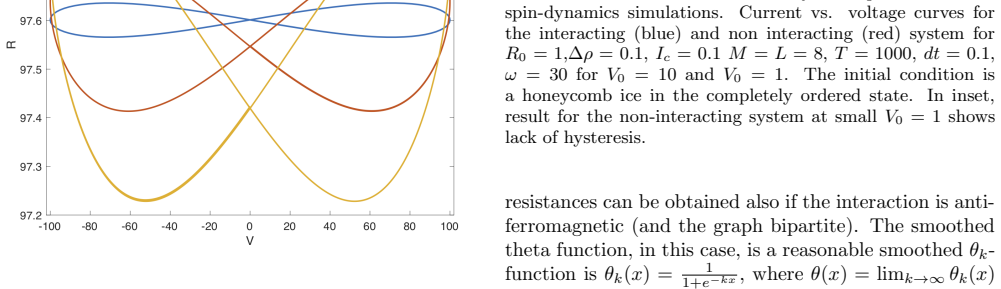
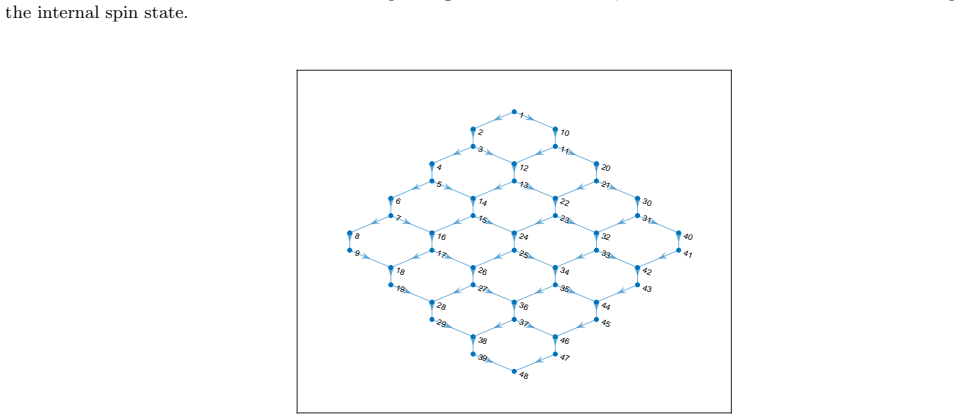
The central claim is that the electric response of a connected artificial spin ice is determined by its spin configuration through the exact relation $R^{-1}=G_0+\Delta\rho\, \mathbf Q^t M(s)\mathbf Q$, where $G_0$ is the field-free conductance, $\Delta\rho$ the anisotropic magnetoresistance coefficient, $\mathbf Q$ a network-dependent vector, and $M(s)$ a matrix built from products $s_i s_j$ of neighboring island moments. This state-dependent conductance changes in time because currents alter the moments: thermally, when Joule heating takes nanoislands close to their superparamagnetic threshold across a sharp or smooth ordering transition, the device resistance switches between a low-temperature and a high-temperature value, making it a magnetic phase-change resistor; athermally, currents above a threshold $I_c$ invert moments along the wires, with the ice rule restricting the allowed vertex configurations in the honeycomb lattice. Numerically integrating the coupled spin-current dynamics yields zero-crossing pinched hysteresis loops in the I-V plane, and the hysteresis area depends on whether the many-body ice-rule constraints are included.
Load-bearing premise
The paper assumes that current flowing through the nanowires can actually flip the magnetic moments—either by heating the islands across their magnetic ordering temperature or by spin-transfer torque above a threshold current—and if that current–moment coupling is too weak at achievable current densities, the resistance cannot change and the memristive effect disappears.
Editorial extensions
If this is right
- A connected artificial spin ice is a resistive memory: reading the conductance through a small voltage reveals the stored magnetic configuration, while a larger current or applied field rewrites it.
- Memristive behavior persists even without ice-rule interactions, but the interactions smooth and enlarge the hysteresis, so the lattice geometry and frustration level are design knobs for the device response.
- In the thermal mechanism, the device behaves as a magnetic phase-change resistor: current-controlled Joule heating moves the material between a low-resistance and a high-resistance phase near its ordering temperature.
- Because anisotropic magnetoresistance contributes only a few percent, the resistive contrast is small yet detectable, and the V-R Lissajous figures can distinguish a sharp phase transition from a smooth crossover as the drive frequency changes.
- The framework provides a path to reprogrammable alternatives to spin-torque and phase-change memristors for unconventional or bio-inspired computing.
Reading between the lines
- Although the paper treats the two switching mechanisms separately, a realistic device could combine them; if so, the hysteresis shape should interpolate between the sharp athermal jumps and the smooth thermal loop as temperature is raised toward the superparamagnetic threshold.
- A concrete prediction the paper leaves implicit is a threshold voltage $V_c$ below which the athermal device is a perfect Ohmic resistor and above which hysteresis appears; measuring $V_c$ as a function of wire resistance would test the domain-wall model directly.
- Extending the same construction to other frustrated lattices, such as square ice or Shakti ice, would yield different $M(s)$ matrices and therefore different pinched-loop shapes, making the memory manifold as designable as the spin-ice geometry itself.
- The quadratic form in Eq. (4) suggests that conductance states are not arbitrary: only those spin configurations allowed by the ice rule are addressable, so the number of distinct memory levels is bounded by the configurational entropy of the lattice.
Signed reviews
Editorial analysis
A structured set of objections, weighed in public.
Referee Report
Summary. Caravelli, Chern, and Nisoli propose that connected artificial spin ice nanowires can function as memristive devices through anisotropic magnetoresistance (AMR). Using a graph-theoretic circuit formalism, they derive the first-order conductance G = G0 + Δρ Q^t M(s) Q, where the state-dependent term is a quadratic form in the magnetic configuration. They then consider two mechanisms that couple current to the spin state: Joule-heating–induced thermal flipping near the superparamagnetic threshold, modeled by a phase-change–like effective resistance (Eq. 5), and an athermal threshold current Ic above which spins invert, simulated on a honeycomb lattice (Fig. 4). Both produce zero-crossing pinched I-V loops, which the authors interpret as memristive memory behavior.
Significance. If the mechanisms are physically realizable, the framework offers a route toward reprogrammable, lattice-designable resistive memory in artificial spin ice, extending previous work on magnetoresistive transport (Chern, Phys. Rev. Applied 8, 064006 (2017)). The derivation of Eq. (4) from standard circuit theory and the AMR law is clean, and the explicit construction of M(s) for Kagome ice in the Supplementary Material is a useful addition. The paper is also honest about its assumptions: it explicitly labels the thermal mechanism as a posit and the athermal switching as an effective model. However, the significance is currently limited by the lack of physical parameter estimates and by a dimensional inconsistency in the thermal effective-resistance formula, which compromise the quantitative claims.
major comments (3)
- [Main text, section 'Another mechanism for moment inversion...' and Fig. 4] The athermal memristive response is a direct consequence of the assumed threshold rule, not a derived consequence of spin-transfer-torque physics. The rule that a wire current above Ic inverts the spin, restricted to ice-rule-valid vertices, is implemented ad hoc; Ic is quoted only in arbitrary units (Ic=0.1, R0=1, V0=10). Without a mapping of the simulated currents to current densities in permalloy nanowires and a comparison with domain-wall depinning thresholds and electromigration damage limits, the predicted pinched hysteresis in Fig. 4 is not tied to observable conditions. This is load-bearing because the central claim of memristive behavior in the athermal case depends entirely on this rule.
- [Eqs. (5) and (6); SM Eqs. (35)–(37)] The thermal effective-resistance formula, Eq. (5), is dimensionally inconsistent as written. In Eq. (6), R< and R> are defined as R< = Q·M< Q and R> = Q·M> Q, and from the conductance formula (SM Eq. (14)) the quantity Q^t M Q has dimensions of conductance divided by Δρ (with Q of dimension inverse resistance), not of resistance. Therefore the terms θ_k(T−Tc) R_<^{-2} and θ_k(Tc−T) R_>^{-2} have dimensions of resistance^4 and cannot be added to R_0^{-1}. This invalidates the quantitative form of the thermal phase-change model in both Eq. (5) and the crossover version in Eq. (7). The authors should redefine R< and R> as true resistances, or rewrite Eq. (5) with terms that have the correct dimensions of conductance.
- [Introduction/Mechanism and SM Eq. (29)] The thermal mechanism is proposed only as a posit: 'We posit that if the nanoislands are close enough to the superparamagnetic threshold they can become thermally active due to the Joule effect.' The heat-balance model, SM Eq. (29), introduces parameters C_v m and σ without numerical estimates for permalloy or a check that Joule heating at safe current densities can drive islands across the superparamagnetic threshold. Consequently, the thermal memristive hysteresis in SM Fig. 8 is a demonstration within a model, not a quantitative prediction. This concern is separate from the dimensional issue in Eq. (5) and needs an order-of-magnitude assessment.
minor comments (5)
- [Throughout] The manuscript contains numerous typos and grammatical errors, including 'resistence', 'teh Joule effect', 'incorporetates', 'reminishent', 'heach whire', and 'voltage on voltage on a node must be zero'. A thorough proofreading pass is needed.
- [SM, after Eq. (38)] The reference for the 'thermal memristor framework' is left as '[ ? ]'; it should be filled in, presumably Yang et al. (ref. [53] of the main text).
- [Fig. 3 caption] The caption states 'We plot in particular R/R0 but for R0 = 1 and in units in which V0 = 1', which is unclear about the normalization of the vertical and horizontal axes; please specify the plotted quantity explicitly.
- [Abstract] The phrase 'a current-dependent effect dynamic resistive state' is ungrammatical and should read 'a current-dependent dynamic resistive state'.
- [Main text, near Eq. (5)] The notation R< and R> is confusing because, as defined in Eq. (6), these are quadratic forms with dimensions of conductance squared, not resistances; the naming obscures the dimensional issue raised in the major comments.
Circularity Check
No material circularity: the state-dependent conductance is derived in-paper from AMR and circuit theory, and the switching rules are transparent model inputs rather than fitted or self-cited predictions.
full rationale
The substantive derivation is Eq. (4): G = G0 + Δρ Q^t M(s) Q, obtained in SM-C/SM-D from the AMR constitutive relation, Kirchhoff laws, and a linearization in Δρ. This relation between spin configuration and conductance is independent of the switching dynamics and is not equivalent to any input assumption; it is derived, not posited. The current-dependent mechanisms are explicitly introduced as assumptions: the thermal mechanism is introduced with 'We posit that if the nanoislands are close enough to the superparamagnetic threshold they can become thermally active due to the Joule effect', and the athermal mechanism is introduced with 'This phenomenon can be effectively modeled in our system by assuming that if the current in a wire is higher than a certain threshold Ic, then the spin along that wire is inverted'. These rules are grounded in external experimental citations for current-induced domain-wall motion, not fitted to the paper's own outputs, and the paper does not claim to derive spin-transfer physics from first principles. The simulated pinched hysteresis follows from those assumed rules, but the paper presents the simulation as an exploration of consequences rather than as an empirical validation or as an independent prediction of the switching mechanism. The main self-citation is [52], used for the vertex-voltage mapping; however, the supplementary material re-derives the needed mapping from Eq. (2), so that citation is not load-bearing. Separate from circularity, Eq. (5) has an apparent dimensional inconsistency (R< and R> are defined as conductance-dimensioned quadratic forms yet appear as R^{-2}), but this is a technical correctness issue rather than a circularity of the derivation chain.
Assumptions & free parameters
free parameters (4)
- AMR coefficient Δρ =
0.1 in simulations
- switching threshold current Ic =
0.1
- crossover sharpness k in θ_k =
1 (Fig. 3)
- thermal model coefficients (C_v m, σ)
assumptions (5)
- standard math Kirchhoff's law circuit solution i = -A^T (A R A^T)^{-1} A V (Eq. 3) is valid for the resistor network with voltage sources.
- domain assumption Anisotropic magnetoresistance law E = ρ0 J + (ρ|| - ρ⊥) m(m·J) (Eq. 1) applies to permalloy nanowires.
- domain assumption Boundary voltage generators can be set to zero by the orientation prescription in SM-B.
- ad hoc to paper Magnetization dynamics are governed either by Metropolis flips with ferromagnetic coupling and Joule-heating temperature (Eqs. 27-29) or by instantaneous threshold spin inversion above Ic.
- domain assumption The ice-rule constraint restricts spin flips to vertices with magnetic charge Q = ±1.
Cite this review
Pith. "Pith review of Artificial Spin Ice Phase-Change Memory Resistors." pith.science (2026). https://pith.science/paper/Z6ANBL5B
@misc{pith2026190808073,
  author       = {Pith},
  title        = {Pith review of: Artificial Spin Ice Phase-Change Memory Resistors},
  year         = {2026},
  howpublished = {\url{https://pith.science/paper/Z6ANBL5B}},
  note         = {Machine review of arXiv:1908.08073}
}
read the original abstract
We study the implications of the anisotropic magnetic resistance on permalloy nanowires, and in particular on the property of the resistance depending on the type of lattice. We discuss how the internal spin configuration of artificial spin ice nanowires can affect their effective resistive state, and which mechanisms can introduce a current-dependent effect dynamic resistive state. We discuss a spin-induced thermal phase-change mechanism, and an athermal domain-wall spin inversion. In both cases we observe memory behavior reminiscent of a memristor, with an I-V hysteretic pinched behavior.
Figures


Figures from the paper (10 more)




Reference graph
Works this paper leans on
-
[1]
The internal currents depend on the voltage, which in turn depends on the spin configuration within the mate- rial, and linearly in the currents as from eqn. (2). Then, a self-consistent nonlinear equation for the voltages can be obtained. Since the anisotropic magnetoresistance is a small effect (it contributes 3-5% on the material re- sistance) we can lin...
-
[2]
R. F. Wang et al., Nature 439(7074):303-6, (2006)
work page 2006
- [3]
- [4]
- [5]
- [6]
-
[7]
L. J. Heyderman, R. L. Stamps, J. of Phys.: Condensed Matter, 25(36):363201 (2013)
work page 2013
- [8]
Show all 71 references
-
[9]
IA Chioar, et al., Phys. Rev. B, 93(21):214410 (2016). Nature, 540(7633):410-413 (2016)
2016
-
[10]
Nisoli, V
C. Nisoli, V. Kapaklis, P. Schiffer, Nature Phys.13(3):200-203 (2017)
2017
-
[11]
Nisoli et al., Phys
C. Nisoli et al., Phys. Rev. Lett., 105(4):047205 (2010)
2010
-
[12]
V. S. Bhat et al., Phys. Rev. Lett. 111(7):077201 (2013)
2013
-
[13]
Gilbert et al., Nat Phys
I. Gilbert et al., Nat Phys. 10(9):670-675 (2014) 5
2014
-
[14]
Tierno, Phys Rev
P. Tierno, Phys Rev. Lett. 116(3):038303 (2016)
2016
-
[15]
Ortiz-Ambriz, P
A. Ortiz-Ambriz, P. Tierno, Nature Comm. 7 (2016)
2016
-
[16]
M. L. Latimer et al., Phys. Rev. Lett., 111:067001 (2013)
2013
-
[17]
Loehr, A
J. Loehr, A. Ortiz-Ambriz, P. Tierno. Phys. Rev. Lett. 117(16):168001 (2016)
2016
-
[18]
Li et al.,Small 14, 1800868 (2018)
Z. Li et al.,Small 14, 1800868 (2018)
2018
-
[19]
J. C. Gartside et al., Nature Nano., 13(1):53-58 (2018)
2018
-
[20]
Castelnovo et al.,Annu
C. Castelnovo et al.,Annu. Rev. Condens. Matter Phys., 3(1):35-55 (2012)
2012
-
[21]
Wang et al., Science, 352(6288):962966, 2016
Y.-L. Wang et al., Science, 352(6288):962966, 2016
2016
-
[22]
Lao et al., Nature Phys
Y. Lao et al., Nature Phys. 14 (2009)
2009
-
[23]
Mengotti et al., Nat
E. Mengotti et al., Nat. Phys., 7(1):68-74 (2010)
2010
-
[24]
Gliga, et al., Phys
S. Gliga, et al., Phys. Rev. Lett, 110(11):117205 (2013)
2013
-
[25]
Chern, P
G.-W. Chern, P. Mellado, EPL 114 (3): 37004 (2016)
2016
-
[26]
P. E. Lammert et al., Nat. Phys., 6(10):786-789 (2010)
2010
-
[27]
Gilbert et al., Phys
I. Gilbert et al., Phys. Rev. B, 92(10):104417 (2015)
2015
-
[28]
Arava et al, Nanotechnology 29, no
H. Arava et al, Nanotechnology 29, no. 26 265205 (2018)
2018
- [29]
-
[30]
S. A. Wolf et al., Science 294(5546):1488-1495 (2001)
2001
-
[31]
J. H. Hensen, E. Folven, G. Tufte, Proc. of ALIFE 2018, pp. 15-22, MIT Press, 10.1162/isal-a-00011 (2018)
2018 doi
-
[32]
Patra, S
M. Patra, S. K. Maiti, Eur. Phys. Lett. 121(38004), (2018)
2018
-
[33]
Ney et al., Nature 425(6957): 485-7 (2003)
A. Ney et al., Nature 425(6957): 485-7 (2003)
2003
-
[34]
F. L. Traversa et al., Science Advances 1 (6), e1500031 (2015)
2015
-
[35]
Zhang, IEEE in Design, Automation and Test in Europe Conference and Exhibition, 10.7873/DATE.2014.316 (2014)
Y. Zhang, IEEE in Design, Automation and Test in Europe Conference and Exhibition, 10.7873/DATE.2014.316 (2014)
2014 doi
-
[36]
Manukian et al.,IEEE Trans Neural Netw Learn Syst
H. Manukian et al.,IEEE Trans Neural Netw Learn Syst. (2017)
2017
-
[37]
F. L. Traversa, M. Di Ventra, Chaos 27, 023107 (2017)
2017
-
[39]
Traversa, M
F. Traversa, M. Di Ventra, J. App. Phys.,123 (2018)
2018
-
[40]
Ielmini, H.-S
D. Ielmini, H.-S. P. Wong, Nature Electronics 1, 333-343 (2018)
2018
-
[41]
Caravelli, Entropy 21(8), 789 (2019)
F. Caravelli, Entropy 21(8), 789 (2019)
2019
-
[42]
Caravelli, J
F. Caravelli, J. P. Carbajal, Technologies 2018, 6(4), 118; engrXiv preprint:c4qr9
2018
-
[43]
Di Ventra, Y
M. Di Ventra, Y. V. Pershin, Nature Phys. 9, 200-202 (2013)
2013
-
[44]
Serrano-Gotarredona et al., Front
T. Serrano-Gotarredona et al., Front. Neurosci. 7: 2 (2013) https://doi.org/10.3389/fnins.2013.00002
2013
-
[45]
D. S. Jeong et al, Adv. Electron. Mater., 2: 1600090. (2016)
2016
-
[46]
Csaba, et al., IEEE Trans
G. Csaba, et al., IEEE Trans. on Nano., 99(4), 2009 (2003)
2003
-
[47]
Imre et al., Science, 311 (5758) 205-208, (2006)
A. Imre et al., Science, 311 (5758) 205-208, (2006)
2006
-
[48]
M. T. Niemier et al., J. of Phys.: Condensed Matter, 23(49), 493202 (2011)
2011
-
[49]
Gonellia, et al., J
M. Gonellia, et al., J. of Mag. and Mag. Mat. 460, 432 (2018)
2018
-
[50]
T. R. McGuire and R. I. Potter,IEEE Trans. Magnetics 11, 1018 (1975)
1975
-
[51]
Le, et al
B. Le, et al. Phys. Rev. B 95, 060405(R) (2017)
2017
-
[52]
Chern, Phys
G.-W. Chern, Phys. Rev. Applied 8,064006 (2017)
2017
-
[53]
W. R. Branford et al.,Science 335(6076), pp. 1597-1600 (2012)
2012
-
[54]
We thus consider for simplicity instantaneous inversion
the switching is extremely fast. We thus consider for simplicity instantaneous inversion. We account for the manybody interaction among spins by imposing constraints on the possible vertex config- urations. Honeycomb spin ice [52, 58, 59, 63] is frus- trated and at low energy e...
-
[55]
F. Yang, M. P. Gordon, J. J. Urban,J. of App. Phys. 125, 025109 (2019)
2019
-
[56]
Yamaguchi et al., Phys
A. Yamaguchi et al., Phys. Rev. Lett. 92(7), 077205-4 (2004)
2004
-
[57]
Krishnia, I
S. Krishnia, I. Purnama, W. S. Lew, J. Mag. Mag. Ma- terials 420 (2016) 158-165,
2016
-
[58]
Vernier et al, Eur
N. Vernier et al, Eur. Phys. Lett. 65(526), 2004
2004
-
[59]
Pushp et al., Nature Phys
A. Pushp et al., Nature Phys. volume 9, pages 505511 (2013)
2013
-
[60]
Y. Qi, T. Brintlinger, J. Cumings Phys. Rev. B 77, 094418 (2008)
2008
-
[61]
Zhang et al, Nature 500, pages 553557 (2013)
S. Zhang et al, Nature 500, pages 553557 (2013)
2013
-
[63]
Caravelli, Phys
F. Caravelli, Phys. Rev. E 96(5) (2017)
2017
-
[64]
Caravelli Int
F. Caravelli Int. J. of Par., Em. and Dist. Sys., 33:4, pp. 350-366, (2018)
2018
-
[65]
Chern, O
G.-W. Chern, O. Tchernyshyov,Phil. Trans. Roy. Soc. A 370, 5718 (2012)
2012
-
[66]
F. C. Sheldon, M. Di Ventra, Phys. Rev. E 95(1), 2017
2017
-
[67]
Locatelli, V
N. Locatelli, V. Cros, J. Grollier, Nature Materials, 13, 11 (2014)
2014
-
[68]
Raoux, F
S. Raoux, F. Xiong , M. Wuttig, E. Pop, MRS Bulletin 39, pp. 703-710 (2014)
2014
-
[69]
Stiles, J
M. Stiles, J. Miltat, B. Hillebrands, A. Thiaville (Eds.): Spin Dynamics in Confined Magnetic Structures III, Top- ics Appl. Physics 101, 225308 (2006) (Springer-Verlag Berlin Heidelberg 2006) Artificial Spin Ice Phase-Change Memory Resistors: Supplementary Material Francesco Ca...
2006 arXiv
-
[70]
We define also Vβ,i The goal of this section is to derive the voltages Vβ,z based on the configuration of the spins, which as we will see is connected to the voltages Ei β1,β2 below
Let us call Fi the number of resistances attached to the node ni, which in graph theory is commonly called degree. We define also Vβ,i The goal of this section is to derive the voltages Vβ,z based on the configuration of the spins, which as we will see is connected to the voltag...
-
[71]
Bollobas, Modern Graph Theory, Springer Science, New York (1998)
B. Bollobas, Modern Graph Theory, Springer Science, New York (1998)
1998
-
[72]
Caravelli, F
F. Caravelli, F. L. Traversa, M. Di Ventra,Phys. Rev. E 95, 022140 (2017)
2017
-
[73]
Chern, Phys
G.-W. Chern, Phys. Rev. Applied 8,064006 (2017) 12 FIG. 9. Lissajous figure for the resistance as a function of the voltage for a sharp ordering transition ( k = ∞), for a sinusoidal input and as a function of the frequency of functional form V = V0 sin(ωt)
2017
Reviewed August 14, 2026 · model on record in the stance chip above.
Discussion (0). Continue with ORCID to comment.