Spin-dependent neutrino oscillations in torsion backgrounds: A quantum-field-theoretic analysis
Pith reviewed 2026-06-25 20:30 UTC · model grok-4.3
The pith
Constant spatial torsion splits neutrino spin states and changes both oscillation frequencies and amplitudes in quantum field theory.
A machine-rendered reading of the paper's core claim, the machinery that carries it, and where it could break.
Core claim
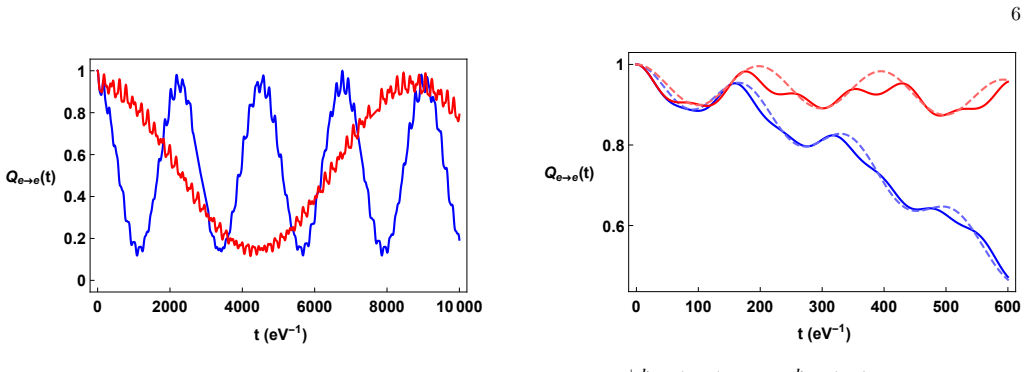
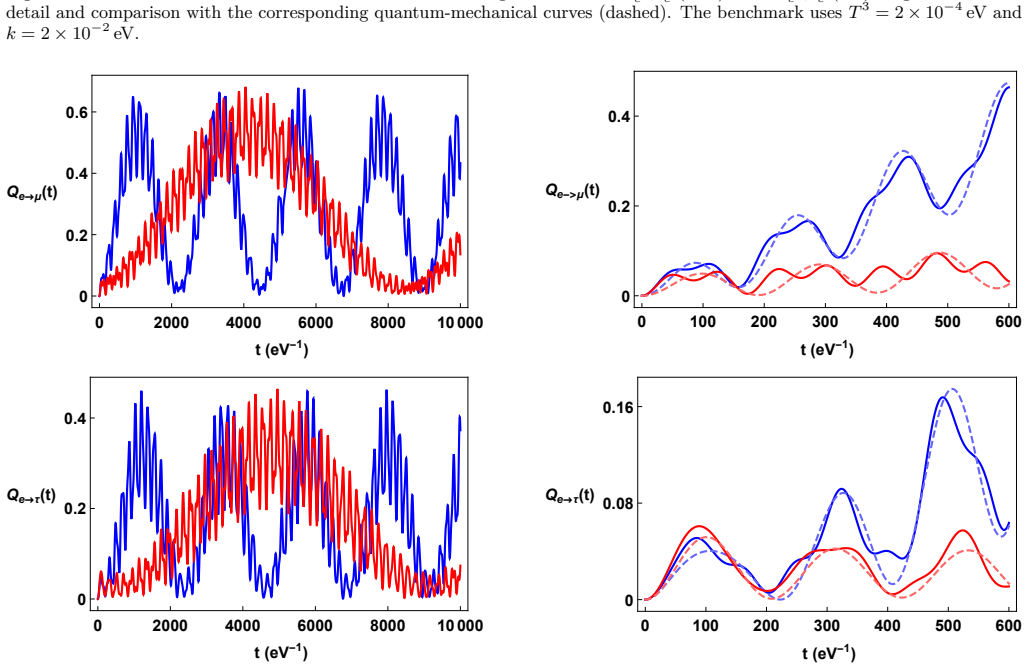
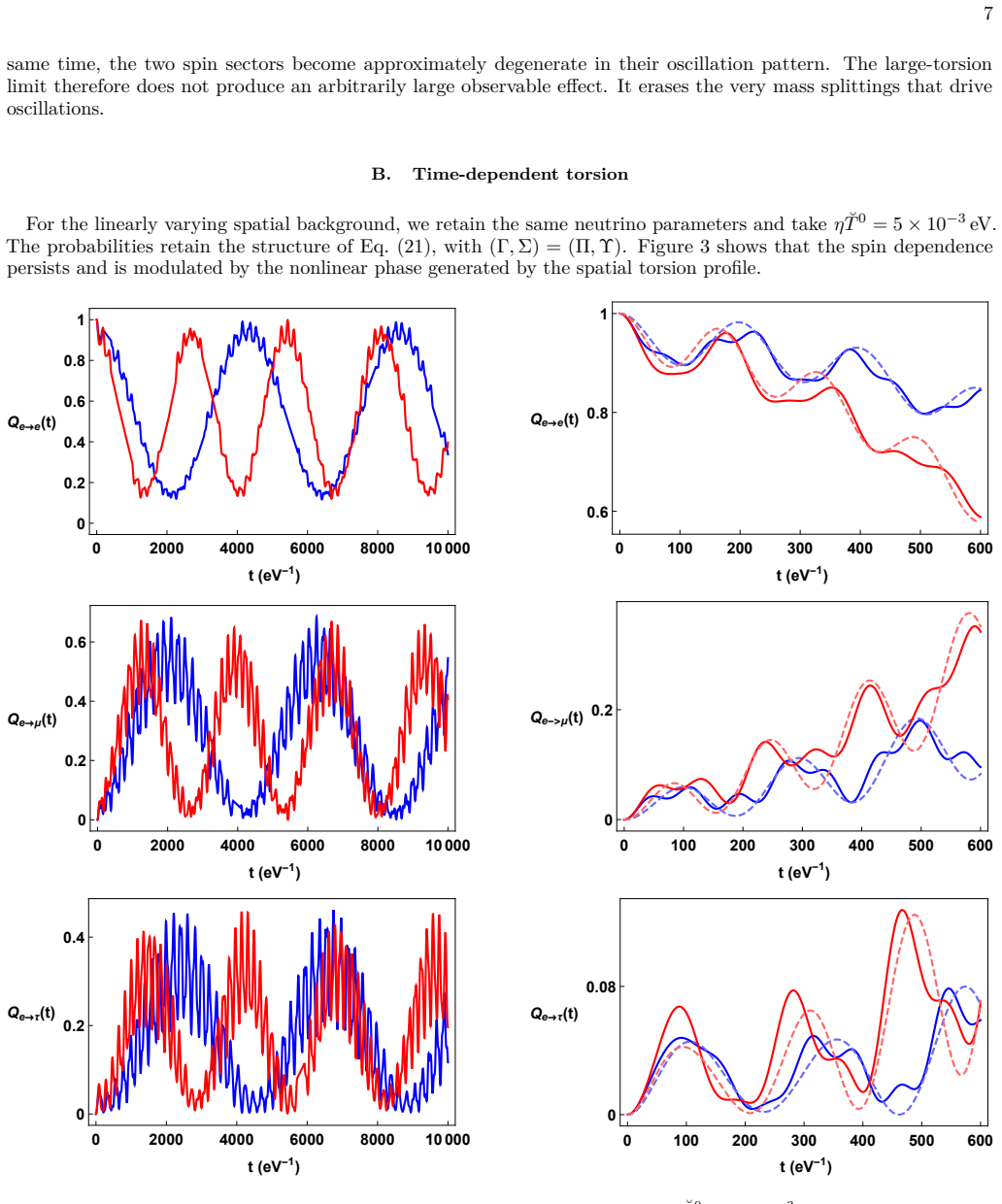
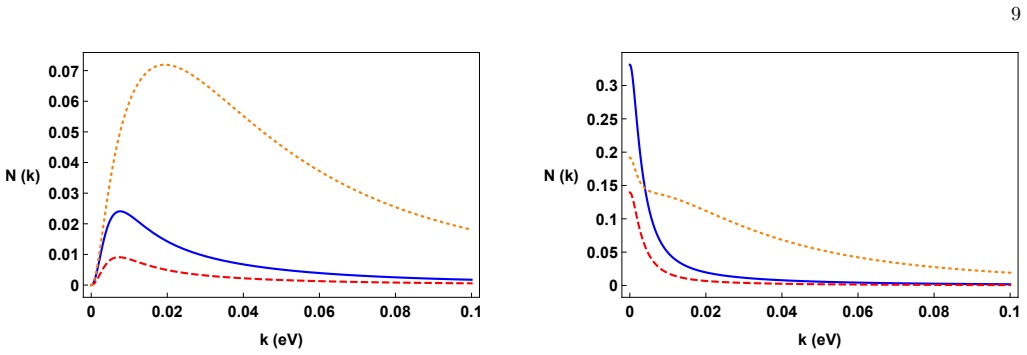
In the Einstein-Cartan framework with curvature neglected, quantizing Dirac fields in constant and linearly time-dependent axial-torsion backgrounds shows that a constant spatial torsion lifts spin degeneracy through spin-dependent effective masses and energies. In the quantum-field-theoretic formulation of flavor oscillations this splitting alters both oscillation frequencies and amplitudes, since the Bogoliubov coefficients entering the flavor operators depend on spin. The effect peaks at low momentum when the torsion scale matches the neutrino masses, while dominant torsion suppresses relative mass splittings and can inhibit flavor conversion; spin dependence also appears in the Dirac CP
What carries the argument
Spin-dependent Bogoliubov coefficients arising when Dirac fields are quantized in axial-torsion backgrounds and used to construct the flavor operators.
If this is right
- Oscillation amplitudes become spin-dependent in addition to the frequencies.
- Dominant torsion suppresses flavor conversion by reducing relative mass splittings.
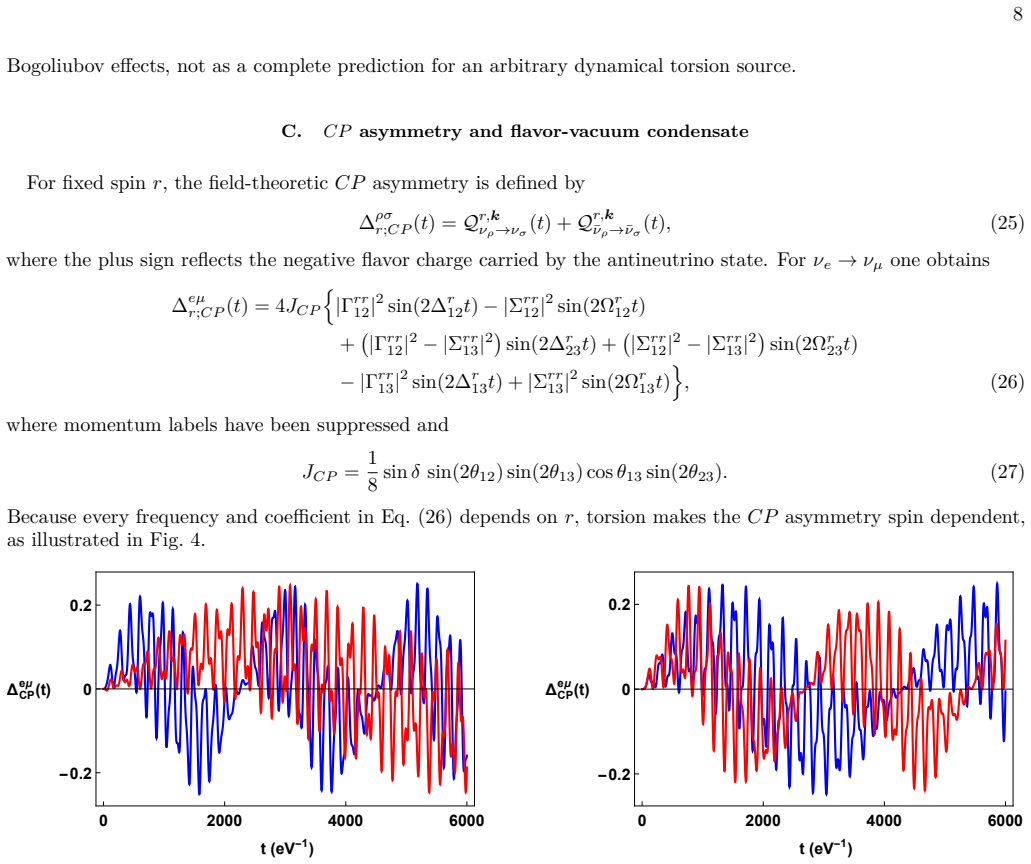
- The Dirac CP asymmetry acquires a spin dependence.
- Condensate densities in the flavor vacuum vary with spin.
- The difference between field-theoretic and quantum-mechanical descriptions is largest for nonrelativistic neutrinos.
Where Pith is reading between the lines
- Torsion-induced spin effects could appear in environments where modified gravity allows nonzero torsion, such as early-universe or dense-matter settings.
- Low-momentum neutrino beams might be used to search for or bound torsion parameters through altered oscillation patterns.
- The spin dependence suggests possible connections to polarization observables in neutrino propagation.
Load-bearing premise
Curvature can be neglected while the axial torsion is treated as constant or linearly time-dependent when quantizing the Dirac fields.
What would settle it
A measurement of neutrino flavor-conversion probabilities that depend on spin orientation in a manner matching the torsion-modified Bogoliubov coefficients but not standard quantum-mechanical oscillation formulas.
Figures
read the original abstract
We study neutrino mixing in a background with spacetime torsion within the quantum-field-theoretic formulation of flavor oscillations. Working in the Einstein--Cartan framework and neglecting curvature, we quantize Dirac fields in constant and linearly time-dependent axial-torsion backgrounds. A constant spatial torsion component lifts the degeneracy between the two spin orientations through spin-dependent effective masses and energies. In quantum field theory this splitting modifies not only the oscillation frequencies but also the amplitudes, because the Bogoliubov coefficients entering the flavor operators depend on spin. The effect is largest at low momentum when the torsion scale is comparable to the neutrino masses, while a dominant torsion term suppresses the relative mass splittings and can inhibit flavor conversion. We also discuss the induced spin dependence of the Dirac $CP$ asymmetry and of the condensate densities in the flavor vacuum. The results identify nonrelativistic neutrinos as the natural regime in which the difference between the field-theoretic and quantum-mechanical descriptions is most pronounced.
Editorial analysis
A structured set of objections, weighed in public.
Referee Report
Summary. The paper claims that within the Einstein-Cartan framework (neglecting curvature), quantizing Dirac fields in constant and linearly time-dependent axial-torsion backgrounds produces spin-dependent effective masses and energies from a constant spatial torsion component. This splitting enters the Bogoliubov coefficients of the flavor operators, modifying both oscillation frequencies and amplitudes in a spin-dependent manner. The effect is largest at low momentum when the torsion scale is comparable to neutrino masses; a dominant torsion term suppresses relative mass splittings and can inhibit conversion. The analysis further identifies spin dependence in the Dirac CP asymmetry and in the condensate densities of the flavor vacuum, with the largest deviation from the quantum-mechanical description occurring for nonrelativistic neutrinos.
Significance. If the central derivation holds, the work supplies a concrete, parameter-free illustration of how torsion-induced spin splitting propagates from the modified Dirac dispersion into the flavor vacuum structure via Bogoliubov transformations. This distinguishes the QFT treatment from standard quantum-mechanical oscillation formulas precisely in the low-momentum regime and supplies falsifiable signatures (spin-dependent amplitudes and condensates) that could be tested in future phenomenological studies of neutrinos in modified-gravity or early-universe settings.
major comments (1)
- [§3] §3 (mode solutions and Bogoliubov coefficients): the central claim that spin-dependent effective masses modify the oscillation amplitudes rests on the explicit spin dependence of the Bogoliubov coefficients; the manuscript must display the overlap integrals or the resulting coefficient expressions for the constant-torsion case so that readers can confirm the amplitude modification is not merely a frequency shift.
minor comments (2)
- [Abstract] Abstract: the assertion that 'a dominant torsion term suppresses the relative mass splittings' should be tied to a specific equation or limiting expression so the mechanism is immediately visible.
- Notation: the axial torsion vector and its constant versus linearly time-dependent components should be introduced with a single, consistently used symbol and dimension statement to prevent confusion between the two cases.
Simulated Author's Rebuttal
We thank the referee for the positive assessment and the recommendation for minor revision. The single major comment is addressed below by agreeing to include the requested explicit expressions.
read point-by-point responses
-
Referee: [§3] §3 (mode solutions and Bogoliubov coefficients): the central claim that spin-dependent effective masses modify the oscillation amplitudes rests on the explicit spin dependence of the Bogoliubov coefficients; the manuscript must display the overlap integrals or the resulting coefficient expressions for the constant-torsion case so that readers can confirm the amplitude modification is not merely a frequency shift.
Authors: We agree that the explicit forms are needed for clarity. In the revised manuscript we will insert the overlap integrals between the mode solutions and the resulting spin-dependent Bogoliubov coefficients for the constant spatial torsion background directly into §3. These expressions will show that the coefficients acquire an explicit spin dependence through the torsion-induced effective masses, thereby modifying the oscillation amplitudes in addition to the frequencies. revision: yes
Circularity Check
No significant circularity; derivation is self-contained
full rationale
The paper performs a standard quantization of Dirac fields in prescribed constant and linearly time-dependent axial-torsion backgrounds (neglecting curvature) within the Einstein-Cartan framework. It derives spin-dependent effective masses, energies, Bogoliubov coefficients, oscillation frequencies/amplitudes, CP asymmetry, and condensate densities directly from the modified dispersion relations and mode overlaps. No fitted parameters are renamed as predictions, no self-definitional loops appear, and no load-bearing self-citations or uniqueness theorems are invoked to force the central results. The construction begins from the Dirac equation in the given background and produces the claimed spin-dependent effects without reduction to inputs by construction.
Axiom & Free-Parameter Ledger
axioms (2)
- domain assumption Einstein-Cartan framework with torsion but neglecting curvature
- domain assumption Quantization of Dirac fields in constant and linearly time-dependent axial-torsion backgrounds
Reference graph
Works this paper leans on
-
[1]
S. Capozziello and M. De Laurentis, Extended Theories of Gravity, Phys. Rept.509, 167 (2011), arXiv:1108.6266 [gr-qc]
Pith/arXiv arXiv 2011
-
[2]
Brans and R
C. Brans and R. H. Dicke, Mach’s principle and a relativistic theory of gravitation, Phys. Rev.124, 925 (1961)
1961
-
[3]
Quiros, Selected topics in scalar–tensor theories and beyond, Int
I. Quiros, Selected topics in scalar–tensor theories and beyond, Int. J. Mod. Phys. D28, 1930012 (2019), arXiv:1901.08690 [gr-qc]
Pith/arXiv arXiv 2019
-
[4]
Kobayashi, Horndeski theory and beyond: a review, Rept
T. Kobayashi, Horndeski theory and beyond: a review, Rept. Prog. Phys.82, 086901 (2019), arXiv:1901.07183 [gr-qc]
Pith/arXiv arXiv 2019
-
[5]
S. Capozziello and S. Vignolo, Metric-affinef(R)-gravity with torsion: An overview, Annalen der Physik19, 238 (2010), arXiv:0910.5230 [gr-qc]
Pith/arXiv arXiv 2010
-
[6]
S. Capozziello, T. Harko, T. S. Koivisto, F. S. N. Lobo, and G. J. Olmo, Hybrid metric-palatini gravity, Universe1, 199 (2015), arXiv:1508.04641 [gr-qc]
Pith/arXiv arXiv 2015
-
[7]
Y.-F. Cai, S. Capozziello, M. De Laurentis, and E. N. Saridakis,f(T)teleparallel gravity and cosmology, Reports on Progress in Physics79, 106901 (2016), arXiv:1511.07586 [gr-qc]
Pith/arXiv arXiv 2016
-
[8]
Capozziello, V
S. Capozziello, V. De Falco, and C. Ferrara, Comparing equivalent gravities: Common features and differences, European Physical Journal C82, 865 (2022)
2022
-
[9]
S. Capozziello, S. Cesare, and C. Ferrara, Extended geometric trinity of gravity, European Physical Journal C85, 932 (2025), arXiv:2503.08167 [gr-qc]
arXiv 2025
-
[10]
C. Mancini, G. M. Tino, and S. Capozziello, Equivalent gravities and equivalence principle: Foundations and experimental implications, Foundations of Physics55, 69 (2025), arXiv:2501.06487 [gr-qc]. 10
arXiv 2025
-
[11]
F. W. Hehl, P. Von Der Heyde, G. D. Kerlick, and J. M. Nester, General Relativity with Spin and Torsion: Foundations and Prospects, Rev. Mod. Phys.48, 393 (1976)
1976
-
[12]
I. L. Shapiro, Physical aspects of the space-time torsion, Phys. Rept.357, 113 (2002), arXiv:hep-th/0103093
Pith/arXiv arXiv 2002
- [13]
-
[14]
Julio Cirilo-Lombardo, Fermion helicity flip and fermion oscillation induced by dynamical torsion field, EPL127, 10002 (2019)
D. Julio Cirilo-Lombardo, Fermion helicity flip and fermion oscillation induced by dynamical torsion field, EPL127, 10002 (2019)
2019
-
[15]
S. M. Bilenky and B. Pontecorvo, Lepton Mixing and Neutrino Oscillations, Phys. Rept.41, 225 (1978)
1978
-
[16]
S. M. Bilenky and S. T. Petcov, Massive Neutrinos and Neutrino Oscillations, Rev. Mod. Phys.59, 671 (1987), [Erratum: Rev.Mod.Phys. 61, 169 (1989), Erratum: Rev.Mod.Phys. 60, 575–575 (1988)]
1987
-
[17]
Fukudaet al.(Super-Kamiokande), Evidence for oscillation of atmospheric neutrinos, Phys
Y. Fukudaet al.(Super-Kamiokande), Evidence for oscillation of atmospheric neutrinos, Phys. Rev. Lett.81, 1562 (1998), arXiv:hep-ex/9807003
Pith/arXiv arXiv 1998
-
[18]
A. Capolupo, G. Lambiase, and A. Quaranta, Neutrinos in curved spacetime: Particle mixing and flavor oscillations, Physical Review D101, 095022 (2020), arXiv:2003.00516 [hep-th]
arXiv 2020
-
[19]
Capolupo, A
A. Capolupo, A. Quaranta, and R. Serao, Field mixing in curved spacetime and dark matter, Symmetry15, 807 (2023)
2023
-
[20]
M. Blasone and G. Vitiello, Quantum field theory of fermion mixing, Annals Phys.244, 283 (1995), [Erratum: Annals Phys. 249, 363–364 (1996)], arXiv:hep-ph/9501263
Pith/arXiv arXiv 1995
-
[21]
M. Blasone, A. Capolupo, and G. Vitiello, Quantum field theory of three flavor neutrino mixing and oscillations with CP violation, Phys. Rev. D66, 025033 (2002), arXiv:hep-th/0204184
Pith/arXiv arXiv 2002
-
[22]
M. Blasone, A. Capolupo, O. Romei, and G. Vitiello, Quantum field theory of boson mixing, Phys. Rev. D63, 125015 (2001), arXiv:hep-ph/0102048
Pith/arXiv arXiv 2001
- [23]
-
[24]
Capolupo, Dark matter and dark energy induced by condensates, Adv
A. Capolupo, Dark matter and dark energy induced by condensates, Adv. High Energy Phys.2016, 8089142 (2016), arXiv:1608.05407 [hep-th]
Pith/arXiv arXiv 2016
-
[25]
Capolupo, S
A. Capolupo, S. Carloni, and A. Quaranta, Quantum flavor vacuum in the expanding universe: A possible candidate for cosmological dark matter?, Physical Review D105, 105013 (2022)
2022
-
[26]
Capolupo, S
A. Capolupo, S. Monda, G. Pisacane, A. Quaranta, and R. Serao, Dark universe from qft mechanisms and possible experimental probes, Universe11, 142 (2025)
2025
-
[27]
A. Capolupo, S. Capozziello, G. Pisacane, and A. Quaranta, Missing matter in galaxies as a neutrino mixing effect, Physics of the Dark Universe48, 101894 (2025), arXiv:2411.17319 [hep-ph]
arXiv 2025
-
[28]
A. Capolupo and A. Quaranta, Neutrino capture on tritium as a probe of flavor vacuum condensate and dark matter, Physics Letters B839, 137776 (2023), arXiv:2205.09640 [hep-ph]
arXiv 2023
-
[29]
A. Capolupo, G. Pisacane, A. Quaranta, and R. Serao, Single arm interferometry to probe the scalar field dark matter, Phys. Rev. D113, 055027 (2026), arXiv:2505.13574 [hep-ph]
arXiv 2026
-
[30]
A. Capolupo, A. Quaranta, and R. Serao, The impact of theX17 boson on particle physics anomalies: Muon anomalous magnetic moment, Lamb shift andWmass, Phys. Dark Univ.47, 101748 (2025), arXiv:2410.01430 [hep-ph]
arXiv 2025
-
[31]
M. Adak, T. Dereli, and L. H. Ryder, Neutrino oscillations induced by space-time torsion, Class. Quant. Grav.18, 1503 (2001), arXiv:gr-qc/0103046
Pith/arXiv arXiv 2001
-
[32]
L. Fabbri and S. Vignolo, A torsional completion of gravity for Dirac matter fields and its applications to neutrino oscillations, Mod. Phys. Lett. A31, 1650014 (2016), arXiv:1504.03545 [gr-qc]
Pith/arXiv arXiv 2016
-
[33]
Capolupo, G
A. Capolupo, G. De Maria, S. Monda, A. Quaranta, and R. Serao, Quantum field theory of neutrino mixing in spacetimes with torsion, Universe10, 170 (2024)
2024
-
[34]
Spacetime torsion signatures in neutrino oscillation physics
A. Capolupo, S. Monda, G. Pisacane, A. Quaranta, and R. Serao, Spacetime torsion signatures in neutrino oscillation physics, International Journal of Modern Physics A 10.1142/S0217751X26460139 (2026), arXiv:2606.00617 [hep-th]
work page internal anchor Pith review Pith/arXiv arXiv doi:10.1142/s0217751x26460139 2026
-
[35]
M. G. Bettiet al.(PTOLEMY), Neutrino physics with the PTOLEMY project: active neutrino properties and the light sterile case, JCAP07, 047, arXiv:1902.05508 [astro-ph.CO]
arXiv 1902
discussion (0)
Sign in with ORCID, Apple, or X to comment. Anyone can read and Pith papers without signing in.