Spatially heterogeneous noise restructures flocking into geometry-locked and vortex states
Reviewed by Pith T0 review T1 audit T2 compute T3 formal T4 kernel 2026-07-08 19:37 UTCgrok-4.5pith:Z6N7Q2ULrecord.jsonopen to challenge →
The pith
Heterogeneous noise restructures Vicsek flocks into global, geometry-locked, and confined vortex regimes.
A machine-rendered reading of the paper's core claim, the machinery that carries it, and where it could break.
Core claim
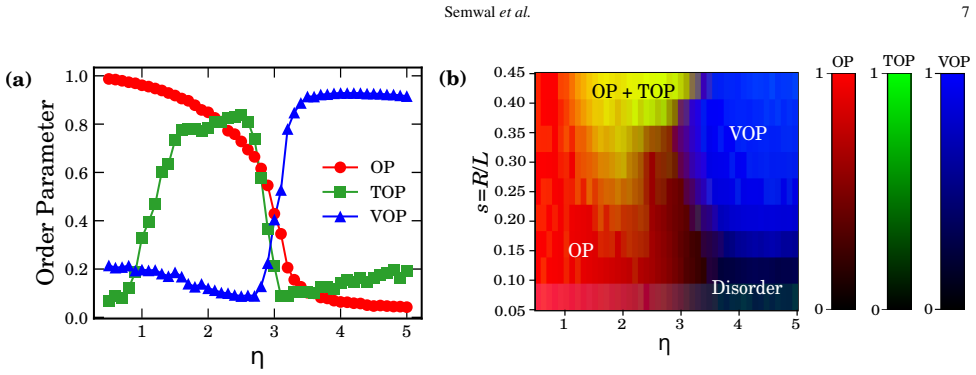
In a Vicsek model containing a circular non-noisy region surrounded by a noisy environment, increasing the exterior noise drives the system through three distinct dynamical regimes: conventional global flocking at low noise, geometry-locked motion aligned with the simulation boundaries at intermediate noise, and vortical motion confined within the non-noisy region at high noise. Multiple non-noisy regions further allow directional coupling in the geometry-locked regime and antiferromagnetic order among the vortices.
What carries the argument
An extended Vicsek model whose only environmental heterogeneity is a step-like spatial contrast in angular noise—a quiet circular disk set in a noisy exterior—creates a contrast in local directional order that restructures flocking as the exterior noise is raised.
If this is right
- Raising exterior noise alone can switch a flock from free collective motion to boundary-locked alignment without changing particle rules.
- At high exterior noise, ordered motion collapses into vortices trapped inside quiet patches.
- Multiple quiet patches can couple their geometry-locked directions or form an antiferromagnetic vortex pattern.
- Spatial patterning of noise therefore supplies a generic control knob for steering active matter into chosen collective states.
- The reported regimes match patterns already seen in experiments with active particles on patterned landscapes.
Where Pith is reading between the lines
- Quiet-island patterning could be used in robotic swarms or colloids to park vortices or lock global headings by design.
- The intermediate geometry-locked state is likely sensitive to container shape, so non-square boundaries should select different preferred directions.
- Elongated or annular quiet regions might split the high-noise regime into counter-rotating pairs or channel-like flows rather than single vortices.
- Combining noise contrast with mild density or speed heterogeneities could stabilize the same states at lower noise thresholds.
Load-bearing premise
The claim rests on the premise that a simple step-like contrast in Vicsek angular noise, with ordinary local alignment and standard simulation boundaries, is enough to produce geometry-locked and vortex states without extra forces, density traps, or motility gradients.
What would settle it
Run Vicsek simulations or equivalent active-particle experiments with a fixed quiet circular region while ramping exterior noise; the claim fails if intermediate noise never produces boundary-aligned global motion, high noise never produces confined vortices, or multi-disk setups never develop antiferromagnetic vortex order.
Figures




read the original abstract
Spatially heterogeneous environments continually challenge the ability of active matter to sustain coherent collective motion. Understanding how collective motion remains robust under changing environments is central to both the functioning of biological systems and the design of smart active matter. Here, we extend the Vicsek model to include a circular non-noisy region surrounded by a noisy environment - a configuration in which the noise difference sets up a contrast in local directional order between the two regions. We find that, as the surrounding noise is increased, the system passes through three distinct dynamical regimes: (i) conventional global flocking at low noise; (ii) geometry-locked motion, aligned with simulation boundaries, at intermediate noise; and (iii) vortical motion within the non-noisy region at high noise. Extending the environment to multiple non-noisy regions, we find that the geometry-locked regime can develop a directional coupling, while the vortex mode leads to antiferromagnetic order between the regions. Taken together, our results demonstrate that the spatial modulation of order and disorder offers a powerful and generic strategy for steering active matter, aligning with recent experimental observations of active particles in patterned landscapes.
Editorial analysis
A structured set of objections, weighed in public.
Referee Report
Summary. The manuscript extends the Vicsek model by placing a circular non-noisy (quiet) disk inside a noisy exterior, so that a spatial contrast in angular noise creates a contrast in local directional order. Numerical simulations are reported to show that raising the exterior noise drives the system through three regimes: (i) conventional global flocking at low exterior noise, (ii) geometry-locked polarization aligned with the simulation-box axes at intermediate noise, and (iii) vortical motion confined to the quiet disk at high noise. With multiple quiet patches the locked regime is said to develop directional coupling while the vortex regime yields antiferromagnetic order between patches. The authors present this as a generic strategy for steering active matter by spatial modulation of order and disorder, with qualitative contact to experiments on patterned landscapes.
Significance. If the three-regime sequence is robust against finite-size and boundary artifacts, the work would supply a minimal, experimentally relevant route to reconfigure flocking states by noise patterning alone, without density traps or motility gradients. The multi-patch directional coupling and antiferromagnetic vortex order are potentially useful emergent responses for design of smart active matter. The narrative is clear and aligns with current experimental motifs. Strengths that would raise impact if present include well-defined order parameters, systematic parameter sweeps, and finite-size checks; those elements are not yet secure enough for the central claim to stand without revision.
major comments (3)
- [Results (geometry-locked / intermediate-noise regime)] The intermediate geometry-locked regime (abstract; Results discussion of intermediate exterior noise) is defined by polarization locked to the simulation-box axes. In the Vicsek model global polarization is a soft Goldstone mode weakly pinned by the C4 anisotropy of a square box (periodic or hard-wall). The quiet disk can act merely as a localized ordered seed that amplifies this pre-existing pinning rather than the circle geometry itself selecting the direction. Without controls that isolate box anisotropy—circular confining boundaries, rotated boxes, or systematic L/R o∞ scaling of locking strength and free-energy barriers—the claim that spatial noise contrast alone produces a distinct bulk geometry-locked regime is unsubstantiated. This is load-bearing for the three-regime narrative and for multi-patch directional coupling that inherits the same locking.
- [Results / Methods (order parameters and phase identification)] The three regimes are identified primarily by snapshots and qualitative polarization directions. A continuous, well-defined order-parameter suite (global polarization magnitude and orientation relative to box axes, local vorticity or circulation inside the quiet disk, and a locking susceptibility) together with finite-size scaling of regime boundaries versus exterior noise, density, and R/L is required to establish that the transitions are sharp and meaningful rather than smooth crossovers or finite-size pinning. Absent these diagnostics the phase diagram remains phenomenological.
- [Results (high-noise vortex and multi-patch sections)] The high-noise vortex is more plausibly interface-driven, yet confinement must be quantified: does the vortex core size and circulation track the quiet-disk radius R independently of system size L, and is the state stable under changes of outer boundary conditions? Without such checks the claim of a distinct third regime, and of antiferromagnetic multi-patch order built on it, remains incomplete.
minor comments (5)
- [Model / Methods] State the full model equations, noise implementation (additive vs. multiplicative angular noise), interaction radius, packing fraction, and precise boundary conditions (periodic vs. hard walls) in one place so that the free-parameter list is unambiguous.
- [Results / Figures] Report statistics (ensemble averages, error bars, run-to-run variance) on polarization and vorticity measurements rather than single-run snapshots.
- [Model] Clarify whether the quiet-disk noise is strictly zero or a small residual value, and whether particles can freely cross the interface; both choices affect the effective interfacial tension.
- [Discussion] Add brief comparison or citation to continuum/hydrodynamic treatments of spatially heterogeneous Vicsek or Toner–Tu models to place the phenomenology in a broader theoretical context.
- [Multi-patch Results / Figures] Multi-patch figures would benefit from explicit arrows or color maps of local polarization and a quantitative measure of inter-patch angular correlation (ferro- vs. antiferromagnetic).
Simulated Author's Rebuttal
We thank the referee for a careful and constructive report. The three major comments correctly identify load-bearing points: (i) whether geometry locking is selected by the quiet-disk noise contrast or by residual C4 box anisotropy, (ii) the need for continuous order parameters and finite-size diagnostics rather than snapshot-based regime assignment, and (iii) quantitative confinement of the high-noise vortex (core size vs R, independence of L and outer BCs) that underpins multi-patch antiferromagnetic order. We agree that these checks were incomplete in the submitted manuscript. We will revise by adding the requested order-parameter suite, finite-size and boundary-condition controls, and explicit tests that isolate box anisotropy from disk geometry. Where a control cannot fully eliminate residual pinning we will state that limitation clearly. Below we answer each major comment point by point.
read point-by-point responses
-
Referee: The intermediate geometry-locked regime is defined by polarization locked to the simulation-box axes. In the Vicsek model global polarization is a soft Goldstone mode weakly pinned by the C4 anisotropy of a square box. The quiet disk can act merely as a localized ordered seed that amplifies this pre-existing pinning rather than the circle geometry itself selecting the direction. Without controls that isolate box anisotropy—circular confining boundaries, rotated boxes, or systematic L/R→∞ scaling of locking strength and free-energy barriers—the claim that spatial noise contrast alone produces a distinct bulk geometry-locked regime is unsubstantiated. This is load-bearing for the three-regime narrative and for multi-patch directional coupling.
Authors: We agree that residual C4 pinning of the Vicsek Goldstone mode is a serious alternative explanation and that the submitted manuscript did not isolate it. The intermediate regime is therefore not yet established as a bulk geometry-locked state selected by the quiet-disk noise contrast alone. In revision we will (1) measure locking strength and free-energy barriers (or orientation histograms / mean residence times) as functions of L/R at fixed density and exterior noise, testing whether locking survives L/R→∞ or collapses as expected for pure box pinning; (2) rotate the square box (or the noise pattern) relative to the axes and check whether the preferred polarization tracks the box or the disk; and (3) where feasible, repeat key runs with circular confining boundaries or larger aspect-ratio domains to suppress C4 anisotropy. If locking persists only when box anisotropy is present, we will reframe the intermediate regime as noise-contrast-amplified box pinning rather than a distinct bulk geometry-locked phase, and we will qualify the multi-patch directional-coupling claim accordingly. If locking remains after these controls, we will present that as evidence that the spatial noise contrast itself stabilizes a preferred orientation. Either outcome will be reported honestly; the three-regime narrative will be revised to match the data. revision: yes
-
Referee: The three regimes are identified primarily by snapshots and qualitative polarization directions. A continuous, well-defined order-parameter suite (global polarization magnitude and orientation relative to box axes, local vorticity or circulation inside the quiet disk, and a locking susceptibility) together with finite-size scaling of regime boundaries versus exterior noise, density, and R/L is required to establish that the transitions are sharp and meaningful rather than smooth crossovers or finite-size pinning. Absent these diagnostics the phase diagram remains phenomenological.
Authors: This criticism is correct. Regime assignment in the submitted text relied too heavily on snapshots and qualitative polarization directions. We will introduce a continuous order-parameter suite: (i) global polarization magnitude |P| and its orientation θ_P relative to the box axes (with a locking order parameter such as ⟨cos(4θ_P)⟩ or equivalent); (ii) local circulation / vorticity integrated over the quiet disk (and, for multi-patch systems, per-patch circulation and relative signs); and (iii) a locking susceptibility (fluctuations of orientation or of the locking order parameter) to locate regime boundaries. We will map these quantities versus exterior noise η_ext, density, and R/L, and perform finite-size scans to test whether boundaries sharpen or drift with L. If the data show only smooth crossovers or strong finite-size pinning, we will describe the sequence as a continuous crossover diagram rather than sharp phase transitions. The revised Results and Methods will define all order parameters explicitly and replace qualitative regime labels with quantitative thresholds or crossover loci supported by the scans. revision: yes
-
Referee: The high-noise vortex is more plausibly interface-driven, yet confinement must be quantified: does the vortex core size and circulation track the quiet-disk radius R independently of system size L, and is the state stable under changes of outer boundary conditions? Without such checks the claim of a distinct third regime, and of antiferromagnetic multi-patch order built on it, remains incomplete.
Authors: We agree that confinement of the high-noise vortex was not quantified and that an interface-driven mechanism is a plausible alternative. In revision we will measure vortex core size (e.g., radius of peak tangential velocity or of the circulation-supporting region) and net circulation as functions of R at fixed L and as functions of L at fixed R, testing whether the core tracks R and remains independent of L once L ≫ R. We will also vary outer boundary conditions (periodic vs hard walls; circular outer domain where practical) and check stability of the single-disk vortex and of multi-patch relative circulation (antiferromagnetic sign structure). If the vortex core fails to track R, depends strongly on L, or collapses under BC changes, we will reclassify the high-noise state as interface- or boundary-dominated rather than a bulk quiet-disk vortex regime, and we will qualify or withdraw the claim that multi-patch antiferromagnetic order is built on a robust third regime. If the diagnostics support R-locked, L-independent circulation that is stable under outer BC changes, we will present those data as the quantitative basis for the third regime and for the multi-patch order. The abstract and conclusions will be aligned with whichever outcome the controls yield. revision: yes
Circularity Check
No significant circularity: forward Vicsek simulations with imposed noise contrast; regimes are observed outcomes, not fitted or definitionally forced predictions.
full rationale
The paper extends the standard Vicsek model by imposing a step-like spatial contrast in angular noise (quiet circular disk vs noisy exterior) and reports three dynamical regimes from direct simulation as surrounding noise is varied: global flocking, geometry-locked boundary-aligned motion, and confined vortical motion, plus multi-patch coupling/antiferromagnetic order. These are forward computational observations of an explicitly defined model, not analytic first-principles derivations that reduce to their inputs by construction. There is no parameter fitted to a data subset and then re-presented as an independent prediction of a closely related quantity; no self-definitional loop equating an output to its defining input; no load-bearing uniqueness theorem imported from the authors’ prior work; and no ansatz smuggled in via self-citation that forces the central regimes. Alignment with “recent experimental observations of active particles in patterned landscapes” is stated as consistency, not as circular fitting of the reported regimes. Finite-size pinning of the intermediate geometry-locked state to the simulation box is a legitimate correctness/robustness concern, but it is not circularity under the enumerated patterns. The derivation chain is therefore self-contained simulation of an imposed model against external benchmarks of collective-motion phenomenology; score 0 is the honest finding.
Axiom & Free-Parameter Ledger
free parameters (4)
- surrounding (exterior) noise strength
- interior (non-noisy region) noise strength
- particle density / packing
- interaction radius and quiet-disk radius / system size
axioms (3)
- domain assumption Particles update orientation by local Vicsek-style neighbor averaging plus angular noise.
- domain assumption Noise strength can be prescribed as a fixed spatial field (quiet disk, noisy exterior) independent of density and velocity.
- domain assumption Simulation boundaries (periodic or confining) and finite box geometry can lock global orientation in the intermediate-noise regime.
Reference graph
Works this paper leans on
-
[1]
Bechingeret al.,Active particles in complex and crowded environments, Rev
C. Bechingeret al.,Active particles in complex and crowded environments, Rev. Mod. Phys.88(2016) 045006
work page 2016
-
[2]
G. Jacucciet al.,Patchy energy landscapes promote stability of small groups of active particles, Communications Physics7(2024) 245
work page 2024
- [3]
-
[4]
O. Chepizhko, E. G. Altmann, and F. Peruani,Optimal noise maximizes collective motion in heterogeneous media, Phys. Rev. Lett.110(2013) 238101
work page 2013
-
[5]
D. Vahabli and T. Vicsek,Emergence of synchronised rotations in dense active matter with disorder, Communications Physics6 (2023) 56
work page 2023
- [6]
-
[7]
H. Wioland, E. Lushi, and R. E. Goldstein,Directed collective motion of bacteria under channel confinement, New Journal of Physics18(2016) 075002
work page 2016
-
[8]
M. Theillard, R. Alonso-Matilla, and D. Saintillan,Geometric control of active collective motion, Soft Matter13(2017) 363
work page 2017
-
[9]
K. J. Modica, A. K. Omar, and S. C. Takatori,Boundary design regulates the diffusion of active matter in heterogeneous environ- ments, Soft Matter19(2023) 1890
work page 2023
-
[10]
C. W. Breuner, R. S. Sprague, S. H. Patterson, and H. A. Woods,Environment, behavior and physiology: do birds use barometric pressure to predict storms?, Journal of Experimental Biology216(2013) 1982
work page 2013
-
[11]
B. M. Van Doren and K. G. Horton,A continental system for forecasting bird migration, Science361(2018) 1115
work page 2018
-
[12]
I. D. Couzin,Collective animal migration, Current Biology28(2018) R976
work page 2018
-
[13]
I. D. Couzin, J. Krause, N. R. Franks, and S. A. Levin,Effective leadership and decision-making in animal groups on the move, Nature433(2005) 513
work page 2005
-
[14]
F. Yang, S. Liu, H. J. Lee, R. Phillips, and M. Thomson,Dynamic flow control through active matter programming language, Nature Materials24(2025) 615
work page 2025
-
[15]
N. A. S ¨oker, S. Auschra, V . Holubec, K. Kroy, and F. Cichos,How activity landscapes polarize microswimmers without alignment forces, Phys. Rev. Lett.126(2021) 228001. 14 Spatially heterogeneous noise restructures flocking
work page 2021
-
[16]
A. Souslov, B. C. van Zuiden, D. Bartolo, and V . Vitelli,Topological sound in active-liquid metamaterials, Nature Physics13 (2017) 1091
work page 2017
- [17]
-
[18]
K. Hanet al.,Emergence of self-organized multivortex states in flocks of active rollers, Proceedings of the National Academy of Sciences of the United States of America117(2020) 9706
work page 2020
-
[19]
J. Arlt, V . A. Martinez, A. Dawson, T. Pilizota, and W. C. K. Poon,Dynamics-dependent density distribution in active suspensions, Nature Communications10(2019) 2321
work page 2019
-
[20]
H. Wioland, F. G. Woodhouse, J. Dunkel, J. O. Kessler, and R. E. Goldstein,Confinement stabilizes a bacterial suspension into a spiral vortex, Phys. Rev. Lett.110(2013) 268102
work page 2013
-
[21]
Z. Quet al.,Persistent fluid flows defined by active matter boundaries, Communications Physics4(2021) 198
work page 2021
-
[22]
K.-T. Wuet al.,Transition from turbulent to coherent flows in confined three-dimensional active fluids, Science355(2017) eaal1979
work page 2017
- [23]
-
[24]
S. Liu, S. Shankar, M. C. Marchetti, and Y . Wu,Viscoelastic control of spatiotemporal order in bacterial active matter, Nature 590(2021) 80
work page 2021
-
[25]
P. Galajda, J. Keymer, P. Chaikin, and R. H. Austin,A wall of funnels concentrates swimming bacteria, Journal of Bacteriology 189(2007) 8704
work page 2007
-
[26]
J. Arlt, V . A. Martinez, A. Dawson, T. Pilizota, and W. C. K. Poon,Painting with light-powered bacteria, Nature Communications 9(2018) 768
work page 2018
-
[27]
S. Jahanshahi, C. Lozano, B. Liebchen, H. L ¨owen, and C. Bechinger,Realization of a motility-trap for active particles, Commu- nications Physics3(2020) 127
work page 2020
-
[28]
H. Massana-Cid, C. Maggi, G. Frangipane, and R. Di Leonardo,Rectification and confinement of photokinetic bacteria in an optical feedback loop, Nature Communications13(2022) 2740
work page 2022
-
[29]
S. C. Takatori, R. De Dier, J. Vermant, and J. F. Brady,Acoustic trapping of active matter, Nature Communications7(2016) 10694
work page 2016
-
[30]
K. Han, A. Glatz, and A. Snezhko,Globally correlated states and control of vortex lattices in active roller fluids, Phys. Rev. Res. 5(2023) 023040
work page 2023
-
[31]
M. Xu, Y . Lan, Y . Yuehua, and H. Jiang,Long-lived unidirectional flow of active particles within long-narrow channels, Soft Matter20(2024)
work page 2024
-
[32]
O. Chepizhko and F. Peruani,Diffusion, subdiffusion, and trapping of active particles in heterogeneous media, Phys. Rev. Lett. 111(2013) 160604
work page 2013
-
[33]
A. Bricard, J.-B. Caussin, N. Desreumaux, O. Dauchot, and D. Bartolo,Emergence of macroscopic directed motion in populations of motile colloids, Nature503(2013) 95
work page 2013
-
[34]
J. Katuriet al.,Control of colloidal cohesive states in active chiral fluids, Communications Physics7(2024) 291
work page 2024
-
[35]
Z. T. Liuet al.,Activity waves and freestanding vortices in populations of subcritical quincke rollers, Proceedings of the National Academy of Sciences118(2021) e2104724118
work page 2021
-
[36]
M. J. Falk, V . Alizadehyazdi, H. Jaeger, and A. Murugan,Learning to control active matter, Physical Review Research3(2021) 033291
work page 2021
-
[37]
J.-x. Qian and Y .-q. Lu,The collective motion of self-propelled particles affected by the spatial-dependent noise based on vicsek rules, Physica A: Statistical Mechanics and its Applications626(2023) 129079
work page 2023
-
[38]
J. Huang and Z.-G. Shao,Collective motion of binary chiral particle mixtures with environmental complex noise, Phys. Rev. E 110(2024) 034135
work page 2024
-
[39]
J. Huang and Z.-G. Shao,Collective motion of chiral particles in complex noise environments, The European Physical Journal E 47(2024) 11
work page 2024
-
[40]
J. Huang and Z.-G. Shao,Collective motion of self-trapping chiral active particles induced by a noisy geometric environment, Phys. Rev. E111(2025) 055403
work page 2025
-
[41]
M. Y . Khan, S. B. Babu, and W. Wang,Emergent rotational order and reentrant global order of vicsek agents in a complex noise environment, Phys. Rev. E113(2026) 034103
work page 2026
- [42]
-
[43]
Z. Houet al.,Emergent tetratic order in crowded systems of rotationally asymmetric hard kite particles, Nature Communications 11(2020) 2064
work page 2020
-
[44]
K. Han, A. Sokolov, A. Glatz, and A. Snezhko,Manipulation of self-organized multi-vortical states in active magnetic roller suspensions, Journal of Magnetism and Magnetic Materials589(2023)
work page 2023
-
[45]
D. Nishiguchi, I. S. Aranson, A. Snezhko, and A. Sokolov,Engineering bacterial vortex lattice via direct laser lithography, Nature Communications9(2018) 4486
work page 2018
-
[46]
H. Wioland, F. G. Woodhouse, J. Dunkel, and R. E. Goldstein,Ferromagnetic and antiferromagnetic order in bacterial vortex lattices, Nature Physics12(2016) 341
work page 2016
-
[47]
G. Linet al.,Experimental evidence of stress-induced critical state in schooling fish, PRX Life3(2025) 033018
work page 2025
-
[48]
L. Barberis and F. Peruani,Large-scale patterns in a minimal cognitive flocking model: Incidental leaders, nematic patterns, and aggregates, Phys. Rev. Lett.117(2016) 248001
work page 2016
-
[49]
X. Wang, P.-C. Chen, K. Kroy, V . Holubec, and F. Cichos,Spontaneous vortex formation by microswimmers with retarded attrac- tions, Nature Communications14(2023) 56
work page 2023
-
[50]
M. R. D’Orsogna, Y . L. Chuang, A. L. Bertozzi, and L. S. Chayes,Self-propelled particles with soft-core interactions: Patterns, stability, and collapse, Phys. Rev. Lett.96(2006) 104302
work page 2006
-
[51]
J. Delcourt, N. W. F. Bode, and M. Deno ¨el,Collective vortex behaviors: Diversity, proximate, and ultimate causes of circular animal group movements, The Quarterly Review of Biology91(2016) 1
work page 2016
-
[52]
P. Patraet al.,Collective migration reveals mechanical flexibility of malaria parasites, Nature Physics18(2022) 586
work page 2022
-
[53]
L. Caprini, B. Liebchen, and H. L ¨owen,Self-reverting vortices in chiral active matter, Communications Physics7(2024) 153
work page 2024
-
[54]
Dunajovaet al.,Chiral and nematic phases of flexible active filaments, Nature Physics19(2023) 1916
Z. Dunajovaet al.,Chiral and nematic phases of flexible active filaments, Nature Physics19(2023) 1916
work page 2023
-
[55]
B. Ventejou, H. Chat ´e, R. Montagne, and X.-q. Shi,Susceptibility of orientationally ordered active matter to chirality disorder, Phys. Rev. Lett.127(2021) 238001
work page 2021
-
[56]
R. Saavedra and M. Ripoll,Directed swarm assembly due to mixed misaligned perception-dependent motility, Communications Physics8(2025) 203
work page 2025
-
[57]
J. Toner and Y . Tu,Long-range order in a two-dimensional dynamicalXYmodel: How birds fly together, Phys. Rev. Lett.75 (1995) 4326
work page 1995
-
[58]
M. C. Marchettiet al.,Hydrodynamics of soft active matter, Reviews of Modern Physics85(2013) 1143
work page 2013
- [59]
- [60]
-
[61]
H. Reinkenet al.,Organizing bacterial vortex lattices by periodic obstacle arrays, Communications Physics3(2020) 76
work page 2020
discussion (0)
Sign in with ORCID, Apple, or X to comment. Anyone can read and Pith papers without signing in.