REVIEW 5 major objections 5 minor 26 references
An Explainable Machine Learning Approach for Age and Gender Estimation in Living Individuals Using Dental Biometrics
T0 review · 5 major / 5 minor · reviewed 2026-08-12 · deepseek-v4-flash
Pith's one-line read An ensemble of tooth-specific machine-learning models estimates age group with 73.26% F1 and gender with 77.53% F1 from routine bitewing X-rays.
desk verdict Routine ML on dental x-rays; the reported F1s hinge on an ambiguous SMOTE/split order that a referee should pin down. read the letter →
The pith
A machine-rendered reading of the paper's core claim, the machinery that carries it, and where it could break.
The reading
What carries the argument
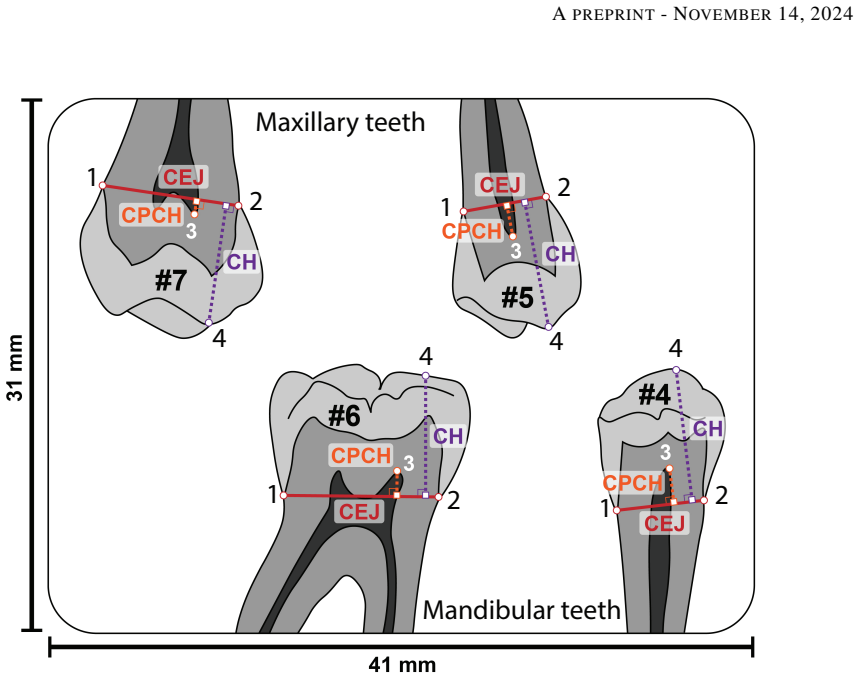
The central machinery is the Tooth Coronal Index (TCI), the ratio of coronal pulp cavity height to coronal height multiplied by 100, measured on bitewing radiographs at six tooth positions. The paper trains a separate classifier on each tooth's CH, CPCH, and TCI values and then fuses the classifiers' probabilistic outputs with majority voting or non-trainable combiners (mean, median, maximum, minimum). SHAP (SHapley Additive exPlanations) values rank the contribution of each dental feature to each prediction, providing the explainability layer.
What would settle it
Take a fresh set of bitewing radiographs and have two or more clinicians independently mark all landmarks, then train the ensemble on one clinician's measurements and evaluate it on the other clinician's: if the age-group or gender F1 drops by more than a few points, or if the landmark measurements themselves have poor inter-observer agreement, the paper's central claim is falsified.
Extended reading notes
Core claim
On its own terms, this paper claims that the three measurements CH, CPCH, and TCI, taken from the second premolar, first molar, and second molar in both jaws of living patients, are sufficient inputs for an ensemble of machine-learning classifiers to estimate age group and gender with F1 scores of 73.26% and 77.53% respectively. The best-performing single models are XGBoost for age and random forest for gender, but the full ensemble of all models, using majority voting or mean/median combiners, matches or exceeds them. The authors interpret this as a step toward replacing subjective expert assessment with a non-invasive, explainable screening tool.
Load-bearing premise
The load-bearing premise is that the manually marked measurements of crown height, pulp cavity height, and the derived ratio are accurate and consistent across observers; the paper presents no inter- or intra-observer reliability data to rule out measurement noise as the true driver of the reported F1 scores.
Editorial extensions
If this is right
- A dental X-ray already taken for routine care could double as a demography-screening input, adding no extra radiation or tooth extraction.
- The same feature set and ensemble design could be tried on skeletal remains, the extension the paper explicitly names as future work.
- Because the ensemble outperforms every single model, future development in forensic odontology should expect gains from tooth-specific specialization rather than one global model.
- SHAP explanations give clinicians a per-case trace of which dental measurements drove the age or gender call, supporting use where decisions must be justified.
- The approach needs only standard periapical radiographs, not CT or laboratory equipment, so it could transfer to low-resource forensic settings.
Reading between the lines
- The reported accuracy may be optimistic because the landmarks were placed manually with no inter- or intra-observer variability study; a deployment-grade system would need to show the pipeline tolerates measurement noise.
- Gender predictions (77.53% F1) beat five-way age predictions (73.26%), hinting that crown-size dimorphism is a stronger signal in this dataset than pulp shrinkage; a testable consequence is that adding root or third-molar measures could close the age gap more than any further classifier tuning.
- Collapsing age into five coarse brackets discards the continuous ageing signal; treating age as a regression problem on the same TCI features might yield finer chronological estimates and a more direct comparison with the original TCI regression formulations.
- The method's robustness to radiograph quality—older films, varied exposure, different machines—is untested; a realistic benchmark would evaluate the ensemble on a multi-site archive.
Signed reviews
Editorial analysis
A structured set of objections, weighed in public.
Referee Report
Summary. This paper develops machine learning classifiers for age-group and gender estimation from dental biometric measurements (coronal height, coronal pulp cavity height, and tooth coronal index) extracted from bitewing radiographs of 862 living individuals. The authors compare seven boosting/tree-based classifiers, propose an ensemble that trains per-tooth models and combines them via majority voting or non-trainable combiners, and use SHAP for interpretability. The headline results are an F1 score of 73.26% for age-group classification (XGB) and 77.53% for gender classification (attributed in the abstract to Random Forest, but to the ensemble in Table 6). The paper claims this constitutes a significant advancement in non-invasive dental forensic methods.
Significance. If the reported performance is a valid generalization estimate, the paper demonstrates a modestly useful, non-invasive screening tool for age and gender estimation that could complement expert analysis in forensic dentistry. The manuscript is careful in describing ethical approval, inclusion/exclusion criteria, and the clinical measurement protocol. A strength is the systematic comparison of several standard classifiers and the exploration of ensemble and non-trainable combiner strategies, which provides a useful baseline for the community. However, the central numerical claims are compromised by the apparent order of SMOTE before the train/test split, the lack of uncertainty quantification, and the inconsistency between the abstract and the main results table. These issues must be resolved before the results can be taken as evidence of a significant advancement.
major comments (5)
- [Figure 1; Section 3.3] The paper does not state whether SMOTE is applied inside the cross-validation loop or to the full dataset before the 80/20 split. Figure 1 places "Data Balancing (SMOTE)" in the Pre-processing stage, before the Machine Learning stage, and Section 3.3 describes the split and 5-fold CV only afterward. If SMOTE is fit on the entire dataset before splitting, synthetic minority samples generated from test-set originals can leak into the training set, and the classifier is evaluated on data whose synthetic neighbors were seen during training. This would inflate the reported F1 scores for both age and gender estimation, making the central claim unsubstantiated. The authors must clarify the exact pipeline order and, if the current implementation matches the figure, re-run the experiments with SMOTE applied independently to each training fold.
- [Tables 3-7; Section 3.3] The paper reports a single F1 and AUC value per model with no confidence intervals, fold-wise standard deviations, or statistical comparison. Section 3.3 states that 5-fold cross-validation was applied and that performance is the mean across folds, yet no variance information is provided anywhere in the results. Without this, the reader cannot judge whether differences such as XGB 73.26 vs. the ensemble 73.87 in Table 6 are meaningful, nor whether the reported numbers are stable. Provide fold-wise results or at least standard deviations/confidence intervals for the key experiments.
- [Abstract vs. Table 6] The abstract states that the Random Forest model achieved the highest F1 score of 77.53% for gender estimation, but Table 6 reports Random Forest at 76.54% and the "Ensemble of above models" at 77.53%. Similarly, the abstract credits XGB with the best age estimation F1 of 73.26%, while Table 6 lists the ensemble at 73.87% as the best. This is a direct factual inconsistency in the headline result. The abstract and the results section must be reconciled to report the same model-to-score mapping.
- [Table 2 vs. Section 3.2] The baseline results in Table 2 were obtained using all dental features, including canine, first pre-molar, and third molar, which Section 3.2 explicitly excludes from the rest of the study because they were frequently missing. The ensemble results in Tables 6-7 use only the second pre-molar, first molar, and second molar. Consequently, the improvement from baseline to ensemble is confounded by a change in the feature set, not solely by the ensemble method. Either re-run the baseline on the reduced feature set or explicitly discuss this confound when claiming ensemble learning is responsible for the improvement.
- [Section 3.1.1] All features are derived from manual landmark placements on radiographs using ImageJ, but the paper provides no inter-observer or intra-observer reliability data and no quantification of landmark placement error. Classifier performance is directly limited by the consistency of these manual measurements; without reliability statistics (e.g., ICC or Bland-Altman limits) on a random subset of radiographs, the reported F1 scores may not generalize to other operators or settings. This is a load-bearing limitation for a method intended as an automated clinical or forensic tool.
minor comments (5)
- [Figure 1; Section 4.1] Figure 1 lists SVM and Logistic Regression among the machine learning models, but these models are not discussed in Section 3.3 or in the results tables; conversely, AdaBoost, LGB, and ETC are used later but not listed in Figure 1. Please align the model lists between the figure, the methods, and the results.
- [Section 3.1; Abstract] The abstract describes periapical radiographs, while Section 3.1 repeatedly states that bitewing radiographs were used. This terminology inconsistency should be corrected.
- [Table 1] Table 1 is titled "Features Extracted" but the last two rows list Age and Gender, which are the prediction targets rather than features. This should be clarified to avoid confusion.
- [Section 3.3] The relationship between the 80/20 split and the 5-fold cross-validation is unclear: is the 5-fold CV applied to the 80% training set, or to the entire dataset? Please specify the exact evaluation protocol.
- [Throughout] There are several typographical and wording issues, such as "evaluation matrix" in Figure 1 (should be "evaluation metrics"), "Kvp" for kVp, and "Amp" for mA in Section 3.1. A careful proofread is recommended.
Circularity Check
No circularity found; the paper is an empirical ML benchmarking study with no derivation chain that reduces to its inputs.
full rationale
The paper reports an empirical machine-learning benchmark on a private dental radiograph dataset. There is no claimed first-principles derivation: the target quantities (age group and gender) are labels in the dataset, and the features (CH, CPCH, TCI) are measured dental distances. TCI is defined by Eq. 1 as CPCH/CH x 100, which is a standard ratio feature; using CH, CPCH, and TCI together as inputs does not make the target an input. The ensemble method described in Sec. 3.4 is majority voting over tooth-specific models, and the non-trainable combiners are standard averaging rules; none of these fit a parameter to the target and then rename it as a prediction. The SHAP analysis is post-hoc interpretation of the trained models, not part of the prediction chain. The paper contains no load-bearing self-citations; references are to external prior work and standard algorithm sources. The only notable methodological concern is the ordering of SMOTE relative to the 80/20 split: Fig. 1 places Data Balancing (SMOTE) in pre-processing before the machine-learning stage, while Sec. 3.3 describes splitting and 5-fold cross-validation. If SMOTE were fit on the full dataset before splitting, the reported F1 scores would be optimistically biased due to leakage. However, the paper is ambiguous about the exact order, and this is a data-handling validity issue rather than a case where the reported results reduce to their own inputs by construction. Per the analysis rules, ambiguity and potential leakage are not circularity without a quoted, explicit reduction. The abstract's attribution of the 77.53% gender F1 to RF while Table 6 lists it as the ensemble is an internal inconsistency, not a circular step. Therefore the appropriate score is 0.
Assumptions & free parameters
free parameters (2)
- Model hyperparameters =
Grid-searched, not reported
- Age group boundaries =
0-20, 21-30, 31-40, 41-50, 51+
assumptions (3)
- domain assumption Manually measured CH and CPCH values from bitewing radiographs are accurate and reproducible across operators.
- domain assumption SMOTE-generated synthetic samples follow the same distribution as real dental data.
- domain assumption The tooth coronal index (TCI) as defined by Drusini is a valid biomarker for age and gender prediction.
Cite this review
Pith. "Pith review of An Explainable Machine Learning Approach for Age and Gender Estimation in Living Individuals Using Dental Biometrics." pith.science (2026). https://pith.science/paper/Z7DRNIAO
@misc{pith2026241108195,
  author       = {Pith},
  title        = {Pith review of: An Explainable Machine Learning Approach for Age and Gender Estimation in Living Individuals Using Dental Biometrics},
  year         = {2026},
  howpublished = {\url{https://pith.science/paper/Z7DRNIAO}},
  note         = {Machine review of arXiv:2411.08195}
}
read the original abstract
Objectives: Age and gender estimation is crucial for various applications, including forensic investigations and anthropological studies. This research aims to develop a predictive system for age and gender estimation in living individuals, leveraging dental measurements such as Coronal Height (CH), Coronal Pulp Cavity Height (CPCH), and Tooth Coronal Index (TCI). Methods: Machine learning models were employed in our study, including Cat Boost Classifier (Catboost), Gradient Boosting Machine (GBM), Ada Boost Classifier (AdaBoost), Random Forest (RF), eXtreme Gradient Boosting (XGB), Light Gradient Boosting Machine (LGB), and Extra Trees Classifier (ETC), to analyze dental data from 862 living individuals (459 males and 403 females). Specifically, periapical radiographs from six teeth per individual were utilized, including premolars and molars from both maxillary and mandibular. A novel ensemble learning technique was developed, which uses multiple models each tailored to distinct dental metrics, to estimate age and gender accurately. Furthermore, an explainable AI model has been created utilizing SHAP, enabling dental experts to make judicious decisions based on comprehensible insight. Results: The RF and XGB models were particularly effective, yielding the highest F1 score for age and gender estimation. Notably, the XGB model showed a slightly better performance in age estimation, achieving an F1 score of 73.26%. A similar trend for the RF model was also observed in gender estimation, achieving a F1 score of 77.53%. Conclusions: This study marks a significant advancement in dental forensic methods, showcasing the potential of machine learning to automate age and gender estimation processes with improved accuracy.
Figures


Figures from the paper (5 more)




Reference graph
Works this paper leans on
-
[1]
Explainable artificial intelligence (xai): Concepts, taxonomies, opportunities and challenges toward responsible ai
Alejandro Barredo Arrieta, Natalia Díaz-Rodríguez, Javier Del Ser, Adrien Bennetot, Siham Tabik, Alberto Barbado, Salvador García, Sergio Gil-López, Daniel Molina, Richard Benjamins, et al. Explainable artificial intelligence (xai): Concepts, taxonomies, opportunities and challenges toward responsible ai. Information fusion, 58:82–115, 2020
2020
-
[2]
Emre Avuçlu and Fatih Ba¸ sçiftçi. The determination of age and gender by implementing new image processing methods and measurements to dental x-ray images. Measurement, 149:106985, 2020
work page 2020
-
[3]
Role of dental pulp in age estimation: A quantitative and morphometric study
Anjum Baker, K Karpagaselvi, Jayalakshmi Kumaraswamy, MR Ranjini, and Jabeen Gowher. Role of dental pulp in age estimation: A quantitative and morphometric study. Journal of Forensic Dental Sciences, 11(2):95, 2019
work page 2019
-
[4]
Ilenia Bianchi, Giorgio Oliva, Giulia Vitale, Beatrice Bellugi, Giorgio Bertana, Martina Focardi, Simone Grassi, Domenico Dalessandri, and Vilma Pinchi. A semi-automatic method on a small italian sample for estimating sex based on the shape of the crown of the maxillary posterior teeth. In Healthcare, volume 11, page 845. MDPI, 2023
work page 2023
-
[5]
Analysis of a random forests model
Gérard Biau. Analysis of a random forests model. The Journal of Machine Learning Research, 13:1063–1095, 2012
work page 2012
-
[6]
Xgboost: extreme gradient boosting
Tianqi Chen, Tong He, Michael Benesty, Vadim Khotilovich, Yuan Tang, Hyunsu Cho, Kailong Chen, Rory Mitchell, Ignacio Cano, Tianyi Zhou, et al. Xgboost: extreme gradient boosting. R package version 0.4-2 , 1(4):1–4, 2015
2015
-
[7]
Opportunities and challenges in explainable artificial intelligence (xai): A survey
Arun Das and Paul Rad. Opportunities and challenges in explainable artificial intelligence (xai): A survey. arXiv preprint arXiv:2006.11371, 2020
arXiv 2006
-
[8]
Stefano De Luca, Inmaculada Alemán, Francesca Bertoldi, Luigi Ferrante, Paola Mastrangelo, Mariano Cingolani, and Roberto Cameriere. Age estimation by tooth/pulp ratio in canines by peri-apical x-rays: reliability in age determination of spanish and italian medieval skeletal remains. Journal of Archaeological Science, 37(12):3048– 3058, 2010
work page 2010
Show all 26 references
-
[9]
The coronal pulp cavity index: A forensic tool for age determination in human adults
AG Drusini. The coronal pulp cavity index: A forensic tool for age determination in human adults. Cuad Med Forense, 14(53-54):235–249, 2008
2008
-
[10]
The coronal pulp cavity index: a biomarker for age determination in human adults
Andrea G Drusini, Oriella Toso, and Cristina Ranzato. The coronal pulp cavity index: a biomarker for age determination in human adults. American Journal of Physical Anthropology: The Official Publication of the American Association of Physical Anthropologists, 103(3):353–363, ...
1997
-
[11]
Light gradient boosting machine: An efficient soft computing model for estimating daily reference evapotranspiration with local and external meteorological data
Junliang Fan, Xin Ma, Lifeng Wu, Fucang Zhang, Xiang Yu, and Wenzhi Zeng. Light gradient boosting machine: An efficient soft computing model for estimating daily reference evapotranspiration with local and external meteorological data. Agricultural water management, 225:105758, 2019
2019
-
[12]
Dental age estimation using the pulp-to-tooth ratio in canines by neural networks
Maryam Farhadian, Fatemeh Salemi, Samira Saati, and Nika Nafisi. Dental age estimation using the pulp-to-tooth ratio in canines by neural networks. Imaging Science in Dentistry, 49(1):19–26, 2019
2019
-
[13]
Darpa’s explainable artificial intelligence (xai) program.AI magazine, 40(2):44–58, 2019
David Gunning and David Aha. Darpa’s explainable artificial intelligence (xai) program.AI magazine, 40(2):44–58, 2019
2019
-
[14]
Multi-class adaboost
Trevor Hastie, Saharon Rosset, Ji Zhu, and Hui Zou. Multi-class adaboost. Statistics and its Interface, 2(3):349– 360, 2009
2009
-
[15]
On combining classifiers
Josef Kittler, Mohamad Hatef, Robert PW Duin, and Jiri Matas. On combining classifiers. IEEE Transactions on Pattern Analysis and Machine Intelligence, 20(3):226–239, 1998
1998
-
[16]
A unified approach to interpreting model predictions
Scott M Lundberg and Su-In Lee. A unified approach to interpreting model predictions. In I. Guyon, U. V . Luxburg, S. Bengio, H. Wallach, R. Fergus, S. Vishwanathan, and R. Garnett, editors, Advances in Neural Information Processing Systems 30, pages 4765–4774. Curran Associat...
2017
-
[17]
Logistic regression in data analysis: an overview
Maher Maalouf. Logistic regression in data analysis: an overview. International Journal of Data Analysis Techniques and Strategies, 3(3):281–299, 2011
2011
-
[18]
Ricardo Machado, Gabriel Filipe Pamplona, Claudemir de Souza Júnior, Jaqueline Nascimento, Eduardo Donato Eing Elgelke Back, Daniel Comparin, Sérgio Aparecido Ignácio, Stella Maria Glaci Reinke, Ana Cristina Kovalik, and Ulisses Xavier da Silva Neto. Clinical determination of ...
2023
-
[19]
Modelling and parameter identification of coefficient of friction for deep-drawing quality steel sheets using the catboost machine learning algorithm and neural networks
Sherwan Mohammed Najm, Tomasz Trzepieci´nski, and Marek Kowalik. Modelling and parameter identification of coefficient of friction for deep-drawing quality steel sheets using the catboost machine learning algorithm and neural networks. The International Journal of Advanced Man...
2023
-
[20]
Improving automated pediatric bone age estimation using ensembles of models from the 2017 rsna machine learning challenge
Ian Pan, Hans Henrik Thodberg, Safwan S Halabi, Jayashree Kalpathy-Cramer, and David B Larson. Improving automated pediatric bone age estimation using ensembles of models from the 2017 rsna machine learning challenge. Radiology: Artificial Intelligence, 1(6):e190053, 2019
2017
-
[21]
Nih image to imagej: 25 years of image analysis
Caroline A Schneider, Wayne S Rasband, and Kevin W Eliceiri. Nih image to imagej: 25 years of image analysis. Nature methods, 9(7):671–675, 2012
2012
-
[22]
Extra-tree classifier with metaheuristics approach for email classification
Aakanksha Sharaff and Harshil Gupta. Extra-tree classifier with metaheuristics approach for email classification. In Advances in Computer Communication and Computational Sciences: Proceedings of IC4S 2018, pages 189–197. Springer, 2019
2018
-
[23]
Age estimation by assessment of pulp chamber volume: a bayesian network for the evaluation of dental evidence
Emanuele Sironi, Franco Taroni, Claudio Baldinotti, Cosimo Nardi, Gian-Aristide Norelli, Matteo Gallidabino, and Vilma Pinchi. Age estimation by assessment of pulp chamber volume: a bayesian network for the evaluation of dental evidence. International Journal of Legal Medicine...
2018
-
[24]
Determination of sex from tooth pulp tissue.Libyan Journal of Medicine, 5(1):5084, 2010
Gajendra Veeraraghavan, Ashok Lingappa, Shiva Prasad Shankara, Gowda Panchaksharappa Mamatha, Bas- tian Thattil Sebastian, and Ahmed Mujib. Determination of sex from tooth pulp tissue.Libyan Journal of Medicine, 5(1):5084, 2010
2010
-
[25]
Dental age estimation methods in adult dentitions: An overview
Meenal Verma, Nikhil Verma, Rakhee Sharma, and Ashish Sharma. Dental age estimation methods in adult dentitions: An overview. Journal of Forensic Dental Sciences, 11(2):57, 2019
2019
-
[26]
Non-destructive dental-age calculation methods in adults: intra-and inter-observer effects
Guy Willems, Christian Moulin-Romsee, and Tore Solheim. Non-destructive dental-age calculation methods in adults: intra-and inter-observer effects. Forensic science international, 126(3):221–226, 2002. 16
2002
Reviewed August 12, 2026 · model on record in the stance chip above.
Discussion (0). Continue with ORCID to comment.