REVIEW 3 major objections 5 minor 83 references
Today’s best vision-language models still miss nearly half of the modular decisions real robots must make, and those misses track real physical failure.
Reviewed by Pith at T0; open to challenge. T0 means a machine referee read the full paper against a public rubric. the ladder, T0–T4 →
Expert-curated modular Robot-VQA benchmark of 474 questions across 39 robot tasks shows SOTA VLMs have large gaps that correlate with physical robot execution.
T0 review reviewed 2026-07-11 challenge →
load-bearing objection Useful modular VQA benchmark that fills a real gap for robot VLMs; physical correlations are suggestive but rest on a thin sample. the 3 major comments →
RoboVista: Evaluating Vision Language Models for Diverse Robot Applications
The pith
A machine-rendered reading of the paper's core claim, the machinery that carries it, and where it could break.
The reading
Core claim
State-of-the-art vision-language models exhibit large, persistent performance gaps on modular robot decision points (best overall accuracy 56.5 percent), and a model’s RoboVista score correlates strongly with real-world spatial estimation error and with progress on closed-loop surgical knot-tying under shared autonomy.
What carries the argument
Robot Question Answering (RQA): a module-level abstraction that maps each functional block of a robot pipeline—perception, high-level decision making, motion awareness, failure recovery—into a robot-centric visual question with a single verified answer and human rationale, then assembles those questions into the RoboVista benchmark.
Load-bearing premise
The 474 expert-built multiple-choice questions, each tied to one modular decision taken from published robot systems, are representative enough of real decision quality that accuracy on them can stand in for how well a model would help an actual robot.
What would settle it
Run the same physical bimanual distance-alignment and dVRK knot-tying protocols with a model whose RoboVista score has been deliberately raised (or lowered) by training or prompting, and check whether physical error and task progress move in the predicted direction; if the correlation collapses, the central claim fails.
Editorial analysis
A structured set of objections, weighed in public.
Referee Report
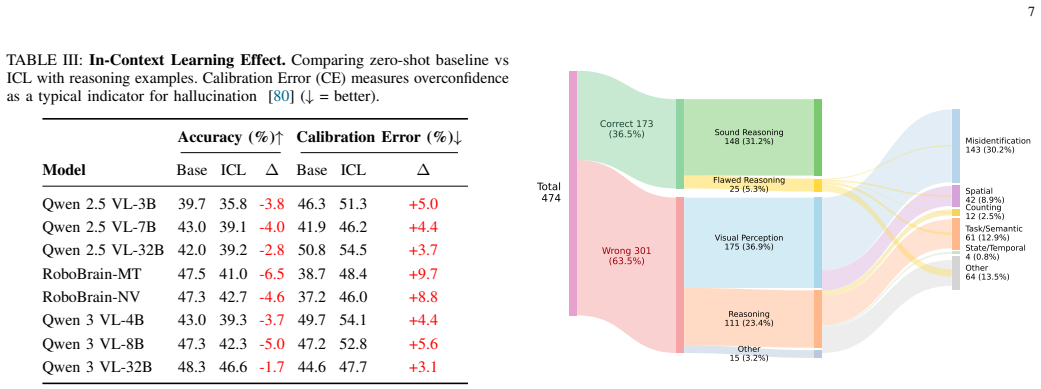
Summary. The paper introduces Robot Question Answering (RQA), a modular framework that maps decision points from classical robot pipelines (perception, high-level planning, motion awareness, failure recovery) into robot-centric multiple-choice VQA instances, and instantiates it as RoboVista: 474 expert-annotated questions spanning 39 task types across agriculture, industry, domestic, surgical, driving, and open datasets. Each instance includes robot-visible or onboard imagery, five answer choices, and human rationales. Zero-shot evaluation of open- and closed-source VLMs shows substantial gaps (best overall accuracy 56.5% for Gemini 2.5 Pro). Ablations examine Chain-of-Thought and in-context learning; failure analysis separates perception from reasoning errors. Two physical experiments (bimanual gripper alignment and shared-autonomy dVRK knot-tying) report correlations between RoboVista scores and real-world spatial error / task progress.
Significance. If the reported gaps and the proxy relationship hold, RoboVista supplies a needed diagnostic complement to trajectory-scale embodied VQA benchmarks (Robo2VLM, RoboBrain, ERQA). Its deliberate coverage of data-scarce modular domains (surgery, agriculture, industrial deformable assembly) and expert-verified rationales are genuine strengths. The physical correlation experiments, even if under-powered, are a welcome attempt to link VQA accuracy to closed-loop execution rather than treating the benchmark as self-justifying. The work is therefore of clear interest to the robotics and VLM communities as both an evaluation resource and a design template for modular robot-centric VQA.
major comments (3)
- Section VI and Fig. 7b: The claimed strong negative correlation between RoboVista score and bimanual position error (Pearson r = −0.78, Spearman ρ = −0.93) rests on roughly 6–7 models that already appear in the main zero-shot ranking. No p-values, confidence intervals, or leave-one-out sensitivity are reported. With such small N a single outlier can dominate; the manuscript should either enlarge the model set, report statistical significance, or explicitly frame the result as exploratory rather than confirmatory of proxy validity.
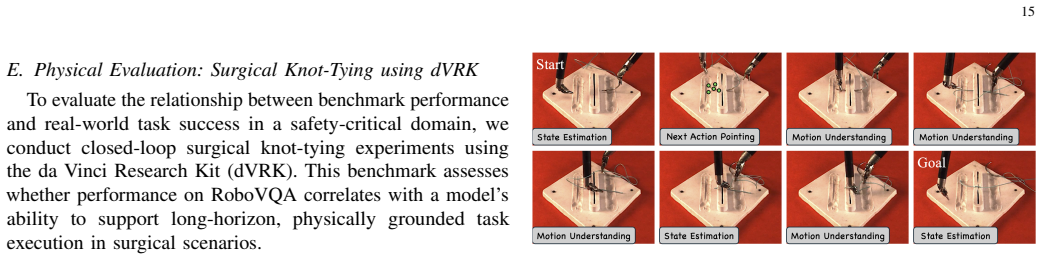
- Table IV (surgical knot-tying): Only three models are evaluated, and the 16 closed-loop queries are drawn from the same surgical domain (and RQA construction process) that contributes to the RoboVista-Surgery score. This partial non-independence weakens the claim that higher benchmark accuracy predicts greater real-task progress. The paper should either add held-out procedural stages / models or qualify the association more carefully.
- Section IV Quality Control and Appendix A: Inter-annotator agreement (e.g., exact-match or rationale consistency) is not quantified, nor is the procedure for generating and validating the four distractors described beyond “algorithmically grounded.” Because the central claim treats accuracy on these 474 items as a reliable proxy for modular decision quality, a short quantitative reliability analysis (or explicit statement of its absence) is load-bearing and should be added.
minor comments (5)
- Table I vs. Table II: GPT-5 overall accuracy is listed as 48.1% (zero-shot) in Table I but 55.5% in Table II; clarify whether different checkpoints, decoding, or subset filtering explain the discrepancy.
- Fig. 4 table header says “39 unique task types” while Appendix Table V reports “Unique Tasks 33”; reconcile the counts.
- Section V decoding: main text states temperature 0.7; Appendix B states temperature 0.0 (greedy). Align the reported protocol.
- Figs. 5 and 6 (and Appendix Figs. 8–9) appear to reuse nearly identical failure-analysis diagrams with swapped model names; ensure captions and percentages match the intended model.
- Abstract and Introduction claim “strong correlation”; given the sample-size caveats above, softer language (“suggestive association”) would better match the evidence presented.
Circularity Check
No derivation circularity; mild non-independence only in the surgical physical validation, where progress is itself sequential VQA accuracy on RQA questions from the same domain.
specific steps
-
other
[Section VI.B / Table IV / Appendix Table VIII]
"Across all models, higher RoboVista-surgical scores are associated with greater shared autonomy task progress. Models with stronger benchmark performance consistently complete more stages of the knot-tying procedure before requiring assistance. ... Human experts ... design a sequence of VQA questions with RQA framework that correspond to critical decision points in the knot-tying process ... We evaluate multiple vision-language models by asking the designed questions in sequence and measuring how far the knot-tying task can progress"
Task progress is operationalized as the number of sequential RQA VQAs answered correctly (with ≤3 interventions) on a 16-question knot-tying sequence whose construction, visual style, and decision points are identical to those used for the 30 Knot-Tying items that contribute to the RoboVista-Surgery score. The association between RoboVista-Surgery accuracy and this progress metric is therefore partly by construction rather than an independent physical measurement of continuous robot execution.
full rationale
RoboVista is an empirical VQA benchmark constructed from external robot systems, papers, and fresh expert annotations; model accuracies are measured against fixed human labels with no free parameters fitted to produce the reported gaps (best 56.5 %). The bi-manual gripper experiment measures continuous distance/position errors under geometric priors and reports an independent correlation (Pearson r = −0.78) with overall RoboVista scores; that measurement does not reduce to the VQA labels by construction. The sole mild circularity is the surgical knot-tying closed-loop experiment: progress is defined by sequential correctness on 16 RQA-designed VQAs that match the style, domain, and source of the 30 Knot-Tying items already inside RoboVista-Surgery, so the reported association is partly expected rather than fully independent physical evidence. No self-definitional equations, fitted-then-predicted quantities, uniqueness theorems, or ansatz smuggling appear. Self-citations are ordinary source attributions for the underlying robot pipelines and do not load-bear any uniqueness claim. Score 2 reflects one non-central, partial non-independence; the central empirical claims remain self-contained.
Axiom & Free-Parameter Ledger
axioms (3)
- domain assumption Complex robot behaviors can be usefully decomposed into the four functional layers of perception, high-level decision making, motion/action estimation and failure recovery (Fig. 2 and Section III-A).
- domain assumption A multiple-choice VQA instance with five options and an expert rationale is a faithful probe of the underlying module decision (Definition 1–3).
- domain assumption Expert annotators (graduate-level and above, majority PhDs in robotics) produce unambiguous, visually grounded ground-truth answers.
invented entities (2)
-
Robot Question Answering (RQA) framework
no independent evidence
-
RoboVista benchmark
no independent evidence
Cite this review
Pith. "Pith review of RoboVista: Evaluating Vision Language Models for Diverse Robot Applications." pith.science (2026). https://pith.science/paper/ZAHYZQ7V
@misc{pith2026260704610,
  author       = {Pith},
  title        = {Pith review of: RoboVista: Evaluating Vision Language Models for Diverse Robot Applications},
  year         = {2026},
  howpublished = {\url{https://pith.science/paper/ZAHYZQ7V}},
  note         = {Machine review of arXiv:2607.04610}
}
read the original abstract
Diverse applications for robotics, such as industry and agriculture, require robots to operate across various embodiments, changing visual conditions, and complex planning. Vision-Language Models (VLMs) offer a promising foundation for general-purpose and interpretable robotic reasoning. Aligning VLMs with diverse robot applications requires a modular understanding of the individual decision components that underlie robotic behavior. Capturing such structure is challenging for conventional robot benchmarks that are primarily based on teleoperated, end-to-end datasets. We propose Robot Question Answering (RQA), a modular evaluation framework and RoboVista, a benchmark curated from real robotic systems, research papers, and expert annotations. RoboVista contains 474 Visual Question Answering (VQA) instances with human annotated reasoning and covers 39 unique task types in agricultural, industrial, domestic, surgical robotics, autonomous driving, and open robot datasets. Experiments on RoboVista show that state-of-the-art VLMs exhibit substantial gaps. Physical robot experiments suggest strong correlation between RoboVista performance and real-world task execution.
Figures




Reference graph
Works this paper leans on
-
[1]
Industrial robot grasping with deep learning using a programmable logic controller (plc),
E. Solowjow, I. Ugalde, Y . Shahapurkar, J. Aparicio, J. Mahler, V . Satish, K. Goldberg, and H. Claussen, “Industrial robot grasping with deep learning using a programmable logic controller (plc),” in2020 IEEE 16th International Confer- ence on Automation Science and Engineering (CASE), 2020, pp. 97–103
2020
-
[2]
Automating deformable gasket assembly,
S. Adebola, T. Sadjadpour, K. El-Refai, W. Panitch, Z. Ma, R. Lin, T. Qiu, S. Ganti, C. Le, J. Drake, et al., “Automating deformable gasket assembly,” in2024 IEEE 20th International Conference on Automation Science and Engineering (CASE), IEEE, 2024, pp. 4146–4153
2024
-
[3]
Energy efficient planning for repetitive heterogeneous tasks in precision agriculture,
S. Xie, K. Goldberg, and D. Song, “Energy efficient planning for repetitive heterogeneous tasks in precision agriculture,” in2025 IEEE International Conference on Robotics and Automation (ICRA), 2025, pp. 7139–7145
2025
-
[4]
Can machines garden? systematically comparing the alphagarden vs. professional horticulturalists,
S. Adebola, R. Parikh, M. Presten, S. Sharma, S. Aeron, A. Rao, S. Mukherjee, T. Qu, C. Wistrom, E. Solowjow, et al., “Can machines garden? systematically comparing the alphagarden vs. professional horticulturalists,” in2023 IEEE International Conference on Robotics and Automation (ICRA), 2023, pp. 11 779–11 785
2023
-
[5]
Surgical d-knot: Augmented dexterity for tying double knots by monitoring optical flow in monocular attention windows,
Z. Chen, K. Hari, T. Dasari, K. Shieh, R. Jain, D. M. Fer, G. Guthart, and K. Goldberg, “Surgical d-knot: Augmented dexterity for tying double knots by monitoring optical flow in monocular attention windows,” in2025 IEEE/RSJ International Conference on Intelligent Robots and Systems (IROS), IEEE, 2025, pp. 2148–2155
2025
-
[6]
Stitch 2.0: Extending augmented suturing with ekf needle estimation and thread management,
K. Hari, Z. Chen, H. Kim, and K. Goldberg, “Stitch 2.0: Extending augmented suturing with ekf needle estimation and thread management,”IEEE Robotics and Automation Letters, vol. 10, no. 12, pp. 12 700–12 707, 2025
2025
-
[7]
Learning transferable visual models from natural language supervision,
A. Radford, J. W. Kim, C. Hallacy, A. Ramesh, G. Goh, S. Agarwal, G. Sastry, A. Askell, P. Mishkin, J. Clark, et al., “Learning transferable visual models from natural language supervision,” inProceedings of the 38th International Conference on Machine Learning, M. Meila and T. Zhang, Eds., ser. Proceedings of Machine Learning Research, vol. 139, PMLR, 18...
2021
-
[8]
An introduction to vision-language modeling,
F. Bordes, R. Y . Pang, A. Ajay, A. C. Li, A. Bardes, S. Petryk, O. Ma ˜nas, Z. Lin, A. Mahmoud, B. Jayaraman, et al., “An introduction to vision-language modeling,”arXiv preprint arXiv:2405.17247, 2024
Pith/arXiv arXiv 2024
-
[9]
Design2Code: Benchmarking multimodal code generation for automated front-end engineering,
C. Si, Y . Zhang, R. Li, Z. Yang, R. Liu, and D. Yang, “Design2Code: Benchmarking multimodal code generation for automated front-end engineering,” inProceedings of the 2025 Conference of the Nations of the Americas Chapter of the Association for Computational Linguistics: Human Language Technologies (Volume 1: Long Papers), L. Chiruzzo, A. Ritter, and L. ...
2025
-
[10]
G. R. Team, S. Abeyruwan, et al.,Gemini robotics: Bringing ai into the physical world, 2025. arXiv: 2503.20020[cs.RO]
Pith/arXiv arXiv 2025
-
[11]
V oxposer: Composable 3d value maps for robotic manipulation with language models,
W. Huang, C. Wang, R. Zhang, Y . Li, J. Wu, and L. Fei-Fei, “V oxposer: Composable 3d value maps for robotic manipulation with language models,”arXiv preprint arXiv:2307.05973, 2023
Pith/arXiv arXiv 2023
-
[12]
Prompting with the future: Open-world model predictive control with interactive digital twins,
C. Ning, K. Fang, and W. -C. Ma, “Prompting with the future: Open-world model predictive control with interactive digital twins,” inProceedings of Robotics: Science and Systems (RSS), 2025
2025
-
[13]
Vqa: Visual question answering,
S. Antol, A. Agrawal, J. Lu, M. Mitchell, D. Batra, C. L. Zitnick, and D. Parikh, “Vqa: Visual question answering,” in Proceedings of the IEEE international conference on computer vision, 2015, pp. 2425–2433
2015
-
[14]
Visual question answering: A survey of methods, datasets, evaluation, and challenges,
B. S. Kim, J. Kim, D. Lee, and B. Jang, “Visual question answering: A survey of methods, datasets, evaluation, and challenges,”ACM Comput. Surv., vol. 57, no. 10, May 2025
2025
-
[15]
Making the v in vqa matter: Elevating the role of image understanding in visual question answering,
Y . Goyal, T. Khot, D. Summers-Stay, D. Batra, and D. Parikh, “Making the v in vqa matter: Elevating the role of image understanding in visual question answering,” inProceedings of the IEEE conference on computer vision and pattern recognition, 2017, pp. 6904–6913
2017
-
[16]
J. H. Lee, M. Kerzel, K. Ahrens, C. Weber, and S. Wermter, “What is right for me is not yet right for you: A dataset for grounding relative directions via multi-task learning,”arXiv preprint arXiv:2205.02671, 2022
Pith/arXiv arXiv 2022
-
[17]
Mmmu: A massive multi- discipline multimodal understanding and reasoning benchmark for expert agi,
X. Yue, Y . Ni, T. Zheng, K. Zhang, R. Liu, G. Zhang, S. Stevens, D. Jiang, W. Ren, Y . Sun, et al., “Mmmu: A massive multi- discipline multimodal understanding and reasoning benchmark for expert agi,” in2024 IEEE/CVF Conference on Computer Vision and Pattern Recognition (CVPR), 2024, pp. 9556–9567
2024
-
[18]
MMMU-pro: A more robust multi-discipline multimodal understanding benchmark,
X. Yue, T. Zheng, Y . Ni, Y . Wang, K. Zhang, S. Tong, Y . Sun, B. Yu, G. Zhang, H. Sun, et al., “MMMU-pro: A more robust multi-discipline multimodal understanding benchmark,” inProceedings of the 63rd Annual Meeting of the Association for Computational Linguistics (Volume 1: Long Papers), W. Che, J. Nabende, E. Shutova, and M. T. Pilehvar, Eds., Vienna, ...
2025
-
[19]
Robo2vlm: Improving visual question answering using large- 10 scale robot manipulation data,
K. Chen, S. Xie, Z. Ma, P. R. Sanketi, and K. Goldberg, “Robo2vlm: Improving visual question answering using large- 10 scale robot manipulation data,” inThe Thirty-ninth Annual Conference on Neural Information Processing Systems Datasets and Benchmarks Track, 2025
2025
-
[20]
Robobrain: A unified brain model for robotic manipulation from abstract to concrete,
Y . Ji, H. Tan, J. Shi, X. Hao, Y . Zhang, H. Zhang, P. Wang, M. Zhao, Y . Mu, P. An, et al., “Robobrain: A unified brain model for robotic manipulation from abstract to concrete,” CVPR, 2025
2025
-
[21]
O. X.-E. Collaboration, A. O’Neill, A. Rehman, A. Gupta, A. Maddukuri, A. Gupta, A. Padalkar, et al.,Open X-Embodiment: Robotic learning datasets and RT-X models, https://arxiv.org/ abs/2310.08864, 2023
Pith/arXiv arXiv 2023
-
[22]
Manip: A modular architecture for integrating inter- active perception for robot manipulation,
J. Yu, T. Sadjadpour, A. O’Neill, M. Khfifi, L. Y . Chen, R. Cheng, M. Z. Irshad, A. Balakrishna, T. Kollar, and K. Goldberg, “Manip: A modular architecture for integrating inter- active perception for robot manipulation,” in2024 IEEE/RSJ International Conference on Intelligent Robots and Systems (IROS), IEEE, 2024, pp. 1283–1289
2024
-
[23]
Chain-of-thought prompting elicits reasoning in large language models,
J. Wei, X. Wang, D. Schuurmans, M. Bosma, F. Xia, E. Chi, Q. V . Le, D. Zhou, et al., “Chain-of-thought prompting elicits reasoning in large language models,”Advances in neural information processing systems, vol. 35, pp. 24 824–24 837, 2022
2022
-
[24]
A survey on in-context learning,
Q. Dong, L. Li, D. Dai, C. Zheng, J. Ma, R. Li, H. Xia, J. Xu, Z. Wu, B. Chang, et al., “A survey on in-context learning,” in Proceedings of the 2024 conference on empirical methods in natural language processing, 2024, pp. 1107–1128
2024
-
[25]
Language models are few-shot learners,
T. Brown, B. Mann, N. Ryder, M. Subbiah, J. D. Kaplan, P. Dhariwal, A. Neelakantan, P. Shyam, G. Sastry, A. Askell, et al., “Language models are few-shot learners,”Advances in neural information processing systems, vol. 33, pp. 1877–1901, 2020
1901
-
[26]
Z. Chen, K. Hari, and K. Goldberg,Surgical debridement dataset, https://github.com/open-h-embodiment/data-collection, GitHub repository, 2025
2025
-
[27]
Toward robotic weed control: Detection of nutsedge weed in bermuda- grass turf using inaccurate and insufficient training data,
S. Xie, C. Hu, M. Bagavathiannan, and D. Song, “Toward robotic weed control: Detection of nutsedge weed in bermuda- grass turf using inaccurate and insufficient training data,”IEEE Robotics and Automation Letters, vol. 6, no. 4, pp. 7365–7372, 2021
2021
-
[28]
Coupled active perception and manipulation planning for a mobile manipulator in precision agriculture applications,
S. Xie, C. Hu, D. Wang, J. Johnson, M. Bagavathiannan, and D. Song, “Coupled active perception and manipulation planning for a mobile manipulator in precision agriculture applications,” inIEEE International Conference on Robotics and Automation (ICRA), 2024
2024
-
[29]
Botany-bot: Digital twin monitoring of occluded and underleaf plant structures with gaussian splats,
S. Adebola, C. M. Kim, J. Kerr, S. Xie, P. Akella, J. L. S. Rincon, E. Solowjow, and K. Goldberg, “Botany-bot: Digital twin monitoring of occluded and underleaf plant structures with gaussian splats,” in2025 IEEE/RSJ International Conference on Intelligent Robots and Systems (IROS), IEEE, 2025, pp. 1839– 1846
2025
-
[30]
Omni-scan: Creating visually-accurate digital twin object models using a bimanual robot with handover and gaussian splat merging,
T. Qiu, Z. Ma, K. El-Refai, H. Shah, C. M. Kim, J. Kerr, and K. Goldberg, “Omni-scan: Creating visually-accurate digital twin object models using a bimanual robot with handover and gaussian splat merging,” in2025 IEEE/RSJ International Conference on Intelligent Robots and Systems (IROS), IEEE, 2025, pp. 18 782–18 789
2025
-
[31]
The teenager’s problem: Efficient garment decluttering as probabilistic set cover,
A. Adler, A. Ahmad, Y . Qiu, S. Wang, W. C. Agboh, E. Llontop, T. Qiu, J. Ichnowski, T. Kollar, R. Cheng, et al., “The teenager’s problem: Efficient garment decluttering as probabilistic set cover,”arXiv preprint arXiv:2310.16951, 2023
Pith/arXiv arXiv 2023
-
[32]
Spatialvlm: Endowing vision-language models with spatial reasoning capabilities,
B. Chen, Z. Xu, S. Kirmani, B. Ichter, D. Sadigh, L. Guibas, and F. Xia, “Spatialvlm: Endowing vision-language models with spatial reasoning capabilities,” inProceedings of the IEEE/CVF Conference on Computer Vision and Pattern Recognition (CVPR), Jun. 2024, pp. 14 455–14 465
2024
-
[33]
S. Karamcheti, S. Nair, A. Balakrishna, P. Liang, T. Kollar, and D. Sadigh,Prismatic vlms: Investigating the design space of visually-conditioned language models, 2024. arXiv: 2402.07865 [cs.CV]
Pith/arXiv arXiv 2024
-
[34]
Openvla: An open-source vision-language-action model,
M. J. Kim, K. Pertsch, S. Karamcheti, T. Xiao, A. Balakrishna, S. Nair, R. Rafailov, E. Foster, G. Lam, P. Sanketi, et al., “Openvla: An open-source vision-language-action model,” in Proceedings of the Conference on Robot Learning (CoRL), 2024
2024
-
[35]
π0: A generalist robot policy,
P. I. Team, “ π0: A generalist robot policy,”arXiv preprint arXiv:2410.24164, 2024
Pith/arXiv arXiv 2024
-
[36]
Text2motion: From natural language instructions to feasible plans,
K. Lin, C. Agia, T. Migimatsu, M. Pavone, and J. Bohg, “Text2motion: From natural language instructions to feasible plans,”Autonomous Robots, vol. 47, pp. 1345–1365, 2023
2023
-
[37]
PaLM- E: An embodied multimodal language model,
D. Driess, F. Xia, M. S. M. Sajjadi, C. Lynch, A. Chowdhery, B. Ichter, A. Wahid, J. Tompson, Q. Vuong, T. Yu, et al., “PaLM- E: An embodied multimodal language model,” inProceedings of the 40th International Conference on Machine Learning (ICML), 2023, pp. 8469–8488
2023
-
[38]
Rekep: Spatio-temporal reasoning of relational keypoint constraints for robotic manipulation,
W. Huang, C. Wang, Y . Li, R. Zhang, and L. Fei-Fei, “Rekep: Spatio-temporal reasoning of relational keypoint constraints for robotic manipulation,”arXiv preprint arXiv:2409.01652, 2024
Pith/arXiv arXiv 2024
-
[39]
Moka: Open-world robotic manipulation through mark-based visual prompting,
K. Fang, F. Liu, P. Abbeel, and S. Levine, “Moka: Open-world robotic manipulation through mark-based visual prompting,” Robotics: Science and Systems XX, 2024
2024
-
[40]
Kalie: Fine-tuning vision-language models for open-world manipulation without robot data,
G. Tang, S. Rajkumar, Y . Zhou, H. R. Walke, S. Levine, and K. Fang, “Kalie: Fine-tuning vision-language models for open-world manipulation without robot data,” in2025 IEEE International Conference on Robotics and Automation (ICRA), IEEE, 2025, pp. 9507–9515
2025
-
[41]
Maestro: Orchestrating robotics modules with vision-language models for zero-shot generalist robots,
J. Shi, R. Yang, K. Chao, B. S. Wan, Y . S. Shao, J. Lei, J. Qian, L. Le, P. Chaudhari, K. Daniilidis, et al., “Maestro: Orchestrating robotics modules with vision-language models for zero-shot generalist robots,” inNeurIPS 2025 Workshop on Space in Vision, Language, and Embodied AI, 2025
2025
-
[42]
ChartQA: A benchmark for question answering about charts with visual and logical reasoning,
A. Masry, D. X. Long, J. Q. Tan, S. Joty, and E. Hoque, “ChartQA: A benchmark for question answering about charts with visual and logical reasoning,” inFindings of the Associa- tion for Computational Linguistics: ACL 2022, S. Muresan, P. Nakov, and A. Villavicencio, Eds., Dublin, Ireland: Association for Computational Linguistics, May 2022, pp. 2263–2279
2022
-
[43]
P. Lu, H. Bansal, T. Xia, J. Liu, C. Li, H. Hajishirzi, H. Cheng, K.-W. Chang, M. Galley, and J. Gao,Mathvista: Evaluating mathematical reasoning of foundation models in visual contexts,
-
[44]
arXiv: 2310.02255[cs.CV]
-
[45]
Embodied question answering,
A. Das, S. Datta, G. Gkioxari, S. Lee, D. Parikh, and D. Batra, “Embodied question answering,” inProceedings of the IEEE Conference on Computer Vision and Pattern Recognition (CVPR), 2018
2018
-
[46]
Vision-and-language navigation: Interpreting visually-grounded navigation instructions in real environments,
P. Anderson, Q. Wu, D. Teney, J. Bruce, M. Johnson, S. Gould, and A. van den Hengel, “Vision-and-language navigation: Interpreting visually-grounded navigation instructions in real environments,” inProceedings of the IEEE Conference on Computer Vision and Pattern Recognition (CVPR), 2018
2018
-
[47]
Manipbench: Benchmarking vision-language models for low-level robot manipulation,
E. Zhao, V . Raval, H. Zhang, J. Mao, Z. Shangguan, S. Nikolaidis, Y . Wang, and D. Seita, “Manipbench: Benchmarking vision-language models for low-level robot manipulation,” Conference on Robot Learning, 2025
2025
-
[48]
Robomind: Benchmark on multi- embodiment intelligence normative data for robot manipulation,
K. Wu, C. Hou, J. Liu, Z. Che, X. Ju, Z. Yang, M. Li, Y . Zhao, Z. Xu, G. Yang, et al., “Robomind: Benchmark on multi- embodiment intelligence normative data for robot manipulation,” inRobotics: Science and Systems (RSS) 2025, Robotics: Science and Systems Foundation, 2025
2025
-
[49]
TurnaboutLLM: A deductive reasoning benchmark from detective games,
Y . Yuan, M. He, M. A. Shahid, Z. Li, J. Huang, and L. Zhang, “TurnaboutLLM: A deductive reasoning benchmark from detective games,” inProceedings of the 2025 Conference on Empirical Methods in Natural Language Processing, C. Christodoulopoulos, T. Chakraborty, C. Rose, and V . Peng, Eds., Suzhou, China: Association for Computational Linguistics, Nov. 2025...
2025
-
[50]
MuSR: Testing the limits of chain-of-thought with multistep 11 soft reasoning,
Z. R. Sprague, X. Ye, K. Bostrom, S. Chaudhuri, and G. Durrett, “MuSR: Testing the limits of chain-of-thought with multistep 11 soft reasoning,” inThe Twelfth International Conference on Learning Representations, 2024
2024
-
[51]
Glazer, E
E. Glazer, E. Erdil, T. Besiroglu, D. Chicharro, E. Chen, A. Gunning, C. F. Olsson, J. -S. Denain, A. Ho, E. de Oliveira Santos, et al.,Frontiermath: A benchmark for evaluating advanced mathematical reasoning in ai, 2025. arXiv: 2411. 04872[cs.AI]
2025
-
[52]
Siciliano and O
B. Siciliano and O. Khatib,Handbook of Robotics. Springer, 2016, Part C: Sensing and Perception, pp. 525-894
2016
-
[53]
S. M. LaValle,Planning Algorithms. Cambridge, UK: Cam- bridge University Press, 2006
2006
-
[54]
K. M. Lynch and F. C. Park,Modern Robotics: Mechanics, Planning, and Control, 1st. USA: Cambridge University Press, 2017
2017
-
[55]
A unified approach for motion and force control of robot manipulators: The operational space formulation,
O. Khatib, “A unified approach for motion and force control of robot manipulators: The operational space formulation,”IEEE Journal on Robotics and Automation, vol. 3, no. 1, pp. 43–53, 1987
1987
-
[56]
Neural module networks,
J. Andreas, M. Rohrbach, T. Darrell, and D. Klein, “Neural module networks,” in2016 IEEE Conference on Computer Vision and Pattern Recognition (CVPR), 2016, pp. 39–48
2016
-
[57]
Spatial planning: A configuration space approach,
T. Lozano-P ´erez, “Spatial planning: A configuration space approach,”IEEE Transactions on Computers, no. 2, pp. 108– 120, 1983
1983
-
[58]
Thrun, W
S. Thrun, W. Burgard, and D. Fox,Probabilistic Robotics. MIT Press, 2005
2005
-
[59]
Chomp: Gradient optimization techniques for efficient motion planning,
N. Ratliff, M. Zucker, J. A. Bagnell, and S. Srinivasa, “Chomp: Gradient optimization techniques for efficient motion planning,” in2009 IEEE International Conference on Robotics and Automation, IEEE, 2009, pp. 489–494
2009
-
[60]
Learning ambidextrous robot grasping policies,
J. Mahler, M. Matl, V . Satish, M. Danielczuk, B. DeRose, S. McKinley, and K. Goldberg, “Learning ambidextrous robot grasping policies,”Science Robotics, vol. 4, no. 26, eaau4984, 2019
2019
-
[61]
Automated pruning of polyculture plants,
M. Presten, R. Parikh, S. Aeron, S. Mukherjee, S. Adebola, S. Sharma, M. Theis, W. Teitelbaum, and K. Goldberg, “Automated pruning of polyculture plants,” in2022 IEEE 18th International Conference on Automation Science and Engineering (CASE), IEEE, 2022, pp. 242–249
2022
-
[62]
Algorithm and system development for robotic micro-volume herbicide spray towards precision weed management,
C. Hu, S. Xie, D. Song, J. A. Thomasson, R. G. H. IV, and M. Bagavathiannan, “Algorithm and system development for robotic micro-volume herbicide spray towards precision weed management,”IEEE Robotics and Automation Letters, vol. 7, no. 4, pp. 11 633–11 640, 2022
2022
-
[63]
Toward precise robotic weed flaming using a mobile manipulator with a flamethrower,
D. Wang, C. Hu, S. Xie, J. Johnson, H. Ji, Y . Jiang, M. Bagavathiannan, and D. Song, “Toward precise robotic weed flaming using a mobile manipulator with a flamethrower,”arXiv preprint arXiv:2407.04929, 2024
Pith/arXiv arXiv 2024
-
[64]
GM/SAE AutoDrive Challenge I (Year 4),Gm/sae autodrive challenge i (year 4) yearbook, https://online.flippingbook.com/ view/101355423/, Online flippingbook yearbook for the Year 4 competition of the AutoDrive Challenge, 2021
arXiv 2021
-
[65]
Points2plans: From point clouds to long-horizon plans with composable relational dynamics,
Y . Huang, C. Agia, J. Wu, T. Hermans, and J. Bohg, “Points2plans: From point clouds to long-horizon plans with composable relational dynamics,” in2025 IEEE International Conference on Robotics and Automation (ICRA), IEEE, 2025, pp. 1208–1216
2025
-
[66]
Fail2progress: Learning from real-world robot failures with stein variational inference,
Y . Huang, N. Alvina, M. Devendran Shanthi, and T. Hermans, “Fail2progress: Learning from real-world robot failures with stein variational inference,” inConference on Robot Learning (CoRL), 2025, 2025
2025
-
[67]
Handloom: Learned tracing of one-dimensional objects for inspection and manipulation,
V . Viswanath, K. Shivakumar, M. Parulekar, J. Ajmera, J. Kerr, J. Ichnowski, R. Cheng, T. Kollar, and K. Goldberg, “Handloom: Learned tracing of one-dimensional objects for inspection and manipulation,” inConference on Robot Learning, PMLR, 2023, pp. 341–357
2023
-
[68]
Bagging by learning to singulate layers using interactive perception,
L. Y . Chen, B. Shi, R. Lin, D. Seita, A. Ahmad, R. Cheng, T. Kollar, D. Held, and K. Goldberg, “Bagging by learning to singulate layers using interactive perception,” in2023 IEEE/RSJ International Conference on Intelligent Robots and Systems (IROS), IEEE, 2023, pp. 3176–3183
2023
-
[69]
Autobag: Learning to open plastic bags and insert objects,
L. Y . Chen, B. Shi, D. Seita, R. Cheng, T. Kollar, D. Held, and K. Goldberg, “Autobag: Learning to open plastic bags and insert objects,” in2023 IEEE International Conference on Robotics and Automation (ICRA), 2023, pp. 3918–3925
2023
-
[70]
Blox-net: Generative design-for-robot-assembly using vlm supervision, physics simulation, and a robot with reset,
A. Goldberg, K. Kondap, T. Qiu, Z. Ma, L. Fu, J. Kerr, H. Huang, K. Chen, K. Fang, and K. Goldberg, “Blox-net: Generative design-for-robot-assembly using vlm supervision, physics simulation, and a robot with reset,” in2025 IEEE International Conference on Robotics and Automation (ICRA), IEEE, 2025, pp. 15 493–15 500
2025
-
[71]
Bomp: Bin-optimized motion planning,
Z. Tam, K. Dharmarajan, T. Qiu, Y . Avigal, J. Ichnowski, and K. Goldberg, “Bomp: Bin-optimized motion planning,” in2024 IEEE/RSJ International Conference on Intelligent Robots and Systems (IROS), IEEE, 2024, pp. 11 056–11 063
2024
-
[72]
Learning to efficiently plan robust frictional multi-object grasps,
W. C. Agboh, S. Sharma, K. Srinivas, M. Parulekar, G. Datta, T. Qiu, J. Ichnowski, E. Solowjow, M. Dogar, and K. Goldberg, “Learning to efficiently plan robust frictional multi-object grasps,” in2023 IEEE/RSJ International Confer- ence on Intelligent Robots and Systems (IROS), IEEE, 2023, pp. 10 660–10 667
2023
-
[73]
Agibot world colosseo: A large-scale manipulation platform for scalable and intelligent embodied systems,
Q. Bu, J. Cai, L. Chen, X. Cui, Y . Ding, S. Feng, X. He, X. Huang, et al., “Agibot world colosseo: A large-scale manipulation platform for scalable and intelligent embodied systems,” in2025 IEEE/RSJ International Conference on Intelligent Robots and Systems (IROS), IEEE, 2025
2025
-
[74]
Droid: A large-scale in-the-wild robot manipulation dataset,
A. Sharma, V . Sundaresan, Y . Zhu, P. Shah, K. Liu, M. Laskin, J. Tompson, A. Wahid, Y . Chebotar, and K. Hausman, “Droid: A large-scale in-the-wild robot manipulation dataset,”arXiv preprint arXiv:2310.01894, 2023
Pith/arXiv arXiv 2023
-
[75]
An open-source research kit for the da vinci® surgical system,
P. Kazanzides, Z. Chen, A. Deguet, G. S. Fischer, R. H. Taylor, and S. P. DiMaio, “An open-source research kit for the da vinci® surgical system,” in2014 IEEE International Conference on Robotics and Automation (ICRA), 2014, pp. 6434–6439
2014
-
[76]
S. Bai, K. Chen, X. Liu, J. Wang, W. Ge, S. Song, K. Dang, P. Wang, S. Wang, J. Tang, et al., “Qwen2. 5-vl technical report,”arXiv preprint arXiv:2502.13923, 2025
Pith/arXiv arXiv 2025
-
[77]
A. Yang, A. Li, B. Yang, B. Zhang, B. Hui, B. Zheng, B. Yu, C. Gao, C. Huang, C. Lv, et al., “Qwen3 technical report,” arXiv preprint arXiv:2505.09388, 2025
Pith/arXiv arXiv 2025
-
[78]
Robobrain 2.5: Depth in sight, time in mind,
H. Tan, E. Zhou, Z. Li, Y . Xu, Y . Ji, X. Chen, C. Chi, P. Wang, H. Jia, Y . Ao, et al., “Robobrain 2.5: Depth in sight, time in mind,”arXiv preprint arXiv:2601.14352, 2026
arXiv 2026
-
[79]
G. Comanici, E. Bieber, M. Schaekermann, I. Pasupat, N. Sachdeva, I. Dhillon, M. Blistein, O. Ram, D. Zhang, E. Rosen, et al., “Gemini 2.5: Pushing the frontier with advanced reasoning, multimodality, long context, and next generation agentic capabilities,”arXiv preprint arXiv:2507.06261, 2025
Pith/arXiv arXiv 2025
-
[80]
To think or not to think: A study of thinking in rule- based visual reinforcement fine-tuning,
M. Li, J. Zhong, S. Zhao, Y . Lai, H. Zhang, W. B. Zhu, and K. Zhang, “To think or not to think: A study of thinking in rule- based visual reinforcement fine-tuning,” inThe Thirty-ninth Annual Conference on Neural Information Processing Systems, 2025
2025
This paper was first reviewed by grok-4.5 on July 11, 2026.
discussion (0)
Sign in with ORCID, Apple, or X to comment. Anyone can read and Pith papers without signing in.