SMGPS: A study of Galactic HII regions with extended morphology
Pith reviewed 2026-07-01 01:32 UTC · model grok-4.3
The pith
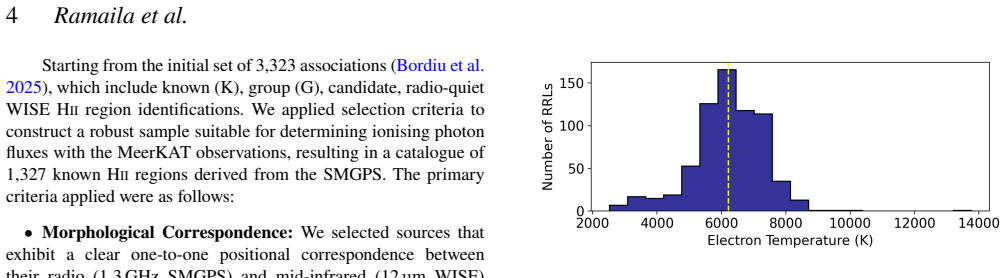
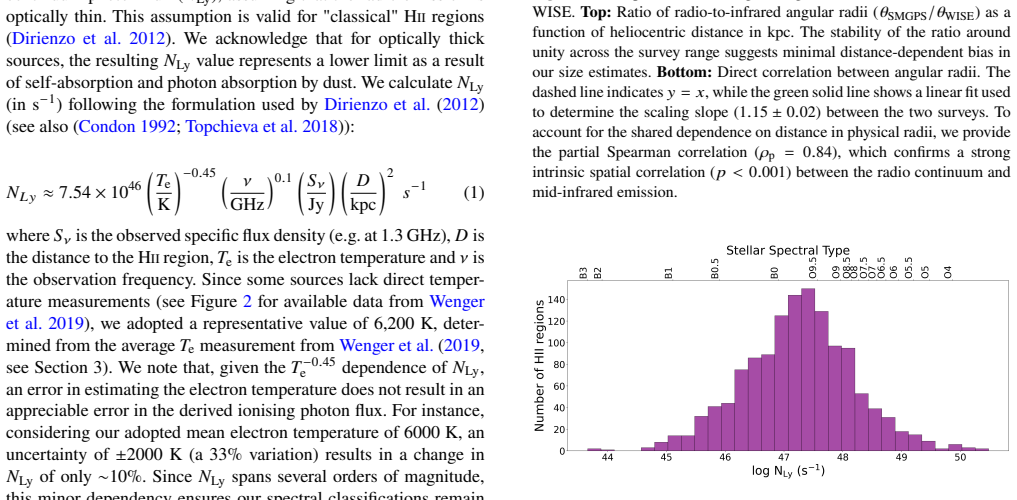
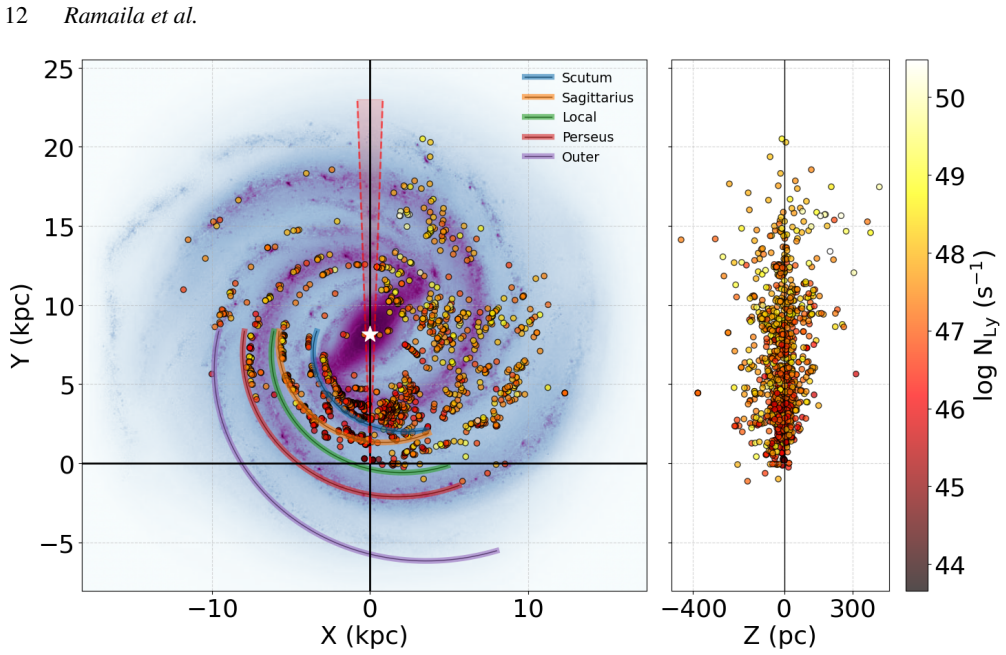
Measurements of 1,327 Galactic HII regions show B0 stars as the typical ionizers with mean log N_Ly of 47.5 s^{-1}.
A machine-rendered reading of the paper's core claim, the machinery that carries it, and where it could break.
Core claim
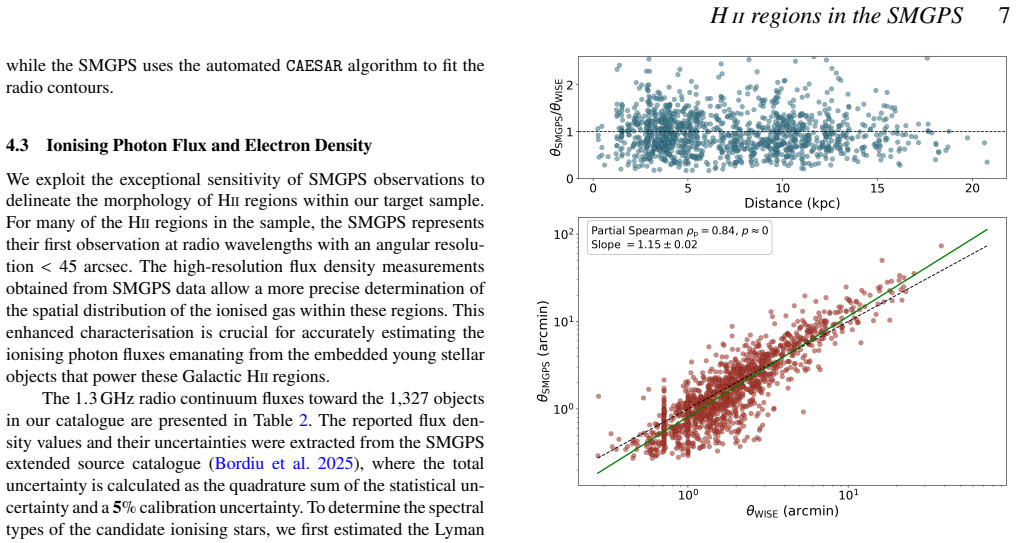
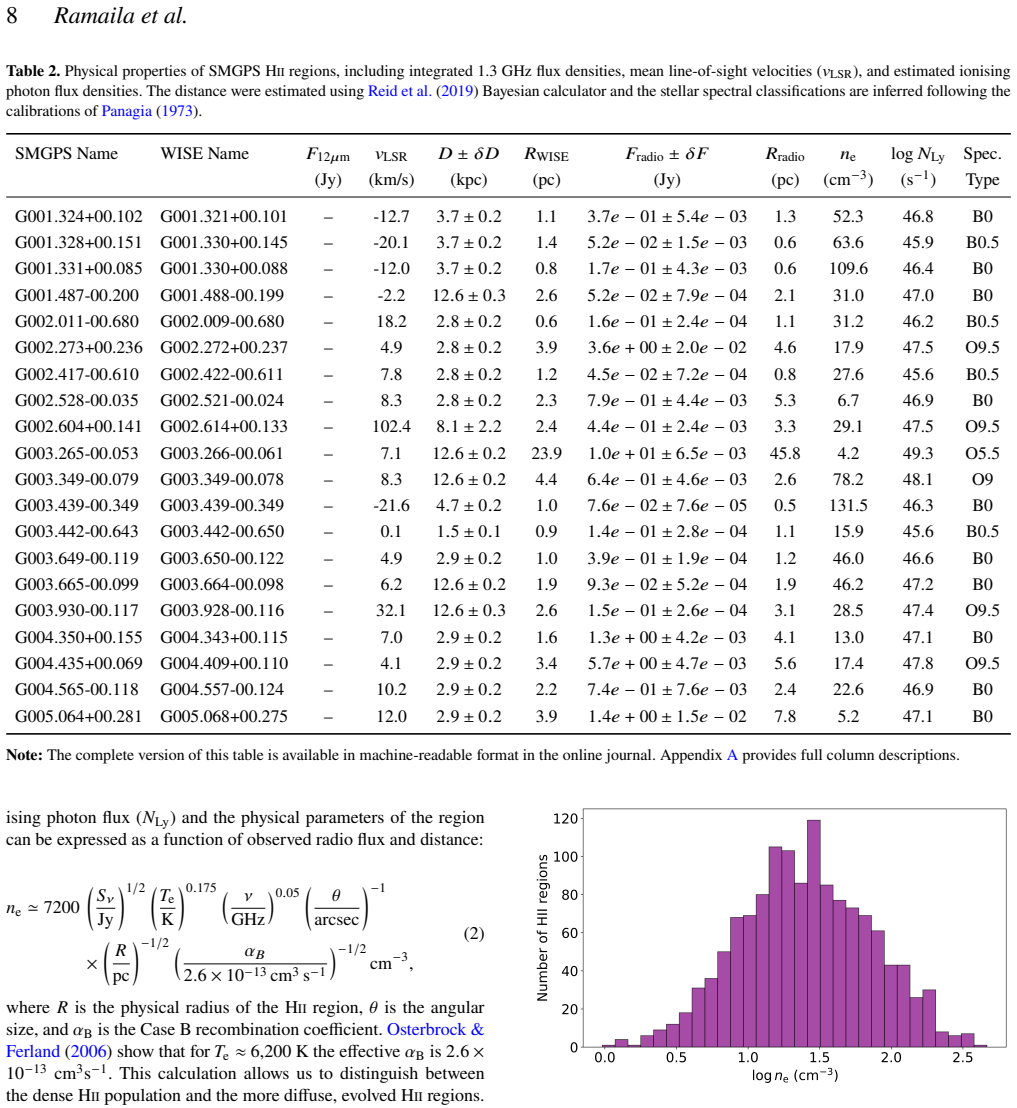
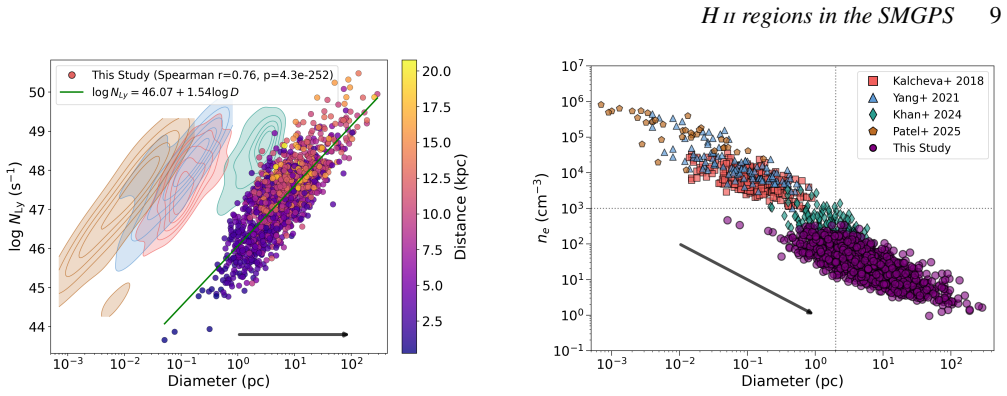
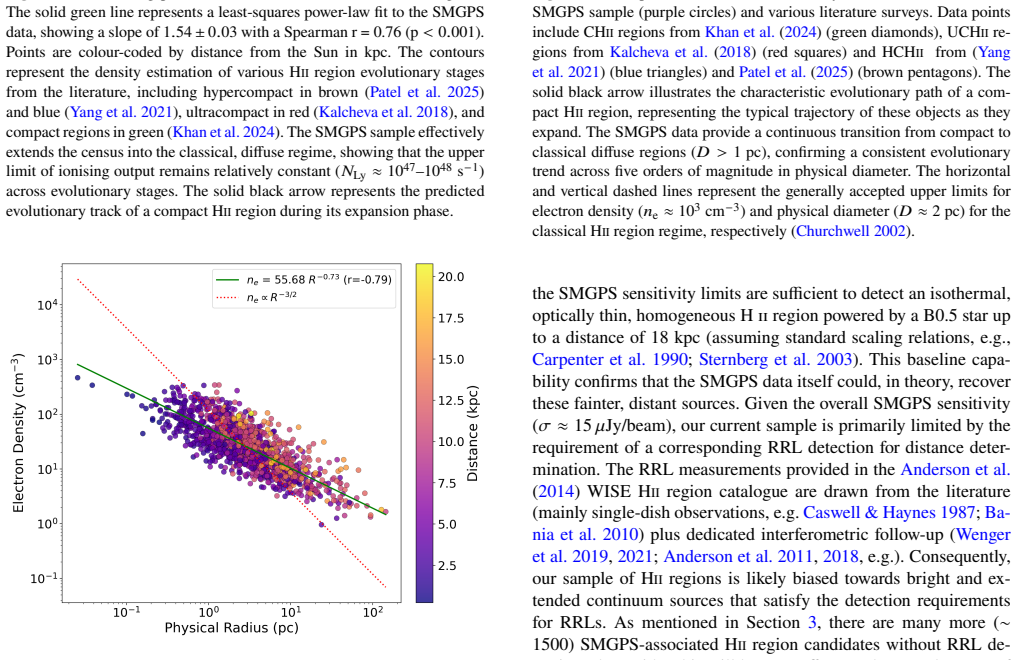
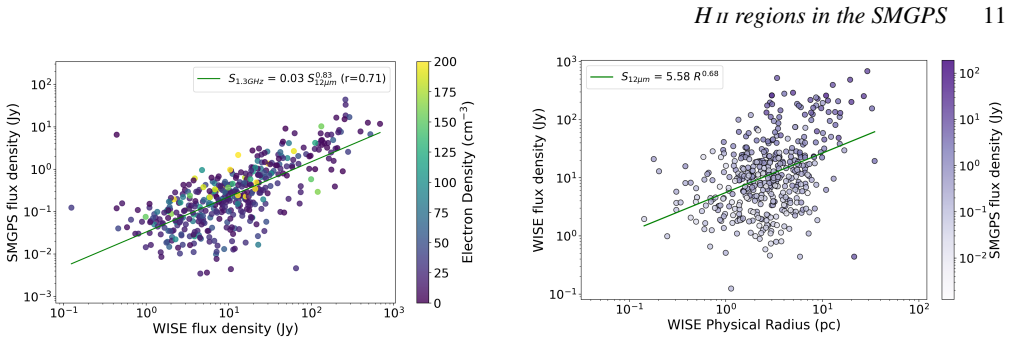
Wide-field 1.3 GHz continuum data yield distances and Lyman-photon fluxes N_Ly for 1,327 Galactic HII regions. The ionizing stellar spectral types range from B3 to O4, with B0 stars forming 40 percent of the sample and a mean log(N_Ly) equal to 47.5 s^{-1}. The physical radius measured at 1.3 GHz correlates with the mid-infrared radius at a slope of 1.15 plus or minus 0.02. N_Ly follows a power-law relation with radius while electron density scales as n_e proportional to R to the power of -0.73. No significant correlation appears between N_Ly and Galactocentric distance.
What carries the argument
Derivation of Lyman-photon flux N_Ly from integrated 1.3 GHz flux density together with assigned distance, used to classify ionizing stellar spectral types and to test scaling relations with radius and density.
If this is right
- B0 stars constitute the dominant ionizing population, corresponding to a mean log(N_Ly) of 47.5 s^{-1}.
- Physical radii at radio and infrared wavelengths are related by a near-linear power law with slope 1.15 plus or minus 0.02.
- Electron density declines with radius according to n_e proportional to R^{-0.73}.
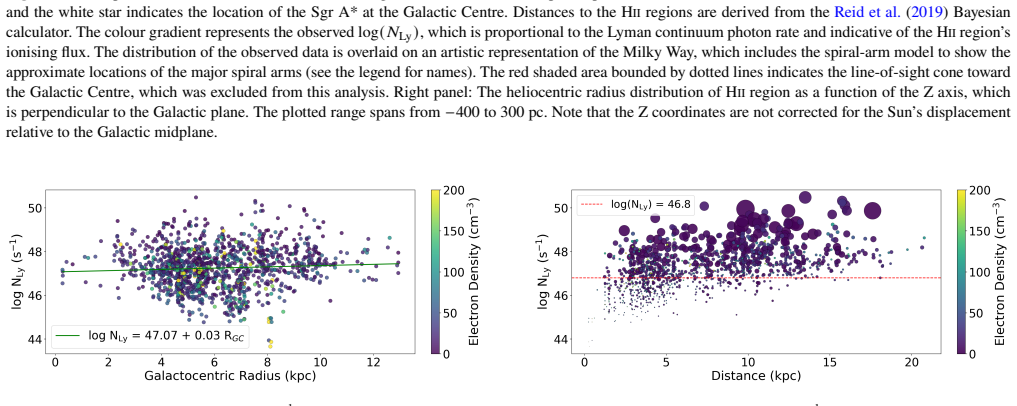
- N_Ly shows no correlation with Galactocentric distance, indicating control by local rather than global Galactic factors.
- An effective completeness limit exists near log(N_Ly) approximately 46.8 s^{-1} for sources without recombination line velocities.
Where Pith is reading between the lines
- If local environments govern HII region properties, then simulations of massive-star feedback should emphasize small-scale density and turbulence over disk-wide gradients.
- The tight radio-infrared radius correlation offers a route to size estimates for HII regions using only infrared data when radio coverage is incomplete.
- Obtaining recombination line velocities for the fainter sources would test whether the reported completeness limit can be pushed lower and would enlarge the sample of low-luminosity regions.
Load-bearing premise
That the 1.3 GHz radio emission can be treated as purely thermal free-free radiation from HII regions without appreciable non-thermal contamination or source confusion, and that distances remain accurate for faint sources that lack radio recombination line velocities.
What would settle it
A substantial fraction of the 1,327 sources showing non-thermal spectral indices between 1.3 GHz and another frequency, or systematic mismatches between the assigned distances and independent kinematic or parallax measurements, would invalidate the reported N_Ly values and spectral types.
Figures
read the original abstract
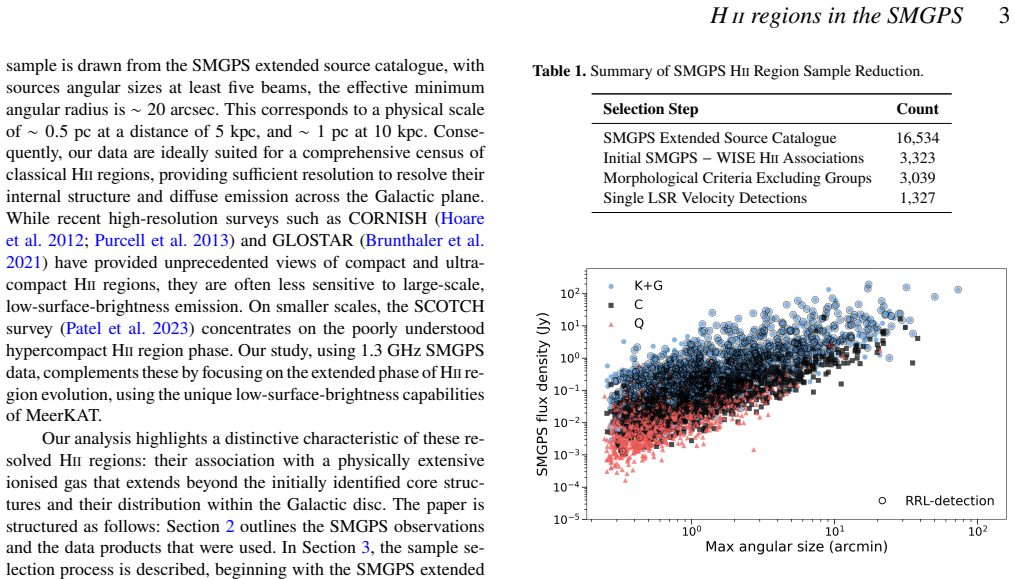
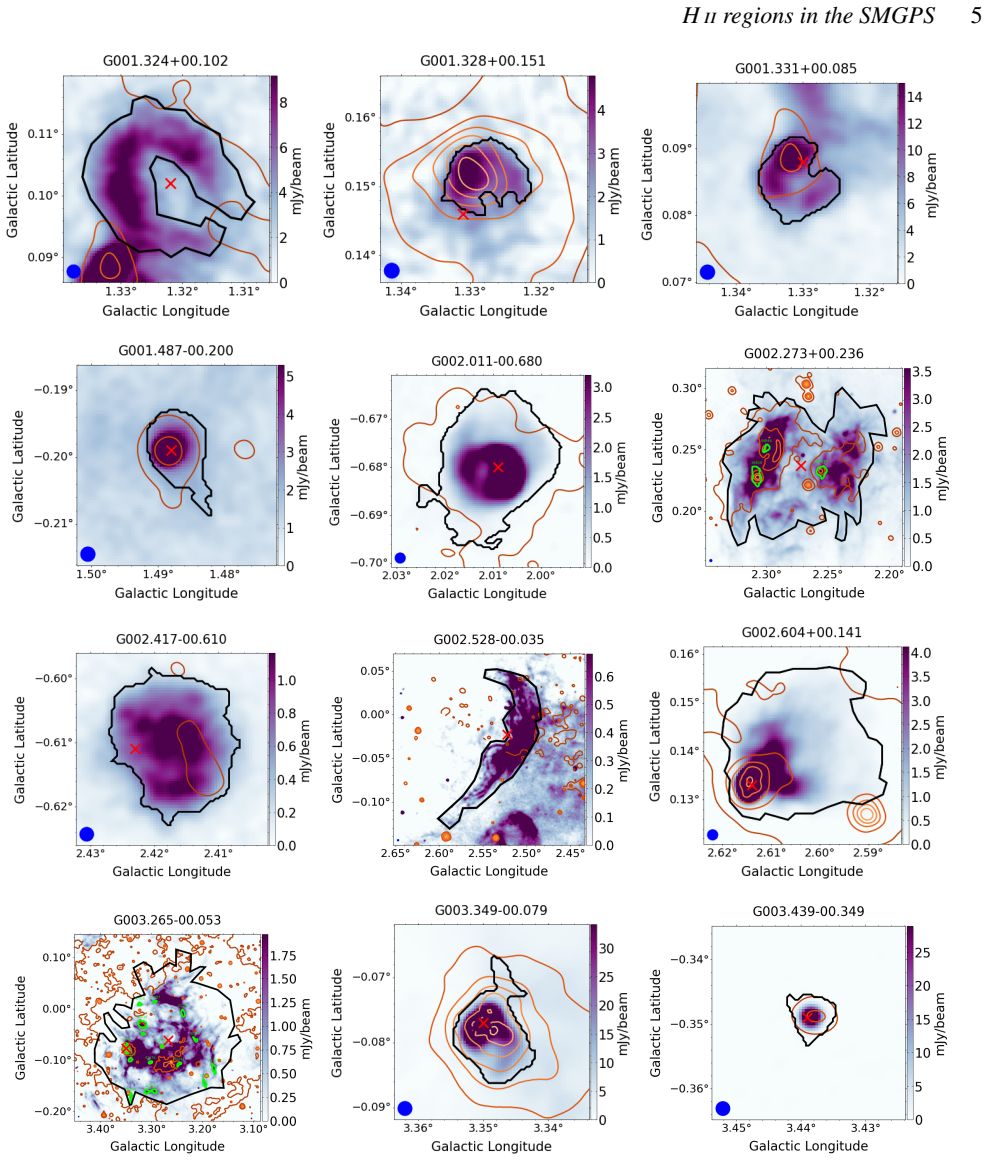
We present a study of ionised hydrogen ($\textrm{H}\scriptstyle\mathrm{II}$) regions in the Galactic Plane using data from the SARAO MeerKAT Galactic Plane Survey (SMGPS). The SMPGS is a wide-field, wide-band 1.3 GHz radio continuum survey ($251^\circ \leq l \leq 358^\circ$ and $2^\circ \leq l \leq 61^\circ$ at $\quad |b| \leq 1^\circ.5$) that has enabled us to trace the diffuse emission enveloping recently formed massive stars. Our multifrequency synthesis images reveal faint and extended emission that was previously overlooked by $\textrm{H}\scriptstyle\mathrm{II}$ region surveys. We report the distances and Lyman-photon flux ($N_{\mathrm{Ly}}$) measurements for 1,327 Galactic $\textrm{H}\scriptstyle\mathrm{II}$ regions from which we characterise the spectral types for candidate ionising stars. The spectral types range from B3 to O4. The typical stellar spectral type responsible for ionisation is the B0, which constitutes about $\text{40 %}$ of our catalogue, corresponding to a mean $\log(N_{\mathrm{Ly}}) = 47.5\ \mathrm{s}^{-1}$. Moreover, as a result of the lack of radio recombination line (RRL) velocity measurements for faint $\textrm{H}\scriptstyle\mathrm{II}$ regions, we identify the effective completeness limit at $\log(N_{\mathrm{Ly}}) \approx 46.8\ \mathrm{s}^{-1}$. The multiwavelength approach reveals that the physical radius at 1.3 GHz and in the mid-infrared are well correlated with a slope of $1.15 \pm 0.02$. We find clear power-law relations between $N_{\mathrm{Ly}}$ and physical radius, and an inverse correlation between electron density and radius ($n_{\rm e} \propto R^{-0.73}$). However, no significant correlation is observed between the $N_{\mathrm{Ly}}$ and Galactocentric distance, suggesting that the observed trends are governed primarily by local star-forming environments rather than large-scale Galactic gradients.
Editorial analysis
A structured set of objections, weighed in public.
Referee Report
Summary. The paper reports distances and Lyman-photon fluxes (N_Ly) for 1,327 Galactic HII regions identified in the SMGPS 1.3 GHz continuum survey, deriving spectral types of candidate ionizing stars (B3 to O4, with B0 comprising ~40% and mean log(N_Ly)=47.5 s^{-1}). It identifies an effective completeness limit at log(N_Ly)≈46.8 due to missing RRL velocities for faint sources, and presents power-law correlations including physical radius at 1.3 GHz vs. mid-IR (slope 1.15±0.02), N_Ly-radius relations, and n_e ∝ R^{-0.73}, with no significant N_Ly-Galactocentric distance correlation.
Significance. If the thermal free-free assumption and distance assignments hold, the large sample and reported multiwavelength correlations would provide a useful empirical baseline for extended HII region properties and local star-formation conditions. The radius-IR correlation and inverse density-radius relation are potentially reusable results, but the headline spectral-type statistics and completeness limit rest on distance-dependent quantities whose uncertainties are not fully propagated.
major comments (2)
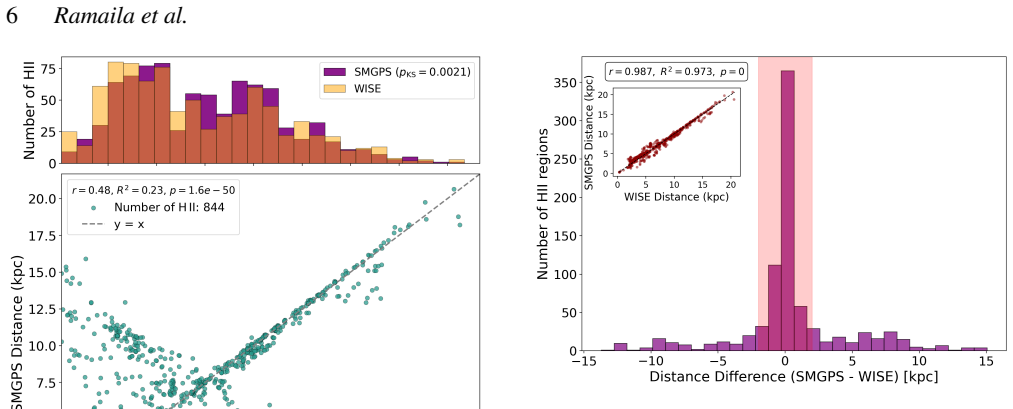
- [Abstract and distance/N_Ly sections] Abstract and distance/N_Ly derivation sections: The reported 40% B0 fraction and mean log(N_Ly)=47.5 are derived from N_Ly values for the full sample, yet the abstract explicitly notes that faint sources lack RRL velocities and distances must rely on other methods (HI absorption, masers, photometric). Since N_Ly scales as S_ν d², unquantified distance errors for this ~40% subset directly affect the spectral-type distribution and mean value; no error budget or sensitivity test for this subset is described.
- [Completeness and correlation sections] Completeness and correlation sections: The effective completeness limit at log(N_Ly)≈46.8 and the reported power-law relations (radius-IR slope 1.15, n_e ∝ R^{-0.73}) are constructed from the same distance-dependent N_Ly and radius values. Without explicit propagation of distance uncertainties for the no-RRL sources or a baseline comparison using only RRL-confirmed sources, these derived quantities risk systematic bias.
minor comments (2)
- [Abstract] Clarify in the abstract or methods the exact fraction of sources with vs. without RRL velocities and the specific distance methods applied to each.
- [Results on correlations] The notation for electron density (n_e) and radius (R) in the inverse correlation should be defined consistently with any equations or tables presenting the fit.
Simulated Author's Rebuttal
We thank the referee for their careful reading and constructive comments on our manuscript. We agree that the impact of distance uncertainties on the non-RRL subset merits explicit quantification and will revise the paper to include sensitivity tests and subsample comparisons as detailed below.
read point-by-point responses
-
Referee: [Abstract and distance/N_Ly sections] Abstract and distance/N_Ly derivation sections: The reported 40% B0 fraction and mean log(N_Ly)=47.5 are derived from N_Ly values for the full sample, yet the abstract explicitly notes that faint sources lack RRL velocities and distances must rely on other methods (HI absorption, masers, photometric). Since N_Ly scales as S_ν d², unquantified distance errors for this ~40% subset directly affect the spectral-type distribution and mean value; no error budget or sensitivity test for this subset is described.
Authors: We acknowledge this limitation in the submitted version. The non-RRL distances follow standard literature methods (HI absorption, masers, photometric parallaxes) whose typical fractional uncertainties are documented in the cited references, but we did not propagate them into the reported statistics or perform a sensitivity test. In revision we will add a Monte Carlo analysis that perturbs distances for the ~40% non-RRL sources within their estimated errors and reports the resulting range on the B0 fraction and mean log(N_Ly). revision: yes
-
Referee: [Completeness and correlation sections] Completeness and correlation sections: The effective completeness limit at log(N_Ly)≈46.8 and the reported power-law relations (radius-IR slope 1.15, n_e ∝ R^{-0.73}) are constructed from the same distance-dependent N_Ly and radius values. Without explicit propagation of distance uncertainties for the no-RRL sources or a baseline comparison using only RRL-confirmed sources, these derived quantities risk systematic bias.
Authors: We agree that a direct comparison to the RRL-confirmed subsample is valuable. The completeness limit is observationally defined by the lack of RRL detections for faint sources rather than by distance per se, but N_Ly and radius do depend on distance. In the revised manuscript we will (i) repeat the power-law fits on the RRL-only subsample and (ii) propagate distance uncertainties via Monte Carlo resampling of the non-RRL sources to assess stability of the reported slopes and the completeness threshold. revision: yes
Circularity Check
Observational catalogue with empirical correlations; no derivation reduces to inputs by construction
full rationale
The paper reports direct measurements of distances and N_Ly for 1327 HII regions from 1.3 GHz continuum, derives spectral types, and presents empirical correlations (radius-MIR slope 1.15, N_Ly-radius power law, n_e ∝ R^{-0.73}). The completeness limit at log(N_Ly)≈46.8 is identified from the absence of RRL velocities in faint sources, not from any fitted model or self-referential prediction. No equations, self-citations, or ansatzes are shown that would make derived quantities equivalent to inputs by construction. The work is self-contained against external benchmarks as a data-driven catalogue.
Axiom & Free-Parameter Ledger
Reference graph
Works this paper leans on
-
[1]
, year = 1939, month = may, volume =
The Physical State of Interstellar Hydrogen. , year = 1939, month = may, volume =. doi:10.1086/144074 , adsurl =
-
[2]
1978 , publisher=
Physical Processes in the Interstellar Medium , author=. 1978 , publisher=
1978
-
[3]
1979 , publisher=
Radiative Processes in Astrophysics , author=. 1979 , publisher=
1979
-
[4]
Astrophysics of gaseous nebulae and active galactic nuclei
-
[5]
The Green Bank Telescope Galactic H II Region Discovery Survey
The Green Bank Telescope Galactic H II Region Discovery Survey. , keywords =. doi:10.1088/2041-8205/718/2/L106 , archivePrefix =. 1006.5929 , primaryClass =
work page internal anchor Pith review Pith/arXiv arXiv doi:10.1088/2041-8205/718/2/l106 2041
-
[6]
The Southern H II Region Discovery Survey. II. The Full Catalog. , keywords =. doi:10.3847/1538-4365/abf4d4 , archivePrefix =. 2103.12199 , primaryClass =
-
[7]
Complete search for hypercompact H II regions in the fourth quadrant
SCOTCH - III. Complete search for hypercompact H II regions in the fourth quadrant. , keywords =. doi:10.1093/mnras/staf450 , archivePrefix =. 2506.02737 , primaryClass =
-
[8]
Massive Star Birth: A Crossroads of Astrophysics , year = 2005, editor =
Hypercompact HII regions. Massive Star Birth: A Crossroads of Astrophysics , year = 2005, editor =. doi:10.1017/S1743921305004424 , adsurl =
-
[9]
, keywords =
The spiral structure of our Galaxy determined from H II regions. , keywords =
-
[10]
The coordinated radio and infrared survey for high-mass star formation. III. A catalogue of northern ultra-compact H II regions. , keywords =. doi:10.1051/0004-6361/201832734 , archivePrefix =. 1803.09334 , primaryClass =
work page internal anchor Pith review Pith/arXiv arXiv doi:10.1051/0004-6361/201832734
-
[11]
Galactic H II region catalog using radio recombination lines
A global view on star formation: The GLOSTAR Galactic plane survey: X. Galactic H II region catalog using radio recombination lines. , keywords =. doi:10.1051/0004-6361/202449390 , archivePrefix =. 2407.05770 , primaryClass =
-
[12]
The WISE Catalog of Galactic HII Regions
The WISE Catalog of Galactic H II Regions. , keywords =. doi:10.1088/0067-0049/212/1/1 , archivePrefix =. 1312.6202 , primaryClass =
work page internal anchor Pith review Pith/arXiv arXiv doi:10.1088/0067-0049/212/1/1
-
[13]
The SARAO MeerKAT 1.3 GHz Galactic Plane Survey. , keywords =. doi:10.1093/mnras/stae1166 , archivePrefix =. 2312.07275 , primaryClass =
-
[14]
The nebulae around LBVs: a multiwavelength approach
The nebulae around LBVs: a multiwavelength approach. Bulletin de la Societe Royale des Sciences de Liege , keywords =. doi:10.48550/arXiv.1011.3730 , archivePrefix =. 1011.3730 , primaryClass =
work page internal anchor Pith review Pith/arXiv arXiv doi:10.48550/arxiv.1011.3730
-
[15]
MeerKAT Science: On the Pathway to the SKA , year = 2016, month = jan, eid =
The MeerKAT Radio Telescope. MeerKAT Science: On the Pathway to the SKA , year = 2016, month = jan, eid =. doi:10.22323/1.277.0001 , adsurl =
-
[16]
, year = 1953, month = nov, volume =
A Catalogue of Emission Nebulae Near the Galactic Plane. , year = 1953, month = nov, volume =. doi:10.1086/145765 , adsurl =
-
[17]
, year = 1955, month = jan, volume =
A Survey of Southern HII Regions. , year = 1955, month = jan, volume =
1955
-
[18]
, year = 1959, month = oct, volume =
On the Possibility of Detection of Allowed Lines of Atomic Hydrogen in the Radio-Frequency Spectrum. , year = 1959, month = oct, volume =
1959
-
[19]
Science , year = 1965, month = oct, volume =
Hydrogen Emission Line n _ 110 --> n _ 109 : Detection at 5009 Megahertz in Galactic H II Regions. Science , year = 1965, month = oct, volume =. doi:10.1126/science.150.3694.339 , adsurl =
-
[20]
, year = 1970, month = mar, volume =
A Survey of H1O9 Recombination Line Emission in Galactic HII Regions of the Northern Sky. , year = 1970, month = mar, volume =
1970
-
[21]
, keywords =
H110alpha and H2CO survey of galactic radio sources. , keywords =
-
[22]
, keywords =
Southern HII regions: an extensive study of radio recombination line emission. , keywords =
-
[23]
The Southern H II Region Discovery Survey. I. The Bright Catalog. , keywords =. doi:10.3847/1538-4365/aaf8ba , archivePrefix =. 1812.05003 , primaryClass =
work page internal anchor Pith review Pith/arXiv arXiv doi:10.3847/1538-4365/aaf8ba
-
[24]
American Astronomical Society Meeting Abstracts \#217 , year = 2011, series =
The GBT Galactic HII Region Discovery Survey Source Catalog. American Astronomical Society Meeting Abstracts \#217 , year = 2011, series =
2011
-
[25]
American Astronomical Society Meeting Abstracts \#217 , year = 2011, series =
Galactic Structure As Probed By The GBT HRDS. American Astronomical Society Meeting Abstracts \#217 , year = 2011, series =
2011
-
[26]
American Astronomical Society Meeting Abstracts \#219 , year = 2012, series =
Locating New Sites of Massive Star Formation With WISE. American Astronomical Society Meeting Abstracts \#219 , year = 2012, series =
2012
-
[27]
The Arecibo HII Region Discovery Survey
The Arecibo H II Region Discovery Survey. , keywords =. doi:10.1088/0004-637X/759/2/96 , archivePrefix =. 1209.4848 , primaryClass =
work page internal anchor Pith review Pith/arXiv arXiv doi:10.1088/0004-637x/759/2/96
-
[28]
The Galactic Center Lobe as an H II Region. , keywords =. doi:10.3847/1538-4357/ad4d93 , archivePrefix =. 2405.11054 , primaryClass =
-
[29]
Finding Distant Galactic HII Regions
Finding Distant Galactic HII Regions. , keywords =. doi:10.1088/0067-0049/221/2/26 , archivePrefix =. 1510.07347 , primaryClass =
work page internal anchor Pith review Pith/arXiv arXiv doi:10.1088/0067-0049/221/2/26
-
[30]
A Green Bank Telescope Survey of Large Galactic HII Regions
A Green Bank Telescope Survey of Large Galactic H II Regions. , keywords =. doi:10.3847/1538-4365/aa956a , archivePrefix =. 1710.07397 , primaryClass =
work page internal anchor Pith review Pith/arXiv arXiv doi:10.3847/1538-4365/aa956a
-
[31]
The Southern HII Region Discovery Survey (SHRDS): Pilot Survey
The Southern H II Region Discovery Survey (SHRDS): Pilot Survey. , keywords =. doi:10.3847/1538-3881/aa71a7 , archivePrefix =. 1705.08610 , primaryClass =
work page internal anchor Pith review Pith/arXiv arXiv doi:10.3847/1538-3881/aa71a7
-
[32]
The Wide-field Infrared Survey Explorer (WISE): Mission Description and Initial On-orbit Performance
The Wide-field Infrared Survey Explorer (WISE): Mission Description and Initial On-orbit Performance. , keywords =. doi:10.1088/0004-6256/140/6/1868 , archivePrefix =. 1008.0031 , primaryClass =
work page internal anchor Pith review Pith/arXiv arXiv doi:10.1088/0004-6256/140/6/1868
-
[33]
Preliminary Results from NEOWISE: An Enhancement to the Wide-field Infrared Survey Explorer for Solar System Science. , keywords =. doi:10.1088/0004-637X/731/1/53 , archivePrefix =. 1102.1996 , primaryClass =
work page internal anchor Pith review Pith/arXiv arXiv doi:10.1088/0004-637x/731/1/53 1996
-
[34]
The 1.28 GHz MeerKAT DEEP2 Image. , keywords =. doi:10.3847/1538-4357/ab5d2d , archivePrefix =. 1912.06212 , primaryClass =
-
[35]
The MeerKAT Galaxy Cluster Legacy Survey. I. Survey Overview and Highlights. , keywords =. doi:10.1051/0004-6361/202141488 , archivePrefix =. 2111.05673 , primaryClass =
-
[36]
, year = 2008, month = apr, volume =
Obit: A Development Environment for Astronomical Algorithms. , year = 2008, month = apr, volume =. doi:10.1086/586754 , adsurl =
-
[37]
Cuc(aesar) source finder: Recent developments and testing. , keywords =. doi:10.1017/pasa.2019.29 , archivePrefix =. 1909.06116 , primaryClass =
-
[38]
Continuum sources from the THOR survey between 1 and 2 GHz
Continuum sources from the THOR survey between 1 and 2 GHz. , keywords =. doi:10.1051/0004-6361/201527697 , archivePrefix =. 1601.03427 , primaryClass =
work page internal anchor Pith review Pith/arXiv arXiv doi:10.1051/0004-6361/201527697
-
[39]
Ultracompact HII regions: the impact of newly formed massive stars on their environment. , keywords =. doi:10.1007/BF00872764 , adsurl =
-
[40]
Ultra-Compact HII Regions and Massive Star Formation. , keywords =. doi:10.1146/annurev.astro.40.060401.093845 , adsurl =
-
[41]
, year = 1973, month = nov, volume =
Some Physical parameters of early-type stars. , year = 1973, month = nov, volume =. doi:10.1086/111498 , adsurl =
-
[42]
A Compact Array imaging survey of southern bright-rimmed clouds
A Compact Array imaging survey of southern bright-rimmed clouds. , keywords =. doi:10.1051/0004-6361:20031681 , archivePrefix =. astro-ph/0311041 , primaryClass =
work page internal anchor Pith review Pith/arXiv arXiv doi:10.1051/0004-6361:20031681
-
[43]
Cometary globules. III. Triggered star formation in IC 1848. , keywords =
-
[44]
The Morphologies and Physical Properties of Ultracompact H II Regions. , keywords =. doi:10.1086/191329 , adsurl =
-
[45]
Automated detection of extended sources in radio maps: progress from the SCORPIO survey
Automated detection of extended sources in radio maps: progress from the SCORPIO survey. , keywords =. doi:10.1093/mnras/stw982 , archivePrefix =. 1605.01852 , primaryClass =
work page internal anchor Pith review Pith/arXiv arXiv doi:10.1093/mnras/stw982
-
[46]
The SARAO MeerKAT Galactic Plane Survey extended source catalogue. , keywords =. doi:10.1051/0004-6361/202450356 , archivePrefix =. 2502.15640 , primaryClass =
-
[47]
The Infrared and Radio Fluxes Densities of Galactic HII Regions
The Infrared and Radio Flux Densities of Galactic H II regions. , keywords =. doi:10.3847/1538-4357/aa84b6 , archivePrefix =. 1708.05359 , primaryClass =
work page internal anchor Pith review Pith/arXiv arXiv doi:10.3847/1538-4357/aa84b6
-
[48]
A Parallax-based Distance Estimator for Spiral Arm Sources
A Parallax-based Distance Estimator for Spiral Arm Sources. , keywords =. doi:10.3847/0004-637X/823/2/77 , archivePrefix =. 1604.02433 , primaryClass =
work page internal anchor Pith review Pith/arXiv arXiv doi:10.3847/0004-637x/823/2/77
-
[49]
Trigonometric Parallaxes of High-mass Star-forming Regions: Our View of the Milky Way. , keywords =. doi:10.3847/1538-4357/ab4a11 , archivePrefix =. 1910.03357 , primaryClass =
-
[50]
The new I. A. U. system of galactic coordinates (1958 revision). , year = 1960, month = jan, volume =. doi:10.1093/mnras/121.2.123 , adsurl =
-
[51]
The physical and chemical structure of Sagittarius B2. IV. Converging filaments in the high-mass cluster forming region Sgr B2(N). , keywords =. doi:10.1051/0004-6361/201935200 , archivePrefix =. 1906.10979 , primaryClass =
work page internal anchor Pith review Pith/arXiv arXiv doi:10.1051/0004-6361/201935200 1906
-
[52]
ATLASGAL --- properties of compact HII regions and their natal clumps
ATLASGAL - properties of compact H II regions and their natal clumps. , keywords =. doi:10.1093/mnras/stt1310 , archivePrefix =. 1307.4105 , primaryClass =
work page internal anchor Pith review Pith/arXiv arXiv doi:10.1093/mnras/stt1310
-
[53]
The Spectral Type of the Ionizing Stars and the Infrared Fluxes of HII Regions
The Spectral Type of the Ionizing Stars and the Infrared Fluxes of HII Regions. Astronomy Reports , keywords =. doi:10.1134/S1063772918110082 , archivePrefix =. 1811.09093 , primaryClass =
work page internal anchor Pith review Pith/arXiv arXiv doi:10.1134/s1063772918110082
-
[54]
Schuller, F. and Menten, K. M. and Contreras, Y. and Wyrowski, F. and Schilke, P. and Bronfman, L. and Henning, T. and Walmsley, C. M. and Beuther, H. and Bontemps, S. and Cesaroni, R. and Deharveng, L. and Garay, G. and Herpin, F. and Lefloch, B. and Linz, H. and Mardones, D. and Minier, V. and Molinari, S. and Motte, F. and Nyman, L.-Å. and Reveret, V. ...
-
[55]
Hoare, M. G. and Purcell, C. R. and Churchwell, E. B. and Diamond, P. and Cotton, W. D. and Chandler, C. J. and Smethurst, S. and Kurtz, S. E. and Mundy, L. G. and Dougherty, S. M. and Fender, R. P. and Fuller, G. A. and Jackson, J. M. and Garrington, S. T. and Umana, G. and Urquhart, J. S. and Zijlstra, A. A. , title = ". Publications of the Astronomical...
-
[56]
Purcell, C. R. and Hoare, M. G. and Cotton, W. D. and Lumsden, S. L. and Urquhart, J. S. and Churchwell, E. B. and Diamond, P. and Dougherty, S. M. and Fender, R. P. and Fuller, G. A. and Gledhill, T. M. and Jackson, J. M. and Kurtz, S. E. and Marti, J. and Moore, T. J. T. and Mundy, L. G. and Muxlow, T. W. B. and Oudmaijer, R. D. and Pandian, J. D. and P...
-
[57]
Beuther, H. and Bihr, S. and Rugel, M. and Walsh, A. J. and Bronfman, L. and Johnston, K. and others , title = ". Astronomy & Astrophysics. 2016. doi:10.1051/0004-6361/201628796
-
[58]
Classification of compact radio sources in the Galactic plane with supervised machine learning. , keywords =. doi:10.1017/pasa.2024.26 , archivePrefix =. 2402.15232 , primaryClass =
-
[59]
The SARAO MeerKAT Galactic Plane survey compact source catalogue. , keywords =. doi:10.1093/mnras/staf1849 , archivePrefix =. 2510.23707 , primaryClass =
-
[60]
Testing Triggered Star Formation in Six H II Regions
Testing Triggered Star Formation in Six H II Regions. , keywords =. doi:10.1088/0004-6256/144/6/173 , archivePrefix =. 1210.2647 , primaryClass =
work page internal anchor Pith review Pith/arXiv arXiv doi:10.1088/0004-6256/144/6/173
-
[61]
Condon, J. J. Radio Emission from Normal Galaxies. Annual Review of Astronomy and Astrophysics. 1992. doi:https://doi.org/10.1146/annurev.aa.30.090192.003043
-
[62]
The 1.28 GHz MeerKAT Galactic Center Mosaic. , keywords =. doi:10.3847/1538-4357/ac449a , archivePrefix =. 2201.10541 , primaryClass =
-
[63]
The MeqTrees software system and its use for third-generation calibration of radio interferometers
The MeqTrees software system and its use for third-generation calibration of radio interferometers. , keywords =. doi:10.1051/0004-6361/201015013 , archivePrefix =. 1101.1745 , primaryClass =
work page internal anchor Pith review Pith/arXiv arXiv doi:10.1051/0004-6361/201015013
-
[64]
Star Formation in the Milky Way and Nearby Galaxies
Star Formation in the Milky Way and Nearby Galaxies. , keywords =. doi:10.1146/annurev-astro-081811-125610 , archivePrefix =. 1204.3552 , primaryClass =
work page internal anchor Pith review Pith/arXiv arXiv doi:10.1146/annurev-astro-081811-125610
-
[65]
Molecular clouds and star formation toward the Galactic plane within 216.25 l 218.75 and -0.75 b 1.25. , keywords =. doi:10.1051/0004-6361/201527334 , archivePrefix =. 1602.00460 , primaryClass =
work page internal anchor Pith review Pith/arXiv arXiv doi:10.1051/0004-6361/201527334
-
[66]
Radio Continuum and Recombination Line Study of UC HII Regions with Extended Envelopes
Radio Continuum and Recombination Line Study of Ultracompact H II Regions with Extended Envelopes. , keywords =. doi:10.1086/319447 , archivePrefix =. astro-ph/0010535 , primaryClass =
work page internal anchor Pith review Pith/arXiv arXiv doi:10.1086/319447
-
[67]
A multi-wavelength study of Galactic H II regions with extended emission. , keywords =. doi:10.1051/0004-6361/202450043 , archivePrefix =. 2407.04123 , primaryClass =
-
[68]
Expanded Very Large Array Observations of the Nebula Around G79.29+0.46. , keywords =. doi:10.1088/2041-8205/739/1/L11 , adsurl =
-
[69]
A deep/wide 1-2 GHz snapshot survey of SDSS Stripe 82 using the Karl G. Jansky Very Large Array in a compact hybrid configuration. , keywords =. doi:10.1093/mnras/stw1250 , archivePrefix =. 1605.09079 , primaryClass =
work page internal anchor Pith review Pith/arXiv arXiv doi:10.1093/mnras/stw1250
-
[70]
Ultracompact H II Regions. II. New High-Resolution Radio Images. , keywords =. doi:10.1086/191952 , adsurl =
-
[71]
Beyond the Solar Circle $-$ Trends in Massive Star Formation Between the Inner and Outer Galaxy
Beyond the solar circle - trends in massive star formation between the inner and outer galaxy. , keywords =. doi:10.1093/mnras/stz1262 , archivePrefix =. 1905.01714 , primaryClass =
work page internal anchor Pith review Pith/arXiv arXiv doi:10.1093/mnras/stz1262 1905
-
[72]
Physics of the interstellar medium
-
[73]
doi:10.1201/9780585368115 , adsurl =
The physics of the interstellar medium. doi:10.1201/9780585368115 , adsurl =
-
[74]
The SARAO MeerKAT Galactic Plane Survey filamentary source catalogue. , keywords =. doi:10.1093/mnras/stae2690 , archivePrefix =. 2412.07852 , primaryClass =
-
[75]
The Green Bank Telescope H II Region Discovery Survey. III. Kinematic Distances. , keywords =. doi:10.1088/0004-637X/754/1/62 , archivePrefix =. 1205.4228 , primaryClass =
work page internal anchor Pith review Pith/arXiv arXiv doi:10.1088/0004-637x/754/1/62
-
[76]
SCORPIO: A deep survey of Radio Emission from the stellar life-cycle
SCORPIO: a deep survey of radio emission from the stellar life-cycle. , keywords =. doi:10.1093/mnras/stv1976 , archivePrefix =. 1506.04531 , primaryClass =
work page internal anchor Pith review Pith/arXiv arXiv doi:10.1093/mnras/stv1976
-
[77]
Their Physics and Astronomical Applications
Radio Recombination Lines. Their Physics and Astronomical Applications. doi:10.1007/978-0-387-09604-9 , publisher =
-
[78]
, year = 2015, month = aug, volume =
Molecular Clouds in the Milky Way. , year = 2015, month = aug, volume =. doi:10.1146/annurev-astro-082214-122324 , adsurl =
-
[79]
, year = 1970, month = jul, volume =
Carbon Monoxide in the Orion Nebula. , year = 1970, month = jul, volume =. doi:10.1086/180567 , adsurl =
-
[80]
, year = 1970, month = jan, volume =
H109 Recombination Line Measurements of the W 51 Region. , year = 1970, month = jan, volume =
1970
discussion (0)
Sign in with ORCID, Apple, or X to comment. Anyone can read and Pith papers without signing in.