REVIEW 3 major objections 3 minor
A sampling-based retargeter cuts jitter and raises success in real-time hand teleoperation for robots.
Reviewed by Pith at T0; open to challenge. T0 means a machine referee read the full paper against a public rubric. the ladder, T0–T4 →
T0 review · grok-4.5
2026-07-15 09:53 UTC pith:ZBHADDBX
load-bearing objection Useful systems claim for low-jitter hand retargeting backed by an 18-person study, but we only have the abstract so the method and causal story stay opaque. the 3 major comments →
Smooth Operator: A Real-Time Sampling-Based Algorithm for Kinematic Hand Retargeting
The pith
A machine-rendered reading of the paper's core claim, the machinery that carries it, and where it could break.
Core claim
A gradient-free, sampling-based kinematic retargeter (SBR) yields lower jitter, higher task success (54.1 percent), and lower NASA-TLX workload (36.4/100) than gradient-based baselines when mapping human hand motion onto a robot hand in real time, as measured in an 18-participant study of three complex manipulation tasks.
What carries the argument
Sampling-Based Retargeter (SBR): a real-time, gradient-free optimizer that draws candidate joint configurations from sampling-based control principles and selects the one that best matches the human hand pose while preserving temporal smoothness.
Load-bearing premise
The measured gains in success rate and reduced workload are caused by the sampling-based algorithm itself rather than by interface details, hardware calibration, practice order, or the particular choice of three tasks and eighteen participants.
What would settle it
An independent replication of the same three tasks with a new cohort that uses identical hardware and interfaces but finds no statistically significant advantage for SBR over the gradient baselines on success rate or NASA-TLX would falsify the central claim.
If this is right
- Demonstration datasets collected with SBR should contain fewer discontinuous joint trajectories, raising the quality ceiling for VLA and VAM training.
- Teleoperators can sustain longer sessions before fatigue, increasing the volume of usable data per hour of human time.
- Future retargeting papers can adopt the paper's three-task, multi-metric protocol as a shared benchmark rather than inventing ad-hoc tests.
- Real-time control stacks that previously avoided gradient-based retargeters because of jitter now have a practical alternative that stays under real-time budgets.
Where Pith is reading between the lines
- Because the method is sampling-based, it may remain usable on robots whose kinematics produce non-differentiable contact or under-actuated joints where gradients are hard to define.
- The same sampling loop could be extended to multi-finger force or impedance retargeting once contact sensors become standard on teleoperation hands.
- If jitter is the dominant noise source in current demonstration corpora, simply re-retargeting archived human motion with SBR might improve downstream policy performance without new human collection.
Editorial analysis
A structured set of objections, weighed in public.
Referee Report
Summary. The manuscript (assessed from the abstract alone) proposes Sampling-Based Retargeter (SBR), a gradient-free, sampling-based kinematic hand retargeting algorithm intended for low-jitter, real-time teleoperation. Motivated by jitter and local-minima issues in gradient-based retargeters that degrade demonstration quality for learning-based manipulators (VLA/VAM), the authors claim SBR is drawn from sampling-based control and is evaluated in simulation plus an 18-participant real-world user study on three complex manipulation tasks. Relative to gradient-based baselines, SBR is reported to achieve the highest overall task success rate (54.1%) and the lowest NASA-TLX workload (36.4/100), and the work is positioned as both an effective retargeter and a rigorous benchmarking methodology for future retargeting research.
Significance. If the full results hold under scrutiny, a real-time, low-jitter, gradient-free kinematic retargeter that measurably improves task success and reduces operator workload would be practically valuable for collecting higher-quality teleoperation data that upper-bounds VLA/VAM performance. Explicit community benchmarking methodology would also be a useful contribution. These claims cannot yet be credited as established, because the full algorithm, cost/sampling design, statistics, and protocol are not available in the material under review.
major comments (3)
- Abstract only: the central algorithmic claim (SBR as a novel gradient-free sampling-based retargeter with low jitter in real time) is not accompanied by any sampling distribution, cost function, constraint handling, or timing/complexity statement. Without those load-bearing definitions, superiority over gradient baselines cannot be assessed for correctness, novelty relative to sampling-based control, or real-time feasibility.
- Abstract, user-study claims (54.1% success; NASA-TLX 36.4/100; N=18; 3 tasks): point estimates are given without error bars, statistical tests, multiple-comparison correction, or protocol details (counterbalancing, practice, calibration, interface identity across conditions). Causal attribution of gains to the retargeting algorithm itself versus confounds is therefore not yet supported.
- Abstract, 'rigorous benchmarking methodology' claim: no task definitions, success criteria, baseline implementations, ablation of sampling vs. other design choices, or simulation-to-real protocol are provided. The benchmarking contribution cannot be evaluated or reused from the available text.
minor comments (3)
- Abstract: 'highest overall task success rate (54.1%)' and 'lowest NASA-TLX (36.4/100)' should state the comparator set and whether scores are means, medians, or aggregates across tasks/participants.
- Abstract: 'significantly reducing operator cognitive fatigue' uses 'significantly' without indicating a statistical test; prefer precise language until tests are reported.
- Abstract: expand or define SBR on first use in a way that distinguishes it from generic sampling-based MPC/control so readers can place the contribution.
Circularity Check
No circularity: abstract-only empirical systems claim rests on external user study, not self-referential derivation.
full rationale
The available material is only the abstract of an empirical robotics paper. It introduces SBR as a gradient-free sampling-based kinematic retargeter and reports comparative results (54.1% task success, NASA-TLX 36.4) from an 18-participant real-world study against gradient-based baselines. There are no equations, fitted parameters renamed as predictions, uniqueness theorems, or load-bearing self-citations that reduce a claimed derivation to its own inputs. The central claims are experimental outcomes, not first-principles results forced by construction. Per the hard rules, an abstract-only empirical claim that does not exhibit self-definitional or fitted-input circularity scores 0; residual concerns about causal attribution or post-hoc metric framing are correctness/external-validity issues, not circularity.
Axiom & Free-Parameter Ledger
free parameters (1)
- unspecified SBR sampling/cost hyperparameters
axioms (3)
- domain assumption Sampling-based control methods from the existing literature can be adapted to produce real-time, low-jitter kinematic hand retargeting superior to gradient-based local optimization.
- domain assumption Task success rate and NASA-TLX scores on three complex manipulation tasks with 18 participants are valid primary metrics of retargeter quality for downstream learning-based manipulation.
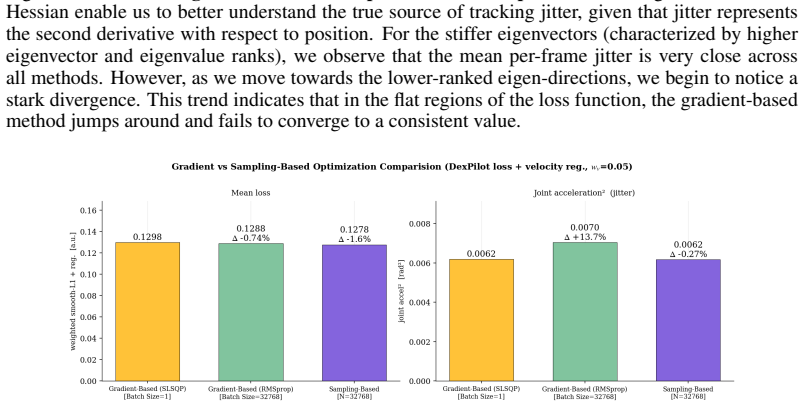
- domain assumption Gradient-based retargeters' convergence to different local minima is the dominant source of jitter that degrades teleoperation data and experience.
read the original abstract
Advances in learning-based robotic manipulation, such as Vision-Language-Action (VLA) models and Video Action Models (VAMs), heavily rely on high-quality teleoperation data. Their capabilities are strictly upper-bounded by the quality of the underlying human demonstrations. Current gradient-based retargeting algorithms often converge to different local minima, resulting in jitter that affects data quality and teleoperation experience. To address this, we introduce the Sampling-Based Retargeter (SBR), a novel gradient-free retargeting method drawn from the rich literature of sampling-based control and explicitly designed for low-jitter, real-time kinematic retargeting. We evaluate SBR both in simulation and through a rigorous real-world user study involving 18 participants performing 3 complex manipulation tasks. Compared to gradient-based baselines, SBR achieved the highest overall task success rate (54.1%) while significantly reducing operator cognitive fatigue, recording the lowest NASA-TLX workload score (36.4 out of 100). Ultimately, we establish SBR as a highly effective, intuitive retargeter for dexterous manipulation, providing the community with a rigorous benchmarking methodology to guide future retargeting research.
Figures



discussion (0)
Sign in with ORCID, Apple, or X to comment. Anyone can read and Pith papers without signing in.