REVIEW 3 major objections 4 minor 297 references
A small lunar farside radio telescope could survey the quiet sky before satellite traffic spoils it.
Reviewed by Pith at T0; open to challenge. T0 means a machine referee read the full paper against a public rubric. the ladder, T0–T4 →
T0 review · deepseek-v4-flash
2026-08-01 01:33 UTC pith:ZBNH7WWY
load-bearing objection A credible mission-concept white paper with a solid farside environmental premise, but the 'closing window' argument leans entirely on an unpublished satellite-traffic model — referee should ask for the model and a closed data/power budget. the 3 major comments →
The Lunar Farside Transients and Technology Telescope (LFT3) Mission
The pith
A machine-rendered reading of the paper's core claim, the machinery that carries it, and where it could break.
Core claim
The paper's central claim is that the lunar farside's permanently Earth-shielded zone is the only place where the full low-frequency radio spectrum can be observed cleanly, and that a modest, commercially launched lander can exploit it before the environment degrades. It asserts that the lunar RFI environment in 2030 will be equivalent to Earth's in the early 1960s—quieter than when the Wow! signal was recorded—making this mission a 'time machine' for radio astronomy. The mission is designed to land at a specific shielded-zone site, coordinate with a neighboring farside lander, and deliver a 300–2700 MHz multibeam UHF survey plus HF/VHF coverage, with all data relayed through a lunar orbiter
What carries the argument
The physical mechanism that carries the argument is the Shielded Zone of the Moon: the hemisphere permanently turned away from Earth, which blocks terrestrial transmitters and the ionosphere, opening frequencies below ~30 MHz that are otherwise inaccessible. The instrument that exploits this is a three-band radio telescope on a commercial lander: a 48-element dual-polarization Vivaldi UHF array (300–2700 MHz) with a Blass-matrix beamformer producing 10 steerable beams; HF (0.1–50 MHz) and VHF (60–260 MHz) antennas; and three FPGA spectrometers with an on-demand GPU for high-resolution technosignature searches. This architecture is explicitly sized to the constraints of a ~100 kg payload, ~10
Load-bearing premise
The entire urgency story rests on an unpublished forecast that lunar-orbiting satellites will be continuously visible from the farside starting in mid-2028; if that forecast is wrong, the 'once in human history' framing collapses.
What would settle it
Track the real lunar-orbital traffic between now and 2028 and compute the fraction of time at least one satellite is above the proposed landing site's horizon. If continuous visibility does not begin by mid-2028, the paper's premise fails; alternatively, prove that the ~278 GB of data generated per lunar cycle cannot be lossily compressed into the 100 GB/month budget without losing the stated science products.
If this is right
- If the mission launches by 2030, it would produce the first complete, RFI-free low-frequency spectral map of the sky, a permanent baseline for all future cislunar radio observations.
- Technosignature searches would become unambiguous: a narrowband signal detected in this environment would not need the on/off subtraction and RFI-vetoing used on Earth.
- The HF and VHF bands would open the last unexplored region of the electromagnetic spectrum, enabling solar, planetary, and exoplanet studies that are physically impossible from the ground.
- As an incumbent user of the microwave spectrum, the mission would create a regulatory precedent for protecting the lunar farside's radio-quiet zone as human activity grows there.
- Coordinated observation with a neighboring farside lander could separate true astrophysical signals from lunar-regolith effects, which is critical for global 21-cm cosmology.
Where Pith is reading between the lines
- The 'only mission' claim is narrower than it sounds: the paper itself notes another lander is scheduled for nearly the same site in 2027 and a rover has operated on the farside since 2019. What genuinely sets this proposal apart is the wideband 0.1–2700 MHz survey, not farside access per se.
- If the unpublished satellite-traffic projection is wrong in either direction, the urgency framing changes but the science does not; a farside telescope would still be valuable as the quietest observational platform available.
- The 100 GB/month downlink is the true constraint; the paper's reliance on 'possibly lossy' compression means the delivered science will hinge on how well reduced data products preserve transient and spectral fidelity.
- The mission implicitly proposes the lunar farside as a natural radio observatory; a testable extension would be to quantify, using the same satellite-population model, how quickly a full radio-quiet reserve disappears once the first lunar-orbiting communication constellations are deployed.
Editorial analysis
A structured set of objections, weighed in public.
Referee Report
Summary. The paper presents a mission concept, LFT3, a ~$150M CLPS-class lunar lander with a ~100 kg science payload to be deployed near the lunar antipode before 2030. It plans a 0.1–2700 MHz spectral survey using a 48-element dual-polarization UHF array plus HF/VHF antennas, motivated by the ITU-designated Shielded Zone of the Moon and the absence of a lunar ionosphere. The science case spans technosignatures, transients, solar-system emission, spectral lines, cosmology, and RF-environment monitoring, and the paper argues that the farside RFI environment is currently unique but will degrade quickly as lunar satellite traffic grows.
Significance. If the timing, data-return, and payload assumptions hold, LFT3 would provide a broad-band, RFI-free spectral baseline for the lunar farside and open new low-frequency parameter space for technosignature and transient searches. The environmental premise is well supported by external literature and ITU regulation, and the paper is commendably specific about the payload architecture, operations concept, and public memo/data repositories. I also see no internal circularity: no headline result reduces to a fitted value. The manuscript's central quantitative claim, however, rests on an unpublished satellite-population projection, while the data-rate budget exceeds the stated downlink. These points need to be resolved before the 'unique window in human history' argument can carry the paper.
major comments (3)
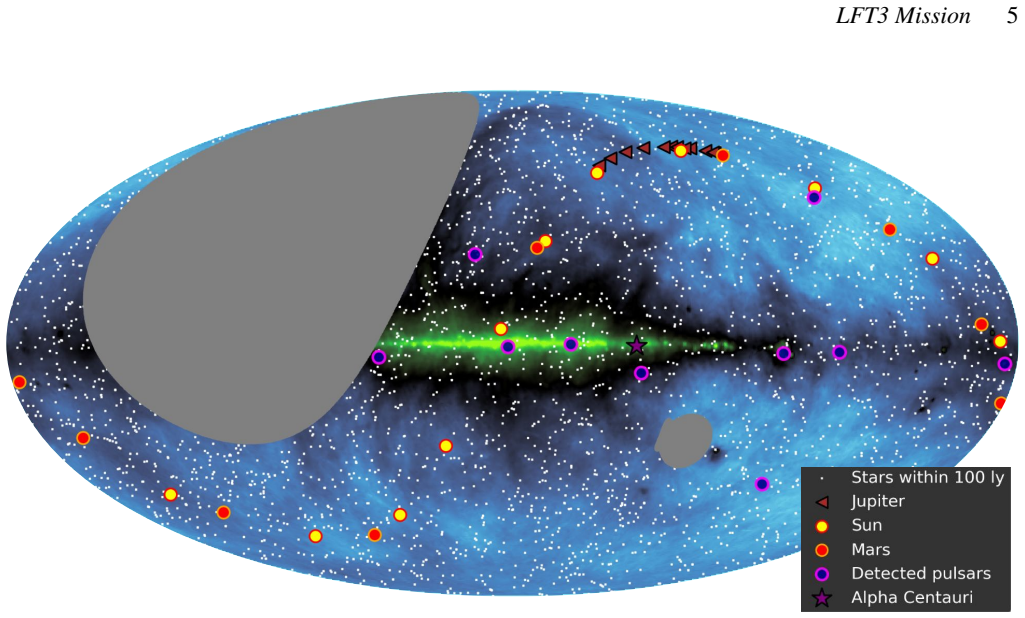
- [§2, Fig. 1] The load-bearing urgency claim — 'Beginning in mid-2028, there are significant periods of time when there will always be at least one satellite above the horizon' and the '2030 ≈ 1960s Earth' analogy — is attributed only to Ashe et al. (2026, in preparation). No equations, orbital-population assumptions, satellite lifetimes, or sensitivity analysis are shown. Overestimates and underestimates of this projection both undermine the stated mission rationale. Moreover, the paper's own timeline has LFT3 launching before 2030, i.e., after the projected onset, so the manuscript should define what level of RFI is still scientifically acceptable. Please either include the model's assumptions and validation or explicitly reframe the urgency claim as conditional and qualitative.
- [Abstract; §3.7.1] The unqualified statement that 'LFT3 is the only mission proposed to go to the lunar farside and exploit this unique opportunity' is contradicted by the paper's own text: §3.4 notes that LuSEE-Night should launch in early 2027 and land near the same site, §3.7.1 mentions Chang'e 4 operating on the farside since 2019 and China's planned DSL interferometer, and Fig. 3 shows Chang'e 4 and Chang'e 6 landing sites nearby. The uniqueness claim should be restricted to the specific combination of a full HF/VHF/UHF surface survey and coordinated RFI monitoring, or revised.
- [Table 4; §4.1] The stated data products total roughly 278 GB per 28-day lunar cycle (255.6 GB dynamic spectra, 20 GB baseband, plus catalogs and metadata), while the downlink budget is 100 GB/month. The manuscript acknowledges that 'possibly lossy' compression could close the gap, but gives no compression ratio, fidelity requirements, or effect on the science products. Since completing the survey before the RFI environment degrades is one of the mission's two hard constraints, this data-rate budget needs to be closed quantitatively or the observational program must be explicitly descoped.
minor comments (4)
- [§3.1.1] The sentence beginning 'In addition, interplanetary scintillation (IPS) observations from the lunar farside were obtained. could be used...' is grammatically broken and appears to be a fragment from an earlier draft. Please rephrase.
- [§2] The first sentence 'The lunar farside represents a unique opportunity in human history for quiet, high-quality observations (Heidmann 2002; Bassett et al. 2020; Michaud et al. 2020)' is missing a closing period before the next sentence. There are also several minor typographical errors elsewhere (e.g., 'intergrations', 'emisisons', 'bandwiths').
- [§3.4] The coordinated observations with LuSEE-Night are described as desirable, but the paper does not quantify the likelihood that LuSEE-Night will still be operating when LFT3 arrives, given that LFT3 is scheduled for launch before 2030 while LuSEE-Night launches in early 2027. The coordination benefits should be presented as contingent on LuSEE-Night lifetime.
- [References] Several load-bearing references are 'in preparation' (Ashe et al. 2026; LuSEE-Night Collaboration 2026; Haymore et al. 2026; Gajjar & Brown 2025). At least for the central timing model, a public preprint or a summary appendix in this paper is needed; otherwise the reader cannot verify the main quantitative premise.
Circularity Check
Timing premise rests on an unpublished self-cited satellite-population model; the '2030 = 1960s' equivalence is definitional, but no scientific result reduces to a fit.
specific steps
-
self citation load bearing
[§2 and Figure 1 bottom panel; References (Ashe et al. 2026)]
"To characterize this growth, Figure 1 (bottom panel) shows the number of satellites above the horizon for a projection of orbits and lifetimes for the currently planned missions. Beginning in mid-2028, there are significant periods of time when there will always be at least one satellite above the horizon, and typically there will be many. ... (Ashe et al. 2026). References: Ashe C., Marshall E., DeBoer D., Keane E., 2026, Modeling RFI on the Lunar Farside, in preparation"
The paper's central urgency claim — that the RFI-free window closes from mid-2028 — is supported only by 'Ashe et al. 2026, in preparation,' a paper whose four authors (Ashe, Marshall, DeBoer, Keane) are co-authors of this manuscript. No equations, input assumptions, or sensitivity analysis for the projection are given in the present paper, so the load-bearing timing premise cannot be checked or reproduced from the manuscript itself. This is self-citation used as the sole evidentiary basis for a central argument, not an independent, reproducible result.
-
self definitional
[Figure 1 caption and inset]
"The red curve/top axis is a projection of lunar-orbiting satellites, matched to the historical earth-orbiting record, indicating that we still have an opportunity to make these new measurements in the RFI environment of an earlier era. ... the projected RFI environment on the lunar farside in 2030 is equivalent to that of the early 1960s on Earth"
The '2030 ≈ early 1960s' equivalence is not an independently derived finding; it is produced by matching the lunar-satellite timeline to the historical Earth-satellite timeline, so the equivalence holds by construction of the axis matching rather than by measurement or model output. The 'time travel' analogy is therefore a normalization chosen to illustrate the narrative, not a quantitative prediction.
full rationale
The manuscript is a mission white paper rather than a derivation paper, so the most common circularity patterns (fitted input called prediction, ansatz smuggled in via citation, uniqueness imported from authors) do not apply. The science projections rest on standard sensitivity relations, external catalogs (ATNF, Gaia), and published flux densities, which are independent of this paper's own outputs. The scientific payload description is self-contained against external benchmarks. The principal circular/self-referential element is the timing premise: the claim that the lunar farside RFI environment degrades starting in mid-2028 is sourced solely to Ashe et al. (2026, in preparation), authored by four co-authors of this paper, with no equations or sensitivity analysis reproduced here. This is self-citation made load-bearing for the mission's urgency argument, though it does not constitute a statistical 'prediction from a fit' of the paper's own data. I additionally flag the '2030 = 1960s' equivalence as definitional because it arises from matching timelines rather than from a derived quantity. The abstract's 'only mission' claim is contradicted by the paper's own text (LuSEE-Night landing nearby in early 2027, Chang'e 4 on the farside since 2019, DSL as a planned lunar-orbiting interferometer), but that inconsistency is a correctness/accuracy issue rather than circularity and is not scored as a circular step. Overall, no scientific result reduces to its inputs by construction; the timing/urgency claim is the self-referential part, giving a score of 4 rather than higher.
Axiom & Free-Parameter Ledger
free parameters (3)
- Lunar satellite growth projection (Figure 1) =
mid-2028 onset of continuous ≥1 satellite above horizon; '2030 ≈ 1960s Earth'
- Science payload budgets (Table 2) =
day 100 W / night 20 W / comms 100 GB per month / 20 TB storage
- UHF array configuration =
48 dual-pol Vivaldi elements, 18 cm spacing, 10 dual-pol beams, 0.1–2700 MHz coverage
axioms (5)
- domain assumption The lunar farside shielded zone is essentially free of anthropogenic RFI today and will remain so until the projected satellite growth.
- domain assumption The sensitivity curves (Fig. 2) and detection-threshold estimates (Figs. 6, 7) are correct.
- domain assumption Lunar regolith electromagnetic properties at the landing site do not destroy the low-frequency antenna response below ~50 MHz.
- domain assumption Science-target flux models (Jupiter HOM/DAM, SKR, UKR from Zarka et al. 2012; exoplanet auroral predictions from Grießmeier 2017) are reliable order-of-magnitude inputs.
- domain assumption A launch before 2030 is feasible within the ~$150M CLPS budget and the proposed 20-week lunar night/day survival.
read the original abstract
We present here an overview of the Lunar Farside Transients and Technology Telescope (LFT3) mission to take advantage of the extremely clear radio frequency environment on the lunar farside. Radio observations performed from the lunar farside effectively and fully mitigate two unavoidable limitations of terrestrial-based radio telescopes: (i) the prevalence of interfering radio transmitters from human activity; and (ii) the impact of the Earth's ionosphere. However, in the era of cost-effective access to the Moon, there are many scheduled lunar missions over the next few years, and the window of opportunity to perform radio interference-free observations from the lunar farside is closing fast. LFT3 is the only mission proposed to go to the lunar farside and exploit this unique opportunity in human history. LFT3 will observe in an uncluttered radio environment to conduct unambiguous technosignature searches, transient surveys, solar physics and planetary emissions studies, spectral line observations, and cosmological science observations. LFT3 will provide an important incumbent use of the microwave spectrum for cislunar radio astronomy.
Figures




Reference graph
Works this paper leans on
-
[3]
Planetary Radio Emissions VIII , year = 2017, editor =
The Saturnian kilometric radiation before the Cassini Grand Finale. Planetary Radio Emissions VIII , year = 2017, editor =. doi:10.1553/PRE8s171 , archivePrefix =. 1709.07693 , primaryClass =
Pith/arXiv arXiv 2017
-
[4]
, year = 2012, month = dec, volume =
Planetary and exoplanetary low frequency radio observations from the Moon. , year = 2012, month = dec, volume =. doi:10.1016/j.pss.2012.08.004 , adsurl =
-
[5]
Earth-based detection of Uranus' aurorae. , keywords =. doi:10.1029/2012GL051312 , adsurl =
-
[6]
Planetary, Solar and Heliospheric Radio Emissions IX , year = 2023, editor =
Comparative visibility of planetary auroral radio emissions and implications for the search for exoplanets. Planetary, Solar and Heliospheric Radio Emissions IX , year = 2023, editor =. doi:10.25546/103091 , adsurl =
doi:10.25546/103091 2023
-
[7]
A 1.1-1.9 GHz SETI Survey of the Kepler Field. I. A Search for Narrow-band Emission from Select Targets. , keywords =. doi:10.1088/0004-637X/767/1/94 , archivePrefix =. 1302.0845 , primaryClass =
-
[8]
Detecting Extraterrestrial Civilizations that Employ an Earth-level Deep Space Network. , keywords =. doi:10.3847/2041-8213/adf6b0 , archivePrefix =. 2508.15425 , primaryClass =
Pith/arXiv arXiv 2041
-
[9]
Robinson, M. S. and Brylow, S. M. and Tschimmel, M. and Humm, D. and Lawrence, S. J. and Thomas, P. C. and Denevi, B. W. and Bowman-Cisneros, E. and Zerr, J. and Ravine, M. A. and Caplinger, M. A. and Ghaemi, F. T. and Schaffner, J. A. and Malin, M. C. and Mahanti, P. and Bartels, A. and Anderson, J. and Tran, T. N. and Eliason, E. M. and McEwen, A. S. an...
2010
-
[10]
2026 , month = mar, day =
2026
-
[11]
and Amato, M
Neal, Clive R. and Amato, M. , title =. 2020 , month = aug, day =
2020
-
[12]
4-8 GHz Spectrotemporal Emission from the Galactic Center Magnetar PSR J1745-2900. ApJ , keywords =. doi:10.3847/1538-4357/ac1d45 , archivePrefix =. 2108.05404 , primaryClass =
-
[13]
Wright and Shubham Kanodia and Emily Lubar , title =
Jason T. Wright and Shubham Kanodia and Emily Lubar , title =. doi:10.3847/1538-3881/aae099 , url =
-
[14]
A Radio Technosignature Search of TRAPPIST-1 with the Allen Telescope Array. AJ , keywords =. doi:10.3847/1538-3881/ad823c , archivePrefix =. 2409.08313 , primaryClass =
-
[15]
The Astronomical Journal , year=
A Narrowband Technosignature Search Toward the Hycean Candidate K2-18b Using the VLA and MeerKAT , author=. The Astronomical Journal , year=. 2602.09553 , archivePrefix=
-
[16]
Stellar Surface Inhomogeneities as a Potential Source of the Atmospheric Signal Detected in the K2-18b Transmission Spectrum. AJ , keywords =. doi:10.3847/1538-3881/ac2824 , archivePrefix =. 2109.14608 , primaryClass =
-
[17]
Carbon-bearing Molecules in a Possible Hycean Atmosphere. ApJl , keywords =. doi:10.3847/2041-8213/acf577 , archivePrefix =. 2309.05566 , primaryClass =
Pith/arXiv arXiv 2041
-
[18]
Modified Wideband Blass Matrix Beamformer for the Lunar Farside Technosignatures and Transients Telescope (LFT3) , author=. Proc. 2026 IEEE International Symposium on Antennas and Propagation (AP-S), Detroit, MI, 12-17 July , pages=. 2026 , organization=
2026
-
[19]
Space Science Review , year =
LuSEE-Night: Analog and Digital Spectrometer Subsystem , author =. Space Science Review , year =
-
[20]
and Rutherford, Benjamin B.W
Slater, Windy S. and Rutherford, Benjamin B.W. and Mee, Jesse K. and Pinson, Ryan E. and Gruber, Matthew and Sabogal, Daniel and Troxel, Ian A. , booktitle=. Single Event Effects and Total Ionizing Dose Radiation Testing of NVIDIA Jetson Orin AGX System on Module , year=
-
[21]
Koribalski, B. S. et al. , title =. Ap&SS , year =
-
[22]
Meyer, M. et al. , title =. PASA , year =
-
[23]
The Milky Way in Molecular Clouds: A New Complete CO Survey. , eprint =. doi:10.1086/318388 , adsurl =
-
[24]
A Model-independent Radio Telescope Dark Matter Search in the L and S Bands. , keywords =. doi:10.3847/2041-8213/adc9aa , adsurl =
-
[25]
Revisiting rotationally excited CH at radio wavelengths: A case study towards W51. , keywords =. doi:10.1051/0004-6361/202449603 , archivePrefix =. 2411.08193 , primaryClass =
-
[26]
A first look for molecules between 103 and 133 MHz using the Murchison Widefield Array. , keywords =. doi:10.1093/mnras/stx1838 , archivePrefix =. 1707.06009 , primaryClass =
-
[27]
ARCADE 2 Observations of Galactic Radio Emission. , keywords =. doi:10.1088/0004-637X/734/1/4 , archivePrefix =. 0901.0562 , primaryClass =
-
[28]
The Radio Background below 100 MHz. , keywords =. doi:10.3847/2041-8213/aabf86 , archivePrefix =. 1804.08581 , primaryClass =
Pith/arXiv arXiv 2041
-
[29]
Nitric Oxide and Other Molecules: Molecular Modeling and Low-frequency Exploration Using the Murchison Widefield Array. , keywords =. doi:10.3847/1538-4357/abc33a , archivePrefix =. 2010.09868 , primaryClass =
Pith/arXiv arXiv 2010
-
[30]
Axion dark matter: What is it and why now?. Science Advances , keywords =. doi:10.1126/sciadv.abj3618 , archivePrefix =. 2105.01406 , primaryClass =
-
[31]
Exploration of the polarization angle variability of the Crab Nebula with POLARBEAR and its application to the search for axionlike particles. , keywords =. doi:10.1103/PhysRevD.110.063013 , archivePrefix =. 2403.02096 , primaryClass =
-
[32]
A first detection of neutral hydrogen intensity mapping on Mpc scales at z 0.32 and z 0.44. arXiv e-prints , keywords =. doi:10.48550/arXiv.2301.11943 , archivePrefix =. 2301.11943 , primaryClass =
-
[33]
Deep investigation of neutral gas origins (DINGO): H I stacking experiments with early science data. , keywords =. doi:10.1093/mnras/stac3065 , archivePrefix =. 2210.09697 , primaryClass =
-
[34]
Radio frequency interference identification and mitigation using simultaneous dual-station observations. Radio Science , keywords =. doi:10.1029/2004RS003172 , archivePrefix =. astro-ph/0502149 , primaryClass =
-
[35]
GASKAP-HI pilot survey science I: ASKAP zoom observations of HI emission in the Small Magellanic Cloud. , keywords =. doi:10.1017/pasa.2021.59 , archivePrefix =. 2111.05339 , primaryClass =
Pith/arXiv arXiv 2021
-
[36]
HI4PI: A full-sky H I survey based on EBHIS and GASS. , keywords =. doi:10.1051/0004-6361/201629178 , archivePrefix =. 1610.06175 , primaryClass =
-
[37]
The Universe at Low Radio Frequencies , year = 2002, editor =
Signatures of HI in the Early Universe: The End of the Dark Ages. The Universe at Low Radio Frequencies , year = 2002, editor =
2002
-
[38]
A 2.9 hr Periodic Radio Transient with an Optical Counterpart. , keywords =. doi:10.3847/2041-8213/ad890e , archivePrefix =. 2408.15757 , primaryClass =
Pith/arXiv arXiv 2041
-
[39]
A highly magnetized long-period radio transient exhibiting unusual emission features. Science Advances , keywords =. doi:10.1126/sciadv.adp6351 , archivePrefix =. 2501.10528 , primaryClass =
-
[40]
First M87 Event Horizon Telescope Results. I. The Shadow of the Supermassive Black Hole. , keywords =. doi:10.3847/2041-8213/ab0ec7 , archivePrefix =. 1906.11238 , primaryClass =
Pith/arXiv arXiv 2041
-
[41]
Interferometric Imaging Directly with Closure Phases and Closure Amplitudes. , keywords =. doi:10.3847/1538-4357/aab6a8 , archivePrefix =. 1803.07088 , primaryClass =
-
[42]
Low-frequency Radio Recombination Lines Away from the Inner Galactic Plane. , keywords =. doi:10.3847/1538-3881/ad08ba , archivePrefix =. 2302.14185 , primaryClass =
-
[43]
VLBA astrometry of PSRs B0329+54 and B1133+16: Improved pulsar distances and comparison of global ionospheric models. arXiv e-prints , keywords =. doi:10.48550/arXiv.2506.14368 , archivePrefix =. 2506.14368 , primaryClass =
work page internal anchor Pith review Pith/arXiv arXiv doi:10.48550/arxiv.2506.14368
-
[44]
First VLBI imaging of SiO v = 0, J = 1 0 masers in VY Canis Majoris. , keywords =. doi:10.1093/pasj/psaf013 , archivePrefix =. 2503.05250 , primaryClass =
-
[45]
Exploring Compact Symmetric Objects with Complex Morphologies. , keywords =. doi:10.3847/1538-4357/adcc28 , archivePrefix =. 2503.23240 , primaryClass =
-
[46]
Constraining the photon coupling of ultra-light dark-matter axion-like particles by polarization variations of parsec-scale jets in active galaxies. , keywords =. doi:10.1088/1475-7516/2019/02/059 , archivePrefix =. 1811.10997 , primaryClass =
Pith/arXiv arXiv 2019
-
[47]
Room for New Physics in the Rayleigh-Jeans Tail of the Cosmic Microwave Background. , keywords =. doi:10.1103/PhysRevLett.121.031103 , archivePrefix =. 1803.07048 , primaryClass =
-
[48]
In Situ Measurements of Dark Photon Dark Matter Using Parker Solar Probe: Going beyond the Radio Window. , keywords =. doi:10.1103/PhysRevLett.134.171001 , archivePrefix =. 2405.12285 , primaryClass =
-
[49]
doi:10.1088/1538-3873/abf329 , archivePrefix =
The Breakthrough Listen Search for Intelligent Life: MeerKAT Target Selection. doi:10.1088/1538-3873/abf329 , archivePrefix =. 2103.16250 , primaryClass =
-
[50]
The Extended Kardashev Scale. , keywords =. doi:10.3847/1538-3881/ab792b , adsurl =
-
[51]
A Lunar Farside Low Radio Frequency Array for Dark Ages 21-cm Cosmology , author=. 2103.08623 , archivePrefix=
-
[52]
PyGDSM: Python interface to Global Diffuse Sky Models
-
[53]
Conceptual Design of the Lunar Crater Radio Telescope (LCRT) on the Far Side of the Moon , year=
Bandyopadhyay, Saptarshi and Mcgarey, Patrick and Goel, Ashish and Rafizadeh, Ramin and Delapierre, Melanie and Arya, Manan and Lazio, Joseph and Goldsmith, Paul and Chahat, Nacer and Stoica, Adrian and Quadrelli, Marco and Nesnas, Issa and Jenks, Kenneth and Hallinan, Gregg , booktitle=. Conceptual Design of the Lunar Crater Radio Telescope (LCRT) on the...
-
[54]
Zarka, P. and Pedersen, B. M. , date =. Radio detection of uranian lightning by Voyager 2 , url =. Nature , number =. 1986 , bdsk-url-1 =. doi:10.1038/323605a0 , id =
doi:10.1038/323605a0 1986
-
[55]
Results from NASA's First Radio Telescope on the Moon: Terrestrial Technosignatures and the Low-Frequency Galactic Background Observed by ROLSES-1 Onboard the Odysseus Lander. arXiv e-prints , keywords =. doi:10.48550/arXiv.2503.09842 , archivePrefix =. 2503.09842 , primaryClass =
-
[56]
LuSEE 'Night': The Lunar Surface Electromagnetics Experiment , booktitle =
-
[57]
AGU Fall Meeting Abstracts , year = 2023, volume =
The Lunar Surface Electromagnetics (LuSEE) payloads for NASA's CLPS program. AGU Fall Meeting Abstracts , year = 2023, volume =
2023
-
[58]
The Radiometric Bode's Law and Extrasolar Planets. , keywords =. doi:10.1086/422449 , adsurl =
-
[59]
The detectability of radio emission from exoplanets. , keywords =. doi:10.1093/mnras/sty1138 , archivePrefix =. 1804.11006 , primaryClass =
-
[60]
Deep radio interferometric search for decametre radio emission from the exoplanet Tau Bo \"o tis b. , keywords =. doi:10.1051/0004-6361/202452868 , archivePrefix =. 2501.06301 , primaryClass =
-
[61]
Ellingson, Steven W. RFI Mitigation and the SKA. The Square Kilometre Array: An Engineering Perspective. 2005. doi:10.1007/1-4020-3798-8_24
-
[62]
2024 , note =
ITU , title =. 2024 , note =
2024
-
[63]
Interstellar communication. VI. Searching X-ray spectra for narrowband communication. arXiv e-prints , keywords =. doi:10.48550/arXiv.1712.06639 , archivePrefix =. 1712.06639 , primaryClass =
-
[64]
Experimental Astronomy , keywords =
Ultra-low-frequency radio astronomy observations from a Seleno-centric orbit. Experimental Astronomy , keywords =. doi:10.1007/s10686-022-09887-0 , archivePrefix =. 2212.09590 , primaryClass =
-
[65]
Research Notes of the American Astronomical Society , keywords =
Breakthrough Listen Search for the WOW! Signal. Research Notes of the American Astronomical Society , keywords =. doi:10.3847/2515-5172/ac9408 , adsurl =
-
[66]
Earth Detecting Earth: At What Distance Could Earth's Constellation of Technosignatures Be Detected with Present-day Technology?. , keywords =. doi:10.3847/1538-3881/ada3c7 , archivePrefix =. 2502.02614 , primaryClass =
-
[67]
Simulation of the Earth's radio-leakage from mobile towers as seen from selected nearby stellar systems. , keywords =. doi:10.1093/mnras/stad378 , archivePrefix =. 2304.13779 , primaryClass =
-
[68]
2025 , note =
Steve Prabu and David DeBoer and Charlie Ashe , title =. 2025 , note =
2025
-
[69]
Steve Prabu and David DeBoer and Andrew P. V. Siemion and Charlie Ashe and Jake D. Turner , title =. 2026 , note =
2026
-
[70]
2025 , note =
Steve Prabu and David DeBoer and Andrew Siemion , title =. 2025 , note =
2025
-
[71]
DeBoer and Charlie K
David R. DeBoer and Charlie K. Ashe and Owen A. Johnson and Evan F. Keane and Andrew C. Lesh and Ella J. Marshall and Steve Prabu and Kaia L. Reenock and Anze Slosar and Chenoa D. Tremblay and Jake D. Turner and Karl F. Warnick and Andrew P. V. Siemion and Jamie Drew and S. Pete Worden , title =. 2025 , note =
2025
-
[72]
Acta Astronautica , keywords =
Projections of Earth's technosphere: Luminosity and mass as limits to growth. Acta Astronautica , keywords =. doi:10.1016/j.actaastro.2025.01.048 , archivePrefix =. 2410.23420 , primaryClass =
Pith/arXiv arXiv 2025
-
[73]
Journal of Geophysical Research (Planets) , keywords =
Lunar equatorial surface temperatures and regolith properties from the Diviner Lunar Radiometer Experiment. Journal of Geophysical Research (Planets) , keywords =. doi:10.1029/2011JE003987 , adsurl =
-
[74]
Nature Communications , year =
Geological Characteristics of Chang’E-6 Landing Area in Micro-scale Unveiled by New Observation Data , author =. Nature Communications , year =. doi:10.1038/s41467-025-59443-5 , url =
-
[75]
arXiv preprint arXiv:2001.11028 , year=
The Lunar Lander Neutron and Dosimetry (LND) Experiment on Chang’E 4 , author=. arXiv preprint arXiv:2001.11028 , year=
Pith/arXiv arXiv 2001
-
[76]
Global 21-cm Cosmology from the Farside of the Moon. arXiv e-prints , keywords =. doi:10.48550/arXiv.2103.05085 , archivePrefix =. 2103.05085 , primaryClass =
-
[77]
2023 , month = dec, version =
Detrimental Emission Levels for Orbital RFI , author =. 2023 , month = dec, version =
2023
-
[78]
LuSEE 'Night': The Lunar Surface Electromagnetics Experiment. arXiv e-prints , keywords =. doi:10.48550/arXiv.2301.10345 , archivePrefix =. 2301.10345 , primaryClass =
-
[79]
Astrophysics and Space Science Library , year = 2009, series =
Radio Recombination Lines. Astrophysics and Space Science Library , year = 2009, series =. doi:10.1007/978-0-387-09604-9 , adsurl =
-
[80]
Research in Astronomy and Astrophysics , keywords =
Detecting H I Galaxies with Deep Neural Networks in the Presence of Radio Frequency Interference. Research in Astronomy and Astrophysics , keywords =. doi:10.1088/1674-4527/acd0ed , archivePrefix =. 2304.13108 , primaryClass =
-
[81]
Cosmic Mysteries and the Hydrogen 21-cm Line: Bridging the Gap with Lunar Observations , journal =
-
[82]
Zawdie, K. A. and Drob, D. P. and Siskind, D. E. and Coker, C. , title =. Radio Science , volume =. doi:https://doi.org/10.1002/2017RS006256 , url =. https://agupubs.onlinelibrary.wiley.com/doi/pdf/10.1002/2017RS006256 , abstract =
discussion (0)
Sign in with ORCID, Apple, or X to comment. Anyone can read and Pith papers without signing in.