REVIEW 3 major objections 4 minor 48 references
Self-similar collapse with elasticity
T0 review · 3 major / 4 minor · reviewed 2026-08-15 · deepseek-v4-flash
Pith's one-line read Elastic matter, as in a neutron star's crust, admits continuous self-similar collapsing solutions that generalize the perfect-fluid critical collapse solution, and regularity restricts the allowed elasticity parameters.
desk verdict A genuine first construction of CSS elastic collapse solutions with a solid ODE core, but the parameter bound is a numerical non-finding dressed as an analyticity claim, and the paper needs a reproducibility pass. read the letter →
The pith
A machine-rendered reading of the paper's core claim, the machinery that carries it, and where it could break.
The reading
What carries the argument
The argument runs through a reduction to ODEs: spherical symmetry plus a homothetic Killing vector converts the Einstein-elastic PDEs into five first-order ordinary differential equations for $A$, $N$, $V$, $\tilde{\delta}$, $\tilde{\eta}$ that depend only on $x = \ln(-r/t)$. The matter model is closed by a scale-invariant elastic energy density built with a power-law free function; its parameters are $n$, $s$, $\nu$. The decisive object is the sonic-point matrix of the $(\delta,V)$ subsystem: where its determinant vanishes, regularity requires two extra conditions, selecting a one-parameter family at the sonic point. Shooting from the regular center, whose asymptotic form is known, and matching at the sonic point yields a discrete family of solutions; the algebraic constraints (32)-(33) act as numerical consistency checks. This machinery identifies continuous self-similar collapse with the existence of regular solutions of a boundary value problem.
What would settle it
Perform a fully nonlinear time evolution of spherical elastic collapse, tuning initial data to the black-hole threshold. If the dynamics never approaches the fundamental CSS profile, or if a regular solution can be continued through the second sonic point, the central claim fails.
Extended reading notes
Core claim
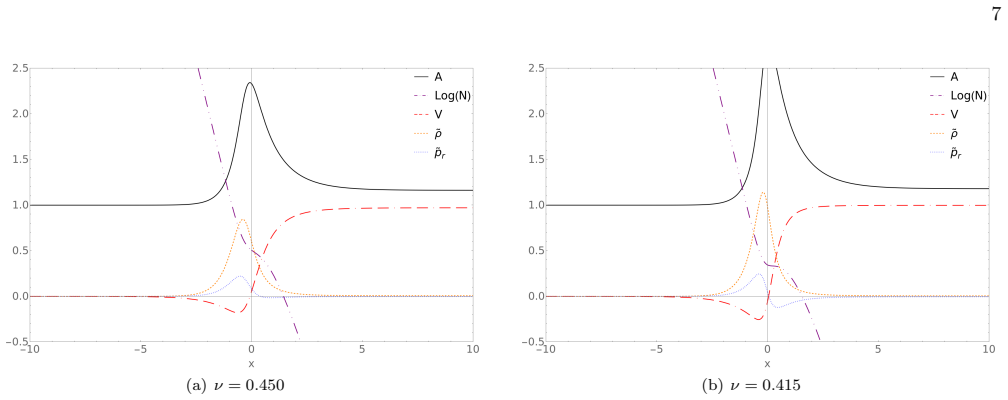
The central claim is that elastic matter, not just perfect fluids, can support continuous self-similar collapse in general relativity. For spherical symmetry and a scale-invariant elastic model with polytropic index $n$, shear index $s$, and Poisson ratio $\nu$, the paper constructs regular self-similar spacetimes numerically. With $n=s=3$, regular solutions exist for $0.415 \lesssim \nu \le 1/2$; at $\nu=1/2$ and $s=n$ the solution reduces to the known perfect-fluid radiation critical solution. Increasing elasticity (lower $\nu$ or larger $s$) raises the density near the sonic point, makes the radial pressure negative for $\nu \lesssim 0.47$, makes the longitudinal speed $c_L$ vary instead of staying constant, and separates the two transverse speeds $c_T$ and $\tilde{c}_T$. Below $\nu \approx 0.415$ a second sonic point appears in the region $x>0$, and the authors find no regular solution through it, so regularity itself imposes the parameter bound.
Load-bearing premise
The results rest on the particular power-law form chosen for the free function in the scale-invariant elastic energy density of Eq. (18); if real elastic matter does not follow that equation of state, the existence of regular solutions and the reported parameter bounds could change.
Editorial extensions
If this is right
- A direct elastic analog of the perfect-fluid critical solution exists, so elasticity does not destroy continuous self-similarity.
- Regularity imposes parameter bounds; for $n=s=3$ only $\nu \gtrsim 0.415$ is allowed, with the second sonic point marking the failure boundary.
- The solution space contains a fundamental mode and overtones with multiple zeros of $V$, matching the perfect-fluid structure beyond the fundamental.
- Elasticity makes the longitudinal sound speed non-constant and introduces two transverse speeds, changing the causal structure that any perturbation analysis must use.
- The profiles with negative radial pressure and higher density near the sonic point are the new qualitative signatures to look for in near-threshold elastic collapse.
Reading between the lines
- If the fundamental CSS mode turns out to be the critical solution under perturbations, its Lyapunov exponents will give a critical exponent that likely depends on $\nu$ and $s$, breaking the perfect-fluid value; the paper does not compute this.
- The regularity bounds are probably an artifact of the specific power-law energy density; because other free functions $h$ also yield self-similar evolutions, the $\nu \gtrsim 0.415$ threshold may shift for other models.
- A natural testable extension is to map the allowed region in $(n,s,\nu)$ and compare it with neutron-star-crust parameters; physical crusts may sit close to the fluid limit, but large shear stiffness could push them toward the singular second sonic point.
- If near-critical elastic collapse produces larger densities and negative pressures, primordial black hole mass scalings and gravitational-wave signatures derived from perfect-fluid critical collapse could need revision for realistic equations of state.
Signed reviews
Editorial analysis
A structured set of objections, weighed in public.
Referee Report
Summary. The paper studies continuous self-similar (CSS) collapse of self-gravitating elastic matter in general relativity. It adopts a scale-invariant elastic energy density from Alho et al., reduces the spherically symmetric field equations to a five-function ODE system with parameters n, s, and nu, and formulates a boundary value problem with regularity conditions at a sonic point and at the regular center. Numerically solving this system with a shooting method, the authors construct CSS solutions generalizing the Evans-Coleman perfect-fluid solution, including overtones. They report new elastic effects: negative radial pressure, a non-constant longitudinal sound speed, two transverse wave speeds, and the appearance of a second sonic point that they cannot integrate through; from this they infer bounds on the elasticity parameters, e.g. 0.415 <~ nu <= 1/2 for n = s = 3.
Significance. If the numerical constructions are correct, this is the first demonstration that relativistic elastic matter admits continuous self-similar collapse solutions, an important first step toward studying critical collapse with neutron-star-relevant microphysics. The derivation of the ODE system is careful and transparent, the perfect-fluid limit is recovered exactly, and the use of algebraic constraints to monitor numerical accuracy is a good practice. The main new claimed phenomena (negative radial pressure, non-constant sound speed, multiple wave speeds, and a possible second sonic point) are physically interesting. However, the paper's evidence is purely numerical and lacks convergence tests and machine-readable code, and the parameter-bound claim is presented more strongly than the numerical evidence supports.
major comments (3)
- [Sec. III C, Sec. III D, and Sec. IV (Conclusion)] The claim that 'the requirement of analyticity imposes bounds on the elasticity parameters' is not established by the evidence presented. The paper states in Sec. III C that 'Solutions with multiple sonic points are most likely singular,' citing [18], and in Sec. III D that 'numerically we were unable to obtain regular behavior across the second sonic point.' This is a numerical non-finding, not a proof that no regular solution with two sonic points exists. In principle, requiring the sonic-point regularity conditions (47)-(48) and the algebraic constraints (32)-(33) to hold at both sonic points could be satisfied for a discrete set of parameter values, and the described shooting method is not designed to search for such cases. The abstract and conclusion should either present this as 'no regular solutions were found in our numerical exploration' or be backed by an analysis of the regularity conditions at the second sonic point. As written, the bound 0.415 <~ nu <= 1/2 is a load-bearing conclusion that overstates the numerical evidence.
- [Sec. III C and Sec. III D] The central existence claim rests entirely on numerical integration, but the paper provides no convergence tests, no error estimates, and no code or data availability statement. The only accuracy check is the qualitative statement in Sec. III C that violations of the constraints (32)-(33) 'remain bounded and small' over x in [-10,10]. Please report quantitative maximum violations of (32)-(33) as a function of step size, demonstrate convergence of the sonic-point series expansion against the ODE integration, and ideally release the shooting code. Without such details, the reader cannot independently assess the accuracy of the constructed solutions; the phrase 'continuously differentiable everywhere' in Sec. III C is a numerical assertion rather than a demonstrated property.
- [Sec. II C and Sec. IV (Conclusion)] The parameter bounds are derived within a specific scale-invariant elastic model based on the power-law choice for the free function h(delta/eta) in Eq. (18). The paper itself notes in the Conclusion that 'Other choices of the free function h also lead to acceptable self-similar elastic evolutions.' The abstract's statement that elasticity 'imposes bounds on the elasticity parameters of the material' should be qualified as applying to this model family, not to elastic matter in general. Without this qualification, the bound risks being over-interpreted as a universal property of elastic collapse.
minor comments (4)
- [Sec. III D and Sec. IV] The notation 'nu<~ 0.47' and '0.415<~ nu <= 1/2' is nonstandard; please use conventional symbols such as 'nu <~ 0.47' or, preferably, 'nu lesssim 0.47' and '0.415 lesssim nu <= 1/2'.
- [Fig. 7 caption] The caption says 'and Fig. 7, respectively' but should refer to Fig. 7(b); also, the phrase 'Visual inspection reveals a strong resemblance' could be replaced with a quantitative measure of similarity, such as the L2 norm of differences over the integration domain.
- [Eq. (7)] The stress-energy tensor expression uses dx^a dx^b without explicit symmetrization; while the intended meaning is clear, adding brackets or a comment would avoid ambiguity for readers unfamiliar with the notation.
- [Sec. III D] The statement that lowering nu below 0.415 'raises the possibility of the occurrence of a second sonic point' is not accompanied by a precise criterion for locating sonic points beyond Eq. (43); specifying how the determinant was monitored during integration would improve reproducibility.
Circularity Check
No circularity: CSS solutions are constructed from a stated elastic model; no fitted parameter is renamed as a prediction and no load-bearing self-citation appears.
full rationale
The paper's central result—existence of continuous self-similar collapse solutions for relativistic elasticity—is obtained by explicitly solving the five-ODE system (26), (27), (31), (34), (35) with boundary conditions at the sonic point and at x→−∞. The energy density model, Eq. (18), is an input adopted from Alho et al. [46] and is stated as such ('By taking a power-law expression for h, consistent with the isotropic state and linear elasticity conditions, the following form was obtained for the energy density [46]'), not claimed as a prediction derived here. The wave speeds, negative radial pressure, and second-sonic-point behavior are computed consequences of this model, not fitted parameters. The only citations carrying structural weight are [46] for the scale-invariant elastic model and [18]/[48] for the standard sonic-point and asymptotic analysis; none of these are by the present authors, so there is no self-citation chain. The claimed bound on the Poisson ratio (0.415<~nu<=1/2 for n=s=3) rests on numerical inability to integrate through a second sonic point and on the expectation from [18] that multi-sonic-point solutions are singular; however, that is a question of numerical evidence and proof completeness, not a circular reduction. The conclusion explicitly acknowledges that other choices of the free function h also give acceptable self-similar evolutions, confirming the model dependence is exposed rather than smuggled in. No equation is defined in terms of the target result, and no fitted parameter is renamed as a prediction.
Assumptions & free parameters
free parameters (3)
- polytropic index n
- shear index s
- Poisson ratio nu
assumptions (4)
- domain assumption Continuous self-similarity ansatz with homothetic vector xi satisfying L_xi g = 2g
- ad hoc to paper Scale-invariant elastic energy density with a power-law free function h(delta/eta)
- domain assumption Sonic point regularity conditions (ad-bc=0 and af-ec=0)
- domain assumption Asymptotic fixed point at x->-infinity with delta/eta -> 1
Cite this review
Pith. "Pith review of Self-similar collapse with elasticity." pith.science (2026). https://pith.science/paper/ZC2RWZNW
@misc{pith2026250907136,
  author       = {Pith},
  title        = {Pith review of: Self-similar collapse with elasticity},
  year         = {2026},
  howpublished = {\url{https://pith.science/paper/ZC2RWZNW}},
  note         = {Machine review of arXiv:2509.07136}
}
abstract
Critical collapse is a well-studied subject for a variety of self-gravitating matter. One of the most intensively examined models is that of perfect fluids, which have been used extensively to describe compact objects such as stars, as well as being of cosmological interest. However, neutron stars are believed to possess an elastic crust, thus departing from a perfect fluid body, and critical collapse with elastic materials is an entirely unexplored topic. In this work, we employ a scale-invariant elastic matter model to study self-similar collapse with elasticity. As with perfect fluid models, we show that including elasticity allows for continuous self-similar configurations, which we determine numerically by solving the associated boundary value problem. The set of solutions is discrete and we focus on the fundamental mode, but also present some results for overtones. Similarly to the perfect fluid case, the existence of a sonic point plays a central role. We find that the addition of elasticity, by either increasing the shear index $\mathrm{s}$ or decreasing the Poisson ratio $\nu$, leads to an increase in compressibility and can yield negative radial pressures around the sonic point. Simultaneously, the elastic longitudinal wave speed ceases to be constant, while the two possible transverse wave speeds grow further apart. The departure from the perfect fluid case can be so dramatic as to generate a second sonic point, which does not seem to be regular. This, in turn, imposes bounds on the elasticity parameters of the material. This study represents the first step in the analysis of critical collapse with elastic materials.
Figures


Figures from the paper (3 more)


Reference graph
Works this paper leans on
- [18]
-
[1]
P. M. Chaikin and T. C. Lubensky,Principles of Con- densed Matter Physics(Cambridge University Press, 1995)
1995
-
[2]
S. N. Dorogovtsev, A. V. Goltsev, and J. F. F. Mendes, Reviews of Modern Physics80, 1275–1335 (2008)
work page 2008
-
[3]
C. Gundlach, D. Hilditch, and J. M. Mart´ ın-Garc´ ıa, Critical Phenomena in Gravitational Collapse (2025), arXiv:2507.07636 [gr-qc]
arXiv 2025
-
[4]
M. W. Choptuik, Phys. Rev. Lett.70, 9 (1993)
1993
- [5]
- [6]
- [7]
Show all 48 references
-
[8]
Gundlach, R
C. Gundlach, R. H. Price, and J. Pullin, Phys. Rev. D 49, 890 (1994), arXiv:gr-qc/9307010
1994 arXiv
-
[9]
Garfinkle, Phys
D. Garfinkle, Phys. Rev. D51, 5558 (1995), arXiv:gr- qc/9412008
1995
-
[10]
R. S. Hamad´ e and J. M. Stewart, Class. Quant. Grav. 13, 497 (1996), arXiv:gr-qc/9506044
1996 arXiv
-
[11]
Gundlach, Phys
C. Gundlach, Phys. Rev. Lett.75, 3214 (1995), arXiv:gr- qc/9507054
1995
-
[12]
Gundlach, Phys
C. Gundlach, Phys. Rev. D55, 695 (1997), arXiv:gr- qc/9604019
1997
-
[13]
P. R. Brady, C. M. Chambers, and S. C. V. Gon¸ calves, Phys. Rev. D56, R6057 (1997), arXiv:gr-qc/9709014
1997 arXiv
-
[14]
Evans and J
C. Evans and J. Coleman, Phys. Rev. Lett.72, 1782 (1994), arXiv:gr-qc/9402041
1994 arXiv
-
[15]
Koike, T
T. Koike, T. Hara, and S. Adachi, Phys. Rev. Lett.74, 5170 (1995), arXiv:gr-qc/9503007
1995 arXiv
-
[16]
Maison, Phys
D. Maison, Phys. Lett. B366, 82 (1996), arXiv:gr- qc/9504008
1996
-
[17]
D. W. Neilsen and M. W. Choptuik, Class. Quant. Grav. 17, 761 (2000), arXiv:gr-qc/9812053
2000 arXiv
-
[19]
M. W. Choptuik, T. Chmaj, and P. Bizo´ n, Phys. Rev. Lett.77, 424 (1996), arXiv:gr-qc/9603051
1996 arXiv
-
[20]
Gundlach, Phys
C. Gundlach, Phys. Rev. D55, 6002 (1997), arXiv:gr- qc/9610069
1997
-
[21]
Gundlach and J
C. Gundlach and J. M. Mart´ ın-Garc´ ıa, Phys. Rev. D54, 7353 (1996), arXiv:gr-qc/9606072
1996 arXiv
-
[22]
A. M. Abrahams and C. R. Evans, Phys. Rev. Lett.70, 2980 (1993)
1993
-
[23]
M. E. Cahill and A. H. Taub, Commun. Math. Phys.21, 1 (1971)
1971
-
[24]
Ori and T
A. Ori and T. Piran, Phys. Rev. D42, 1068 (1990)
1990
-
[25]
Chamel and P
N. Chamel and P. Haensel, Living Rev. Rel.11, 10 (2008), arXiv:0812.3955 [astro-ph]
2008 arXiv
-
[26]
A. J. Penner, N. Andersson, D. I. Jones, L. Samuels- son, and I. Hawke, Astrophys. J. Lett.749, L36 (2012), arXiv:1109.5041 [astro-ph.SR]. 10
2012 arXiv
-
[27]
A. J. Penner, N. Andersson, L. Samuelsson, I. Hawke, and D. I. Jones, Phys. Rev. D84, 103006 (2011), arXiv:1107.0669 [astro-ph.SR]
2011 arXiv
-
[28]
Gittins, N
F. Gittins, N. Andersson, and J. P. Pereira, Phys. Rev. D101, 103025 (2020), arXiv:2003.05449 [astro-ph.HE]
2020 arXiv
-
[29]
J. C. Niemeyer and K. Jedamzik, Phys. Rev. Lett.80, 5481 (1998), arXiv:astro-ph/9709072
1998 arXiv
-
[30]
A. M. Green and A. R. Liddle, Phys. Rev. D60, 063509 (1999), arXiv:astro-ph/9901268
1999 arXiv
-
[31]
Hawke and J
I. Hawke and J. M. Stewart, Class. Quant. Grav.19, 3687 (2002)
2002
-
[32]
Musco, J
I. Musco, J. C. Miller, and L. Rezzolla, Class. Quant. Grav.22, 1405 (2005), arXiv:gr-qc/0412063
2005 arXiv
-
[33]
Musco, J
I. Musco, J. C. Miller, and A. G. Polnarev, Class. Quant. Grav.26, 235001 (2009), arXiv:0811.1452 [gr-qc]
2009 arXiv
-
[34]
Franciolini, I
G. Franciolini, I. Musco, P. Pani, and A. Urbano, Phys. Rev. D106, 123526 (2022), arXiv:2209.05959 [astro- ph.CO]
2022 arXiv
-
[35]
Escriv` a, E
A. Escriv` a, E. Bagui, and S. Clesse, JCAP05, 004, arXiv:2209.06196 [astro-ph.CO]
-
[36]
M. W. Choptuik, E. W. Hirschmann, S. L. Liebling, and F. Pretorius, Phys. Rev. D68, 044007 (2003), arXiv:gr- qc/0305003
2003
-
[37]
T. W. Baumgarte, B. Br¨ ugmann, D. Cors, C. Gundlach, D. Hilditch, A. Khirnov, T. Ledvinka, S. Renkhoff, and I. S. Fern´ andez, Phys. Rev. Lett.131, 181401 (2023), arXiv:2305.17171 [gr-qc]
2023 arXiv
-
[38]
Marouda, D
K. Marouda, D. Cors, H. R. R¨ uter, F. Atteneder, and D. Hilditch, Phys. Rev. D109, 124042 (2024), arXiv:2402.06724 [gr-qc]
2024 arXiv
-
[39]
J. P. Pereira, M. Bejger, L. Tonetto, G. Lugones, P. Haensel, J. L. Zdunik, and M. Sieniawska, Astrophys. J.910, 145 (2021), arXiv:2011.06361 [astro-ph.HE]
2021 arXiv
-
[40]
Carter and H
B. Carter and H. Quintana, Proc. R. Soc. Lond. A331, 57 (1972)
1972
-
[41]
Karlovini and L
M. Karlovini and L. Samuelsson, Class. Quant. Grav.20, 3613 (2003), arXiv:gr-qc/0211026
2003 arXiv
-
[42]
Beig and B
R. Beig and B. Schmidt, Class. Quant. Grav.20, 889 (2003), arXiv:gr-qc/0211054
2003 arXiv
-
[43]
J. D. Brown, Class. Quant. Grav.38, 085017 (2021), arXiv:2004.03641 [gr-qc]
2021 arXiv
-
[44]
A. Alho, J. Nat´ ario, P. Pani, and G. Raposo, Class. Quant. Grav.41, 073002 (2024), arXiv:2307.03146 [gr- qc]
2024 arXiv
-
[45]
A. Alho, J. Nat´ ario, P. Pani, and G. Raposo, Phys. Rev. D105, 044025 (2022), [Erratum: Phys.Rev.D 105, 129903 (2022)], arXiv:2107.12272 [gr-qc]
2022 arXiv
-
[46]
A. Alho, J. Nat´ ario, P. Pani, and G. Raposo, Phys. Rev. D109, 064037 (2024), arXiv:2306.16584 [gr-qc]
2024 arXiv
- [47]
-
[48]
T. Hara, T. Koike, and S. Adachi, Renormalization group and critical behavior in gravitational collapse (1996), arXiv:gr-qc/9607010 [gr-qc]. 11 Appendix A: More details about the numerical results The profiles of the normalized density,eρ, and the normalized radial pressure,ep...
1996 arXiv
Reviewed August 15, 2026 · model on record in the stance chip above.
Discussion (0). Continue with ORCID to comment.