REVIEW 2 major objections 5 minor 48 references
A training-free, multi-resolution geometric score that tells 3D part growth where to freeze can segment meshes as accurately as learned models—and more consistently across datasets.
Reviewed by Pith at T0; open to challenge. T0 means a machine referee read the full paper against a public rubric. the ladder, T0–T4 →
Hi-TOPS, a training-free meso-scale Flow-Freeze prior with TSDF-guided superquadric fitting, achieves competitive 3D part decomposition and the best mIoU on PartNet (55.87).
T0 review reviewed 2026-08-05 challenge →
load-bearing objection Hi-TOPS is a genuinely useful training-free mesh decomposition pipeline, but its headline quantitative claims rest on hyperparameters tuned on an evaluation subset, and its boundary score has a face-count dependence that should be tested before calling the prior 'stable'. the 2 major comments →
Hi-TOPS: Hierarchical Topology-aware Scoring Prior for 3D Part Decomposition
The pith
A machine-rendered reading of the paper's core claim, the machinery that carries it, and where it could break.
The reading
Core claim
The central claim is that a hand-built, fixed-parameter geometric prior can stand in for learned semantics in part decomposition. On a voxelized mesh the paper defines a per-cell score S_B(i) = (λ1 μκ_i + λ2 σκ_i + λ3 Δκ_i + λ4 φ_norm,i) · sqrt(φ_den,i), computes it at resolutions 16, 32, and 64, thresholds the top 15% as Freeze, and fuses the three maps coarse-to-fine so that fine Freeze evidence survives while coarse Flow support is retained. The Flow-Freeze partition is then used as a hard constraint on superquadric inflation: seeds are placed first at the farthest interior points (bodies) and then at residual surface components (thin parts), growth is driven by minimizing a TSDF discrepa
What carries the argument
The Flow-Freeze prior is a scalar structural field on the active voxels of a mesh, S_B(i) = (λ1 μκ_i + λ2 σκ_i + λ3 Δκ_i + λ4 φ_norm,i) · sqrt(φ_den,i), whose top-α level set (α = 0.15) marks boundary-critical 'freeze' cells while the complement marks expandable 'flow' cells. The field is computed at resolutions {16, 32, 64} and fused by four octree rules, then used as a hard constraint in TSDF-guided superquadric inflation: it determines where body and surface seeds are placed, which expansions are accepted, and where growth stops so that articulation seams and thin attachments survive.
Load-bearing premise
The load-bearing premise is that a fixed score on coarse box-shaped cells—built from curvature, normal change, and sampling density, with the top 15 percent marked as freeze—reliably indicates where parts separate on arbitrary shapes; if a true boundary creates none of those cues, the method will miss it.
What would settle it
Feed Hi-TOPS a mesh whose ground-truth part boundary lies in a region of flat, low-curvature surface with no normal discontinuity and uniform sampling density, e.g., a cylinder whose cap-to-body seam has been smoothed so no geometric cue fires. If no voxel at the seam enters the top-15% Freeze set, the decomposition merges cap and body, falsifying the claim that the score is a reliable boundary proxy.
If this is right
- Because it needs no training data or 2D priors, the pipeline can be applied to any new mesh category without retraining or dataset-specific tuning.
- The output is a set of editable superquadrics plus residual surface patches, so the same decomposition doubles as a compact abstraction for editing, animation, and controlled generation.
- The structural-scale analysis implies that methods working only at global or only at local scales will keep bridging joints or fragmenting surfaces; boundary evidence at the meso scale is the missing ingredient.
- On articulation-heavy, long-tailed benchmarks, the geometry-only prior is more consistent than trained models, indicating that distribution shift rather than representation quality is what limits those models.
Where Pith is reading between the lines
- Beyond the paper: the Flow-Freeze field could be used as a free source of pseudo-labels to train or distill a fast network, since the prior itself requires no annotation.
- Beyond the paper: because the paper reports that {32,64,128} beats {16,32,64} in accuracy at much higher cost, allocating fine voxels only where the score is locally uncertain would likely recover most of that gain at a fraction of the runtime.
- Beyond the paper: the cue-to-boundary proxy could be stress-tested on deliberately nonuniform meshes and on shapes with smoothed, unarticulated seams; this would separate genuine geometric content from implementation choices.
- Beyond the paper: replacing superquadrics with a more flexible primitive family, such as generalized cylinders or convex decompositions, while keeping the Flow-Freeze constraint should extend the method to highly non-convex parts.
Editorial analysis
A structured set of objections, weighed in public.
Referee Report
Summary. The paper proposes Hi-TOPS, an unsupervised geometry-only method for 3D mesh part decomposition. It voxelizes a normalized mesh at three resolutions, computes per-voxel scores from mean/std/gradient of curvature, normal variation, and a density factor, then thresholds the top 15% as 'Freeze' regions. A rule-based octree fusion combines the three resolutions into a hierarchical Flow-Freeze prior. Superquadrics are seeded via EDT maxima ('Body') and residual-component centroids ('Surface'), inflated by TSDF-guided least-squares fits that must stay inside Flow voxels, and transferred back to the mesh via curvature-aware edge primitives with distance-weighted voting. On PartObjaverse-Tiny, PartNet-selected, and HY3D-Bench, Hi-TOPS reports mIoU 51.63, 55.87, and 47.22, outperforming primitive-based baselines, competitive with learned models, and showing the lowest cross-dataset mIoU standard deviation (3.5).
Significance. If the results hold, Hi-TOPS is a significant contribution: it demonstrates that a hand-designed meso-scale geometric prior can rival learned part segmentation without training data or 2D foundation models, and it provides a detailed, reproducible pipeline (pseudocode and hyperparameters in appendices). The PartNet result (+10.3 mIoU over PartField) is particularly striking. The main caveats are that the core score's tessellation sensitivity and the test-subset hyperparameter search are not yet resolved, so the strength of the quantitative claims is conditional. The paper ships detailed algorithm pseudocode, a full hyperparameter table, and component ablations, which are strengths.
major comments (2)
- [Eq. (3), App. B] The 'stable prior' claim is undermined because the score's density factor sqrt(phi_den) = sqrt(n_i) is face-count dependent. Since Nface=36 samples are placed per face, n_i is proportional to local triangle count, not surface area or geometric complexity. A 4x non-uniform subdivision of a patch quadruples n_i and doubles S_B in those voxels; because Freeze is the global top-15% quantile (Eqs. 4-5), remeshing can re-rank voxels and move Freeze labels from articulations to densely tessellated smooth regions. Since SQ fitting uses B_freeze as a hard constraint (Alg. A.2, flow-zone acceptance) and the edge-primitive assignment preserves freeze boundaries, this directly changes the output decomposition. The paper's own limitation (Sec. 5) says the cues 'may remain sensitive to tessellation' but no experiment quantifies this. Please add a remeshing-stability experiment (e.g., identical shape a
- [App. D.1-D.2, Table 4] The reported configuration is not a single truly dataset-agnostic setting: alpha, lambda, R, Nface, and q were fixed, but Appendix D.2 says the cue weights were selected by grid search on a fixed 36-shape subset of PartObjaverse-Tiny, and Table 4 uses the same subset to select the resolution hierarchy. No validation split is documented, and the final PartObjaverse-Tiny numbers in Table 1 are computed on the full 200-shape set that includes this subset. This makes part of the reported advantage on PartObjaverse-Tiny reflect selection on the test benchmark. Please either (a) introduce an explicit train/validation/test split, reporting main results on a held-out test set, or (b) report performance on all benchmarks under several reasonable hyperparameter choices to show the conclusions are insensitive. Note also that Table 4 shows {32,64,128} (mIoU 57.66) beats the chosen {16,32,64} (56.56)
minor comments (5)
- [Sec. 3.3 / App. E.2] Equation numbering is inconsistent: Eq. 8 in the main text is the SQ-to-mesh assignment, but App. E.2 (B.3) refers to Eq. 8 as the parameter-update acceptance rule. Renumber to avoid ambiguity.
- [Table 3] The row 'w/o TSDF Res=32' is placed under 'Geometric Cues', but removing TSDF is a fitting-stage ablation, not a geometric cue. Move it to the TSDF-related ablation group for clarity.
- [App. D.2] The sentence 'The table has been reorganized for clarity (same setting in Table 3)' appears to be an editorial leftover. Rewrite to describe the sensitivity table directly.
- [App. A / Table 1] The reported mIoU uses many-to-one greedy matching, which can be optimistic for over-segmented predictions. Please add a sensitivity check with Hungarian matching or report over/under-segmentation statistics.
- [Throughout] Minor typos: 'Hi-Tops' in App. A should be 'Hi-TOPS'; Fig. 2 caption has repetitive 'Normal Normal' formatting.
Circularity Check
Default weights and Freeze ratio were selected by grid search on a PartObjaverse-Tiny subset, so part of the reported PartObjaverse-Tiny advantage reflects test-set selection; the geometry-driven derivation itself is not circular.
specific steps
-
fitted input called prediction
[Appendix D.1 (Ablation Protocol), Appendix D.2 (Search for Cues' Weights), Table A.5; main results Table 1]
"All ablations use a fixed 36-shape PartObjaverse-Tiny subset; ... Cue weights were determined via grid search. We found that uniform setting (1,1,1,1) yields stable performance across scenes and therefore adopt it as the default configuration."
The paper presents a single dataset-agnostic setting (λ=(1,1,1,1), α=0.15) and then reports mIoU on PartObjaverse-Tiny (51.63) and cross-dataset std (3.5) as evidence of generalizability. But λ was selected by grid search on a 36-shape PartObjaverse-Tiny subset, and Table A.5 shows (1,1,1,1) is the best mIoU on that same subset. Table 3 similarly picks α=0.15 as the best of {5%,15%,25%} on the same subset. The PartObjaverse-Tiny column therefore is not an independent prediction from first principles; it partly reflects optimization against the evaluation set. The underlying score field (Eq. 3-8) never uses part labels, and the other two benchmarks are unaffected, so this is partial rather than total circularity.
full rationale
The central derivation is self-contained: S_B (Eq. 3) is a hand-specified geometric proxy over voxelized curvature/normal/density cues; Freeze is the top-α level set (Eq. 4-5); SQ fitting and assignment (Eq. 6-8, App. E) are geometry-only and never touch ground-truth labels. No load-bearing self-citation or uniqueness theorem is invoked; the citations to Light-SQ, DORA, and MPS are component borrowings, not justifications of the core claim. The main circular component is the selection of the default hyperparameters (λ, α) on a 36-shape subset of PartObjaverse-Tiny (App. D.1/D.2, Tables 3/A.5), followed by reporting PartObjaverse-Tiny mIoU and cross-dataset consistency in Table 1. That makes part of the headline advantage reflect test-set selection, but does not make the decomposition output equivalent to the fitted inputs. The limitation section also concedes that local cues may be sensitive to tessellation and dense details; this is a stability caveat, not a circularity.
Axiom & Free-Parameter Ledger
free parameters (5)
- Freeze ratio alpha =
0.15
- Cue weights lambda =
(1,1,1,1)
- Resolution set R =
{16,32,64}
- Dihedral cut quantile q =
90
- Per-face barycentric sample count Nface =
36
axioms (5)
- ad hoc to paper Meso-scale voxel grids (16/32/64) capture the boundary evidence needed for decomposition.
- domain assumption Curvature, normal inconsistency, and sampling density are sufficient intrinsic cues for part boundaries.
- domain assumption The top-alpha level set of the score separates boundary-critical from expandable regions.
- domain assumption A superquadric fitted under TSDF alignment can represent body parts and thin attachments.
- standard math Standard voxelization and cotangent Laplacian computations are correct.
Cite this review
Pith. "Pith review of Hi-TOPS: Hierarchical Topology-aware Scoring Prior for 3D Part Decomposition." pith.science (2026). https://pith.science/paper/ZCFHLVN7
@misc{pith2026260800767,
  author       = {Pith},
  title        = {Pith review of: Hi-TOPS: Hierarchical Topology-aware Scoring Prior for 3D Part Decomposition},
  year         = {2026},
  howpublished = {\url{https://pith.science/paper/ZCFHLVN7}},
  note         = {Machine review of arXiv:2608.00767}
}
read the original abstract
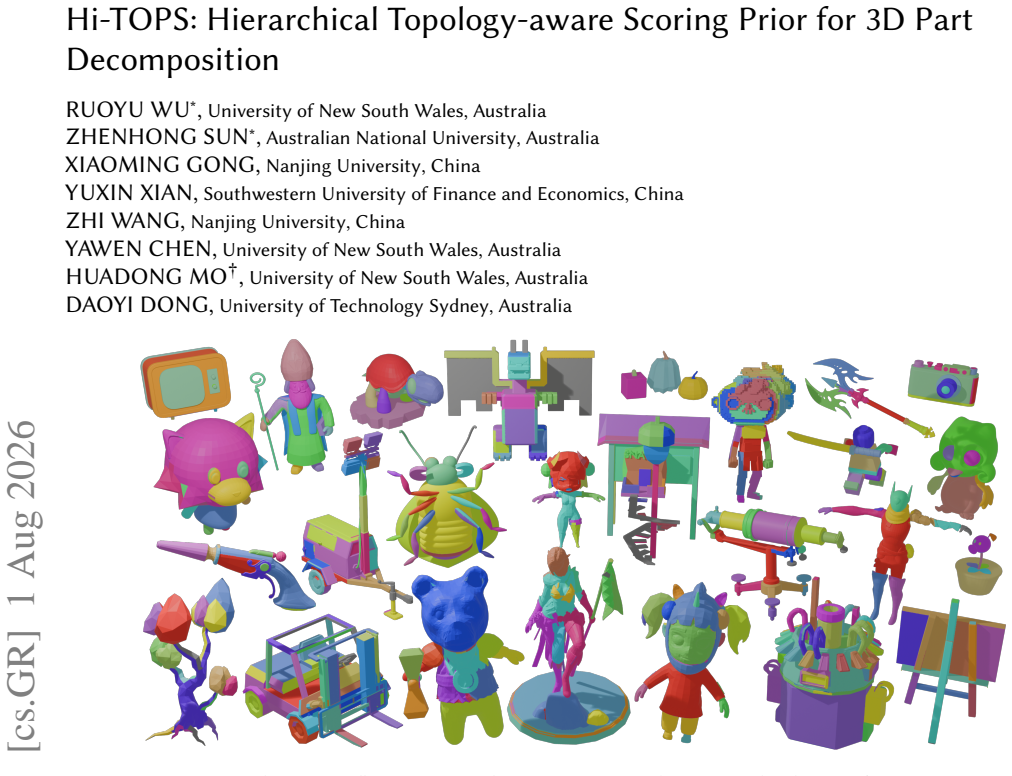
Accurate 3D part decomposition requires separating shapes into structurally meaningful components with precise boundaries while preserving articulation seams and thin attachments. Existing approaches often suffer from a structural-scale mismatch: geometric evidence for separation is most reliable at the meso scale, yet many pipelines operate either too globally to respect joints or too locally to remain robust to noise. We propose Hi-TOPS, a Hierarchical Topology-aware Scoring Prior that aggregates complementary intrinsic cues into a multi-resolution Flow-Freeze field. Flow regions provide expandable support for primitive coverage, while Freeze regions restrict growth near articulations and thin structures. A TSDF-guided body-surface superquadric fitter then captures dominant cores and residual surface structures, followed by SQ-to-mesh assignment for connected, boundary-aligned parts. Across diverse benchmarks, Hi-TOPS delivers stable, editable decompositions without semantic supervision or 2D foundation priors.
Figures




Reference graph
Works this paper leans on
-
[1]
Ye, Jingwen and He, Yuze and Zhou, Yanning and Zhu, Yiqin and Xiao, Kaiwen and Liu, Yong-Jin and Yang, Wei and Han, Xiao , title =. 2025 , isbn =. doi:10.1145/3721238.3730732 , booktitle =
-
[2]
Wang, Yuhan and Chen, Weikai and Hu, Zeyu and Zhang, Runze and Yin, Yingda and Wu, Ruoyu and Luo, Keyang and Qian, Shengju and Ma, Yiyan and Li, Hongyi and Gao, Yuan and Zhou, Yuhuan and Luo, Hao and Wang, Wan and Shen, Xiaobin and Li, Zhaowei and Zhu, Kuixin and Hong, Chuanlang and Wang, Yueyue and Feng, Lijie and Wang, Xin and Loy, Chen Change , title =...
-
[3]
Marching-Primitives: Shape Abstraction from Signed Distance Function , author =. Proceedings IEEE Conf. on Computer Vision and Pattern Recognition (CVPR) , year =
- [4]
-
[5]
Tulsiani, Shubham and Su, Hao and Guibas, Leonidas J. and Efros, Alexei A. and Malik, Jitendra , booktitle=. Learning Shape Abstractions by Assembling Volumetric Primitives , year=
-
[6]
Robust Shape Fitting for 3D Scene Abstraction , year=
Kluger, Florian and Brachmann, Eric and Yang, Michael Ying and Rosenhahn, Bodo , journal=. Robust Shape Fitting for 3D Scene Abstraction , year=
- [7]
-
[8]
Edelsbrunner and Letscher and Zomorodian , title =. Discrete Comput. Geom. , month = nov, pages =. 2002 , issue_date =. doi:10.1007/s00454-002-2885-2 , abstract =
-
[9]
IEEE Transactions on Visualization and Computer Graphics , month = nov, pages =
Gyulassy, Attila and Natarajan, Vijay and Pascucci, Valerio and Hamann, Bernd , title =. IEEE Transactions on Visualization and Computer Graphics , month = nov, pages =. 2007 , issue_date =. doi:10.1109/TVCG.2007.70552 , abstract =
- [10]
-
[11]
Changfeng Ma and Yang Li and Xinhao Yan and Jiachen Xu and Yunhan Yang and Chunshi Wang and Zibo Zhao and Yanwen Guo and Zhuo Chen and Chunchao Guo , booktitle=. P\. 2025 , url=
work page 2025
-
[12]
Zhe Zhu and Le Wan and Rui Xu and Yiheng Zhang and Honghua Chen and Zhiyang Dou and Cheng Lin and Yuan Liu and Mingqiang Wei , journal=
-
[13]
Qi and Su, Hao and Kaichun, Mo and Guibas, Leonidas J
Charles, R. Qi and Su, Hao and Kaichun, Mo and Guibas, Leonidas J. , booktitle=. PointNet: Deep Learning on Point Sets for 3D Classification and Segmentation , year=
-
[14]
SGPN: Similarity Group Proposal Network for 3D Point Cloud Instance Segmentation , year=
Wang, Weiyue and Yu, Ronald and Huang, Qiangui and Neumann, Ulrich , booktitle=. SGPN: Similarity Group Proposal Network for 3D Point Cloud Instance Segmentation , year=
- [15]
-
[16]
IEEE/CVF International Conference on Computer Vision (CVPR) , year =
PartDistill: 3D Shape Part Segmentation by Vision-Language Model Distillation , author =. IEEE/CVF International Conference on Computer Vision (CVPR) , year =
-
[17]
S2AM3D: Scale-controllable Part Segmentation of 3D Point Clouds
Su, Han and Huang, Tianyu and Wan, Zichen and Wu, Xiaohe and Zuo, Wangmeng , title =. arXiv preprint arXiv:2512.00995 , year =
work page internal anchor Pith review Pith/arXiv arXiv
-
[18]
IEEE/CVF Winter Conference on Applications of Computer Vision (WACV) , year =
Garosi, Marco and Tedoldi, Riccardo and Boscaini, Davide and Mancini, Massimiliano and Sebe, Nicu and Poiesi, Fabio , title =. IEEE/CVF Winter Conference on Applications of Computer Vision (WACV) , year =
-
[19]
Liu, Minghua and Zhu, Yinhao and Cai, Hong and Han, Shizhong and Ling, Zhan and Porikli, Fatih and Su, Hao , booktitle=. PartSLIP: Low-Shot Part Segmentation for 3D Point Clouds via Pretrained Image-Language Models , year=
-
[20]
Proceedings of the IEEE/CVF International Conference on Computer Vision (ICCV) , month =
Liu, Minghua and Uy, Mikaela Angelina and Xiang, Donglai and Su, Hao and Fidler, Sanja and Sharp, Nicholas and Gao, Jun , title =. Proceedings of the IEEE/CVF International Conference on Computer Vision (ICCV) , month =. 2025 , pages =
2025
-
[21]
MirageRoom: 3D Scene Segmentation with 2D Pre-Trained Models by Mirage Projection , year=
Sun, Haowen and Duan, Yueqi and Yan, Juncheng and Liu, Yifan and Lu, Jiwen , booktitle=. MirageRoom: 3D Scene Segmentation with 2D Pre-Trained Models by Mirage Projection , year=
- [22]
-
[23]
Proceedings of the IEEE/CVF International Conference on Computer Vision (ICCV) , month =
Ma, Ziqi and Yue, Yisong and Gkioxari, Georgia , title =. Proceedings of the IEEE/CVF International Conference on Computer Vision (ICCV) , month =. 2025 , pages =
work page 2025
-
[24]
PartSLIP++: Enhancing Low-Shot 3D Part Segmentation via Multi-View Instance Segmentation and Maximum Likelihood Estimation , author=. 2023 , eprint=
work page 2023
-
[25]
Yuchen Zhou and Jiayuan Gu and Tung Yen Chiang and Fanbo Xiang and Hao Su , booktitle=. Point-. 2025 , url=
work page 2025
- [26]
-
[27]
DINOv2: Learning Robust Visual Features without Supervision , author=. arXiv:2304.07193 , year=
- [28]
-
[29]
CVPR , year=
Sonata: Self-Supervised Learning of Reliable Point Representations , author=. CVPR , year=
-
[30]
2022 , booktitle=
Grounded Language-Image Pre-training , author=. 2022 , booktitle=
2022
-
[31]
arXiv preprint arXiv:2206.05836 , year=
GLIPv2: Unifying Localization and Vision-Language Understanding , author=. arXiv preprint arXiv:2206.05836 , year=
-
[32]
Girshick, Ross and Donahue, Jeff and Darrell, Trevor and Malik, Jitendra , title =. 2014 , isbn =. doi:10.1109/CVPR.2014.81 , booktitle =
-
[33]
ACM Transactions on Graphics (TOG) , volume=
Approximate convex decomposition for 3d meshes with collision-aware concavity and tree search , author=. ACM Transactions on Graphics (TOG) , volume=. 2022 , publisher=
work page 2022
-
[34]
Mangan, A.P. and Whitaker, R.T. , journal=. Partitioning 3D surface meshes using watershed segmentation , year=
- [35]
-
[36]
Zhang, Xi and Li, Guiqing and Xiong, Yunhui and He, Fenghua , title =. Proceedings of the 5th International Conference on Advances in Geometric Modeling and Processing , pages =. 2008 , isbn =
work page 2008
-
[37]
The Visual Computer , volume =
Mesh segmentation driven by Gaussian curvature , author =. The Visual Computer , volume =. 2005 , publisher =. doi:10.1007/s00371-005-0319-x , url =
-
[38]
and Yi, Li and Tripathi, Subarna and Guibas, Leonidas J
Mo, Kaichun and Zhu, Shilin and Chang, Angel X. and Yi, Li and Tripathi, Subarna and Guibas, Leonidas J. and Su, Hao , title =. The IEEE Conference on Computer Vision and Pattern Recognition (CVPR) , month =
- [39]
-
[40]
PlanarRecon: Realtime 3D Plane Detection and Reconstruction from Posed Monocular Videos , year=
Xie, Yiming and Gadelha, Matheus and Yang, Fengting and Zhou, Xiaowei and Jiang, Huaizu , booktitle=. PlanarRecon: Realtime 3D Plane Detection and Reconstruction from Posed Monocular Videos , year=
-
[41]
He, Yuze and Zhao, Wang and Liu, Shaohui and Hu, Yubin and Bai, Yushi and Wen, Yu-Hui and Liu, Yong-Jin , title =. Proceedings of the 38th International Conference on Neural Information Processing Systems , articleno =. 2024 , isbn =
work page 2024
-
[42]
arXiv preprint arXiv:1801.09847 , year=
Open3D: A modern library for 3D data processing , author=. arXiv preprint arXiv:1801.09847 , year=
-
[43]
arXiv preprint arXiv:2509.08643 , year=
X-Part: high fidelity and structure coherent shape decomposition , author=. arXiv preprint arXiv:2509.08643 , year=
-
[44]
OmniPart: Part-Aware 3D Generation with Semantic Decoupling and Structural Cohesion , author=. 2025 , eprint=
work page 2025
-
[45]
HoloPart: Generative 3D Part Amodal Segmentation , author=. 2025 , eprint=
work page 2025
-
[46]
BANG: Dividing 3D Assets via Generative Exploded Dynamics , volume=
Zhang, Longwen and Zhang, Qixuan and Jiang, Haoran and Bai, Yinuo and Yang, Wei and Xu, Lan and Yu, Jingyi , year=. BANG: Dividing 3D Assets via Generative Exploded Dynamics , volume=. ACM Transactions on Graphics , publisher=. doi:10.1145/3730840 , number=
-
[47]
Proceedings of the IEEE/CVF Conference on Computer Vision and Pattern Recognition , pages=
Dora: Sampling and benchmarking for 3d shape variational auto-encoders , author=. Proceedings of the IEEE/CVF Conference on Computer Vision and Pattern Recognition , pages=
-
[48]
Proceedings of the IEEE/CVF Conference on Computer Vision and Pattern Recognition , pages=
Richdreamer: A generalizable normal-depth diffusion model for detail richness in text-to-3d , author=. Proceedings of the IEEE/CVF Conference on Computer Vision and Pattern Recognition , pages=
This paper was first reviewed by deepseek-v4-flash on August 5, 2026.
discussion (0)
Sign in with ORCID, Apple, or X to comment. Anyone can read and Pith papers without signing in.