Probing the Circular Unruh Effect with Cavity-Controlled Lamb Shifts
Pith reviewed 2026-06-26 14:02 UTC · model grok-4.3
The pith
The Lamb shift of a centripetally accelerated atom in a high-Q cavity probes the circular Unruh effect at accelerations as low as 0.5 m/s².
A machine-rendered reading of the paper's core claim, the machinery that carries it, and where it could break.
Core claim
The Lamb shift of a centripetally accelerated atom inside a high-Q cavity supplies a spectroscopic probe of the circular Unruh effect; the cavity reshapes the electromagnetic density of states so that noninertial corrections produce measurable, tunable level shifts, yielding a 10 Hz rotation-induced shift at accelerations of 0.5 m/s²—more than twenty orders of magnitude below the scale required for direct Unruh detection.
What carries the argument
The cavity's reshaping of the electromagnetic density of states, which converts tiny noninertial corrections into tunable atomic level shifts.
If this is right
- The Lamb shift can be enhanced, strongly quenched, or completely screened by choice of atomic angular velocity and cavity detuning.
- A rotation-induced shift of order 10 Hz appears at accelerations of 0.5 m/s² for experimentally realistic cavity and atom parameters.
- Cavity-controlled Lamb-shift spectroscopy constitutes a viable route to laboratory tests of the circular Unruh effect in the ultralow-acceleration regime.
Where Pith is reading between the lines
- The same cavity-tuning mechanism could be used to isolate the Unruh contribution from competing relativistic corrections in precision measurements.
- Because the setup uses only centripetal acceleration, confirmation would strengthen the flat-spacetime analogue between accelerated frames and thermal radiation.
Load-bearing premise
The cavity modifies the electromagnetic density of states in such a way that noninertial corrections dominate the observed Lamb shift.
What would settle it
An experiment that measures no frequency shift whose magnitude and dependence on angular velocity match the predicted 10 Hz scale at 0.5 m/s² would falsify the claim.
Figures
read the original abstract
The Unruh effect predicts that accelerated observers perceive the inertial vacuum as populated by particles, providing a flat-spacetime analogue of Hawking radiation. Its direct observation, however, remains experimentally challenging, since an Unruh temperature of $1\,\mathrm{K}$ requires accelerations of order $10^{20}\,\mathrm{m/s^2}$. Here, we show that the Lamb shift of a centripetally accelerated atom inside a high-$Q$ cavity provides a sensitive spectroscopic probe of the Unruh effect at dramatically lower accelerations. The cavity reshapes the electromagnetic density of states and converts otherwise tiny noninertial corrections into tunable level shifts. Depending on the atomic angular velocity and cavity detuning, the Lamb shift can be enhanced, strongly quenched, or completely screened. Remarkably, for experimentally realistic parameters, a rotation-induced shift of order $10\;\mathrm{Hz}$ can arise already at accelerations as low as $0.5\,\mathrm{m/s^2}$, more than twenty orders of magnitude below the acceleration scale conventionally associated with direct Unruh detection. These results identify cavity-controlled Lamb-shift spectroscopy as a viable route toward laboratory tests of the circular Unruh effect in the ultralow-acceleration regime.
Editorial analysis
A structured set of objections, weighed in public.
Referee Report
Summary. The manuscript proposes using the Lamb shift of a centripetally accelerated atom inside a high-Q cavity as a spectroscopic probe of the circular Unruh effect. It argues that the cavity modifies the electromagnetic density of states, amplifying otherwise negligible noninertial corrections to the atomic level shift. For experimentally realistic parameters, the work claims that a rotation-induced frequency shift of order 10 Hz arises at accelerations as low as 0.5 m/s²—more than twenty orders of magnitude below the scale required for direct Unruh detection—depending on angular velocity and cavity detuning. The effect can be enhanced, quenched, or screened by cavity parameters.
Significance. If the central calculation holds, the result identifies a concrete, tunable route to laboratory tests of the circular Unruh effect in the ultralow-acceleration regime using established cavity-QED techniques. The approach converts perturbative vacuum-fluctuation corrections into observable spectroscopic signals via density-of-states engineering, offering falsifiable predictions for frequency shifts at accessible accelerations. This constitutes a genuine advance over direct-detection proposals that require extreme accelerations.
minor comments (2)
- Abstract: the numerical claim (10 Hz at 0.5 m/s²) is stated without an explicit pointer to the section or equation containing the mode-sum evaluation and parameter values; adding a parenthetical reference would improve traceability for readers.
- The manuscript would benefit from a short dedicated paragraph (perhaps in §3 or §4) summarizing the error budget and sensitivity to cavity Q-factor and detuning uncertainties, even if the central derivation is analytic.
Simulated Author's Rebuttal
We thank the referee for their supportive review, accurate summary of our results, and recommendation of minor revision. No major comments were raised in the report.
Circularity Check
No significant circularity
full rationale
The paper's derivation computes the cavity-modified Lamb shift for a centripetally accelerated atom by treating the circular Unruh vacuum fluctuations as a perturbative correction to the standard cavity QED mode sum, with the enhancement arising directly from the cavity's density-of-states reshaping parameterized by detuning and Q-factor. All numerical estimates (e.g., ~10 Hz shift at 0.5 m/s²) follow from the stated perturbative expansion and input parameters without any reduction to self-definition, fitted inputs renamed as predictions, or load-bearing self-citations. The central claim remains self-contained against external cavity QED benchmarks and does not invoke uniqueness theorems or ansatze from prior author work.
Axiom & Free-Parameter Ledger
axioms (2)
- domain assumption The Unruh effect applies to circular acceleration inside a cavity
- domain assumption High-Q cavity modifies electromagnetic density of states to convert noninertial effects into measurable Lamb shifts
Reference graph
Works this paper leans on
-
[1]
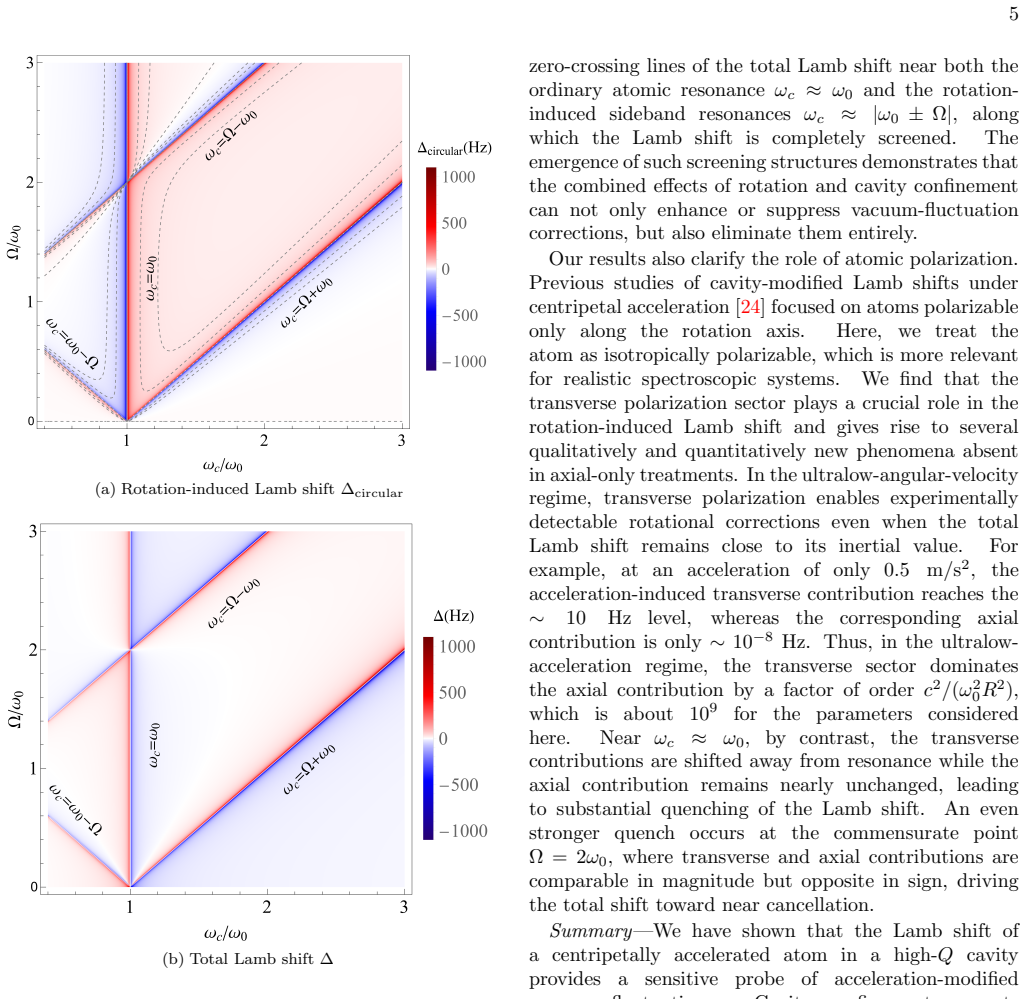
This indicates that rotation can substantially reduce the total Lamb shift and allow resolvable noninertial shifts even at ultralow angular velocities. For example, for an isotropically polarizable atom (d 2 ρ =d 2 ϕ =d 2 z ≡d 2) with parameters consistent with the Markov approximation [28]:d= 10−29 Cm, V= 10 −10 m3, Q= 10 7, R= 50 nm, ω 0 = 5×10 11 Hz, a...
-
[2]
S. A. Fulling, Nonuniqueness of canonical field quanti- zation in Riemannian space-time, Phys. Rev. D7, 2850 (1973)
1973
-
[3]
P. C. W. Davies, Scalar production in Schwarzschild and Rindler metrics, J. Phys. A: Math. Gen.8, 604 (1975)
1975
-
[4]
W. G. Unruh, Notes on black-hole evaporation, Phys. Rev. D14, 870 (1976)
1976
-
[5]
Hawking, Black hole explosions?, Nature248, 30 (1974)
S. Hawking, Black hole explosions?, Nature248, 30 (1974)
1974
-
[6]
S. W. Hawking, Particle creation by black holes, Commun. Math. Phys.43, 199 (1975)
1975
-
[7]
W. E. Lamb and R. C. Retherford, Fine structure of the Hydrogen atom by a microwave method, Phys. Rev.72, 241 (1947)
1947
-
[8]
Bezginov, T
N. Bezginov, T. Valdez, M. Horbatsch, A. Marsman, A. C. Vutha, and E. A. Hessels, A measurement of the atomic hydrogen Lamb shift and the proton charge radius, Science365, 1007 (2019)
2019
-
[9]
Audretsch and R
J. Audretsch and R. M¨ uller, Radiative energy shifts of an accelerated two-level system, Phys. Rev. A52, 629 (1995)
1995
-
[10]
Passante, Radiative level shifts of an accelerated hydrogen atom and the Unruh effect in quantum electrodynamics, Phys
R. Passante, Radiative level shifts of an accelerated hydrogen atom and the Unruh effect in quantum electrodynamics, Phys. Rev. A57, 1590 (1998)
1998
-
[11]
J. R. Letaw and J. D. Pfautsch, Quantized scalar field in rotating coordinates, Phys. Rev. D22, 1345 (1980)
1980
-
[12]
J. S. Bell and J. M. Leinaas, Electrons as accelerated thermometers, Nucl. Phys.B212, 131 (1983)
1983
-
[13]
Hacyan, A
S. Hacyan, A. Sarmiento, Vacuum energy of the electromagnetic field in a rotating system, Phys. Lett. B179, 287 (1986)
1986
-
[14]
J. S. Bell and J. M. Leinaas, The Unruh effect and quantum fluctuations of electrons in storage rings, Nucl. Phys.B284, 488 (1987)
1987
-
[15]
S. K. Kim, K. S. Soh, and J. H. Yee, Zero-point field in a circular-motion frame, Phys. Rev. D35, 557 (1987)
1987
-
[16]
W. G. Unruh, Acceleration for orbiting electrons, Phys. Rep.307, 163 (1998)
1998
-
[17]
Audretsch, R
J. Audretsch, R. M¨ uller, and M. Holzmann, Generalized Unruh effect and Lamb shift for atoms on arbitrary stationary trajectories, Class. Quantum Grav.12, 2927 (1995)
1995
-
[18]
Y. Peng, J. Hu, and H. Yu, Significant modifications of Lamb shift at small centripetal accelerations, arXiv:2603.05945
-
[19]
E. M. Purcell, Spontaneous emission probabilities at radio frequencies, Phys. Rev.69, 681 (1946)
1946
-
[20]
M. O. Scully, V. V. Kocharovsky, A. Belyanin, E. Fry, and F. Capasso, Enhancing acceleration from ground- state atoms via cavity quantum electrodynamics, Phys. Rev. Lett.91, 243004 (2003)
2003
-
[21]
Lochan, H
K. Lochan, H. Ulbricht, A. Vinante, and S. K. Goyal, Detecting acceleration-enhanced vacuum fluctuations with atoms inside a cavity, Phys. Rev. Lett.125, 241301 (2020)
2020
-
[22]
Jaffino Stargen and K
D. Jaffino Stargen and K. Lochan, Cavity optimization for Unruh effect at small accelerations, Phys. Rev. Lett. 129, 111303 (2022)
2022
-
[23]
Zheng, X.-F
H.-T. Zheng, X.-F. Zhou, G.-C. Guo, and Z.-W. Zhou, Enhancing analog Unruh effect via superradiance in a cylindrical cavity, Phys. Rev. Res.7, 013027 (2025)
2025
-
[24]
Y. Peng, Y. Zhou, J. Hu, and H. Yu, Extensive Manipulation of Transition Rates and Substantial Population Inversion of Rotating Atoms Inside a Cavity, Phys. Rev. Lett.136, 013202 (2026)
2026
-
[25]
Arya and S
N. Arya and S. K. Goyal, Lamb shift as a witness for quantum noninertial effects, Phys. Rev. D108, 085011 (2023)
2023
-
[26]
N. Arya, D. Jaffino Stargen, K. Lochan, and S. K. Goyal, Strong noninertial radiative shifts in atomic spectra at low accelerations, Phys. Rev. D110, 085007 (2024)
2024
-
[27]
H. S. Sahota, S. Kaushal, and K. Lochan, Cavity- controlled inhibition of decoherence in accelerated quantum detectors, arXiv:2604.02422
-
[28]
Breuer and F
H.-P. Breuer and F. Petruccione,The Theory of Open Quantum Systems(Oxford University Press, Oxford, 2007)
2007
-
[29]
Throughout this work we assume the weak- coupling regimeg≪κ, whereg=d p ωc/(2ℏϵ0V) is the atom–field coupling strength
The cavity mode considered here possesses a Lorentzian linewidthκ=ω c/Q, corresponding to a correlation time τB ∼κ −1. Throughout this work we assume the weak- coupling regimeg≪κ, whereg=d p ωc/(2ℏϵ0V) is the atom–field coupling strength. Under this condition τB ∼κ −1 ≪g −1, so the cavity memory time is much shorter than the characteristic atomic evolutio...
discussion (0)
Sign in with ORCID, Apple, or X to comment. Anyone can read and Pith papers without signing in.