REVIEW 3 major objections 6 minor 1 cited by
DFREC: DeepFake Identity Recovery Based on Identity-aware Masked Autoencoder
T0 review · 3 major / 6 minor · reviewed 2026-08-11 · deepseek-v4-flash
Pith's one-line read A single deepfake image can be unmixed into both the swapped-in face and the original target face.
desk verdict DFREC is a genuinely new task formulation with decent engineering, but the headline IDSim numbers partly measure what the model was trained to optimize, and source recovery is never quantified. read the letter →
The pith
A machine-rendered reading of the paper's core claim, the machinery that carries it, and where it could break.
The reading
What carries the argument
The load-bearing mechanism is the identity-aware masked autoencoder in the Target Identity Recovery Module. A semantic-guided masking stage uses the source-affiliation map to decide which image patches to hide, preferring patches most likely to belong to the swapped-in source face, while an identity fusion decoder concatenates the latent target identity features extracted by the source reconstruction module with the visible patch embeddings, so the model is conditioned on who the target is rather than simply inpainting texture. The segmentation map is trained with no direct supervision; it is driven only by the downstream reconstruction losses for the source and target faces.
What would settle it
Take face-swapped images and replace the forged face region with a patch cropped from an unrelated person's photo, so that no target-identity signal remains in the swapped area, then run DFREC: if the identity similarity between the 'recovered target' and the true target does not drop to near-chance levels, the reported recovery is likely driven by background context rather than by separated target identity features. A second check is to compare the unsupervised segmentation map against ground-truth swap masks; if their overlap is no better than random, the claimed identity separation is not what the network actually learned.
Extended reading notes
Core claim
The central claim is that a face-swapped image is not merely a new identity on an old body: it is a mixture of two identities, and the mixture can be unmixed. The paper supports this by measuring identity similarity, finding that a forgery is roughly as similar to its target face as to its source face, which indicates that target-identity information survives the swap. DFREC operationalizes the unmixing with an identity segmentation map that classifies each pixel's affiliation with the source face, a source reconstruction network that splits its own latent features into a source stream and a target stream, and a masked autoencoder that hides the source-related patches and fills them in using visible background patches plus the extracted target stream. Trained with identity, perceptual, attribute, and patch-recovery losses, the system reconstructs both faces from the single forged image, and reports identity similarity superior to existing baselines on FaceForensics++, CelebaMegaFS, and FFHQ-E4S across six face-swapping algorithms.
Load-bearing premise
The method assumes that a face-swapped image retains enough of the target person's identity, mixed into the swapped area, that it can be separated out and used to rebuild the target face; if the forged face never came from the target face, for example through direct cropping and splicing, the recovery breaks down.
Editorial extensions
If this is right
- Forensic investigators could obtain both the suspect's face and the victim's face from a single deepfake frame, giving a concrete link between a forged video and real identities.
- The same network can flag a face as real or fake by checking whether its recovered target reconstruction differs from the input, so recovery doubles as an interpretable detector.
- Recovery generalizes across face-swapping algorithms in the paper's experiments, meaning a model trained on a few swap types can still reconstruct targets from unseen forgeries.
- The recovered target face remains identifiable even after common post-processing such as blur, JPEG compression, and Gaussian noise, per the paper's robustness tests.
- Pristine images pass through the system unchanged, so the method can be applied to a mixed batch of real and fake faces without corrupting the genuine ones.
Reading between the lines
- If the identity-splitting premise holds beyond face-swapping, the same three-module design could be applied to other attribute-manipulation forgeries—expression reenactment, aging, makeup transfer—where a target identity still underlies the edited image.
- Because the segmentation is unsupervised, a testable implication is that DFREC's success across unseen forgeries depends on a consistent swap-region signature rather than on true identity understanding; a perfectly blended diffusion-based edit would stress whether the target trace is still separable.
- A practical extension the paper does not explore: embedding the recovered source face and matching it against a known-identity database would turn recovery from a visualization tool into an automated suspect-ranking step for investigators.
- The recovered target face could be used as a privacy safeguard, allowing platforms to reconstruct and blur the victim's identity in a deepfake before the image spreads further.
Editorial analysis
A structured set of objections, weighed in public.
Referee Report
Summary. The paper proposes DFREC, a deepfake face-recovery framework that aims to reconstruct both the source identity and the target identity from a single face-swapped image. The method consists of an Identity Segmentation Module (ISM) that separates source- and target-related facial information, a Source Identity Recovery Module (SIRM) that reconstructs the source face and extracts latent target-identity features, and a Target Identity Recovery Module (TIRM) that uses an identity-aware Masked Autoencoder to fuse background context with the target-identity features and reconstruct the target face. The loss function combines FaceNet-based identity losses, VGG-based perceptual losses, an attribute loss, and a patch-recovery loss. Experiments are reported on FaceForensics++, CelebaMegaFS, and FFHQ-E4S across six face-swapping methods, with comparisons to inpainting and deepfake-recovery baselines using FID, IDSim, and a derived identity-based recovery accuracy Accid. The central claim is that DFREC is the only scheme that can recover both pristine source and target faces directly from a forgery image with high fidelity.
Significance. If fully validated, DFREC would be a useful forensic tool because it offers interpretable identity traceability rather than just a detection score. The architecture is well motivated, and the authors evaluate on several datasets and forgery algorithms, including cross-dataset generalization and robustness to post-processing. The ablation study in Table VI and Table VII provides evidence for the contribution of the ISM, the identity fusion, and the individual loss terms. However, the current evidence does not fully support the headline claims: the primary identity metric shares its feature extractor with the training objective, source-recovery performance is never quantified, and the method's stated limitation on splicing/cropping is not reflected in the abstract's unqualified claim. These are correctable with additional experiments and re-analysis, which is why I view the paper as promising but not yet acceptable in its present form.
major comments (3)
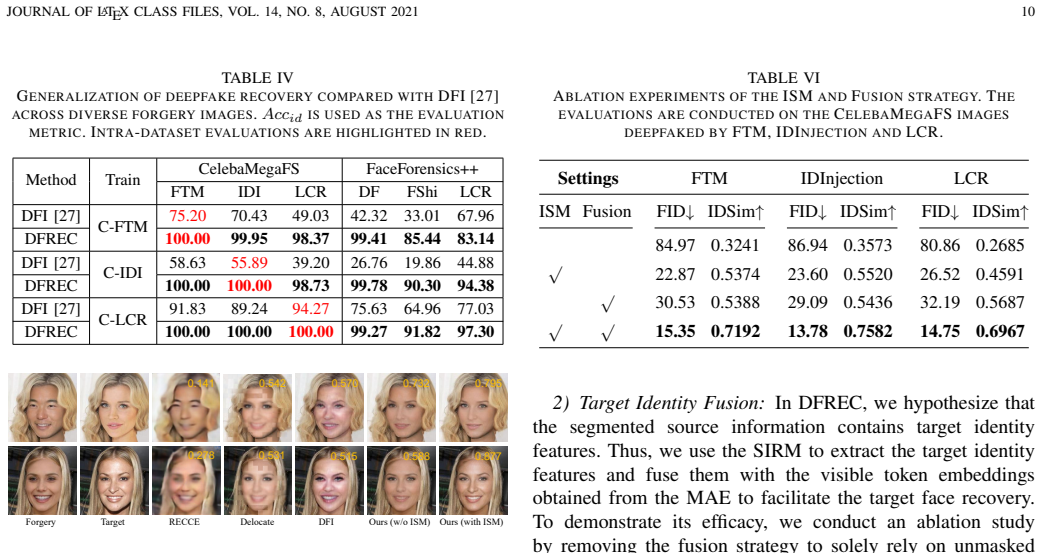
- [IV.A.3 and III.D] The headline identity metric is not neutral between DFREC and the baselines. IDSim is defined in Section IV.A.3 as the cosine similarity between FaceNet embeddings of the original and recovered target faces, using the pretrained FaceNet of [30]. The target identity loss in Eq. (3) minimizes L2 distances between the same FaceNet feature layers (Mixed6a, repeat 3, block8, last_bn), and this loss enters the total objective through Eqs. (4) and (10). None of the baselines (MAT, RePaint, RECCE, Delocate, DFI) are trained to optimize FaceNet target-identity similarity, so the margins in Table I (e.g., 0.5367 vs 0.4749 on FF++-DeepFake) partly reflect that DFREC has been fit to the evaluation metric itself. I request an independent identity metric, such as ArcFace or MegaFace embeddings, or a human perceptual identity-matching study, reported for both target and source recovery. FID is a distributional image-quality metric and does not measure identity, so it cannot substitute for this.
- [Abstract and Table I] The central claim that DFREC 'is the only scheme that can recover both pristine source and target faces' is not quantitatively supported for the source face. Table I reports FID and IDSim only between the recovered target face and the original target face; Tables II, V, VI, and VII likewise measure target recovery. Source recovery appears only in qualitative figures (Figs. 3-5 and Fig. 7). Because the claim of dual recovery is the paper's main novelty, the source-recovery branch needs direct quantitative evaluation: source FID and an independent source IDSim against the original source face, along with a comparison of what each baseline can or cannot produce for the source. Without this, the abstract's 'both faces' claim is an overstatement relative to the evidence.
- [Section V] The limitations section states that when the forged face is not derived from the target face (e.g., direct cropping and splicing), performance is 'significantly constrained.' This is a substantial scope restriction relative to the unqualified 'deepfake identity recovery' claim in the abstract and conclusion. The evaluation only covers face-swapping forgeries generated by trained swapping models. The scope should either be qualified in the abstract and conclusion, or the paper should include a splicing/cropping condition in the experiments to characterize the method's actual boundary. This is not a request to solve splicing, but the claim 'high fidelity' should be scoped to the face-swapping setting that is actually tested.
minor comments (6)
- [Abstract and Section I] There are typos in the abstract and introduction: 'fadelity' should be 'fidelity,' and 'DEREC' in the contribution bullet should be 'DFREC.'
- [Table I] The header 'FaceForensic++' in Table I should be 'FaceForensics++' to match the dataset name used elsewhere in the paper.
- [IV.A.3] The definition of Accid is terse: it uses identity similarity between the input face and the recovered target face, but for a forged input the recovered target is intentionally different from the input, whereas for a pristine input it is the same. Please specify which feature extractor is used for this similarity and state the threshold rationale more explicitly.
- [Algorithm 1] In Algorithm 1, when the global mean of the segmentation map is at least 0.9, all patch weights are replaced by random values (step 5-7). This behavior is surprising and should be explained: does it correspond to a nearly all-source image, and why are all patch weights randomized in that case?
- [Tables II and IV] The red highlighting used for intra-dataset evaluations should be described in the captions and must be distinguishable in grayscale printing.
- [Section IV.F.3 / Table VII] The ablation table for losses reports single point estimates without error bars or statistical significance. Given that the differences between some configurations are small (e.g., IDSim 0.7192 vs 0.7109), a variance estimate across multiple seeds or test splits would strengthen the claim that all loss terms contribute.
Circularity Check
No circularity found: the shared FaceNet embedding between the training identity loss and the IDSim metric is a metric-alignment concern, not a circular derivation.
full rationale
DFREC is an empirical supervised face-recovery system, not a first-principles derivation. The identity loss in Eq. (3) minimizes L2 distances between FaceNet features of the recovered and pristine target faces, while the IDSim evaluation metric computes cosine similarity in FaceNet features. These share a feature extractor, so the evaluation metric is aligned with the training objective and is not fully independent. However, this is not circular in the sense required by the analysis: the model output is a reconstructed image, the evaluation is on held-out test data, IDSim is not definitionally identical to the multi-layer L2 loss, and the paper also reports FID, qualitative comparisons, and ablations using PSNR, SSIM, attribute, and pose metrics. The limitation stated in Section V, that performance degrades when the forged face is not derived from the target face, is an honest boundary condition rather than a hidden circular assumption. No parameter is fitted to the test metric and then reported as a prediction, and no load-bearing claim rests on a self-citation chain. Therefore the central recovery claim has independent empirical content, and no specific circular reduction can be exhibited.
Assumptions & free parameters
free parameters (5)
- Identity loss weight alpha =
2
- Perceptual loss weight beta =
2
- Loss weights lambda1, lambda2, lambda3 =
0.5 each
- Mask ratio lambda =
0.5
- Accid threshold =
0.9
assumptions (4)
- domain assumption Face-swapping forgeries preserve target identity information through attribute-identity correlation
- domain assumption FaceNet pretrained on VGGFace2 provides a valid and sufficient measure of identity similarity
- ad hoc to paper The ISM can learn meaningful source/target segmentation without direct segmentation supervision
- domain assumption Background context and latent target identity features are sufficient to inpaint the masked target face
Cite this review
Pith. "Pith review of DFREC: DeepFake Identity Recovery Based on Identity-aware Masked Autoencoder." pith.science (2026). https://pith.science/paper/ZDNYPYSZ
@misc{pith2026241207260,
  author       = {Pith},
  title        = {Pith review of: DFREC: DeepFake Identity Recovery Based on Identity-aware Masked Autoencoder},
  year         = {2026},
  howpublished = {\url{https://pith.science/paper/ZDNYPYSZ}},
  note         = {Machine review of arXiv:2412.07260}
}
read the original abstract
Recent advances in deepfake forensics have primarily focused on improving the classification accuracy and generalization performance. Despite enormous progress in detection accuracy across a wide variety of forgery algorithms, existing algorithms lack intuitive interpretability and identity traceability to help with forensic investigation. In this paper, we introduce a novel DeepFake Identity Recovery scheme (DFREC) to fill this gap. DFREC aims to recover the pair of source and target faces from a deepfake image to facilitate deepfake identity tracing and reduce the risk of deepfake attack. It comprises three key components: an Identity Segmentation Module (ISM), a Source Identity Reconstruction Module (SIRM), and a Target Identity Reconstruction Module (TIRM). The ISM segments the input face into distinct source and target face information, and the SIRM reconstructs the source face and extracts latent target identity features with the segmented source information. The background context and latent target identity features are synergetically fused by a Masked Autoencoder in the TIRM to reconstruct the target face. We evaluate DFREC on six different high-fidelity face-swapping attacks on FaceForensics++, CelebaMegaFS and FFHQ-E4S datasets, which demonstrate its superior recovery performance over state-of-the-art deepfake recovery algorithms. In addition, DFREC is the only scheme that can recover both pristine source and target faces directly from the forgery image with high fadelity.
Figures


Figures from the paper (5 more)


Forward citations
Cited by 1 Pith paper
-
RPRA-ADD: Forgery Trace Enhancement-Driven Audio Deepfake Detection
A reconstruction-perception-reinforcement-attention framework for audio deepfake detection reports state-of-the-art EERs on ASVspoof 2019/2021 and competitive results on sound and singing benchmarks.
Reference graph
Works this paper leans on
-
[30]
Facenet: A unified embed- ding for face recognition and clustering,
F. Schroff, D. Kalenichenko, and J. Philbin, “Facenet: A unified embed- ding for face recognition and clustering,” in Proceedings of the IEEE conference on computer vision and pattern recognition , 2015, pp. 815– 823
2015
-
[1]
Detecting deepfakes with self-blended images,
K. Shiohara and T. Yamasaki, “Detecting deepfakes with self-blended images,” in Proceedings of the IEEE/CVF Conference on Computer Vision and Pattern Recognition , 2022, pp. 18 720–18 729
2022
-
[2]
Protecting celebrities from deepfake with identity consistency transformer,
X. Dong, J. Bao, D. Chen, T. Zhang, W. Zhang, N. Yu, D. Chen, F. Wen, and B. Guo, “Protecting celebrities from deepfake with identity consistency transformer,” in Proceedings of the IEEE/CVF Conference on Computer Vision and Pattern Recognition , 2022, pp. 9468–9478
2022
-
[3]
Ti2net: temporal identity inconsistency network for deepfake detection,
B. Liu, B. Liu, M. Ding, T. Zhu, and X. Yu, “Ti2net: temporal identity inconsistency network for deepfake detection,” in Proceedings of the IEEE/CVF Winter Conference on Applications of Computer Vision , 2023, pp. 4691–4700
work page 2023
-
[4]
Istvt: interpretable spatial-temporal video transformer for deepfake detection,
C. Zhao, C. Wang, G. Hu, H. Chen, C. Liu, and J. Tang, “Istvt: interpretable spatial-temporal video transformer for deepfake detection,” IEEE Transactions on Information Forensics and Security , vol. 18, pp. 1335–1348, 2023
work page 2023
-
[5]
Preserving fairness generalization in deepfake detection,
L. Lin, X. He, Y . Ju, X. Wang, F. Ding, and S. Hu, “Preserving fairness generalization in deepfake detection,” in Proceedings of the IEEE/CVF Conference on Computer Vision and Pattern Recognition , 2024, pp. 16 815–16 825
2024
-
[6]
Exposing the deception: Uncovering more forgery clues for deepfake detection,
Z. Ba, Q. Liu, Z. Liu, S. Wu, F. Lin, L. Lu, and K. Ren, “Exposing the deception: Uncovering more forgery clues for deepfake detection,” in Proceedings of the AAAI Conference on Artificial Intelligence , vol. 38, no. 2, 2024, pp. 719–728
2024
-
[7]
Adaptive texture and spectrum clue mining for generalizable face forgery detection,
J. Liu, J. Xie, Y . Wang, and Z.-J. Zha, “Adaptive texture and spectrum clue mining for generalizable face forgery detection,” IEEE Transactions on Information Forensics and Security , vol. 19, pp. 1922–1934, 2024
work page 1922
Show all 42 references
-
[8]
Implicit identity driven deepfake face swapping detection,
B. Huang, Z. Wang, J. Yang, J. Ai, Q. Zou, Q. Wang, and D. Ye, “Implicit identity driven deepfake face swapping detection,” in Pro- ceedings of the IEEE/CVF Conference on Computer Vision and Pattern Recognition, 2023, pp. 4490–4499
2023
-
[9]
Mask-guided portrait editing with conditional gans,
S. Gu, J. Bao, H. Yang, D. Chen, F. Wen, and L. Yuan, “Mask-guided portrait editing with conditional gans,” in Proceedings of the IEEE/CVF conference on computer vision and pattern recognition, 2019, pp. 3436– 3445
2019
-
[10]
Advancing high fidelity identity swapping for forgery detection,
L. Li, J. Bao, H. Yang, D. Chen, and F. Wen, “Advancing high fidelity identity swapping for forgery detection,” in Proceedings of the IEEE/CVF conference on computer vision and pattern recognition, 2020, pp. 5074–5083
2020
-
[11]
Simswap: An efficient framework for high fidelity face swapping,
R. Chen, X. Chen, B. Ni, and Y . Ge, “Simswap: An efficient framework for high fidelity face swapping,” in Proceedings of the 28th ACM international conference on multimedia , 2020, pp. 2003–2011
2020
-
[12]
One shot face swapping on megapixels,
Y . Zhu, Q. Li, J. Wang, C. Xu, and Z. Sun, “One shot face swapping on megapixels,” in Proceedings of the IEEE conference on computer vision and pattern recognition (CVPR) , June 2021, pp. 4834–4844
2021
-
[13]
Region-aware face swapping,
C. Xu, J. Zhang, M. Hua, Q. He, Z. Yi, and Y . Liu, “Region-aware face swapping,” in Proceedings of the IEEE/CVF Conference on Computer Vision and Pattern Recognition , 2022, pp. 7632–7641
2022
-
[14]
Fine- grained face swapping via regional gan inversion,
Z. Liu, M. Li, Y . Zhang, C. Wang, Q. Zhang, J. Wang, and Y . Nie, “Fine- grained face swapping via regional gan inversion,” in Proceedings of the IEEE/CVF conference on computer vision and pattern recognition, 2023, pp. 8578–8587
2023
-
[15]
Face-adapter for pre-trained diffusion models with fine- grained id and attribute control,
Y . Han, J. Zhu, K. He, X. Chen, Y . Ge, W. Li, X. Li, J. Zhang, C. Wang, and Y . Liu, “Face-adapter for pre-trained diffusion models with fine- grained id and attribute control,” in European Conference on Computer Vision. Springer, 2025, pp. 20–36
2025
-
[16]
Learning to discover forgery cues for face forgery detection,
J. Tian, P. Chen, C. Yu, X. Fu, X. Wang, J. Dai, and J. Han, “Learning to discover forgery cues for face forgery detection,” IEEE Transactions on Information Forensics and Security , vol. 19, pp. 3814–3828, 2024
2024
-
[17]
Face x-ray for more general face forgery detection,
L. Li, J. Bao, T. Zhang, H. Yang, D. Chen, F. Wen, and B. Guo, “Face x-ray for more general face forgery detection,” in Proceedings of the IEEE/CVF conference on computer vision and pattern recognition, 2020, pp. 5001–5010
2020
-
[18]
Laa-net: Localized artifact attention network for quality-agnostic and generalizable deepfake detection,
D. Nguyen, N. Mejri, I. P. Singh, P. Kuleshova, M. Astrid, A. Kacem, E. Ghorbel, and D. Aouada, “Laa-net: Localized artifact attention network for quality-agnostic and generalizable deepfake detection,” in Proceedings of the IEEE/CVF Conference on Computer Vision and Pattern R...
2024
-
[19]
Learning self- consistency for deepfake detection,
T. Zhao, X. Xu, M. Xu, H. Ding, Y . Xiong, and W. Xia, “Learning self- consistency for deepfake detection,” in Proceedings of the IEEE/CVF international conference on computer vision , 2021, pp. 15 023–15 033
2021
-
[20]
Core: Consistent representation learning for face forgery detection,
Y . Ni, D. Meng, C. Yu, C. Quan, D. Ren, and Y . Zhao, “Core: Consistent representation learning for face forgery detection,” in Proceedings of the IEEE/CVF conference on computer vision and pattern recognition, 2022, pp. 12–21
2022
-
[21]
Transcending forgery specificity with latent space augmentation for generalizable deepfake detection,
Z. Yan, Y . Luo, S. Lyu, Q. Liu, and B. Wu, “Transcending forgery specificity with latent space augmentation for generalizable deepfake detection,” in Proceedings of the IEEE/CVF Conference on Computer Vision and Pattern Recognition , 2024, pp. 8984–8994
2024
-
[22]
Masked relation learning for deepfake detection,
Z. Yang, J. Liang, Y . Xu, X.-Y . Zhang, and R. He, “Masked relation learning for deepfake detection,” IEEE Transactions on Information Forensics and Security, vol. 18, pp. 1696–1708, 2023
2023
-
[23]
Construct- ing new backbone networks via space-frequency interactive convolution for deepfake detection,
Z. Guo, Z. Jia, L. Wang, D. Wang, G. Yang, and N. Kasabov, “Construct- ing new backbone networks via space-frequency interactive convolution for deepfake detection,” IEEE Transactions on Information Forensics and Security, vol. 19, pp. 401–413, 2024
2024
-
[24]
End-to- end reconstruction-classification learning for face forgery detection,
J. Cao, C. Ma, T. Yao, S. Chen, S. Ding, and X. Yang, “End-to- end reconstruction-classification learning for face forgery detection,” in Proceedings of the IEEE/CVF Conference on Computer Vision and Pattern Recognition, 2022, pp. 4113–4122
2022
-
[25]
Delocate: Detection and localization for deepfake videos with randomly-located tampered traces,
J. Hu, X. Liao, D. Gao, S. Tsutsui, Q. Wang, Z. Qin, and M. Z. Shou, “Delocate: Detection and localization for deepfake videos with randomly-located tampered traces,” arXiv preprint arXiv:2401.13516 , 2024
2024 arXiv
-
[26]
Deepreversion: Reversely inferring the original face from the deepfake face,
J. Ai, Z. Wang, B. Huang, and Z. Han, “Deepreversion: Reversely inferring the original face from the deepfake face,” in 2023 International Joint Conference on Neural Networks (IJCNN) . IEEE, 2023, pp. 1–7. JOURNAL OF LATEX CLASS FILES, VOL. 14, NO. 8, AUGUST 2021 12
2023
-
[27]
Deepfake face prove- nance for proactive forensics,
J. Ai, Z. Wang, B. Huang, Z. Han, and Q. Zou, “Deepfake face prove- nance for proactive forensics,” in 2023 IEEE International Conference on Image Processing (ICIP) . IEEE, 2023, pp. 2025–2029
2023
-
[28]
Hyperseg: Patch-wise hypernetwork for real-time semantic segmentation,
Y . Nirkin, L. Wolf, and T. Hassner, “Hyperseg: Patch-wise hypernetwork for real-time semantic segmentation,” in Proceedings of the IEEE/CVF Conference on Computer Vision and Pattern Recognition , 2021, pp. 4061–4070
2021
-
[29]
Masked au- toencoders are scalable vision learners,
K. He, X. Chen, S. Xie, Y . Li, P. Doll ´ar, and R. Girshick, “Masked au- toencoders are scalable vision learners,” inProceedings of the IEEE/CVF conference on computer vision and pattern recognition , 2022, pp. 16 000–16 009
2022
-
[31]
Vggface2: A dataset for recognising faces across pose and age,
Q. Cao, L. Shen, W. Xie, O. M. Parkhi, and A. Zisserman, “Vggface2: A dataset for recognising faces across pose and age,” in 2018 13th IEEE international conference on automatic face & gesture recognition (FG 2018). IEEE, 2018, pp. 67–74
2018
-
[32]
Imagenet: A large-scale hierarchical image database,
J. Deng, W. Dong, R. Socher, L.-J. Li, K. Li, and L. Fei-Fei, “Imagenet: A large-scale hierarchical image database,” in 2009 IEEE Conference on Computer Vision and Pattern Recognition. IEEE Computer Society, 2009, pp. 248–255
2009
-
[33]
Adaptively weighted multi-task deep network for person attribute classification,
K. He, Z. Wang, Y . Fu, R. Feng, Y .-G. Jiang, and X. Xue, “Adaptively weighted multi-task deep network for person attribute classification,” in Proceedings of the 25th ACM international conference on Multimedia , 2017, pp. 1636–1644
2017
-
[34]
Deep learning face attributes in the wild,
Z. Liu, P. Luo, X. Wang, and X. Tang, “Deep learning face attributes in the wild,” in Proceedings of International Conference on Computer Vision (ICCV), December 2015
2015
-
[35]
Faceforensics++: Learning to detect manipulated facial images,
A. Rossler, D. Cozzolino, L. Verdoliva, C. Riess, J. Thies, and M. Nießner, “Faceforensics++: Learning to detect manipulated facial images,” in Proceedings of the IEEE/CVF international conference on computer vision, 2019, pp. 1–11
2019
-
[36]
Progressive growing of gans for improved quality, stability, and variation,
T. Karras, T. Aila, S. Laine, and J. Lehtinen, “Progressive growing of gans for improved quality, stability, and variation,” in International Conference on Learning Representations , 2018
2018
-
[37]
A style-based generator architecture for generative adversarial networks,
T. Karras, S. Laine, and T. Aila, “A style-based generator architecture for generative adversarial networks,” in Proceedings of the IEEE/CVF conference on computer vision and pattern recognition, 2019, pp. 4401– 4410
2019
-
[38]
Mat: Mask- aware transformer for large hole image inpainting,
W. Li, Z. Lin, K. Zhou, L. Qi, Y . Wang, and J. Jia, “Mat: Mask- aware transformer for large hole image inpainting,” in Proceedings of the IEEE/CVF conference on computer vision and pattern recognition , 2022, pp. 10 758–10 768
2022
-
[39]
Repaint: Inpainting using denoising diffusion probabilistic models,
A. Lugmayr, M. Danelljan, A. Romero, F. Yu, R. Timofte, and L. Van Gool, “Repaint: Inpainting using denoising diffusion probabilistic models,” in Proceedings of the IEEE/CVF conference on computer vision and pattern recognition , 2022, pp. 11 461–11 471
2022
-
[40]
Blendface: Re-designing identity encoders for face-swapping,
K. Shiohara, X. Yang, and T. Taketomi, “Blendface: Re-designing identity encoders for face-swapping,” in Proceedings of the IEEE/CVF International Conference on Computer Vision , 2023, pp. 7634–7644
2023
-
[41]
Accurate 3d face reconstruction with weakly-supervised learning: From single image to image set,
Y . Deng, J. Yang, S. Xu, D. Chen, Y . Jia, and X. Tong, “Accurate 3d face reconstruction with weakly-supervised learning: From single image to image set,” in 2019 IEEE/CVF Conference on Computer Vision and Pattern Recognition Workshops (CVPRW). IEEE, 2019, pp. 285–295. BIOGRA...
2019
-
[2009]
He has coedited 6 books, published 13 book chapters, more than 120 international journal papers ( >90 are in IEEE) and more than 200 refereed international conference papers (mostly in IEEE), and delivered over 60 keynotes, tutorials and invited seminars. His current research ...
2018
Reviewed August 11, 2026 · model on record in the stance chip above.
Discussion (0). Continue with ORCID to comment.